There has been a lot of debate recently regarding the role of plant foods in cross-channel Chumash exchange systems (Arnold 2012; Arnold and Martin Reference Arnold and Martin2014; Fauvelle Reference Fauvelle2011, Reference Fauvelle2012, Reference Fauvelle2013, Reference Fauvelle2014; Gill and Erlandson Reference Gill and Erlandson2014). Much of this discussion stems from the importance of these exchange systems in models of the development of Chumash social and political complexity (e.g., King Reference King, Bean and Blackburn1976). A popular model for the origins of Chumash chiefdoms holds that, during times of environmental stress, inhabitants of the Channel Islands supplemented their diets by trading for food with the more resource-rich mainland (Arnold Reference Arnold1992; Kennett Reference Kennett2005). According to this model, the ability of elites to control such exchange led to the intensification of island economies and the solidification of social hierarchies (Arnold Reference Arnold2001, Reference Arnold2004). For decades, this has been an extremely productive approach for archaeologists working in the Channel area. Recently, however, two lines of evidence have challenged this model.
First, recent work calls into question the degree to which the islands represented marginal environments, in need of any large amount of mainland food. Gill has uncovered large amounts of corms (geophytes) from the Brodiaea complex in island middens, suggesting that islanders may not have needed to import large numbers of mainland nuts and seeds, as these were not highly ranked island foods (Gill Reference Gill, Jazwa and Perry2013, Reference Gill2014, Reference Gill2015; Gill and Erlandson Reference Gill and Erlandson2014). The corms are most likely blue dicks (Dichelostemma capitatum), which are abundant on the islands and have higher return rates than acorns (Gill Reference Gill and Hoppa2015; Gill and Erlandson Reference Gill and Erlandson2014). Emphasis on the collection and consumption of geophytes such as blue dicks is also supported by the large numbers of digging stick weights found in archaeological contexts on the islands (Sutton Reference Sutton2014). Together with rich marine resources, the presence of abundant geophytes on the islands calls into question the concept that the islands were marginal or terrestrially “depauperate,” as they have been described in the literature (e.g., Kennett Reference Kennett2005:71). Indeed, the idea that islanders would have needed to import plant resources from the mainland due to a lack of resources might owe more to modern overgrazing and environmental damage than any prehistoric reality (Braje Reference Braje2015; Gill and Hoppa Reference Gill and Hoppa2015).
Second, it is questionable whether bulky food goods could be efficiently transported across the Santa Barbara Channel. Acorns were one of the most easily stored and heavily traded food items in prehistoric California and have featured prominently in models of cross channel exchange (Arnold Reference Arnold1992; Kennett Reference Kennett2005; King Reference King, Bean and Blackburn1976). Staple foods such as acorns, however, would have been difficult to transport in space-limited Chumash canoes. Using the cargo volume of a reconstructed plank canoe, Fauvelle (Reference Fauvelle2011, Reference Fauvelle2013) argues that it would have taken near-daily canoe trips to supplement the islands with a substantial portion of calories from mainland acorns. As cross channel trips were dangerous, with many yearly fatalities, such levels of transport are unlikely to have been sustainable (Hudson et al. Reference Hudson, Timbrook and Rempe1978). This inefficiency of transport is also supported by a paucity of acorn remains in island middens. The last three decades of archaeological work on the channel islands have returned only a few hundred acorn fragments from archaeological contexts (Arnold and Martin Reference Arnold and Martin2014; Gill Reference Gill, Jazwa and Perry2013, Reference Gill2015; Martin and Popper Reference Martin, Popper and Arnold2001; Thakar Reference Thakar2014), and, in terms of density, acorn nutmeat and nutshell remains are rare throughout the islands’ occupation, rarely exceeding .005 grams per liter (Gill Reference Gill and Hoppa2015; Martin and Popper Reference Martin, Popper and Arnold2001). Such numbers are hardly indicative of any heavy consumption of acorns in Channel Island prehistory.
Despite the importance of subsistence exchange in many models of the development of Chumash chiefdoms, there is little information on the paleobotany of the Channel Islands (but see Gill Reference Gill, Jazwa and Perry2013; Martin and Popper Reference Martin, Popper and Arnold2001). Arnold and Martin (Reference Arnold and Martin2014) help alleviate this situation by presenting the results of several years of paleobotanical investigations at four sites on Santa Cruz Island. Although Arnold and Martin (Reference Arnold and Martin2014) report inconclusive evidence for any importation of acorns, they did identify 63 seeds from the species Sesuvium verrucosum, or western sea-purslane (from .01 to .03 count per liter; Arnold and Martin Reference Arnold and Martin2014:235). Currently, western sea-purslane grows only on the mainland coast, suggesting that this plant may have been traded across the channel to the islands. Arnold and Martin (Reference Arnold and Martin2014:238) argue that the presence of sea-purslane seeds in island middens represents a “sure indicator” of cross-channel exchange, suggesting that, through trade with the mainland, “islanders may have fairly consistently acquired and consumed these seeds” (Arnold and Martin Reference Arnold and Martin2014:241). According to Arnold and Martin (Reference Arnold and Martin2014), this evidence supports their thesis that Chumash complexity developed, at least in part, by channel islanders seeking to supplement their diet through trade in times of resource stress brought on by climate change.
In order to test the hypothesis that western sea-purslane seeds may have been a primary food resource gathered on the mainland for export to the islands, we submitted a sample of Sesuvium verrucosum seeds and greens for proximate analysis. Here we present the results of this analysis and compare values for western sea-purslane with those for other possible trade foods. We argue that that the exchange of sea-purslane seeds across the Santa Barbara channel is unlikely to have occurred in prehistory and suggest that their presence in Santa Cruz Island middens is more likely indicative that Sesuvium verrucosum grew locally on the islands prior to the overgrazing caused by introduced farm animals in the nineteenth and twentieth centuries.
Western Sea-Purslane
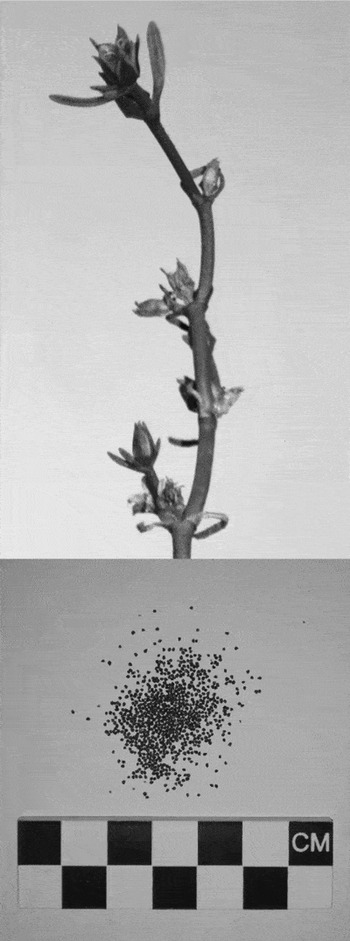
Sesuvium verrucosum (western sea-purslane, here shortened to sea-purslane) is a drought-resistant flowering herb found in coastal environments and desert washes throughout the southwestern United States (Figure 1). Sea-purslane is a native California species belonging to the Aizoaceae family and should not be confused with common purslane (Portulaca oleracea), which is of European origin. Currently, sea-purslane is not found on the Channel Islands, but grows in small patches on the mainland coast near Santa Barbara, as well as the San Joaquin Valley, the San Francisco Bay Area, coastal San Diego, and parts of the Mojave Desert. Sea-purslane plants have edible leaves and stems and are occasionally added to salads as greens by modern beach combers. If sea-purslane was traded across the Santa Barbara channel, however, it is unlikely that this exchange would have focused on leaves and stems, as they are perishable and unlikely to survive the rigors of open-ocean, long-distance transport. Instead, Arnold and Martin (Reference Arnold and Martin2014) argue that sea-purslane seeds were collected, stored, and transported across the Santa Barbara Channel.
Top: Sesuvium verrucosum stem showing seed heads and flower. Bottom: Sesuvium verrucosum seeds shown with scale.

The consumption of sea-purslane seeds has very little support in the ethnohistoric literature. Notably, no ethnohistoric account describes the eating of Sesuvium verrucosum seeds anywhere in prehistoric California. In fact, accounts of the eating of purslane seeds of any species are rare in North America. In his extensive account of the indigenous plants of the American west, Ebeling (Reference Ebeling1986:40, 485, 581, 777) mentions only four cases of purslane seeds being eaten, all in the Southwest. None of these cases refer to Sesuvium verrucosum. In most of these cases, purslane seeds were eaten either as a byproduct of gathering the leaves and stems, or as a starvation food. In none of these cases could purslane seeds be described as a common or important resource. Purslane seeds are occasionally found in human coprolites, especially in desert environments, but this could be explained by the consumption of leaves and stems as greens (Wilke Reference Wilke1978). Given this ethnohistoric background, purslane seeds of any species do not seem like the type of food that would be gathered on a large scale for long-distance exchange, and were certainly not seen as a “primary food resource” by the few groups that consumed them.
As sea-purslane seeds are generally not consumed as food, there has been no previous caloric or nutrition analysis done on them. The results of the proximate analysis of a 20-g sample of Sesuvium verrucosum seeds are in Table 1 and are compared to those for sea-purslane leaves (Sesuvium verrucosum), coast live oak acorns (Quercus agrifolia), and southern California black walnuts (Juglans californica). In addition to presenting the first published values for western sea-purslane, to the authors’ knowledge, Table 1 contains the first caloric values for southern California black walnuts, a species native only to coastal southern California (see Gilliland Reference Gilliand1985 to compare with other California walnut species). As can be seen in Table 1, the caloric value of sea-purslane seeds is relatively low: about 25 percent less than that of acorns. This means that they would have raised the same transport efficiency issues that have been reported for other, more calorically valuable nuts and seeds (Fauvelle Reference Fauvelle2011, Reference Fauvelle2013). The overwhelming majority of the calories from the sea-purslane plant would be found in its greens, which contain only 21 calories per gram but make up 99.87 percent of the plant by weight (compared to .13 percent for seeds). Sea-purslane leaves are thus likely to have been the primary target for any subsistence exploitation.
Proximate Analysis Results of Several Possible Southern California Plant Foods.

In addition to sea-purslane, Arnold and Martin (Reference Arnold and Martin2014:244) also suggested canary grass (Phalaris sp.) and southern California black walnuts (Juglans californica) as possible mainland-to-island trade foods. Although Arnold and Martin (Reference Arnold and Martin2014:235, 241) suggested that 18 specimens of canary grass from Santa Cruz island represent mainland imports, canary grass grows on Santa Rosa Island today and may have existed on Santa Cruz Island in prehistory (Gill Reference Gill and Hoppa2015:202). Therefore, the presence of canary grass in archaeological deposits is not a clear indicator of mainland exchange. With a high fat content, California black walnuts may have been a more attractive target for exchange from an energy maximizing position. With only 30 walnut fragments (Arnold and Martin Reference Arnold and Martin2014; Thakar Reference Thakar2014) found in archaeological investigations on Santa Cruz Island to date, however, current material evidence for any sustained importation of walnuts to the island remains very thin.
Perhaps the largest difficulty that would have been involved in any cross-channel exchange of sea-purslane seeds would have been collecting significant numbers of seeds on the mainland. Individual sea-purslane seeds are extremely small, and gathering enough to fill a canoe would have been an exceedingly difficult task. Plants grown at the University of California in San Diego contained an average of 18 seed heads per plant. Using the values in Table 1, and an average weight of .147 mg per sea-purslane seed, this means that it would take over 10,000 sea-purslane plants to provide just one individual with a 100-calorie meal. Finding this much sea-purslane would have posed nearly insurmountable challenges. As described by Martin and Popper (Reference Martin, Popper and Arnold2001:251), sea-purslane is “very uncommon” on the modern Santa Barbara mainland (an observation supported by the authors’ personal experience). Any large-scale collection of sea-purslane seeds, therefore, would not have been sustainable over any length of time. Considering these constraints, together with the plant's relatively low caloric yield and its lack of mention in ethnohistoric accounts, it seems unlikely that it would have been a major trade resource in prehistory.
Discussion
If sea-purslane was not traded across the Santa Barbara Channel, how do we explain the presence of sea-purslane seeds in middens on Santa Cruz Island? The most parsimonious explanation is that the plant grew locally on the islands in prehistory. Although sea-purslane does not grow there today, other small weeds are susceptible to overgrazing, making it likely that sea-purslane could have been eliminated by the thousands of sheep and cattle that grazed on the island during the ranching period in the late nineteenth and early twentieth centuries. The extent of the damage caused by this ranching is still unknown, but overgrazing could be the source for the common perception that the islands’ plant resources were impoverished (Braje Reference Braje2015; Gill Reference Gill, Jazwa and Perry2013, Reference Gill2015). As sea-purslane is a drought resistant plant, it makes sense that it may have been collected during the climatic anomalies described by Arnold and Martin (Reference Arnold and Martin2014). Following this logic, island populations may have expanded their diet to include locally available purslane during times of environmental stress. This would explain its increase in abundance during the Transitional period, which corresponded to frequent droughts.
If purslane did grow on the Channel Islands in prehistory, it was probably consumed for its greens, rather than for its seeds. As reported in Table 2, sea-purslane greens are comparable in caloric content to spinach or arugula and would have added additional greens and vitamins to islander diets. The consumption of sea-purslane leaves has support in ethnohistoric documentation, and its collection would have made economic sense were it locally available. Leaves of similar coastal taxa (for example Salicornia spp.) have also been eaten throughout the world (Mudie et al. Reference Mudie, Greer, Brakel, Dickson, Schinkel, Peterson-Welsh, Stevens, Turner, Shadow and Washington2005:119–120). Seeds may have been accidently eaten with the leaves, and those found in archaeological contexts are likely to have arrived there together with whole plants, rather than as a separately targeted resource. Considering the low caloric value of purslane seeds, the difficulty involved in collecting them, and the lack of accounts for their consumption in California's ethnohistoric record, it seems unlikely that sea-purslane seeds were a trade good exchanged across the Santa Barbara Channel on any large scale.
This does not mean that sea-purslane seeds, or any other plant foods, were never traded to Santa Cruz Island. We agree with Arnold and Martin (Reference Arnold and Martin2014:243) that a situation in which Channel Islanders were “importing all daily supplies from across the channel” would have been untenable. To the authors’ knowledge, no one has advanced or critiqued such a position. Similarly, no one has denied that some plant-foods were exchanged across the Santa Barbara Channel. In fact, the ethnohistoric record makes it clear that they were (Hudson et al. Reference Hudson, Timbrook and Rempe1978; King Reference King, Bean and Blackburn1976; Timbrook Reference Timbrook and Glassow1993). The question, rather, is one of scale: was the exchange of plant foods of sufficient volume to impact regional sociopolitical trajectories? This is an important question, as it has direct implications for our understanding of social histories in the channel region. A lack of evidence for the large-scale trade of plant foods to the Channel Islands should cause us to question evolutionary models that see climate-based food scarcity as a central factor in the development of complex regional exchange systems. Currently, a number of studies have indicated that subsistence exchange across the Santa Barbara channel was most likely modest, with islanders acquiring the vast majority of their food from local sources (Fauvelle Reference Fauvelle2011, Reference Fauvelle2013; Gill Reference Gill and Hoppa2015; Gill and Erlandson Reference Gill and Erlandson2014). Considering this preponderance of evidence, we suggest that the field move away from subsistence-focused models for cross-channel Chumash exchange. Climate-based scarcity may indeed have caused social changes in the Channel Region, but we currently do not have enough evidence to argue that the transportation of plant foods was a major component of this process. If anything, the data suggest otherwise.
Acknowledgments
The research presented in this paper as supported by a grant from the University of California Pacific Rim Research Program (DG-14-27). Proximate analysis of plant samples was conducted at Michelson Laboratories in Commerce, California. We would like to thank Kristina Gill, Hala Yakzan, and four anonymous reviewers for their helpful comments on early drafts of this report. Thanks also to Bob Kelly for his generous editorial assistance with this manuscript. The abstract was checked by Nora Franco.