It is by no means unknown, in Middle-Eastern art-music traditions, to find claims that a given rhythmic cycle was invented on a particular occasion by a particular musician, the most obvious and reliable instance being provided by ‘Abd al-Qādir al-Marāġī (d. 1435), who tells us that he was commissioned to create a new cycle to commemorate a victory.Footnote 1 With frenkçin, then, a cycle where the very name clearly suggests some form of western derivation or inflection,Footnote 2 it was perhaps only to be expected that we should encounter a similar narrative that pinpointed its origin, associating its creation with the impulse provided by a particular cultural encounter with the West. It has to be said, though, that no such account appears as a standard feature of the contemporary theoretical discourse surrounding Turkish art music: works that deal with the rhythmic cycles tend to be expository catalogues unconcerned with origins and derivations,Footnote 3 and it is only in one major modern reference work that we come across the notion of western inspiration, together with a tentative suggestion as to the period during which frenkçin emerged.Footnote 4 The detailed narrative of origin certainly first appears in a text by an eminent Turkish scholar, but it is one written in French—the comprehensive survey article by Rauf Yekta Bey published in 1922Footnote 5—and possibly in consequence it has so far been relayed primarily in western languages. The discussion by Kösemihal, the one significant Turkish scholar to have accepted this account,Footnote 6 appears to have had little impact, and it remains to be seen whether the relatively recent translation of Rauf Yekta Bey's article into TurkishFootnote 7 will stimulate renewed interest in this version in Turkey itself.Footnote 8
In the event, the story quoted by Rauf Yekta Bey to account for the invention of frenkçin becomes attached to another narrative that is deemed to validate it. Taken together, they are of interest for the way they associate the creation of this particular cycle with the diplomatic initiatives that marked the beginning of one of the most symbolically charged and longest lasting links between the Ottoman Empire and a European state, its alliance with France. Indeed, frenkçin is itself considered an alliance, a form of creative borrowing combined with indigenous elaboration.
Perhaps the most influential version of this story complex in a western language is the much-reduced outline given by Shiloah.Footnote 9 The event in question is dated to 1543 when, we are told:
“on the occasion of the treaty signing, François I sent Süleyman an orchestra as a sign of friendship; guest performances by the newly arrived musicians seem to have inspired the creation of two new rhythms: frenkcin (12/4) and frengi feri (14/4)”.
Despite its extremely abbreviated form, one may note that by comparison with the original French version this one still manages to contain two forms of amplification: the anachronistic inflation of the body of musicians from a necessarily modest sixteenth-century ensemble to orchestral proportions; and the additional creation of a second cycle, frengifer. The former is, no doubt, a simple expansion, possibly not even intentional, while the latter is a quite logical extension in that the name frengifer again, and in exactly the same way, points to a western connection. But it is an addition or creative embellishment nonetheless, for it is mentioned neither by Rauf Yekta Bey nor in any earlier version of this encounter; and accepting Öztuna's presumption that frengifer did not appear on the scene contemporaneously with frenkçin but is a later offshoot, it will be disregarded in what follows.Footnote 10
According to Rauf Yekta Bey's original version of what might be termed the invention story,Footnote 11 a distinguished group of French musicians (une compagnie de célèbres musiciens français) visited Istanbul for the first time during the reign of Süleyman the Magnificent, and the music-loving Sultan wished to hear them. During the concert he was sufficiently impressed by a piece with a distinctive iambic rhythm to ask his musicians to emulate it. Accordingly, one of the Turkish musicians devised a rhythmic cycle he called frenkçin, and used it as the basis for several compositions that greatly pleased the Sultan.
This account is admitted to be an oral tradition, and it appears only to surface in nineteenth-century Istanbul. Rauf Yekta Bey is, accordingly, suitably cautious, especially as his enquiries elicited the story from only a single source, albeit an illustrious one, his teacher Zekai Dede (1824–97), one of the major and most reliable transmitters of the Ottoman classical repertoire as well as a notable composer in his own right. In fact, Rauf Yekta Bey declares that he was initially disinclined to believe it, and only changed his mind after coming across a related narrative in a work by Aubert published in 1827. He was sufficiently impressed to quote the passage in full:Footnote 12
François 1er, en 1543, envoya à Solyman 1er un corps de musiciens, les plus habiles qu'il y eût alors en France, croyant lui faire grand plaisir; ce Prince les fit jouer plusieurs fois devant lui, leur fit beaucoup de compliments, les combla même de présents; mais il leur enjoignit, sous peine de la vie, de sortir de ses Etats dans le plus court délai. Après les avoir entendus, il s’était senti tellement ému, qu'il avait craint qu'une pareille musique parvînt à énerver son âme guerrière et produisît le même effet sur son peuple.
On reading this, his doubts are allayed. But why such a scrupulous scholar should have been so speedily persuaded is difficult to understand, despite his evident respect for French scholarship. He could certainly claim to find here supporting evidence for the presence of French musicians in Istanbul, the pre-condition for Zekai Dede's frenkçin narrative; indeed, the circumstances adduced provide historical specificity and, especially, a convincing motive for their presence—elements sufficiently potent to survive in Shiloah's reduced outline. But what Aubert is relating is fundamentally different to the invention story, a narrative we might call, rather, the expulsion story, and when they are juxtaposed two glaring inconsistencies appear: one is the lack of any reference in the expulsion story to frenkçin, and the other is the equally obvious psychological reason for this: a sovereign who fears the potentially deleterious effects of western music on the moral fibre of his subjects is hardly likely to want to commission his own musicians to imitate a particular feature of it, and even had he done so in a fit of enthusiasm during the first few performances he would presumably, on later reflection, have asked them to desist.
Some sixty years later, the matter was addressed once again, by Kurt and Ursula Reinhard.Footnote 13 Citing Rauf Yekta Bey as their source, they first repeat the invention story. Alert, however, to the evident discrepancy between the invention and the expulsion stories, they introduce the latter with a disclaimer:
Es gibt über diesen Rhythmus auch noch eine andere Anekdote, die aber wenig Wahrscheinlichkeit für sich hat, da man sich nur schlecht vorstellen kann, daß sich nach den darin geschilderten Vorkommnissen der usul frenkçin überhaupt durchsetzen konnte.
This points to the essentially contradictory nature of Süleyman's reactions when the two stories are combined, but the Reinhards’ conclusion that the expulsion story is implausible because, if true, frenkçin could hardly have established itself, signally fails to convince. They seem to have been led astray by a simple but fundamental error: the expulsion story is not, as they assume and indeed explicitly state here, about frenkçin at all, but is quite independent of it. A more persuasive conclusion would surely be that it is the invention story that is the more obviously invented; and if so, the question that remains is the quite separate one of the extent to which the expulsion story is plausible. (A little later in their catalogue of rhythmic cycles the Reinhards reach frengifer, and detect in it the presumed influence of the same sixteenth-century French musicians. It is this passage, presumably, that suggested the spurious notion of joint invention to Shiloah.)
The source material provided by Rauf Yekta Bey is reviewed by Aksoy in his invaluable historical survey of western reactions to Turkish music, and he goes on to adduce an earlier authority, clearly the one on which Aubert relied, which takes us back a century further, to 1715.Footnote 14 As expected, there is again no mention of frenkçin: we are now dealing solely with the expulsion story, told in a more ample form that is worth giving in full:Footnote 15
On trouve dans les Memoires de M. de la Forest Ambassadeur de François I. à Constantinople, pour le/Traité fait avec Solyman II. Footnote 16 l'an 1543, que le Roi croyant faire plaisir à son nouvel Allié, lui envoya un corps de musiciens des plus accomplis, croyant lui faire un present digne de sa grandeur. Solyman les reçût d'abord très-favorablement, & leur donna le tems de lui faire entendre trois differens concers dans son Palais en presence de toute sa Cour; il en parut fort content par rapport à la satisfaction de l'ouye; mais ayant remarqué que cette Musique amolissoit son ame guerriere, il jugea par lui-même qu'elle pouvoit faire encore plus d'impression dans celle de ses Courtisans. Il loua fort les Musiciens, neanmoins comme il apprehendoit que la Musique ne causât par la suite de son établissement, autant de desordre dans son Empire, que la liberté de l'usage du vin en peut faire naître; cette reflexion l'obligea de renvoyer ce corps de Musique, après avoir fait casser tous leurs Instrumens, avec défenses aux Musiciens de s’établir dans son Empire, sur peine de la vie: il leur/fit cependant un grand present pour les consoler de leur disgrace. Soliman crut encore que c’étoit un trait de politique de François I. car il dit à l'Ambassadeur de France, qu'il croyoit que son Maître lui avait envoyé ce divertissement pour le détourner des occupations de la Guerre, de même que les Grecs envoyerent aux Persans le jeu d'Echets pour ralentir leur passion belliqueuse.
This, then, contains a number of elements lost in Aubert's version, notably the beginning, which gives a seemingly authoritative eye-witness source; the smashing of the instruments; and the final analytical flourish in which Süleyman reveals his dark suspicions of the French king's Macchiavellian motives.Footnote 17
It is this account that Kösemihal had already translated into Turkish and published in 1939, prefacing it to his translation of the invention story as recounted by Rauf Yekta Bey. Yet again, the discrepancy between them is erased: unbeknown to each other, we are told, the same event is recorded in France in the musical literature, and in Turkey is preserved by oral transmission.Footnote 18 Kösemihal's conclusion, however, is couched with a degree of caution, and there is no mention of the creation of frenkçin: he merely refers in general terms to the positive reaction to “certain beautiful elements” (bir takım güzel unsurlar) in the French pieces that were played. More recently, the Bourdelot/Bonnet text has also come to the attention of Cazaux, working independently on the literature relating to music during the reign of François I.Footnote 19 She first cites a nineteenth-century work,Footnote 20 slightly later than Aubert, but one which follows the Bourdelot/Bonnet version much more faithfully, and refers in addition to an eighteenth-century version closely modelled on the same source text.Footnote 21 Finally, she indicates, as a possible origin that Bourdelot/Bonnet could have elaborated, the existence of a much briefer allusion in a mid seventeenth-century work:Footnote 22
Le roy François I. . . . institua cette Chapelle de musique . . . en l'année 1543 et peut-être fut-ce en ceste mesme année qu'il envoya, comme on dit, des musiciens à Soliman empereur des Turcs, pensant luy faire plaisir.
This could certainly have provided the date, but as a literary impetus it seems hardly sufficient to generate the thematic complexity of the 1715 text, and if we go back to Aksoy, who is content to lay the available documentation bare without commenting on its plausibility or otherwise, we find a much more likely source, for he locates an earlier and considerably more ample seventeenth-century version of the narrative in Praetorius (1571–1621). The relevant passage occurs immediately after a brief description of a procession to celebrate the circumcision of a Christian convert to Islam, accompanied by the music of shawm and drum (davul-zurna):Footnote 23
Diese Lumpen Music wird noch heutiges Tages bey den Türcken in hohem Wert geachtet/unsere aber dagegen zum eussersten verachtet. Denn wie einßmals Franciscus I. König in Franckreich/dem Türckischen Bluthunde Solymanno welcher Anno C. 1520. der Türckischen Hegyræ aber 926. in sein Tyrannisch Regiment getretten/ein groß und statlich Instrumentum Musicum, daran etliche Männer mit verwunderung der Türcken genung zu tragen gehabt/sampt etzlichen ausserlesenen in der Musica wolgeübten Künstlern und Musicanten zur sonderlichen Verehrung überschicket hatte/ist es im anfang zwar dem Türckischen Käyser lieb und angenehm gewesen. Alß aber bald hernach zu Constantinopel das Volck mit hauffen zulieff/solche außländische/liebliche Musicanten zu hören/und sonderliche lust und liebe zu dieser Kunst gewan/besorgete sich der Türckische Käyser/es müchten die Seinen ihre grobe Barbarey hiedurch ablegen uñ freundlicher/oder seinem vorgeben nach/Weich und Weibisch werden: Ließ derowegen solch herzlich Instrument zerbrechen/unnd mit Fewr verbrennen unnd schickete dem Frantzosen seine Musicanten wieder zu Hausse.
This overcomes the virulent hostility of its opening remarks sufficiently to manage to present the same essential outlines of a spectacular but unsuccessful attempt at cultural diplomacy. In Praetorius’ version it ends rather more brusquely, the musicians being packed off home with neither presents nor death threats, and he makes no attempt to account for the obvious contradiction that a people portrayed initially as dismissing ‘our’ music with utter contempt should respond to it with such evident enthusiasm. But the most significant difference is the inclusion of an element completely lost in the later French account, the splendid if unwieldy instrumentum musicum that is central to the royal gesture, and is singled out as the object that is smashed and, a lurid touch omitted from the later versions, consigned to the flames.
No earlier accounts of this event have come to light, and Praetorius does not identify a source, so that the only reference we have is the decidedly odd one Bonnet/Bourdelot make to the memoirs of the French ambassador, Jean de la Forest, which should, at the very least, have provided the correct date. By 1543 French-Ottoman diplomacy was being conducted on the French side by Polin/Paulin, who was principally concerned at the time with sorting out the logistical and diplomatic difficulties attendant upon the Ottoman fleet under Barbarossa wintering in Toulon. It was, rather, in 1535 that Jean de la Forest was sent as French ambassador, first to Tunis to visit Barbarossa and urge him, in support of François’ Italian ambitions, to attack Corsica and other Genoese targets, and then on to Istanbul, where he eventually succeeded in negotiating with the grand vizier Ibrahim the first capitulations, signed in 1536.Footnote 24
This then, rather than 1543, would have been the appropriate date to invoke in relation to a treaty. To give any credence to Bonnet/Bourdelot one would have to assume that 1543 was a scribal slip or a misreading of 1534, the year in which the Turkish delegation with which de la Forest departed had actually come to France. Reference to this event is made in the Journal d'un bourgeois,Footnote 25 briefly interrupting its obsessive catalogue of unpleasant forms of execution, with the arrival of the delegation being dated to the end of December. The Journal also shows the Parisian rumour machine at work, hinting, quite absurdly, at the possible cementing of an alliance through marriage and conversion, but at a more factual level it records the king's subsequent dispatch of de la Forest together with the returning Turkish delegation.Footnote 26
There is no mention of musicians.Footnote 27 Had there been any, one might note in addition to the hardships of the circuitous journey, which cannot have done their instruments any good, the practical inconvenience for them that when de la Forest arrived in Istanbul, Süleyman was away on campaign and did not return until the end of December 1535. But of perhaps more obvious relevance is to note that de la Forest, accompanying the Turkish army on its way to the Albanian coast in 1537, fell ill and died, so that it is difficult to entertain seriously the notion that he had penned his memoirs.Footnote 28 A further difficulty is that the extant materials relating to music during the reign of François I, within which one might expect to find at least some reference to the musicians who had been sent on such an exciting and hazardous trip, remain resolutely silent. In short, the only conclusion to be drawn is that the French musical mission is a fiction: there is not a shred of evidence to confirm it; logistics and logic militate against it; and the source cited by Bonnet/Bourdelot is suspect in the extreme. It is impossible not to agree with Cazaux, who regards the whole episode as no more than an amusing anecdote.
It is possible, nevertheless, that the expulsion story was not a complete invention spun out of thin air, but was a creative reworking of and around pre-existing narrative elements that referenced real events. One may note, for example, the final text relating to Süleyman the Magnificent that Aksoy identified, an observation by someone even closer in time and place than Praetorius, Ogier Ghiselin de Busbecq, the Hapsburg ambassador to the Porte from 1554 to 1562, who therefore arrived in Istanbul two years before Süleyman's death. It is true that Süleyman's reign was not notable for any intellectual engagement with music: the production of theoretical or other writings on music was meagre; but even if Rauf Yekta Bey's high estimation of Süleyman's interest in music is probably wishful thinking, there can be little doubt that a certain level of musical activity was maintained at court when the Sultan was in residence. The palace archives contain a payment list for the court musicians employed in 1525, five years after Süleyman's accession;Footnote 29 we know of one or two prominent musicians of this period, including Hasan Can (d. 1567), a distinguished performer, composer and teacher active at court; and Busbecq informs us that Süleyman used to enjoy listening to young people singing and playing string instruments.Footnote 30 Against this background of normality, the anecdote Busbecq relates is one of violent disruption: Süleyman, inspired to repentance towards the end of his life by the stern admonitions of an old woman with a reputation for piety, is reported to have smashed all the palace musical instruments and consigned them to the flames, despite them being beautifully decorated with gold and precious stones.Footnote 31
This, clearly, could have provided the model for the destruction and burning topos in Praetorius’ narrative, and also a historical linkage with Süleyman. But what of the instrument that, according to him, perished in the fire, a singular and bulky object that can only have been, or have incorporated, some form of organ?Footnote 32 We hear of an organ ordered in 1568 from Venice by Piyale Paşa, intended as a gift for the Sultan, which duly arrived in 1569;Footnote 33 and there is mention of an earlier one intended for dispatch to Istanbul in 1533.Footnote 34 But nothing is known of the fate of these two, whereas a third, likewise intended as a gift for a Sultan, provides a better-documented and much more likely candidate. As in Praetorius’ account, it had a central role in a diplomatic overture, but a genuine one this time: in 1599, Elizabeth I, likewise seeking trading advantages and even military cooperation against Spain, dispatched an imposing gift to Sultan Mehmet III (1595–1603), an elaborate instrumentum musicum, a compound, complex automaton consisting of various sound-producing clockwork mechanisms and an organ. The Sultan, we are told, was duly impressed.Footnote 35 So, too, was his successor, Ahmet I (1603–17), but not, unfortunately, in the same way, and in all probability the sad demise of the organ followed soon after his accession. In a vivid account by the historian Mustafa b. Ibrahim Safi, we are told how Ahmet reacted to what is referred to not as an organ but as a clock. Presumably there was no one who could play it (or was allowed to do so), but its mechanical parts still worked, for the Sultan “viewed the clock and saw the persons and likenesses and heard the sounds and unholy voices they gave forth”. Condemning it as “against the sacred law and reason”, the Sultan set about demolishing it: “Exceedingly valuable and precious though the clock was . . . he showed it no respect but took a heavy battleaxe . . . and . . . destroyed that assembly and razed those idolatrous images to the ground . . . he then gave an order . . . and they burnt them”.Footnote 36
It would be surprising if news of this event failed to be passed along the diplomatic grapevine, and all that is then needed to complete the basics of the plot is the crucial switch of nationality and period. The topos of piety justifying destruction and burning links this more recent act to the earlier one committed by Süleyman that was presumably familiar to Praetorius from Busbecq's account, and thus facilitates the transposition in time, while for the substitution of a French connection a satisfactory motive can be discerned if we combine the virulently anti-Ottoman bias displayed by PraetoriusFootnote 37 with the anti-French reactions, felt particularly strongly in the German principalities, that François I had provoked by his barely disguised efforts to secure an effective military alliance with a state viewed as the sworn enemy of Christendom.Footnote 38 Admittedly, this would be a rather drastic reconfiguration in relation to the time span between 1599 and the composition of a work published in 1619. But the vivid account written by the maker of Elizabeth's gift, Thomas Dallam,Footnote 39 of how he transported the mechanism, installed it in the palace, put it through its paces and performed on it to the appreciative Sultan, would not have been available to Praetorius, and as an expert organologist of encyclopaedic interests he would have been more gripped by a story about a fascinating and complex instrument in an exotic location than by the specifics of the diplomatic background, assuming that these had not actually already been lost in the telling. Given his presumed suspicions of French policy towards a power that was still regarded, after the shock of the siege of Vienna in 1529, as a dangerous threat to central Europe, it would not be at all strange for him to assume that gossip about Sultans being given and then destroying an organ, that most imposing of western instruments, was related to a devious French plot, and once that interpretation had taken hold it was an almost inevitable conclusion that the event should then, via the Busbecq connection, lose its original chronological moorings and become attached to the beginning of the objectionable Franco-Ottoman entente and associated with its instigator, François I. If so, the filling out of the story, possibly Praetorius’ own invention, to include a number of musicians who then, as a final touch, are unceremoniously packed off home, can be read as a way of allowing him to vent his displeasure at the existence of the alliance by underlining the failure of the musical mission with almost brutal relish, just as his final gruffly insulting reference to ‘the Frenchman’ can be thought to reflect the hostile reaction of a staunch Lutheran to a monarch noted for his persecution of Protestants.Footnote 40
Without further evidence coming to light, it must be conceded that the suggestion that the origin for the whole narrative complex might be located in Elizabethan diplomacy can be no more than a plausible conjecture. But whatever prompted the elaboration of the expulsion story, it is clear that its various motifs accord with the conventional palette of European perceptions of the Turk, yielding a combination of elements of bellicosity, potential moral laxity (even if internally censored), brutality and generosity. As we move to the various French versions the focus is now on the musicians; the bulky organ disappears, together with its attendants; and a specific diplomatic context is injected. There are also shifts of emphasis among the remaining elements that reflect both eighteenth-century conventions of courtly propriety and changing perceptions that allow certain virtues to the Turks: the gift is meant to be worthy of a ruler now no longer bloody but grand; the common people vanish and courtiers come to the fore; and the musicians, despite still being ejected and having their instruments destroyed, are praised by the Sultan and receive gifts in compensation. It is equally clear that, much later, the narrative needed to be recast again, and this time quite drastically, to accommodate the novel element of the origin of frenkçin, for the emphasis on positive appreciation unaccompanied by fears of moral contamination required that the expulsion motif, together with the destruction of instruments, be jettisoned. All that could be said to remain of it is the subsequent effacement of those who provided the initial impulse in favour of the foregrounding of the inventiveness and compositional creativity of a Turkish musician.
There can be no doubt, then, that Rauf Yekta Bey's initial doubts about the veracity of the account transmitted to him by Zekai Dede were fully justified. In whatever form the earlier story was conveyed to musical circles in Istanbul, it is there, quite probably in the early to mid nineteenth century, as part of the gradual realignment of the cultural map that included an awareness of, if not yet a direct engagement with, the potency of western music, that Süleyman's ultimately negative response was erased in favour of his initial enthusiastic reaction, expanded now to include the desire for emulation and the consequent grafting on of the frenkçin element, accounting thereby for the putative western ingredient indicated by its name.
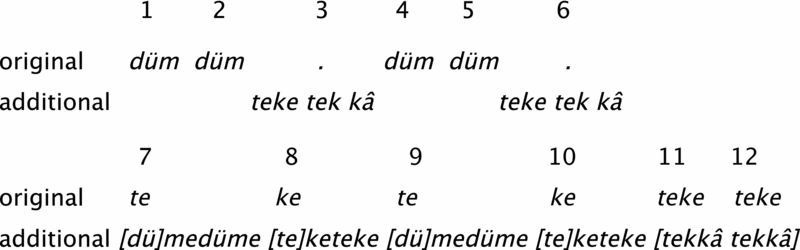
However fanciful, the invention story is nevertheless musicologically, as well as etymologically, grounded to the extent that the iambic element identified as the western source occupies the first half of this 12 time-unit cycle, and is articulated exclusively by düm strokes, while the remainder, to be equated, following the morphology of the narrative, with the fictional additional input of Süleyman's court musician, contains in contrast no düm strokes at all and is internally duple rather than triple in articulation, so that the whole is patterned as 6 (3 + 3) + 6 (2 + 2 + 2):

This distribution is strikingly atypical. Indeed, apart from the shortest cycle, sofyan, which with only four time units offers little scope for more, frenkçin is the only cycle in which the basic düm/tek timbral contrast appears just once, at the mid point. Not surprisingly, perhaps, it is one of the rarer usuls.Footnote 41
Nor is it surprising to find that the available documentation of this cycle only accords with the dating suggested by the invention story to the extent that no reference to it is to be found in the various extant fifteenth-century Turkish theoretical texts.Footnote 42 But neither is it cited during the sixteenth and early seventeenth centuries. True, the theoretical literature from this period is so scanty that nothing definite can be concluded from its non-appearance there,Footnote 43 although it is surely significant that Ali Ufki (1610?-75), who recorded the court repertoire of the early to mid seventeenth century, and gave definitions of a considerable number of rhythmic cycles,Footnote 44 nowhere refers to it. Nevertheless, its emergence may reasonably be dated to the mid seventeenth century, for it is cited in a text written in 1675,Footnote 45 and is attested in the song-text collection largely made by Hafız Post (1630?-94),Footnote 46 occurring in three pieces, one of which is by Hafız Post himself and the other two by a slightly younger contemporary. The first description of it is provided shortly after, at the beginning of the eighteenth century, by Demetrius Cantemir (1673–1723), who includes a detailed account (that given above) within his catalogue of cycle definitions,Footnote 47 but whereas this might be thought to indicate that it was by then well established, the available evidence suggests that it was infrequently used: there is just one piece in frenkçin among the compositions, all instrumental, notated by Cantemir, and, taking this and the songs recorded in the Hafız Post collection as representative, frenkçin would appear to have been used in less than 0.4% of the pieces making up the repertoire of c1700.Footnote 48
As to the presumed European reference, or even inspiration, behind the name, we may surmise that, despite his own silence, the palace milieu in which Ali Ufki worked was a likely environment within which it could have emerged. This is not just because of its cosmopolitan atmosphere but more specifically because of the presence of European musicians such as Ali Ufki in the court ensemble at the time—indeed, he reports that its current leader (sazende-başı) was an Italian renegade,Footnote 49 so that it would not be excessively fanciful to imagine occasional performances of European dance forms as a prompt to rhythmic experiment, in the present case perhaps most obviously the triple-time saraband, with its characteristic lengthening of the note on the second beat.
Cantemir's definition of the frenkçin cycle is echoed by a number of later eighteenth-century textsFootnote 50 (with only occasional insignificant variations) and, allowing for the fact that modern descriptions include discriminations absent from his repertoire of stroke types, is the definition still recognised as normative today.Footnote 51 In short, the basic structure of frenkçin has remained stable since the beginning of the eighteenth century. It has also remained a decidedly marginal cycle: very few pieces are noted outside the Mevlevi repertoire, and even there it is restricted to the third selâm of a few ayin, where it appears in place of the more usual devri kebir, and the notational record is, in consequence, extremely thin. Nevertheless, from the handful of representative compositions that have been recorded it is possible to piece together something of the changes that have taken place in melodic articulation, thus adding further evidence that might help characterise the evolution of another, albeit slender, segment of the classical tradition.
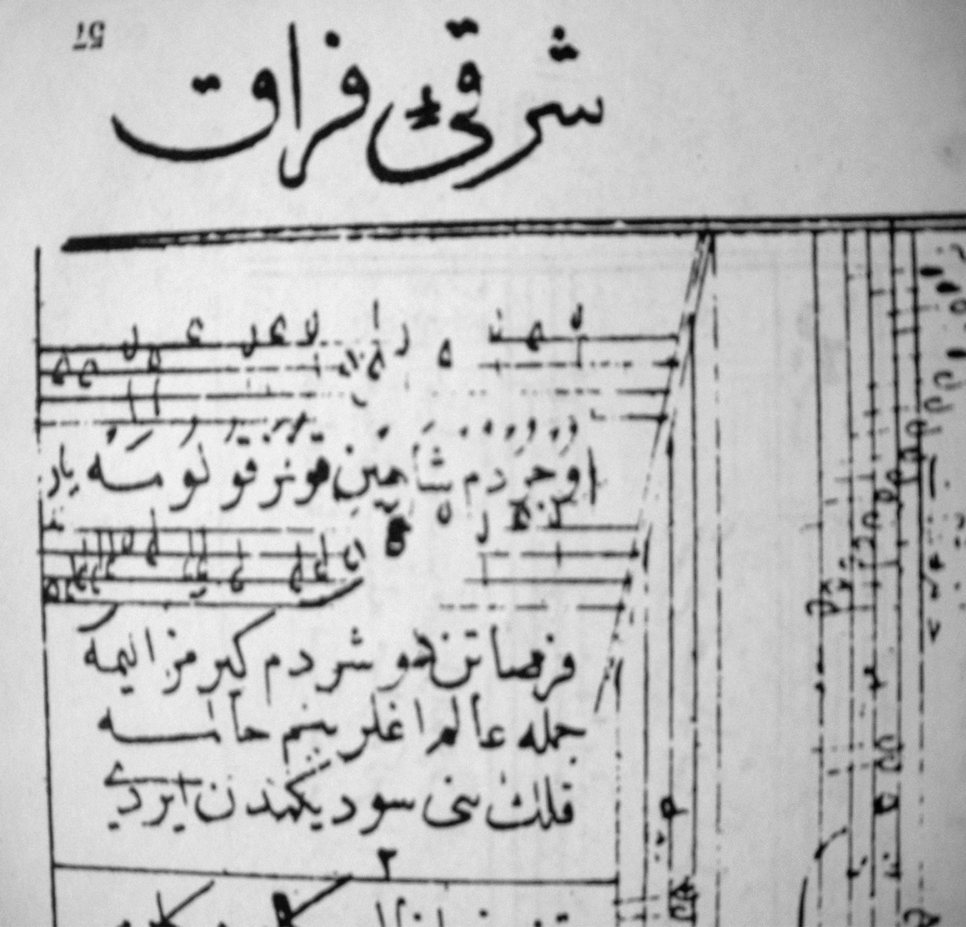
The earliest known piece thought to be in frenkçin is, in fact, a composition notated by Ali Ufki (Example. 1), a strophic song labelled simply ‘Şı’ but lacking, as is normal with such pieces, any verbal definition of the rhythmic cycle. Its identification as being in frenkçin was made by Cevher,Footnote 52 presumably by matching the pattern of durations in the vocal line to that of the cycle. His interpretation is eminently reasonable, for if four cycles are identified (Ali Ufki's original notation has no internal divisions) then each begins with four pitches the duration of which is of the pattern 1+2+1+2, which matches exactly that of the first four percussions of the cycle. What follows is more variegated (1+5; 1+1+4; 2+2+1+1; 1+1+1+1+2), but still relatable in three of the four cycles to the duple distribution of the remainder of the percussion pattern.
Example 1.

When we turn to Cantemir's solitary notated example,Footnote 53 the first section (hane) of which is given in Example 2, we have rather more purchase for analysis, as it contains 12 different cycles (out of a total of 20). In contrast to the presumed example given by Ali Ufki, there is, though, surprisingly little in the melody here that explicitly foregrounds the pattern of the frenkçin percussion underlay. In the four cycles of the first sub-section, for example, the shape of the melody suggests that the cycle could just as readily be perceived as 4+4+4. There are certainly several others where the first half is articulated as 3+3, but it is clear that this pattern is not predominant, and in any case instead of the expected (1+2) subdivisions we more frequently encounter either (1+1+1) or (2+1) or even no subdivision at all.
Example 2.

The question therefore arises of how this piece is differentiated melodically from the norms observable in the other and more common cycle of 12 time units, çenber, where an internal 4+4+4 division appears to predominate. One general distinction between the two cycles appears to have related to tempo,Footnote 54 çenber generally being performed at a significantly slower speed than frenkçin, and with this may be correlated significantly lower melodic density (measured as the number of pitch changes over a given number of time units): in the frenkçin piece the average is 7.2 pitch changes per cycle as against, to take the arbitrary sample of the first ten cycles of each of the first two çenber pieces, 15 and 11 respectively.
Although a single example cannot provide sufficient evidence for secure conclusions to be drawn, a number of differences in melodic patterning may nevertheless be noted. Thus the frenkçin piece does not exhibit the shape typical of the central cell in the çenber repertoire:
and is further differentiated from çenber norms in that it adopts a cadence pattern characteristic of longer cycles (in which the first note, represented here with a crossed note head, is normally one or two pitches above the second):
so that the finalis is reached on time unit 8, whereas in çenber it is usually reached on time units 9, 10 or 11. Noteworthy also, in contrast now to berefşan, where a similar initial 3+3 (but patterned as 2+1+2+1) is nearly always clearly marked in the melody, is that in ten of the total of 20 cycles, including all of the first four, time unit 7 is not marked by an attack.
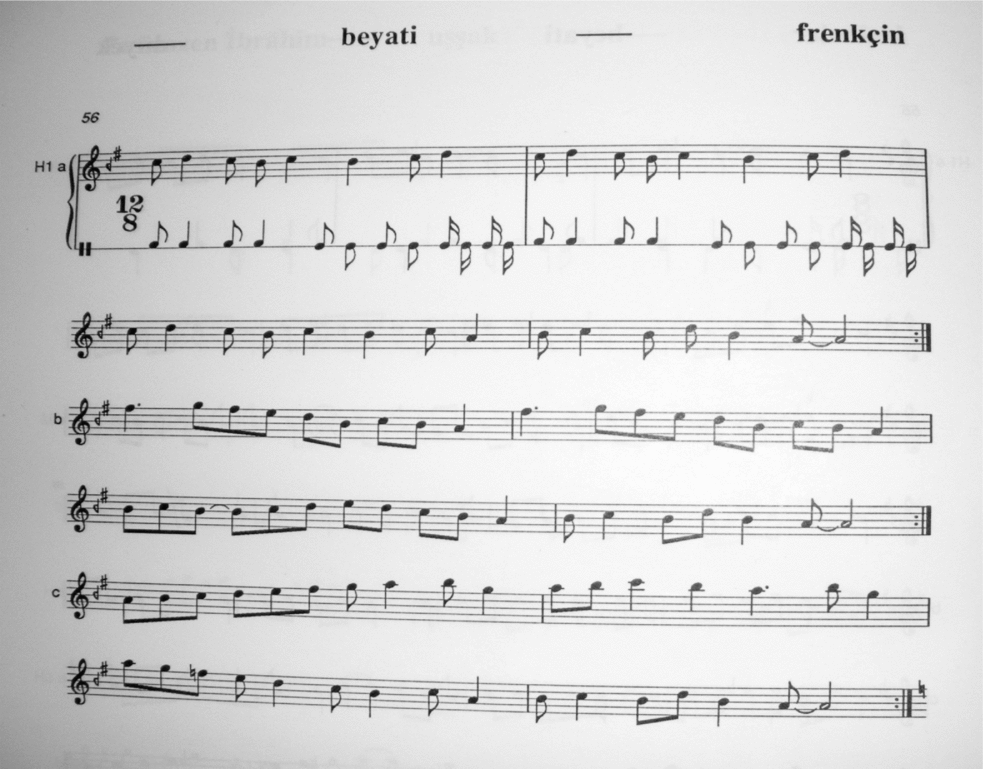
The next potential source, the so-called Kevseri collection, generally considered to have been compiled around the middle of the eighteenth century, appears to offer no further examples.Footnote 55 Accordingly, we have to wait until the notations provided towards the end of the eighteenth century by Abd ül-Baki (1765–1821)Footnote 56 and the frenkçin material these contain, which occurs in the third selâm Footnote 57 of a Mevlevi ayin by Abd ül-Baki's patron, Selim III (1761–1808). Fortunately, this ayin survives in the modern repertoire, so that in addition to the comparisons that can be made with Cantemir's notation we are able, thanks to the juxtaposed transcriptions provided in the Mevlevi ayinleri Footnote 58 of the Abd ül-Baki notation and the late nineteenth/early twentieth-century version, to track subsequent changes, or the lack of them, in the same material.
As was to be expected, the melodic contour of the later version exhibits certain differences, as Example 3 shows. These are, nevertheless, relatively minor and, in part, predictable, consisting of the addition of adjacent tones and alterations to the rhythmic articulation that make it more regular. However, these alterations have the effect of further diluting the relationship with the percussion underlay. In the Abd ül-Baki version the melody largely retains the 3 + 3 + 6 (=2+2+2) distribution, even if it could reasonably be claimed that rather than (1 + 2) + (1 + 2) the beginning of the first two cycles tends to suggest (2 + 1) + (1 + 2), but the later version drifts considerably further away, so that in the absence of percussion to mark the frenkçin pattern the beginnings of the same two cycles would now suggest 2 + 2 + 2.
This omits the repeated measures: the original consists of seven, with 3 being a repeat of 1, and 4 and 6 of 2.

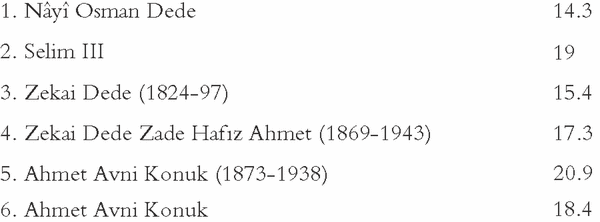
This dilution of the relationship between melody and percussion underlay is congruent with changes elsewhere that are relatable to a general process of retardation, but what is noteworthy here is that the text is not affected, in the sense that the syllables are placed at exactly the same points in the cycle as before, so that their rhythmic articulation in relation to the percussion underlay is undisturbed. What also remains unchanged in these two versions is their melodic density: both yield an average of 19 changes per cycle. Not surprisingly, this is much higher than the equivalent figures for the notations by Ali Ufki and Cantemir, 6 and 7.2 respectively, the approximately threefold increase being in line with changes encountered elsewhere. Taken in isolation it suggests a perceptible degree of retardation, although given the size of the sample, especially when account is taken of the brevity of each piece, further exacerbated by the high level of internal repetition, these figures should be treated with considerable caution. Despite this, it is of interest to note that the earliest Mevlevi piece, accepting its attribution to an older contemporary of Cantemir, Nâyî Osman Dede (1652?-1730), has a melodic density of 14.3, approximately twice that of the earliest notations, but still significantly below that of the composition by Selim III. But although melodic density can be a useful index of diachronic transformation elsewhere, the nineteenth-century frenkçin repertoire fails to confirm whatever expectation these differences might arouse, for some revert to a lower level not much above that of the Nâyî Osman Dede example. Arrayed chronologically, we have:
Fig. 1.

In fact, a better indication that the Nâyî Osman Dede piece possibly preserves a stylistically older stratum might be thought to reside in its high level of conformity to the implications of the percussion underlay, the rhythmic articulation of the melody exhibiting a clear 3 + 3 + 2 + 2 + 2 pattern, when set against the drift away from this detectable in the differences between the earlier and later versions of the Selim III composition.Footnote 60 Indeed, even more dramatic changes might have been anticipated if account is taken of developments in other cycles: as Feldman notes, the much larger group of third selâm pieces in devri kebir juxtaposes earlier and later forms of this cycle, and in berefşan the 3 + 3 beginning, so prominent in the instrumental repertoire of the beginning of the eighteenth century, is no longer marked in the nineteenth-century repertoire.
In the event, however, the later Mevlevi pieces fail to fulfil such expectations. As they are by Zekai Dede, his son, and one of his pupils, a certain family resemblance would hardly be surprising, but whatever the reason it is certainly the case that they do not exhibit the successive increases in melodic density that might of themselves point to a process of retardation. To be correlated with this stability is the retention, at the beginning of the cycle, of the 3 + 3 pattern in the rhythmic articulation of the melody, and it is also retained in the disposition of the verse syllables, which remains predictably uniform throughout this repertoire of Mevlevi pieces, as demonstrated in fig. 2, which plots the predominant distributions in each of the six.
Fig. 2.

In (2) the absence of a syllable on time unit 2 could be explained by the prosodic structure, the first foot being - ∪ - -, but as the same foot is also initial in (3), (5) and (6) it is clear that the need to array the syllables in conformity with the percussion underlay tended to override the prosodic pull.Footnote 61 It may be added that the same distribution of text syllables in the first half of the cycle is observable in vocal pieces in the later derivation firengifer,Footnote 62 which splices together the first six time units of frenkçin and the last eight of fer.Footnote 63 The regularity all these settings exhibit in this particular respect confirms a persistence of compositional method that incidentally raises further questions about the degree to which the piece notated by Cantemir can be considered fully representative. It is true that the frequent absence of an attack on time unit 7 now appears more rather than less normal,Footnote 64 but otherwise the unusual degree of rhythmic ambiguity, caused by the frequent avoidance of the initial 3(1+2) + 3(1+2) articulation, suggests a fluctuation between a recognisable frenkçin configuration in some cycles and a quite atypical one in others for which there is no obvious explanation.
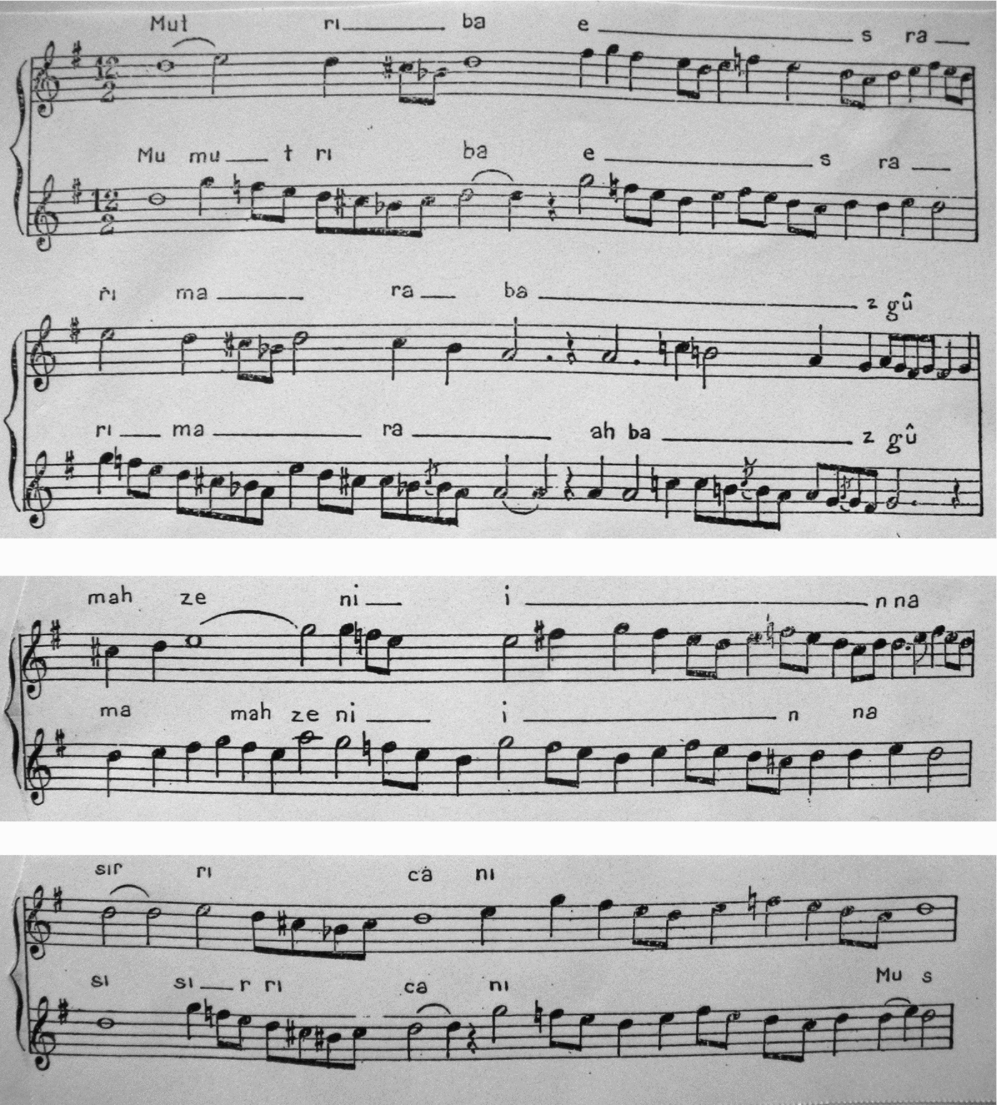
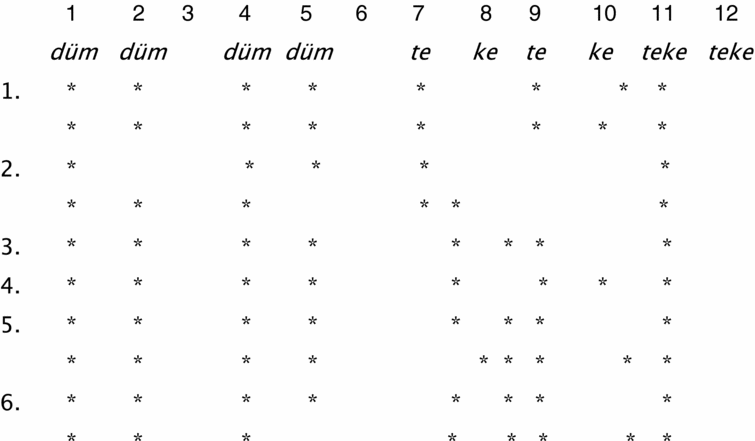
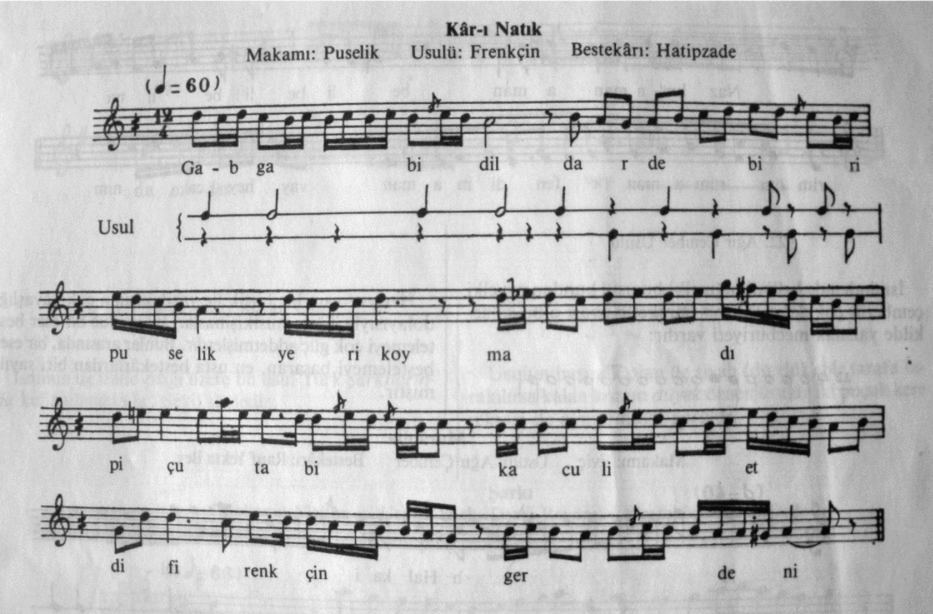
For a secular vocal example of frenkçin we may turn back to Rauf Yekta Bey's French article. He provides in illustration (Example 4), the relevant section of a kâr-ı natık by Hatipzade, a lengthy form in which the text names the various modes (here buselik) and rhythmic cycles traversed in the course of the composition. This frenkçin material (consisting of four rhythmic cycles) exhibits virtually the same distribution of text syllables as in Fig. 2, aligning itself in particular with the later selâms in which the attack relating to time unit 7 is delayed, a feature that occurs here in all four cycles. As the tempo indication is a leisurely 1 = 60 and the melodic density is, at 24.5, considerably higher than in the Mevlevi material, one might wish to detect here a typically nineteenth-century style showing signs of retardation coupled, in this case, with a clear melodic separation of the cycle into two halves, the first marked by a cadential caesura, the second by a delayed onset. But although the combination of melodic density and tempo are good indications of retardation when set against the earliest notations, it is, paradoxically, in the Mevlevi corpus that retardation is most apparent, for recent performance practice adopts an even slower tempo, 1 = c40,Footnote 65 in all probability at least twice and perhaps three times as slow as what we might conjecture to have been the norm in Cantemir's day. To be correlated with this tempo shift is not just a significantly higher melodic density but also a higher density in the percussion underlay, for the basic pattern now has several time units subdivided, resulting in what is termed the velvele form of the cycle, shown in fig. 3 (which gives in brackets the sometimes insignificant differences in stroke qualities in the second half of the cycle). The original 12 attacks are thereby augmented to 32, again suggestive of an almost threefold retardation.
Fig. 3.

Example 4.

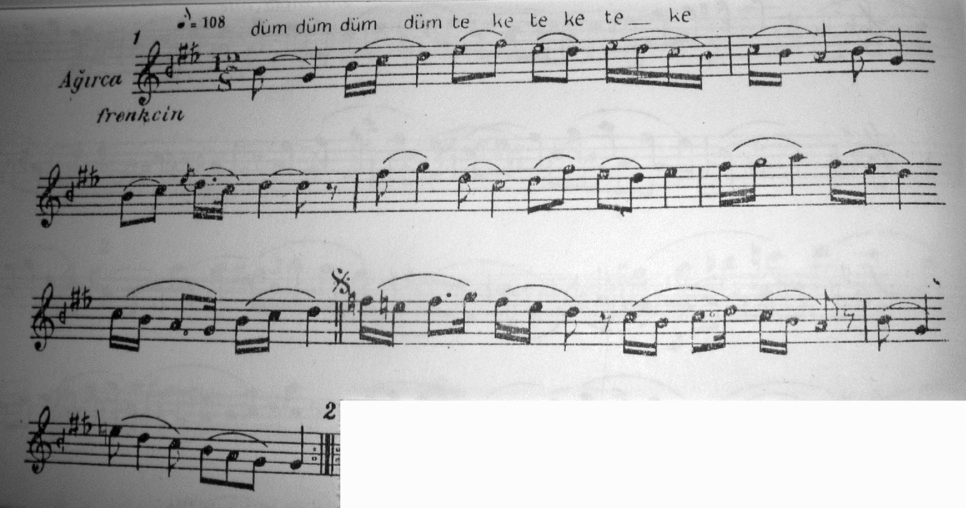
There remain to be considered the two pieces with which Rauf Yekta Bey's colleague Suphi Ezgi exemplifies frenkçin.Footnote 66 These consist of a minuscule anonymous ilahi which aligns itself, unsurprisingly, with the melodic and textual patterns found in the Mevlevi repertoire, and a more substantial instrumental composition of his own entitled ‘spring song’ (bahariyye), the beginning of which is given in Example 5.
Example 5.

Here one might have expected to encounter characteristics similar to those of the kâr-ı natık sample given by Rauf Yekta Bey. However, Ezgi's composition exhibits a marked stylistic shift: the tempo given, 1 = 108, is much brisker; the melodic density is much lower, averaging 12.5; there is not a single case in all the 14 cycles (ignoring repeats) of the delay of the attack relating to time unit 7; and the rhythmic structure is strongly emphasized in the melody, patterned as 3(1+2) + 3(1+2) + 2 + 2 + 2. In short, what Ezgi provides here is not a further manifestation of the tradition in its late nineteenth-early twentieth-century form, let alone a further development of it, but rather a deliberately backward-looking didactic essay showing how the structure of a frenkçin piece should conform to that provided by the percussion underlay, rather than be obscured through melodic elaboration. It accords entirely with his general editorial approach to the preservation of the canon, reclaiming a ‘classical’ ideal cleansed of modern accretions that to him represent a debasement.Footnote 67 The result in this case is a stripped-down melodic style that harks back to that exhibited in the Nâyî Osman Dede selâm, the resemblances being particularly clear in the melodic disposition of the beginning, which may be compared with the first and fifth cycles of the earlier piece. There is greater melodic complexity later, but the initial character thus established is one of pseudo-archaic simplicity.
However powerful his influence in the theoretical domain, Ezgi's piece does not seem to have served as a model for younger composers, and Rauf Yekta Bey's example remains the more representative. It is one that left him wistfully wondering whether contemporary French scholars could detect in it any traces of the music played for the delectation of Süleyman the Magnificent. Evidently not, is the blunt and obvious answer, given the history of the invention and expulsion stories explored above. But if we sidestep the chronological and geographical niceties and adhere to the fundamental premiss of a possible European model on the basis of which the more extended and complex structure of frenkçin was elaborated, one could at least point to one element of continuity, the persistent adherence to an iambic pattern both in the distribution of the song-text syllables over the first half of the cycle and the corresponding prominence of the düm strokes in the velvele form of the percussion pattern, and speculate that here one might just imagine detecting in the background some faint echo of origin.