The World Health Organization (WHO) defines disability, in very broad terms, as the difficulty an individual may have relating to his or her surrounding environment. Nonetheless, since the eighteenth century, Spanish literature has portrayed disability as a metaphor for deficiency, imperfection, monstrosity, disorder, and even excess. In this sense, the grotesque amputation suffered by the protagonist, Tristana, in Benito Pérez Galdós's famous homonymous novel written in 1892 can be interpreted as a settling of accounts of society with a woman who was too independent and intellectually ambitious for her time. Literary production became in that sense a reflection of a society that wove together a series of prejudices regarding disability, resulting in the stigmatization and invisibility of these individuals.
In the field of disability studies, the majority of the scholarship conducted throughout the twenty century has been in the English-speaking field. It was not until the end of the first decade of the twenty-first century that Hispanism began to take an interest in the subject through pioneering studies such as Benjamin Fraser's Disability Studies and Spanish Culture: Films, Novels, the Comic and the Public Exhibition (Liverpool University Press, 2013); Encarnación Juárez-Almendros's Disabled Bodies in Early Modern Spanish Literature: Prostitutes, Aging Women and Saints (Liverpool University Press, 2017); Connie L. Scarborough's Viewing Disability in Medieval Spanish Texts: Disgraced or Graced (Amsterdam University Press, 2018); or Fraser's most recent book, Cognitive Disability Aesthetics: Visual Culture, Disability Representations, and the (In)Visibility of Cognitive Difference (University of Toronto Press, 2018).
However, as shown by these titles, theatre and performance projects on disability seem to be a forgotten line of inquiry, even though Antonio Buero Vallejo (1916–2000) was the Spanish playwright who brought to the stage a wide range of works on disability within the post–Civil War context. More recently, Laila Ripoll and Pilar Pombo have returned to this topic in relation to the memory of the aftermath of that war. It is undoubtedly within the scope of inclusive theatre and community outreach theatre that disabilities are now being explored more urgently to combat false stereotypes and stimulate the inclusion on the social, work, and institutional levels.
The purpose of this interview is to approach artistic creators who have dealt with disability directly, whether working with the impaired or giving a concrete form to disability from the stage. In the following conversation (translated from the original Spanish) I engage with two theatre professionals who have worked in different areas of inclusive theatre in Spain, to outline the current state of this type of theatre socially and artistically, to explore the creative process, and to evaluate progress made to the present date.
Victoria Teijeiro is a professional actor, acting instructor, and head of La Quintana Teatro. Since 2014 she has directed La Quinta del Arte, a nonprofit cultural association with headquarters in A Coruña (Galicia, Spain) and, on the state level, she has led theatre workshops with persons both with and without disabilities, staging two productions to date: La gran boda [The big wedding] (29 July 2017) and Despertares [Awakenings] (1, 12, and 13 July 2018). She is currently studying for a doctorate in Inclusive Theatre at Universidad Autónoma de Madrid. Together with Isabel Rodes, a professional actress of national renown and prestige on the Spanish stage—and with the support and participation of other artists, such as Irma Correa and Rubén Tejerina—Teijeiro cocreated Desde lo invisible [From the invisible] for the company La Quintana Teatro, which specializes in addressing current social issues. Desde lo invisible won the prestigious national Max Award, granted by the Sociedad General de Autores y Editores (SGAE), for best new play performed in 2008; it was restaged in 2018 for the Festival of Performing Arts and Disabilities of the Centro Dramático Nacional and continued to run throughout the year in various Spanish theatres. The play premiered in the United States in September 2018 at the University of Massachusetts, Amherst as part of the conference Theaters of Marginality.
***
Esther Fernández: Victoria, you have commented that La Quinta del Arte is the only company currently in A Coruña. How many inclusive theatre companies are there in the rest of Spain? How do you see the development of this type of theatre in Spain in comparison to Europe and the United States?
Victoria Teijeiro: La Quinta del Arte, at the moment, operates as a cultural association staging theatrical productions within the amateur theatre framework. Of course, there are many amateur theatre groups in Galicia, with normate members.Footnote 1 There are also groups of people with disabilities who emerge from social centers or institutions. But there are no inclusive centers, open spaces of diversity, with mixed groups, where any person can train independently of his or her circumstance or condition (disability, illness, etc.) and where diversity is embraced as a concept that brings together all of society. …
Currently in Spain there are very few inclusive theatre companies. The Tercer Cuaderno (Third Program) de Mayo de 2018 de Inclusión Social, held by the Comisión de Inclusión Social de la Red Española de Teatros y Auditorios (Spanish Network of Theatres and Auditoriums), included only four inclusive theatre performances: Fiesta, fiesta, fiesta [Party, party, party], by The Cross Border Project; Postales para un niño [Postcards for a child], by Teatro Más; Compañeros de barrio [Neighborhood companions], by Panta Rhei (puppet show); and Desde lo invisible. In addition to these, such well-known companies as Palmyra Teatro, El Tinglao, and Down Madrid theatre company have also worked with actors both with and without intellectual disabilities.
We created La Quinta del Arte with the hope that it would be a temporal platform, that it would serve as a vehicle to help people understand that diverse spaces exist, and that people would be motivated to participate in activities with different groups to raise awareness and break down prejudices and barriers. We are confident that in a short time it will no longer be necessary to use the term “inclusive theatre” but, rather, anyone will be able to go to a theatre workshop knowing that it is open to everyone in our society.
EF: I've noticed that many of the inclusive theatre and dance shows are held in public spaces, and almost all of them are free. Why is that? Is it an ethical or professional question?
VT: There are several festivals for inclusive theatre where attendance is free; the festival pays the company, and through them the intention is to generate increased public attendance for this type of performance. The festivals are in large part the great providers of visibility, given that whereas the market is now complicated for theatre companies, the idea of being inclusive can generate prejudices and fears on the part of the programmer who, in some cases, may opt for a “sure” bet, thinking that the public will be more reticent if it knows that there are people with disabilities in the cast. Less professionalism? Showing a reality that people often don't want to see? … We don't know what questions will come up, but on the road to inclusion we have advanced. Still, there is a long way to go. It has been ten years since we first brought Desde lo invisible (which received the Max Award) to my homeland, to Galicia. We were programmed through Social Services for free performances. (They must have understood that to speak about disabilities was beneficial, and so they programmed it.)
EF: Continuing with the ethics question, in the show Desde lo invisible, Isabel, you play different roles of people with intellectual disabilities. How does an actor prepare for that? That is, how do you protect your character from yourself? What risks does that involve? What satisfactions?
Isabel Rodes: I don't believe there is any way to work on something like this if you haven't done a lot of research into this world. We begin by working on characters based on real people we've known. We don't imitate them but, rather, we try to grasp something specific and concrete from each one and then transfer it to the stage. Often, through improvisation, we confront our own prejudices and give free rein to what the character, whom we have constructed, demands in a logical way, considering if this were really one of the people we knew, how that person would react to our own barriers, our fears, and our personal desires. It's a very rewarding struggle between character and actor. The risk is always of offending someone who feels identified or who doesn't understand our deep sense of respect for people with varying abilities. The satisfaction is being able to bring the spectator closer to a world that tends to seem distant and that stirs up a whirlwind of discovered emotions.
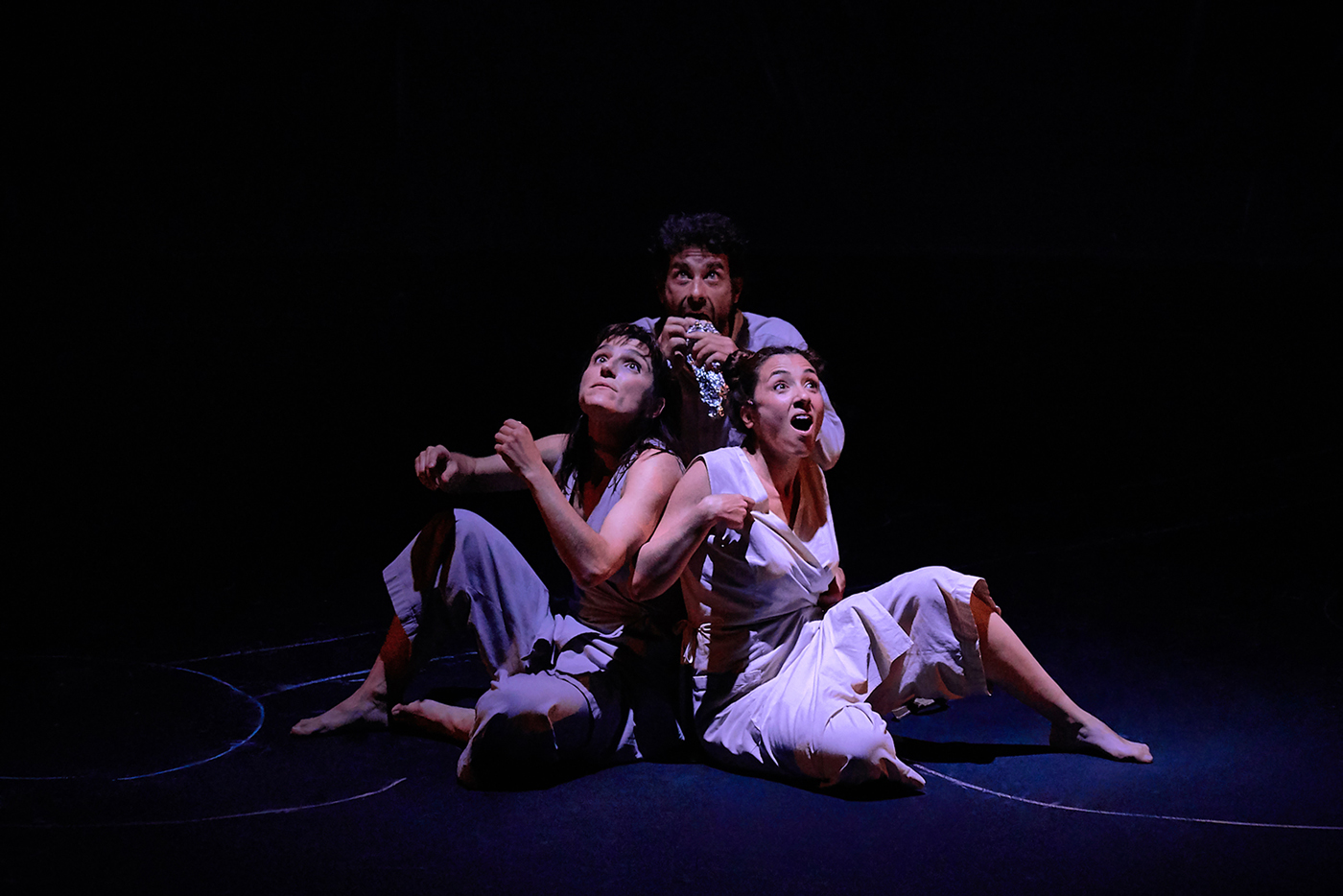
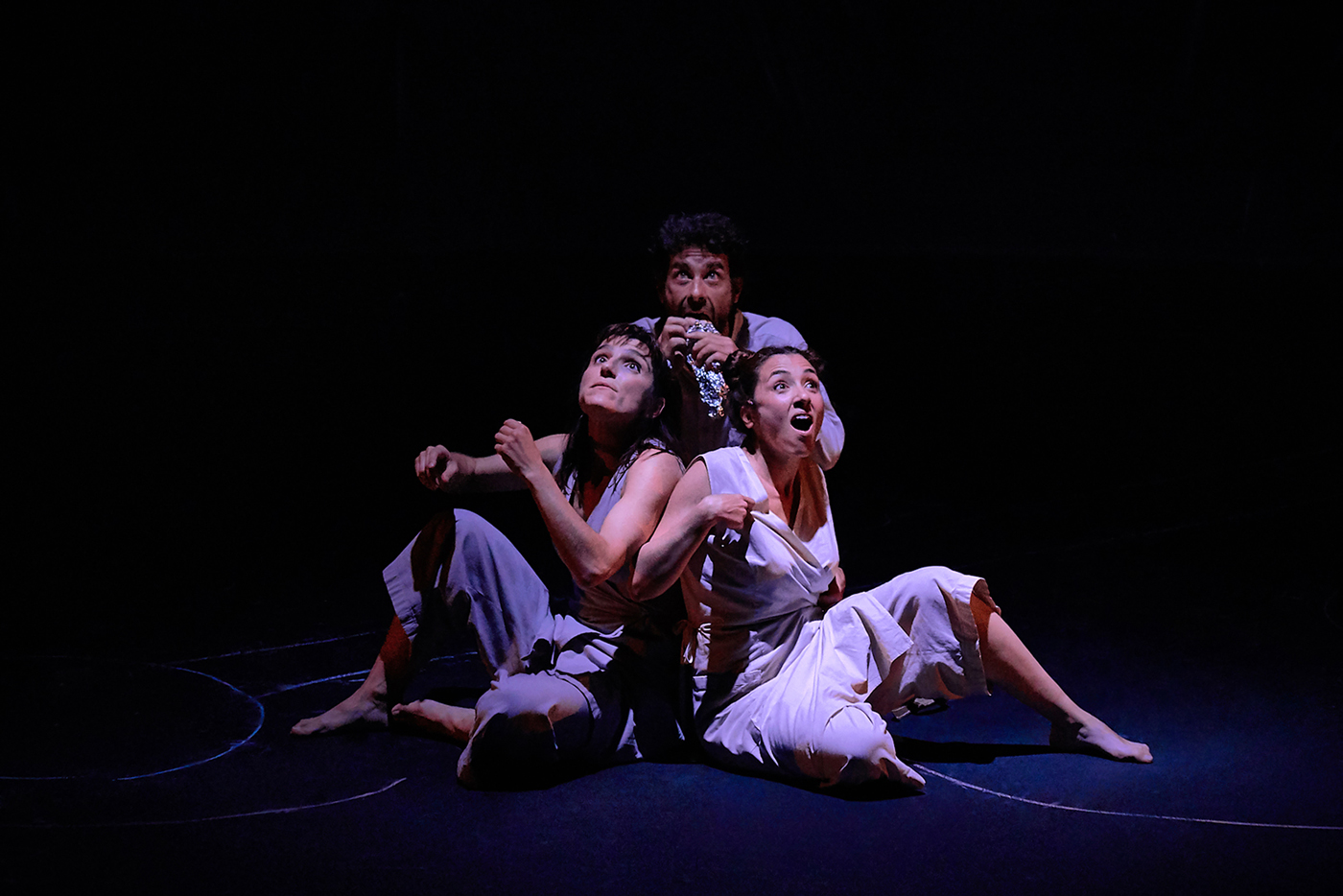
EF: Both you, Isabel and Victoria, decided to do your final graduation projects through a work that you created from nothing on the theme of disabilities: Desde lo invisible [Fig. 1]. Earlier, you mentioned that to start this project you worked in an occupational workshop for people with disabilities for six months. How did the two of you fit in? What were you looking for and what expectations did you have? And what did you come out with?
IR: We were hoping to do a kind of theatre that has a social dimension, in which the performance would be a vehicle for leading the audience to discover other realities. We were interested in intellectual disabilities because it was not a topic that had received much interest outside its own circles, and we knew from the occupational workshop that they were very eager to be seen and that they had an absolute commitment to the theatre and its transformative quality. Both the individuals and their monitors received us, and immediately embraced us, and gave us everything they had available in order to put on this show. It gave us enormous satisfaction to be able to do and tell what we really wanted to express: the happiness that comes from not wanting to be anywhere else than where we were at that moment, creating and loving.
EF: Earlier, you mentioned that when Desde lo invisible premiered in 2008, the disabled people you worked with in the occupational workshop as preparation also attended the premiere. What was their reaction to seeing themselves played onstage, to seeing themselves through you?
IR: We were very concerned because, once again, we were afraid of disappointing them, or that they might feel taken advantage of, or that they might misunderstand and think we were making fun of them. But everything turned out positively. It's possible that some of them recognized themselves, but you could tell that they looked at the positive side, you could hear it in the recordings that, for them, were like being on television. In fact, they saw a play in which the normate goes through normal everyday situations, things he [or she] recognizes in their day-to-day lives. Sometimes funny situations, and sometimes not so funny. But that's reality. They had fun, but we also needed to know the opinions of their family members, monitors, and friends to be sure that our perception of the world of people with intellectual disabilities, seen from their perspective, was correct.
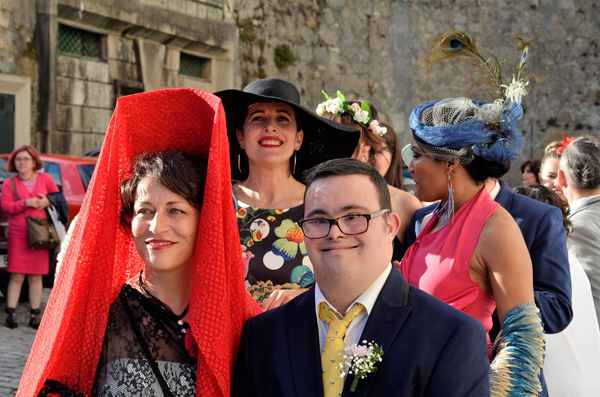
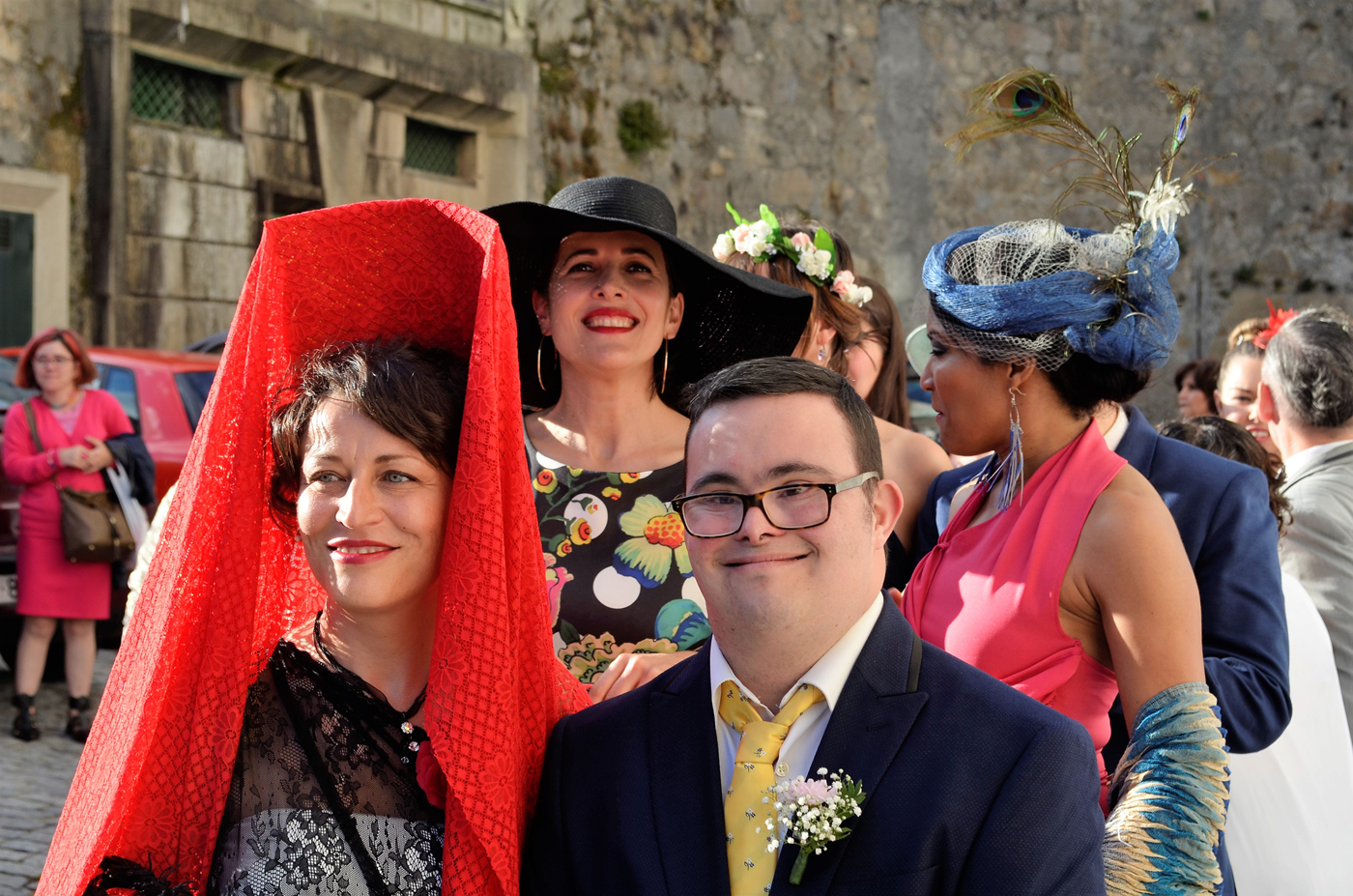
EF: In contrast to what you did in Desde lo invisible, in your projects, La gran boda [Fig. 2] and Despertares, you work with mixed groups of people both with and without disabilities. How do you manage to work with the two groups? What difficulties arise? How do you work through the different barriers that come up over the course of the collaborative process that can sometimes go on for months?
VT: After working for several years with associations and groups of people with disabilities, I realized that the way I related to them was the same as with any other group of theatre aficionados (without disabilities). We needed more actors in the group “Les Felices” of GRUMICO (a group of persons with physical disabilities in A Coruña), and they were the ones who demanded that the doors be opened for them. They wanted to work with people who weren't members of the association, anyone. After that, and as fruit of that successful experience, I discovered just how beneficial it is to work with mixed groups, because the creative process itself enables one to be understood and valued based on one's abilities and contributions as artists and not on one's mental or physical limitations. In fact, those who benefited the most were the ones without disabilities, who always commented at the end of the workshop on how much they'd learned on the human level and how much that whole creative experience had given them.
Isabel Rodes (right, as Teresa), Didier Maes (center, as Quique), and Victoria Teijeiro (left, as Josete) in Desde lo invisible, a collective project by Irma Correa, José Manuel Pizarro, Isabel Rodes, Rolando San Martín, Victoria Teijeiro, and Rubén Tejerina. Photo: marcosGpunto. Reproduced courtesy of Isabel Rodes and Victoria Teijeiro.
La gran boda, directed by Victoria Teijeiro. Elena Rodríguez (as Merche Castro, mother of the groom) and Samuel Valiño (as Javi Quiroga, groom). Photo: Lucía Fernández. Reproduced courtesy of Victoria Teijeiro.
Working with them is much simpler and more intuitive than it might seem. Each group is different, and one has to learn the different individual rhythms in order to establish a group rhythm in which no one feels they are going too fast or too slow. The most difficult thing, in my opinion, is to homogenize the roles so that everyone works together and contributes, and no one feels they are there “to help the disabled person,” or “to do charity work,” or, needless to say, to justify that “I can't do it because I have a disability.” From the very start, I get them to see that what will unite us is the theatre, and that I'm going to demand the most from each of them. We view the theatre as a game, but work and talent have to go hand in hand in the artistic act.
EF: Victoria, in what way do you view inclusion and diversity as key concepts for working with persons with intellectual disabilities in the area of theatre? How do you see that in your day-to-day work with them?
VT: I think it is fundamental to differentiate between the concepts of inclusion and integration. Inclusion is an approach that responds positively to the diversity of people and individual differences, understanding that diversity is not a problem but rather an opportunity for the enrichment of society through active participation in family life, education, work, and all social, cultural, and community processes in general.Footnote 2
With integration, however, one part of the population, which finds itself outside the system, demands that it should be integrated into the system. In this process, the system remains more or less intact, while those who need to be integrated have the task of adapting to it. This is why I understand inclusion and diversity to be concepts that have to go hand in hand and, yes, I defend the idea that theatre art is a very good way to come together. Of course, there are other ways, and there can't be too many ways to achieve this social objective, which is the improvement of the quality of life for everyone, by valuing all our differences.
The group does all it can to serve as a support for everyone and to give value and recognition to everyone in their day-to-day life. They are groups that tend to be very united, and they are strengthened more by the diversities they contribute than any other more homogenized group (in my experience, I'm speaking).
EF: In both Desde lo invisible and in the projects with La Quinta del Arte, improvisation seems to play a fundamental role in the creative process. What is it about improvisation that dialogues so well with this inclusive theatre?
VT: Collective creation enables the group to contribute and reach a consensus on the story that will be presented onstage. With Desde lo invisible, we didn't want to succumb to prejudices, so we decided to turn to reality in order to be able to display it thereafter onstage. These processes are very rich on both the personal and group levels. To be able to stand up and get to know a world so different from most of ours is a lesson in humanity and a tremendous lesson on all levels. It enables one to understand better the problems and virtues of people, and this leaves an impression on oneself.
When I began to work with collectives at risk of social exclusion I found it almost impossible to find texts for them, as they were such a varied group I couldn't find works with characters of equal importance independent of the number of lines they delivered. Also, undoubtedly in some cases, they were also worried about “having to learn a text by memory.”
Improvisations allowed us to play characters and situations, so that (comparing with them afterward) we began putting together the play and developing the plot of the story they wanted to tell. In this way, everyone participates in the creative process, and it is much easier for them to study the text; since the characters speak through their own mouths, they internalize rehearsal after rehearsal, and it is a much richer and more natural approach.
IR: I suppose it's the idea of letting yourself go toward a void in which you have no control over what you say, how you'll react to things you never even imagined could happen, and most of all the certainty that the ending has not been written yet, there is no text that protects you or that knows more than you do. In improvisation, there is a fear of silence, of not knowing what to say, but you know that if that happens, someone will support you and provide you with a story line to grab on to. That's what happens with inclusive theatre: you don't know who is supporting whom, who is leading whom and, what's most important, it doesn't matter.
EF: Based on your experience as theatre professionals, how can we continue to open the stage arts to those with disabilities? What remains for us to do in our country?
VT:Well, as I said before, there are currently very few inclusive companies, so, based on that. … What can we do? Well, continue raising awareness, working, reaching out, and educating. For our part, the actors, we have to continue bringing new audiences to the theatre and generating an open-minded and diverse public. We have to succeed in making theatre increasingly accessible, so that it reaches all types of people. But this is a job that requires working in teams.
IR: We need to continue working, making it possible for inclusive art to be seen not only in cultural centers, surrounded by family and friends who are themselves part of the world of special abilities. We need to educate the public to find beauty everywhere. Not compassion. Beauty. The beauty of a body struggling to the death to hold its balance and not fall at every step, the beauty of an infinite scream, the beauty of someone bearing the sadness of the world and yet making it dance in a wheelchair, the beauty created from silence beginning and ending in the movement of someone's little finger, the beauty of the need to express oneself, of needing to tell a story, of needing to show oneself … and be seen.