Introduction
A core feature of schizophrenia is widespread cognitive impairment (Reichenberg & Harvey, Reference Reichenberg and Harvey2007), which strongly predicts poor functional outcomes (Bowie et al., Reference Bowie, Leung, Reichenberg, McClure, Patterson, Heaton and Harvey2008; Bowie & Harvey, Reference Bowie and Harvey2006; Bowie, Reichenberg, Patterson, Heaton, & Harvey, Reference Bowie, Reichenberg, Patterson, Heaton and Harvey2006; Green, Reference Green1996; Green, Kern, Braff, & Mintz, Reference Green, Kern, Braff and Mintz2000; Strassnig et al., Reference Strassnig, Raykov, O'Gorman, Bowie, Sabbag, Durand and Harvey2015), in part through negative symptom severity (Ventura, Hellemann, Thames, Koellner, & Nuechterlein, Reference Ventura, Hellemann, Thames, Koellner and Nuechterlein2009). Effective treatments for cognition and negative symptoms, however, are lacking (Buchanan et al., Reference Buchanan, Davis, Goff, Green, Keefe, Leon and Marder2005; Firth et al., Reference Firth, Stubbs, Rosenbaum, Vancampfort, Malchow, Schuch and Yung2017; Fusar-Poli et al., Reference Fusar-Poli, Papanastasiou, Stahl, Rocchetti, Carpenter, Shergill and McGuire2015; Insel, Reference Insel2010; Revell, Neill, Harte, Khan, & Drake, Reference Revell, Neill, Harte, Khan and Drake2015; Wykes, Huddy, Cellard, McGurk, & Czobor, Reference Wykes, Huddy, Cellard, McGurk and Czobor2011). Cognitive impairment in psychotic illness is also transdiagnostic, with the same profile of impairment across psychotic disorders (Hill et al., Reference Hill, Reilly, Keefe, Gold, Bishop, Gershon and Sweeney2013; Reichenberg et al., Reference Reichenberg, Harvey, Bowie, Mojtabai, Rabinowitz, Heaton and Bromet2009). Here, we extend models of cognitive impairment, negative symptomatology, and functional outcomes to incorporate candidate neurophysiological measures that are applicable across the spectrum of psychotic disorders.
We focus on the cognitive domain of executive function because it is among the most impaired in psychotic disorders (Reichenberg et al., Reference Reichenberg, Harvey, Bowie, Mojtabai, Rabinowitz, Heaton and Bromet2009) and predicts everyday functioning: whereas general cognitive ability predicts activities of daily living and vocational functioning (Strassnig et al., Reference Strassnig, Raykov, O'Gorman, Bowie, Sabbag, Durand and Harvey2015), executive function also plays a role in interpersonal behavior (Bowie et al., Reference Bowie, Leung, Reichenberg, McClure, Patterson, Heaton and Harvey2008). Thus, both global functioning and domain-specific functioning are of interest. We focus on performance monitoring because it is a proposed mechanism of impaired executive function in psychotic illness (Kerns, Nuechterlein, Braver, & Barch, Reference Kerns, Nuechterlein, Braver and Barch2008) and is a promising treatment target (Reinhart, Zhu, Park, & Woodman, Reference Reinhart, Zhu, Park and Woodman2015). Performance monitoring involves the rapid detection of behavioral errors, signaling the need for increased cognitive control to maintain task performance (Holroyd, Yeung, Coles, & Cohen, Reference Holroyd, Yeung, Coles and Cohen2005). Performance monitoring is most active in situations where stimulus-response rules are well-learned and response certainty is high (Holroyd & Coles, Reference Holroyd and Coles2002) and is distinguishable from other aspects of executive function that are impaired in psychotic disorders (Kerns et al., Reference Kerns, Nuechterlein, Braver and Barch2008). Thus, impaired performance monitoring is a candidate pathophysiological process of psychosis that may partially account for the broader deficit in executive function and its associated illness features. We test this possibility using structural equation modeling, examining mediated effects of performance monitoring on behavioral measures of executive function, clinical ratings of symptoms, and everyday functioning within a heterogeneous sample of individuals with psychotic disorders and never-psychotic (NP) adults.
Performance monitoring was assessed using event-related potentials (ERPs). Studies distinguish between two functionally and anatomically distinct neural measures: the error-related negativity (ERN) and error positivity (Pe) (Falkenstein, Hohnsbein, Hoormann, & Blanke, Reference Falkenstein, Hohnsbein, Hoormann and Blanke1991; Gehring, Goss, Coles, Meyer, & Donchin, Reference Gehring, Goss, Coles, Meyer and Donchin1993). The ERN occurs within 100 ms following error commission on speeded tasks and captures automatic error detection, whereas the Pe occurs from 300 to 500 ms and relates to conscious error recognition (Hajcak, McDonald, & Simons, Reference Hajcak, McDonald and Simons2003; Nieuwenhuis, Ridderinkhof, Blom, Band, & Kok, Reference Nieuwenhuis, Ridderinkhof, Blom, Band and Kok2001). The ERN is generated by the dorsal anterior cingulate cortex and motor cortex (Debener et al., Reference Debener, Ullsperger, Siegel, Fiehler, von Cramon and Engel2005; Iannaccone et al., Reference Iannaccone, Hauser, Staempfli, Walitza, Brandeis and Brem2015; Mathalon, Whitfield, & Ford, Reference Mathalon, Whitfield and Ford2003), whereas the Pe has a distinct source, possibly in the posterior cingulate cortex (O'Connell et al., Reference O'Connell, Dockree, Bellgrove, Kelly, Hester, Garavan and Foxe2007; Vocat, Pourtois, & Vuilleumier, Reference Vocat, Pourtois and Vuilleumier2008). Numerous studies have shown that the ERN is reduced among individuals with schizophrenia (Alain, McNeely, He, Christensen, & West, Reference Alain, McNeely, He, Christensen and West2002; Bates, Kiehl, Laurens, & Liddle, Reference Bates, Kiehl, Laurens and Liddle2002; Horan, Foti, Hajcak, Wynn, & Green, Reference Horan, Foti, Hajcak, Wynn and Green2012; Kansal, Patriciu, & Kiang, Reference Kansal, Patriciu and Kiang2014; Kim et al., Reference Kim, Kang, Shin, Yoo, Kim and Kwon2006; Kopp & Rist, Reference Kopp and Rist1999; Llerena, Wynn, Hajcak, Green, & Horan, Reference Llerena, Wynn, Hajcak, Green and Horan2016; Mathalon et al., Reference Mathalon, Fedor, Faustman, Gray, Askari and Ford2002; Morris, Yee, & Nuechterlein, Reference Morris, Yee and Nuechterlein2006). It is also reduced in high-risk populations (Laurens et al., Reference Laurens, Hodgins, Mould, West, Schoenberg, Murray and Taylor2010; Perez et al., Reference Perez, Ford, Roach, Woods, McGlashan, Srihari and Mathalon2012) and unaffected siblings (Simmonite et al., Reference Simmonite, Bates, Groom, Jackson, Hollis and Liddle2012), suggesting a neural endophenotype of risk for psychosis and associated cognitive impairment. There is evidence of a reduced Pe in schizophrenia (Foti et al., Reference Foti, Perlman, Hajcak, Mohanty, Jackson and Kotov2016; Foti, Kotov, Bromet, & Hajcak, Reference Foti, Kotov, Bromet and Hajcak2012; Kansal et al., Reference Kansal, Patriciu and Kiang2014; Perez et al., Reference Perez, Ford, Roach, Woods, McGlashan, Srihari and Mathalon2012, although also see Alain et al., Reference Alain, McNeely, He, Christensen and West2002; Horan et al., Reference Horan, Foti, Hajcak, Wynn and Green2012; Kim et al., Reference Kim, Kang, Shin, Yoo, Kim and Kwon2006; Mathalon et al., Reference Mathalon, Fedor, Faustman, Gray, Askari and Ford2002; Morris et al., Reference Morris, Yee and Nuechterlein2006). The ERN is reduced in other psychotic disorders (Foti et al., Reference Foti, Kotov, Bromet and Hajcak2012; Minzenberg, Gomes, Yoon, Swaab, & Carter, Reference Minzenberg, Gomes, Yoon, Swaab and Carter2014), whereas a reduced Pe is relatively specific to schizophrenia (Foti et al., Reference Foti, Kotov, Bromet and Hajcak2012, Reference Foti, Perlman, Hajcak, Mohanty, Jackson and Kotov2016). While correlations with symptoms are equivocal (Horan et al., Reference Horan, Foti, Hajcak, Wynn and Green2012; Kansal et al., Reference Kansal, Patriciu and Kiang2014; Kim et al., Reference Kim, Kang, Shin, Yoo, Kim and Kwon2006; Llerena et al., Reference Llerena, Wynn, Hajcak, Green and Horan2016; Mathalon et al., Reference Mathalon, Fedor, Faustman, Gray, Askari and Ford2002), there is some evidence that performance monitoring deficits relate to greater negative symptom severity (Bates et al., Reference Bates, Kiehl, Laurens and Liddle2002; Foti et al., Reference Foti, Kotov, Bromet and Hajcak2012, Reference Foti, Perlman, Hajcak, Mohanty, Jackson and Kotov2016; Reinhart et al., Reference Reinhart, Zhu, Park and Woodman2015) and occupational functioning (Foti et al., Reference Foti, Kotov, Bromet and Hajcak2012), which is consistent with the neurocognitive models described above (Ventura et al., Reference Ventura, Hellemann, Thames, Koellner and Nuechterlein2009).
Evidence has primarily come from bivariate correlations between neural measures of performance monitoring and clinical characteristics; pathway models explaining the nature of these relationships are lacking. As an example, a recent study of impaired auditory processing in schizophrenia utilized structural equation modeling to test a bottom-up model whereby abnormal ERPs contribute to cognitive impairment and clinical outcomes (Thomas et al., Reference Thomas, Green, Hellemann, Sugar, Tarasenko, Calkins and Light2017). Auditory ERPs related to global functioning through general cognitive ability and the negative symptom dimension of avolition. Such pathway models may be clinical useful insofar as they lay the groundwork for targeted interventions on neural deficits, enabling estimates of which outcomes are most likely to be affected by improvement in neural functioning and the likely magnitude of those effects.
Here, we followed the same conceptual approach to test a bottom-up model whereby neural deficits in performance monitoring contribute to impaired executive function, which in turn contributes to negative symptom severity and everyday functioning. Pathways were examined among an epidemiologic cohort with psychotic disorders (N = 181), including schizophrenia, mood disorders with psychotic features, and substance-induced psychosis, as well as NP adults (N = 242). The ERN/Pe are high-priority neural measures for clinical translation to improve executive function in psychotic disorders (Kerns et al., Reference Kerns, Nuechterlein, Braver and Barch2008), and the current study adds to this foundation. Previous reports from a subsample of this cohort (92 cases) explored bivariate links between symptoms, everyday functioning, and course of illness across a battery of ERPs, including performance monitoring (Foti et al., Reference Foti, Kotov, Bromet and Hajcak2012, Reference Foti, Perlman, Hajcak, Mohanty, Jackson and Kotov2016; Foti, Kotov, & Hajcak, Reference Foti, Kotov and Hajcak2013; Kotov et al., Reference Kotov, Foti, Li, Bromet, Hajcak and Ruggero2016), attention (Perlman et al., Reference Perlman, Foti, Jackson, Kotov, Constantino and Hajcak2015), semantic processing (Jackson et al., Reference Jackson, Foti, Kotov, Perlman, Mathalon and Proudfit2014), and emotional reactivity (Culbreth, Foti, Barch, Hajcak, & Kotov, Reference Culbreth, Foti, Barch, Hajcak and Kotov2018). The current analyses are the first to use the full cohort and model pathways from ERPs to cognition and associated illness features, with the following aims:
(1) Is performance monitoring associated with cognitive impairment across the psychosis spectrum? Performance monitoring is a key sub-process of impaired executive function in schizophrenia (Kerns et al., Reference Kerns, Nuechterlein, Braver and Barch2008), yet only one study has tested whether performance monitoring is associated with independent, behavioral assessments of cognitive ability, with equivocal results (Kim et al., Reference Kim, Kang, Shin, Yoo, Kim and Kwon2006). As a first step toward establishing pathways from performance monitoring to functioning, we tested whether reduced ERN and Pe correlated with poor performance on a range of neuropsychological tests. We expected ERN and Pe to relate most strongly to tests of executive functioning, above and beyond general cognitive ability. Given that cognitive impairment (Reichenberg et al., Reference Reichenberg, Harvey, Bowie, Mojtabai, Rabinowitz, Heaton and Bromet2009) and performance monitoring deficits (Foti et al., Reference Foti, Kotov, Bromet and Hajcak2012) are most severe in schizophrenia, we also tested whether neural-cognitive links are observed across the psychosis spectrum (Sheffield et al., Reference Sheffield, Kandala, Tamminga, Pearlson, Keshavan, Sweeney and Barch2017). If so, this would support the modeling of transdiagnostic pathways from neural impairment to functional outcomes. On the other hand, if neural-cognitive links are moderated by diagnostic status, it would indicate that different pathway models are called for in these subgroups.
(2) How does performance monitoring relate to symptom dimensions? Cognitive impairment strongly relates to negative symptom severity (Ventura et al., Reference Ventura, Hellemann, Thames, Koellner and Nuechterlein2009), including its two sub-dimensions of avolition (i.e. avolition, apathy, anhedonia, and asociality) and inexpressivity (i.e. alogia and flat affect) (Blanchard & Cohen, Reference Blanchard and Cohen2006; Kotov et al., Reference Kotov, Foti, Li, Bromet, Hajcak and Ruggero2016; Kring, Gur, Blanchard, Horan, & Reise, Reference Kring, Gur, Blanchard, Horan and Reise2013; Strauss et al., Reference Strauss, Horan, Kirkpatrick, Fischer, Keller, Miski and Carpenter2013). Avolition and inexpressivity have distinct relationships with brain functioning (Shaffer et al., Reference Shaffer, Peterson, McMahon, Bizzell, Calhoun, van Erp and Manoach2015) and everyday outcomes (Harvey, Khan, & Keefe, Reference Harvey, Khan and Keefe2017). Greater construct precision will enhance the ability to model pathways from neural measures to functioning (Thomas et al., Reference Thomas, Green, Hellemann, Sugar, Tarasenko, Calkins and Light2017). Preliminary findings from a subsample of this cohort suggest that ERN primarily relates to inexpressivity and Pe to avolition (Foti et al., Reference Foti, Perlman, Hajcak, Mohanty, Jackson and Kotov2016), and we tested associations with these sub-dimensions among the full cohort here. Although we focus primarily on negative symptoms, correlations with positive and disorganized symptoms were included to demonstrate specificity. This clinical cohort contains 20 years of archival data, enabling tests of replicability with retrospective illness characteristics.
(3) What pathways link performance monitoring to cognition, symptom severity, and functioning? Based on models that negative symptoms mediate links between cognition and functioning (Ventura et al., Reference Ventura, Hellemann, Thames, Koellner and Nuechterlein2009), we tested an extended model linking performance monitoring to cognition, then negative symptom severity, then functioning. Included were measures of global (Thomas et al., Reference Thomas, Green, Hellemann, Sugar, Tarasenko, Calkins and Light2017; Ventura et al., Reference Ventura, Hellemann, Thames, Koellner and Nuechterlein2009) and domain-specific real-world functioning (Bowie et al., Reference Bowie, Leung, Reichenberg, McClure, Patterson, Heaton and Harvey2008). We expected effects of ERN and Pe on negative symptoms would be mediated by poor executive function and not concurrent deficits in attention or general cognitive ability. We expected that reduced ERN and Pe would relate to poor everyday functioning through a pathway of impaired executive function and then negative symptom severity (Foti et al., Reference Foti, Perlman, Hajcak, Mohanty, Jackson and Kotov2016).
Methods
Participants
The clinical cohort was from the Suffolk County Mental Health Project (Bromet et al., Reference Bromet, Schwartz, Fennig, Geller, Jandorf and Kovasznay1992, Reference Bromet, Kotov, Fochtmann, Carlson, Tanenberg-Karant, Ruggero and Chang2011), an epidemiologic study of first-admission psychosis. Participants were recruited from the 12 inpatient psychiatric facilities of Suffolk County, NY, from 1989 to 1995. Eligibility criteria were the presence of psychosis, aged 15–60, and ability to provide consent. Follow-up assessments were conducted 6 months later and again at years 2, 4, 10, and 20. Master's-level interviewers administered the Structured Clinical Interview for DSM-IV (SCID) (First, Spitzer, Gibbon, & Williams, Reference First, Spitzer, Gibbon and Williams2001). Primary DSM-IV diagnoses were formulated at year 20 by consensus of three or more psychiatrists using all available longitudinal information. Analyses focused on year 20 measures; archival measures were considered when probing the temporal stability of correlations with year-20 ERPs.
At year 20, ERP data were available from 181 individuals with psychotic disorders (out of 222, see online Supplementary material): 93 with schizophrenia or schizoaffective disorder, 50 with bipolar disorder, 16 with major depression, 9 with substance-induced psychosis, and 13 with psychotic disorders not otherwise specified. ERN/Pe data have been published as part of longitudinal analyses (Foti et al., Reference Foti, Perlman, Hajcak, Mohanty, Jackson and Kotov2016) and phenotypic models of psychosis (Kotov et al., Reference Kotov, Foti, Li, Bromet, Hajcak and Ruggero2016). Based on previous findings (Foti et al., Reference Foti, Kotov, Bromet and Hajcak2012, Reference Foti, Kotov and Hajcak2013, Reference Foti, Perlman, Hajcak, Mohanty, Jackson and Kotov2016) and to maximize power, two subgroups were created for diagnostic comparisons: schizophrenia spectrum (schizophrenia and schizoaffective disorder) and other psychotic disorders (bipolar disorder, major depression, substance-induced, and not otherwise specified psychotic disorders).
Contemporaneous with the year 20 assessment and using the same laboratory equipment, data were collected from NP adults. Data were available from 242 (out of 254) individuals. The NP group was recruited using random digit dialing from zip codes where the clinical group currently resided and was matched on age and gender. Exclusion criteria were lifetime psychosis (assessed by the SCID) or lifetime psychiatric hospitalization.
Written informed consent was obtained at each session. This research was approved annually by the Committee on Research Involving Human Subjects at Stony Brook University. Participants received financial compensation for their time.
Measures
Performance monitoring
ERP procedures are described elsewhere (Foti et al., Reference Foti, Kotov, Bromet and Hajcak2012, Reference Foti, Kotov and Hajcak2013, Reference Foti, Perlman, Hajcak, Mohanty, Jackson and Kotov2016) and in the online Supplementary material. An arrow flankers task was used (Eriksen & Eriksen, Reference Eriksen and Eriksen1974). An array of arrows was presented on each trial, and participants pressed a button indicating the orientation of the center arrow. The electroencephalograph was processed using standard procedures including re-referencing, filtering, segmentation, ocular correction, artifact rejection, and baseline correction. ERP waveforms were averaged separately for correct and error trials (clinical cohort: M = 22.45 error trials averaged, s.d. = 16.71, range = 2–90; NP: M = 19.89, s.d. = 12.72, range = 2–69; see online Supplementary material). Error minus correct waveforms were calculated for the ERN (0–100 ms at Cz) and Pe (300–500 ms at Pz).
Cognition
Cognitive functioning was assessed at year 20 using four tests: Trail Making, Stroop Color-Word, Letter-Number Sequencing, and Vocabulary (Lezak, Howieson, & Loring, Reference Lezak, Howieson and Loring2004; Spreen & Strauss, Reference Spreen and Strauss1998; Wechsler, Reference Wechsler1981). A composite score of executive function was calculated as the mean of standardized scores on Trail Making B, Stroop, and Letter-Number Sequencing. For comparison, we considered Trail Making A as a measure of simple attention/processing speed, and the Vocabulary subtest of the Wechsler Adult Intelligence Scale – Revised as a measure of general cognitive ability (Canivez & Watkins, Reference Canivez and Watkins2010; Silverstein, Reference Silverstein1982).
Symptoms and functioning
Symptoms of psychosis in the month preceding each assessment wave were rated by master's-level interviewers using the Scale for the Assessment of Positive Symptoms (SAPS) (Andreasen, Reference Andreasen1983b) and the Scale for the Assessment of Negative Symptoms (SANS) (Andreasen, Reference Andreasen1983a). Sub-dimensions were scored as factor-analytically derived subscales (Kotov et al., Reference Kotov, Foti, Li, Bromet, Hajcak and Ruggero2016). SAPS was scored as reality distortion (hallucinations and delusions) and disorganized (bizarre behavior and thought disorder), and SANS as inexpressivity (affective flattening and alogia) and avolition (apathy, anhedonia, and asociality) (Blanchard & Cohen, Reference Blanchard and Cohen2006; Kring et al., Reference Kring, Gur, Blanchard, Horan and Reise2013; Strauss et al., Reference Strauss, Horan, Kirkpatrick, Fischer, Keller, Miski and Carpenter2013).
Functioning was assessed using social, role, and global measures, which have differential associations with cognition (Bowie et al., Reference Bowie, Leung, Reichenberg, McClure, Patterson, Heaton and Harvey2008) and negative symptoms (Harvey et al., Reference Harvey, Khan and Keefe2017; Kotov et al., Reference Kotov, Foti, Li, Bromet, Hajcak and Ruggero2016). Past-month social functioning was calculated from the Quality of Life Scale (QLS) (Heinrichs, Hanlon, & Carpenter, Reference Heinrichs, Hanlon and Carpenter1984) as the sum of social activity, sociosexual relationships, and relationships with friends (Kotov et al., Reference Kotov, Foti, Li, Bromet, Hajcak and Ruggero2016; Velthorst et al., Reference Velthorst, Fett, Reichenberg, Perlman, van Os, Bromet and Kotov2017). Past-month role functioning was assessed on the QLS as the degree of impairment in expected role. The Social and Occupational Functioning Assessment scale (SOFAS) was rated by psychiatrist consensus as participants' global functioning in the past year, based on all available information (Goldman, Skodol, & Lave, Reference Goldman, Skodol and Lave1992). Symptoms and functioning were rated at each assessment wave.
Statistical analysis
Characteristics of the clinical and NP groups were compared using t tests and chi-square tests. Associations with ERPs in the clinical cohort were assessed using bivariate correlations and adjusting for multiple comparisons by setting a false discovery rate of q = 0.05 (Benjamini & Hochberg, Reference Benjamini and Hochberg1995). Where significant concurrent associations were observed, we examined their emergence and stability by calculating correlations between 20-year ERP variables and clinical variables from previous assessments. Analyses were performed using IBM SPSS Statistics (Version 24.0).
Moderation models tested the generalizability of ERP–cognition correlations across the psychosis spectrum (schizophrenia, other psychosis, and never psychotic) (Sheffield et al., Reference Sheffield, Kandala, Tamminga, Pearlson, Keshavan, Sweeney and Barch2017), and mediation models tested how cognitive variables accounted for ERP–symptom relationships; analyses were calculated using PROCESS (Hayes, Reference Hayes2017). Results informed the full mediation model (i.e. structural equation model) by which ERPs influence cognition, symptoms, and functioning, estimated in Mplus (Version 7) with bootstrapped standard errors (Muthén & Muthén, Reference Muthén and Muthén1998–2012).
Results
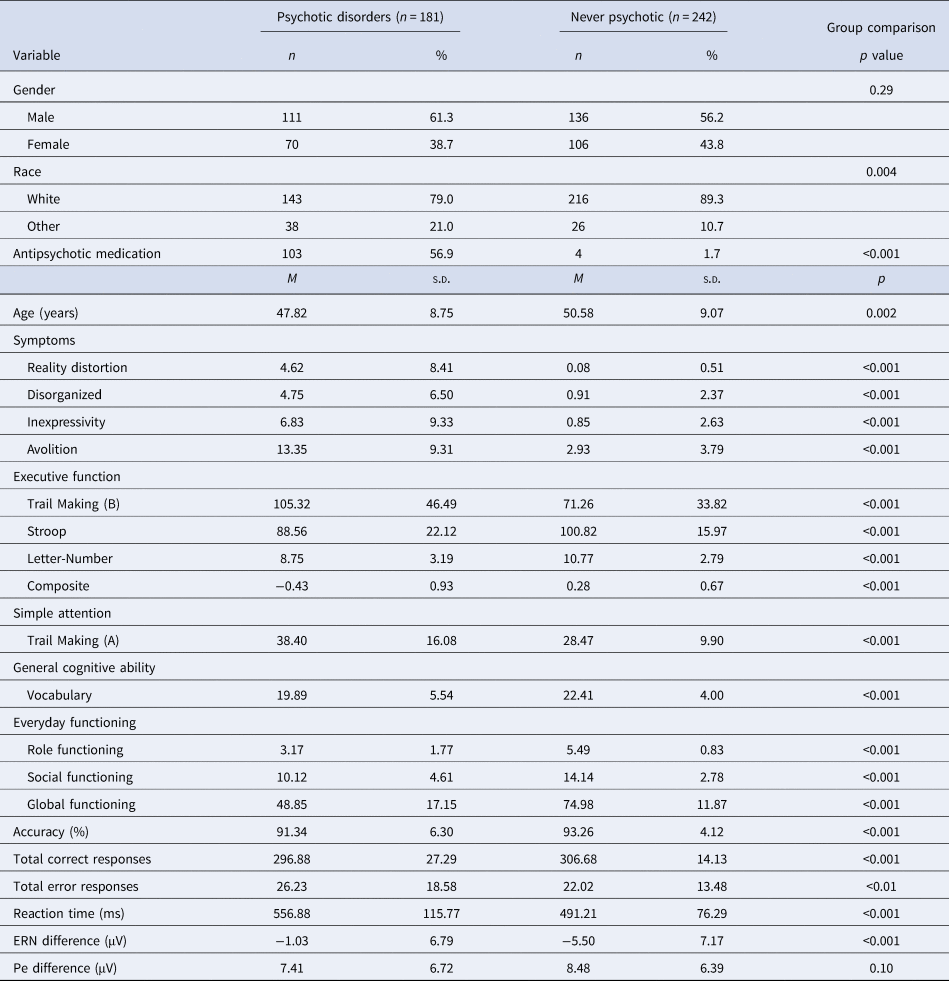
Characteristics of the clinical and NP groups are given in Table 1 and online Supplementary Table S1. Groups were similar with regard to gender. The clinical cohort was slightly younger and included a larger proportion of non-white participants. As expected, antipsychotic medications were more common among the clinical cohort, symptom scores were higher, performance on cognitive tests was poorer, and everyday functioning was worse. ERP contrasts (error v. correct) were significant in both the clinical cohort (ERN: d = −0.15, p < 0.05; Pe: d = 1.19, p < 0.001) and NP group (ERN: d = −0.79, p < 0.001; Pe: d = 1.52, p < 0.005), indicating error-related brain activity (online Fig. 1). ERP difference scores were used for subsequent analyses.
Sample characteristics

Is performance monitoring impaired across psychotic disorders?
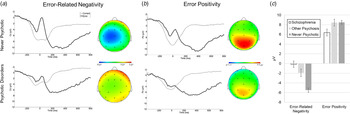
As expected, participants were slower and less accurate on congruent v. incongruent trials, and these flanker effects were consistent across groups (online Supplementary Table S2). We examined ERPs across schizophrenia, other psychosis, and NP groups (Fig. 1).Footnote †Footnote 1 There were main effects of group on the ERN (F (2,420) = 22.43, p < 0.001) and Pe (F (2,420) = 4.21, p < 0.05); effects remained significant adjusting for age and gender (ERN: F (2,418) = 23.06, p < 0.001; Pe: F (2,418) = 5.04, p < 0.01). The ERN was blunted in schizophrenia v. NP (M = 5.28, s.e. = 1.04, p < 0.001) and other psychosis v. NP (M = 3.62, s.e. = 0.88, p < 0.001); the schizophrenia and other psychosis groups did not differ (M = 1.67, s.e. = 1.04, p = 0.11). The Pe was blunted in schizophrenia v. both NP (M = −2.18, s.e. = 0.79, p < 0.01) and other psychosis (M = −2.29, s.e. = 0.97, p < 0.05), which did not differ (M = 0.11, s.e. = 0.81, p = 0.90). Thus, reduced ERN was common across psychotic disorders, whereas reduced Pe was relatively specific to schizophrenia.Footnote 2
ERP data. (a) Averaged waveforms for the ERN, presented separately for NP adults (top) and individuals with psychotic disorders (bottom). Scalp topographies are the error minus correct difference from 0 to 100 ms. (b) Averaged waveforms for the Pe. Scalp topographies are the difference from 300 to 500 ms. (c) Group means and standard errors of neural measures of performance monitoring across the psychosis spectrum.

What illness characteristics are associated with impaired performance monitoring?
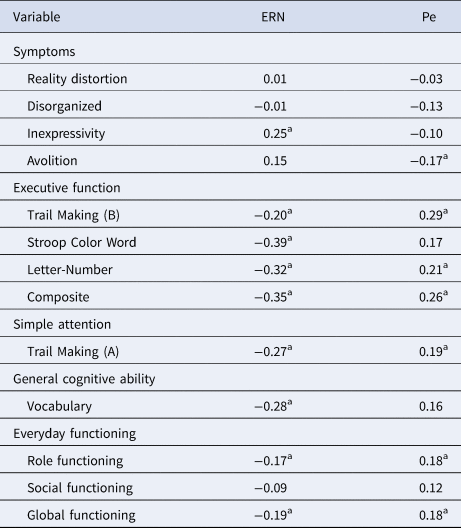
Concurrent associations with illness characteristics were examined among the clinical cohort (Table 2). ERPs were associated with independent indicators of executive function (Stroop, Letter-Number, and Trail Making B), attention/processing speed (Trail Making A), and general cognitive ability (Vocabulary; also online Supplementary Table S3). Because the three executive function tests were strongly correlated (r's = 0.58–0.62, p's < 0.001), we also considered the composite score. Reduced ERN and Pe were associated with worse composite executive function.
Cross-sectional associations of performance monitoring with clinical and neuropsychological measures among individuals with psychotic disorders

Note: N = 181. The ERN difference score is a negative-going ERP, so positive correlation coefficients indicate a direct association, and vice versa.
a p < 0.03 (critical value adjusting for false discovery rate).
ERPs were correlated with negative symptom: blunted ERN with inexpressivity and Pe with avolition; neither ERP was associated with psychotic or disorganized symptoms. Greater ERN and Pe amplitudes were associated with better role functioning and global functioning, but not social functioning. Subsequent analyses focused on SOFAS as a summary index of functioning.
We evaluated the replicability of associations by testing correlations of 20-year ERPs with retrospective clinical characteristics (online Supplementary Tables S4 and S5). The ERN–inexpressivity link emerged 6 months following first hospitalization, the Pe-avolition link at 2 years, and the Pe-SOFAS link at 6 months. While the magnitude of associations fluctuated across assessments, there was no evidence of crossover between illness characteristics: converse associations (ERN-avolition, ERN-SOFAS, and Pe-inexpressivity) were not significant at previous assessments.
Does performance monitoring relate to cognition across the psychosis spectrum?
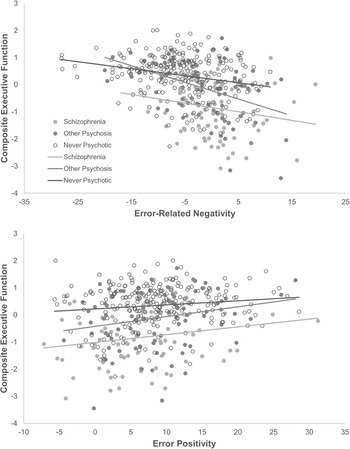
The generalizability of ERP associations with composite executive function was tested by including group (schizophrenia, other psychosis, and NP) as a moderator. We evaluated two contrasts: schizophrenia v. NP, and schizophrenia v. other psychosis. Slopes and scatterplots are given in Fig. 2. Reduced ERN (β = −0.29, p < 0.001) and Pe (β = 0.18, p < 0.001) predicted worse executive function. Relationships were not moderated by group, and contrasts were not significant (p's > 0.05). Neurophysiological measures of performance monitoring are associated with independent measures of executive function across the psychosis spectrum.
Relationships between neural measures of performance monitoring and independent measures of executive function across the psychosis spectrum. Outcome is composite executive function score, combining the Stroop, Letter-Number Sequencing, and Trail Making (B) tests.

What are the pathways by which performance monitoring affects symptoms and functioning?
Pathway analyses form ERPs to negative symptoms and global functioning were conducted within the clinical cohort. First, we tested how cognition mediated ERP–symptom relationships, with three parallel mediators: composite executive function, attention/processing speed, and general cognitive ability. The ERN–inexpressivity link was fully mediated (direct effect of 0.15, p = 0.11) by composite executive function (standardized indirect effect of 0.12, p < 0.05), but not attention/processing speed or general cognitive ability (p's > 0.05). The Pe–avolition link was fully mediated (direct effect of −0.11, p = 0.14) by composite executive function (indirect effect of −0.08, p < 0.05) and attention/processing speed (indirect effect of −0.03, p < 0.05), but not general cognitive ability (p > 0.05). Mediation effects of cognitive variables were not moderated by diagnosis (schizophrenia v. other psychosis; p's > 0.05). Thus, executive function and attention/processing speed were retained for pathway analyses.
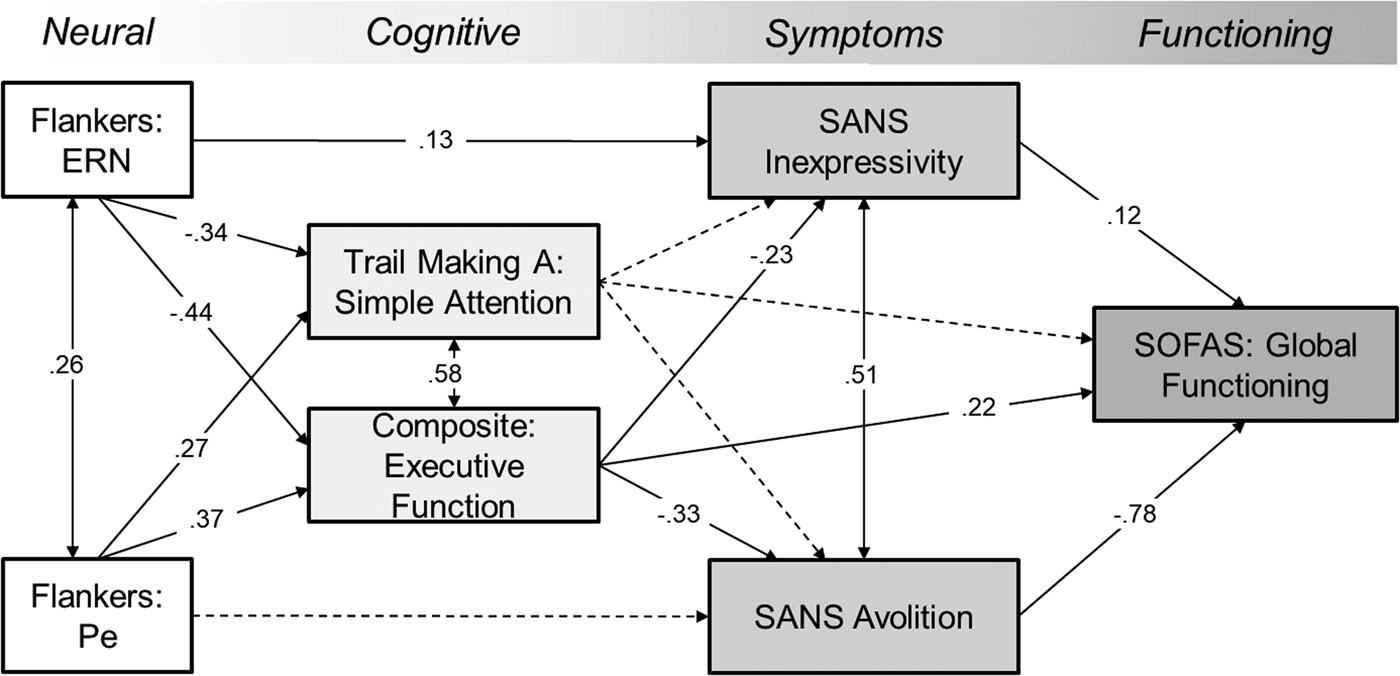
The full mediation model connected error-related ERPs, performance-based cognitive variables, negative symptom sub-domains, and global functioning within the clinical cohort (Fig. 3). Based on the results above, pathways were specified whereby ERN affects global functioning through impaired cognition and inexpressivity, and Pe acts through avolition. Among the cognitive variables, composite executive function and attention/processing speed were included as simultaneous mediators of symptoms and functioning. All paths were significant except for attention to inexpressivity (p = 0.08), avolition (p = 0.07), and global functioning (p = 0.57), as well as Pe to avolition (p = 0.53). Indirect paths of executive function were significant: ERN → executive function → inexpressivity, β = 0.10, p < 0.05; and Pe → executive function → avolition, β = −0.12, p < 0.01. The ERN → inexpressivity relationship reflected partial mediation (direct path of β = 0.13, p < 0.05). Finally, we tested double mediation from Pe to global functioning, with cognition and avolition as mediators. The path was significant: Pe → executive function → avolition → SOFAS, β = 0.10, p < 0.01.
Structural equation model of performance monitoring, cognitive impairment, negative symptoms, and everyday functioning among individuals with psychotic disorders (N = 181). All variables are observed (not latent constructs). Executive function is the composite of Trail Making (B), Letter-Number, and Stroop; Inexpressivity and Avolition are SANS subscales. Global functioning is the highest in the past year. Coefficients are completely standardized. All paths with solid lines are statistically significant (p's < 0.05).

Discussion
This study is the first to show that the ERN and Pe relate to performance-based measures of executive function, assessed separately, and that these ERP–cognition links are consistent across individuals with psychotic disorders and NP adults. Impairment in performance monitoring related to concurrent negative symptom severity and functioning among individuals with psychotic disorders. There was also partial evidence of selectivity observed across two decades: ERN related most consistently to inexpressivity (but not avolition or functioning), and Pe to avolition and global functioning (but not inexpressivity). Finally, path models indicated that neural deficits in performance monitoring may contribute to negative symptom severity and functional impairment in psychotic disorders primarily through impairment in executive function.
Structural equation modeling identified candidate pathways linking neural measures with cognitive deficits and illness features: reduced ERN to inexpressivity was partially mediated by executive function; reduced Pe to global functioning was mediated by executive function, then avolition. These cross-sectional patterns are consistent with a model in which performance monitoring deficits – in combination with other illness processes – contribute to cognitive impairment, which in turn contributes to negative symptoms and everyday functioning. Paths from cognitive impairment to negative symptoms to everyday functioning have been documented before (Bowie et al., Reference Bowie, Reichenberg, Patterson, Heaton and Harvey2006; Harvey et al., Reference Harvey, Khan and Keefe2017; Strassnig et al., Reference Strassnig, Raykov, O'Gorman, Bowie, Sabbag, Durand and Harvey2015), and this expanded model incorporates neurophysiological deficits. These results can inform proposed mechanisms of negative symptoms: inexpressivity may arise in part from reduced cognitive capacity (Cohen, McGovern, Dinzeo, & Covington, Reference Cohen, McGovern, Dinzeo and Covington2014), and avolition from deficits in maintaining contextual information to accurately predict outcomes, assign value, and compute effort (Gold et al., Reference Gold, Strauss, Waltz, Robinson, Brown and Frank2013; Kring & Barch, Reference Kring and Barch2014). Therefore, the ERN–inexpressivity path may relate to diminished cognitive capacity in psychotic disorders, whereas the Pe-avolition-functioning path may instead relate to context maintenance.
These results have implications for future studies to facilitate outcome-specific interventions. Impaired executive function is an important treatment target in psychosis (Buchanan et al., Reference Buchanan, Davis, Goff, Green, Keefe, Leon and Marder2005; Insel, Reference Insel2010), and outcomes have been unsatisfactory to date (Firth et al., Reference Firth, Stubbs, Rosenbaum, Vancampfort, Malchow, Schuch and Yung2017; Revell et al., Reference Revell, Neill, Harte, Khan and Drake2015; Wykes et al., Reference Wykes, Huddy, Cellard, McGurk and Czobor2011). The ERN is partially modifiable with antipsychotic medications (Bates, Liddle, Kiehl, & Ngan, Reference Bates, Liddle, Kiehl and Ngan2004; Schneider et al., Reference Schneider, Bahmer, Metzger, Reif, Polak, Pfuhlmann and Ehlis2013), although these do not target performance monitoring directly. One study used direct current stimulation to improve performance monitoring and increase ERN amplitude in schizophrenia (Reinhart et al., Reference Reinhart, Zhu, Park and Woodman2015). While downstream effects on cognition and illness features were not tested, parameter estimates from the current sample enable the following predictions: a 1 s.d. improvement in ERN amplitude would produce improvement of 0.35 in executive function and 0.25 in inexpressivity. Likewise, a 1 s.d. improvement in Pe amplitude would produce improvement of 0.26 in executive function, 0.17 in avolition, and 0.18 in global functioning – approximately 3 SOFAS points. While inferences of causality are premature given the cross-sectional nature of these analysis, one possible implication is that ERN and Pe may be upstream contributors to an etiologic pathway that flows from neural abnormalities to cognitive deficits, negative symptoms, and functional impairment. Understanding of this pathway is valuable insofar as it contributes to broader efforts to explicate etiology of psychotic disorders, and identify actionable targets for treatment of cognitive impairment and negative symptoms.
Perspectives on the psychological processes reflected by error-related ERPs may help contextualize the links with illness features. ERN modulation has been interpreted with respect to reinforcement learning (Holroyd & Coles, Reference Holroyd and Coles2002), conflict monitoring (Yeung, Botvinick, & Cohen, Reference Yeung, Botvinick and Cohen2004), and preconscious error detection (Nieuwenhuis et al., Reference Nieuwenhuis, Ridderinkhof, Blom, Band and Kok2001). Individual differences in ERN amplitude have been proposed to reflect trait differences in defensive motivation and action preparation (Weinberg, Riesel, & Hajcak, Reference Weinberg, Riesel and Hajcak2012). The ERN–inexpressivity link suggests that, in psychotic disorders, symptoms of inexpressivity may reflect impairment in the continuous self-monitoring and adaptation of expressive behavior in response to environmental demands. The Pe, on the other hand, is thought to reflect conscious error awareness (Nieuwenhuis et al., Reference Nieuwenhuis, Ridderinkhof, Blom, Band and Kok2001) and decision confidence (Boldt & Yeung, Reference Boldt and Yeung2015). The Pe–avolition link may capture a shared deficit in conscious maintenance of goals to facilitate decision-making.
With regard to functioning, the bivariate correlations suggest that the Pe–functioning link reflects role rather than social functioning, as measured here. Other work has shown that executive function uniquely predicts real-world interpersonal behavior (Bowie et al., Reference Bowie, Leung, Reichenberg, McClure, Patterson, Heaton and Harvey2008). It is notable that the extension of the Pe–avolition link to global functioning is to be expected given that avolition and global functioning are strongly related constructs, partly due to definitional overlap. Future work should clarify pathways from each ERP to domain-specific functioning. While independent ERN and Pe pathways were observed, this should be viewed with caution in light of their differential psychometric properties (Foti et al., Reference Foti, Kotov and Hajcak2013).
A strength of this study is the test of neural-cognitive links spanning the psychosis spectrum. The ERN and Pe related to performance-based measures of executive function across schizophrenia, other psychotic disorders, and NP groups. This is broadly consistent with neuroimaging evidence that functional connectivity is a generalizable mechanism of cognitive impairment across psychotic disorders and controls (Sheffield et al., Reference Sheffield, Kandala, Tamminga, Pearlson, Keshavan, Sweeney and Barch2017). The current report complements another recent study modeling pathways from early auditory ERPs to functioning specifically in schizophrenia (Thomas et al., Reference Thomas, Green, Hellemann, Sugar, Tarasenko, Calkins and Light2017). Here, we characterized a pathway from performance monitoring to clinical outcomes that may be broadly relevant across the psychosis spectrum.
The current results have several limitations. Pathway analyses were cross-sectional, precluding inferences of causality. While consistent with a model in which performance monitoring has downstream consequences for negative symptoms and functioning, this requires direct testing in longitudinal data. Indeed, there is evidence that performance monitoring prospectively predicts future negative symptoms (Foti et al., Reference Foti, Perlman, Hajcak, Mohanty, Jackson and Kotov2016), and the ERN is modifiable through targeted intervention (Reinhart et al., Reference Reinhart, Zhu, Park and Woodman2015). Data were drawn from the 20-year assessment, and the path models are most applicable to middle- and late-phase psychosis. Other work has found reduced ERN and Pe in early phase schizophrenia (Perez et al., Reference Perez, Ford, Roach, Woods, McGlashan, Srihari and Mathalon2012), warranting extension of the current pathways to earlier illness phases. The executive function tasks were somewhat constrained, although there is evidence of their ecological validity in schizophrenia (Bowie et al., Reference Bowie, Leung, Reichenberg, McClure, Patterson, Heaton and Harvey2008; Zayat, Rempfer, Gajewski, & Brown, Reference Zayat, Rempfer, Gajewski and Brown2011). Finally, a majority of the clinical cohort was prescribed antipsychotic medication. Pathways were independent of medication status, however, and as an epidemiological study this cohort is reasonably representative of individuals with psychotic illness in clinical settings.
The current study sheds light on performance monitoring deficits in psychotic disorders by conducting the first evaluation bridging neurophysiological dysfunction with cognitive impairment, symptom presentation, and everyday functioning across the psychosis spectrum. The ERN and Pe relate to impaired executive function in psychotic disorders, as well as downstream associations with illness features. Identifying these pathways may ultimately lead to the development of personalized treatments based on neurophysiological functioning.
Supplementary material
The supplementary material for this article can be found at https://doi.org/10.1017/S0033291720000768.
Acknowledgments
We gratefully acknowledge the participants and mental health community of Suffolk County for contributing their time and energy to this project. We are indebted to dedicated efforts of study coordinators, interviewers for their careful assessments, and to the psychiatrists who derived the consensus diagnoses. Special thanks to Janet Lavelle for her many contributions to the study.
Financial support
This work was supported by the National Institutes of Health (MH44801 to EB and MH110434 to RK) and Stony Brook University (Clinical Research Scholar Award).
Conflict of interest
PH has received consulting fees or travel reimbursements from Alkermes, Boehringer Ingelheim, Intra-Cellular Therapies, Jazz Pharma, Minerva Pharma, Otsuka America, Roche Pharma, Sanofi Pharma, Sunovion Pharma, Takeda Pharma, and Teva during the past year; he receives royalties from the Brief Assessment of Cognition in Schizophrenia; he is chief scientific officer of i-Function, Inc.; he has a research grant from Takeda and from the Stanley Medical Research Foundation. DM has served as a consultant for Aptinyx, Boehringer-Ingelheim Pharmaceuticals, Cadent Therapeutics, and Greenwich Biosciences. All other authors report no biomedical financial interests or potential conflicts of interest.
Ethical standards
The authors assert that all procedures contributing to this work comply with the ethical standards of the relevant national and institutional committees on human experimentation and with the Helsinki Declaration of 1975, as revised in 2008.