Introduction
One serious challenge confronting the People's Republic of China (PRC) today is its rapidly ageing population. The average life expectancy of Chinese males and females has increased from 67 and 70 years old in 1990 to 72 and 77 years old in 2010, respectively (National Bureau of Statistics of PRC 2015). With the ageing of the ‘baby boom’ cohort, China now has the largest number of older people in the world. In 2014, the number of older people aged 60 and over reached 212 million, accounting for 16 per cent of the Chinese population (Ministry of Civil Affairs of PRC 2014). The mandatory retirement age in China – 60 years old for males and 50 years old for females – is lower than that in many other countries in the world, and a major reform is currently being considered by the government to increase the retirement age in the face of population ageing. The Chinese state pension system consists of multiple schemes that are targeted at different groups of older people (Li Reference Li2014). These pension schemes are isolated from each other, and vary remarkably in terms of payment generosity, sources of funding and participation rules. In such a system, financial inequality is a major concern (Wu Reference Wu2013). While employees in the public sector in general receive decent financial support from the state after they retire from work, residents in poor rural villages often have no pension coverage but have to rely on their own savings.
Social care, which aims to help people with their daily activities, is crucial when people gradually lose their physical and cognitive functioning abilities in their old age, and find it more difficult to look after themselves. An ageing population, therefore, results in a rising demand for social care (Walker Reference Walker2002). In most developed economies, social care is jointly provided by family, the private sector and the government. Care provided by family members is also known as informal care or unpaid care, whereas care provided by the private sector and the government usually falls into the scope of formal care, as formal carers are often specially trained professionals (Beesley Reference Beesley2006). The institutional arrangements of formal and informal care differ among different countries. In some countries such as France and Japan, entitlement to the receipt of formal care is ‘carer blind’. The availability of informal care does not influence older people's eligibility for government support (Fernandez et al. Reference Fernandez, Forder, Trukeschitz, Rokosova and McDaid2009). In other countries such as England and Australia, in contrast, the amount of informal care provided by family members is considered in the assessment of an old person's eligibility for government support (Comas-Herrera, Wittenberg and Pickard Reference Comas-Herrera, Wittenberg and Pickard2010; Robertson, Gregory and Jabbal Reference Robertson, Gregory and Jabbal2014). However, after the enactment of the Care Act 2014, the English system is expected to gradually move in a more ‘carer-blind’ direction (Clements Reference Clements2015).
In the case of China, a social care system based on joint provision barely exists. Looking after disabled older people is mainly the responsibility of family members. There are two underlying reasons behind this. First, the Chinese government is still in the early days of designing an integrated social care system where the private and public sectors could provide formal care services for older people with different levels of need. Most community-based elderly care centres were established very recently (Zhou and Walker Reference Zhou and Walker2016). The government has not made it clear how these facilities will be funded, which groups of people they will serve and what outcomes they are supposed to achieve in the future. Care home services are narrowly targeted at older people who face the ‘three Nos’, namely people with no offspring, no income and no ability to look after themselves. Many disabled older people literally have no access to these services, unless they are willing to pay the expensive fees charged by the care homes (Wong and Leung Reference Wong and Leung2012). The main objective for the government at the current stage is to rapidly expand the capacity of formal care provision. This is reflected in a number of policy documents published in the past few years by the central government and its functional departments (State Council of PRC 2011, 2013; Ten Ministries and Commissions of PRC 2013). The target is that, by 2020, more than 90 per cent of the county and township communities, and more than 60 per cent of the rural villages, will have an elderly care centre; there will be 30 care home beds for every 1,000 older people.
Second, with a long tradition of Confucianism, the predominating value in Chinese society is that family members are supposed to be the main providers of care (Zhan and Montgomery Reference Zhan and Montgomery2003). For example, governed by the discourse of filial piety, adult children feel a strong sense of duty to care for their elderly parents. Indeed, this sense of duty has already become part of the legislation. Both the Constitution of the PRC and the Law on Protection of the Rights and Interests of the Elderly of the PRC stipulate that adult children should look after their parents (National People's Congress of PRC 2004, 2013). Adult children who are unable to personally care for their parents should provide financial assistance to them. In practice, those who fail to fulfil the duty of filial piety might be criticised in moral terms or sanctioned in financial terms.
Despite the important role of informal care, very little is known in the existing literature about the receipt of informal care in the Chinese older population. Furthermore, concern has been raised about the sustainability of informal care alone to meet the rising demand for social care in the future. China started implementing its one-child policy more than three decades ago, and the fertility rate of the population has dropped significantly ever since (Wong and Leung Reference Wong and Leung2012). As the parents of the only-child cohort enter middle or old age, this translates into a parallel decline in the provision of informal care by their children (Feng et al. Reference Feng, Liu, Guan and Mor2012; Zimmer and Kwong Reference Zimmer and Kwong2003). Without care from other sources to compensate for this decline, there will be an increasingly widening gap in care in the decades to come.
Against this backdrop, this paper investigates the factors affecting the receipt of informal care among older people in China. The research findings will help us to gain a better understanding of how informal care provided by a spouse, children or other family members is distributed among the older population. This knowledge will be especially valuable because it will enable us to project how the demand for informal care will change if the determinants of care receipt change in the future. It will also help the Chinese government to make plans on formal care provision to address the challenges imposed by the ageing population. The paper is structured as follows. The next section discusses the theoretical framework and identifies the potential determinants for receiving informal care in the Chinese context. This is followed by a description of the research methods. The third section presents the analyses and results. The last section summarises the main research findings and discusses their theoretical and policy implications.
Analytical framework in the Chinese context
Based on the analytical frameworks developed by Kemper (Reference Kemper1992) and Vlachantoni et al. (Reference Vlachantoni, Shaw, Evandrou and Falkingham2015), we divide the potential factors affecting the receipt of informal care into three groups: need factors, demographic factors and socio-economic factors. Studies have been conducted to examine the impact of these factors in several countries. First, need has been considered to be the direct reason for using informal care (Agree Reference Agree1999). Kemper's research suggested that ‘[t]he greater the need for care, the more … informal care the disabled elderly are expected to use’ (Reference Kemper1992: 425). Need for care has been measured by severity of physical disability. Most empirical studies have found that disability is an important factor affecting the receipt of informal care (Kemper Reference Kemper1992; Larsson and Silverstein Reference Larsson and Silverstein2004; Pickard et al. Reference Pickard, Wittenberg, Comas-Herrera, Davies and Darton2000; Suanet, Van Groenou and Van Tilburg Reference Suanet, Van Groenou and Van Tilburg2012; Vlachantoni et al. Reference Vlachantoni, Shaw, Evandrou and Falkingham2015).
Second, demographic factors such as age, gender, living arrangements and marital status have also been conceptualised as important determinants of care receipt. A strong association had been found between the receipt of care and older people's living arrangements (Pickard et al. Reference Pickard, Wittenberg, Comas-Herrera, Davies and Darton2000) or marital status (Glaser et al. Reference Glaser, Stuchbury, Tomassini and Askham2008; Vlachantoni et al. Reference Vlachantoni, Shaw, Evandrou and Falkingham2015). Older people living with someone else in the same household or those having a surviving partner have been found to be more likely to receive informal care. This suggests that the receipt of informal care is not only the result of the need for care, but also hinges heavily upon the availability of care. However, due to the heterogeneity of the population under investigation, the statistical significance of these demographic factors tends to vary considerably from one group of people to another.
The most commonly explored socio-economic factors in the literature are income and educational qualifications. The extent to which these factors play an important role is still an issue under debate. For those studies which have found a statistically significant impact, higher income levels or educational qualifications have been negatively associated with the receipt of informal care (Kemper Reference Kemper1992; Peek, Coward and Peek Reference Peek, Coward and Peek2000; Larsson and Silverstein Reference Larsson and Silverstein2004). When information on income has been unavailable, housing tenure or ownership of a car has often been used as a marker of income (Macintyre et al. Reference Macintyre, Ellaway, Der, Ford and Hunt1998).
It should be pointed out that all of the studies discussed above were conducted in developed countries. None of them examined the receipt of informal care in China, a developing country where the social, economic and political contexts are totally different from those of developed countries. To investigate the issue in the Chinese context, features unique to Chinese society should be given due attention. Like many developing countries, China has a dual economy structure where highly developed industrial sectors in cities and backward agricultural sectors in rural areas co-exist (Cai Reference Cai2012). This creates a divide in social and family structures between rural and urban China. One the one hand, nuclear families are becoming increasingly common in the cities. Filial piety, as the corner stone of Chinese traditional values, has been weakened (Cheung and Kwan Reference Cheung and Kwan2009). On the other hand, extended families are still the preferred family model in rural China, and traditional values have not undergone as much change in rural areas as in urban China (Silverstein, Cong and Li Reference Silverstein, Cong and Li2006). These rural–urban variations directly affect older people's access to, and their expectations of, informal care. Therefore, it is hypothesised in this paper that the receipt of informal care is affected by whether older people live in rural or urban areas in China.
Another factor is the availability of financial assistance from children. As mentioned above, the government policy stipulates that adult children who are unable to care for their parents should provide financial support instead. The existing literature suggests that the provision of financial assistance is a common practice among adult children in China (Zimmer and Kwong Reference Zimmer and Kwong2003). First, financial assistance changes the socio-economic status of older people. According to Kemper's (Reference Kemper1992) theories, this might affect their chances of receiving informal care. Second, it might affect older people's preference for different types of informal care. For example, older people receiving financial support from their children might turn to their spouses or other relatives for help so that their children will not be overburdened. In either case, financial assistance should be incorporated into the analytical framework in the Chinese context.
Research methods
Sources of data
The data used in this paper come from the China Health and Retirement Longitudinal Survey (CHARLS), which collects ageing and health-related information on people aged 45 and over in private households in China. The baseline interviews were conducted in 2011, and the same respondents were followed in the second wave study in 2013. Those who had died or withdrawn from the study by Wave 2 were replaced with new interviewees. Since the questions relating to informal care were remarkably different between the two waves, we were unable to pool the data together. Instead, we only used information from the second wave (i.e. the 2013 CHARLS).
Following a four-stage cluster sampling procedure, the survey collected household and individual-level data. The standard probability-proportional-to-size (PPS) rule was used in the sampling. Conducted in 450 villages or communities out of 28 provinces with a response rate of 80 per cent, the CHARLS provided a nationally representative sample (Zhao et al. Reference Zhao, Strauss, Yang, Giles, Hu, Hu, Lei, Liu, Park, Smith and Wang2013). The 2013 CHARLS had a total sample size of 18,605 people and consisted of nine modules. The analyses in this paper focus on the 8,906 older people who were aged 60 and over in 2013, and draws on the information in three modules including demographic background, family information, and functional limitations and helpers.
Measurements
Survey questions related to the receipt of informal care revolve around people's need for help with activities of daily living (ADLs) or instrumental activities of daily living (IADLs). ADLs are personal care tasks in people's daily lives, whereas IADLs are tasks of a domestic nature. The CHARLS asked respondents if they received any informal help with six ADLsFootnote 1 and six IADLs.Footnote 2 If the respondents reported receiving informal help with any of the ADLs or IADLs, they were then provided with a list of family members and asked who helped them.
Based on the answers to these questions, we created three groups of informal care variables. The first group consisted of three binary variables, which indicated whether or not a person was receiving informal care from three separate sources: care from a spouse, care from children, and care from other family members or relatives. A variable was coded as 1 if a person reported receiving informal care from a particular source; otherwise it was coded as 0. The second group included two multi-category variables confined to people receiving informal care. One variable focused on care recipients who had never married, or were widowed, separated or divorced, all of whom were defined as single care recipients. It consisted of three categories: care from children only, care from other family members only, and care from both children and other family members. The other variable was related to married care recipients, and this also consisted of three categories: spouse care only, non-spouse care only, and both spouse and non-spouse care. The third group concerns the intensity of informal care. Since the CHARLS only collected information on the intensity of informal care people received from their children in Wave 2, we created one continuous variable indicating the weekly hours of care from this particular source. We were not able to examine the weekly hours of informal care in total or from other sources due to unavailability of data.
Need factors, demographic factors and socio-economic factors were selected into the analysis on the basis of the analytical framework discussed in the previous section subject to data availability in the survey. Four need variables were identified in the survey: physical disability, cognitive functioning, self-perceived health and receipt of health care (including receipt of outpatient care in the preceding month or receipt of inpatient care in the preceding year). There is very little information on formal social care in the survey, which reflects the fact that this sector is still in its infancy in China (see above). The CHARLS asked respondents whether they could perform each of the ADL or IADL tasks. Respondents were provided with four choices: ‘I do not have any difficulty’, ‘I have difficulty but can do it’, ‘I need help’ and ‘I cannot do it’. The last two choices – needing help and inability to perform the task – were regarded as an indication of disability. To be consistent and comparable with the analyses in the existing literature (Pickard et al. Reference Pickard, Wittenberg, Comas-Herrera, Davies and Darton2000; Wittenberg et al. Reference Wittenberg, Comas-Herrera, King, Malley, Pickard and Darton2006), a multi-category indicator was constructed to measure the severity of disability. People who reported having IADL disabilities only or having difficulty in performing any of the ADL tasks were regarded as having mild disability; people with one ADL disability were regarded as having moderate disability; and people with two or more ADL disabilities were regarded as having severe disability. The rest were considered independent people.
Five orientation questions (day, month, year, day of the week and season) were asked to test the cognitive functioning of the respondents. The number of incorrect answers to these questions indicates the severity of cognitive impairment. Other questions such as immediate word recall, delayed word recall and calculation were also asked in the survey. However, due to a large number of missing values in these variables, they were not selected into the analyses.
The demographic and socio-economic variables included in the analyses were age, gender, marital status, living arrangements in the household, household income, housing tenure and educational qualifications. Hukou status was selected into the analyses to examine the impacts of older people's rural–urban residence on the receipt of informal care.Footnote 3 The survey also asked respondents whether their children had regularly given them money in the previous year. This information was used in the analyses to look at the impact of financial assistance on the receipt of informal care.
Data analysis
Regression analyses were conducted to examine the effects of need, and demographic and socio-economic factors on the receipt of informal care. For the dependent variables with binary categories, we built binary logit regression models that could be expressed as follows:
 $$\displaystyle{{\Pr \left( {{\rm Car}{\rm e}_i = 1} \right)} \over {1 - \Pr \left( {{\rm Car}{\rm e}_i = 1} \right)}} = {\rm e}^{[{\rm \beta} _0 + \mathop \sum \nolimits_{k = 1}^m ({\rm \beta} _kx_{ik})]}$$
where
 $\Pr \left( {{\rm Car}{\rm e}_i = 1} \right)$
denotes the probability of an old person i receiving informal care, x
k
(k = 1, 2 … m) are the independent variables and denote the need, and demographic and socio-economic characteristics of this person, and β
k
(k = 0, 1 … m) are the coefficients of x
k
. We calculated eβ
k
for each independent variable, which could be interpreted as the odds ratios of care receipt when an older person's characteristics change by one unit or from one category to another.
The second group of dependent variables with multiple categories was examined in multinomial logit regression models that took the following form:
 $$\displaystyle{{\Pr \left( {{\rm Car}{\rm e}_i = j} \right)} \over {\Pr \left( {{\rm Car}{\rm e}_i = 1} \right)}} = {\rm e}^{\mathop \sum \nolimits ({\rm \beta} _0 + {\rm \beta} _k^{\left( j \right)} x_{ik})},\; j = {\rm} 2\;{\rm or}\;3.$$
 $\Pr \left( {{\rm Car}{\rm e}_i = j} \right)$
denotes the probability of receiving informal care from a particular source j (j = 1, 2 or 3), x
ik
are the characteristics of each person and
 ${\rm \beta} _k^{\left( j \right)} $
are the coefficients for x
ik
under the source j. The model estimates the relative probabilities (or risks) of receiving informal care from source j against an arbitrarily selected base outcome. In the equation, outcome 1 is chosen as the base outcome. We calculated
 ${\rm e}^{{\rm \beta} _k^{\left( j \right)}} $
for each independent variable k and each care source j, which could be interpreted as the relative-risk ratios of receiving care from source j against the base outcome when an older person's characteristics change by one unit or from one category to another.
To investigate the determinants of informal care intensity, we built a two-part model. The first part is a logit model taking the form of Equation (1). The second part is a linear regression model which can be expressed as follows:
 $${\rm Hou}{\rm r}_i = \; {\rm \beta} _0 + \mathop \sum \nolimits_{k = 1}^m ({\rm \beta} _kx_{ik}) + \varepsilon _i$$
Hour i denotes the weekly hours of informal care an old person i receives from his or her children, x k (k = 1, 2 … m) are the independent variables, and β k (k = 0, 1 … m) are the coefficients of x k . It must be pointed out that the second part is a conditional model. Conditional on receipt of informal care, an older person's weekly hours of care from children change by β k if this person's characteristics change by one unit or from one category to another. Combining Equations (1) and (3), we can calculate the overall marginal effects of the independent variables on care intensity for the entire sample.
The CHARLS used the cluster sampling under the PPS rule (see above), which means that the clusters were not sampled with equal probabilities. Meanwhile, there was non-response in the course of sampling. To compensate for the potential bias of the descriptive estimates, a range of sample weights were generated by the survey (Zhao et al. Reference Zhao, Strauss, Yang, Giles, Hu, Hu, Lei, Liu, Park, Smith and Wang2013). Since the focus of our analyses was the receipt of informal care at the individual level, we calculated the sample characteristics weighted by the individual weights with household and individual non-response adjustment. For the regression models, the sampling probabilities varied exogenously by design. In this case, both the weighted and unweighted coefficients were consistent, but the weighted results tended to be less precise (i.e. larger standard errors) (Solon, Haider and Wooldridge Reference Solon, Haider and Wooldridge2013). Therefore, we only report the unweighted regression results in this paper.
There was a non-trivial proportion of older people (17%) who did not report their income in the survey. We first tested the income variable with the missing values excluded from the sample in the regression analysis, and found that it was not a significant variable in any of the regression models. We then conducted multiple imputation on the income variable to impute the missing values (Rubin Reference Rubin1987), and included this variable in the regression models. Again we did not find a significant impact in any of the models. Finally, we excluded the income variable altogether and fitted the models again. Comparing the two sets of results, we found that excluding this variable made little difference to the modelling results. In light of these analyses, it became clear that the income variable was not an important determinant, and thus we decided not to report the regression results of the income variable. But we will discuss the implications of these results at the end of the paper.
For the independent variables, we report the odds ratios in the case of the binary logit models or the relative-risk ratios in the case of the multinomial logit regression models (see above). We report the robust standard errors and two-tailed significance levels of the z-statistic. We conducted a series of model specification tests. Since different tests do not always provide a consistent story, a simultaneous examination of these tests enables us to evaluate comprehensively whether the models are well-fitted. For the binary logit models, we report the results of the joint significance test, the McFadden's Pseudo-R 2 statistic, the results of the Pearson goodness-of-fit test and the results of the Hosmer-Lemeshow (H-L) goodness-of-fit test. For the multinomial logit models, apart from the joint significance test, the McFadden's Pseudo-R 2 statistic and the H-L goodness-of-fit test, we also report the results of the generalised Hausman test.Footnote 4 In the multinomial logit regression models, we explicitly exclude those older people who do not receive informal care from the analysis by design. Such a model design is based on the assumption of the independence of irrelevant alternatives (IIA). The generalised Hausman test indicates whether the IIA assumption is met and, as a consequence, whether the models with a partial sample generate unbiased estimates of relative-risk ratios.Footnote 5 The analyses were conducted using Stata version 13.
Results
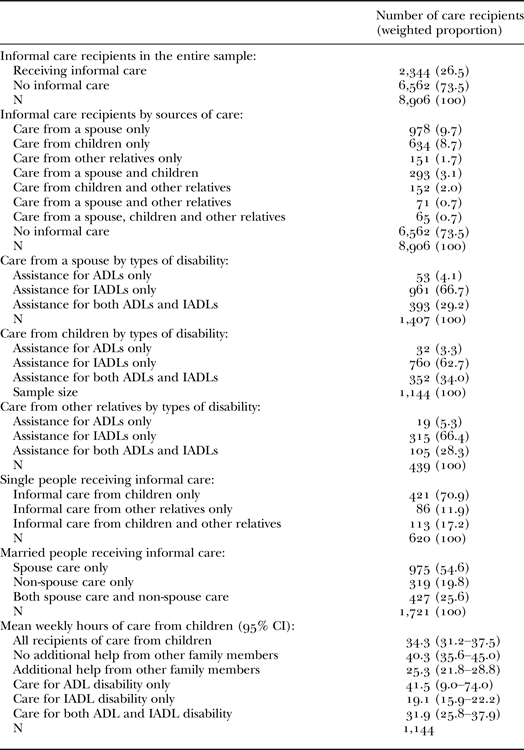
Table 1 shows the proportions of older people receiving informal care from different sources in the 2013 CHARLS sample (N = 8,906). In total, 27 per cent of older people aged 60 and over in China receive informal care. Ten per cent of older people receive care from a spouse only, 9 per cent receive care from children only and 2 per cent receive care from other relatives only. Less than 1 per cent of older people receive care from these three sources at the same time. Four per cent of older people receive care for ADL disability only, 67 per cent receive care for IADL disability only, and 29 percent receive care for both ADL and IADL disability. Such a pattern of care does not vary a lot for different care sources.
Descriptive statistics of informal care recipients

Notes: ADL: activity of daily living. IADL: instrumental activity of daily living. CI: confidence interval.
Source: China Health and Retirement Longitudinal Survey, 2013, authors' calculations.
Among the 2,344 care recipients in the sample, 27 per cent (N = 620) were never married, divorced, separated or widowed (i.e. single care recipients). Eighty-eight per cent of the single care recipients receive informal care from children; this figure covers people receiving care from children only and those receiving care from both children and other relatives. There are 1,720 married care recipients, of whom 80 per cent receive care from their spouses.
Among the 1,144 people receiving care from children, they on average receive 34 hours of care from their children each week. Care intensity differs according to the availability of additional help and the type of disability. Older people on average receive 40 hours of care each week from their children if they do not receive care from other sources. In comparison, they only receive 25 hours of care from their children each week if they also receive care from a spouse or other family members. Older people with assistance for ADL disability only receive twice as many hours of care from children as those with assistance for IADL disability only.
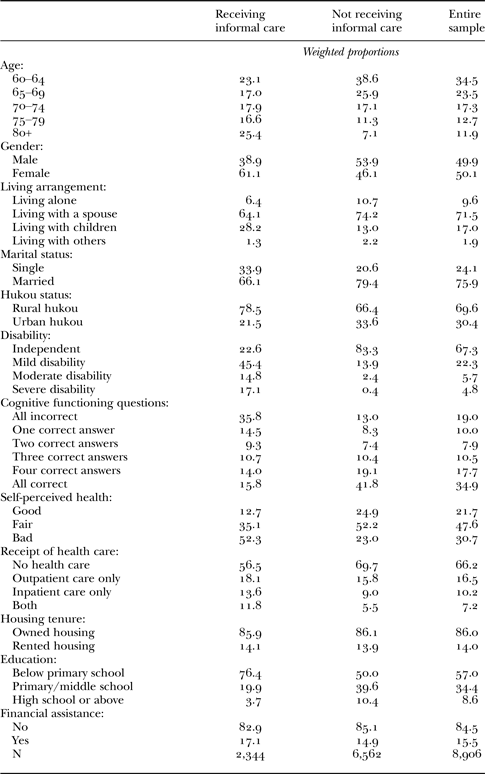
Table 2 shows the sample characteristics broken down by whether or not they receive informal care. More than half of the sample (58%) are aged between 60 and 69, and 50 per cent of the sample are females. Gender is not balanced among the older people receiving care, with females accounting for 61 per cent of the care recipients. Seventy-six per cent of the older people are married and 72 per cent live with their spouses. Some older people in the younger age groups are married, but are not living with their spouses for work reasons. Slightly less than 10 per cent of the older people live alone and 70 per cent have a rural hukou. Twenty-two per cent of the sample have mild physical disability (IADL disability only or difficulty with ADL tasks), and 11 per cent have either moderate (one ADL disability) or severe disability (two or more ADL disabilities). Fifty-seven per cent of the sample did not finish primary school or did not receive any formal education, 34 per cent finished primary or middle school, and 9 per cent finished high school or above.
Descriptive statistics of sample characteristics

Source: China Health and Retirement Longitudinal Survey, 2013, authors' calculations. Figures may not add up due to rounding.
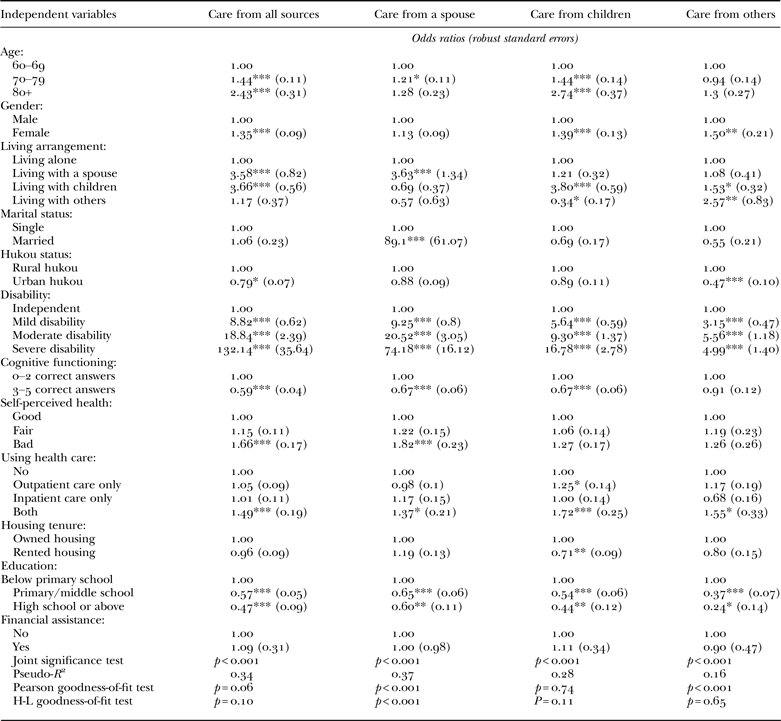
Table 3 shows the determinants of receiving informal care from different sources among older people in China. The results, shown in four columns, are estimates of four separate binary logit regression models. The first column relates to all of the informal care recipients in the sample. Except for marital status, housing tenure and financial assistance from children, all of the other variables have a significant impact on the receipt of informal care. All other things being equal, people in the higher age groups, those living with a spouse or children, or those holding a rural hukou are more likely to receive informal care. Females are more likely than males to receive informal care. People with disability are more likely than independent people to receive informal care. Furthermore, the likelihood of receiving informal care increases with severity of disability: for people with severe disability, the odds of receiving informal care are 138 times higher than those among independent people. People who see themselves as having fair or poor health are more likely than those with good self-perceived health to receive informal care. People with higher levels of education are less likely to receive informal care.
Determinants of receiving informal care from different sources among older people in China (four binary logit regression models)

Notes: N = 8,906. H-L: Hosmer-Lemeshow.
Source: China Health and Retirement Longitudinal Survey 2013, authors' calculation.
Significance levels: * p < 0.05, ** p < 0.01, *** p < 0.001.
The other three columns show the determinants of receiving informal care from a spouse, children or other family members, respectively. People in the older age groups and people with more severe physical disability or cognitive impairment are more likely to receive spouse care. Unlike the informal care recipients in general, gender is not a significant determinant of using spouse care. In addition, the likelihood of receiving spouse care does not differ according to people's hukou status.
Receipt of care from children and receipt of spouse care have some common determinants. The difference is that housing tenure is a significant factor for care from children. People living in a rented property are less likely than those living in their own home to receive care from children. Marital status is not a significant factor. For those people who were never married, widowed, separated or divorced, their odds of receiving care from children are higher than those for married people, but the difference does not reach statistical significance. Hukou status does not affect the receipt of informal care from children.
Regarding informal care from other relatives, its determinants are remarkably different from those of spouse care or care from children. Age, marital status, cognitive impairment and self-perceived health do not have a significant impact on care receipt. People living with children or other people are more likely than people living alone to receive care from relatives, but living with a spouse does not make a difference. Hukou status plays an important role: people holding an urban hukou are less likely to receive care from other relatives in the family.
The specification tests show that the binary logit models are well-fitted in general. They all pass the joint significance test, which means that none of the models is fundamentally wrong. The McFadden's R 2 statistic ranges from 0.16 to 0.34. McFadden (Reference McFadden, Hensher and Stopher1979) argued that, for logit models, R 2 values of 0.2–0.4 represent an excellent fit. Three models meet this criterion. Two models pass the Pearson goodness-of-fit test and three models pass the H-L goodness-of-fit test.
Multinomial logit regression analyses were conducted to examine the determinants of care receipt from a particular source when there are multiple sources of care. The analyses focused solely on the informal care recipients; those who do not receive informal care were excluded from the analyses. The care recipients were divided into two groups according to their marital status: single and married care recipients (Table 1). Two multinomial logit regression models were built to examine these two groups of people respectively.
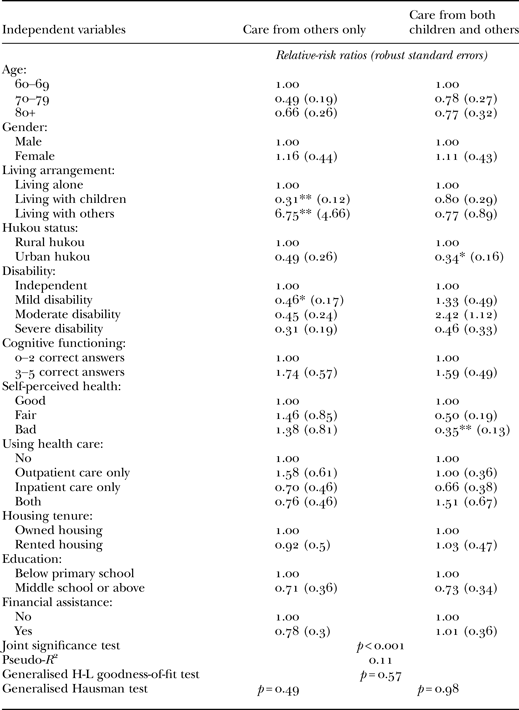
Table 4 shows the determinants of care receipt among the single care recipients. The dependent variable has three categories: receiving care from children only, receiving care from other relatives and receiving care from both sources. The base outcome is receipt of care from children only. Age and gender do not have a significant impact. None of the socio-economic factors demonstrates statistical significance in the results either. All other things being equal, people with more disability are more likely than independent people to receive informal care from children, rather than from other relatives. More severe disability also increases the likelihood of receiving care from both sources. However, such a difference does not reach statistical significance. Living arrangements play a vital role. Whether a person receives informal care from children or other relatives depends on with whom this person lives. In addition, people with a rural hukou are more likely than people with an urban hukou to receive care from both children and other relatives, rather than receive care from children only.
Determinants of receiving informal care among single older people in China (multinomial logit regression model, base outcome: informal care from children only)

Notes: N = 620. H-L: Hosmer-Lemeshow.
Source: China Health and Retirement Longitudinal Survey, 2013, authors' calculations.
Significance levels: * p < 0.05, ** p < 0.01.
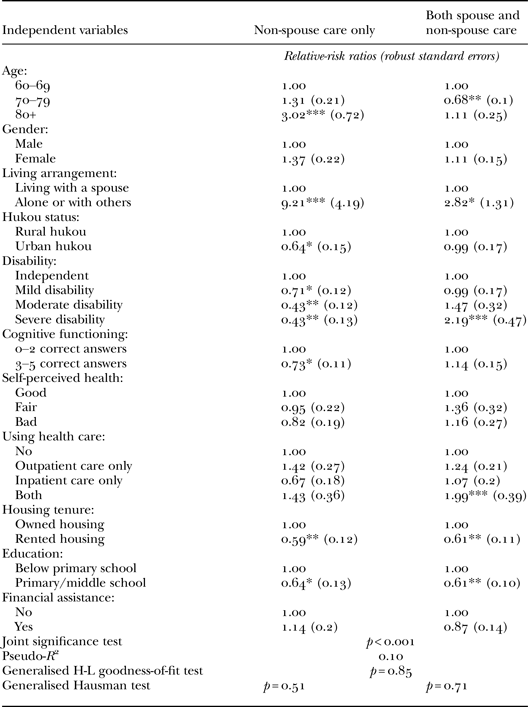
Table 5 shows the determinants of care receipt among married care recipients. The dependent variable has three categories: receiving spouse care only, receiving non-spouse (including children and other relatives) care only and receiving both. Receipt of spouse care only is the base outcome. All other things being equal, married people in the higher age groups are more likely to receive non-spouse care only, rather than receive spouse care only. Married people who live alone or live with others (including children and other relatives) are more likely than married people who live with a spouse to receive non-spouse care, or receive both spouse and non-spouse care, rather than receive spouse care only. Married people with more severe disability are more likely than independent people to receive spouse care only, rather than receive non-spouse care only. People with a rural hukou are more likely than people with an urban hukou to receive non-spouse care only rather than receive spouse care only. In contrast to single care recipients, married care recipients differ by socio-economic status. People who did not finish primary school or who did not receive a formal education are more likely than those with higher levels of education to receive non-spouse care, or receive both spouse care and non-spouse care, rather than just receive spouse care.
Determinants of receiving informal care among married older people in China (multinomial logit regression model, base outcome: spouse care only)

Notes: N = 1,721. H-L: Hosmer-Lemeshow.
Source: China Health and Retirement Longitudinal Survey, 2013, authors' calculations.
Significance levels: * p < 0.05, ** p < 0.01, *** p < 0.001.
It can be seen from Tables 4 and 5 that both multinomial logit regression models pass the generalised H-L goodness-of-fit test. They also pass the generalised Hausman test. This means that excluding the non-recipients of informal care from the analyses does not generate biased estimates.
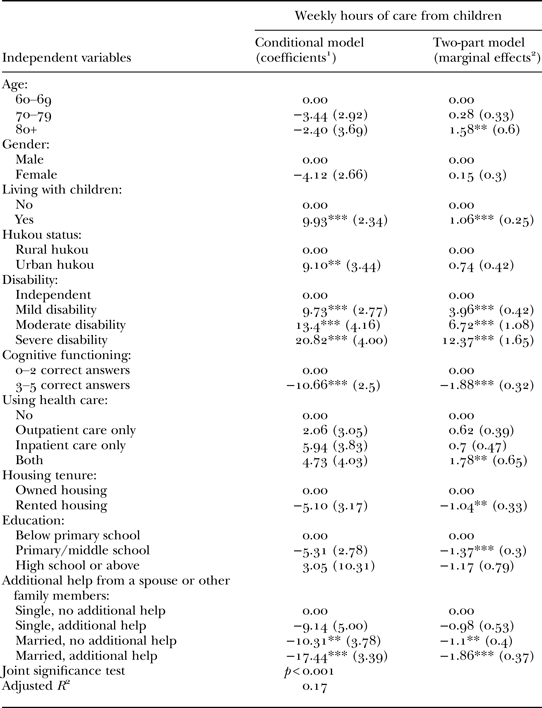
Table 6 reports the determinants of informal care intensity. The results for the first part of the model are shown in Table 3, so here we only report the results for the second (conditional) part of the model and the overall marginal effects of the two-part model. All other things being equal, older people with more severe physical disability or cognitive impairment receive more hours of informal care from children. Even though hukou status does not affect the receipt of informal care from children, older people with an urban hukou receive more hours of informal care from children than those with a rural hukou. Consistent with the results shown in Table 1, older people tend to receive fewer hours of informal care from children if they also receive informal care from a spouse or other relatives. Conditional on receipt of care from children, other factors including age, gender, receipt of health care, housing tenure and education do not affect the hours of informal care received from children.
Factors affecting the intensity of informal care from children (a two-part model)

Notes: N = 8,906. 1. Robust standard errors of the coefficients are in parentheses. 2. Robust standard errors of the marginal effects based on the delta method are in parentheses.
Source: China Health and Retirement Longitudinal Survey, 2013, authors' calculations.
Significance levels: ** p < 0.01, *** p < 0.001.
Conclusion and discussion
The proportion of older people in China is increasing rapidly, and so is the demand for social care. Since formal care services are not widely available yet, older people have to rely heavily on care provided by a spouse, children or other relatives in the family to meet their needs in their daily lives. So far very little is known in the existing literature about older people's informal care and support in the Chinese context. This paper uses a nationally representative sample – the second wave data of the CHARLS collected in 2013 – to examine the factors affecting receipt of informal care among people aged 60 and over in China. This concluding section will discuss three issues: the contribution of this paper to the international literature, the future landscape of care demand and possible pathways of building the social care system in China.
It was found that individuals' needs were the most important factor driving the receipt of informal care. For all of the regression models without exception, severity of disability had a significant impact. People with more severe disability were more likely to receive care from various sources. These findings are highly consistent with those in the developed countries (Glaser et al. Reference Glaser, Stuchbury, Tomassini and Askham2008; Kemper Reference Kemper1992; Larsson and Silverstein Reference Larsson and Silverstein2004; Pickard et al. Reference Pickard, Wittenberg, Comas-Herrera, Davies and Darton2000). Comparing different sources of care, we found that disabled people were more likely than independent people to receive care from a spouse or children, rather than receive care from other relatives in the family. The existing literature has shown that people tend to rely on those people who are closer to them in kinship for informal care (Dujardin et al. Reference Dujardin, Farfan-Portet, Mitchell, Popham, Thomas and Lorant2011; Hirst Reference Hirst2001). Our results suggest that this pattern is even stronger among older people with more severe disability.
With regard to demographic factors, living arrangements were found to be the most important determinant. People living alone were less likely than those living with someone to receive informal care. Among the recipients of informal care, people living alone were more likely to receive this care from other relatives in the family. Consistent with the existing literature (Glaser et al. Reference Glaser, Stuchbury, Tomassini and Askham2008; Vlachantoni et al. Reference Vlachantoni, Shaw, Evandrou and Falkingham2015), we found that in China older people's likelihood of receiving informal care increased with age. The only exception was that people in the higher age groups were not necessarily more likely to receive informal care from other relatives.
Education seemed to be the most important socio-economic factor. People with lower levels of education were more likely to receive informal care. We also investigated, separately, the impact of education for those older people with different levels of disability. The negative relationship between the educational qualifications and the likelihood of receiving informal care remains statistically significant.Footnote 6 These findings are consistent with studies conducted in developed countries (Kemper Reference Kemper1992; Larsson and Silverstein Reference Larsson and Silverstein2004; Peek, Coward and Peek Reference Peek, Coward and Peek2000). However, the results seem inconsistent with those reported by Lu, Liu and Piggott (Reference Lu, Liu and Piggott2015) on the basis of CHARLS Wave 1 data. This discrepancy might be attributed to the fact that the questionnaire design in relation to using informal care in Wave 2 is completely different from that in Wave 1.
We examined two factors that are unique to Chinese society, namely hukou status and regular financial assistance from children. It was found that people's hukou status played a significant role. People living in rural areas were more likely to receive informal care from other relatives in the family or to receive care from more than one source. Silverstein, Cong and Li (Reference Silverstein, Cong and Li2006) argued that extended families are still the norm in rural areas. Rural residents expect other relatives in the family to care for them, and other relatives are also more accessible as a source of care. Our results seem to support their theory.
We found no evidence that financial assistance from children affects the receipt of informal care. None of the regression models showed that this was a significant factor. We also investigated the impact of household income on receipt of informal care (see the Data analysis section). Similar to financial assistance from children, we did not find any evidence that household income was a significant factor in any of the models. These results seem to suggest that the receipt of informal care in China is not based on financial considerations.
The analysis in this paper was based on the framework developed by Kemper (Reference Kemper1992) and Vlachantoni et al. (Reference Vlachantoni, Shaw, Evandrou and Falkingham2015). This framework also has some overlap with Anderson's (Reference Anderson1995) behavioural model which has been widedly used to examine health-care utilisation. The advantages of using this kind of framework are twofold. First, it provides a useful tool to identify the potential determinants in a structured and systematic manner. Second, the potential determinants proposed in the framework are largely comparable in different contexts. To some extent, this facilitates international comparisons.
However, the limitations of this framework should also be given due attention. The framework assumes that all of the determinants have a one-way causal impact on care receipt. This assumption is worthy of scrutiny especially when some people may receive both informal care and health care. Previous empirical studies have treated the receipt of health care as an indicator of need (Murphy, Whelan and Norman Reference Murphy, Whelan and Normand2015). This is also the approach adopted in this paper. However, it should be borne in mind that such an approach assumes away the possbile joint determination between the use of informal care and health care. Put differently, it assumes that the use of health care is not an endogenous factor.Footnote 7 Given the focus of this paper, we did not test the endogeneity of using health care and thus did not specify the causal relationships between these two variables in the Chinese context. But this is certainly an important issue that merits a separate study in the future.
At present, approximately one in four older people aged 60 and over in China are receiving informal care from a family member to help with their daily activities (Table 1). As the Chinese older population reached 212 million in 2014, this translates into 53 million informal care recipients. To set this in context, the figure is comparable to the entire population of England (54 million in 2014) (Office for National Statistics UK 2015a ).
The research findings in this paper enable us to paint a crude picture of the demand for social care in the following decades. Given the rapid change in the age structure, there seems little doubt that China will face huge pressure to meet old people's care needs. Due to low fertility rates, concern has been raised that there may not be enough younger adults to look after their parents in the future (Li and Zhang Reference Li and Zhang2013). Two consequences are likely to follow. First, more people in old age will have unmet needs because of the unavailability of care from children. Second, younger adults will be overstretched by their care responsibilities. They might have to give up their jobs to care for their parents, or they might fall sick themselves and need care from others.
In response to the ageing population in China, the Chinese government has decided to relax the one-child policy and encourage people to have more children (Central Committee of the Communist Party of PRC 2015: Article 7.8). However, this will not necessarily lead to an immediate rise in the fertility rate. As a matter of fact, due to the high costs of child rearing in China, some young couples cannot afford to raise a second child, even though they may very much want to do so (Ruan et al. Reference Ruan, Si, Song and Tang2015). This implies that one or two isolated policies will not suffice to address the issue of population ageing in China. What is needed is a co-ordinated welfare system that addresses the issue from multiple dimensions. For example, the government could consider reforming the existing child benefit policy alongside the reform of the family planning policy. Financial subsidies could be provided to those couples who wish to have a second child to relieve them of the financial burden.
Demographic patterns do not always bear bad news. Our analyses show that, apart from children, spouses are another major source of care: 80 per cent of married care recipients received care from a spouse. The majority of people (76%) are still married in old age in China. This stands in stark contrast to developed countries, which have low marriage rates among the older population.Footnote 8 Therefore, it can be argued that in the case of China, spouse care to some extent could buffer the future decline in care from children. Moreover, China has a large gap in life expectancy between men (72.4 years) and women (77.4 years) at the moment (National Bureau of Statistics of PRC 2015). Many developed countries have seen this gender gap decreasing over the past decades as a result of a decline in avoidable mortality of older males (e.g. reduction in lung cancer caused by smoking) (Pattison et al. Reference Pattison, Mcpherson, Blakemore and Haberman2012). If China could follow the same demographic trajectory in the future, there would be more male spouse carers available to provide informal care.
Second, the Chinese government has invested heavily in the education sector in the past three decades, which has led to a rapid increase in the numbers and proportions of people with higher levels of educational qualifications (Chan, Ngok and Phillips Reference Chan, Ngok and Phillips2008). This means that older people in future cohorts will be better educated than those examined in this paper. Given the relationship between educational qualifications and the receipt of unpaid care, it seems reasonable to argue that reliance on informal care will be lessened among older people in future cohorts.
It must also be noted that informal care in China is not equally distributed among different groups of people. Some might have substantially higher unmet needs than others. All other things being equal, disabled older people living alone (predicted probability = 0.31) were only 50 per cent as likely as those living with their children (predicted probability = 0.60) to receive informal care. Formal care will be absolutely crucial to ease the pressure imposed on informal care. As the government puts in more resources to expand the capacity of formal care services across the country, the issue of equality should be seriously considered. The government might want to prioritise formal care services for those older people who have care needs but have no access to informal care, so that the government support can be directed to those who need it most. Formal care facilities, such as elderly care centres in the community or care homes, could concentrate on those people who live alone or have no children. This means that formal care services could act as a complement to informal care. The foremost objective at this stage is to identify unmet needs and fill in the gap in care.
Once the formal care sector has sufficient capacity and professional carers become more experienced in service provision, the government could consider moving the system in a more ‘carer-blind’ direction. In this case, the provision of formal care is based on people's needs for care, rather than the availability of informal care. Such a system not only helps people with similar care needs achieve equal health outcomes, but also relieves informal carers of caring burdens that might adversely affect their health, employment or quality of life in general.