One of the most notorious incidents in the Elizabethan military conquest of Ireland was the brutal massacre of up to six hundred Spanish and Italian papal troops on the order of the English Lord Deputy Arthur Grey, 14th Baron de Wilton (1536–1593), at Dún An Óir (Forto del Oro), Smerwick, County Kerry, on 10 November 1580.Footnote 1 Because of the involvement of Lord Grey's secretary, the poet and planter Edmund Spenser (ca. 1552–1599), in all likelihood an eyewitness, the incident has received significant cross-disciplinary attention from historians and literary scholars alike. In Spenser's dialogue A View of the Present State of Ireland,Footnote 2 the Munster planter and poet emerged as a staunch defender of Grey's actions at Smerwick and his record in Ireland.Footnote 3 The historian Vincent Carey, in an important article on the events at Smerwick, has emphasized the religious rationales and justifications for the massacre, arguing that Grey's actions were heavily informed by a virulently anti-Catholic, Protestant apocalyptic mentalité that envisioned the pope as both the Vicar of Satan and the Antichrist.Footnote 4 For Carey, the Smerwick massacre marked “an important stage in the development of an [sic] xenophobic and anti-Catholic rationale for brutal war in Ireland, and for war against Spain in England.”Footnote 5 Both accounts—Grey's written account to Queen Elizabeth, composed shortly after the event, and the “semiofficial” printed account of the events at Smerwick that appeared early in 1581—celebrated the surrender and massacre of the papal troops in apocalyptic terms as a great victory over the papal Antichrist, and in providential terms as an outward sign of divine favor toward the queen and her government in Ireland.Footnote 6
I do not take direct issue with Carey's findings but instead seek to complement them by examining the juridical rationales and justifications given for Grey's actions under the law of nations (ius gentium). The intention is to investigate the relationship between the religious and juridical rationales for the massacre and shed new light on the broader relationship between the early modern law of nations, Protestantism, and what Brendan Bradshaw has characterized as “catastrophic violence” in the Elizabethan conquest of Ireland.Footnote 7 Unlike the position of Spenser and that of some modern-day scholars, my argument is not concerned with Lord Grey's reputation—which, given the hindsight of more than four hundred years, is beyond redemption.Footnote 8 His actions were clearly a violation of modern standards of international law and morality; were he to perpetrate a similar act today, he would undoubtedly find himself held accountable before an appropriate international tribunal.Footnote 9 In the late sixteenth century, however, circumstances were very different, and the established law of nations was not a seamless web but manifested significant cleavages allowing for the construction of localized spheres of exception in which the recognized laws of warfare did not apply. These spaces offered a convenient juridical rationale for the commission of “atrocities,” such as the exemplary sacking of fortified towns that refused to open their gates, accept a garrison, or that otherwise colluded with the enemy.Footnote 10 More significantly, the law also accommodated the concept of what we would today refer to as “unlawful combatants.” According to leading authorities of the period, these individuals were not considered lawful enemies but were accounted as pirates, brigands, or, in the words of Marcus Tullius Cicero (106–43 BCE), “communis hostis omnium”—a common enemy to all. Furthermore, oaths and covenants made with such individuals were of no force, and to break faith with them was not an unjust act. Following Cicero, leading authorities on the law of war such as Pierino Belli (1502–1575), Balthazar de Ayala (1548–1584), and Alberico Gentili (1552–1608) all affirmed that breaking faith with pirates and brigands was an acceptable practice because they enjoyed no standing under the law of nations as lawful enemies. Bearing no commission to make war from any sovereign Christian prince, these individuals stood outside of the generally accepted legal constraints governing armed conflict, constituting an exception to the prevailing rule of international law.
This article consists in two parts. The first considers the status of “unlawful enemies” under the law of nations during the latter half of the sixteenth century. This category comprehended any, including pirates, brigands, and rebels, who perpetrated acts of war without a commission from a lawful Christian prince. The second surveys the surviving evidence from the massacre. It considers not only the apocalyptically charged rationales offered immediately following the massacre but also demonstrates strong continuity between these rationales and the later, more juridical arguments of A View of the Present State of Ireland and the ideas of Gentili, a figure with whom both Grey and Spenser shared significant patronage ties. For the militantly Protestant, vociferously anti-Catholic Grey, the pope was the Antichrist, making his status as a lawful Christian prince highly problematic. According to this advanced Protestant mentalité, the papal troops at Smerwick had no standing under the law of nations, because their commission to make war came not from any lawful enemy but from the Vicar of Satan himself. The religious motivations for the massacre that Carey has emphasized, therefore, closely informed and complemented the juridical rationale offered in its defense. Furthermore, any assurance or promise of mercy that Grey may have made to these servants of the Antichrist would not have been binding, given their status as pirates and brigands under the law of nations. As reprehensible as Grey's actions may remain in our eyes and in those of his numerous critics, they were not, as one recent commentator has stated, “completely contrary to the recognized ius gentium.”Footnote 11
Unlawful Enemies and the Law of Nations
The idea of communis hostis omnium was nothing new in 1580 but had its origin in Roman times. Its most influential discussion, broadly cited in treatises on the law of war during the later sixteenth century, came in the closing passages of book 3 of Cicero's De Officis (44 BCE), a text widely available in English translation from the time of Henry VIII's Reformation onward.Footnote 12 Cicero affirmed that for justice to thrive in the commonwealth, it was essential that individuals within civil society keep faith and maintain their oaths and covenants. In Cicero's view, faith should be kept with all—not only other citizens but also slaves and aliens including lawful enemies in time of war. Cicero's leading exemplar of just conduct toward a “lawful enemy” (iustus hostis) was the Consul Marcus Atilius Regulus (fl. third century BCE). Regulus, taken prisoner during the first Punic War (264–241 BCE), was granted his parole under oath to return to Rome on the specific condition that he attempt to secure the release of “certein gentlemen taken prisoners.”Footnote 13 His sworn oath to his captors bound him to return to captivity in Carthage should he fail to negotiate the prisoners’ release. Upon his arrival in Rome, Regulus argued before the Senate that “it was not expedient to have the captiues restored” because “they were yonge, and good capteins: whereas he was worne, and spent with age.”Footnote 14 Because the Romans deemed Carthage a iustus hostis, or lawful enemy, Regulus honored the terms of his parole and returned to Carthage to face death and “extreme tormentes” rather than break faith with his captors.Footnote 15
Cicero did, however, allow for the possibility of unlawful enemies who were considered communis hostis omnium, who enjoyed no standing under the law of nations. As a consequence, there were two significant exceptions to his strict dictum on keeping faith, both of which stood outside the universal fellowship of human society. The first concerned tyrants such as Gaius Julius Caesar (100–44 BCE), whose very existence stood against fundamental principles of justice, and were justly slain. The second, and more significant for our argument here, were pirates, who also stood outside the scope of justice. While affirming that sworn oaths should be kept with a lawful enemy of one's country, as Regulus had done with Carthage, Cicero explicitly excluded “rouers” or “pirates” from the law of arms. Breaking faith with them was no injustice, according to Cicero, because their lack of legal standing under the law of nations meant that they were not considered iustus hostis:
The lawe of armes, and the promes of an othe is manye times to be kept with our enemie. For whatso in such sort is sworne, that the minde of the swearer conceiueth, it is necessarie to be done: ye same is to be obserued: whatso falleth otherwise: the same if one do not, it is no periurie. As if you bring not the sûme of money yt ye promised rouers for your life: ther is no deceiuing in it; no, though, beyng sworne therto, ye do it not. For a pirate is not coûted in the noûber of enemies to ones country but a common enemie to all men [communis hostis omnium]. With such a one neither promes, neyther othe ought alike, as with us to be kept.Footnote 16
Harry D. Gould has argued that there was a significant disjunction between Cicero's authorial intentions and the reception of his ideas during the sixteenth century and that when Cicero's remarks are read closely in their original historical context, one finds that he clearly did not advocate for either the wholesale massacre of pirates or a “general war” against them.Footnote 17 Pompeius Magnus (106–48 BCE), for example, treated the Cilician pirates allied with Mithridates, king of Pontus (ca. 132–63 BCE), as though they were lawful enemies, even showing “great clemency” toward them upon their surrender or defeat.Footnote 18 Nor was Cicero's authority always uncritically accepted during the early modern period. Hugo Grotius (1583–1645), in his De Jure Belli ac Pacis Libri (1625), strongly criticized Cicero's views on whether oaths should be kept with pirates and brigands, arguing instead that the obligation to observe an oath was owed directly to God and not to the beneficiary of the oath.Footnote 19
Sixteenth-century jurists like Belli, Ayala, and Gentili, however, had not enjoyed the opportunity to read Grotius's influential treatise and frequently interpreted Cicero's remarks on pirates very literally, placing them firmly outside of both the law of nations and its renaissance progeny, the law of war. All three of these authors, writing both before and shortly after the events at Smerwick, explicitly cited Cicero in affirming that there was no obligation to honor oaths and covenants made with pirates, referring to them as communis hostis omnium.Footnote 20 To break faith with a pirate or brigand was therefore not an unjust act. As a result, in the hands of early modern jurists, the notion of the pirate became, in the words of Peter Schröder, “an incredibly charged political tool, because once an enemy is denied access to international law, he was severely discriminated against, and could be dealt with accordingly.”Footnote 21 This cleavage in the early modern law of nations allowed for the construction of localized spheres of legal exception in which military entrepreneurs such as Grey could engage in extreme military violence at their own discretion, unconstrained by received laws of war and nations. The prevailing law of nations afforded Grey, Spenser, and the Elizabethan regime a convenient juridical rationale for atrocity that both complemented and reinforced the religious rationales on offer. For Grey and his secretary, Dún An Óir in the hands of papal troops was no better than a pirate fortress garrisoned by brigands and outlaws, and its defenders enjoyed no standing under the law of nations. Thus, any promise of mercy that the lord deputy might have made to them at their surrender would not have been binding.
Massacre at Smerwick
The events at Smerwick have left a multi-vocal record, much of it intended for propagandistic purposes. Although the reconstruction of a single univocal narrative after the manner of traditional political history may be practically unattainable, the record does nevertheless enable the recovery of diverse, subjective perspectives on the events as well as the discernment of certain common features recurring in the various accounts. For example, the majority of accounts insisted that from the outset the lord deputy carefully questioned both the status of Dún An Óir's defenders and the authority of the pope as a sovereign prince, thus rendering their status as lawful enemies questionable. Even the Spanish ambassador, Bernardino de Mendoza (ca. 1540–1604), in his report to Phillip II, faithfully recounted Grey's questioning of the papal troops as to who sent them and why, their answers, and Grey's responses.Footnote 22 Over a decade before the composition of A View of the Present State of Ireland with its juridical justification of Grey's actions under the law of nations, the issue of whether the papal troops at Smerwick were lawful enemies or brigands and pirates clearly emerged in the sources composed in the immediate aftermath of the massacre. The religious and juridical arguments in support of Grey's actions were complementary, frequently combining to form a surprisingly cogent, rhetorical strategy incorporating both juridical and apocalyptic dimensions.
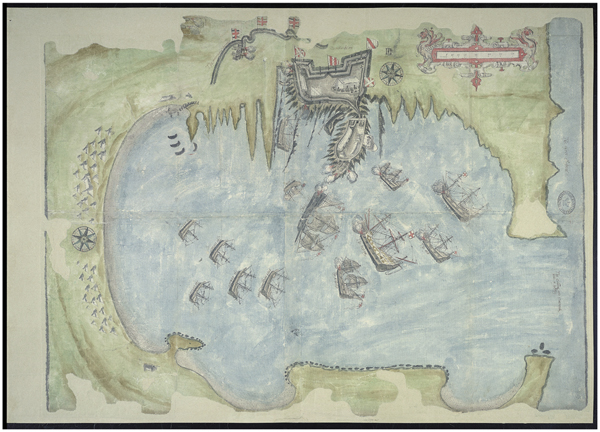
The Second Desmond Revolt, 1579–1583, commenced with the return to Ireland of Sir James Fitzmaurice Fitzgerald (d. 1579), who landed at Smerwick with a small contingent of around sixty Italian and Spanish papal troops on 17 July 1579, raising the papal banner above Dún An Óir and proceeding to reinforce the ancient fort there.Footnote 23 Accompanying Fitzmaurice was the exiled English priest, theologian, and polemicist Nicholas Sander (ca. 1530–1581), who immediately set to work producing letters and proclamations promoting the rebellion both in Ireland and abroad.Footnote 24 The revolt did not initially gather much support, and Fitzmaurice died in an ambush at the hands of the Burkes of Castleconnell on 18 August 1579.Footnote 25 The Earl of Desmond's brother Sir John of Desmond (ca. 1540–1582) succeeded him as leader of the rebellion, but his forces were defeated at Monasternenagh on 3 October, and the revolt seemed to be winding down by the end of the year.Footnote 26 It gained new life the following summer, however, with the rebellion of James Eustace, 3rd Viscount Baltinglass, who enthusiastically raised the papal banner in Leinster, denouncing Elizabeth's claim to the title of “supreme governor” in ecclesiastical affairs in a letter to the Earl of Ormond.Footnote 27 He was joined by Fiach MacHugh O'Byrne, one of the more able military commanders among the native Irish.Footnote 28 Grey was appointed lord deputy on 7 July 1580 and charged with the clear military objective of suppressing the revolt. He arrived at Dublin on 12 August along with his entourage, including his trusted secretary Spenser.Footnote 29 Things did not initially go well: Grey's first action at Glenmalure on 25 August proved something of an embarrassment, his force of two thousand men sustaining one hundred casualties during an ambush in the difficult terrain of the Wicklow Mountains by a numerically inferior force under Fiach of around seven hundred.Footnote 30 More ominously, on 13 September, a papal force of some six hundred Spanish and Italian troops under the command of Colonel Bastiano di San Guiseppi landed at Smerwick and began to further fortify Dún An Óir.Footnote 31 Late in September, Grey set out across Munster with the intention of reducing the fort, planning to rendezvous with an English fleet under the command of Admiral Sir William Winter. After a few days camping at Dingle to await Winter's ships, he brought his force of eight hundred tired, hungry, and poorly clothed men before the fort. On 7 November, the siege proceeded with the digging of entrenchments and the hauling up of heavy ordinance from the fleet (figure 1).Footnote 32 Although Grey's force barely outnumbered the defenders, San Guiseppi would later overestimate its strength at two thousand men, and the defenders’ poor morale, combined with the English forces’ vast superiority in artillery, led them to seek terms after a brief intense period of bombardment.Footnote 33
The siege of Dún An Óir, Smerwick Harbour, County Kerry, 7–10 November 1580. The National Archives, MPF/1/75.

Grey was not a subtle man, and nor was he at all politique in his understanding of religious matters. He identified his queen's enemies, whether Irish or papal, in diabolical terms as the enemies of God. He was a man of strongly Protestant religious convictions, whom Carey has described as an “advanced Protestant” and Stephen G. Ellis as a “stern Puritan.”Footnote 34 Andrew Hadfield has characterized him as “a confident, straightforward man who saw the world in terms of black and white and who was unable to understand why anyone could see matters differently, reflecting his military training and outlook.”Footnote 35 Gerard Kilroy's recent assessment has been much less charitable, describing Grey as “a brutal man … committed to forceful repression of Catholics.”Footnote 36 Grey's own account of the events at Smerwick and his role in them reveals a Protestant zealot who perceived the landing of papally sponsored troops in Ireland as a diabolical enterprise planned and orchestrated by the Antichrist in Rome, Pope Gregory XIII (1502–1585; pope 1572–1585).Footnote 37
There is, however, another important dimension to Grey's account of the massacre in which the law of nations played a crucial role alongside his virulently antipapal rhetoric. Grey's narrative of the events at Smerwick clearly demonstrated that he understood fully the implications of his actions under the law of nations. Grey was very careful to relate in detail all exchanges with the defenders of Dún An Óir concerning who had sent them and under whose commission they presumed to enter the queen's realm of Ireland for the purposes of making war. Whether his knowledge of the laws of nations and of arms derived from his past experiences as a professional soldier or from his secretary's humanist studies remains a matter of conjecture. However, recent doctoral research has convincingly established that English military men serving in Ireland and in the Low Countries during the period were well schooled in the prevailing laws of war.Footnote 38 Grey would have been well aware that in Ireland he faced rebels, traitors, and those unlawful combatants who fought alongside them and not a lawful enemy such as the Army of Flanders.
A close reading of Grey's account of the massacre demonstrates that it was framed with acute awareness of the prevailing laws of war and of nations. Grey wrote to Elizabeth on 12 November, a scant two days after the massacre, offering a detailed account of the events leading up to and including the massacre, carefully recounting his exchanges with the papal troops.Footnote 39 His initial contact was with the enemy camp master, “one Alexandro” (that is, Alessandro), an Italian who was joined shortly by a Spanish captain at Grey's request. Noting that there existed no declared state of war between England and Spain, Grey questioned the two messengers as representatives of their respective nations, seeking to ascertain who had sent them and for what purposes. After some discussion, both the camp master and the Spanish captain acknowledged that they were sent not by the king of Spain, “an absolute Prince” under the law of nations, but by the pope for the defense of the Catholic faith:
He [“Alexandro”] tolde me that certeyn Spaniards & Italians were there arriued vpon fayre speaches & great promises wch altogether vayne & false they fownd; & … yt was no part of their entent to molest or take any govermt from y[our] Maty: for proof, that they were ready to depart as they cam; & deliuer … [into?] my hands ye Forte: myne answere was yt for that I perceyved theyr … people to stand of two nations Italian and Spanish I would give no a[nswer] vnlesse a Spaniard were likewise by: he presently went & retourned … [with] a Spanish Captein. I then tolde ye Spaniard yt I knew their nation … haue an absolute Prince, one yt was in good league & amity wt yr M[ajesty] … wch made mee to merveyle yt any of his people should bee fownd asociates … [with?] them yt made about to mayntene Rebelles against you & to disturb … any yr High. gouernments & taking yt yt it could not bee his king[’s] … will, I was to know by whome & for what cause they were sent … his replye was yt ye king had not sent them, but yt one Iohn Martines de Ricaldi [Juan Martinez de Recalde, ca. 1526–1588], gouernour for ye king at Bilbo [i.e., Bilbao] had willed him to levie a band & to repaire wt yt to St. Andreas & there to be directed by this theyr Coronell here, whome he followed as a blind man not knowing whether. The other avouched yt they were all sent by the Pope for the defence of the Catholic fede.Footnote 40
Having ascertained the status of the Spanish and Italian troops under the law of nations, Grey delivered a scathing response, combining juridical argument with apocalyptic, anti-papal rhetoric, explicitly denying the pope's status as a lawful Christian prince under the law of nations:
My answere was yt I would not greatly haue mervyled yf men beeing commanded by Naturall & absolute Princes did sometymes take in hand wrong actions; but yt men & yt of accompt, as some of them made showe of, should be carried into uniust, desperate & wicked actions by one yt nether from God nor man could clayme any princely power or empire, but indeed a detestable shaveling ye right Antichrist & generall ambitious tyrant over all right principalities and patrone of ye Diabolic fede, I could not but greatly reste in wonder; theyr fault therefore farre to be aggrauated by ye vilenesse of their Commaunder & yt my hands no condition of composition they were to expecte, other then yt they should simply render me ye forte, & yield theyr selues to my will for lyfe or death.Footnote 41
While acknowledging the Spanish king as both a natural and absolute prince, Grey did not ascribe the same status to the pope, denying him “any princely power or empire” and naming him the “patrone of ye Diabolic fede.” Footnote 42 His appeals for quarter under the law of war denied, San Guiseppi surrendered his command “at mercy,” embracing Grey's knees and imploring him to spare his life and the lives of his men.Footnote 43 Under the prevailing law of war, such a surrender was without condition, leaving Grey as victor with, in Barbara Donagan's words, “extensive discretionary power” over the captives. It was a power he quickly chose to exercise, ordering two of his captains to undertake the slaughter.Footnote 44 These men were Humphrey Macworth, an obscure servitor of whom little is known, and the younger half-brother of Sir Humphrey Gilbert (1537–1583), Walter Raleigh (1554–1618), who would later achieve great fame as an explorer and historian.Footnote 45 Only about twenty officers and men were spared, including the disgraced colonel.Footnote 46 Grey recalled the scene of the slaughter as brutal and chaotic: “There were 600 slayne; munition & vittaile great store, though much wasted through ye disorder of ye Souldiers wch in furie could not bee helped.”Footnote 47 The Irish camp followers, including pregnant women, were summarily hanged, but Lawrence Moore, described by Sander as “a holy Priest,” was first tortured, his limbs broken with a blacksmith's hammer, along with Oliver Plunkett, “an Irish gentleman,” and an Englishman, William Wollick.Footnote 48 Grey lost only one man to enemy action: John Cheke, who was fatally shot when he raised his head above the English entrenchments.Footnote 49 Grey reported that his men seized furniture and arms (pikes, halberds, arquebuses, ammunition, etc.) for four thousand men from the fort, strongly suggesting that the papal expedition had been actively seeking to broaden the rebellion.Footnote 50
Grey's rationales for the massacre did not stay tucked away in the queen's study in Spenser's formal italic hand but quickly found a broader audience through the media of print. The semiofficial account of the events at Smerwick appeared early in 1581 under the title The True Reporte of the Prosperous Successe which God gaue vnto our English Soldiours against the Forreine Bands of our Romaine Enemies, lately ariued (but soone inough to theyr cost) in Ireland, in the Yeare 1580. The brief tract, signed “A. M.,” probably for the anti-Catholic polemicist and former spy Anthony Munday (ca. 1560–1633), was heavily based on Grey's account to Elizabeth.Footnote 51 It also explicitly recounted Grey's questioning of San Guiseppi's messengers concerning the status of the troops inside the fort and who sent them, denouncing the pope as the Antichrist:
Then issued out a braue Italian [presumably “Alessandro”], who beeing demaunded by my Lord Deputie who sent him thether answered. The Holy Father: Wylle you (sayd my Lord) aduenture in the seruice of a shaveling, an Antichrist, a murtherer of bothe soule & body, against such a Prince as my Mistresse is: you shall haue iust reward of your seruice. And requiring him to bring foorth the chieefe of the Spaniardes, he asked the sayd Spaniarde, who sent him thether: He sayd he could not tell. Whether the King of Spaine: he sayd no: Whether with the Kinges knowledge: he answered no: But (he sayd) at Porto in Portugall, the Gouernor there cõmaunded mee, to goe to such a place, where I should receyue my charge, which I dyd, but whether I should goe, or against whome, I know not, and so brought to this place as blindfold, and (as I see now) utterly betrayed. The (quoth my Lord) if you be not sent by the King, you come as a runnagate, and receiue the like byer.Footnote 52
In both accounts, one intended for the queen and the other for the English public, the “Holy Father” was not a lawful enemy but “a shaveling, an Antichrist.” He was, as Grey earlier affirmed, neither a natural nor an absolute prince, receiving his office and power from the devil and not from any Christian nation or God. Similarly, the Spaniard with whom Grey later exchanged words replied in the negative when asked whether the king of Spain had sent him. The printed account carefully followed Grey's initial narrative, questioning the status of the papal troops at Dún An Óir under the law of nations, combining legal argument with virulently anti-Catholic polemic explicitly questioning the pope's status as a lawful Christian prince.
The report of the Spanish ambassador Mendoza to King Phillip, although disparaging of Grey's conduct, affirmed this aspect of the exchange between the lord deputy and the two messengers over the terms of surrender. Grey's apocalyptic, anti-Catholic rhetoric is notably absent from Mendoza's account. However, his questioning of the defenders’ legal status, asking under whom they served, and who had sent them remains clearly evident:
The Viceroy asked them under whose authority they were, to which they answered only that the came by orders of the Pope; whereupon he answered that he could not treat them as soldiers but simply as thieves. Notwithstanding this they surrendered on condition of their lives being spared. When this was done the Viceroy sent a company of his men to take possession of the fort, on the 10th, and they slaughtered 507 men who were in it and some pregnant woman, besides which they hanged 17 Irish and Englishmen, amongst whom was an Irishman named Plunkett, and a priest, and an English servant of Dr. [Nicholas] Sanders. Only a single one of the Viceroy's men was injured.Footnote 53
This was very much a hostile account. Where Mendoza clearly departed from the “official” accounts under English provenance was in his insistence that the garrison had surrendered “on condition [of] their lives being spared” and had not simply thrown themselves on the lord deputy's mercy, surrendering the fort unconditionally. Grey's questioning of the papal troops’ status under the law of nations was preserved, but the Spanish ambassador's narrative portrayed him as a dishonorable man, a liar and an oath-breaker, who, having offered the papal troops their lives as the condition of their surrender, then treacherously reneged on his promise of mercy.
The account of John Hooker, published in 1586 as part of an addendum to the second volume of Raphael Holinshed's Chronicle (1577), with a dedicatory to Raleigh, similarly recounted Grey's questioning of the defenders of the fort, inquiring who had sent them and what was their purpose in occupying and fortifying the Queen's land against her authority:
But before anie assault giuen he [Grey] summoned the fort; requiring of them who they were, what they had there to doo, by whom they were sent, and whie they fortified in hir maiesties land & required therewith to yéeld up the fort. But they answered that they were sent some from the holie father, which had giuen that realme to king Philip; and some from king Philip, who was to receiue and recover that land to the holie churche of Rome, which by hir maiesties means was become schismaticall, and out of the church, with other reprochfull speeches: and that therefore they were in that respect to keepe what they had and to recouer what they yet had not.Footnote 54
Alan Ford has characterized Hooker as having “an explicitly Protestant and apocalyptic view of history” that strongly emphasized the threat of the papal Antichrist.Footnote 55 There is little likelihood that Hooker as an advanced Protestant would ever have accepted papal authority to arbitrate international conflicts between sovereign entities, any more than Grey, who had explicitly denied the pope “any princely power.” Furthermore, any claim that the pope had by his own authority given the queen's realm of Ireland to the king of Spain would clearly not have been recognized. A papal bull issued under Pope Paul IV in 1555, Illius per quem Reges, had previously recognized Ireland as a kingdom and Mary I and her husband Philip of Spain as queen and king of Ireland, providing some legal foundation to the Spanish monarch's claim to the Irish crown by virtue of his earlier marriage.Footnote 56 Indeed, there is a strong possibility that Hooker was writing to refute the appeal of Dr. William Allen (1532–1594) to this precedent in his defense of the papal deposing power as exercised in the bull of Pius V, Regnans in Excelsis (1570).Footnote 57 This bull had excommunicated Queen Elizabeth, absolved her subjects from their lawful obedience, and declared “her to be deprived of her pretended title to the … crown [of England] and of all lordship dignity and privilege whatsoever.”Footnote 58 Given this context, we can safely presume that both Hooker and the Elizabethan regime did not recognize the pope's authority either to arbitrate in international disputes or to depose monarchs who had become heretical and schismatical (that is, Protestant). As with Grey's initial report of the massacre and Munday's published account, an apocalyptic understanding of history went hand in hand with appeals to the laws of nations and of war. As servants of the Antichrist, the defenders of Dún An Óir were not lawful enemies and enjoyed no standing under the law of nations.
This brings us to the View’s defense of Grey's actions. Andrew Hadfield has observed that the View’s defense of Grey “is careful to make no mention of religion” and, unlike earlier rationales appearing immediately in the aftermath of the massacre, the Antichrist played no role in the dialogue's recollection of events.Footnote 59 On the surface, this would seem to be a significant departure. However, in continuity with earlier reports, the law of nations continued to play a central role in the View’s account of the events concluding the siege at Smerwick, with the veteran servitor Ireneus claiming firsthand knowledge of Grey's conduct toward the papal troops and vigorously defending his actions. In keeping with the period's leading authorities on the law of nations, Grey explicitly denied the defenders of Dún An Óir the status of “lawful enemies,” refusing to treat with them or to offer terms and conditions of surrender. In the View, Eudoxus repeated the aspersions cast against Grey's character that “in that sharp execution of the Spaniards at the fort of Smerwick, I heard it specially noted, and if it were true, as some reported, surely it was a great touch to him in honour. For some say that he promised them life, others that he did at least put them in the hope thereof.”Footnote 60 The veteran servitor Ireneus, often seen as the interlocutor for Spenser, offered in response a lengthy juridical defense of Grey, framed specifically in terms of the law of nations, denying that the lord deputy ever promised mercy or treated with the papal troops as lawful enemies:
This I can assure you, myself being as near as any that he was so far from either promising or putting in hope, that when first their secretary called, as I remember signor Jeffrey, an Italian, being sent to treat with the Lord Deputy for Grace was flatly refused, and afterward their colonel named Don Sebastian came forth to entreat that they might depart with their armours like soldiers, at least with their lives, according to the custom of war and the law of nations, it was strongly denied him, and told him by the Lord Deputy himself, that they could not justly plead either the custom of war or law of nations, for they were not any lawful enemies, and if they were, willed them to show by what commission they came thither into another Prince's dominion, whether from the pope or the king of Spain, or any other. The which when they said they had not, but they were only adventurers, that came to seek fortune abroad and serve in wars amongst the Irish who desired to entertain them, it was then told them that the Irish themselves, as the Earl and John of Desmond with the rest were no lawful enemies, but rebels and traitors and therefore they that came to succour them no better than rogues and runagates, specially coming with no license or commission from their own king, so as it should be dishonourable for him in the name of his Queen to condition or make any terms with such rascals: but left to them their choice to yield and submit themselves or no, whereupon the said colonel did absolutely yield himself and the fort with all therein, and craved only mercy; which it being thought good not to show them, both for danger of themselves, if, being saved, they should afterwards join with the Irish, and also for terror of the Irish, who were much emboldened by those foreign succours and also put in hope of more ere long. There was no other way but to make that short end of them that was made.Footnote 61
Unlike earlier rationales for Grey's actions, the View’s argument was framed solely in terms of the law of nations and the law of arms and made no reference to the papal Antichrist, even suggesting at one point that a lawful commission from the pope would have been acceptable had the troops possessed one. However, consistent with the views of Cicero and the leading authorities of the period, without such a commission the defenders of Dún An Óir did not fall within the category of lawful enemies and were in no position to negotiate terms. Thus they found themselves at Grey's mercy, and he chose to withhold it.
The conspicuous absence of the Antichrist from the View's account of the events at Smerwick suggests a greater consistency with the politique views of those authorities on the law of nations like Gentili who did not recognize confessional differences between Christian rulers as a just cause for war.Footnote 62 Hadfield has also suggested that Spenser may not have seen eye to eye with Grey on religious matters, and this may very well have been the case.Footnote 63 Another possible explanation is that the intended audience of the manuscript tract in the mid-1590s was largely an English one, many of whom had a more politique understanding of religious matters than did Grey. The important figure here was Robert Devereaux, 2nd Earl of Essex, who would emerge during the Elizabethan fin de siècle as a major political and military figure, becoming a privy councilor, earl marshal, lord deputy of Ireland, and general of the English army there in 1599.Footnote 64 This prospective audience would have included not only Essex but also his learned circle, including such distinguished figures as Sir Henry Savile (1549–1622), Anthony Bacon (1558–1601), and Sir Francis Bacon (1561–1626), as well as Essex's secretaries, Sir Henry Wotton (1568–1639), Henry Cuffe (1562/3–1601), William Temple (1555–1627), and Thomas Smith (ca. 1556–1609). These individuals were all deeply familiar with the latest trends in humanist learning, including a vogue for the ideas of Niccolò Machiavelli (1469–1527) and a more skeptical attitude toward politics and political life heavily informed by their reading of the Roman historian Cornelius Tacitus (ca. 56–ca. 120 BCE).Footnote 65
Spenser was not only heavily exposed to these same intellectual currents but he also cultivated and at least belatedly received Essex's patronage during the 1590s, with the ill-fated earl paying for and possibly attending the impoverished poet-planter's funeral in 1599.Footnote 66 Furthermore, although Essex styled himself as the martial champion of the Protestant cause at home and abroad, his posture toward English Catholics was in practice much more conciliatory and politique than was that of other major figures on the Privy Council, such as William Cecil, Lord Burghley (1520/21–1598), and it was certainly more moderate than Grey's. As Paul Hammer has noted, “Essex's Protestantism did not make him personally anti-Catholic.”Footnote 67 Essex and his circle were certainly firm Protestants, as was Spenser, but they did not necessarily share Grey's apocalyptic perspective on events in Ireland, nor the vociferously anti-Catholic mentalité that Carey has identified in the accounts of the massacre appearing immediately after the event.
Gentili's views on combatant status, maturing during the last two decades of Elizabeth's reign, are particularly significant to our discussion. Although his authority in matters of international law was subsequently (and permanently) eclipsed by that of Grotius, Gentili, was not only an almost exact contemporary of Spenser, but also shared with him a number of important patronage ties during the 1580s and ’90s, a period often referred to as the “second reign” of Elizabeth.Footnote 68 An Italian Protestant, Gentili arrived in England in 1580, the same year as the massacre at Smerwick, fleeing the Roman Inquisition in Italy via Tübingen in Germany. Educated at the University of Perugia where he received his Doctor of Civil Law, he quickly came to the notice of Essex's influential stepfather Robert Dudley, earl of Leicester (1532/33–1588), and rose rapidly in the world of English academia. He began lecturing at St. Johns College Oxford in 1581, becoming regius professor of civil law in 1587 and emerging as a noted authority on the law of nations by the end of the century.Footnote 69 Both Grey and Spenser were very much enmeshed in the same “Leicester-Sidney” patronage network as Gentili, Spenser having secured his appointment as Grey's secretary through his patron Leicester and the earl's brother-in-law Sir Henry Sidney (1529–1586), the former lord deputy of Ireland.Footnote 70 Similarly, Gentili benefited from Leicester's patronage as chancellor of the University of Oxford in his academic career and had significant connections to the Sidneys, dedicating his treatise De Legationibus Libri Tres, or Three Books on Embassies (1585), to his friend Sir Philip Sidney (1554–1586), poet, soldier, courtier, and son of the former lord deputy with whom Gentili enjoyed numerous learned exchanges during the early 1580s.Footnote 71 Joanna Craigwood has even argued that Sidney and Leicester “instigated and influenced Gentili's work on embassy.”Footnote 72 During this period, Gentili became closely associated with the “pro-war” faction on the Privy Council, of which Leicester was a leading figure.Footnote 73 Aside from his literary fame, the younger Sidney was also a very important public figure, widely hailed as “the example of the best flower of English Protestant knighthood” until his untimely death from gangrenous leg wounds sustained at Zutphen in October 1586.Footnote 74 Gentili's later treatise De Jure Belli Libri Tres, or Three books on the Law of War (1598), which had initially appeared in three separate parts in 1588–89, was dedicated to the younger Sidney's successor as the public exemplar of Protestant martial prowess, none other than Leicester's stepson Essex, who had married Sidney's widow, Frances Walsingham (1567–1632) in 1590.Footnote 75 Gentili's ties to the more politique-minded Essex circle of the 1590s have been well documented, with the earl himself not only serving as patron to the regius professor's scholarly endeavors but also standing as godfather to Gentili's son.Footnote 76
Gentili's views on combatant status rested heavily on the authority of Cicero, making clear demarcation between lawful and unlawful enemies under the law of nations. Heavily influenced by the celebrated French jurist Jean Bodin's (1529/30–1596) theory of sovereign states, Gentili affirmed that a lawful state of war could exist only between equal sovereign entities.Footnote 77 Like Belli before him and his contemporary Ayala, he cited De Officiis to the effect that “Pirates are the common enemies of all mankind, and therefore Cicero says that the laws of war cannot apply to them.”Footnote 78 He marshaled a range of historical exempla from both Roman and more recent history in support of his arguments that pirates, brigands, and robbers were outside of the law of nations and that they should not be considered as any iustus hostis.Footnote 79 For example, when the rebel slave leader Spartacus made overtures to Marcus Lincius Crassus (ca. 115–53 BCE) on the possibility of making a treaty, “his proposal was indignantly spurned.”Footnote 80 A “servile war,” or war with slaves, was no war under the law of nations, and rebellious slaves were no lawful enemies. Gentili explained the reasons for this at length:
The Roman people never applied the term “civil wars” to the conflicts with Spartacus or Crixus, or even with the proscribed citizens Sertorius and Perpenna. As a rule, they granted an ovation, and not a triumph to those who had gained a victory, not over regular enemies, but over pirates, slaves, and such like who seemed unworthy of the title of enemy. For the word hostis, “enemy,” while it implies equality, like the word “war,” since names are general and include several varieties, is sometimes extended to those who are not equal, namely, to pirates, proscribed persons, and rebels; nevertheless it cannot confer right due to enemies, properly so called, and the privileges of regular warfare.Footnote 81
For Gentili, pirates, robbers, rebels, and brigands were “common enemies, and they are attacked with impunity by all, because they were without the pale of the law.”Footnote 82 As Schröder has noted, Gentili's writings represented a significant shift in international thought, offering “a juridical, and political approach which eliminates the medieval notion of bellum iustum, and instead introduces the concept of a iustus hostis.”Footnote 83 Such an enemy was, in the words of Alan Cromartie, “an armed antagonist enjoying equal rights, irrespective of the merits of the conflict.”Footnote 84 What mattered was less whether a war was just in its cause than how that war was conducted between sovereign states under the law of nations. The emphasis became less the bellum ad iustum, or just war, than the ius in bello, or justly conducted war.
The reasons for this shift were directly related to the religious divisions that emerged in Europe over the course of the sixteenth century. These divisions were front and center in Elizabethan Ireland, where the forces of militant Catholic reformation represented by figures such as Sander, Fitzmaurice, and Baltinglass collided violently with those of an equally militant Protestantism represented by figures such as Grey and the Sidneys.Footnote 85 The Protestant reformations of the early sixteenth century had permanently changed the way European nations conducted not only war but also diplomacy.Footnote 86 In the later Middle Ages, both the Holy Roman emperor and the Papacy were able claim the role of a universal arbiter in internationals disputes between sovereign nations. For example, in the Treaty of Tordesillas (1494), the pope had successfully brokered an agreement between Portugal and Spain over their rival claims to sovereignty and possession in a global context.Footnote 87 However, for later jurists such as the politique Bodin and the Protestant Gentili, living in a world divided by rival confessions, and for Protestant nations such as England and Scotland, where committed reformers such as Grey saw the pope as the Vicar of Satan and the Antichrist, this was no clearly longer a possibility. Indeed, for any “hot” Protestant like Grey, papal and Spanish claims to “universal” monarchy were not only unlawful and illegitimate but also had overtly diabolical overtones.Footnote 88 While the Protestant Gentili did envision third-party arbiters as useful in resolving international disputes between sovereign states, the only criterion that he saw for choosing one was the mutual agreement of both potential (or actual) belligerents. He did not see the papacy as having any special status or particular right of judgment over sovereign states.Footnote 89 Instead, the international legal order of post-reformation Europe would need to depend on sovereign states recognizing each other as equals, and either waging war justly, or forming compacts based in mutual trust.Footnote 90 The defenders of Dún An Óir, however, in both Grey's and Spenser's eyes, stood outside this international network of sovereign entities and enjoyed no standing under the law of nations. While his actions were certainly reprehensible, both Grey and subsequently his secretary had legitimate recourse to an established body of law in defending the brutal atrocity committed at Smerwick.
Whether Grey promised the papal troops at Smerwick mercy or not will probably never be known with certainty, but it seems highly unlikely that they would have surrendered without some reasonable expectation of mercy. What is clear is that the juridical rationale for Grey's actions was evident in a number of diverse sources produced in the massacre's immediate aftermath, even in the report of Mendoza, who was decidedly hostile to Grey, protesting his actions at Smerwick to the queen and attacking the lord deputy's honor for having promised mercy and then withheld it. Such accounts, like the more politique account of the View, did not include Grey's apocalyptic, virulently anti-Catholic rhetoric, but they did acknowledge the lord deputy's argument, advanced under the prevailing law of nations, that the papal troops at Dún An Óir were not lawful enemies. Despite the absence of Grey's vociferously anti-Catholic rhetoric from the View, there is a substantial continuity between the apocalyptically charged accounts of the massacre appearing immediately following the tragic events at Smerwick and the juridical rationale for Grey's actions offered under the law of nations in the View. Grey may very well have been the faithless monster that critics like Philip O'Sullivan Beare (ca. 1590–1660) would later vilify him as, and he was certainly an exemplar of the kind of militantly Protestant, virulently anti-Catholic mentalité that was becoming increasingly entrenched during the period among New English servitors and planters.Footnote 91 Nevertheless, his actions also demonstrated a knowledge and awareness of the laws of nations and of war, as did the subsequent rationales offered in his defense. Grey may have been a monster, but he was a juridically consistent one.
Conclusion
Spain and England were not at war in 1580, a situation that proved highly problematic for the papal troops at Smerwick. A commission from the Spanish king to make war would, at least in theory, have rendered the defenders of Dún An Óir lawful enemies. However, by Grey's account, the papal troops possessed no such commission, being sent by the “Holy Father.” From Grey's perspective, albeit not necessarily Spenser's, this made them not only unlawful enemies but also servants of the Antichrist. The question of whether a lawful commission from the king of Spain could have saved the papal troops at Smerwick remains a matter of speculation, but both previous and subsequent events suggest it would not have greatly helped their situation. Months before Grey and Spenser had even set foot in Ireland, in late March 1580, English forces summarily executed six Spanish soldiers and their Italian captain who had surrendered with the rebel garrison at Carrigafoyle Castle.Footnote 92 The Armada survivors who washed up on Ireland's north and west coasts eight years later, who had sailed under the Spanish flag and actually did have a commission to make war from the Spanish king, fared little better as lawful enemies than the defenders of Dún An Óir had as unlawful ones. At the hands of English troops and those Irish aligned with them, common sailors and soldiers were either summarily slaughtered or executed at martial law on the order of the lord deputy Sir William Fitzwilliam (1526–1599). Sir Richard Bingham (1527/28–1599), the president of Connaught, who had commanded the Swiftsure under Admiral Winter during the Smerwick campaign, a man notorious for his brutality toward the native Irish, claimed to have overseen the execution of upward of 1,100 Armada survivors in that province alone.Footnote 93 In contrast, the 494 Armada survivors who found themselves captive in England after clashes in the English Channel during the late summer and autumn of 1588, primarily ordinary sailors and soldiers, were treated as lawful enemies and ransomed en masse by their king early in 1590.Footnote 94 Even without Fitzwilliam's order, the ugly reality was that English military entrepreneurs in Elizabethan Ireland such as Bingham exercised almost complete local autonomy, routinely disregarding the received laws of war whenever it suited them, whether in their conduct toward the native Irish or toward foreign troops bearing a lawful commission to make war.Footnote 95 The massacre at Smerwick was not an isolated episode but part of a broader pattern of extreme military violence in Elizabethan Ireland that would only escalate further with the Nine Years War (1594–1603). As Brendan Bradshaw has argued, any meaningful historical discussion of the period must confront “the phenomenon of catastrophic violence as a central aspect of the history of conquest.”Footnote 96
My intention here has not been to refute Carey's arguments but to expand upon them, demonstrating the ways in which the religious and juridical arguments in support of Grey's actions combined to form a cogent, rhetorical strategy in the immediate aftermath of the massacre. Both religious and juridical rationales for Grey's actions appeared alongside each other in the lord deputy's account of the tragic events at Smerwick, mutually reinforcing each other. The established law of nations was not a seamless web in the sixteenth century but manifested a number of significant cleavages that enabled the construction of localized spheres of legal exception in which the ordinary rules of warfare could be willfully disregarded. These spheres of exception in turn helped facilitate the commission of atrocities like that perpetrated at Smerwick, acts that today would unhesitatingly be classified as war crimes. Although it may seemingly suggest a departure from earlier apocalyptic narratives, the juridical rationale for the massacre at Smerwick offered in the View actually stood in close continuity with the virulently anti-Catholic rhetoric that Carey has identified in earlier attempts to legitimate Grey's actions both to the queen and to the English public in print immediately following the massacre. In Grey's own account, that of the Spanish ambassador, in the semiofficial printed account, and in the View, Grey appears as clearly questioning the status of the papal troops as lawful enemies, establishing a sphere of legal exception in which he could dispose of them at his own discretion. He had, in the fashion of a committed, militant Protestant, asserted that the pope was the Antichrist with no “princely power or empire”; therefore, the pope was no lawful sovereign, and his servants were no better than pirates or brigands with no legal standing under the law of nations. Dún An Óir was, under Grey's and Spenser's interpretations of the law of nations, a piratical fortress, and its defenders, having not been sent by any iustus hostis, were communis hostis omnium, “a common enemie to all men.”