INTRODUCTION
Remembering events typically requires recalling the core elements of an event in their proper spatiotemporal context. For example, to remember a specific meeting with a friend whom we see frequently, we need to recall both where (in the pub) and when (last week and not the week before, because then the meeting took place in the library). Essentially, episodic memory rests upon reinstating the correct spatiotemporal context.
Patients with Korsakoff's syndrome (KS) are well known for suffering profound episodic memory impairments. Widespread damage to the frontal lobes and diencephalic regions is thought to underlie these impairments (Mayes et al., 1988). In addition, there are indications that hippocampal dysfunction might be involved as well, although findings are inconclusive (Paller et al., 1997; Reed et al., 2003). What is most important here is the notion that the functional memory impairments result from problems in encoding and recalling the context of events. The context–memory deficit hypothesis claims that context memory (e.g., recalling object locations or their sequential order) is disproportionally disordered in KS compared to target memory (e.g., recalling object identities; Mayes, 1988; Mayes et al., 1985; 1991). One method to demonstrate this consists of first equating the performance of patients with KS and of controls on target memory and subsequently showing additional limitations in recalling the associated context (cf. Chalfonte et al., 1996).
There are several studies suggesting disabled spatial memory in KS for tasks ranging from spatial probability learning (Oscar-Berman et al., 1976), spatial reversal learning (Oscar-Berman & Zola-Morgan, 1980), maze learning (Nissen et al., 1989), spatial delayed response performance (Oscar-Berman et al., 1992), spatial priming (Verfaellie et al., 1992), and various forms of object location memory (Holdstock et al., 1999; Kessels et al., 2000a; Kopelman et al., 1997; Mayes et al., 1991; Shoqeirat & Mayes, 1991). Note, however, that occasionally no additional spatial memory impairments in KS are obtained (Cave & Squire, 1991, 1992; Chalfonte et al., 1996; MacAndrew & Jones, 1993). According to Kessels et al. (2000a); the reason for this finding could lie in the precise procedures and stimuli used across the various tasks. A second reason could be that often only small groups of patients are tested.
In line with the foregoing, several other studies have revealed disordered memory for temporal information in KS (Downes et al., 2002; Kopelman, 1989; Meudell et al., 1991; Shimamura et al., 1990). Mimura et al. (2000) revealed a problem in time estimation, which was linked to episodic memory impairments. Interestingly, Huppert and Piercy (1976) found that KS patients typically confuse when an event occurred (temporal order) with how frequently it took place (frequency judgment). Meudell et al. (1985) replicated this finding.
Although both spatial and temporal order memory appear to be clearly affected in KS, it remains unclear which contextual feature is most prominently impaired or whether both are impaired to the same extent. One speculation is that largest impairments could be found for temporal order information, because of the severe deterioration of the prefrontal areas in KS (cf. Hälbig et al., 1998; Shimamura et al., 1990). The prefrontal lobes are thought to be specifically critical for temporal order memory (cf. Kopelman et al., 1997), whereas the posterior brain areas would be more relevant to spatial processing (cf. Kessels et al., 2000b; see, however, the Discussion section). A recent positron emission tomography study by Cabeza et al. (2000) showed that temporal order retrieval particularly engaged prefrontal activation. Note that a dissociation between temporal and spatial order performance, such as poor performance on temporal order memory against much better achievements on spatial order memory in patients with KS, corroborates the notion that temporal and spatial order memory engage functionally domain specific and neurostructurally distinct processes (see below). Hence, the first goal of the present study was to directly compare spatial and temporal order memory in KS patients.
Arguably, the magnitude and direction of the problems observed here could depend to a large degree on the attentional and memory load presented by the task given. Our second goal, thus, was to study in further detail the effect of variations in attentional and memory demands. Notably, these variations form an important characteristic of the natural circumstances in which spatial and temporal order memory is required in daily life. Regarding attentional specificity, the manner of presentation is particularly relevant. How does a purely temporal presentation condition compare to a mixed spatiotemporal condition in which only the temporal information needs to be attended and selected; and how would a purely spatial condition (i.e., simultaneous presentation of object locations) compare to a mixed spatiotemporal condition in which only the spatial feature is relevant? Regarding the latter comparison, the existing evidence suggests that it is difficult to make a positional map when positions are shown serially (cf. Dent, 2002; Igel & Harvey, 1991). Simultaneous presentation of positions allows beneficial, configurational processing. It is unknown how this processing works for the temporal attribute (i.e., is the order of events better remembered when they occur all in the same location or does it help experiencing them in different locations). In turn, it is interesting to examine how KS patients deal with these differences in presentation. Combined spatiotemporal presentation requires shifting of attention to the critical feature during encoding, a process that might be affected in KS because of the presumed frontal cortex damage.
Regarding the effects of memory load, the nature of the memory requirement is important: is it as easy to bind two features together in memory as it is to keep track of a single feature? In other words, is knowing where something happened, automatically accompanied by knowing when it happened? One argument for the possibility that our brain always stores events in an integrated spatiotemporal context is that events that are close in time commonly are also close in distance. If so, a condition in which attention is directed to only a single feature should yield similar performance as a condition in which both temporal and spatial order have to be reconstructed.
In contrast with the view that temporal and spatial information are naturally integrated (i.e., both features engage general coding mechanisms), others have claimed that spatial information is encoded independently from the corresponding temporal code (Anderson, 1976; Nairne & Dutta, 1992). Moreover, recently we found that performance on unexpected temporal order recall trials in a block of spatial order recall trials is worse compared to trials where temporal order recall is expected (Van Asselen et al., 2006). Similar findings characterized spatial order recall. Apparently, there is not a complete and automatic coding of the corresponding attribute when concentrating upon the other attribute. Rather, it seems that there are central, limited capacity resources that are competed for by both memory attributes. It is of particular interest to see how KS patients are doing in these situations. As pointed out above, they are expected to have marked problems on both contextual attributes. The important question is whether they are able to integrate the two features or to keep them in memory at the same time—even though to a much reduced extent—when they have to recall events in the correct order as well as in the correct position. This answer might shed light upon the existence of a binding problem on top of the contextual memory impairments.
METHODS
Research Participants
Twenty-one patients, diagnosed with Korsakoff's syndrome 1 to 6 months before the investigation participated in this study. They were inpatients of the Korsakoff clinic of the Psychiatric Hospital ‘Vincent van Gogh’, Venray, The Netherlands. The patients met the criteria for DSM–IV Alcohol-Induced Persisting Amnestic Disorder (American Psychiatric Association, 1994) and the criteria for Korsakoff syndrome described by Kopelman (2002). All patients had an extensive history of alcoholism and nutritional depletion, notably thiamine deficiency, verified through medical charts or family reports. Neuroradiological examination (computed tomography or magnetic resonance imaging) showed signs of brain atrophy and nonspecific white-matter lesions in most patients, which are often found in KS but not a necessary criterion for the diagnosis (Kopelman, 2002). The current intelligence level of each patient had to be in concordance with the estimation of their level of premorbid functioning based on occupational and educational history to exclude possible cases of dementia. Four patients with estimated IQ scores below 80 were excluded because of the probability of alcohol dementia. For the same reason, two other patients were excluded for whom no IQ estimates and item memory scores (see below) were available. One patient was excluded because of a working memory span of only 3. The remaining 14 patients included 6 women. None of these patients fulfilled the criteria for alcohol dementia (Oslin et al., 1998). Their intelligence scores were comparable to other KS samples reported in the literature (e.g., Fama et al., 2004; Mimura et al., 2000) and were preserved compared to a severe memory decline (see also Oscar-Berman et al., 1993). Table 1 shows that patients were severely impaired on what can be seen as a test of item memory. All of the 12 patients who were administered the Dutch version of the California Verbal Learning Test (CVLT, a task measuring verbal immediate and long-term memory) scored within the second percentile on the total number of List A words recalled across Trials 1–5 (standardized for age, gender). Two patients tested with a Dutch version of the Rey-Auditory Verbal Learning tests had a first and second standardized decile score, respectively (Heslinga et al., 1983). Seven of 12 patients were 2 SD or more below the norm on the Tower of London test (Ganzevles et al., 1994), assessing central executive functioning, in particular planning and problem solving. The foregoing test scores were not available for the controls. Notably, the patients had intact short-term memory compared to the control group, as measured with the Corsi Block-Tapping Test (see Table 1 for the individual patient characteristics).
Demographic variables, neuropsychological test results, and radiological findings for the Korsakoff patients

There were 19 age-, sex-, and education-matched controls (7 women) who were examined as well. Educational levels of all participants were recorded on a scale of seven categories (1 being the lowest; 7 the highest obtained educational level). Mean educational level for the KS patients was 4.5 (SD = 1.0); for the controls this score was 4.3 (SD = 1.5). Mean age for the patients was 49.7 years (SD = 7.0) and for the controls was 55.7 years (SD = 12.7). Patients and controls did not differ in education, age, handedness, and gender.
MATERIALS
For this task, the object relocation computer program described in Kessels et al. (1999) and Postma et al. (1998) was used. Stimuli were presented on a 15-inch LCD monitor with a touch-sensitive screen to select and relocate objects (ELO AccuTouch 2201). There were five different task conditions, each condition containing one practice trial and two experimental trials. Accuracy scores were automatically recorded by the computer program.
In the purely temporal presentation condition, six objects were shown serially, always in the middle of a 19 × 19 cm square frame centered on the screen, each object for 3 seconds. Next, objects were presented horizontally in random order above a one-dimensional horizontal array of six dots. Participants were to place the objects in the correct temporal order on the dots, that is, the leftmost dot should be assigned the object that was presented first and the rightmost dot should be assigned to the last shown item. In the purely spatial presentation condition, six objects were shown simultaneously for 18 seconds at different locations distributed across a 19 × 19 cm square centered on the screen. Next, the objects were deleted from the square and reappeared in random order above the square frame. Participants had to relocate them as accurately as possible to their correct positions, which were marked by black dots in the square frame. In the spatiotemporal presentation–temporal order recall condition, six objects were shown serially for 3 seconds at different locations in the 19 × 19 cm square frame. Recall was the same as in the purely temporal presentation condition: objects were to be arranged in the correct order in the horizontally aligned array of six cells.
Presentation in the remaining two conditions was exactly the same as in the foregoing, but of course using different stimuli. The spatiotemporal presentation–spatial order recall condition required participants just to recall spatial order, in the same way as in the purely spatial presentation condition. The fully combined condition required participants both to select objects in the correct temporal order and to place them at the correct location (see Fig. 1 for a schematic overview of the conditions). Notice that, in all conditions, there was no possibility to correct mistakes. Also there was a dependency between performance for the individual objects in the sense that, when assigning either a wrong spatial or temporal order to a given object, at least one of the other objects was also assigned the wrong place or temporal slot. The objects consisted of small, colored icons of highly familiar items, including animate items (e.g., fish, rabbit), furniture and household objects (e.g., telephone, cheese), tools and utensils (e.g., keys, screwdriver), vehicles (e.g., car, bike), and various others (e.g., brain, money). On average, objects were approximately 1 × 1 cm in size. Each trial included different objects and a different spatial layout.

The displays during the presentation phases of the purely spatial, purely temporal, and spatiotemporal presentation conditions, and the displays in the only spatial feature recall, only temporal feature recall, and the fully combined recall condition are shown. The digits were never shown but are used here to indicate the temporal order of the presented items and the temporal order of recall in the combined condition. Notice that performance in the right-hand bottom display would yield two temporal errors but no spatial errors.
Procedure
Objects could be selected and relocated in a direct manner on the touch-sensitive screen. All participants were instructed explicitly before each condition to which aspects of the presentation they should pay attention to and what was expected from them during recall. This instruction was further illustrated by means of a practice trial that preceded each condition. Practice trials contained only four objects. Half of the participants in both groups started with the two spatial order recall conditions (the purely spatial presentation condition first) followed by the two temporal order recall conditions (again the purely temporal presentation condition always first). For the other half of the participants, the order was reversed. For all participants, the fully combined condition (i.e., both spatial and temporal order recall) was done last. We chose this partly fixed order of conditions to have participants always start with a supposedly easier condition (i.e., the purely spatial or purely temporal presentation) and to have them always end with the most difficult condition (i.e., the fully combined condition). There were no time limitations in the recall phase. The whole experiment lasted approximately 45 minutes.
RESULTS
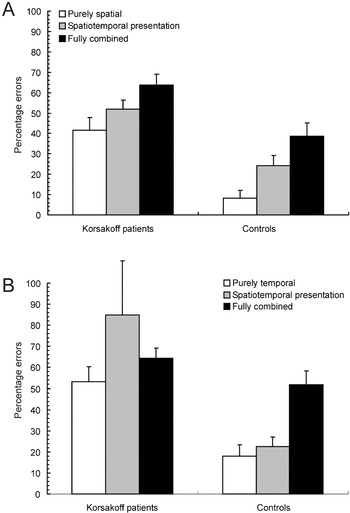
Figure 2A and 2B show error scores in recalling either the spatial order or the temporal order of an item over the three experimental factors. A spatial order error was scored when an item was not in the correct location. Similarly, a temporal order error occurred when the item was not assigned to the correct temporal slot. In both cases, the maximum number of errors on a given trial was 6. A 2 × 3 × 2 repeated measures analysis of variance was conducted with percentage errors as the dependent variable and feature (temporal versus spatial order) and condition (pure, spatiotemporal presentation/single feature recall, and fully combined) as within-subjects factors, and group (KS patients vs. controls) as the between-subjects factor. All three main effects were significant: group, F(1,28) = 21.57, p < .01; feature, F(1,28) = 8.68, p < .01; and condition, F(2,56) = 8.59, p < .01. As expected, KS patients performed worse than controls. The feature effect means that spatial order recall was better than temporal order recall, at least within the precise circumstances of the present study. (The difference between spatial order and temporal order memory was also significant for the pure conditions only: F(1,29) = 10.3, p < .01.) Moreover, the condition effect indicates that, in general, performance is best for the “pure” conditions and worst for the condition requiring integrated spatial and temporal order recall.

(A) Spatial order recall (means and standard errors) in Korsakoff patients and control participants over different presentation and recall conditions. (B) Temporal order recall (means and standard errors) in Korsakoff patients and control participants over different presentation and recall conditions.
Regarding the interaction effects, the interaction feature by condition was not significant: F(2,56) = .54. More interestingly, the interaction between feature and group was also not significant: F(1,28) = 1.3. Hence, KS patients suffer relatively comparable impairments in spatial order recall and temporal order recall. Importantly, condition by group did yield a significant interaction: F(2,56) = 3.48, p = .038. When tested separately for the two subject groups, there was a clear condition effect [F(2,32) = 26.5, p < .01], but no feature by condition interaction [F(2,32] = 1.87,p = .17] for the control participants,meaning that,for both features,performance dropped going from the pure presentation condition to the mixed spatiotemporal presentation condition to the fully combined condition,even though the average pattern appears to suggest a slight difference. Remarkably,for the KS patients,there was no condition effect [F(2,24) = 1.9, p =.18] or a condition by feature interaction [F(2,24) = 1.2, p = .32]. Performance was comparable for all three presentation/recall conditions, for both the temporal and the spatial order feature. Finally, the interaction feature by condition by group was not significant either.
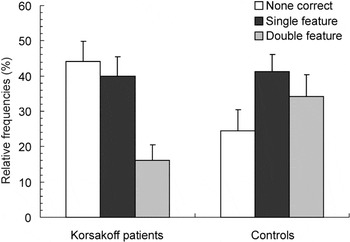
KS patients performed lower than control participants for the combined scores in the fully combined condition (i.e., recalling both place and time of an item correctly), t(31) = 2.23, p = .03. Figure 3 shows the outcome of this condition in more detail. For each individual item presented, we classified performance as either only a single feature correct (either spatial order or temporal order), either both features correct (i.e., the combined scores), or no feature correct. It can be seen that, whereas KS patients had approximately the same percentage of items with only a single feature correct as the controls did, they lacked in recalling spatial and temporal information together. Moreover, controls appear to have approximately as many items with only a single features correct as items with both features correct. To statistically verify this pattern, a χ2 test was performed on the proportions of items in the no feature correct, single feature correct, and double feature correct category for the two groups. This test was highly significant, χ2(2) = 22.22, p < .01, indicating that the category proportions differed strongly for the two groups. Subsequent, separate t tests showed that the difference between the two groups was both significant for the no feature correct category and the double feature correct category but not for the single feature correct category [respectively, t(31) = −2.26, p = .03; t(31) = 2.23, p = .03; t(31) = .18, p = .86]. It thus seems that, although integrated processing of the two features is not obligatory, normally we can combine them if we need to. KS patients, however, suffer in this respect.

Proportions total errors (no feature correct), single feature correct, and both spatial and temporal feature correct (means and standard errors) in the fully combined recall condition in Korsakoff patients and control participants.
It should be mentioned that, even though overall KS patients performed very poorly, they still achieved higher than chance scores. The expected correct score if performance is at chance for single feature recall is 1/6 =∼ 16.67%. For two features together (i.e., recalling both the place and the time correctly), it is 1/36, =∼ 2.78%. Single sample t tests showed KS patients to perform significantly above chance for spatial and temporal order recall and combined recall in all conditions. Only performance for temporal order recall in the spatiotemporal presentation condition did not differ significantly from chance.
We also computed correlations (Pearson's r) between the spatial and temporal order scores in the fully combined condition and the correlations between these two scores and the combined scores. As expected, both spatial feature recall and temporal feature recall in the fully combined condition correlated with the combined recall (patient group: r = .71, p < .01 for the spatial feature; r = .71, p < .01 for the temporal feature. Control group: r = .66, p < .01 for the spatial feature; r = .87, p < .01 for the temporal feature.). The correlations between the spatial feature recall and temporal feature recall themselves were not significant (r = .5, p > .05 in the patients and r = .4, p > .05 in the controls). Although the present study was not set up to perform correlational analyses and limitations in statistical power clearly are present, these data show that knowing where something happened does not necessarily predict also knowing when it happened, suggesting an independence of these two processes.
DISCUSSION
The goal of this study was to directly compare spatial and temporal order recall in KS to see which is most affected. Moreover, we examined the impact of attentional and memory demands in a situation that required participants to either direct attention to a single feature when both features were presented or instead asked them to process and memorize the two contextual features together. A foremost finding is that KS patients have comparable spatial and temporal order memory deficits. Whereas they make 4 to 5 times as many errors on recall of a single feature as controls, they do so for both features to the same relative extent. In the Introduction section, we speculated about finding larger temporal order memory impairments because of the suspected prefrontal dysfunction in KS. This clearly is not the case. These results are in line with studies emphasizing the importance of the frontal areas for spatial working memory, in addition to temporal order memory (cf. Feirrera et al., 1998; Kessels et al., 2000b; Owen et al., 1998). More precisely, a distributed neural network seems to underlie spatial working memory, including the dorsolateral prefrontal cortex, posterior parietal cortex, and hippocampal formation (Constantinidis & Wang, 2004; Friedman & Goldman-Rakic, 1994; Glabus et al., 2003; Inoue et al., 2004), specifically in the right hemisphere (Feigenbaum et al., 1996, Miotto et al., 1996; Nelson et al., 2000, Van Asselen et al., in press). Regarding the neural correlates of temporal order memory, Cabeza et al. (2000) and Kopelman et al. (1997) have emphasized the relevance of again the prefrontal areas. Downes et al. (2002) have argued that, in addition to frontal cortical areas, an extended hippocampal system, including diencephalic and medial temporal lobe structures, critically mediates a context-setting function for temporal information in memory. Zhang et al. (2004) report bilateral prefrontal–motor–parietal activation in a cross-modal temporal order task. We may speculate here on the possibility of lateralized differences between temporal and spatial order memory, with the left hemisphere being relatively more involved in temporal order memory and the right hemisphere more critical for spatial order memory (cf. Kessels et al., 2000b). Admittedly, our data do not bear directly upon this possibility.
A second goal of the present study was to examine how directed attention to a single feature during encoding guides behavior in a situation where both contextual features are present. Of prime importance here is the interaction effect between group and presentation/recall condition. Control participants showed a clear performance decline when going from a condition in which only one feature was presented to a condition with a combined spatiotemporal presentation (i.e., different objects appeared serially at different locations) to a condition that required recall of the spatial and temporal feature together.
Most interestingly, KS patients did not demonstrate the pattern over the various presentation/recall conditions, as discussed above for the control participants. Performance in recalling a single feature was the same when only this feature was presented compared to when two features were presented or even had to be recalled together. These results indicate that KS patients have difficulty in directing attention to encode the critical feature for a given task. This finding is most clearly appreciated when comparing the mixed spatiotemporal presentation/single feature recall conditions to the fully combined condition. KS patients recall temporal order as well—or as poorly—when they only have to attend temporal information as when they have to attend both temporal and spatial information. The same applies for spatial information processing. Chalfonte et al. (1996) report similar problems in directing attention: their KS patients performed as poorly in an intentional learning condition as in an incidental learning condition. Noteworthy, in the present study patients did not seem to benefit from a presentation mode which is limited to a single feature as in the purely spatial or purely temporal presentation condition. Although KS patients seem slightly better in the latter conditions, this difference was not significant and much smaller than the relative difference observed in controls over the various conditions. Again, this finding underscores that contextual feature processing is very poor in KS and is not helped much by directed attention.
The low performance of KS patients might suggest the possibility of a floor effect, which in turn could account for the absence of a difference between the three different conditions in the KS group. However, although KS patients' performance was strongly depressed on all conditions, they did not perform at chance. On average, their scores were significantly above chance, except for temporal recall in the spatiotemporal presentation condition. Apparently, some contextual information is retained in memory in KS. This finding was even found for the combined recall scores in the fully combined condition (see below). Together, this information suggests that the absence of a condition effect does not simply follow from the task conditions being too difficult for the patients.
A further important aim of the present study was to establish how integrated processing of spatial and temporal order information proceeds and in particular how well KS patients fare in doing this. Data from the fully combined condition are central to this question. In this condition, the number of events in which only a single feature was reconstructed correctly was found to be approximately the same in the two groups. However, there was a substantial difference in combined feature recall. Hence, KS patients seem disturbed in binding two contextual attributes at the same time to a target item (e.g., object identity). Moreover, they also had more events in which no feature at all was correct. In line with the results observed in the conditions including single feature presentation and/or single feature recall, the latter finding suggests an essential deficit in memorizing spatial order information as well as in remembering temporal order information. Together, the fully combined condition results confirm and extend the context deficit hypothesis: processing context information is primarily defective in KS, and the more binding is needed, the larger their problems will be. Note, that the control participants not only showed a higher extent of events for which both the temporal and spatial information was remembered correctly than the KS patients, this extent was also comparable to the number of events for which only a single feature was correctly remembered. The fact that the single feature recall conditions yield better scores than the combined feature condition suggests that double feature coding is not obligatory, that is, remembering where something happened does not automatically also mean remembering when it happened, and vice versa (see also Nairne & Dutta, 1992; Van Asselen et al., 2006). On the other hand, the finding that double feature recall approaches single feature recall in the fully combined condition indicates that healthy participants normally can effectively direct their attention toward constructing complex, integrated events, such, however, at the cost of processing along a single contextual feature dimension (see Figure 2A and 2B). Notice that the present study does not clearly pull apart the contribution of attentional mechanisms from the actual integration mechanism itself. Suffice it to say that we think that attentional binding forms an intrinsic part of integrating events in memory.
A finding of secondary interest concerned a general feature effect: spatial order recall was slightly but systematically higher than temporal order recall, but this finding was the case for both KS patients and normal healthy controls. The reason for the spatial recall advantage might follow from the present setup of the tasks: spatial location was clearly more differentiated (i.e., interlocation distances were variable and varied on two dimensions) than temporal order (i.e., time interval between objects was always the same), making the former slightly easier.
In summary, the present results have demonstrated that KS patients have clear shortcomings in processing spatial and temporal order information in memory. In general, this finding corroborates previous studies which showed that either spatial memory is impaired in KS (Holdstock et al., 1999; Kessels et al., 2000a; Kopelman et al., 1997; Mayes et al., 1991; Shoqeirat & Mayes, 1991) and that temporal order memory is hampered (Downes et al., 2002; Kopelman, 1989; Meudell et al., 1991; Shimamura et al., 1990). We want to point out here that, although memory deficits are also found in non-Korsakoff alcoholics, these deficits are minor to those observed in KS patients (Oscar-Berman, 1992; Oscar-Berman & Bonner, 1989; Oscar-Berman et al., 1992). Recently, Brokate et al. (2003) showed that, whereas Korsakoff patients have clear memory impairments and performed worse on tasks testing executive functioning, chronic alcoholics showed no memory impairments and were unimpaired on most of the executive tasks. Hence, the pattern of results reported in the present study seems to be critically dependent upon the brain damage associated with KS. Importantly, the observed shortcomings appear not to be selective but have the same magnitude for temporal and spatial context. By itself, this finding might suggest that spatial and temporal order information are processed by a single, integrated mechanism. However, that in control participants single feature recall conditions yield better scores than combined feature recall conditions indicates that this mechanism is not the case. Processing of spatial and temporal order information together does not occur automatically but requires reorienting of attentional capacity. KS patients suffer marked limitations in their ability to do so and to bind the two types of contextual information in memory. It could be of interest to see how far residual capacity to integrate multiple contextual features in memory predicts patients' possibility to cope with daily life problems. Together, these findings corroborate and extend the context deficit hypothesis.
ACKNOWLEDGMENTS
This study was supported by a PIONIER research grant to A.P. and M.v.A. (NWO #440-20-000) and a VENI research grant to R.K. (NWO #451-02-037) from the Netherlands Organization for Scientific Research (NWO).