Introduction
Vegetable production in Brazil is grounded in conventional systems involving intense tillage and the high use of agricultural inputs, which have environmental impacts such as soil erosion and contamination and the eutrophication and siltation of water resources. However, there are current agronomic techniques, such as those outlined in conservation agriculture (CA), that focus on minimal soil disturbance, permanent organic mulching on the soil surface, and crop rotation, which significantly reduce the environmental impacts (Mitchell et al. Reference Mitchell, Reicosky, Kueneman, Fisher and Beck2019; Palm et al. Reference Palm, Blanco-Canqui, DeClerck, Gatere and Grace2014).
In CA, most growers are dependent on herbicide spraying to kill cover crops and cultivate cash crops, which has several environmental impacts, such as weed resistance and soil and water contamination (Barré et al. Reference Barré, Le Viol, Julliard and Kerbiriou2018; Brazilian Ministry of Health 2016). Integrating cover crops into the farming process brings several benefits, such as increasing soil fertility and weed suppression. Studies have reported the efficacy of cover crops in decreasing weed establishment, which reduces or eliminates herbicide spraying (Kumar et al. Reference Kumar, Obour, Jha, Liu, Manuchehri, Dille, Holman and Stahlman2020; Silva et al. Reference Silva, Hirata and Monquero2009; Vidal Reference Vidal1995). The efficacy of cover crops in the context of weed suppression is first related to competition for light and space during their growth and then to residue accumulated on the soil surface, which provides control due to the physical action of the mulch (Anderson Reference Anderson2015; Osipitan et al. Reference Osipitan, Dille, Assefa, Radicetti, Ayeni and Knezevic2019). Moreover, the allelopathic action of some cover crops may contribute to effective weed control action in the agricultural environment (Clark Reference Clark2007; Einhellig and Souza Reference Einhellig and Souza1992; Vidal and Trezzi Reference Vidal and Trezzi2004).
Studies aimed at developing no-tillage techniques for vegetable production without herbicides are very important for improving knowledge for technological developments on weed suppression (Altieri et al. Reference Altieri, Lana, Bitterncourt, Kielin, Comim and Lovato2011; Peigné et al. Reference Peigné, Casagrande, Payet, David, Sans, Blanco-Moreno, Cooper, Gaskoyne, Antiche, Barbèri, Bigongiali, Surböck, Kranzler, Beekman and Willekens2015).
The success of mechanical killing of the cover crop for weed management is related to several components, including rapid and vigorous initial growth and high biomass production by cover crops, efficient action of the roller-crimper to kill cover crops, adequate establishment of the cash crop within the organic mulch of the cover crop, and efficient management of weeds in cash crops (Forcella et al. Reference Forcella, Eklund and Peterson2015; Luna et al. Reference Luna, Mitchell and Shrestha2012; Moyer Reference Moyer2011; Teasdale and Mohler Reference Teasdale and Mohler2000).
Studies on terminating cover crops mechanically by roller-crimper have shown promising results, with high efficacy in killing cover crops for adequate establishment of cash crops when using cover crop residues as organic mulch, thus reducing or eliminating the need for herbicides for managing weeds (Ciaccia et al. Reference Ciaccia, Canali, Campanelli, Testani, Montemurro, Leteo and Delate2015; Kornecki et al. Reference Kornecki, Price, Raper and Arriaga2009; Moyer Reference Moyer2011; RobaČer et al. Reference RobaČer, Canali, Kristensen, Bavec, Mlakar, Jakop and Bavec2016). Canali et al. (Reference Canali, Campanelli, Ciaccia, Leteo, Testane and Montemurro2013) reported the benefits of cover crop roller-crimping technology on weed suppression for vegetables growing under no-tillage compared with green manure incorporated with conventional tillage.
However, the hypotheses proposed in this study are as follows: (1) cover crops will be more efficient than weeds in growth and thus dominate them, reducing their establishment and infestation; (2) the roller-crimper will provide efficient mechanical action to kill the cover crops, providing a physical organic mulch barrier for weeds on the soil surface; (3) spraying glyphosate on flattened cover crops will enhance weed suppression; and (4) mulch produced from roller-crimped cover crops will be effective in ensuring no-tillage vegetable production with low weed establishment.
Therefore, our objective in this research was to study (1) the potential of different cover crop species to suppress weeds, (2) the efficiency of a roller-crimper plus glyphosate spraying for terminating cover crops and providing soil cover, and (3) the impact of cover crop and termination strategies on vegetable (tomato [Solanum lycopersicum L.] and broccoli [Brassica oleracea L. var. botrytis]) growth and yield.
Material and Methods
Description of the Experimental Site
The trial was carried out in Ribeirão Preto, São Paulo State, Brazil, at the Agronomic Institute (21.217°S, 47.873°W) at an elevation of 646 m above sea level. The climate of the site is a tropical according Köppen climatic classes with average annual rainfall around 1,427 mm, a maximum average temperature of 25 C, and a minimum average of 19.3 C. The soil is classified as Oxisol eutroferric with clay texture, with a composition of 10.2% sand, 32.1% silt, and 57.7% clay. The chemical fertility is pH 5.4; organic matter, 24 g dm−3; phosphorus, 30 mg dm−3; potassium, 4.9 mmolc dm−3; calcium, 39 mmolc dm−3; magnesium, 16 mmolc dm−3; CEC, 92 mmolc dm−3; and base saturation (BS) of 78%.
The most frequent broadleaf weeds at the site of the trial were joyweeds [Alternanthera phytidea (L.) R. Br.], common purslane (Portulaca oleracea L.), common lambsquarters (Chenopodium album L.), Santa Maria feverfew (Parthenium hysterophorus L.) and Benghal dayflower (Commelina benghalensis L.); among the grassy weeds (family Poaceae), the most frequent were Jamaican crabgrass (Digitaria horizontalis Willd.), southern sandbur (Cenchrus echinatus L.), and goosegrass [Eleusine indica (L.) Gaertn.]. These weeds are worrisome for vegetable production in Brazil due to their aggressiveness, annual and perennial habits, and competitiveness with the cash crops, which impairs the vegetable yield and profitability. Thus, integrated management of these weeds is necessary to achieve success in crop production.
Experimental Design
The experiment was carried out in two steps. In the first step, the experimental design was set up in a randomized complete block replicated four times, where the treatments were four cover crop species of pearl millet [Pennisetum glaucum (L.) R. Br.], forage sorghum [Sorghum bicolor (L.) Moench], jack bean [Canavalia ensiformis (L.) DC], and sunn hemp (Crotalaria juncea L.), plus no cover crop control (establishment and growth of weeds under natural environmental conditions in the plots), totaling 20 plots each 6-m wide and 15-m long (90 m2). In the second step, after mechanical killing of the cover crops and before vegetable transplanting, treatments with and without glyphosate being sprayed on the flattened cover crops were set up as subplots. Therefore, the experimental design was arranged in a split plot with four replications (10 by 4), totaling 40 experimental plots. Each subplot was 6-m wide and 7.5-m long (45 m2).
The cover crop treatments were assigned to the same main plots, and the glyphosate was sprayed on the same subplots in both 2016 and 2017; the measurements of traits were performed in the same plots and subplots, respectively. The trial was performed over 2 yr under crop rotation interspersed with cover crop and vegetable cropping with tomato and broccoli (Table 1).
Climatic conditions of the averages of maximum and minimum temperatures (T), rainfall, and days with rain during the growing of summer cover crops and vegetable crops.

Cover Crop Production
Before cover crop sowing, weeds were mowed to eliminate them and to standardize the experimental area. There was no need for liming, as the base saturation was 78%, which is suitable for cover crops and vegetable growth.
The cover crop species were sown with a no-till seeder model SA9400 (Vence Tudo, Ibirubá, Rio Grande do Sul, Brazil), which had a continuous-flow seed distribution system and 25-cm row spacing. Summer cover crop seed rates were selected according to Wutke et al. (Reference Wutke, Trani, Ambrosano and Drugowich2009): pearl millet, 69 kg ha−1; forage sorghum, 25 kg ha−1; sunn hemp, 80 kg ha−1; jack beans, 383 kg ha−1.
Cover crops were sown on December 27, 2016, for the first season and on October 27, 2017, for the second season of the trial. It was possible to sow the cover crops in October 2017 because of an early rainy season that year. Because of the favorable weather conditions for cover crop establishment and growth, there was no need for irrigation (Table 1). There was also no crop management, such as fertilization and weed control, leaving the cover crops to grow spontaneously in free competition with the weeds.
Efficacy of the Cover Crops for Weed Suppression
To study the efficacy of the cover crop on weed suppression, weed density was surveyed within two randomly placed quadrats (1 m by 1m) in each plot, at the end of the cover crop cycle, at 58 and 70 d after sowing (DAS) of cover crops in 2016 and 2017, respectively. Subsequently, the weeds were harvested and put in a forced-air circulation drying oven at 70 C until they reached a constant biomass for subsequent measurement of the weed dry biomass.
Cover Crop Shoot Dry Biomass
The cover crops grew for 58 d in 2016 and 70 d in 2017 (Table 1). At the end of the cover crop cycle, plant samples were taken at the same place in the plots that weed samples were taken (1 m by 1 m). Samples were oven-dried at 70 C for 72 h until reaching a constant mass and weighed to determine cover crop shoot dry biomass. Afterward, the cover crops were flattened using the roller-crimper model Terras Altas® (Agrimec, Santa Maria, Rio Grande do Sul, Brazil) fit with a blunt blade, with two passes on the cover crops to kill them by mechanical action and to produce organic mulch on the soil.
Establishing Subplots with Glyphosate Spraying
After cover crops were flattened with the roller-crimper, glyphosate (N-(phosphonomethyl) glycine acid, 720 g ae) was sprayed on each previously randomized experimental subplot corresponding to an area 6-m wide by 7.5-m long (45 m2). For this application, we used a motorized costal pump with a 3-m-wide bar and six fan nozzles spaced 0.5 m apart, with a flow rate of 0.70 L min−1 and a ground-spray volume of 350 L ha−1, with a glyphosate dose of 4 L ha−1.
Farming Practices for Growing Vegetables
Seedlings of both tomato and broccoli were produced at a private nursery in trays (50 cm by 40 cm) of 200 cells in a greenhouse with a controlled environment. A substrate composed of coconut fiber + rice + peat in a proportion of 1:1:1 was used for vegetable sowing. Tomato seedlings were ready for transplanting at 45 DAS and broccoli at 40 DAS. Tomato (on March 2017) and broccoli (on January 2018) were transplanted after the cover crops were flattened and glyphosate was sprayed on the crimped cover crops (Table 1). The gap between glyphosate spraying and vegetable transplanting, 22 d for tomato and 6 d for broccoli, was to avoid crop injury from glyphosate residue.
The hybrid tomato ‘Candieiro,’ which has determinate growth habit and is a leader in the tomato market in Brazil with high agronomic performance and yield in the field and resistance to Tomato Spotted Wilt Virus (Tospovirus) and Tomato Yellow Curl Virus (Begamovirus), was transplanted in a single row with a mechanical transplanter fit with a 6.1-m straw cutter (Sathya Maquinarias, Indaiatuba, São Paulo, Brazil), pulled by 65-horsepower tractor. Plant spacing was 1.80 m between rows and 0.5 m between plants. The tomato crop was fertilized with 60 kg ha−1 of N, 500 kg ha−1 of P2O5, and 200 kg ha−1 of K2O at planting. Fertilizer side-dressing was performed with 200 kg ha−1 of N and 200 kg ha−1 of K2O split into five applications at 20-d intervals, starting at 15 d after seedling transplantation.
The hybrid broccoli ‘Avenger,’ which produces a single inflorescence and is a leader in the fresh market with high agronomic performance and yield, was transplanted at spacing of 0.90 m between rows and 0.5 m between plants using the same mechanical transplanter as was used for tomato transplanting. At planting, broccoli was fertilized with 60 kg ha −1 of N, 400 kg ha −1 of P2O5, and 120 kg ha −1 of K2O. Afterward, 150 kg ha−1 of N and 200 kg ha−1 of K2O were applied as four side-dressing applications at 15, 30, 45, and 60 days after transplanting.
Pest and disease control of tomato and broccoli crops based on biological products such as Metarhizium anisopliae, Beauveria bassiana, Bacillus thuringiensis, and neem and melaleuca oils was carried out. For irrigation of both horticultural crops, a drip system with a flow rate of 2.0 L h−1 m−1 was used, and soil moisture was monitored by tensiometers to determine the irrigation moment and evapotranspiration and thus the quantity of water applied to the crop. Climatic conditions during the vegetable growing cycle are shown in Table 1.
Weed Establishment during Vegetable Growth
For weed density evaluation, the quantity of weeds at two random points within 1 m2 was determined in each experimental plot. Once accounted for, the aboveground parts of the weeds were harvested and placed in a forced-air circulation drying oven at 70 C until they reached a constant biomass.
After drying, the weed biomass was measured. These evaluations were carried out in two periods of the vegetable growth. The samples were taken at 45 and 60 d after transplanting (DATr) for the tomato and at 30 and 50 DATr for the broccoli, because in these phases of the respective vegetable crops weed management is required to avoid weed competition for light, water, and nutrients impairing the yield (Melo et al. Reference Melo, Madeira and Peixoto2010; Silva et al. Reference Silva, Hirata and Monquero2009). After sampling at 30 and 45 DATr for the broccoli and tomato crops, respectively, weed management was done with a mower to ensure crop yield.
Agronomic Performance of the Vegetables
For the tomato growth evaluation, two plants were harvested per experimental plot at 45 and 60 DATr. After harvesting, the plant samples were dried in a forced-air circulation drying oven at 70 C until they reached a constant mass, after which the tomato dry biomass was measured. For yield evaluation, the fruits of eight plants per experimental plot were harvested when they reached ripening, and then the fresh mass of the commercial fruits was measured with the aid of a digital scale. Tomato harvesting began at 100 DATr and continued for another 45 d once a week for a total of six harvests.
To evaluate broccoli growth, two plants per experimental plot were harvested on two occasions during the crop cycle, at 30 and 50 DATr. The plants were placed in the drying oven, where they remained for 72 h at 70 C until they reached constant mass. Then, the dry biomass was measured with the aid of a digital scale. For broccoli yield evaluation, the commercial inflorescences of six plants per experimental plot were harvested at 70 DATr, and the fresh biomass was measured with the aid of a digital scale.
Statistical Analysis
Data were analyzed using the SAS/STAT software v. 9.2 (SAS Institute, Cary, NC, USA). First, data were checked for normality by BoxCox test and later analyzed to detect outlier values by R-Student and Cook’s distance statements. Data were analyzed for ANOVA using PROC MIXED at a significance level of 0.05. The separation of least-squares means (LSMEANS) for cover crop, year, and their interaction was accomplished using the PDIFF and Adjust=Tukey (Ritz et al. Reference Ritz, Kniss and Streibig2015). The trial data were statistically analyzed in two steps. In the first step, cover crop performance on weed establishment was designated as a fixed effect, with the block and years (2016 and 2017) as random effects. In the second step, glyphosate spraying was considered to be the second experimental factor and was analyzed along with cover crop as the fixed effects, with block as a random effect.
Results and Discussion
Cover Crop Growth and Weed Suppression
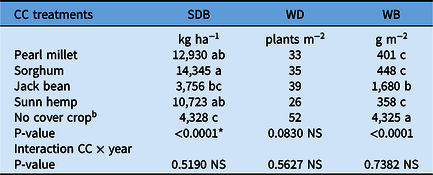
There was no significant interaction between the cover crop and the growing season (2016 and 2017) for the traits evaluated in the research. Therefore, the effects of cover crops were averaged over growing seasons (Table 2).
Shoot dry biomass (SDB), weed density (WD), and weed dry biomass (WB) at 60 d after cover crop sowing over two cover crop (CC) growing seasons (2016 and 2017). a

a Different lowercase letters in a column indicate treatments differ by the Tukey test at a 0.05 level of significance. Asterisk (*) denotes significance and NS denotes nonsignificance of the treatments and interaction with year by F-test of ANOVA at a 0.05 level of significance.
b No cover crop: yield of shoot dry biomass of the spontaneous growth of native weeds.
However, there was a significant difference among the cover crops in the yield of shoot dry biomass (P < 0.0001). Sorghum with 14,300 kg ha−1 was more productive than jack beans (3,700 kg ha−1) and no cover crop–spontaneous growth of weeds (4,300 kg ha−1) but was not significantly different from pearl millet (12,900 kg ha−1) and sunn hemp (10,700 kg ha−1).
Regarding weed infestation at the end of the cover crop growing period, there was no difference among treatments for the weed density. However, weed biomass was lowest with sunn hemp, pearl millet, and sorghum (P < 0.0001), indicating the suppressive capacity of these species on weeds.
The growth of cover crops, specifically pearl millet, sorghum, and sunn hemp, was more efficient in reducing weed biomass (Table 2). Vidal and Trezzi (Reference Vidal and Trezzi2004) reported the efficiency of sorghum and pearl millet to suppress weed density by approximately 41% and weed biomass by 74% during cover crop growth. In our trial, we noted that rapid and vigorous growth of cover crops is an important factor for weed suppression.
Thus, it is likely that the greater competitiveness of the higher-biomass cover crops for light, water, and nutrients led to decreased weed establishment. Similar to our findings, Soti and Racelis (Reference Soti and Racelis2020) reported that sudangrass [Sorghum bicolor (L.) Moench ssp. drummondi (Nees ex Steud) de Wet & Harlan] and sunn hemp have the potential to control weeds in the organic production of vegetables in semiarid subtropical Texas. In our trial, the maximum effective action of the roller-crimper to kill sunn hemp was verified; with intermediate action for pearl millet and jack beans, with 15% regrowth; and inferior action for sorghum, for which regrowth reached 21% (data not shown). These results are supported by the results of Kornecki et al. (Reference Kornecki, Price, Raper and Arriaga2009), who found that various types of roller-crimpers effectively killed cereal rye (Secale cereale L.) cover crops with mechanical termination efficiency above 90%. However, it should be highlighted that achieving successful establishment of soil surface organic mulch and weed suppression is dependent upon the type of roller-crimper and the cover crop species (Creamer and Dabney Reference Creamer and Dabney2002).
Weed Establishment in the Tomato Crop
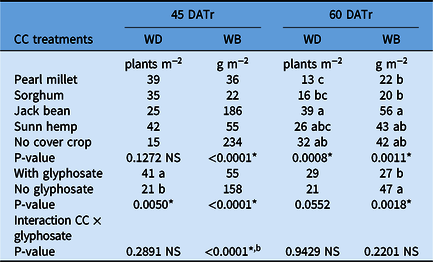
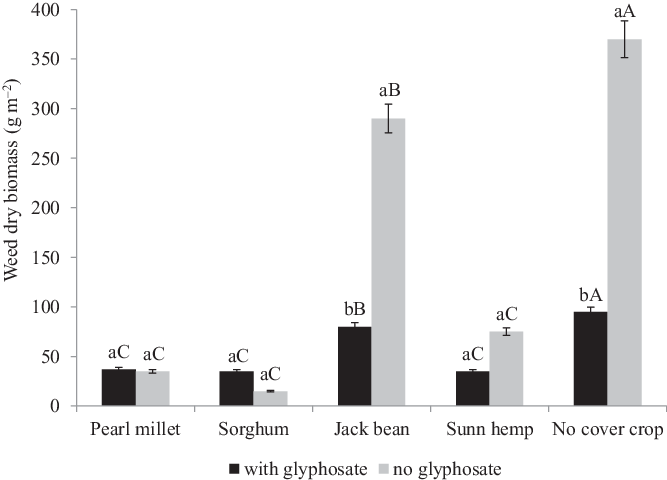
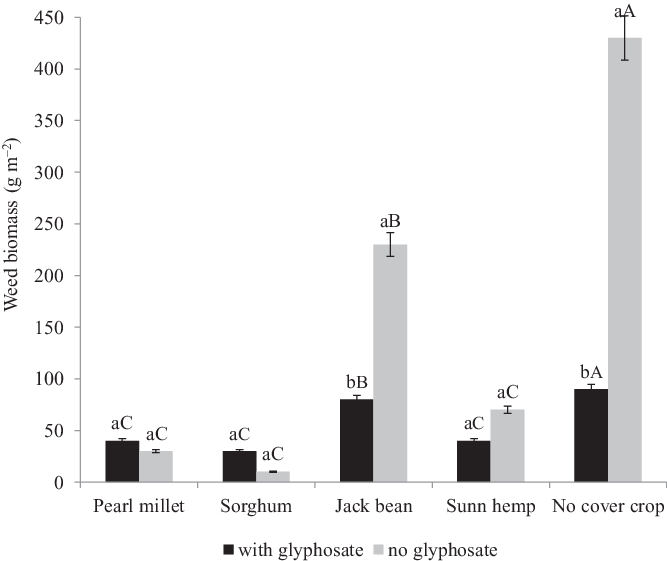
In the evaluation of weed establishment measured at 45 DATr, there was no significant effect of cover crop species on weed density (Table 3). However, when herbicide was sprayed, the weed density was higher than when it was not sprayed (P = 0.005). Regarding weed biomass at 45 DATr for tomato, there was a cover crop by herbicide treatment interaction (P < 0.0001). With jack bean and the no cover crop (control), glyphosate spraying reduced weed biomass by 1.8-fold compared with no spraying (Figure 1). However, sunn hemp, pearl millet, and sorghum cover crops were more efficient in reducing weed biomass, so the application of glyphosate did not further decrease weed biomass.
Weed density (WD) and weed dry biomass (WB) measured at 45 and 60 d after transplanting tomato (DATr) in the cover crop (CC) treatments with and without glyphosate spraying. a

a Different lowercase letters in a column indicate differences among treatments as determined by the Tukey test at a 0.05 level of significance. Asterisk (*) denotes significance and NS denotes nonsignificance of the treatments and their interactions by F-test of ANOVA at 0.05 level of significance.
b Due to a significant cover crop by glyphosate interaction, simple effects are presented in Figure 1.
Interaction of cover crop (CC) and herbicide treatment on weed dry biomass (g m−2) at 45 d after transplanting tomato; different lowercase and uppercase letters indicate, respectively, difference between herbicide treatments and among cover crops, according to the Tukey test at a 0.05 level of significance.

In the evaluation of weeds at 60 DATr for the tomato crop (Table 3), only the organic mulch from the pearl millet had a lower weed density compared with jack beans and no cover crop control but did not differ from the sorghum and sunn hemp (P = 0.0008). For weed biomass evaluation at 60 DATr for tomato, mulches from pearl millet and sorghum were more effective than mulch from jack beans in reducing weed biomass; however, none of the cover crop mulches resulted in weed biomass that was significantly lower than the no cover crop control (P = 0.0011). Regarding glyphosate spraying, there was a significant reduction in weed biomass when herbicide was sprayed compared with no spraying (P = 0.0018). Thus, glyphosate was effective in reducing weed biomass but not weed density. This phenomenon occurs because glyphosate speeds up the decomposition of organic mulches, which diminishes their effectiveness as a physical barrier and favors weed germination. Thus, high weed density provides self-competition, which reduces weed biomass (Miville and Leroux Reference Miville and Leroux2018).
In addition to high biomass production, the great efficacy of sorghum on weed suppression may also be due to the allelopathic substance produced by sorghum, p-benzoquinone, known as sorgoleone, which can contribute to reducing weed establishment in vegetable crops (Einhellig and Souza Reference Einhellig and Souza1992). Regarding pearl millet, although allelopathic substances are not known in this species, it has great suppression potential due its high biomass, which leads to weed suppression (Silva et al. Reference Silva, Hirata and Monquero2009; Vidal and Trezzi Reference Vidal and Trezzi2004).
Tomato Growth and Yield
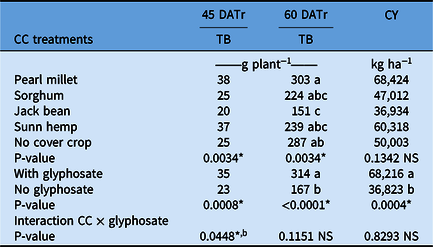
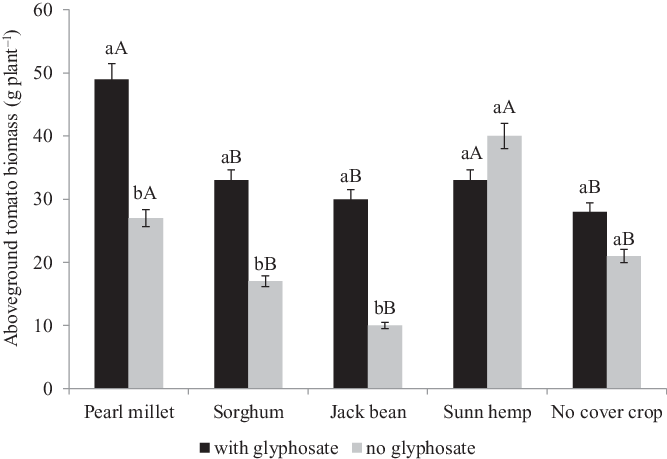
As shown in Table 4, there was a significant cover crop by herbicide interaction (P = 0.0448), wherein herbicide spraying provided a higher growth of the tomato plant at 45 DATr, specifically when cultivated in pearl millet, sorghum, and jack bean organic mulch (Figure 2), whereas no benefit was obtained with glyphosate applied to sunn hemp mulch and the no cover crop control. In the early season (45 DATr), sunn hemp mulch provided excellent growth of tomato even without glyphosate, unlike the three other cover crops.
Tomato dry biomass (TB) at 45 and 60 d after transplanting (DATr) and tomato commercial yield (CY) in the cover crop (CC) treatments with and without glyphosate spraying. a

a Different lowercase letters in a column indicate values differ by the Tukey test at 0.05 level of significance. An asterisk (*) denotes significance and NS denotes nonsignificance of the treatments and their interactions by F-test of ANOVA at a 0.05 level of significance.
b Due to a significant cover crop by glyphosate interaction simple effects are presented in Figure 2.
Interaction of cover crop (CC) and herbicide treatment on tomato shoot dry biomass (g plant−2) at 45 d after transplanting tomato; different lowercase and uppercase letters indicate, respectively, difference between herbicide treatments and among cover crops, according to the Tukey test at a 0.05 level of significance.

At 60 DATr, tomato biomass was higher when grown in pearl millet mulch than in jack bean mulch, but did not differ from the biomass yielded from the other cover crops, including the no cover crop control (P = 0.0034). Herbicide spraying of the flattened cover crops improved tomato biomass over non-spraying.
For commercial tomato yield, there was no significant effect of cover crops (Table 4). However, when herbicide was sprayed, the commercial tomato yield was higher than for the non-sprayed treatment (P = 0.0004).
Langeroodi et al. (Reference Langeroodi, Radicetti and Campiglia2018) reported that in tomato crops, the efficacy of weed suppression by barley (Hordeum vulgare L.) cover crop residues left on the soil surface was greater than for incorporated residues, which may allow for a reduction in herbicide rate for weed management without interfering with tomato yield.
Teasdale and Abdul-Baki (Reference Teasdale and Abdul-Baki1998) reported that cereal rye residue mixed with legumes was effective in suppressing weeds and that the addition of metribuzin herbicide application to cover crop mulch enhanced weed suppression and increased tomato yield, similar to our results with glyphosate spraying. However, the authors pointed out the possibility of growing tomato under no-tillage using a cover crop mulch without herbicide spraying.
Weed Establishment in the Broccoli Crop
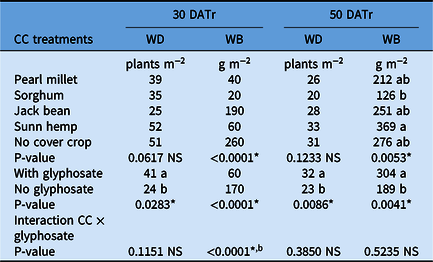
At the evaluation of weed infestation at 30 and 50 DATr of broccoli, there was no significant difference among cover crop treatments for weed density (Table 5). Curiously, herbicide sprayed on cover crop mulch resulted in a higher weed density compared with no spraying (P = 0.0283, P = 0.009). With regard to weed biomass at 30 DATr, there was a significant interaction of cover crop and herbicide (P < 0.0001) due to high weed biomass in the jack bean mulch treatment, and the fact that in the no cover crop (control) treatment, weed biomass was effectively suppressed with glyphosate spraying (Figure 3). The cover crops pearl millet, sorghum, and sunn hemp significantly reduced the weed biomass (P < 0.0001) at 30 DATr for broccoli, such that application of glyphosate provided no further decrease in weed biomass.
Weed density (WD) and weed dry biomass (WB) at 30 and 50 d after transplanting (DATr) of broccoli in the cover crop (CC) treatments with and without glyphosate spraying. a

a Different lowercase letters in a column indicate values differ by the Tukey test at 0.05 level of significance. An asterisk (*) denotes significance and NS denotes nonsignificance of the treatments and their interactions by the F-test of ANOVA at a 0.05 level of significance.
b Due to a significant cover crop by glyphosate interaction, simple effects are presented in Figure 3.
Interaction of cover crop (CC) and herbicide treatment on weed dry biomass (g m−2) at 30 d after transplanting broccoli; different lowercase and uppercase letters indicate, respectively, difference between herbicide treatments and among cover crops according to the Tukey test at a 0.05 level of significance.

Organic mulch from sorghum was more effective than sunn hemp mulch in weed biomass suppression at 50 DATr of broccoli (P = 0.0053; Table 5). Faster decomposition of sunn hemp mulch resulting in the release of nitrogen may have contributed to the germination and establishment of nitrophilic weeds (Jäck et al. Reference Jäck, Ajal and Weih2021; Moyer Reference Moyer2011). At 50 DATr for the broccoli crop, glyphosate-treated areas had a higher weed biomass than areas not sprayed with herbicide (P = 0.0041).
During the first 30 d of the broccoli growing cycle, a significant effect of cover crop on weed suppression was observed, especially for sunn hemp and the grasses sorghum and pearl millet. This could be attributed to these species producing a large quantity of residue on the soil surface, which provided environmental changes that reduced weed seed germination cues by changing the light availability and soil temperature amplitude, as well as the possible allelopathic effect of the cover crops, (Creamer et al. Reference Creamer, Bennett, Stinner, Cardina and Regnier1996; Navarro-Miró et al. Reference Navarro-Miró, Blanco-Moreno, Ciaccia, Chamorro, Testani, Kristensen, Hefner, Tamm, Bender, Jakop, Bavec, Védie, Canali and Sans2019; Teasdale and Mohler Reference Teasdale and Mohler2000).
The significant effect of pearl millet organic mulch on weed suppression in broccoli was consistent with the results of Grisa et al. (Reference Grisa, Mógor, Koehler, Mendes and Da Rolt2019), who demonstrated the potential of this species for the ecological management of weeds. The sunn hemp mulch also had suppressive effect on weed biomass only at 30 DATr of broccoli; however, by 50 DATr, a considerable increase in weed biomass had occurred. The release of nitrogen by the legume may have provided advantages for weed establishment (Creamer et al. Reference Creamer, Bennett, Stinner, Cardina and Regnier1996; Morse Reference Morse2001). Additionally, a higher organic mulching decomposition rate due to a low C/N reduces the physical efficiency of legume organic mulching in inhibiting weed establishment (Teasdale and Abdul-Baki Reference Teasdale and Abdul-Baki1998; Torres et al. Reference Torres, Pereira and Fabian2008). In contrast, the high C/N of grasses provides them a greater ability to reduce weed establishment within growing vegetables due to the lower decomposition rate and, consequently, the longer time organic mulch is maintained on the soil surface.
When glyphosate was sprayed on the cover crop residue, greater weed density and weed biomass were observed at 50 DATr for broccoli compared with the non-sprayed treatment. High precipitation (426 mm) during the broccoli growth cycle (Table 1) may explain the abundant establishment of weeds even with glyphosate spraying. Additionally, Miville and Leroux (Reference Miville and Leroux2018) reported that glyphosate accelerates organic mulch decomposition on the soil surface, allowing greater weed establishment compared with areas that were not sprayed with glyphosate.
Broccoli Growth and Yield
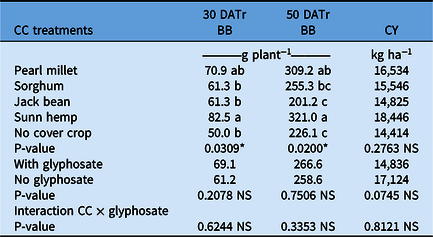
The broccoli dry biomass was higher in organic mulch of sunn hemp than all other treatments except pearl millet at 30 (P = 0.0309) and 50 (P = 0.0200) DATr, but there was no difference among cover crops on the commercial broccoli yield (Table 6). Additionally, there was no effect of herbicide spraying on broccoli growth at any time of evaluation (30 and 50 DATr) or on broccoli yield. Thus, regardless of the cover crop species and herbicide spraying, broccoli produced on average 16,000 kg ha−1 of commercial inflorescence. Melo et al. (Reference Melo, Madeira and Peixoto2010) reported a broccoli commercial average yield of 13,000 kg ha−1 grown under no-tillage regardless of the pearl millet and sorghum straw, which is slightly lower than our trial. Grisa et al. (Reference Grisa, Mógor, Koehler, Mendes and Da Rolt2019) reported 10,200 kg ha−1 of broccoli marketable yield in the pearl millet organic mulch, which was lower than our average yield, but they emphasized the utility of the technique for sustainable broccoli production.
Broccoli dry biomass (BB) at 30 and 50 d after transplanting (DATr) and broccoli commercial yield (CY) in the cover crop (CC) treatments with and without glyphosate spraying. a

a Different lowercase letters in a column indicate values differ by the Tukey test at a 0.05 level of significance. An asterisk (*) denotes significance and NS denotes nonsignificance of the treatments and their interactions by F-test of ANOVA at a 0.05 probability.
With regard to the variable effect of glyphosate in the broccoli trial, these results highlighted the resilience of broccoli to grow and produce without herbicide sprayed on flattened cover crops, which is consistent with the finding of Grisa et al. (Reference Grisa, Mógor, Koehler, Mendes and Da Rolt2019), who reported great efficacy of pearl millet in suppressing weeds in broccoli.
Miville and Leroux (Reference Miville and Leroux2018) indicated a need for glyphosate application before rolling cereal rye to suppress its regrowth and increase pumpkin (Cucurbita pepo L.) yield. However, glyphosate spraying was not effective for weed suppression in the pumpkin crop compared with non-spraying. Thus, we believe that the efficacy of glyphosate spraying on the organic mulch is dependent on the growth habit characteristics of the cash crop and edaphoclimatic conditions.
Although the cover crop–roller-crimper technology has been shown to be effective in significantly reducing weed biomass especially in the early season of cash crops, there is a need for additional weed management beyond 30 and 45 DATr of broccoli and tomato crop, respectively. Organic production under the principles of CA is more complex than conventional tillage, because soil surface organic mulch has to be preserved, which requires implementation of weed management practices with little disturbance.
In conclusion, this work has shown that the rapid and vigorous vegetative growth of pearl millet, sorghum, and sunn hemp cover crops was efficacious in reducing weeds, providing great potential for weed suppression.
The roller-crimper was an effective mechanical method for killing the cover crops. Glyphosate enhanced weed biomass suppression in vegetable crops at 30 and 45 DATr of broccoli and tomato crops, respectively, and improved tomato growth and yield, while broccoli yield was unaffected by glyphosate spraying. Cover crops that give high biomass production and are terminated by roller-crimping to allow for retention of the residue as organic mulch on the soil surface have been demonstrated to have the potential for use in vegetable production.
This technology reduces or even eliminates herbicide in the context of CA in tropical regions.
Acknowledgments
This research was funded by The São Paulo Research Foundation (FAPESP process: 2015/15443-0). Additionally, we are grateful to the field staff of the Instituto Agronômico (IAC) for their support in the execution of these trials. We declare that no conflicts of interest are in this research.