



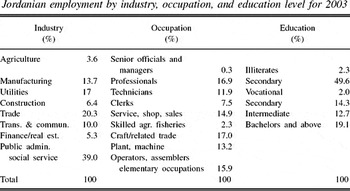
This table shows the employment of Jordanians across industrial, educational, and occupational groups as a percentage of total employment in 2003. Note that the three major industries (in order) are public administration/social services; trade, including hotels and restaurants; and manufacturing. Almost 50 percent of Jordanian workers had less than a secondary education, and almost 50 percent of all employees fell into three occupational groups: service, shop, and market sales; craft and related trades; and elementary occupations.
Our research focuses on Aqaba, a southern city of 86,000 and Jordan's only port, on the Red Sea. Although unique in some aspects, the Aqaba labor market is also influenced by numerous national governmental directives and activities. In August 2000 Jordan's parliament created the Aqaba Special Economic Zone, a sustainable development initiative for the private sector that offers global investors tax advantages and flexible regulation within a duty-free zone. Encompassing an area of 375 square kilometers, this world-class business environment supports a range of enterprises, from tourism to professional services to light manufacturing.
Our study highlights strengths and weaknesses of the Aqaba labor market, including some that apply to Jordan as a whole. It is important to point out that 45.8 percent of all private-sector workers outside of agriculture were in firms employing one to four workers, often defined as the informal sector. Another 19 percent were in firms employing five to nineteen workers. More than half of the 190,000 workers in nonagricultural enterprises employing less than 20 workers were in trade and repairs. It is clear that micro and small firms provide much of the private-sector employment and could constitute, under proper conditions, a growth center for the Jordanian economy—including in Aqaba.
Our goal is to improve the understanding of labor market conditions and the role of labor market institutions, to identify issues of concern, and to recommend ways of resolving problems that already exist or may emerge as a consequence of the new market structures and operations. We place our analysis of the Aqaba labor market in a national context by considering the current change being experienced by all Jordanians and the mindsets through which citizens may view these changes and which influence their interpretations and actions.
No brief summary can do justice to the many forces that have buffeted Jordanian society and its economy in the last two or three generations. Some of the major events that have transformed Jordan are the end of colonialism and British (and French) hegemony over much of the Middle East; the establishment of Israel and the subsequent conflicts and border changes; the creation of OPEC and the resulting massive transfer of wealth from oil-using to oil-producing nations—a change that also impacted Middle East nations with few oil reserves; massive population transfers from rural to urban areas, together with rapid increases in population; the end of the Cold War and the emergence of the global economy; the rapid spread of technology; and the reform plan decreed by the Jordanian government.
Given the history of Jordan, its centralized government, and its centralized economy, it is not surprising that many people still seek government solutions to their myriad problems. Decentralized market processes have not yet proven that they can deliver widespread prosperity. Historically, economic security and economic advancement could be achieved mainly through or with the support of some centralized authority. Moreover, that long history has led some governmental officials to define their roles as determining economic processes—incomes, wages, prices, employment, and so forth—via the coercive power of government, “controlling the market” as it were.
Closely allied to the control mindset is one related to credentialism. Education is crucial to any developing economy because of its connection to productivity, adaptability, and creativity, but the use of education not as human capital development but as a ticket to income and employment can result in a misallocation of resources. Under such conditions, schooling may be undertaken to acquire the sheepskin with its established perquisites and social status without necessarily increasing the graduate's productivity or usefulness. Such a phenomenon is rampant in centrally controlled economies in which entry to particular positions and pay levels are determined by some form of credentialism rather than by performance.
The privatization effort recently undertaken in Jordan at the highest level reflects a market mindset as distinct from a control mindset. Under competitive capitalism, government must take on a different, more hands-off economic role. It does not preclude, however, ameliorative action, such as improving the operations of markets, including the labor market. The Jordanian government's recent reform plan involves slimming the public sector, privatizing state-owned enterprises, enhancing the climate for foreign investment, streamlining approval procedures, minimizing external borrowing, limiting access of non-Jordanians to the employment market, and promoting Jordanian employment throughout the Arab region. We are studying how different mindsets greet this change, one resisting necessary adjustments, another responding with self-confidence and self-reliance.


