Introduction
Following the devastating earthquake in Port-au-Prince, Haiti, on January 12, 2010, France immediately responded to the request by the Haitian authorities for international assistance. One of the interventions of this mission was the deployment of medical teams, doctors and nurses, from various units in order to reinforce overwhelmed local hospitals.
Several medical teams were sent to assist health care workers in the Diquini Hospital, in the district of Carrefour (west of Port-au-Prince) from January 17-26. During this period, the number of French medical doctors (MDs) and nurses working there varied from 30 to 50.
Report
Health Care Activity and Organization
After arriving in Port-au-Prince, the French teams were assigned to the Adventist Hospital of Diquini on January 17, 2010. While the hospital was operating on a 24-hour, seven-days-a-week schedule, for security reasons it was decided that the French teams would work on a full daytime basis during the entire mission.
As the situation on the fifth day after the earthquake was still chaotic, the initial assessment led the French team to implement basic disaster procedures. Several hundred patients spontaneously gathered on the hospital lawns, where a tent-sheltered surgical unit was operated by two Mexican surgeons. A Colombian team (one doctor and three paramedics) also was working there with no known coordination with the other care facilities. At this point, global medical activity was impossible to assess.
A medical laboratory and X-ray facilities were available and functional in the concrete building. In addition, the hospital manager was present, and during the whole mission he was in charge of the teams and work coordination. Every afternoon, he organized a meeting with all the foreign team leaders and proposed or approved organization decisions.
Initially, the French team improvised four rescue posts on the hospital lawn, among the patients and their families. Equipment found in the damaged hospital building helped improve capabilities of the rescue posts. However, after two days of operation it became apparent that this organization scheme made it difficult to get a global vision of activity and to ensure the necessary follow-up care of patients. Furthermore, the patients and their families were moving about freely in this open space, thus changing their referent first-aid post. Added to this, numerous new patients were entering the hospital every day, some presenting with serious injuries such as pelvis or limb fractures.
In order to resolve the issues that had been identified, on January 20, four functional areas were created: (1) post-operative; (2) pre-operative and minor traumatology; (3) medical, including patients with spinal cord injuries; and (4) receiving/triage at the hospital entrance. This new four-unit organization facilitated better patient treatment and follow-up.Reference Redmond, Watson and Nightingale1 It also proved to be an effective way to integrate approximately 60 professionals from 10 different French emergency services and other foreign countries (one-third of them medical doctors and surgeons).
The set up included 19 collective tents that helped to limit patient mobility in the hospital. The collective tents also enabled a reduction in the number of makeshift shelters or individual tents scattered on the hospital lawn.
All patients were registered on a pre-printed form that was used by the hospital prior to the earthquake. Each patient was given a unique identification number that was recorded on his/her file and X-rays and, initially, written on the patient's forearm. The files were archived in the pre-operative area or left with the patient in the post-operative or medical area.
Achievements
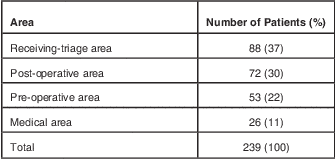
A total of 2,092 medical procedures were performed in the various medical posts of the hospital from January 17 until January 26. The number of patients treated on January 26 in each medical area appears in Table 1. Post-operative activity primarily included application of dressings and intensive care; pre-operative activity consisted of immobilizations and minor surgery; receiving/triage activity was mainly family medicine; and the medical area dealt with obstetric patients as well as spinal cord injuries, a predominant feature in earthquakes.Reference Chen, Song, Kong, Zhou and Liu2
Health Care Activity and Organization of French Teams on January 26, 2010
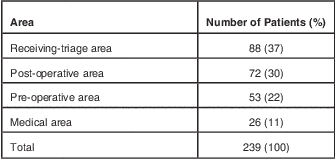
Analysis of the situation on January 26 highlighted the importance of the receiving/triage area as new patients arrived every day. Post-surgery activity accounted for 30% of the daily activity (Table 1).
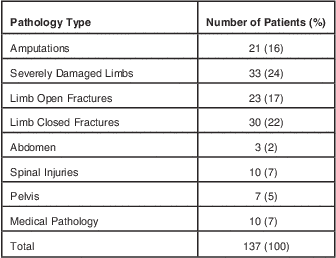
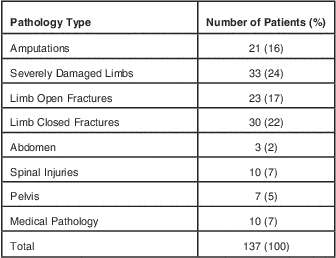
The predominant injury encountered within the 12 days after the earthquake consisted of limb injuries (79%); of these, 22% presented with closed fractures (Table 2).Reference Bulut3 - Reference Hughes and Pappin7 Amputations were performed on patients with crush syndromes or severely damaged limbs. These percentages confirm data published after recent earthquakes in Japan (Kobe, 1995), Iran (1990 and Bam in 2003), Pakistan (Kashmir, 2005) and Turkey (Marmara, 1999) and should be similar to data from the Southeast Asia tsunami victims, where medical pathologies were preponderant.Reference Kwak, Shin, Kim, Kwon and Suh8
From January 19 to 26, teams of the pre-operative and minor traumatology areas ensured follow-up on 441 patients treated in the pre-operative area; 150 had been operated on and 55 had been evacuated. On the remaining 236 patients, emergency practitioners performed surgical wound cleaning, immobilization, and other minor surgery.
Despite the severity of the pathologies and the initial lack of proper equipment, making it impossible to respect Western medical standards, the pre-operative teams had the following objectives:
(1) Carry out operations that normally would be performed in the operating room but which, under the circumstances, needed to be carried out in the pre-operative area to alleviate the already overbooked schedules of the operating room and avoid day-long, or even week-long, delays: finger or toe amputations with flaps; finger skin flap; surgical debridement; fracture reduction; and chest tube insertion;
(2) Prevent infection: patients with infected wounds (defined by the presence of pus) were given oral antibiotics;
(3) Relieve pain: most patients suffered broken limbs and extensive skin loss. In all cases, conscious sedation was obtained with the intravenous administration of ketamine; and
(4) Send the most urgent cases to the surgical teams without delay.
The efforts of doctors and surgeons to avoid amputation were reassuring to the patients.
Triage
Triage was done at the entrance of the hospital during the admission process and daily in the different areas. A triage physician was in charge of coordination, prioritizing treatment and evacuation. The amount of work involved led to allocating up to five physicians for this task.
Decisions were based on injury or medical severity: (1) First priority: life threatening; (2) Second priority: functional prognosis; and (3) Third priority: others. Triage decisions also were based on surgeon and operating room availability. The equipment available also proved to be a major deciding factor, eg, shortage of external fixators. The possibility of evacuation to another local hospital or to a foreign country also influenced triage decisions. All these elements where influenced by ethical concerns such as the amputee's future. Thus, conservative treatments were preferred, consisting mainly of nursing and wound dressing using available resources.
Surgical Unit Activity
On January 18, the hospital manager asked for help from the French teams in order to compensate for the lack of anesthetists in the tent-sheltered surgical unit set up in front of the concrete building. The team decided to perform surgery under spontaneous ventilation general anesthesia. Therefore, it was decided to have the unit managed by an emergency physician and a nurse anesthetist. This team worked with two surgeons from Mexico and was replaced by a French anesthetist on January 25.
Drugs usually administered in prehospital care in France were gathered to supplement the scarce resources available in the hospital (ie, nitrogen protoxide, ketamine, morphinics, propofol).
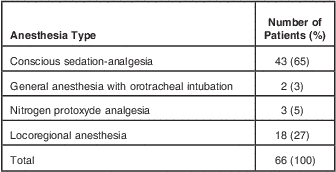
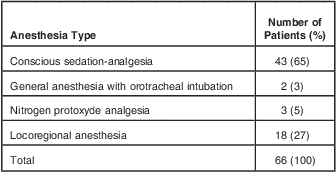
Despite the absence of neurostimulators, transarterial axillary blocks, as well as serial spinal anesthesias using Marcaine were performed. Of the 66 anesthesias performed, locoregional anesthesias represented 27% of the cases (Table 3).
Anesthesia Activity in the Tent Sheltered Operating Room, January 18-26
On January 20, both operating rooms in the hospital building were opened and staffed by surgical teams from Loma Linda University in California, USA. The challenge was to work in close cooperation with the surgeons and the various nongovernmental organizations (NGOs) that offered their services to the hospital. Thus, each day a coordination meeting was organized involving the people in charge of each structure. Thanks to the unconditional support of the hospital manager, and after explaining the importance of triage ahead of surgery, a “mixed” visit was set up every morning involving both the American surgeons and the French emergency physicians. Following this visit, the operating schedule was established for the next 24 hours. The teams worked round-the-clock shifts in the operating room.
With the aim of limb preservation, external fixators were used on upper and lower limbs and the pelvis, even in pediatric cases. The performance of plate or nail osteosynthesis was limited by the absence of an X-ray image intensifier and the inability to perform perioperative X-rays.
Giving priority to major surgery and limb preservation entailed delays as long as several days in post-operative care such as dressing changes. Amputations were performed in two steps, a few days apart, with a guillotine cut and hemostasis done in the first step. Basic post-surgery treatment and follow-up care were carried out by the French teams. The Loma Linda University surgeons were changed every 48 to 72 hours, and they focused only on surgery.
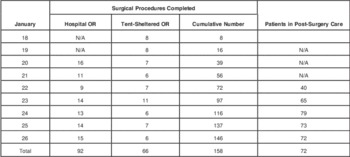
A comparison of surgical and post-surgical activities suggests that many patients may have decided to leave the hospital without any medical advice or suitable out-patient follow-up (Table 4). Indeed, 158 surgical procedures were performed for 150 patients while only 72 inpatients were present in the post-operative ward on January 26 (Table 4).
Surgical Procedures Completed and Number of Patients in Post-Surgery Care, January 18-26

Abbreviation: OR, operating room
Regulation and Evacuations
The task of setting up treatment priorities and the operating schedule was difficult due to patient mobility and the initial difficulty in communication with the surgeons. A coordinating doctor was designated to act as a link between the medical teams.
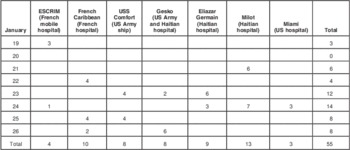
As treatment capability improved in Port-au-Prince and Diquini Hospital no longer was isolated, patient triage included victims to be transferred. Several hospitals accepted patients who, in most cases, could not have been treated in Diquini or who would have had to endure a very long wait for needed treatment. As in other disaster situations, patient transfers and evacuations constituted a major component of patient triage (Table 5).Reference D'Amore and Hardin9 - Reference Tanaka, Iwai and Oda11
Destinations of the 55 Patients Evacuated from January 19-26

Abbreviation: ESCRIM, Port-au-Prince French high school
Haitian hospitals, reinforced by NGOs, took in 22 transfer patients. Some were evacuated to Eliazar Germain Hospital, a newly built structure in the Port-au-Prince town center that had survived the earthquake; this hospital was fitted with equipment, accommodation, and round-the-clock medical staff. The hospital in Milot, a town in northern Haiti that also was spared by the earthquake, called upon their partnership with surgical teams from Florida and were able to increase the hospital's in-patient capacity and accept orthopedic, ENT, and stomatology patients.
Sixteen patients were entrusted to the US Army Health Services, which had set up two field hospitals: one in a building at the Gesko University Hospital, the other on the hospital ship USNS Comfort at anchor off the city coast. This ship, fitted with the same equipment as a regular hospital, can accommodate up to 1,000 patients.
Fourteen patients were evacuated to the French Caribbean or to the hospital set up inside the Port-au-Prince French high school (ESCRIM).
Handicap International provided care for three patients with spinal injuries who were sent for neurosurgery to Miami, Florida USA.
The 55 patients who initially were admitted to Diquini Hospital were evacuated to seven different structures. Three physicians helped select the best-suited hospital. For Haitian hospitals, the French Foreign Affairs Ministry doctor transmitted the necessary information. His position at the French Embassy, his mobility, and direct connection with decision makers also made it easier to organize road or plane transportation. Evacuation to the two US Army hospitals was handled by an English pediatrician living in Port-au-Prince who had offered his help to his American colleagues, especially for patient triage. Finally, a doctor, who worked in the French mobile hospital organized patient transfer to the French Caribbean.
Evacuations were difficult, not only owing to regulation problems, but also because of logistics. For example, Diquini Hospital was one km away from the nearest helicopter supply drop zone, thus road transportation between the hospital and the helicopter was required. When heavy helicopters (with a capacity of six supine patients) were used, transfer between the hospital and helicopter was made in civil or military trucks with the same capacity. Evacuations within Port-au-Prince were performed using the civilian light-duty EC145 helicopter. A firefighter officially assigned to Diquini facilitated the organization of evacuations.
Logistics
All activities depended upon medical stocks, whether anesthetic drugs, antibiotics, or dressings. One of the two pharmacists from the French team was responsible for gathering all the medical equipment available on site. In addition, several rescue teams spontaneously added their supplies, thus avoiding an initial shortage. Supplies also were obtained from the stocks kept near the airport by the World Health Organization and various NGOs. But despite this help, the medical teams had to adapt and downgrade some procedures (eg, spontaneous ventilation general anesthesia, distal amputation performed in the pre-operative area and not in the operating room, improvised drainage tools such as glove fingers or IV lines).
Priority logistical problems were identified as they had immediate consequences on good hospital functioning. In particular, many stretchers disappeared, as the patients kept them as makeshift beds when discharged or when they spontaneously left the hospital.
Recommendations
Regarding the surgical unit, the use of a neurostimulator by trained teams should be considered as part of the anesthesia supplies, as it greatly improves the efficiency, quantity and quality of locoregional anesthesia. In addition, use of a neurostimulator in pre-surgery for particularly painful medical procedures would allow a reduction in the use of level-3 intravenous anesthetics and analgesic (ie, ketamine and morphinics).
Regarding team organization and preparation, it is important to note that while the teams initially had been organized to provide front-line medical assistance, they actually functioned as hospital staff reinforcement. As already observed in other reports, it is essential that the teams and their equipment be prepared to fill general medical care roles and to be self-reliant for an initial period of 10 days. In addition, equipment should be pre-packed in individual batches, like material designed for deployment by helicopter and used under specific conditions such as catastrophic incidents on-board ships.
Conclusion
Local hospital structures overwhelmed by damage from the earthquake were reinforced by simultaneous dispatch of independent medical teams. In this context, a rescue mission can be accomplished only through rigorous organization and perfect multinational integration.Reference Rokach, Pinkert, Nemet, Goldberg and Bar-Dayan12 Disaster medicine, an heir of war medicine, should keep evolving,Reference Briggs13 integrating multinational organizations such as NGOs and military health services of different countries. Also, the training of the medical teams is essential and must include the medical as well as logistical aspects. In the future, better patient follow-up care must be achieved in order to assess therapeutic decisions.
Abbreviations
- ENT:
ear, nose and throat
- NGO:
nongovernmental organization