




No CrossRef data available.
Article contents
Awareness of activity limitations and prediction of performance in patients with brain injuries and orthopedic disorders
Published online by Cambridge University Press: 01 March 2004
Abstract
The aim of this study was to compare the accuracy of performance predictions in experimental tasks with patients' awareness of activity limitations. Participants were 24 patients with brain injuries (i.e., traumatic brain injury and cerebrovascular disorders) and 22 patients with orthopedic disorders. Prediction of performance was examined in a memory task (word list learning) and a motor task (finger tapping). Awareness of activity limitations was measured by comparing patients' self-ratings and staff ratings in the Patient Competency Rating Scale (PCRS). Results for the PCRS showed that patients with orthopedic disorders underestimated and patients with brain injuries (i.e., patients with TBI) overestimated their level of functioning in the total scale and the social/emotional subscale in comparison to staff ratings. Both patient groups agreed with staff ratings in physical/basic self-care items. In the predicted performance tasks a similar pattern could be observed: None of the groups showed an overestimation of performance in the motor task, whereas patients with brain injuries overestimated their competency in the memory task. However, the agreement between both awareness measures (PCRS, predicted performance) was only low, which indicates that they might measure different aspects or levels of self-awareness. (JINS, 2004, 10, 190–199.)
Information
- Type
- Research Article
- Information
- Journal of the International Neuropsychological Society , Volume 10 , Issue 2 , March 2004 , pp. 190 - 199
- Copyright
- © 2004 The International Neuropsychological Society
INTRODUCTION
Aspects of impaired awareness of deficits have been an area of great interest in neurorehabilitation (Fleming & Strong, 1995; McGlynn & Schacter, 1989; Sherer et al., 1998a). A main reason for this interest has been the clinical observation that impairments in self-awareness of deficits after brain injury significantly influence rehabilitation outcome (Ezrachi et al., 1991; Sherer et al., 1998b; Walker et al., 1987).
There is no single method of measuring impaired awareness of deficits (Fleming et al., 1996; Sherer et al., 1998c). The most common method is the comparison of patients' self-ratings of activity limitations with family/significant other's ratings or clinicians' ratings (e.g., Gasquoine, 1992; Prigatano et al., 1986). The most frequently used questionnaire for this comparison is the Patient Competency Rating Scale (PCRS; Prigatano et al., 1986). With the PCRS it has been shown that in patients with brain injuries level of awareness depends on the domain of functioning asked for: Patients tend to overestimate their competency especially in nonphysical areas like social interaction, emotional control, and cognitive functions, whereas they are more accurate in items concerning physical activities/basic self-care activities (Prigatano et al., 1990). This finding has been replicated (Prigatano, 1996; Prigatano & Leathem, 1993) and been extended to a different scale (Gasquoine, 1992), an interview (Sbordone et al., 1998), and ratings of performance in naturalistic tasks (Hart et al., 1998). In contrast, Gauggel and colleagues (2000) found in a study with 87 patients with cerebrovascular accidents (CVA), that disagreement was most pronounced in items concerning motor activities with the patients rating themselves as less impaired than staff members. In items that include cognitive and emotional aspects they rated themselves as more impaired.
Even though the questionnaire approach is the most frequently used method for awareness measurement, it also has some limitations like for example biases that might influence patient, relative, and staff ratings (see, e.g., Fleming et al., 1996; Heilbronner et al., 1989; Wyller et al., 1996).
An alternative method to measure awareness of activity limitations is the predicted performance method, which allows the comparison between patients' predictions of performance in a concrete task and actual performance in that task (Gauggel et al., 2002). Awareness deficits are indicated by a higher prediction than actual performance. In healthy subjects, prediction accuracy has been studied in children of different age groups, indicating that the correlation between prediction and performance increases during the grade school years (Mazzoni & Nelson, 1998). Predicted performance experiments have also been used in patients with memory disorders. Schacter et al. (1986; described in Prigatano & Schacter, 1991) have shown that patients with Alzheimer's disease, but not patients with head injuries or anterior communicating artery aneurysms, overpredicted their performance in a verbal memory task. Gauggel et al. (2002) let 28 patients with CVA or TBI set personal goals for performance in a simple arithmetic task and found a low discrepancy between self-set goals and attained performance. Only one patient in their sample set an extremely high goal while all other patients set low to moderately high goals.
It should be clear from the above description that, at the current time, several quite different methods could be used for the assessment of awareness deficits in patients with brain injuries. All of these methods have their advantages and disadvantages. An interesting question is, whether the results of different methods are comparable. Therefore, the aim of this study was to compare the patient–staff rating method with the predicted performance method.
Both methods were employed in a group of patients with brain injuries and a clinical control group (i.e., patients with orthopedic disorders). Looking at awareness of activity limitations in patients with brain injuries, it is expected that there is a discrepancy between patient and staff ratings in the total scales and especially in social/emotional items of the PCRS (Prigatano, 1996; Prigatano et al., 1990). No or a low discrepancy is expected to occur in orthopedic patients because previous studies have not shown awareness deficits in that group (Godfrey et al., 1993; Wagner & Cushman, 1994).
In addition, we expected the same discrepancy in the predicted performance tasks. It was hypothesized that patients with orthopedic disorders will predict their performance more accurately than patients with brain injuries. Hart et al. (1998) have also provided some evidence that, similar to previous findings in the PCRS, patients with brain injuries tend to show different judgment about their performance in a task depending on the domain of functioning. In their study, patients with brain injuries reported more problems with physical but less problems with cognitive aspects of a task than healthy controls did. To be able to investigate this difference in our study, we chose two different predicted performance tasks: A simple motor task (finger tapping) and a cognitive task (i.e., word-list learning task). It was expected that patients with brain injuries would be accurate in their predictions of performance in the physical task but that they would overpredict their performance in the cognitive task. Patients with orthopedic disorders were expected to be accurate in both tasks.
There should be a relationship between both awareness measures concerning the patients who are identified as being impaired in their awareness of activity limitations. However, we could not specify the degree of this relationship because as yet no data were available.
METHOD
Research Participants
Twenty-four patients with brain injuries (BI) of different etiologies (i.e., traumatic brain injuries and cerebrovascular disorders) and 22 patients with orthopedic disorders took part in this study. All patients were recruited from neuropsychological or orthopedic rehabilitation facilities in Indianapolis, Indiana. Exclusion criteria for the BI group were (1) a severe language disorder, (2) persistent anterograde amnesia, (3) psychiatric hospitalization in the medical history, and (4) age under 16. Decisions for exclusion were based on a neuropsychological assessment at admission. Additionally, no patient with a pervasive neglect and only 3 patients with slight neglect participated. Exclusion criteria for the OP group were (1) any kind of brain injury, (2) psychiatric hospitalization in the medical history, and (3) age under 16.
BI included 13 patients with CVA and 11 patients with TBI. Patients with orthopedic disorders were used as a control group and included patients with pain symptoms and acute or chronic orthopedic disorders (e.g., torn ligament, slipped disc, arthritis, rheumatism). Orthopedic patients were selected as a clinical control group because they also have to adapt to changes in their lives due to health problems and are therefore a better choice than healthy controls (Alfano & Satz, 2000).
The groups were matched as closely as possible in regard to sex, age, and education. They were comparable in almost all of these variables (see Table 1 for details). Unfortunately, due to problems recruiting sufficient male patients with orthopedic disorders in the collaborating facilities, female patients were slightly overrepresented in the control group. We have to consider this in further analyses. BI consisted of 15 male and 9 female participants. OP consisted of 8 male and 14 female patients. A chi-square test revealed a nearly significant group difference [χ2(1, N = 36) = 3.14, p = .08].
Demographic and neuropsychological characteristics of the patient groups

Handedness was determined by asking several questions about handedness. In the BI group, 21 patients were right-handed and 3 patients were left-handed. In the OP group, 21 patients were right-handed and 1 patient was left-handed.
According to institutional guidelines, all patients gave informed consent. None of the patients were paid for participating in the study. Participants were told that the purpose of the study was to examine effects of an injury or illness on cognitive functions and activities of daily living. They were tested individually in one or two sessions depending on their clinical schedule. Patients with brain injuries were tested as soon as possible after admission to the rehabilitation program, so that they had not been engaged in extended treatment activities concerning awareness deficits, as they are typical for holistic rehabilitation programs (see e.g., Fischer & Trexler, 1999; Trexler et al., 2000).
Neuropsychological Assessment
For both patient groups, an assessment of intellectual functioning, mood, and locus of control was carried out to provide an estimate of the cognitive and affective impairments and activity limitations. Intellectual functions were assessed with the subtest reading/word recognition of the Wide Range Achievement Test (WRAT3; Wilkinson, 1993) and the subtest similarities of the Wechsler Adult Intelligence Scale–Revised (WAIS–R; Wechsler, 1981). The WRAT3 subtest reading/word recognition assesses reading level and provides an estimation of premorbid IQ. Possible total scores range from zero to 42 with each point indicating one word correctly pronounced. The subtest similarities of the WAIS–R is a measure of abstraction and reasoning abilities. Depending on the quality of answers, an age scaled score (possible range 1–19) was calculated in reference to the standardization sample with higher scores indicating better reasoning abilities.
Patients filled out the Beck Depression Inventory (BDI–II; Beck et al., 1996) to assess depression. For each participant the raw score was determined and used for further analyses. Possible total scores range from zero to 63. Higher scores correspond to higher levels of depression and a cut-off point of 19 is regarded as an indicator of mild to moderate depression.
Locus of control of health related behavior was assessed with the Multidimensional Health Locus of Control Scales (MHLC; Wallston & Wallston, 1978). This questionnaire consists of 18 questions of which always six different items build one of the three subscales: internal health locus of control, powerful others externality of control, and chance health locus of control. Possible total scores for each scale range from zero to 36 with higher numbers indicating stronger agreement with the statements of that scale. Table 1 gives an overview of test scores, and obtained p values for the two patient groups. No significant group difference was found for the WRAT3 reading/word recognition subtest [t(44) = −0.88, p = .39], which indicates that there was no difference in premorbid level of intellectual functioning. However, as was expected due to the presence of brain injuries in one of the groups, there was a significant group difference in the WAIS–R subtest similarities [t(44) = −2.21, p = .03], with the BI group showing lower scores than the OP group. Also, a tendency for a significant difference between the groups was found for mood [t(43) = 1.97, p = .06], with BI reporting more depressive symptoms than OP. For both groups, however, the mean depression score was below the cut-off for depression.
Tasks and Procedure to Measure Awareness
We employed two different methods to measure awareness: Comparison between patient and staff ratings in the PCRS and discrepancy between predicted and actual performance in a memory and a motor task.
Patient-staff rating discrepancy in the Patient Competency Rating Scale (PCRS)
To measure awareness with a questionnaire we compared the patients' self-ratings with clinicians' ratings in the PCRS. The PCRS is a rating scale, which consists of 30 items and measures activity limitations. Participants are asked to rate the perceived degree of competency in a wide variety of daily tasks. Ratings can be chosen from a 5-point scale from 1 (can't do) to 5 (can do with ease), with higher scores indicating more competencies. Following Prigatano et al. (1990), we also looked at the social/emotional and physical/basic self-care subscales, which consist of 10 and 8 items respectively. Patients' and clinicians' ratings were separately summed over all items and the subscales and difference scores were calculated. For the difference scores positive values indicate an overestimation of competencies by patients in comparison to clinicians' ratings and negative values indicate an underestimation. Patient and clinicians' ratings as well as the difference scores were used as dependent variables.
Discrepancy between predicted and actual performance in a cognitive and motor task
Accuracy of performance prediction in a cognitive task was assessed with a modified version of the Selective Reminding Test (Buschke, 1973). In addition to the regular administration of the test, immediately before hearing a 12-word list, participants were asked to predict the number of words they would be able to recall after hearing the list. They received feedback about their performance after each trial.
Accuracy of performance prediction in a motor task was assessed with a modified version of the Halstead Finger Oscillation Test (Halstead, 1947). The finger tapping procedure was performed as described in the instructions of the test but only with the preferred hand. In addition, before each finger tapping trial, participants were asked to predict their performance in number of taps they will reach. After tapping for 10 s they received feedback. Before the first trial, they were told that nearly nobody is able to reach more than 60 taps within 10 s. To keep the data set comparable for all patients only the first five trials (out of possible 10) were included in the data set. Predicted performance data in the finger-tapping task were not available from one right-handed patient with CVA because she was not able to perform the motor task with her preferred hand.
In both experimental tasks predictions and performances were recorded and averaged over the trials. To get an estimate of the average difference between predictions and performances a percentage score was calculated, ((prediction − performance)/prediction) × 100. Positive scores indicate a higher prediction than performance and negative scores indicate the opposite. The average predictions and performances as well as the percentage scores were used as dependent variables.
Data Analysis and Statistical Methods
A multivariate analysis of variance (MANOVA) was conducted to see if there is a difference between BI and OP over all awareness measures (difference score in the subscales of the PCRS, percentage score in the average predicted performance memory task, percentage score in the average predicted performance motor task). For further comparisons, 2 × 2 (Group × Rater or Group × Aspect) ANOVAs with one repeated measure (patient vs. staff or prediction vs. performance) were calculated to compare BI and OP in single awareness measures. To get an estimate of awareness deficits within the groups, effect sizes (ES)

according to Cohen (1988) were calculated between patients' and clinicians' ratings. ES for independent measures instead of ES for dependent measures were calculated according to the recommendations of Dunlap et al. (1996). Positive effect sizes indicate the expected underestimation of activity limitations by patients in the PCRS or the expected overprediction by patients in the predicted performance task. Negative effect sizes indicate the opposite.
Finally, Pearson product moment correlations were calculated between patient and staff ratings in the PCRS as well as between predictions and performances in the experimental tasks to assess their correspondence. This additional analysis was conducted since despite a large difference (deviation) between measures there could still be a strong correspondence of the data (e.g., due to a different use of the scale; Robins & John, 1997)
Because etiology seems to have an influence on awareness (e.g., Gauggel et al., 2000; Prigatano, 1996) additional subgroup analyses were performed for CVA and TBI. For the interpretation of the results of subgroup analyses it needs to be known that CVA and TBI patients did not differ in any of the demographic or neuropsychological variables, except for age [t(15.38) = −4.39, p = .001]. The difference in age was expected since CVA has a higher prevalence in older and TBI in younger people.
The relationship between both awareness measures was assessed in two ways. First, correlations between the difference scores for the total PCRS and the social/emotional subscales as well as the percentage score in the memory task were calculated. (These correlations were not calculated for the percentage score in the motor task, since no overprediction of performance was expected and observed in this task.) Second, both awareness measures were dichotomized using the 80th percentile of the orthopedic control group as the cut-off for an awareness deficit. The 80th percentile was chosen since it revealed the best value of agreement between the measures. The cut-off scores, therefore, were P80 = 16.39 for the percentage prediction − performance difference in the memory task, P80 = 0.8 for the patient − staff rating difference in the total PCRS and P80 = −1.6 for the difference in the social/emotional PCRS. All patients with a difference score above that cut-off were labelled as unaware whereas patients with a difference score below the cut-off were labelled as aware. Kappa-coefficients were calculated to assess agreement between both measures concerning the classification of patients as aware and unaware.
Finally, Pearson product moment correlations between demographic/neuropsychological variables and awareness variables were calculated to compare relationships between measures. To reduce the number of comparisons, only selected correlations were calculated. These were correlations that have been assessed previously in the awareness literature (i.e., time since onset, intellectual functioning, and depression; Anderson & Tranel, 1989; Gasquoine, 1992; Godfrey et al., 1993).
Even though multiple comparisons have been calculated in this study, an alpha level of .05 (instead of an adjusted alpha) was used for all analyses. This was done because there was also the problem of low statistical power due to small sample sizes in all groups, but especially in the subgroups of patients with CVA and TBI.
Due to a slight overrepresentation of female patients in the control group the influence of gender was analyzed separately. These analyses revealed no significant differences between male and female participants in any of the awareness measures. Therefore, sex has not been considered in further statistical analyses.
RESULTS
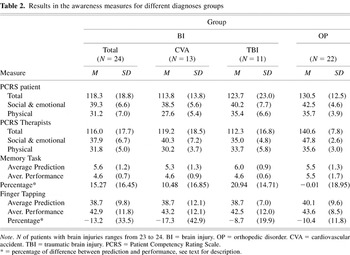
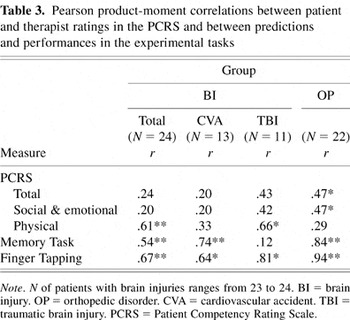
Table 2 gives an overview of the mean patient and staff ratings and predictions and performance data for BI and OP (and for TBI and CVA separately). Table 3 shows Pearson product moment correlations between patient and staff ratings in the PCRS and between predictions and performances in the experimental tasks. The MANOVA with group (BI vs. OP) as between-subject factor provided a significant group difference in awareness measures [F(4,40) = 8.58, p < .001] indicating that BI and OP differed significantly in their awareness measures.
Results in the awareness measures for different diagnoses groups

Pearson product-moment correlations between patient and therapist ratings in the PCRS and between predictions and performances in the experimental tasks

Patient Competency Rating Scale (PCRS)
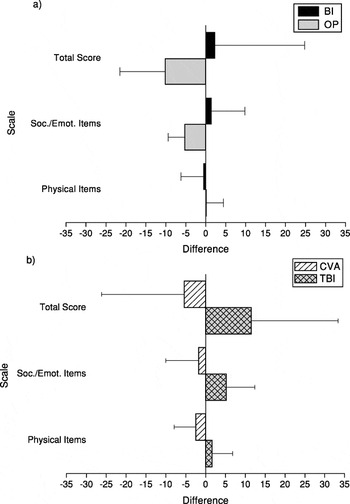
Concerning the difference between BI and OP in the PCRS, in three 2 × 2 (Group × Rater) ANOVAs a significant interaction between Group × Rater was found for the total score [F(1,44) = 5.53, p = .02], and the social/emotional subscale [F(1,44) = 11.55, p = .001], but not for the physical/basic self-care subscale [F(1,44) = 0.30, p = .59]. Effect sizes showed that in BI there was only a slight difference between staff ratings and patients' ratings for any of the scales (total PCRS: d = 0.1, social/emotional PCRS: d = 0.2, physical/basic self-care PCRS: d = −0.1; see Figure 1a). Whereas, patients in OP showed strong overestimations of activity limitations indicated by large ES for the total PCRS (d = −1.0) and the social/emotional subscale (d = −1.4). In OP, like in BI, there was only a slight difference between patient and staff ratings in the physical/basic self-care subscale (d = 0.03).

Differences between patient and therapist ratings in the three PCRS scales (a) for patients with brain injuries (BI) and patients with orthopedic disorders (OP) and (b) for patients with cerebrovascular accidents (CVA) and patients with traumatic brain injury (TBI). Error bars represent 1 SD.
Looking at the subgroups, three 2 × 2 ANOVAs revealed a significant interaction between Group × Rater for the social/emotional PCRS [F(1,22) = 4.81, p = .04], and a tendency for significant interactions in the total PCRS [F(1,22) = 3.70, p = .07], and the physical/basic self-care PCRS [F(1,22) = 3.74, p = .07]. The effect sizes showed opposite directions for the differences between patient and staff ratings for CVA and TBI (see Figure 1b). Only patients with TBI rated their activity limitations lower than staff. This effect was moderately high for the total PCRS (d = 0.6), moderately high to large for the social/emotional PCRS (d = 0.8) and small for the physical/basic self-care PCRS (d = 0.3). Patients with CVA, similar to patients in the orthopedic control group, rated their activity limitations higher than staff for all PCRS scales. The effect sizes were small to moderately high with d = −0.3 for the total PCRS, d = −0.3 for the social/emotional PCRS, and d = −0.6 for the physical/basic self-care PCRS.
Correlations between patient and staff ratings in the PCRS scales showed that the absolute differences between these ratings for TBI were not just due to a different use of the scale in patients and therapists: A significant positive correlation between patient and staff rating could only be found for the physical subscale, but not for the total PCRS or the social/emotional subscale (see Table 3). For OP, in contrast, significant positive correlations between patient and staff ratings were found for the total PCRS and the social/emotional subscale but not for the physical/basic self-care subscale, despite their strong overestimation of limitations. Even though patients with CVA showed an overestimation of limitations like OP, their patient and staff ratings did not correlate significantly for any of the scales.
Predicted Performance Tasks
Memory task
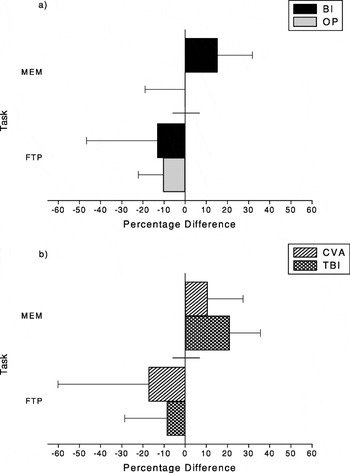
In the comparison of BI and OP, a 2 × 2 (Group × Aspect) ANOVA with aspect (prediction vs. performance) as a repeated measure found a significant interaction between Group × Aspect [F(1,44) = 13.01, p = .001]. Effect sizes indicate that patients with BI overpredicted their performance in the memory task (d = 1.1), whereas patients with OP did not show any difference between their average prediction and performance (d = 0.0; see Figure 2a).

Percentage differences (see text) between prediction and performance in the memory (Mem) and motor task (FTP) (a) for patients with brain injuries (BI) and patients with orthopedic disorders (OP) and (b) for patients with cerebrovascular accidents (CVA) and patients with traumatic brain injury (TBI). Error bars represent 1 SD.
Looking at the BI subgroups CVA and TBI, no significant Group × Aspect interaction was found [F(1,22) = 2.77, p = .11]. Both groups overpredicted their performance in the memory task with TBI patients showing even three times larger overprediction (d = 1.8) than CVA (d = 0.6; see Figure 2b).
Motor task
A 2 × 2 (Group × Aspect) ANOVA with aspect (prediction vs. performance) as a repeated measure did not reveal a significant interaction between Group × Aspect [F(1,43) = 0.12, p = .73]. Effect sizes indicate that both groups equally underpredicted their performance (BI: d = −0.4; OP: d = −0.4). No significant difference was also found between CVA and TBI in this task [F(1,21) = 0.04, p = .85]. Both groups equally underpredicted their performance (CVA: d = −0.4; TBI: d = −0.4; see Figures 2a and 2b).
Correlations between predictions and performances in the experimental tasks underline the results: In the memory task, predictions correlated significantly with performances for all groups, except for patients with TBI. In the motor task, predictions correlated significantly with performances for all groups (see Table 3).
Relationship Between the Awareness Measures
For the relationship between the awareness measures, significant positive correlations between the percentage score in the memory task and the total PCRS difference score (patient − staff; r = .33, p = .03) as well as the social/emotional PCRS difference score (r = .34, p = .02), could be found. Using a different method to estimate the degree of association between the awareness measures, we found a low agreement between both measures (kappa = .22, p = .14 for the total PCRS; kappa = .34, p = .02 for the social/emotional PCRS). Nine out of 18 patients and 12 out of 18 patients labelled as unaware by means of the total PCRS and the social/emotional PCRS subscale, respectively, were also identified as unaware by the cognitive performance prediction task.
Relationship of Awareness to Other Measures
Selected correlations between the awareness measures (social/emotional PCRS and memory task) and other measures are shown in Table 4. None of the differences between patient and staff ratings in the social/emotional PCRS correlated significantly with any of the demographic/neuropsychological variables. For the difference between prediction and performance in the memory task a significant relationship with the WAIS-R similarities could be found, r = −.31, p < .05, which indicates that overpredictions in the memory task were associated with lower scores on the similarities subtest.
Correlations between awareness measures and demographic/neuropsychological variables

DISCUSSION
The purpose of this study was to compare two methods to measure awareness in patients with brain injuries and orthopedic controls. Results in both measures confirmed our hypothesis that patients with brain injuries tend to overestimate their competencies in certain areas whereas patients with orthopedic disorders do not show this tendency. Especially patients with TBI overestimated their competencies in the questionnaire method as compared to clinicians' ratings. They also overpredicted their performance in the cognitive predicted performance task. In contrast, patients with orthopedic disorders tended to underestimate their competencies in both measures. These differences in awareness cannot be accounted for by the differences between BI and the control group (OP) in three of the demographic and neuropsychological variables since sex and mood did not correlate significantly with the awareness measures and reasoning ability only correlated slightly and inconsistently. A limitation of our study, however, is the fact that we were not able to include measures of perceptual and executive skills.
The relationship between both awareness measures was significant, but the agreement using cut-off scores to define aware versus unaware was low. It therefore seems that the PCRS and predicted performance experiments assess different aspects of self-awareness with some overlap. Previous studies in which different awareness measures (e.g., questionnaire and clinicians' rating) have been employed simultaneously found comparable results (e.g., Prigatano & Schacter, 1991; Sherer et al., 1998a, 1998b). These differences fit into theoretical models of self-awareness, which underline the complexity of the concept and limitations of the methods to measure awareness. For example, Fleming and Strong (1995) distinguish between three levels of awareness: Self-awareness or knowledge of deficits, self-awareness of functional implications of deficits, and realistic expectations (realistic prognosis and goal-setting). According to this model, the PCRS measures awareness on the first and second level, whereas predicted-performance experiments assess awareness on the third level.
Our hypothesis concerning the dependency of awareness deficits on the domain of functioning was strongly supported by both awareness measures. Patients with TBI in comparison to their clinicians' ratings especially underestimated their activity limitations in the social/emotional subscale of the PCRS, but much less their limitations in the physical/basic self-care subscale. In the same way, both groups of patients with brain injuries and especially patients with TBI overpredicted their performance in the cognitive task. But none of the groups showed any overprediction in the motor task. These results confirm a frequently reported outcome in studies concerning awareness of deficits in different contexts (Gasquoine, 1992; Hart et al., 1998; Prigatano, 1996) which might be due to the fact that physical/basic self-care problems are more predominant in the first stages after a brain injury and can be identified more reliably by patients than subtle and more complex social, emotional, and cognitive problems (Sbordone et al., 1998).
An inconsistent result is the difference between patients with TBI and CVA in the awareness measures. Only patients with TBI showed the predicted overestimation of competencies in both awareness measures, whereas patients with CVA only showed an overprediction of performance in the memory task, which was three times lower than the overprediction by patients with TBI. A potential reason for the missing overestimation of competencies in the PCRS by patients with CVA could be that the PCRS was initially developed to assess impaired self-awareness in patients with bilateral and asymmetric injuries and therefore might not be sensitive to awareness deficits due to CVA (Prigatano, 1996). Gauggel et al. (2000), however, found a substantial disagreement between staff and patient ratings in a modified version of the PCRS for 87 patients with CVA. Only 3 out of 30 items showed even moderate agreement. Another reason might be that patients with CVA and TBI differed in age. Age, however, did not correlate significantly with any of the awareness measures. Finally, the overall low difference between patient and staff ratings in the PCRS as well as their low correlation for patients with CVA could be due to the fact that the group of patients with CVA is more heterogeneous: It consists of some under- and some over-estimators, whereas the group of patients with TBI mainly consists of patients with different degrees of overestimation. This difference in the variability most likely is accounted for by variables like location, kind, or severity of lesion (e.g., higher likelihood of frontal lesions in patients with TBI; see e.g., McGlynn & Schacter, 1989; Wagner & Cushman, 1994). However, a limitation of our study is that we were not able to assess location, kind, or severity of lesion in detail.
Unexpected were the underestimations of competencies in the PCRS scales (especially the total PCRS and the social/emotional PCRS) by OP and patients with CVA. However, Prigatano and Leathem (1993) and Prigatano (1996) have previously reported underestimations of competencies in the PCRS for a group of Maori patients with TBI and for a control group consisting of patients with different diagnoses (e.g., psychiatric illness, learning disability). Prigatano et al. (1998) have also found a tendency for underestimation in the PCRS for a group of healthy controls. Since these groups showing underestimation are quite different it is not possible to give a simple explanation like for example cultural factors or location of lesion. Depression as another possible reason was excluded in our study since it did not correlate significantly with PCRS difference scores. Significant positive correlations between patient and staff ratings in the PCRS for OP indicate that their underestimation of competencies, at least in part, might be due to a different use of the rating scale by patients and therapists. Therapists more frequently used the most positive rating (can do with ease), whereas patients tended to use lower but corresponding ratings on the scale. This explanation, however, is not true for patients with CVA, since their ratings did not correlate significantly with staff ratings. It therefore might be that there are different mechanisms that account for underestimation of competencies in the different groups.
Surprising was also that in our study no relationship between level of awareness and depression could be found. A negative correlation between awareness and depression has been a consistent finding in recent research studies (e.g., Gasquoine, 1992; Godfrey et al., 1993). In our study, however, the average depression score for all groups was well below the clinically relevant cut-off score. Overall, only 6 out of 46 patients reached the clinical depression level. Therefore, the missing relation between depression and level of awareness is most likely due to limited variability in the depression data.
Overall, this study confirmed the usefulness of predicted performance experiments for the assessment of awareness deficits in patients with brain injuries. These awareness deficits are probably, though, on a different level than the ones assessed by the questionnaire approach. For the clinical context, this result indicates that it might be useful to use different awareness measures to capture the complexity of the concept. However, this result also further underlines the necessity to continue research activities especially concerning the assessment of awareness deficits. Besides its relevance for the understanding of human consciousness in general, self-awareness of deficits also is an important influencing factor on rehabilitation outcome (Sherer et al, 1998b; Walker et al., 1987). There are, however, no practical guidelines for the assessment of awareness deficits in the clinical rehabilitation process. For example, there are no norms, which would allow clinicians to objectify the magnitude and specificity of awareness deficits, which ultimately could guide the selection of rehabilitation activities. Additionally, in further research it would be interesting to investigate the role of different aspects or levels of awareness in the process and outcome of neurorehabilitation, like for example the role of realistic goal-setting.
ACKNOWLEDGMENTS
This paper is a part of the first author's doctoral dissertation, which was supported by the German Academic Research Service (DAAD) (Doktorandenstipendium im Rahmen des gemeinsamen Hochschulsonderprogramms III von Bund und Laendern) and the Illa und Werner Zarnekow Foundation (Stifterverband fuer die Deutsche Wissenschaft) through doctoral fellowships awarded to the first author.
We thank Community Hospitals Indianapolis and especially all clinics, therapists, and patients involved in the study for their support. We also thank Sara Geisler for data collection.
References
REFERENCES
Alfano, M.S. &
Satz, P.
(2000).
Commentary and perspectives on R.M. Allen's “The test
performance of the brain injured.”
Journal of Clinical Psychology,
56,
975–997.Google Scholar
Anderson, S.W. &
Tranel, D.
(1989).
Awareness of disease states following cerebral infarction,
dementia, and head trauma: Standardized assessment.
Clinical Neuropsychologist,
3,
327–339.Google Scholar
Beck, A.T.,
Steer, R.A., &
Brown, G.K.
(1996).
BDI-II manual.
San Antonio, TX:
The Psychological Corporation.
Buschke, H.
(1973).
Selective reminding for analysis of memory and learning.
Journal of Verbal Learning and Verbal Behavior,
12,
543–550.Google Scholar
Cohen, J.
(1988).
Statistical power analysis for the behavioral sciences.
Hillsdale, NJ:
Erlbaum.
Dunlap, W.P.,
Cortina, J.M.,
Vaslow, J.B., &
Burke, M.J.
(1996).
Meta-analysis of experiments with matched groups or repeated
measures designs.
Psychological Methods,
1,
170–177.Google Scholar
Ezrachi, O.,
Ben-Yishay, Y.,
Kay, T.,
Diller, L., &
Rattok, J.
(1991).
Predicting employment in traumatic brain injury following
neuropsychological rehabilitation.
Journal of Head Trauma Rehabilitation,
6,
71–84.Google Scholar
Fischer, S. &
Trexler, L.E.
(1999).
The CNR model of levels of functioning in brain injury
rehabilitation.
Zeitschrift für Neuropsychologie,
10,
103–114.Google Scholar
Fleming, J.M. &
Strong, J.
(1995).
Self-awareness of deficits following acquired brain injury:
considerations for rehabilitation.
British Journal of Occupational Therapy,
58,
55–60.Google Scholar
Fleming, J.M.,
Strong, J., &
Ashton, R.
(1996).
Self-awareness of deficits in adults with traumatic brain injury:
How best to measure?
Brain Injury,
10,
1–15.Google Scholar
Gasquoine, P.G.
(1992).
Affective state and awareness of sensory and cognitive effects
after closed head injury.
Neuropsychology,
6,
187–196.Google Scholar
Gauggel, S.,
Hoop, M., &
Werner, K.
(2002).
Assigned vs. self-set goals and their impact on the performance of
brain-damaged patients.
Journal of Clinical and Experimental Neuropsychology,
24,
1070–1080.Google Scholar
Gauggel, S.,
Peleska, B., &
Bode, R.K.
(2000).
Relationship between cognitive impairments and rated activity
restrictions in stroke patients.
Journal of Head Trauma Rehabilitation,
15,
710–723.Google Scholar
Godfrey, G.F.D.,
Partridge, F.M.,
Knight, R.G., &
Bishara, S.
(1993).
Course of insight disorder and emotional dysfunction following
closed head injury: A controlled cross sectional follow-up study.
Journal of Clinical and Experimental Neuropsychology,
15,
503–515.Google Scholar
Halstead, W.C.
(1947).
Brain and intelligence; A quantitative study of the frontal lobes.
Chicago:
University of Chicago Press.
Hart, T.,
Giovannetti, T.,
Montgomery, M.W., &
Schwartz, M.F.
(1998).
Awareness of errors in naturalistic action after traumatic brain
injury.
Journal of Head Trauma Rehabilitation,
13,
16–28.Google Scholar
Heilbronner, R.L.,
Rouche, J.R.,
Everson, S.A., &
Epler, L.
(1989).
Comparing patient perspectives of disability and treatment effects
with quality of participation in a post-acute brain injury
rehabilitation programme.
Brain Injury,
3,
387–395.Google Scholar
Mazzoni, G. &
Nelson, T.O.
(1998).
Metacognition and cognitive neuropsychology.
Mahwah, NJ:
Lawrence Erlbaum Associates.
McGlynn, S.M. &
Schacter, D.L.
(1989).
Unawareness of deficits in neuropsychological syndromes.
Journal of Clinical and Experimental Neuropsychology,
11,
143–205.CrossRefGoogle Scholar
Prigatano, G.P.
(1996).
Behavioral limitations TBI patients tend to underestimate: A
replication and extension to patients with lateralized cerebral
dysfunction.
Clinical Neuropsychologist,
10,
191–201.Google Scholar
Prigatano, G.P.,
Altman, I.M., &
O'Brien, K.P.
(1990).
Behavioral limitations that traumatic-brain-injured patients tend
to underestimate.
Clinical Neuropsychologist,
4,
163–176.Google Scholar
Prigatano, G.P.,
Bruna, O.,
Mataro, M.,
Munoz, J.M.,
Fernandez, S., &
Junque, C.
(1998).
Initial disturbances of consciousness and resultant impaired awareness
in Spanish patients with traumatic brain injury.
Journal of Head Trauma Rehabilitation,
13,
29–38.Google Scholar
Prigatano, G.P.,
Fordyce, D.,
Zeiner, H.K.,
Roueche, J.R.,
Pepping, M., &
Wood, B.C.
(1986).
Neuropsychological rehabilitation after brain injury.
Baltimore:
The Johns Hopkins University Press.
Prigatano, G.P. &
Leathem, J.M.
(1993).
Awareness of behavioural limitations after traumatic brain injury:
A cross-cultural study of New Zealand Maoris and non-Maoris.
Clinical Neuropsychologist,
7,
123–143.Google Scholar
Prigatano, G.P. &
Schacter, D.L. (Eds).
(1991).
Awareness of deficit after brain injury: Clinical and theoretical
issues.
New York:
Oxford University Press.
Robins, R.W. &
John, O.P.
(1997).
The quest for self-insight. Theory and research on accuracy and
bias in self-perception. In
R. Hogan,
J. A. Johnson, &
S.R. Briggs (Eds.),
Handbook of personality psychology (pp.
649–679).
San Diego, CA:
Academic Press.
Sbordone, R.J.,
Seyranian, G.D., &
Ruff, R.M.
(1998).
Are the subjective complaints of traumatically brain injured
patients reliable?
Brain Injury,
12,
505–515.Google Scholar
Sherer, M.,
Bergloff, P.,
Levin, E.,
High, W.M.,
Oden, K.E., &
Nick, T.G.
(1998b).
Impaired awareness and employment outcome after traumatic brain
injury.
Journal of Head Trauma Rehabilitation,
13,
52–61.Google Scholar
Sherer, M.,
Boake, C.,
Levin, E.,
Silver, B.V.,
Ringholz, G., &
High, W.M.
(1998c).
Characteristics of impaired awareness after traumatic brain injury.
Journal of the International Neuropsychological Society,
4,
380–387.Google Scholar
Sherer, M.,
Oden, K.,
Bergloff, P.,
Levin, E., &
High, W.M.
(1998a).
Assessment and treatment of impaired awareness after brain injury:
Implications for community re-integration.
NeuroRehabilitation,
10,
25–37.Google Scholar
Trexler, L.E.,
Eberle, R., &
Zappala. G.
(2000).
Models and programs of the Center for Neuropsychological
Rehabilitation: Fifteen years experience. In
A. Christensen &
B.P. Uzzell (Eds.),
International handbook of neuropsychological rehabilitation (pp.
215–229).
Dordrecht, The Netherlands:
Kluwer Academic Publishers.
Wagner, M.T. &
Cushman, L.A.
(1994).
Neuroanatomic and neuropsychological predictors of unawareness of
cognitive deficit in the vascular population.
Archives of Clinical Neuropsychology,
9,
57–69.Google Scholar
Walker, D.E.,
Blankenship, V.,
Ditty, J.A., &
Lynch, K.P.
(1987).
Prediction of recovery for closed-head-injured adults: an
evaluation of the MMPI, the Adaptive Behavior Scale, and a
‘Quality of Life’ rating scale.
Journal of Clinical Psychology,
43,
699–707.Google Scholar
Wallston, K.A. &
Wallston, B.S.
(1978).
Development of the Multidimensional Health Locus of Control (MHLC)
Scales.
Health Education Monographs,
6,
160–170.Google Scholar
Wechsler, D.
(1981).
Wechsler Adult Intelligence Scale–Revised.
New York:
The Psychological Corporation.
Wilkinson, G.S.
(1993).
The Wide-Range Achievement Test 3: Administration manual.
Wilmington, DE:
Wide Range Inc.
Wyller, T.B.,
Sveen, U., &
Bautz-Holter, E.
(1996).
The Frenchay Activities Index in stroke patients: agreement between
scores by patients and by relatives.
Disability and Rehabilitation,
18,
454–459.Google Scholar

Demographic and neuropsychological characteristics of the patient groups
Results in the awareness measures for different diagnoses groups
Pearson product-moment correlations between patient and therapist ratings in the PCRS and between predictions and performances in the experimental tasks
Differences between patient and therapist ratings in the three PCRS scales (a) for patients with brain injuries (BI) and patients with orthopedic disorders (OP) and (b) for patients with cerebrovascular accidents (CVA) and patients with traumatic brain injury (TBI). Error bars represent 1 SD.
Percentage differences (see text) between prediction and performance in the memory (Mem) and motor task (FTP) (a) for patients with brain injuries (BI) and patients with orthopedic disorders (OP) and (b) for patients with cerebrovascular accidents (CVA) and patients with traumatic brain injury (TBI). Error bars represent 1 SD.
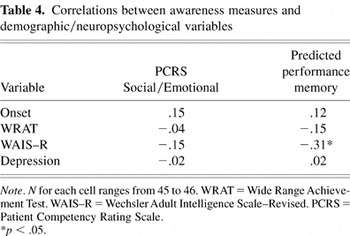
Correlations between awareness measures and demographic/neuropsychological variables
 You have
Access
- 61
- Cited by