Introduction
Since the outbreak of the pandemic in December 2019, coronavirus disease 2019 (Covid-19) continues to pose a significant challenge to the world. As of August 2021, more than 200 million people have contracted Covid-19, with 4.3 million deaths worldwide. Olfactory dysfunction because of Covid-19 has been described as an important clinical manifestation of the disease.Reference Lechien, Chiesa-Estomba, De Siati, Horoi, Le Bon and Rodriguez1 Patients usually recover within a few weeks, but 8–25 per cent of patients continue to suffer persistent olfactory dysfunction symptoms.Reference Boscolo-Rizzo, Guida, Polesel, Marcuzzo, Antonucci and Capriotti2–Reference Saussez, Sharma, Thiriad, Olislagers, Duc and Le Bon4 Patients with persistent olfactory dysfunction suffer significant morbidity, and because of the high prevalence of Covid-19 worldwide, they constitute a significant burden on the healthcare system.
The nasal cavity is an important gateway to the human body for Covid-19. Mucociliary clearance is the primary defence mechanism of the nasal cavity and respiratory system. It consists of the coordinated activity of ciliated cells combined with mucous-secreting glands and mucous membranes.Reference Soylu Ozler, Akbay, Akkoca, Soylu Karapınar and Özel Şimşek5 It has been previously reported that Covid-19 infection impairs mucociliary clearance time in the active infection period.Reference Baki, Damlaca, Yıldız, Gündoğar and Cırık6,Reference Koparal, Kurt, Altuntas and Dogan7 However, its long-term effects on mucociliary clearance time remain unknown. Moreover, the question regarding the differences in the long-term olfactory functions of patients post-Covid-19, with and without olfactory dysfunction, remains to be answered. Therefore, there were two main objectives of this study. The primary objective was to evaluate and compare the olfactory, sinonasal and mucociliary functions of patients with post-Covid-19 long-term persistent olfactory dysfunction. The secondary objective was to determine whether Covid-19 had a subclinical impact on olfactory and mucociliary functions in the long-term post-Covid-19 period.
Materials and methods
Participants and study design
The study was conducted in July 2021 at a secondary medical centre. Participants were prospectively and consecutively recruited from patients who were admitted to the otolaryngology clinic of Kırıkkale Yüksek İhtisas Hospital with either ongoing sudden-onset olfactory dysfunction following Covid-19 or non-specific otolaryngological complaints.
Three groups of patients were formed with 30 patients in each group: group 1 consisted of patients who had Covid-19 infection at least 6 months prior to the study time with self-reporting, persistent, sudden-onset olfactory dysfunction (hyposmia, anosmia) following Covid-19 infection, group 2 consisted of patients who had a Covid-19 infection at least 6 months prior to the study time without any self-reporting olfactory dysfunction (neither during the infection nor the study period), and group 3 comprised age- and sex-matched healthy controls who had not had any history of Covid-19 infection. While recruiting and grouping the patients, olfactory dysfunction was defined in a self-reporting manner because self-reported and psychophysically tested olfactory outcomes seem to be correlated.Reference Prajapati, Shahrvini, MacDonald, Crawford, Lechner and DeConde8
The inclusion criteria were as follows: confirmed chest computed tomography (CT) findings with Covid-19 pneumonia or polymerase chain reaction positive severe acute respiratory syndrome coronavirus-2 viral nucleic acid from nasopharyngeal or oropharyngeal swabs at least 6 months prior to study time for patients in groups 1 and 2, age more than 18 years, and Covid-19 related self-reported ongoing olfactory dysfunction for group 1.
Exclusion criteria included patients who were re-infected with Covid-19 or who had a history of pre-Covid-19 olfactory dysfunction and post-Covid-19 taste dysfunction, participants in group 2 or controls who reported olfactory or taste dysfunction based on the Sino-Nasal Outcome Test (SNOT)-22 scale, allergic rhinitis, nasal polyposis or acute or chronic rhinosinusitis, acute upper airway respiratory infection, a history of head trauma or nasal surgery, severe septum deviation, dementia, and patients with a history of drug abuse or use of drugs that affect smell (decongestant sprays, nasal steroids, chemotherapy and so on), pregnancy, brain or sinonasal malignancy, history of radiotherapy to the head, or metabolic or neurological disease.
Clinical and demographic outcomes
Demographic parameters, including age, gender, smoking (Brinkman index) and education status were recorded. A thorough otolaryngological examination was performed, including fibre-optic nasopharyngoscopy and laryngoscopy, with special attention to olfactory cleft visualisation. The duration of olfactory loss was noted. Additionally, nasal symptoms were assessed with the Turkish version of the Nasal Obstruction Symptom Evaluation scale and the Turkish SNOT-22.Reference Karahatay, Tasli, Karakoc, Aydın and Türker9,Reference Cakir Cetin, Kumus, Keskinoglu, Sütay and Ecevit10
The Turkish version of the Nasal Obstruction Symptom Evaluation scale includes five nasal obstruction related symptoms (nasal stuffiness, nasal obstruction, trouble breathing through the nose, trouble sleeping and inability to obtain sufficient air through the nose during exercise). The severity of each symptom was rated on a Likert scale of 0–4 (0: no problem, 4: problem as bad as it can be) by the participants and was scaled to a total score of 0–100 by multiplying the score by 5. The SNOT-22 test includes symptoms such as runny nose, sneezing, nasal obstruction, coughing, dizziness, facial pain or fullness, decreased sense of smell or taste, and trouble sleeping. Participants were asked to rate the severity of each symptom on a Likert scale of 0–5 (0: no problem, 5: problem as bad as it can be), with a possible range from 0 to 110.
Olfactory evaluation
The psychophysical olfactory evaluation was performed with the Sniffin' Sticks test (Burghardt Messtechnik, Wedel, Germany). Twelve odours were presented via a pen device for 3 seconds, and participants were instructed to choose the odour most similar to their smell experience from among 4 choices. Participants were instructed to mark an answer for each of the 12 odours (even if they smelled nothing). The maximum score of the test is 12, and scores of 6 or below were classified as anosmic, scores of 6 to 10 (including 10) as hyposmic, and scores of 10 to 12 as normosmic. The test was performed in a quiet and well-ventilated room by a single examiner. Participants were not allowed to smoke, eat or drink 15 minutes prior to testing.
Mucociliary clearance time evaluation
Nasal mucociliary clearance time was assessed with the saccharin test, which is an inexpensive, easy to perform and validated method.Reference Asai, Haruna, Otori, Yanagi, Fukami and Moriyama11 All tests were performed by a single examiner at room temperature. Participants rested in the examination room for half an hour and were asked to clear their nasal secretions prior to testing. A quarter of a saccharin tablet was placed in the anterior portion of the lower concha, and participants were asked to sit still without sniffing, coughing, sneezing, or eating or drinking. They were told to report as soon as they tasted saccharin. The time between the insertion of the saccharin tablet and tasting saccharin was accepted as the saccharin clearance time. A typical saccharin clearance time was 7–15 minutes, and values greater than this were considered pathological mucociliary clearance.
Data analysis
Data entry was performed using Microsoft Excel® spreadsheet software. Statistical analyses were performed using SPSS® statistical software (version 25.0) and GraphPad Prism statistical software (version 8.0.1, GraphPad Software, San Diego, USA). Shapiro–Wilk test and normal distribution parameters were used to assess the normality of the data distribution. Nominal categorical variables were compared with a chi-square test and a Fisher's exact test. A Mann–Whitney U test and Kruskal–Wallis test were used to test non-parametric variables. P-values less than 0.05 were accepted as indicating statistical significance.
Results
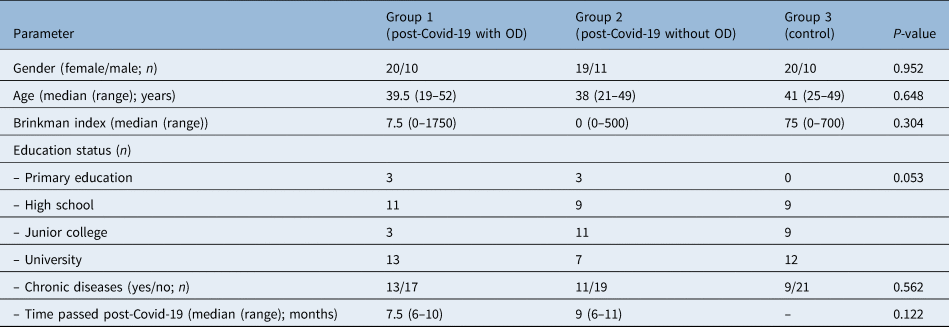
In total, 90 participants were included in the study, with 30 in each group (group 1: post-Covid-19 with olfactory dysfunction; group 2: post-Covid-19 without olfactory dysfunction; group 3: healthy controls). Age, gender, Brinkman index, education status, chronic disease status and time passed post-Covid-19 were similar between the three groups (Table 1).
Demographic and clinical features of patients

Covid-19 = coronavirus disease 2019; OD = olfactory dysfunction
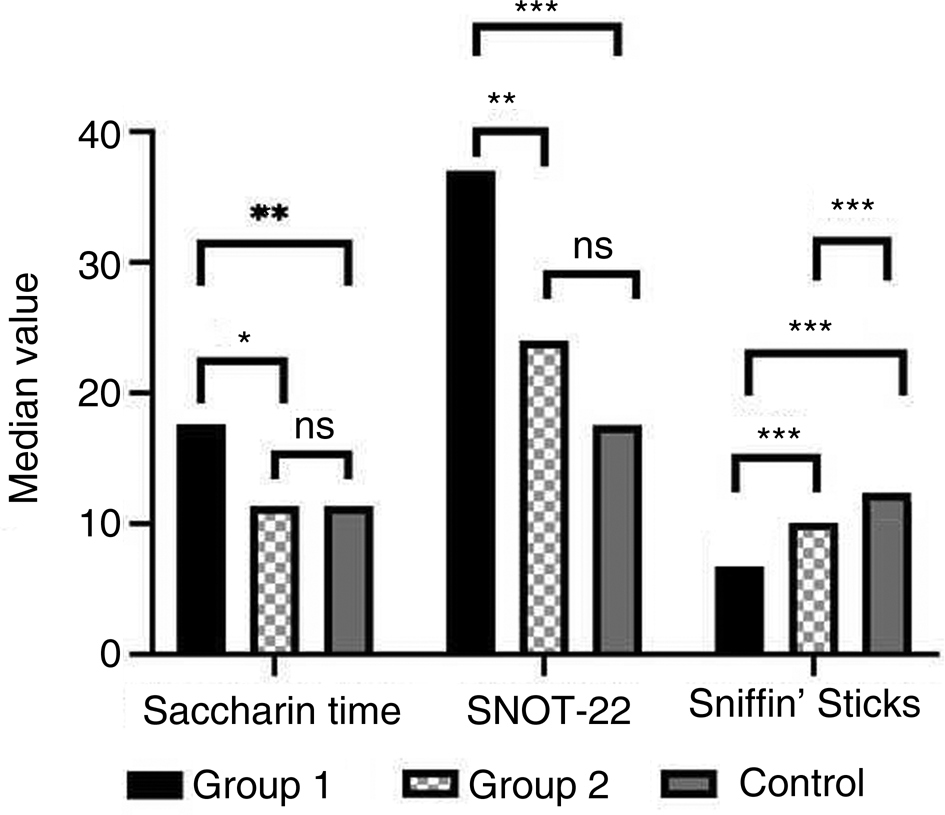
The median values of the SNOT-22, Turkish version of the Nasal Obstruction Symptom Evaluation, saccharin time and Sniffin’ Sticks scores of the study cohort were 25.5 (range, 0–69), 15 (range, 0–85), 12.48 (range, 3.3–40.1) and 10 (range, 1–12), respectively. The results and comparison of each test with regard to groups are given in Table 2 and Figure 1. The median and range SNOT-22 (males, 23 (0–53); females, 28 (0–69); p = 0.286), Turkish version of the Nasal Obstruction Symptom Evaluation (males, 15 (0–60); females, 20 (0–85); p = 0.519), saccharin time (males, 13.3 (3.3–36); females, 10.4 (3.4–40.1); p = 0.09) and Sniffin’ Sticks (males, 10 (4–12); females, 10 (1–12); p = 0.847) scores were not significantly different between males and females.
Graphical representation of saccharin time, Sino-Nasal Outcome Test (SNOT)-22 and Sniffin’ Sticks scores with respect to each group. Statistical significance is indicated as *p < 0.05, **p < 0.01 and ***p < 0.001. ns = not significant

SNOT-22, Turkish Nasal Obstruction Symptom Evaluation, saccharin test and Sniffin’ Sticks test scores for each group

*Group 1 had significantly higher Sino-Nasal Outcome Test (SNOT)-22 scores than group 2 and group 3 (p = 0.004 and p < 0.001). Group 2 and group 3 scores were similar (p = 0.30). †Indicates statistically significant data. ‡Group 1 had significantly longer saccharin time than group 2 and group 3 (p = 0.032 and p = 0.007, respectively). Group 2 and group 3 saccharin times were similar (p = 0.83). **Group 1 had significantly lower Sniffin’ Sticks scores than group 2 and group 3 (p < 0.001 and p < 0.001, respectively). Group 2 had significantly lower scores than group 3 (p < 0.001). T-NOSE = Turkish Nasal Obstruction Symptom Evaluation
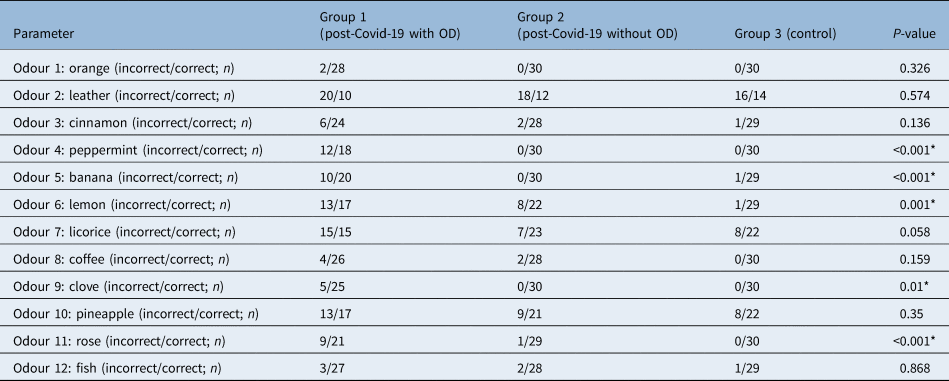
Saccharin time was significantly correlated with SNOT-22 (Spearman r = 0.287; p = 0.006) and the Turkish version of the Nasal Obstruction Symptom Evaluation (Spearman r = 0.258; p = 0.014) scores. Age and Sniffin’ Sticks scores were not correlated with each other or any of the other parameters (SNOT-22, Turkish version of the Nasal Obstruction Symptom Evaluation and saccharin time). The number of correct and incorrect answers for each odour in the Sniffin’ Sticks test is given in Table 3.
Correct and incorrect answers for each odour for each group

*Indicates statistically significant data
Discussion
Post-Covid-19 olfactory dysfunction has emerged as a common problem since the outbreak of the pandemic. It usually subsides within a few weeks; however, in some cases, symptoms may persist for months after the infection.Reference Rebholz, Pfaffeneder-Mantai, Knoll, Hassel, Frank and Kleber12,Reference Raad, Ganti, Goshtasbi, Lehrich, Papagiannopoulos and LoSavio13 Therefore, our primary objective was to determine the residual effects of Covid-19 on olfaction, mucociliary clearance and sinonasal functions. Secondly, there are studies reporting that individuals underestimate their hyposmia through self-reporting.Reference Adams, Wroblewski, Kern, Kozloski, Dale and McClintock14 Thus, our secondary objective was to show whether Covid-19 causes long-lasting asymptomatic olfactory dysfunction in patients who did not suffer olfactory dysfunction when infected.
It is well known that many viral upper respiratory infection agents cause conductive hyposmia or anosmia because of nasal obstruction accompanied by rhinitis symptoms.Reference Las Casas Lima, Cavalcante and Leao15 However, it has been shown that patients with Covid-19 associated olfactory dysfunction rarely experience nasal obstruction (either during the active infection or long-term follow up).Reference Lechien, Chiesa-Estomba, De Siati, Horoi, Le Bon and Rodriguez1,Reference Boscolo-Rizzo, Guida, Polesel, Marcuzzo, Antonucci and Capriotti2 Boscolo-Rizzo reported a 7 per cent rate of blocked nose complaints in patients with persistent olfactory dysfunction.Reference Boscolo-Rizzo, Guida, Polesel, Marcuzzo, Antonucci and Capriotti2 We used the Turkish version of the Nasal Obstruction Symptom Evaluation scale to evaluate the symptoms of nasal obstruction. Although the Turkish version of the Nasal Obstruction Symptom Evaluation scores were higher in group 1 and group 2 than in the control group, they did not reach statistical significance. This confirms that nasal obstruction is not the primary mechanism underlying post-Covid-19 olfactory dysfunction.
Olfactory neuroepithelium consists of neural and non-neuronal tissue elements. Non-neuronal cell types include sustentacular cells, globose and horizontal basal cells (which are simply the stem cells), Bowman's gland and microvillar cells.Reference Ganger and Schindowski16,Reference Brann, Tsukahara, Weinreb, Lipovsek, Van den Berge and Gong17 Sustentacular cells are so-called supportive cells that show the characteristics of both epithelial and neuronal cells.Reference Ganger and Schindowski16 They ensure the structural integrity of neurons and the proper development of the cilia.Reference Bryche, St Albin, Murri, Lacote, Pulido and Ar Gouilh18
Covid-19 associated olfactory dysfunction theoretically has two mechanisms. The first mechanism is the direct injury of the olfactory epithelium secondary to inflammation because of viral infection of the nasal mucosa.Reference Zou, Ruan, Huang, Liang, Huang and Hong19 The second mechanism involves the angiotensin converting enzyme 2 (ACE2) receptor and transmembrane serine protease 2, which are highly expressed in the olfactory mucosa solely in non-neural cells.Reference Brann, Tsukahara, Weinreb, Lipovsek, Van den Berge and Gong17,Reference Sanli, Altundag, Kandemirli, Yildirim, Sanli and Saatci20 This expression enables the virus to enter the cell and prime its spike protein production in non-neural cells, causing indirect damage to the olfactory neural elements.Reference Brann, Tsukahara, Weinreb, Lipovsek, Van den Berge and Gong17,Reference Rahman, Basharat, Yousuf, Castaldo, Rastrelli and Khan21
Moreover, smoking has been described as enhancing the risk of developing olfactory dysfunction due to Covid-19 because the nicotinic acetylcholine receptors stimulate higher expression of angiotensin converting enzyme 2 receptors.Reference Das, Mukherjee and Ghosh22 However, the Brinkman index values (smoking) for our groups were similar.
Although the olfactory symptoms of most patients with Covid-19 associated olfactory dysfunction dissipate within a few weeks, a significant number of patients’ symptoms persist. The persistence rate varies in the literature. Saussez et al. reported a 25.4 per cent persistence rate at 60 days post-Covid-19,Reference Saussez, Sharma, Thiriad, Olislagers, Duc and Le Bon4 whereas Carfi et al. reported 11 per centReference Carfi, Bernabei and Landi3 and Boscolo-Rizzo et al. reported 8.6 per cent persistence rates after 6 months post-Covid-19,Reference Boscolo-Rizzo, Guida, Polesel, Marcuzzo, Antonucci and Capriotti2 which may show some degree of recovery between 2 to 6 months. However, Raad et al. showed that after one month and six months post-Covid-19, smell functions were similar.Reference Raad, Ganti, Goshtasbi, Lehrich, Papagiannopoulos and LoSavio13 Normally sustentacular cells regenerate faster than neural cells.Reference Bryche, St Albin, Murri, Lacote, Pulido and Ar Gouilh18 A persistent olfactory dysfunction lasting for more than three weeks may indicate more severe damage involving olfactory neurons and the central olfactory system.Reference Bryche, St Albin, Murri, Lacote, Pulido and Ar Gouilh18 Rebholz et al. also indicated the dominant role of olfactory neural loss in long-lasting hyposmia.Reference Rebholz, Pfaffeneder-Mantai, Knoll, Hassel, Frank and Kleber12 We may speculate that subclinical ongoing inflammation affecting the olfactory neuroepithelium or temporary or permanent loss of regeneration ability of the olfactory neuroepithelium because of progenitor and stem cell degeneration may be the reason for persistent olfactory dysfunction. Child et al. confirmed that olfactory stem cells have limited neuroregenerative capacity.Reference Child, Herrick, Schwob, Holbrook and Jang23 As a result, the primary reason for long-lasting Covid-19 associated olfactory dysfunction requires further clarification.
• Mucociliary clearance time was significantly prolonged in patients with post-coronavirus disease 2019 (Covid-19) persistent olfactory dysfunction
• Mucociliary clearance time was similar between patients without post-Covid-19 olfactory dysfunction and controls
• Peppermint, banana, lemon, clove and rose odours were significantly identified less in patients with post-Covid-19 persistent olfactory dysfunction
• Covid-19 infection was likely to cause asymptomatic olfactory dysfunction at six months post-Covid-19
Mucociliary clearance is the main defence mechanism of the nasal cavity and respiratory system. The combined activity of ciliated cells, mucous membranes and mucous glands composes mucociliary clearance activity.Reference Soylu Ozler, Akbay, Akkoca, Soylu Karapınar and Özel Şimşek5 Olfactory mucosa is mostly fitted with non-motile cilia; however, there are also small islets of respiratory mucosa with motile cilia.Reference Ganger and Schindowski16 It has been shown that upper respiratory tract viruses like rhinovirus or influenza virus prolong mucociliary clearance time by damaging the nasal mucosa and ciliated cells.Reference Carson, Collier and Hu24 There are prior studies that have also reported prolonged mucociliary clearance time during Covid-19 infection. Baki et al. showed that the mean saccharin time was longer (16.3 minutes) in patients with active Covid-19 infections than in patients in the control group (8.6 minutes).Reference Baki, Damlaca, Yıldız, Gündoğar and Cırık6 In another study, Koparal et al. reported a significantly longer (15.5 minutes) mucociliary clearance time than the control group (9.5 minutes).Reference Koparal, Kurt, Altuntas and Dogan7 Our study showed that this prolonged mucociliary time persists for at least six months in patients with a history of Covid-19 accompanied by sudden onset and ongoing olfactory dysfunction. Moreover, if Covid-19 did not cause olfactory dysfunction during the infection, it was unlikely that mucociliary activity was concurrently impaired. Our findings showed that mucociliary clearance time was impaired in persistent olfactory dysfunction; however, there was no correlation between smell scores and mucociliary clearance time length. We cannot assert that there is a causality effect between prolonged mucociliary clearance time and the severity of olfactory dysfunction; rather, they may be concomitant findings of nasal inflammation. In addition, ciliated cell damage may contribute not only to prolonged mucociliary clearance time but also olfactory dysfunction as it is the common denominator in the olfactory and respiratory mucosa.
Odour specificity in post-Covid-19 olfactory dysfunction has been underreported in the literature. It has been described that certain parts of the olfactory bulb (glomerular modules) were tuned to specific molecular features of odours.Reference Mori, Nagao and Yoshihara25 In our study, we found that peppermint, banana, lemon, clove and rose odours were significantly identified less in the post-Covid-19 olfactory dysfunction group. Rebholz et al. also found that the perception of certain odours (lemon, soap and strawberry) was delayed in the recovery period, and they believed that this could be because of the more difficult or slower regeneration process of associated odour-specific neurons.Reference Rebholz, Pfaffeneder-Mantai, Knoll, Hassel, Frank and Kleber12 The exact mechanism underlying this odour-specific misperception is not clear. Like Rebholz et al., we think that delayed recovery in this specific subset of neurons could be the answer.Reference Rebholz, Pfaffeneder-Mantai, Knoll, Hassel, Frank and Kleber12 In addition, we speculate that certain odour-specific neurons could be more prone to cellular distress. This topic necessitates further research for elucidation.
There were several limitations of our study. First, we did not evaluate olfactory thresholds and discrimination scores, which could potentially provide more insight into the character of post-Covid-19 olfactory dysfunction. Secondly, our patient sample was relatively small. Finally, given that other post-viral olfactory dysfunction recovery periods could take more than six months, our results regarding post-Covid-19 olfactory dysfunction should be interpreted as interim results.
Conclusion
Mucociliary clearance time was significantly prolonged, and higher SNOT-22 scores were observed in patients with persistent post-Covid-19 olfactory dysfunction. Sniffin’ Sticks test scores were the lowest in the post-Covid-19 olfactory dysfunction group. A Covid-19 infection was likely to cause asymptomatic olfactory dysfunction at six months post-Covid-19. Peppermint, banana, lemon, clove and rose odours were significantly identified less in the post-Covid-19 olfactory dysfunction group. Further research is warranted to determine the permanence of olfactory dysfunction.
Competing interests
None declared