Introduction
Variability in cognitive and non-cognitive symptoms are common phenomena in several neurological conditions such as Parkinson's disease (PD) and dementia, but beyond some proscribed circumstances, it has been comparatively little described. Typical accounts describe variability as short-term, non-permanent changes in cognition and behavior, such as fluctuations in cognition and alertness (Walker et al., Reference Walker2000a; Reference Walker2000b; Serrano and Garcia-Borreguero, Reference Serrano and Garcia-Borreguero2004), episodes of excessive daytime sleepiness (Serrano and Garcia-Borreguero, Reference Serrano and Garcia-Borreguero2004), confusion or impaired consciousness (Walker et al., Reference Walker2000b), lucidity (Normann et al., Reference Normann, Asplund and Norberg1998), inconsistency or intra-individual variability (Hultsch et al., Reference Hultsch, MacDonald, Hunter, Levy-Bencheton and Strauss2000), emotional lability (Haupt, Reference Haupt1996), and catastrophic reactions (Haupt, Reference Haupt1996). Even so, caregivers often generalize variation in symptom presentation as being representative of a “good day” or a “bad day”. Both general fluctuation (e.g. good days and bad days) and the occurrence of a single event, often the unexpected recall of an important detail or the ability to formulate a humorous response, are recounted. Despite the extensive literature surrounding fluctuation and variability, in delirium (American Psychiatric Association, 2000; Bhat and Rockwood, Reference Bhat and Rockwood2007) and dementia with Lewy bodies (DLB; Bradshaw et al., Reference Bradshaw, Saling, Hopwood, Anderson and Brodtmann2004; Ferman et al., Reference Ferman2004; McKeith, Reference McKeith2007), there has been comparatively little study of how symptom fluctuation translates into the lived experience of people with Alzheimer's disease (AD) and other non-DLB/PD dementias.
In clinical practice, patients and carers commonly describe significant fluctuation in cognition, function, or behavior. Such periods, which can change from moment to moment or from one day to the next, are seen as a departure from usual symptom expression, often characterized as “good” or “bad.” A retrospective study of clinical interview data from the VISTA Study (Rockwood et al., Reference Rockwood, Fay, Song, MacKnight and Gorman2006) bears this out (Cook et al., Reference Cook, Fay and Rockwood2009). A descriptive analyses of responses to open-ended and semi-structured clinical interview questions found that 32/130 (25%) mild-moderate patients with AD were spontaneously described as having good days and bad days, while another eight (6%) described single episodes of unexpectedly good cognition (Cook et al., Reference Cook, Fay and Rockwood2009). In addition to cognition and memory, fluctuations in mood, interest, initiative, anger and irritability, sleep, and appetite were associated with reports of good days/bad days.
Our group is interested in developing new means of understanding the progression and treatment of AD and other dementias through descriptions of common and troubling symptoms that are otherwise under-studied. To date, these have included patient and carer informed descriptions of verbal repetition (Rockwood et al., Reference Rockwood, Fay, Jarrett and Asp2007; Cook, et al., Reference Cook, Fay and Rockwood2009), misplacing, (Hamilton et al., Reference Hamilton, Fay and Rockwood2009) and decreased initiation (Cook et al., Reference Cook, Fay and Rockwood2008). We believe that such accounts cannot only enhance our appreciation of disease manifestations, but can also help us understand brain function. Here, our objective was to further build the evidence-base for good days/bad days by investigating how this phenomenon has been characterized in clinical notes about patients with AD and other non-DLB/PD dementias.
Methods
Study design and sample
We conducted an exploratory retrospective case series review (Hess, Reference Hess2004) of patients who attended the principal investigator's (PI; KR) tertiary care memory clinic at the Capital Health Geriatric Ambulatory Care/Memory Clinic (GACC) between January 2007 and June 2009 (including home visits). This convenience sample represents the time frame during which the PI began noting instances of good and bad days, to the date when the retrospective review was initiated. It should be noted that while the PI made systematic enquiries about symptom manifestations and changes in symptom expression, he did not specifically ask if patients experienced “good days and bad days.” Patients who attend the GACC follow a bimodal distribution of younger patents (age: 30–65 years, who chiefly have frontotemporal dementia, early-onset AD, or unusual neurodegenerative disorders) and older patients (mean age: 78 years; 67% women, who mostly have late onset AD). Medical records for all patients seen by the PI during the study period (all visits) were reviewed by two research associates (SF, LH) using a consensus approach. Cases were first scanned for a clinical notation about good days or bad days. Records of patients with a clinical diagnosis of AD or mixed AD/vascular cognitive impairment (VCI) were included in the analysis. Although PD and frontotemporal dementia can be safely excluded clinically, the protean manifestations of DLB mean that without access to pathology or biomarkers, it might be that variation in disease expression represents concurrent illness.
Data collection
To gather data as rich in information as possible, all available sources of information were assayed. Paper-based data abstraction forms were designed and used (Allison et al., Reference Allison2000). Data abstracted from patient medical records to allow characterization of the sample included demographic information (e.g. age, sex, education, marital status, living arrangements, relationship to caregiver), diagnostic information (e.g. dementia type, severity, date of diagnosis), and clinical data (e.g. scores on routine tests, such as the Mini-Mental State Examination (Folstein et al., Reference Folstein, Folstein and McHugh1975), Lawton-Brody Instrumental Activities of Daily Living and Physical Self Maintenance Scale (Lawton and Brody, Reference Lawton and Brody1969), Functional Assessment Staging Tool (Reisberg et al., Reference Reisberg, Ferris, de Leon and Crook1982; Reisberg, Reference Reisberg1988), and prescribed cholinesterase inhibitor (ChEI) therapy). Data were sourced from physician and nursing notes, admission and discharge documentation, laboratory and diagnostics reports, and other clinical and administrative data. Missing data were sought through review of electronic patient records. Verbatim descriptions of good and bad days were sourced from clinical chart notes, such as ambulatory care and outpatient records, as well as professional (letters to other physicians and specialists) and personal correspondences (written and electronic letters to/from patients and families) and recorded freehand on the abstraction form. In most cases the PI had made detailed notes in the health records, documenting what patients and their caregivers described in relation to their good days/bad days experience – these were the primary source of information. Occasionally, notations were also recorded by other members of the healthcare team (nurse/nurse practitioner) based on their own interactions and assessments or from informal care providers (caregivers) when available.
Analysis
Clinical data were translated into a de-identified electronic dataset. Descriptive statistics (numbers and proportions for categorical variables; means, standard deviations, and ranges for continuous variables) for demographics, diagnostics, and all clinical test data were used to describe the sample. To minimize the impact of missing data, clinical test data were abstracted from the most proximate visit within six months of the target date; however, if data were not available for imputation, cases were included regardless. Descriptive accounts of good days/bad days phenomena were collated, coded, categorized, and compared iteratively across cases to identify emerging themes using Atlas.ti software and a framework analysis approach (Ritchie and Spencer, Reference Ritchie, Spencer, Bryman and Burgess2002). Framework analysis was developed specifically for qualitative research when a set of questions or objects is posed in advance. The approach provides the procedural structure of a deductive approach while maintaining sufficient flexibility for novel, inductive themes to emerge from the data. The analysts initially familiarized themselves with the data by reading the various clinical notations to identify key descriptors. Of particular interest were symptoms associated with good days/bad days, and characterization of their changes or fluctuation, the intervals between fluctuations and/or the frequency with which they occurred. From this, a thematic framework was developed and the data coded. Similarly coded data were then examined to define and understand the key concepts. Lastly, associations between the themes and commonalities in the characterizations were examined. Descriptive findings common to fewer than five cases are not summarized or reported to ensure anonymity.
Ethics
Approval to conduct this study was obtained from the Institutional Research Ethics Board (REB) at the Capital District Health Authority in Halifax, Nova Scotia prior to data collection. All data were collected and managed in strict accordance with the REB guidelines.
Results
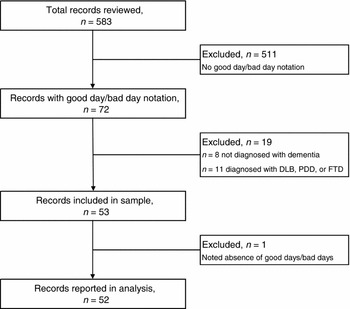
Records for 583 patients seen by the PI between January 2007 and June 2009 were reviewed. Of those, 72 included clinical notations about good days/bad days (Figure 1). Patients without a recorded diagnosis of AD or mixed AD/VCI were excluded (n = 19). Of the 53 patients remaining, one described only the absence of good days and bad days: re: good days and bad days – every day is pretty much the same. We present results for 52 patient records.
Disposition of reviewed patient records. DLB = dementia with Lewy-bodies; PDD = Parkinson's disease dementia; FTD = frontotemporal dementia.

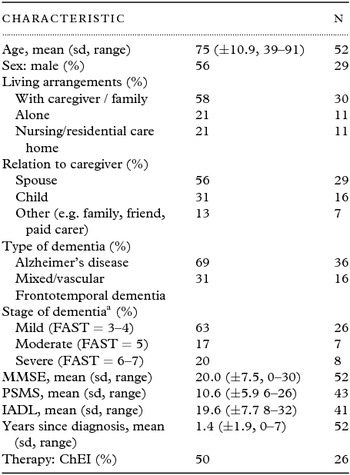
Most of these 52 patients were community-dwelling older adults, newly diagnosed with mild AD, who lived with their spouse and showed some impairment with (chiefly instrumental) activities of daily living (Table 1). Approximately half were receiving ChEI therapy at the time that the good days/bad days notation was recorded.
Characteristics of patients with good days and bad days

aProportions based on total sample (n = 41).
Missing cases not presented in table: FAST = 11 (21%).
ChEI = cholinesterase inhibitor; FAST = Functional Assessment Staging Tool; IADL = instrumental activities of daily living; MMSE = Mini-Mental State Examination; PSMS = Physical Self Maintenance Scale.
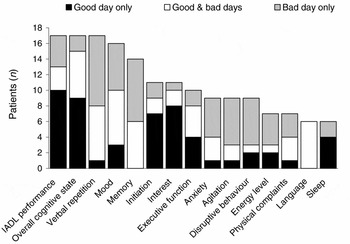
Almost 200 notations referenced good days/bad days (mean = 3.7 ± 2.4 per patient). Most statements implicated symptom areas, in particular changes in a patient's general cognitive state (17/52, 33%; when patients were described as sharper, brighter, foggy, more confused, or capable of remarkable cognitive tasks), verbal repetition (17/52, 33%), and ability to perform instrumental activities of daily living (IADL; 17/52, 33%). Other common descriptions were of mood (16/52, 31%) and memory (14/52, 27%; Figure 2). Several attributes, such as changes in mood (e.g. happier, more cheerful, grumpier, irritable, tearful, cranky), higher order tasks of executive functions (e.g. make quick calculations, solve problems, make plans and follow through), and language (e.g. word-finding difficulty, able to get out entire sentences, virtually mute) were common characterizations for both good and bad days (Figure 2). Even so, distinctions between good and bad days could also be discerned. Good days were more commonly associated with greater expressions of interest (10/11 patients vs. 3/11 where decreased interest characterized bad days), noticeable improvements in general cognitive state (15/17 vs. 8/17), increased initiative (9/11 vs. 4/11), and improved ability to perform tasks of daily living (13/17 vs. 7/17). Bad days were more commonly characterized by worse forgetfulness (14/14 patients versus 6/14 for whom good days were marked by improvements in memory), more frequent verbal repetition (16/17 vs. 8/17), increased anxiety (8/9 vs. 4/9), agitation (8/9 vs. 3/9), and other disruptive behaviors (7/9 vs. 3/9; including delusions, hoarding, and aggression).
Symptoms that characterize good days and bad days by frequency and attribution (good only, bad only, both good and bad).

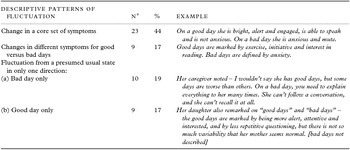
Three patterns emerged in how this phenomenon was described (see Table 2). For most cases, good days and bad days were attributed to changes in the same core set of symptoms, which fluctuated from good to bad (23/52, 44%) – e.g. more/less verbal repetition; seems quite confused on bad days whereas on good days he is quite clear. Note that this categorization includes descriptions in which a majority but not all of the symptoms identified were associated with both good and bad days. For example, the following description was included in this category: good and bad days marked primarily by changes in mood and agitation . . . better sleep results in good days. In other cases, fluctuation in only one direction from a presumed usual state was portrayed (19/52, 37%) – i.e. only good days or only bad days. For example, no good days, bad days cries and repetitive. One notation did not provide detail beyond the note that he has good days and bad days, bad now outnumber the good. For the remaining cases, good days and bad days were characterized by changes in markedly different symptoms (9/52, 17%) – for example, “on a good day, very alert, organized and appropriate . . . on a bad day is weaker, has repetitive questioning and decreased balance.
Common descriptive patterns for good days and bad days

a n = 1, case with insufficient descriptive information.
In the clinical notations, several other factors were identified that contributed to good days/bad days. Medication effects were among the most common – e.g. the impact of treatment [with galantamine] has been to clearly give more good days; Percocet can make for a bad day. Other factors included sleep (good days follow when he sleeps 4–5 hours at night), social interaction (lack of social interaction may contribute to a bad day), and stress (pressure to “perform” [attend an event] triggers a bad day).
Observed temporal patterns and frequency of occurrence were sometimes described in the clinical notes. In some cases, the pattern of the day could be recognized first thing in the morning (she and her family agree that [whether it will be a good day] is evident almost from the time she gets up). Others described the ratio of good days to bad, stating which outnumbered the other (while he has good days and bad, the bad days outnumber the good). Still others attempted to quantify the number of good or bad days (she estimates that bad days could happen in runs of several days in a row, and then go for a week or more without one).
Discussion
In a review of patient records seen both at home and in a memory clinic over two and a half years, 72/583 yielded clinical notations about good days and bad days in dementia, three quarters of which were made in reference to patients with AD and mixed AD/VCI. Three patterns of good days and bad days were discernable. Most reports identified fluctuation from good to bad around a core set of symptoms, or fluctuation from a presumed usual state in only one direction (either good or bad). Fewer reports characterized good days as involving different symptoms than bad days. Fluctuations in behavior were prominent in the characterization of bad days. Even so, the apparent lack of consistency in symptoms associated with the type of day implies that what makes a good day “good” may not be simply more (or less) of what makes a bad day “bad”.
These results build on our previous work on symptom fluctuation in people with mild-to-moderate AD, which identified similar manifestations of good days/bad days and described their association with common behavioral and psychological symptoms of AD, such as depressive features and apathy (Cook et al., Reference Cook, Fay and Rockwood2009). Our results clarify the relative importance of mood and behavior symptoms in the presence of good days and bad days and highlight that some symptoms belong to groups that caregivers consider positive (interest, initiative, IADL performance) or negative (verbal repetition, agitation, anxiety, disruptive behavior). This suggests that caregiver perspectives of this phenomenon may be influenced by their reactions to disruptive or distressing (i.e. negative) symptoms in the people they care for.
Our data must be interpreted with caution. In retrospective chart reviews, data quality is usually not optimal, as richness and quantity are commonly lacking (Findley and Daum, Reference Findley and Daum1989; Hess, Reference Hess2004). The PI's specific interest in good days/bad days, his systematic enquiry about changes in symptom expression, and the recording of such descriptions when reported to him, may have increased our chances of identifying this phenomenon in this sample. Even so, under-representation of good days/bad days is likely, as this retrospective study relied on the healthcare professionals’ decision to include reports of this phenomenon within the medical record. Consequently, no estimate of prevalence is possible. Notably here too, spontaneous identifications of good days and bad days by caregivers cannot be distinguished from those resulting from prompts. Furthermore, we did not scan the records for all descriptions of symptom fluctuation, but limited data collection to notations that specifically made reference to good days or bad days to avoid imposing an unintended characterization of what constitutes this phenomenon. Chart notations may represent direct quotations from caregivers or patients; however it is likely that descriptions have been filtered to some extent. This is reflected by the variable richness and quantity of the notes in the health records. It is not known whether or how often a detailed account (e.g. on bad days he asks me the same thing over and over again, he can't remember what I just told him) resulted in a more general, clinical notation (e.g. worsening short-term memory). In addition, some descriptions were ambiguous. For example, patients were frequently described as “sharp,” “brighter,” or “foggy” with no further clarification (e.g. more/less fatigued, happier, better able to follow conversations). A prospective study would allow for more standardization of prompting and recording of the caregiver experience with good days/bad days. Nevertheless, by drawing attention to the phenomenon, this study helps to develop hypotheses for further inquiries. For example, this sample size is small and represents a mix of dementia diagnoses and severities. It may be that some symptoms and patterns are more prominently associated with earlier stages than later stages, or with AD than mixed dementia, etc. Further study with a larger sample (or more narrowly defined population) is required.
We were not able to address the impact of caregiver coping strategies or knowledge of dementia on reporting of good days/bad days. Caregivers have been reported to associate bad days with higher demands and behavioral problems (e.g. anger/aggression, night waking) and/or disagreements within the family regarding provision of care (Koerner and Kenyon, Reference Koerner and Kenyon2007). Similarly, Polk (Reference Polk2005) found that caregivers of patients with AD characterized good days as those in which they met little resistance when interacting with the care recipient and bad days as those when the recipient resisted routine activities, such as dressing. In our study, one caregiver identified excessive daytime sleeping as the defining feature of a good day because it resulted in less presentation of “bad symptoms.”
A previous study (Polk, Reference Polk2005) found that some caregivers were able to “tell if it was going to be a good day” shortly into the day's activities because bad days often began with resistance or hurtful responses. Caregivers reported spending large portions of bad days attempting to make them good and struggled to find pleasing distractions. Caregivers also experienced frustration at their own inability to determine what brought on “bad days.” In our data, several caregivers described an association between bad days and poor sleep and could often predict how the day would unfold based on the patient's early morning behavior. Further investigation into factors that facilitate or encourage good days and mitigate bad days may help improve quality of life for patients and caregivers.
Variability in cognitive and behavioral symptoms is evident in AD and mixed AD/VCI, but are understudied. Further investigation will generate knowledge that may lead to the development and testing of new or improved means of tracking and managing the symptoms of AD associated with the phenomenon of good days/bad days in a way that could enhance the care and quality of life of people living with this disease and their caregivers – e.g. by helping us understand how to maximize the number and quality of good days or reduce the number and severity of bad days – or enable us to discern patterns that may tell us something new about what's happening in the AD brain.
Disease expression in dementia in relation to both cognitive (Mitnitski et al., Reference Mitnitski, Fallah, Wu, Rockwood and Borenstein2010; Reference Mitnitski, Fallah and Rockwood2011) and brain structure (Song et al., Reference Song, Mitnitski, Zhang, Chen and Rockwood2013) components appears to show stochastic variation (including improvement as well as stabilization and decline) in relation to the baseline state. In other words, the possibility of change from baseline in cognitive status or in brain atrophy and white matter, varies in relation to the degree of baseline impairments. This can be summarized with high precision using a stochastic model, and illustrates that cognition is dynamic and not fixed. Whether good days/bad days represent these same dynamic features or a short timescale is of considerable interest and is motivating future inquiries by our group.
Conflict of interest
None.
Description of authors’ roles
KR conceived the research study, provided access to the data, supervised the data collection and analysis, and contributed to the drafting and critical revision of the manuscript. SF coordinated the study and, together with LH, conducted the analysis and prepared the first draft of the manuscript. ER and LH carried out data collection. ER and PM contributed to interim drafts. All authors read and approved the final manuscript.
Acknowledgments
This work was supported by funding to KR as the Kathryn Allen Weldon Professor of Alzheimer's Research at Dalhousie University and the Fountain Innovation Fund of the Queen Elizabeth II Health Sciences Centre, as well as by the Canadian Institutes of Research (IAD-112240).