Infectious disease outbreaks place a significant burden on the health care workforce and contribute to poor health outcomes in the setting of inadequate disaster preparedness.Reference Khan 1 A study of the 2003 severe acute respiratory syndrome (SARS) epidemic showed that health care workers (HCWs) were neither aware of nor prepared for the outbreak, contributing to its rapid spread and high mortality rate.Reference Koh, Lim and Chia 2 Further limiting disaster preparedness is the inadequate willingness of HCWs to work in a disaster.Reference Chan-Yeung 3 , Reference Chaffee 4 In a 2008 survey of HCWs’ response during a potential avian influenza pandemic, only 50% of workers reported being willing to work, with another 42% being uncertain.Reference Irvin, Cindrich and Patterson 5 These attitudes can lead to critical shortfalls in human resource supply during disaster outbreaks.
Identifying factors that influence willingness to work (WTW) is imperative to improving preparedness for future disasters. Students, who are the future of the health care workforce, are at a uniquely impressionable stage in their training, forming opinions about and establishing comfort with their roles in health care. Therefore, modifying students’ attitudes and perceptions is a major means of influencing the WTW of HCWs. This study focused on health care students with the goal of discerning how their knowledge and attitudes about infectious disease outbreaks influence their WTW, defined as willingness to report to work during an infectious disease outbreak.
Current literature identifies type of disaster as well as level of knowledge and training as factors that influence the WTW of HCWs during a disaster. Arbon et alReference Arbon, Ranse and Cusack 6 have shown that emergency nurses’ WTW increased with skills or knowledge in disaster medicine and with qualifications such as training in emergency nursing, paramedicine, infectious disease, disaster management, and public health. Other research has found a relationship between infectious disease knowledge and WTW, where both physicians and nurses who received higher scores on anthrax knowledge questionnaires demonstrated greater WTW and care for patients infected with anthrax.Reference Rokach, Cohen and Shapira 7 These studies suggest that improving disaster knowledge may enhance WTW during infectious disease outbreaks.
In addition to medical knowledge, providing disaster training and access to adequate personal protective equipment (PPE) have been linked to greater WTW. In a disaster scenario of a bioterrorism attack, physicians, nurses, and pharmacists displayed significantly greater WTW if they had previously attended emergency drills or bioterrorism training.Reference Crane, McCluskey and Johnson 8 Another study demonstrated that, in the face of an influenza pandemic, providers were more willing to work if antiviral treatments were available for both themselves and their families.Reference Stergachis, Garberson and Lien 9
While research has identified potential reasons that HCWs may be unwilling to work, it is unclear whether these views can be traced back to health care students. Understanding the perspective of students can allow us to influence WTW early in its development. Sauser et alReference Sauser, Burke and Ferrer 10 found that medical students in their clinical years were more willing to work if they had procedural preparedness or an interest in surgery or emergency medicine. Tebruegge et alReference Tebruegge, Pantazidou and Ritz 11 identified medical students as less likely to refuse to work during an influenza pandemic when compared to doctors, nurses, and allied health professionals. In a Dutch study, medical students demonstrated considerable willingness to respond during a disaster despite limited knowledge in disaster medicine. However, the reported level of disaster knowledge was self-estimated, failing to reflect an objective relationship between medical student knowledge and willingness to respond.Reference Mortelmans, Bouman and Gaakeer 12 Most nursing students report a professional obligation to volunteer in the event of a pandemic. Their WTW is even greater if adequate protection, such as PPE, is provided.Reference Yonge, Rosychuk and Bailey 13 Although there is literature, albeit scarce, probing medical and nursing students’ WTW in the face of a disaster, there have been no studies to date that address pharmacy students, who serve as future essential members of disaster response.
Recent health threats, including Ebola virus disease (EVD) and Middle East respiratory syndrome (MERS), provide a unique opportunity to assess factors that influence WTW among health care students. To our knowledge, no studies have directly compared the WTW of students in the disciplines of medicine, nursing, and pharmacy. Studying preclinical students in particular is advantageous because interventions in this population allow us to impact HCWs at the onset of their careers. These students have yet to enter the clinical environment and establish their beliefs regarding WTW; thus, they may offer the greatest response to a disaster training intervention. Determining factors that influence WTW can inform the development of appropriate disaster preparedness curricula and promote higher response rates in future HCWs. The current study compared WTW among preclinical medical, nursing, and pharmacy students and further evaluated the influence of knowledge base and prior disaster training on their WTW.
METHODS
The present study involved a cross-sectional survey conducted with the approval of the Rutgers University Institutional Review Board. A 3-part printed questionnaire was distributed to 631 preclinical medical, nursing, and pharmacy students at Rutgers University in Piscataway, New Jersey, in 2015. Preclinical students were identified as those who have not yet entered the clinical curriculum. All surveys were anonymous with no personal identifiers.
The questionnaire was divided into 3 sections. The first contained questions related to demographics and included information about prior emergency response training. The second assessed WTW and possible reasons individuals may be reluctant to report to work during an outbreak. The third evaluated participants’ background knowledge on the topics of EVD and MERS through 6 multiple-choice questions on each entity, addressing disease transmission, epidemiology, clinical presentation, and prevention.
All students received the printed questionnaire at the start of a classroom session. Instructors allotted 10 minutes at the beginning of the class period to allow students to complete the questionnaire. Responses were collected and analyses were performed on the entire cohort as well as by professional discipline.
Statistical analyses were conducted via Mathworks (Natick, MA) MATLAB and Microsoft (Redmond, WA) Excel. A two-way ANOVA at a level of significance of α=0.05 and post-hoc analysis via Tukey’s HSD test at the same significance level were used to discern the effects of student type and mode of disease transmission on fear for health and WTW. The same method was used to clarify the effects of prior disaster training and mode of transmission as independent variables as well as knowledge base and mode of transmission as independent variables. Potential reasons that students may be unwilling to work were analyzed by using Kruskall-Wallis at α=0.05, with consideration of student type and respondent rating of potential reasons on a Likert scale.
RESULTS
Demographics
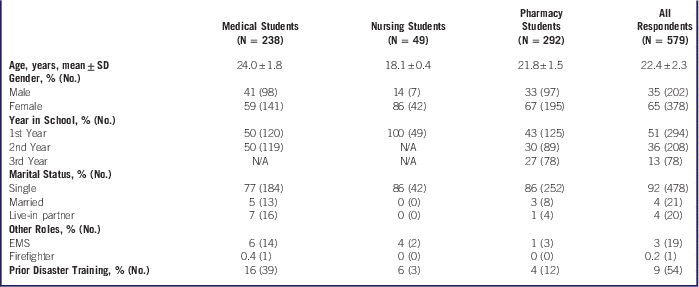
The survey was distributed to 631 preclinical medical, pharmacy, and nursing students at Rutgers University. The overall response rate was 92%, comprising 579 respondents, including 238 medical students (88% response rate), 49 nursing students (91% response rate), and 292 pharmacy students (95% response rate). Respondents were 35% male and had a mean age of 22.4±2.3 years. Of the 213 students who indicated their marital status, 92% reported being single, 4% reported being married, and 4% reported having a live-in partner. Specific demographics for each student type are displayed in Table 1. Of all respondents, 3% served in emergency response roles (ie, emergency medical services, firefighter) and 9% had received some form of formal disaster training. The most common instruction settings for disaster training were large groups of 10 or more members, small groups of 3 to 9 members, and lecture halls. A one-way ANOVA demonstrated significant differences in disaster training experience among the 3 student types (P<0.001). A greater proportion of medical students (16%) received formal disaster training than nursing (6%) and pharmacy students (4%) (P<0.001).
Participant DemographicsFootnote a

a Abbreviations: EMS, emergency medical services; N/A, not included in study population because not considered preclinical.
Willingness to Work
WTW was measured as the highest hypothetical mortality rate of an infectious disease at which the participant would still be willing to adhere to work responsibilities (mortality rate ranging from 0% to 100% in 10% increments). Therefore, a participant who specified a lower mortality threshold indicated a lesser willingness to respond to an outbreak. Participants were asked to evaluate their WTW in the setting of infectious agents with either contact (CT) or respiratory (RT) transmission. They also evaluated fear for their health in an outbreak by using the same mortality scale. Overall, fear for one’s health was strongly associated with decreased WTW in an outbreak of incurable infectious disease (RT: Pearson correlation r=0.57, P<0.001; CT: Pearson correlation r=0.68, P<0.001) and in the availability of PPE (RT: Pearson correlation r=0.46, P<0.001; CT: Pearson correlation r=0.57, P<0.001).
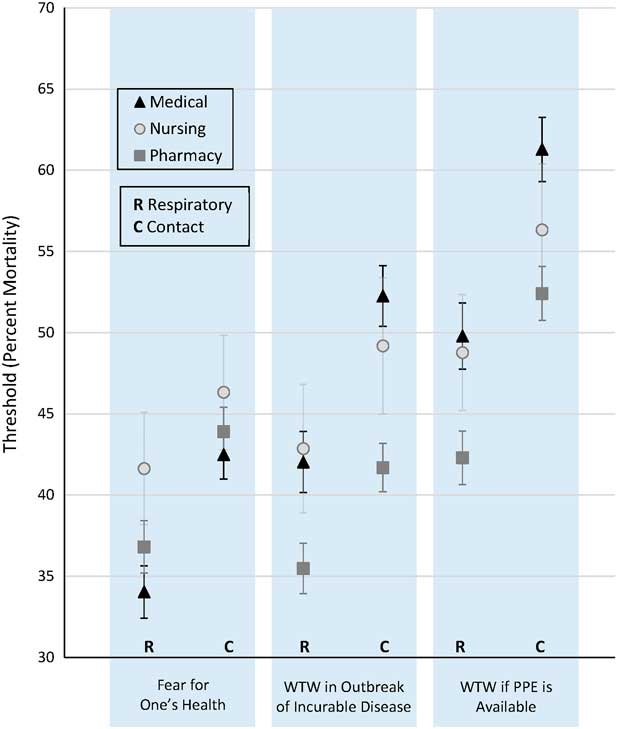
A two-way ANOVA was performed to address fear for one’s health during an outbreak. A significant difference was demonstrated among the 3 types of students (P<0.001) as well as between mode of disease transmission (P=0.049) with nonsignificant interaction (P=0.77). As shown in Figure 1, all classes of respondents were generally more fearful for their health and less willing to respond during an RT infectious outbreak than during a CT one. In general, medical students were the most fearful for their health, citing a 34% and 42% mortality threshold for RT and CT diseases, respectively, whereas nursing students were the least fearful, citing mortality thresholds of 42% and 46%.
Health Care Student Willingness to Work in Infectious Disease Outbreaks Having Respiratory or Contact Transmission. Willingness to work (WTW) was defined as the maximum percentage mortality of an outbreak at which a respondent would still be willing to report to work. Despite being the most fearful for their health, medical students were among the most willing to work, especially if personal protective equipment (PPE) were available. Pharmacy students were consistently the least willing to work. In general, students of all types displayed more fear for their health and less willingness to work in outbreaks with respiratory transmission (R) than in those with contact transmission (C).

An analogous two-way ANOVA was performed to address willingness to respond to an outbreak of incurable infectious disease. A significant difference was again seen among the 3 types of students (P<0.001) and mode of transmission (P=0.0029), with nonsignificant interaction (P=0.66). In this situation, nursing students showed the most WTW in RT (49%) outbreaks. Medical students showed the most WTW in CT (52%) outbreaks. Pharmacy students showed the least WTW in both RT (35%) and CT (42%) outbreaks.
A third two-way ANOVA exploring WTW in an outbreak, given that PPE was available, again revealed a significant difference among the 3 student types (P<0.001) and between modes of transmission (P=0.023), without significant interaction (P=0.82). Of the 3 student types, medical students demonstrated the most WTW in this situation for both RT (50%) and CT (61%) disease. Again, pharmacy students displayed the least WTW, citing mortality thresholds of 42% and 52% for RT and CT outbreaks, respectively.
A two-way ANOVA was also performed comparing respondents with no formal emergency responder disaster training to those with prior training on their view of RT versus CT disease. Although prior training did not have a significant association with fear for one’s health, it was associated with greater WTW even in an incurable outbreak (P=0.0012) and in an outbreak for which PPE was available (P=0.023).
Reasons to Not be Willing to Report to Work
Using a Likert scale ranging from 1 (most important) to 7 (least important), respondents were asked to rate potential reasons that they would be unwilling to report to work during an outbreak. The most important reasons cited overall, and within each student discipline, were concern for “personal safety and health” and “my family’s safety and health.” The 3 types of students differed significantly in their concern for “causing harm” as demonstrated by a Kruskal-Wallis ANOVA (P=0.049). In particular, nursing students displayed the most concern for causing harm, with a median rating of 3, followed by pharmacy students with a median rating of 4, and then medical students, who displayed the least concern, with a median rating of 5. A Kruskal-Wallis ANOVA demonstrated that respondents did not differ in their concern for “my family’s safety and health” on the basis of marital status (P=0.20).
Knowledge Base Questions
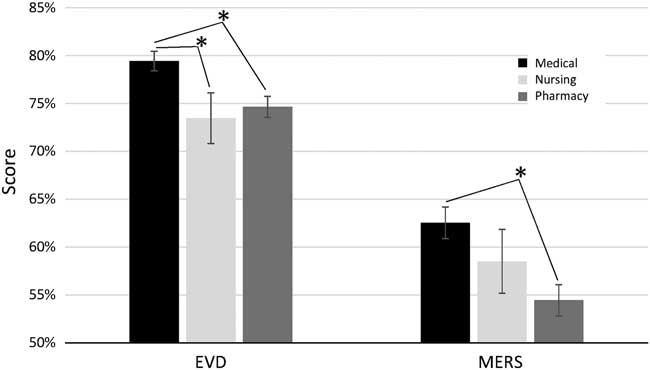
Respondents were evaluated on their knowledge of EVD and MERS through a multiple-choice questionnaire with 6 items related to each disease. A two-way ANOVA demonstrated that respondents were significantly more knowledgeable about EVD (77% correct) than they were about MERS (58% correct) (P<0.001) and that scores varied significantly by student type (P=0.0091). As shown in Figure 2, medical students scored the highest of the 3 groups on both EVD (79% correct) and MERS (63% correct). Respondents with and without prior disaster training did not have significantly different scores on either EVD or MERS questionnaires (P=0.59 and P=0.57, respectively). Although knowledge of either disease generally did not directly correlate with fear for health or WTW, specific knowledge did correlate with certain attitudes. For example, in a CT disease outbreak with available PPE, respondents who correctly demonstrated knowledge of the appropriate PPE for EVD were more willing to work than were those who answered incorrectly (60% versus 54% mortality thresholds, respectively, P=0.018). Respondents who scored above 50% on the MERS knowledge base questionnaire were more fearful for their health than were those who scored 50% and under (34% versus 39% mortality threshold, P=0.015).
Student Responses to Knowledge Base Questions About Ebola Virus Disease and Middle East Respiratory Syndrome. Students demonstrated greater knowledge of Ebola virus disease (EVD) than Middle East respiratory syndrome (MERS). Medical students scored the highest on both questionnaires.
DISCUSSION
In the face of new infectious disease outbreaks, assessing HCW response is a growing priority. This study assessed the role of disaster training and knowledge of recent infectious disease outbreaks on WTW among preclinical medical, nursing, and pharmacy students. The study found knowledge of infectious disease outbreaks to be associated with increased willingness to respond to such disasters.
Overall, the study found that students of all 3 disciplines were willing to work during infectious disease outbreaks conferring high lethality. Students were less willing to work during RT disease outbreaks than during CT ones. Understandably, this indicates a greater fear for RT illnesses due to greater risk of transmission. However, availability of PPE increased students’ WTW in both types of transmission, suggesting that students may be more inclined to work if they feel that they can protect themselves appropriately.
After stratifying the 3 disciplines, it was found that medical students were the most afraid for their health but also the most willing to work. Nursing students were the least afraid, but their WTW was generally lower than that of medical students, and pharmacy students demonstrated the least WTW across all scenarios. Of note, medical students also scored the highest on the knowledge questionnaire. Similar results were shown by Rokach et al,Reference Rokach, Cohen and Shapira 7 who found that physicians, as opposed to nurses, scored higher on questionnaires regarding anthrax epidemiology, clinical presentation, and prevention, and that this medical knowledge was significantly related to willingness to report to work. Our study demonstrates comparable findings in health care students and suggests that superior knowledge of infectious disease may play a dual role: fostering greater fear among medical students but also promoting disaster preparedness and, thus, increased WTW.
Although direct comparisons of knowledge with WTW did not reveal significant correlations, medical students were significantly more knowledgeable and more willing to work than were nursing and pharmacy students. Future studies should examine this further by exploring the possibility of a causal relationship between knowledge and WTW.
The differences in knowledge base among the 3 disciplines may reflect their respective curricula. The extent of disaster education in our study population’s pharmacy curricula is limited to 2 lectures, “Bioterrorism” and “Hazmat and Chemical Warfare.” Past iterations of the American Association of Colleges of Pharmacy (AACP) Center for the Advancement of Pharmacy Education (CAPE) Educational Outcomes 2004 and Accreditation Council for Pharmacy Education (ACPE) 2007 Guidelines included disaster preparedness and bioterrorism in their recommendations for pharmacy programs; however, the most current guidance documents from these organizations only briefly mention bioterrorism and do not mention disaster preparedness at al. 14 - 18 The nursing students in our cohort have a microbiology course during their second year, but the curriculum otherwise lacks disaster preparedness education. The American Association of Colleges of Nursing formed the International Nursing Coalition for Mass Casualty Education in 2003, which developed professional nursing guidelines for mass casualty disasters. However, these recommendations do not apply to nursing students and there are no current guidelines for disaster training in nursing schools.Reference Stanley 19
The medical students in our study received some education on infectious disease outbreaks and disaster preparedness, including a lecture on “Bioterrorism and Preparedness.” The Association of American Medical Colleges (AAMC) released a 2003 report, Training Future Physicians about Weapons of Mass Destruction, which recommends that disaster education span all 4 years of medical school and involve both didactic sessions and experiential learning exercises. 20 Comprehensive guidelines to incorporate disaster preparedness seem to be more prevalent in medical school curricula than in the other disciplines, based on the AAMC guidelines set forth. The results of the current study reflected this, as medical students showed greater knowledge and WTW. The study findings suggest the need for specific recommendations on incorporating such education and training into pharmacy and nursing school curricula, which may help to improve the WTW of students in these fields as both health care students and future HCWs.
Nursing students in our study had a mean age of 18.1 years, which was considerably lower than the mean ages of the medical and pharmacy students, whose mean ages were 24.0 and 21.8 years, respectively. Despite being the youngest group, nursing students demonstrated the least fear of outbreaks and a relatively high WTW. The effect of age on WTW in nurses was illustrated in a 2008 study which found that willingness to care for HIV/AIDS patients was higher for younger than for older nurses.Reference Välimäki, Makkonen and Blek-vehkaluoto 21 Age was also a factor in a 2015 study of clinical nurses, which found that willingness to care for EVD-infected patients was lower for older nurses. This was speculated to be due to conflicting personal priorities, such as raising a family.Reference Kim and Choi 22 The attenuating effect of age on WTW may be mediated by cultural values and personal priorities, a relationship that was not detected in this study.
WTW was significantly greater among students with disaster training. This finding supports previous research, which has consistently demonstrated positive correlations between disaster training and WTW among HCWs.Reference Chaffee 4 However, the magnitude of the relationship in the current study may have been limited by the small number of students with formal disaster training. In addition, the nature of the disaster training that respondents received is uncertain. In order to confirm this association between disaster training and WTW, future studies should target populations with more disaster-trained students.
The top reasons that medical, nursing, and pharmacy students were unwilling to report to work were concern for “personal safety and health” and for “my family’s safety and health,” which are comparable to the results seen in previous studies of practicing professionals.Reference Smith 23 , Reference Qureshi, Gershon and Gebbie 24 Nursing students were most concerned about causing harm to others, whereas medical students were the least concerned. This may reflect philosophical differences in training among the disciplines, an area that warrants further exploration.
There were limitations to our study. Individuals may respond differently on the basis of the type of disaster. Our survey only addressed WTW in the setting of a biological outbreak and did not include the full spectrum of natural, accidental, and intentional threats. Also, although our study focused on one university, other institutions may have varying levels of emphasis on disaster training. One survey of US medical schools found that only 31% of 29 reported schools incorporated disaster medicine into their curricula and an even smaller proportion of those schools offered coursework or elective work in these subjects.Reference Smith, Levy and Hsu 25 Therefore, future research should assess multiple health care institutions with different curricula and examine various types of disasters. Additionally, the remarkably weak emphasis on disaster preparedness in health care education should motivate a push toward including more disaster education in curricula.
CONCLUSIONS
This study was the first to directly compare WTW among students of medicine, nursing, and pharmacy. Our study demonstrated that medical students had both significantly greater knowledge regarding infectious disease outbreaks and greater WTW than did nursing and pharmacy students. Knowledge of infectious disease outbreaks may confer a sense of increased safety and, thus, increased WTW.
The study results suggest that, if an infectious disease outbreak were to occur, medical, nursing, and pharmacy students would be willing to work in situations of highly lethal illness, depending on extent of disease knowledge and availability of PPE. The WTW of health care students may be improved further through disaster preparedness education, particularly on knowledge of infectious disease outbreaks. The resultant greater WTW in health care students can provide a twofold benefit: to foster greater WTW as HCWs and also to allow students to serve as additional vital members of the disaster response taskforce, especially during circumstances of shortfalls in human resource supply. Our results support current AAMC recommendations, and encourage health professions schools to incorporate disaster training into curricula to improve WTW in health care students and as future HCWs.
Acknowledgments
We acknowledge the deans and faculty of Rutgers Robert Wood Johnson Medical School, Rutgers College of Nursing, and Rutgers Ernest Mario School of Pharmacy for their support in the execution of this study. We thank Steven G. Buyske, PhD, for his contributions to the statistical analysis of the data; Joseph E. Cruz, PharmD, for his contributions to editing the manuscript; and Priya Patel, MD, Evelyn Hermes-DeSantis, PharmD, and Joseph A. Barone, PharmD, for their advice and support throughout the project.