Introduction
Persistent throat symptoms such as the sensation of a lump in the throat (globus), throat discomfort, mucus in the throat or “catarrh”, are common primary care and ENT outpatient presentations.Reference O’Hara, Stocken, Watson, Fouweather, McGlashan and MacKenzie1 In the vast majority, patients do not complain of any concerning red flag symptoms and have unremarkable ENT clinical examination findings. In such cases, the diagnosis of laryngopharyngeal reflux (LPR) is often made with clinicians attributing patients’ persistent throat symptoms to the extra-oesophageal effects of gastro-oesophageal reflux (GORD).Reference O’Hara, Stocken, Watson, Fouweather, McGlashan and MacKenzie1
Gastric inlet patch (GIP), also known as a cervical inlet patch, has been gaining attention as a potential cause for persistent throat symptoms. GIP is a heterotopic gastric mucosa found in the upper oesophagus at the level of, or below, the upper oesophageal sphincter. Therefore, the concept that GIP causes persistent throat symptoms by directly irritating the pharyngolarynx through localized acid or mucus production in the upper oesophagus, independent of GORD, is attractive.
Studies have demonstrated a positive association between GIP and persistent throat symptoms.Reference Meining and Bajbouj2 Reflecting this, Rome IV diagnostic criteria for investigation of globus sensation has now been revised to state GIP needs to be excluded.Reference Rusu, Ishaq, Wong and Dunn3 Furthermore, although the current literature is very limited, two pilot studiesReference Meining, Bajbouj, Preeg, Reichenberger, Kassem and Huber4, Reference Dunn, Sui, Anggiansah and Wong5 and one small randomised sham-controlled trialReference Bajbouj, Becker, Eckel, Miehlke, Pech and Prinz6 exist on GIP ablation for the treatment of persistent throat symptoms, with promising results.
In line with the current literature, our unit offered GIP ablation to patients presenting with persistent throat symptoms who had no obvious alternative cause identified for their symptoms, but were found to have GIP. Although patient work up was not standardised the decision to offer ablation was made in a multidisciplinary fashion. The aim of this study was to retrospectively review our centre’s experience.
Materials and Methods
Setting
Single university hospital.
Data collection
Retrospective analysis of patient notes was conducted for consecutive patients who had GIP ablation for persistent throat symptoms between 01/10/2018-31/10/2023. Data collected included patient demographics, investigations performed, investigation findings, treatments received and complications, and Glasgow-Edinburgh Throat Scale (GETS) scores.Reference Deary, Wilson, Harris and MacDougall7 Pre-ablation and immediate post-ablation GETS scores were collected in-person in-clinic. For long-term follow-up results, patients were telephoned to obtain their GETS scores.
Inclusion criteria
Patients who met all of the following inclusion criteria were included in this study: 1) presented to ENT with a primary complaint of persistent throat symptoms defined as the sensation of a lump in the throat (globus), throat discomfort, mucus in the throat or “catarrh”; 2) no obvious cause for their symptoms identified on clinical examination, and on further initial investigations if performed, and labelled LPR; 3) failure of symptom improvement on conservative and medical management for at least 8 weeks; 4) GIP identified on subsequent diagnostic transnasal oesophagoscopy (TNO) performed for persistent throat symptoms; 5) GIP ablated with argon plasma coagulation (APC); 6) both pre-ablation and post-ablation GETS scores available.
Exclusion criteria
The aim of this study was to review the effect of GIP ablation on patients presenting with persistent throat symptoms defined as the sensation of a lump in the throat (globus), throat discomfort, mucus in the throat or “catarrh”. Therefore, patients whose primary complaints were voice issues or swallowing issues with or without elements of persistent throat symptoms were excluded from this study. Patients who did not meet all of the above inclusion criteria were excluded.
Outcome measures
The primary outcome measure was the efficacy of GIP ablation evaluated by comparing the pre- and post-ablation GETS scores. The follow-up time was defined as the time between the ablation and the post-ablation GETS score collection date. Immediate and long-term complications, if present, were recorded to evaluate the safety of the procedure.
Statistical analysis
With the nature of this study being a retrospective observational study, descriptive statistics were used with the accompanying 95% confidence intervals (CI).
Ethical consideration
The Health Research Authority decision tool determined the study to fall under the remit of a clinical audit (available at: http://www.hra-decisiontools.org.uk/research/). Therefore, patient consent and ethical approval was not required.
Results
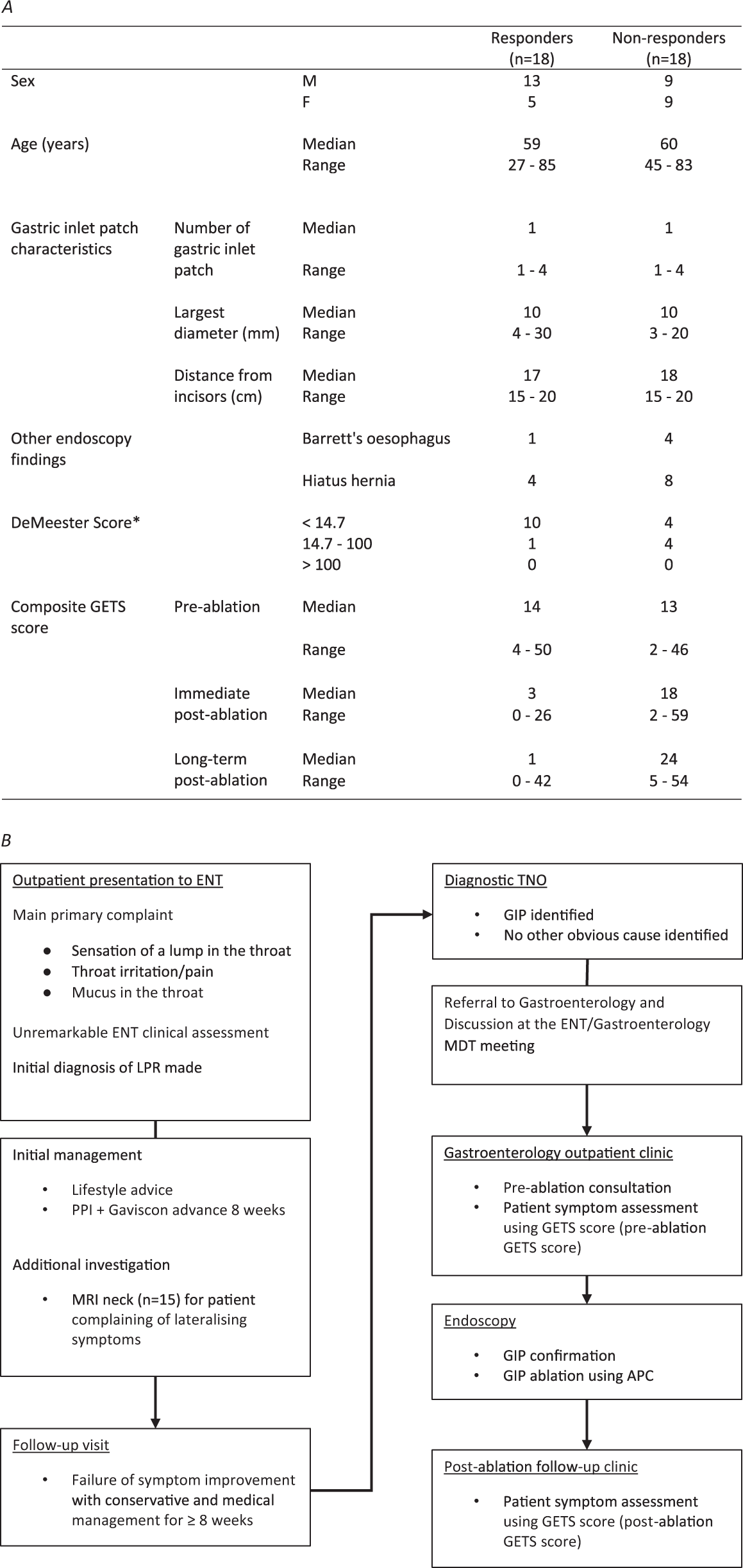
61 patients were identified to have undergone GIP ablation for their persistent throat symptoms. Of the 61 patients identified, 36 patients met the inclusion and exclusion criteria, and were included in this study for analysis (Figure 1).
Patients included in this study. A, patient characteristics. *19 patients underwent oesophageal physiology studies. DeMeester score more than 14.7 is considered abnormal acid reflux with scores between 14.7-100 considered mild-to-moderate gastro-oesophageal reflux, and a score greater than 100 regarded as severe gastro-oesophageal reflux. B, patient journey all the included patients underwent. Abbreviations: LPR, laryngopharyngeal reflux; PPI, proton pump inhibitor; MRI, magnetic resonance imaging; GIP, gastric inlet patch; TNO, transnasal oesophagoscopy; MDT, multidisciplinary team; GETS, Glasgow-Edinburgh Throat Scale; APC, argon plasma coagulation.

Patient journey
All patients included in this study presented to ENT with persistent throat symptoms, and underwent ENT clinical assessment including flexible nasendoscopy. MRI neck was additionally performed for some patients who complained of lateralising throat symptoms (n = 15), and they were all normal in this patient cohort. All patients were provided with lifestyle advice for reflux management, and were started on an empirical 8-week course of proton pump inhibitor and Gaviscon Advance. Diagnostic TNO was offered to patients whose symptoms persisted on their follow-up visit and found their symptoms to be troublesome. If GIP was seen on TNO, patients were referred by ENT to gastroenterology for ablation. Three patients had a formal biopsy performed to confirm the diagnosis of GIP. Otherwise, the diagnosis of GIP was made from visual inspection only, re-confirmed visually by gastroenterology.
Pre-ablation work-up
Pre-ablation patient work-up was not standardised. However, the decision to offer ablation was made in a multidisciplinary fashion. All symptomatic patients who were found to have GIP on their diagnostic TNO with no obvious alternative cause identified for their symptoms, and unresponsive to empirical anti-reflux treatments as outlined above were discussed at our joint ENT/Gastroenterology multidisciplinary meeting. Some patients, but not all (n = 19), underwent further oesophageal physiology studies in the form of a high-resolution manometry and 24h pH impedance manometry to exclude major motility disorders.
Ablation technique
APC ablation of GIP was performed by a single endoscopist (L.A.) for all patients. Either a straight (n = 17) or a circumferential (n = 19) probe was used. The commonest energy setting used was 30 W (n = 27) but varied between 20-60 W (n = 9). Flow rate used were 0.8 L/min (n = 11), between 1-1.5 L/min (n = 4), and 1.8 L/min (n = 21).
Efficacy
50% (n = 18/36) of patients responded to APC ablation (median follow-up 3 months; range 2–8 months) (Figure 1). More specifically, 30.6% (n = 11/36) showed an excellent response defined as 75-100% decrease in their post-ablation GETS score; and 19.4% (n = 7/36) showed a moderate response defined as 30-74% decrease in their post-ablation GETS score. Of the other 50% (n = 18/36) of patients who did not respond to APC ablation, 22.2% (n = 8/36) showed no response defined as their post-ablation GETS score being the same or ±1 from their pre-ablation GETS score; and 27.8% (n = 10/36) responded negatively with their post-ablation GETS score worsening by >15% (Figure 2).
Patients’ composite Glasgow-Edinburgh Throat Scale (GETS) score pre-ablation to post-ablation. A, Median GETS score with 95% confidence interval of the responder group and the non-responder group. B, Individual patients’ composite GETS score – responder group (n = 18/36). C, Individual patients’ composite GETS score – non-responder group (n = 18/36).

Long-term follow-up results could be obtained from 22 patients (n = 22/36) (median follow-up 4.5 years; range 2.7–5.8 years) (Figure 2). Of the 12 patients who initially responded to APC ablation, 75% (n = 9/12) had their clinical effects maintained long-term, defined as long-term GETS score remaining the same or better. Of the 10 patients who did not initially respond to APC ablation, 9 patients continued to have their throat symptoms with their long-term GETS score remaining the same or worse; 1 patient reported a spontaneous improvement in their symptoms.
Overall, the median pre-ablation GETS score was 13 (95% CI [7, 18]) in our cohort. The median post-ablation GETS score at a 3 months median follow-up (range 2–8 months) was 8 (95% CI [3, 14]), and 13 (95% CI [0, 16]) at a 4.5-year median follow-up (range 2.7–5.8 years). Symptomatically, throat irritation, difficulty swallowing food, and the sensation of a lump in the throat showed the best response, whilst catarrh showed the worst response (Table 1).
Median pre-ablation and post-ablation at 3 months median follow-up (range 2–8 months) Glasgow-Edinburgh Throat Scale (GETS) scores with 95% confidence interval. Positive response shows the percentage of patients who responded positively, defined as a decrease in their post-ablation GETS score, to gastric inlet patch ablation rounded to the nearest integer

Abbreviation: CI, confidence interval.
Safety
No immediate or long-term complications were reported.
Discussion
Meining et al. conducted a pilot trial ablating GIP using APC for patients with persistent throat symptoms, and showed symptom resolution in all ten adult patients at 2 months post-ablation.Reference Meining, Bajbouj, Preeg, Reichenberger, Kassem and Huber4 Subsequent randomised sham-controlled trial showed a 76.5% (n = 13/17) response rate with a 17 months median follow-up length.Reference Bajbouj, Becker, Eckel, Miehlke, Pech and Prinz6 This was compared to a 0% (n = 0/10) response rate in the sham procedure arm.Reference Bajbouj, Becker, Eckel, Miehlke, Pech and Prinz6 They went onto show a 74.2% response rate in a bigger patient population (n = 23/31) with a longer follow-up period of 27 months (median).Reference Klare, Meining, von Delius, Wolf, Konukiewitz and Schmid8 Three independent units subsequently reported similar response rate of 72.7 % (n = 8/11) in adult patientsReference Frieling, Kuhlbusch-Zicklam, Weingardt, Heise, Kreysel and Blank9 (median follow-up 1 month), and 100% in paediatric patientsReference Alberty, Chanis and Khoshoo10, Reference Di Nardo, Cremon, Bertelli, Oliva, De Giorgio and Pagano11 (n = 5/5 median follow-up 3 months; n = 12/12 median follow-up 36 months) with APC ablation of GIP for patients presenting with persistent throat symptoms. More recently, Dunn et al. conducted a pilot study ablating GIP using radiofrequency ablation (RFA), and showed 87.5% response rate (n = 7/8) at a median follow-up of 15 months.Reference Dunn, Sui, Anggiansah and Wong5 They are currently undertaking a multicentre doubled blinded sham-controlled trial.Reference Hussein, Rusu, Boger, Cordle, Zeki and Wong12 Table 2 summarises the current literature on the reported efficacy of GIP ablation for persistent throat symptoms (Table 2).
Currently reported efficacy of gastric inlet patch ablation for persistent throat symptoms (adapted and expanded from Table 1 from Meining and Bajbouj 2016Reference Meining and Bajbouj2)

Abbreviation: APC, argon plasma coagulation; RFA, radiofrequency ablation; VAS, visual analogue scale; GETS, Glasgow-Edinburgh throat scale; RSI, reflux symptom index.
Contrary to the current literature, our response rate was lower at 50% (n = 18/36). Our long-term follow-up data shows that the response rate drops over time to 41% (n = 9/22). Reasons for this might include an initial placebo response, an initial partial GIP ablation, and/or GIP recurrence.
Outcome measures
One explanation to the different response rate obtained could be related to the outcome measures used. We used GETS, a validated patient reported outcome measure used for assessing patients’ persistent throat symptom severity.Reference Deary, Wilson, Harris and MacDougall7 However, no other studies used GETS to measure their outcomes. One study used a modified version of GETSReference Bajbouj, Becker, Eckel, Miehlke, Pech and Prinz6, one study used the reflux symptom indexReference Di Nardo, Cremon, Bertelli, Oliva, De Giorgio and Pagano11, four studies used visual analogue scalesReference Meining, Bajbouj, Preeg, Reichenberger, Kassem and Huber4, Reference Dunn, Sui, Anggiansah and Wong5, Reference Klare, Meining, von Delius, Wolf, Konukiewitz and Schmid8, Reference Frieling, Kuhlbusch-Zicklam, Weingardt, Heise, Kreysel and Blank9, and one study used patients’ verbal report at follow up.Reference Alberty, Chanis and Khoshoo10 Therefore, it is difficult to directly compare study results due to the lack of unified outcome measure being used.
Ablation setting
Another explanation for our lower response rate could be related to the ablation setting. All four units that have reported a higher success rate than ours used APC setting of 60W at 2L/min.Reference Meining, Bajbouj, Preeg, Reichenberger, Kassem and Huber4, Reference Bajbouj, Becker, Eckel, Miehlke, Pech and Prinz6, Reference Klare, Meining, von Delius, Wolf, Konukiewitz and Schmid8–Reference Di Nardo, Cremon, Bertelli, Oliva, De Giorgio and Pagano11 The commonest APC setting used at our unit was 30W at 1.8L/min.
Klare et al. performed a follow-up endoscopy in 22 patients and noted a residual/recurrent GIP in 11 patients.Reference Klare, Meining, von Delius, Wolf, Konukiewitz and Schmid8 They also noted symptom relapse to be more common in patients who had residual/recurrent GIP.Reference Klare, Meining, von Delius, Wolf, Konukiewitz and Schmid8 Dunn et al. offered a maximum of two RFA sessions for their patient cohort if residual GIP was seen at follow-up endoscopy.Reference Dunn, Sui, Anggiansah and Wong5, Reference Hussein, Rusu, Boger, Cordle, Zeki and Wong12 Follow-up endoscopy was not performed in our patient cohort to check if our patients’ GIP was fully ablated or not. Therefore, it is possible that the lower response rate in our cohort is reflecting sub-optimal or a failed ablation.
Patient diagnostic work-up
It is currently believed that GIP is a congenital anomaly caused by a misplacement, or a sequestration of endoderm from the gastric anlage in the developing oesophagus.Reference Meining and Bajbouj2 Furthermore, GIP has been reported to be found incidentally in up to 10% of patients undergoing diagnostic oesophagogastroduodenoscopy (OGD) who may not have persistent throat symptoms.Reference Rusu, Ishaq, Wong and Dunn3 Therefore, not all GIP may cause persistent throat symptoms. Our results certainly support this.
Weickert et al. evaluated the histology of GIP and showed GIP mucosa to be either mucoid, oxyntic with acid-producing parietal cells, or mixed type.Reference Weickert, Wolf, Schröder, Autschbach and Vollmer13 One may hypothesise, perhaps GIP’s role in causing throat symptoms is dependent on its histological subtype and whether it is secreting acid, mucus, and/or pepsin. Furthermore, Alagozlu et al. found a strong association between Helicobacter pylori (H. pylori) and persistent throat symptoms in the context of GIP.Reference Alagozlu, Simsek, Unal, Cindoruk, Dumlu and Dursun14 They noted 100% of patients with H. pylori-positive GIP complained of throat symptoms (n = 16/16) whilst 61.5% (n = 32/52) of patients with H. pylori-negative GIP complained of throat symptoms. They hypothesised persistent throat symptoms to represent a non-ulcer dyspepsia of GIP with H. pylori as a potential cause following their observation.Reference Alagozlu, Simsek, Unal, Cindoruk, Dumlu and Dursun14 Of note, routine biopsy is not recommended by the British Society of Gastroenterology and Association of Upper Gastrointestinal Surgeons of Great Britain and Ireland to confirm GIP diagnosis.Reference Beg, Ragunath, Wyman, Banks, Trudgill and Pritchard15 However, considering these findings, it may be worth performing a biopsy to determine its histological subtype and the presence of H. pylori as part of patient diagnostic work-up for a consideration of GIP ablation.
A third of our patients (n = 12/36) were found to have hiatus hernia on their endoscopy, and 66.7% (n = 8/12) did not respond to GIP ablation for their throat symptoms (Figure 1). 19 patients in our cohort underwent oesophageal physiology studies prior to their GIP ablation. DeMeester score is a composite score that measures acid exposure during prolonged ambulatory pH monitoring with a score more than 14.7 being considered abnormal reflux, score between 14.7 and 100 considered mild-to-moderate GORD, and a score greater than 100 considered severe GORD.Reference DeMeester, Wang, Wernly, Pellegrini, Little and Klementschitsch16, Reference Neto, Herbella, Schlottmann and Patti17 10 patients in the responder group had DeMeester score <14.7 with one patient having a score of 15.7. In the non-responder group, 4 patients had DeMeester score <14.7, and 4 patients had DeMeester score between 14.7 and 100 (Figure 1). Thus, although LPR is an area of great debateReference O’Hara, Stocken, Watson, Fouweather, McGlashan and MacKenzie1, these findings suggest that LRP may be the primary aetiology in some patients providing an explanation for non-response to ablation.
The cause for the patient’s persistent throat symptoms may also be multi-factorial. Of note, five patients in our cohort were diagnosed with co-existing Barrett’s oesophagus confirmed on histology. Although the number is too small to draw any conclusions, it is interesting to observe that amongst this patient subgroup, four patients did not respond to GIP ablation whilst one patient showed a moderate response (Figure 1).
There were more male patients in the responder group (Figure 1). However, with the number being too small it is difficult to ascertain whether gender has any influence on treatment outcome. Otherwise, no obvious correlation was observed between patient response and patient age, number of patches, patch size, and initial GETS score within our patient cohort (Figure 1).
Our results illustrate the difficulty in patient selection for GIP ablation and highlight that during the consent process it is important to acknowledge this is an evolving area with uncertainty in predicting patient response. Patients should be worked-up appropriately pre-ablation to, as best as possible, determine how likely the identified GIP is for the patient’s throat symptoms. Reflecting on our results, our practice has now changed to incorporate high-resolution manometry and 24h pH impedance manometry studies pre-ablation.
Being a retrospective analysis of a single-centre experience, many limitations exist, and no generalisable or a definitive conclusion should be drawn from this study. From the inherent nature of the study design, selection bias exists although effort was made to minimise this with our inclusion and exclusion criteria. There was no control group included in our study. Follow-up endoscopy was not performed in our patient cohort to check if our patients’ GIP was fully ablated or not. Although our study provides the largest patient cohort with the longest follow-up period for GIP ablation to date, the number of patients in our study still remain small. Nonetheless our study describes a real-world experience of treating GIP in patients without an alternative explanation for their symptoms.
• Gastric inlet patch, a heterotopic gastric mucosa found in the upper oesophagus, has been gaining attention as a potential cause for persistent throat symptoms such as the sensation of a lump in the throat (globus).
• In thirty-six patients who underwent gastric inlet patch ablation for their persistent throat symptoms, in whom no obvious alternative cause was identified for their throat symptoms, 50% showed moderate-to-excellent response, and 50% showed no response at a median follow-up length of 3 months post-ablation. Its therapeutic effect was maintained in 75% at a median follow-up length of 4.5 years post-ablation.
• Considering the epidemiology, aetiology, and histology of gastric inlet patch, the complex nature of the potential cause for persistent throat symptoms, together with our experience, it is likely that not all gastric inlet patch causes throat symptoms.
• Therefore, patients should be worked-up appropriately pre-ablation to, as best as possible, determine how likely the identified gastric inlet patch is for the patient’s throat symptoms, as gastric inlet patch ablation can be a very effective, and safe, treatment for some patients with persistent throat symptoms that is long-lasting.
• Future studies should focus on patient selection.
Conclusion
Our experience supports the current literature that ablating GIP can be a very effective, and safe, treatment for patients with persistent throat symptoms, with its therapeutic effects long-lasting. However, our experience illustrates that some GIP are incidental, and suggests future studies should focus on patient selection.
Funding statement
None.
Competing interests
None to declare.
Acknowledgement
Chang Woo Lee is currently a Royal College of Surgeons of England Surgical Research Fellow.
Authorship
CWL, KJH and LA were involved with the conception and design of the study. All authors were involved with the acquisition and analysis of data. CWL, TU-W, RN, SP and NS were involved with the drafting of the article. KJH and LA gave critical revision. All authors approved the final manuscript.