Introduction
Hydropsychidae (Trichoptera) is one of the largest families belonging to Trichoptera with > 16 200 described extant species (Morse Reference Morse2018). Most of the larvae belonging to this insect group are filter feeders and can be found in all types of running water and occasionally in waves along the edges of large lakes (Higler and Tolkamp Reference Higler and Tolkamp1983). These are widely used for biomonitoring due to the wide range of pollution tolerance among the species (Lenat Reference Lenat1993; Geraci et al. Reference Geraci, Zhou, Morse and Kjer2010) and their ability to consume all sizes of living or dead, suspended, or deposited organic materials, which are necessary nutrients in freshwater ecosystems (Wallace and Merritt Reference Wallace and Merritt1980).
Recent classification of Hydropsychidae based on morphological and molecular data recognised five subfamilies: Arctopsychinae, Diplectroninae, Hydropsychinae, Macronematinae, and Smicrideinae (Schefter Reference Schefter1996; Geraci et al. Reference Geraci, Kjer, Morse and Blahnik2005). Arctopsychinae was recognised as a separate family by earlier authors (Fischer Reference Fischer1963; Schmid Reference Schmid1968; Levanidova Reference Levanidova1982). More recent morphological and molecular data supported the monophyly of Arctopsychinae, Macronematinae, and Smicrideinae (Schefter Reference Schefter1996; Geraci et al. Reference Geraci, Kjer, Morse and Blahnik2005). Kjer et al. (Reference Kjer, Thomas, Zhou, Frandsen, Prendini and Holzenthal2016) provided additional data in support of the monophyly of the subfamilies Hydropsychinae and Diplectroninae. The two earlier studies also agreed on the basal position of Arctopsychinae relative to the other four subfamilies (Schefter Reference Schefter1996; Geraci et al. Reference Geraci, Kjer, Morse and Blahnik2005), but the latter investigation inferred a basal position for Macronematinae (Kjer et al. Reference Kjer, Thomas, Zhou, Frandsen, Prendini and Holzenthal2016), with relationships (Macronematinae (Arctopsychinae (Diplectroninae (Smicrideinae + Hydropsychinae)))).
Macronematinae (Hydropsychidae) has a complicated taxonomic history. When Hydropsychidae was first subdivided by Brauer (Reference Brauer1868), Oestropsinae (originally the family Oestropsidae) was erected based on the morphological traits of the species without palps. Brauer (Reference Brauer1868) placed the genera Oestropsis Brauer, Oestropsyche Brauer, and Polymorphanisus Walker in his Oestropsinae, while Macronema Pictet was retained in Hydropsychidae (sensu stricto). Later, Aethaloptera Brauer, Amphipsyche McLachlan, and Phanostoma Brauer were described and all three genera were added to Oestropsinae by McLachlan (Reference McLachlan1878), despite Phanostoma having normal mouthparts. Phanostoma was later synonymised with Amphipsyche (Martynov Reference Martynov1935). Ulmer (Reference Ulmer1907) established Macronematinae, considering the proposals made by Brauer (Reference Brauer1868) and McLachlan (Reference McLachlan1878), to separate Blepharopus Kolenati, Aethaloptera, Amphipsyche, Macronema, and Polymorphanisus from the other Hydropsychidae genera. Ulmer (Reference Ulmer1907) did not use either family group names Oestropsidae or Oestropsinae because Oestropsis had been synonymised with Polymorphanisus.
Macronematinae sensu Ulmer (Reference Ulmer1907) was subdivided by Lestage (Reference Lestage1936) using palps as the key character to identify each tribe, although Ulmer (Reference Ulmer1951) continued not to recognise tribes. Within the subfamily, the species with evident palps were placed in Macronematini, while species without palps were placed in Polymorphanisini. Polymorphanisini has since been defined only by the absence of palps, while the monophyly of the Macronematini has been questioned based on differences in larval morphology and retreat types (Gibbs Reference Gibbs1973; Scott Reference Scott1975; Barnard Reference Barnard1984). Nevertheless, this division has been accepted in most studies (Barnard Reference Barnard1980, Reference Barnard1984; Malicky Reference Malicky1998a, Reference Malicky1998b; Oláh Reference Oláh2013). Marlier (Reference Marlier1962) suggested the name Oestropsychini for palp-less division, but Flint (Reference Flint1974, Reference Flint1978) and Scott (Reference Scott1975) proposed standardisation of the tribe name to Polymorphanisini. This change is retained under Article 40 of the International Code of Zoological Nomenclature (1999).
Macronematinae, mostly a Gondwanan element of the Trichoptera fauna, currently has 16 genera (Barnard Reference Barnard1980, Reference Barnard1984; Oláh Reference Oláh2013). Oláh (Reference Oláh2013) synonymised the genus Trichomacronema with Polymorphanisus stating that a single character, such as an obsolete Rs on the forewing in Trichomacronema, does not justify generic status. The remaining four valid genera comprising Polymorphanisini are Aethaloptera (13 species, Afrotropical, Australasian, eastern Palaearctic, Oriental), Oestropsyche (one species, Ausralasian, Oriental), Polymorphanisus (19 species, all Afrotropical and Oriental), and Synoestropsis Ulmer (10 species, Neotropical). Macronematini consists of the 12 genera Amphipsyche (22 species, Afrotropical, eastern Palaearctic, Oriental, western Palaearctic), Baliomorpha Neboiss (11 species, Australasian), Blepharopus (one species, Neotropical), Centromacronema Ulmer (17 species, Nearctic, Neotropical), Leptonema Guérin-Méneville (145 species, Afrotropical, Nearctic, Neotropical), Leptopsyche McLachlan (three species, Australasian), Macronema (33 species, Nearctic, Neotropical), Macrostemum Kolenati (101 species, cosmopolitan except for the western Palaearctic), Plectromacronema Ulmer (three species, Neotropical), Protomacronema Ulmer (nine species, Afrotropical), Pseudoleptonema Mosely (15 species, Oriental), and Pseudomacronema Ulmer (one species, Neotropical).
The classification of the genera within Macronematinae has been based mostly on a single set of key characters: wing venation. At the species level, the identification key of Barnard (Reference Barnard1980, Reference Barnard1984) involved the use of wing venation, male genitalia, and thoracic markings. In Polymorphanisini, Barnard (Reference Barnard1984) suggested that the genus Amphipsyche is most closely related to the genus Protomacronema because of their highly similar wing venation. Among the genera of Macronematini, he noted that only Amphipsyche, Leptopsyche, and Protomacronema do not possess forewing discoidal cell; Amphipsyche and Protomacronema have Fork III sessile in both wings; and their larvae have a raised carina on the head (Barnard Reference Barnard1984). Another remarkably important character regarding wing venation is one or more c-sc crossveins near mid-length in addition to the commonly seen humeral and subapical c-sc crossveins. These additional crossveins are not found in the wings of most groups in Trichoptera; however, in this study, we found that some of the genera belonging to Macronematinae such as Polymorphanisus and Amphipsyche possess this character. Therefore, the crossvein c-sc character was included in this study to investigate how it contributes to the classification of the subfamily. In some genera in Macronematinae such as the genus Macrostemum, species identification is augmented by the use of wing patterns (Flint et al. Reference Flint, Holzenthal and Harris1999). Some species with very confusing genitalia can be confirmed by the wing patterns. The genus Pseudoleptonema is another genus in which each species has a distinct wing pattern in each species.
Male genital segments and appendages are other important key characters in Trichoptera taxonomy (Nielsen Reference Nielsen1957). The pair of inferior appendages, which are also called gonopods, are typically divided into proximal and distal segments (coxopodite and harpago, respectively), although those are indistinguishable in some species (Nielsen Reference Nielsen1957). Nielsen (Reference Nielsen1957) explained the evolution of the unsegmented state by (1) the reduction of the harpago, (2) fusion of two joints, or (3) fusion of the coxopodite with segment IX. The alternative term “gonopods” assumes their appendicular origin as limb podites of segment IX of the genitalia (Oláh and Johanson Reference Oláh and Johanson2008). “Claspers” is another term used for the inferior appendages because of its clasping and grasping function during copulation (Ross Reference Ross1938). In Hydropsychidae, the species commonly have two-segmented inferior appendages. In some genera belonging to Macronematinae, such as Centromacronema, Baliomorpha, Macronema, and Amphipsyche, the inferior appendages are unsegmented.
Another important set of organs in Trichoptera taxonomy is setal warts. The macrosetae and chemoreceptors on these specialised regions serve as sensory organs to detect different forms of environmental energy, such as light, movement, and the charged ionic energy of non-volatile and volatile molecules (Oláh and Johanson Reference Oláh and Johanson2007). Ivanov (Reference Ivanov1990) also suggested that they have a role in flight control. The presence and shapes of these warts are characteristic of different families and genera of Trichoptera and thus are often diagnostic (e.g., Ross Reference Ross1944). Compared with wing venation and male genitalia structures, setal warts have received less attention in taxonomic studies of Trichoptera adults, probably in part because thoracic warts are destroyed on specimens preserved dry on insect pins. However, Wiggins (Reference Wiggins, Merrit and Cummins1984) and Ivanov (Reference Ivanov1990) attempted to homologise cephalic and thoracic setal wart patterns, and Oláh and Johanson (Reference Oláh and Johanson2007) stated that clearing the entire wingless body of an adult can probably give useful information on the setal wart patterns for species description. A nomenclature for head setal warts was made by Oláh and Johanson (Reference Oláh and Johanson2007) to describe species in the Trichoptera families. The names of warts were given based on the name of the cranial sclerites hosting them, the name of the nearest organs, and the name of the wart type. The number of head setal warts was counted for most of the Hydropsychinae species (Oláh and Johanson Reference Oláh and Johanson2007).
The objectives of this study arose from the lack of basic knowledge about the phylogeny of Macronematinae, a need to revise the otherwise confused classification, and an impetus to facilitate prediction of biological traits in the species. The two major objectives were to (1) investigate the phylogenetic relationships of the currently known classification in the established tribes (Polymorphanisini and Macronematini) and genera within Macronematinae and (2) understand the evolutionary development of 12 major morphological traits (including size of the eyes, presence or absence of mouthparts, warts on the dorsum of the head (anterior and posterior), forewing venations and colouration, inferior appendages of the male genitalia, and shape of the phallic apex).
Species-level taxonomy of the Macronematinae was worked and published recently (Uy et al. Reference Uy, Malicky and Bae2018). However, this is the first phylogenetic study based on molecular and morphological data covering 15 out of 16 genera of Macronematinae. The wide distribution of Macronematinae species made our sampling from different biogeographic regions, such as South Africa, limited to sometimes one to two representative species only per genera. Although many species are distributed in South Africa, our analyses were only limited to five Afrotropical species (Aethaloptera dispar Brauer, Aethaloptera maxima Ulmer, Amphipsyche senegalensis Brauer, Macrostemum alienum Ulmer, and Macrostemum capense Walker) because of the difficulty in acquiring fresh materials.
For molecular phylogenetic analysis, we chose a large subunit (28S) nuclear ribosomal DNA (D2 expansion fragment) gene, which is the most highly variable region in eukaryote rRNA and commonly used in phylogenetic studies in Trichoptera (Zhou et al. Reference Zhou, Kjer and Morse2007; Kjer et al. Reference Kjer, Zhou, Frandsen, Thomas and Blahnik2014; Maleki-Ravasan et al. Reference Maleki-Ravasan, Bahrami, Vatandoost, Shayeghi, Koosha and Oshaghi2017), and the mitochondrial cytochrome oxidase I (COI) gene to further investigate the species-level relationships. Here, we present separately the molecular phylogeny using D2 and COI genes using maximum likelihood, parsimony, and Bayesian approaches, and combined gene analysis for the species with both D2 and COI sequences. The resulting implied evolutionary development of the 12 morphological characters were also analysed.
Material and methods
Taxon sampling
Adult samples were collected using light traps, identified, and stored in 95% ethanol for subsequent molecular analyses. Voucher specimens are deposited in the University of the Philippines Biology Invertebrate Museum in Diliman, Quezon City, Philippines. Five species of Hydropsychinae (Cheumatopsyche ceres Malicky and Chantaramongkol, C. lucida Ulmer, C. criseyde Malicky and Chantaramongkol, Hydropsyche harpagofalcata Mey, and H. instabilis Curtis) were used as outgroups in all the analyses performed (Supplementary Table S1).
The GenBank database was also consulted to search for available Macronematinae D2 and COI sequences. A total of 11 D2 sequences from 11 species and 59 COI sequences from 47 species were downloaded and included in the study. Information for the specimens and GenBank accession numbers are presented in Supplementary Table S1.
DNA extraction, polymerase chain reaction, and sequencing
Genomic DNA was extracted from one leg using the “HotSHOT” method, which uses alkaline lysis reagent with neutralisation buffer (Truett et al. Reference Truett, Heeger, Mynatt, Truett, Walker and Warman2000). The primers used and polymerase chain reaction cycling conditions for the D2 and COI genes are shown in Supplementary Table S2. AccuPower polymerase chain reaction premix (Bioneer, Daejeon, South Korea) was used for 20-μL reaction volumes containing 1 U of Top DNA polymerase, dNTP (10 mM), Tris-HCl (pH 9.0), 30 mM KCl, and 1.5 mM MgCl2. The volume of genomic DNA used for each 20 μL polymerase chain reaction was 1–3 μL with a concentration of 5–50 ng, and each primer was 1 μL with a concentration of 10 pmole. Polymerase chain reaction products were separated on 1.5% agarose gel and visualised under ultraviolet light. Purified polymerase chain reaction products were sequenced on ABI Prism 3130 genetic analyser (Applied Biosystems, Foster City, California, United States of America).
Phylogenetic analyses
Molecular phylogeny
Phylogenetic reconstructions were done independently for D2 and COI. A total of 53 D2 sequences from 38 species (including the outgroups) and 96 COI sequences from 62 species (including the outgroups) were used in the analyses (Supplementary Table S1). In most genera with many species, such as Macrostemum, Macronema, Centromacronema, Leptonema, and Polymorphanisus, multiple species (up to three sequences) were used as representative of the genus. Only the genus Leptopsyche, a rare genus known only from West Papua, Indonesia (Oláh and Kovács Reference Oláh and Kovács2015), was not included in either analysis; the genera Protomacronema, Plectromacronema, Pseudomacronema, and Leptopsyche were not included in D2 because of the unavailability of fresh samples or sequences in GenBank.
D2 sequences (679 base pairs) were aligned manually according to secondary structure following Kjer (Reference Kjer1995). Regions of ambiguous alignment (215 base pairs) were excluded from the analysis. COI sequences (658 base pairs) were aligned using the Clustal-W multiple sequences alignment package implemented in MEGA version 6.0 (Tamura et al. Reference Tamura, Stecher, Peterson, Filipski and Kumar2013) and then edited manually. The aligned 28S rRNA D2 and mitochondrial COI dataset can be found in Supplementary Files S1–S2, respectively. Phylogenetic inferences were performed using maximum likelihood generated in MEGA version 6.0 (Tamura et al. Reference Tamura, Stecher, Peterson, Filipski and Kumar2013) and Bayesian inference conducted in Mr. Bayes version 3.2.7a (Ronquist et al. Reference Ronquist, Teslenko, van de Mark, Ayres, Darling and Höhna2012). The GTR + I + Γ model of nucleotide substitution was selected as the best fitting model for D2 and COI sequences by jModelTest version 2.1.10 under the Akaike information criterion (Guindon and Gascuel Reference Guindon and Gascuel2003; Darriba et al. Reference Darriba, Taboada, Doallo and Posada2012). Bootstrap analyses were done for 1000 replicates with both gene sequences in maximum likelihood. The posterior probabilities in Bayesian inference were obtained from a Metropolis-coupled Markov Chain Monte Carlo approach (two independent runs; four chains with 1 000 000 generations for D2 and 10 500 000 for COI; trees sampled every 100 generations). The first 25% of trees were discarded as burn-in prior to constructing a 50% majority-rule consensus tree. The average standard deviation of split frequencies for both runs was < 0.01, indicating convergence. Potential scale reduction factor was 1.0 in all the runs, indicating good sample from the posterior probability distribution.
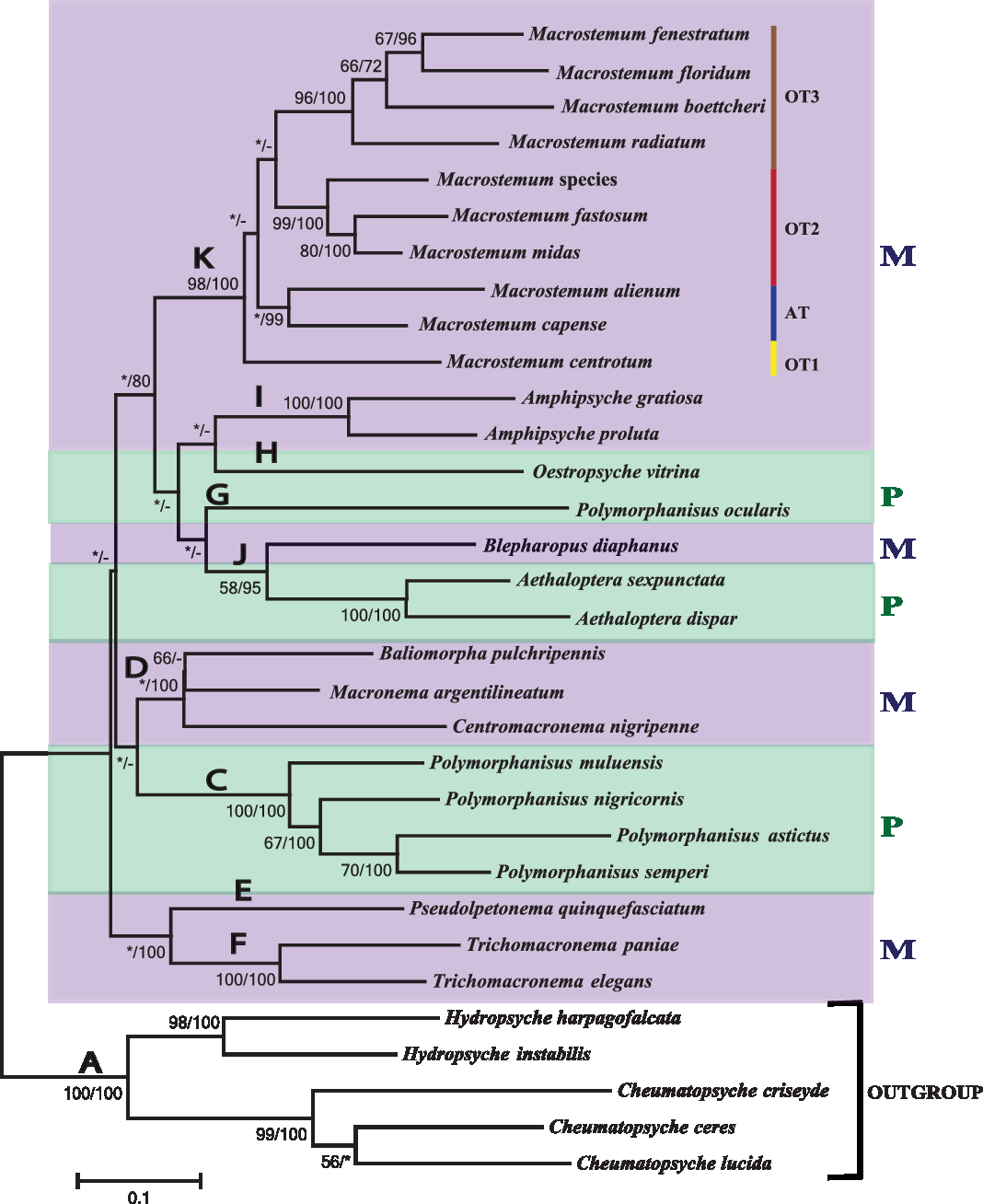
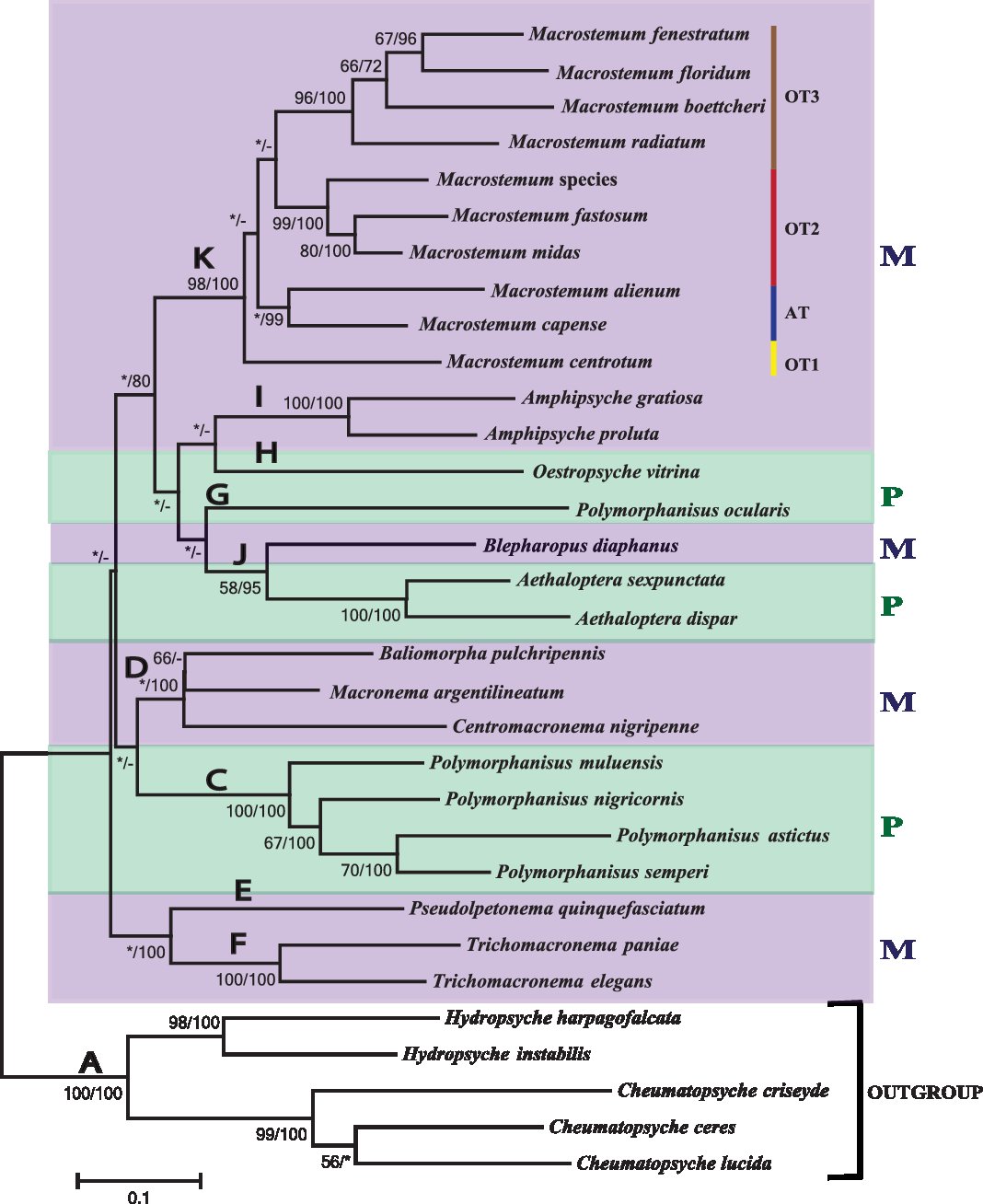
Species with both D2 and COI sequences were later combined to have a D2-COI dataset to verify whether topologies are consistent in either COI or D2 analyses results. The combined dataset consisted of 32 species (1122 base pairs) plus outgroup species covering 11 genera from Macronematinae (Fig. 3). The aligned combined 28S rRNA D2 and mitochondrial COI dataset can be found in Supplementary Material S3. The GTR + I + Γ substitution model was selected as the best fitting model by jModelTest (Guindon and Gascuel Reference Guindon and Gascuel2003; Darriba et al. Reference Darriba, Taboada, Doallo and Posada2012) under the Akaike information criterion. Phylogenetic tree reconstructions using maximum likelihood and Bayesian inference were conducted in a similar manner as done for the entire dataset applied to the Macronematinae except that four chains were only run for 100 000 generations in Bayesian inference.
Reconstructed phylogenetic tree using combined D2 region of large subunit (28S) nuclear ribosomal DNA and mitochondrial COI genes. Tree was inferred from 1122 base pairs of 27 Macronematinae species and five species from Hydropsychinae were used as outgroups. Numbers on the left indicate bootstrap values and on the right indicate posterior probabilities. Bootstrap and posterior probabilities < 50 are indicated by “*” and not supported nodes are indicated by “–”. The species belonging to Polymorphanisini sensu Lestage (Reference Lestage1936) are labelled P and species belonging to Macronematini sensu Lestage (Reference Lestage1936) are labelled M.
Analyses of morphological character evolution
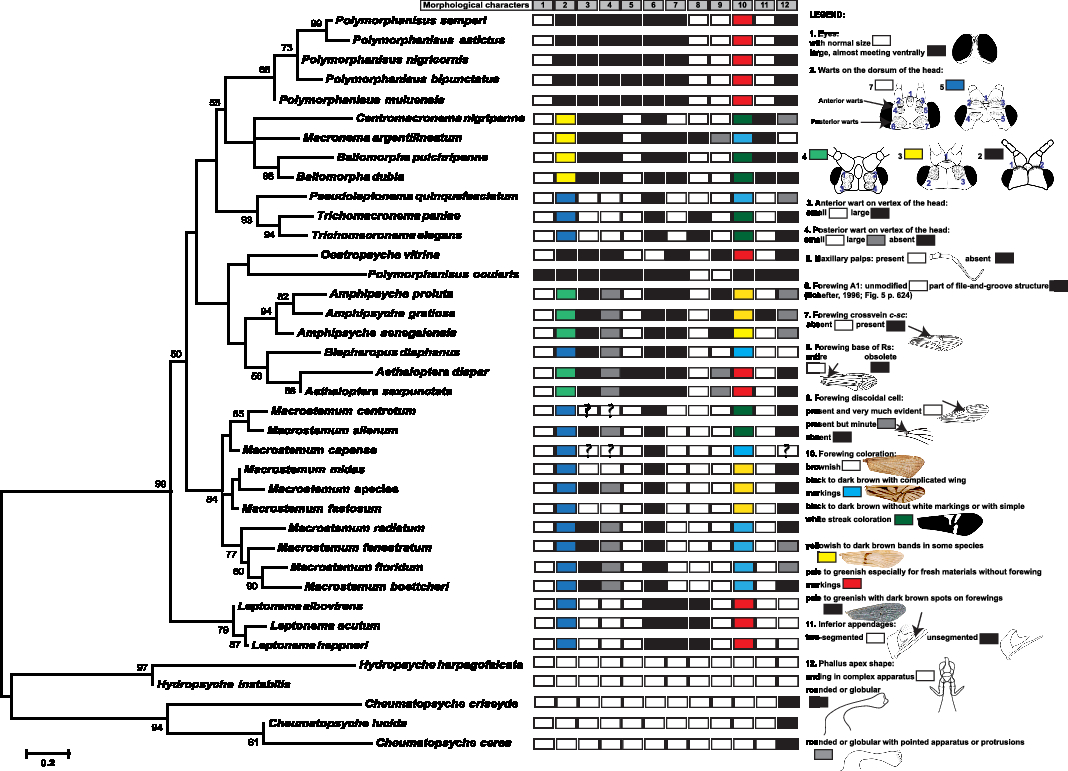
Since most of larval and pupal characters are unknown for the species in Macronematinae, only adult characters were included in the analysis (Supplementary Table S3). Ten morphological characters that were considered informative by previous studies for diagnosis of one or more genera (Barnard Reference Barnard1980, Reference Barnard1984) and two other morphological characters (e.g., characters 2 and 7; Fig. 3) that also differed among the genera in the subfamily were investigated to identify the evolutionary history of those characters within the subfamily. Characters were coded as presented in Supplementary Table S3. The D2 phylogeny was chosen for tracing the evolution of the characters because the COI-based tree could not resolve phylogenetic relationships in the intragenic or interfamily level with adequate support or resulted in polytomies for the deep nodes (Fig. 2). A separate D2 gene-based phylogeny based on maximum likelihood and Bayesian inference, including only one representative sequence per species, was reconstructed for character mapping (Supplementary Fig. S1) with HKY + Γ as the best fitting model and bootstrap analysis using 1000 replicates. A total of 38 D2 gene sequences (464 base pairs) representing 33 species plus five outgroup species were included.
The evolution of morphological characters was analysed using the methods introduced by Wiley et al. (Reference Wiley, Siegel-Causey, Brooks and Funk1991) by polarising the morphological characters on the D2 phylogenetic tree according to the criterion of phylogenetic parsimony by comparing with the outgroup.
Results
Molecular phylogeny
Phylogenetic relationships within Macronematinae
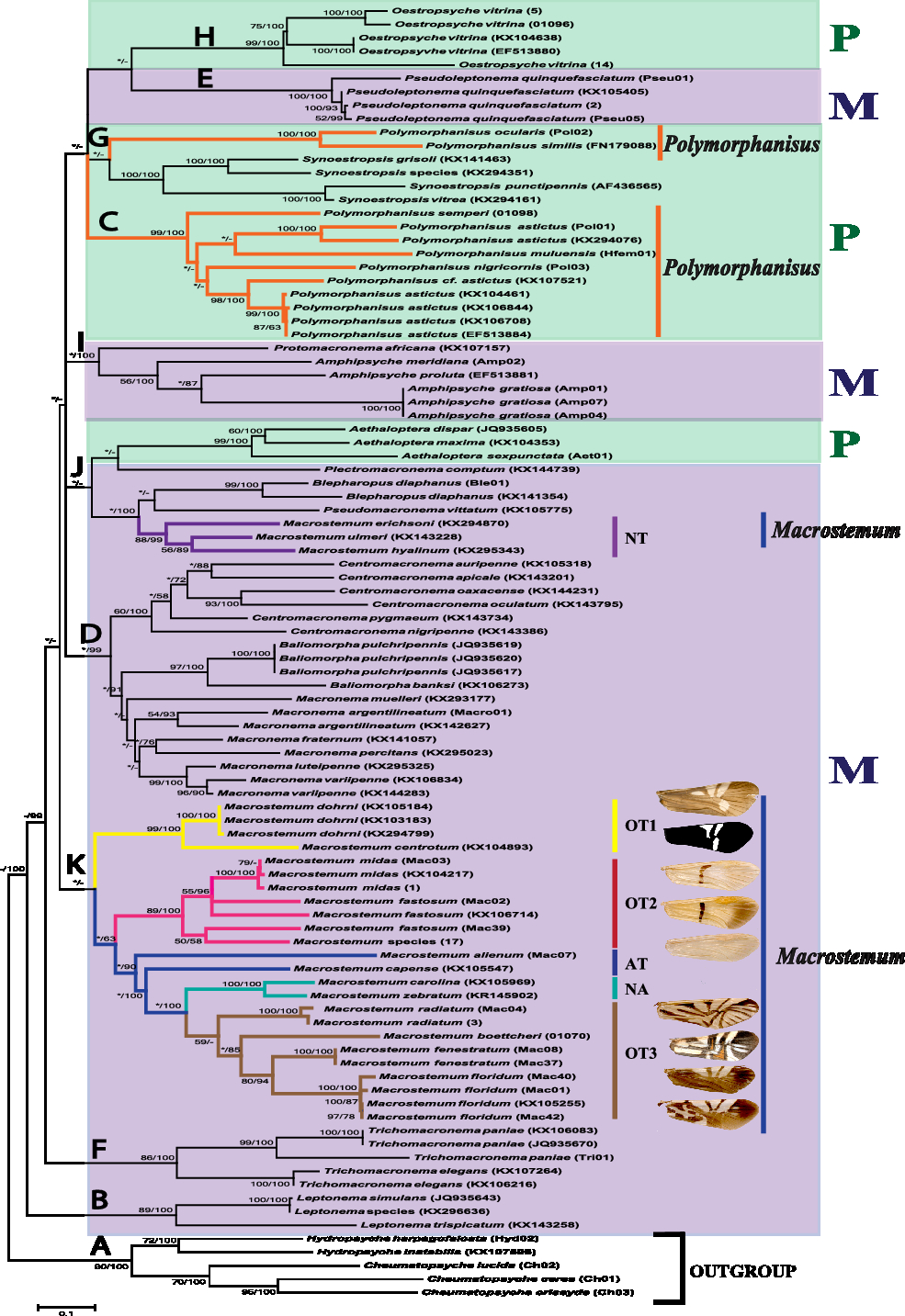
Monophyly of Macronematinae (Fig. 1) and the basal position of the genus Leptonema (Fig. 1 clade B) relative to the other Macronematinae genera were both strongly supported (bootstrap value 99, Bayesian posterior probability 100) in the D2 phylogeny. Monophyly and a basal relationship of Leptonema (89 bootstrap, 100 posterior probability) were also identified in the COI phylogeny (Fig. 2, clade B).
Maximum likelihood and Bayesian 50% majority rule consensus tree of Macronematinae based on DNA sequences of the D2 expansion of 28S ribosomal RNA (28S D2). The phylogenetic tree was inferred using 53 D2 sequences (464 base pairs) from 38 species. A total of 48 sequences from 33 species are from Macronematinae. Five species from Hydropsychinae were used as outgroups. Numbers on the left indicate bootstrap values and on the right indicate posterior probabilities. Bootstrap and posterior probabilities < 50 are indicated by “*” and not supported nodes are indicated by “–”. The species belonging to Polymorphanisini sensu Lestage (Reference Lestage1936) are labelled P and species belonging to Macronematini sensu Lestage (Reference Lestage1936) are labelled M.

Maximum likelihood and Bayesian 50% majority rule consensus tree of Macronematinae based on DNA sequences of the mitochondrial COI gene fragment. The phylogenetic tree was inferred using 96 COI sequences (658 base pairs) from 62 species. A total of 91 sequences from 57 species are from Macronematinae. Five species from Hydropsychinae were used as outgroups. Numbers on the left indicate bootstrap values and on the right indicate posterior probabilities. Bootstrap and posterior probabilities < 50 are indicated by “*” and not supported nodes are indicated by “–”. The species belonging Polymorphanisini sensu Lestage (Reference Lestage1936) are labelled P and species belonging to Macronematini sensu Lestage (Reference Lestage1936) are labelled M.
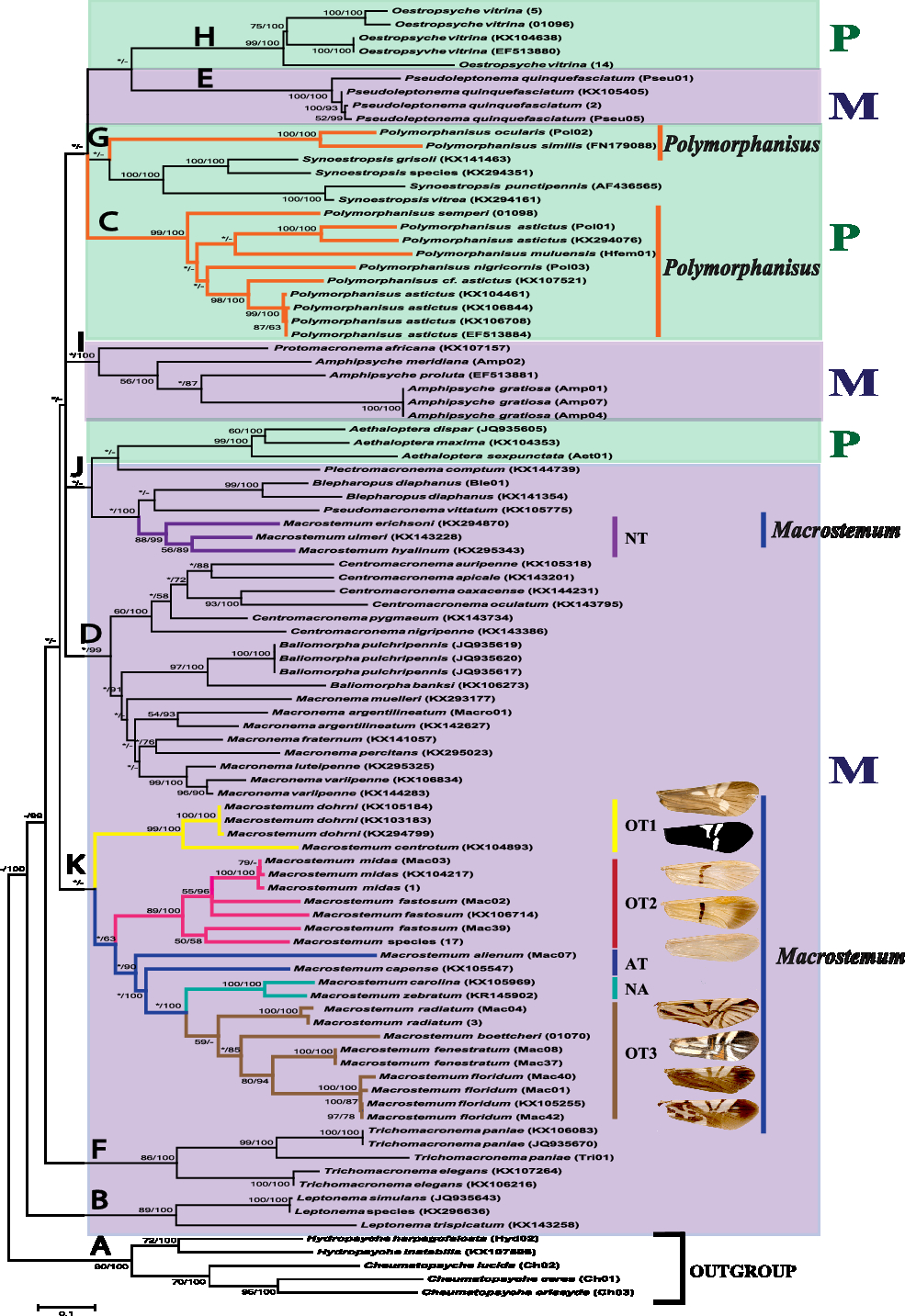
The D2 phylogeny showed the monophyly of each genus except for Polymorphanisus with high supporting values from 80 to 99 in maximum likelihood and 100 posterior probability in Bayesian inference (Fig. 1). When the reconstruction was done using COI gene sequences with more representative species compared with D2 (62 compared with 38 species including outgroup), monophyly of each genus was also observed with relatively high supporting value (71% of taxa with > 86 bootstrap value; 91–100 posterior probability in Bayesian inference), however, not for Polymorphanisus (Fig. 2, clades C and G) or Macrostemum (Fig. 2, clades J and K). The phylogenetic relationships among genera were not resolved in COI with adequate support ( < 50 bootstrap value in maximum likelihood and unresolved deeper nodes in Bayesian inference) and some clades showing polyphyletic relationships among major nodes (Fig. 2, clades D–K). Even though the D2 phylogeny has fewer taxa, it showed better resolution of phylogenetic relationships than the COI cladogram (Fig. 1).
Monophyly of the genus Macrostemum were observed in the D2 gene tree (Fig. 1) and in the combined D2-COI dataset analysis (Fig. 3) where Neotropical Macrostemum species were not included because of lack of fresh specimens or available sequences in GenBank. However, in the COI cladogram, paraphyly of Macrostemum was recognised with respect to the Neotropical species Macrostemum ulmeri Banks, M. hyalinum Pictet, and M. erichsoni Banks. Those Neotropical species did not cluster with other Macrostemum species (Fig. 2, clade J), but with the clade of ((Blepharopus + Pseudomacronema) and (Aethaloptera + Plectromacronema)) (Fig. 2, clade J) in maximum likelihood and clustered with two genera (Blepharopus + Pseudomacronema) in Bayesian inference.
For the genus Polymorphanisus, paraphyly was observed by the clear separation of Polymorphanisus ocularis Ulmer and Polymorphanisus similis Ulmer from other Polymorphanisus species in both D2 and COI phylogenies (Figs. 1–2, clade G) and even in the combined D2-COI dataset analysis (Fig. 3, clade G).
A clade Centromacronema + Baliomorpha + Macronema (Figs. 1–3, clade D) was consistently supported in all the cladograms (D2, COI, and combined D2-COI) either using maximum likelihood or Bayesian inference analyses. The Bayesian inference showed high posterior probability values in all the cladograms in that node (97–100). Flint and Bueno-Soria (Reference Flint and Bueno-Soria1982) stated the possibility that Macronema and Centromacronema are synonyms; we confirmed a close relationship of those two genera plus the genus Baliomorpha.
A sister group relationship Amphipsyche + Protomacronema suggested by Barnard (Reference Barnard1984) based on wing venation was also confirmed in the cladogram using COI gene (Fig. 2, clade I). Although monophyly of the genus Amphipsyche was supported with high bootstrap support (93) and posterior probability (100) in D2 tree (Fig. 1, clade I), a close relationship with Protomacronema could not be recovered due to the unavailability of any D2 sequences of Protomacronema. A sister group relationship for these genera that occurred with low support in our COI cladogram (<50) in the maximum likelihood tree, however, showed a high posterior probability in Bayesian inference (100) (Fig. 2, clade I).
Phylogeographic and wing pattern variations of the genus Macrostemum
Phylogenetic relationships of the D2 and COI phylogenies showed clustering of Macrostemum species based on geography (Fig. 1, clade K; Fig. 2, clades J and K). The same pattern was also observed in the D2-COI reconstructed phylogenetic tree (Fig. 3). In the D2 cladogram, the single OT1 species (Macrostemum centrotum) clustered with Afrotropical species Macrostemum alienum and possibly Afrotropical species Macrostemum capense (Fig. 1), but the OT2 and OT3 clades were moderately well supported in maximum likelihood analysis (Fig. 1: 72 and 71, respectively) while high posterior probability in Bayesian inference (Fig. 1: 100 and 93, respectively); Nearctic and Neotropical species were not included in the analysis. In the COI cladogram, the species of this genus formed Neotropical, Nearctic, and three Oriental (OT 1–3) groups (Fig. 2). High bootstrap support was also recovered by the COI cladogram for both OT1 (99) and OT2 (89) while modest support for OT3 (59). The Bayesian inference recovered 100 posterior probability both in OT1 and OT2 and also in OT3 but with Nearctic species (OT3 + NA) (Fig. 2, clade K).
Species from the three Oriental groups showed different types of wing patterns: (1) dark coloured species with simpler wing patterns for OT1, (2) yellow-coloured species for OT2 with or without dark band wing pattern, and (3) with complicated white markings running transversely and longitudinally for OT3. Species included in group OT1 have white marks on the wings, with either one, two, or more triangular white marks running longitudinally in the forewing, but the transverse bands are concentrated near the edge of the forewing for OT3 (Figs. 1–2, clade K). Transverse bands near the edge of forewing were not observed for OT1 coloured species (Figs. 1–2, clade K).
Tribes not supported
Neither the D2 cladogram nor the COI cladogram and even the combined D2-COI dataset supported the two currently recognised tribes, Polymorphanisini and Macronematini, established by Lestage (Reference Lestage1936) (Figs. 1–3). The analysis using the D2 gene recovered two major clades with low supporting values ( < 50) showing a clade Oestropsyche + Trichomacronema + Macronema +Centromacronema + Baliomorpha + Polymorphanisus and a clade Macrostemum + Aethaloptera + Blepharopus + Amphipsyche (Fig. 1) while the consensus Bayesian inference tree showed no support for the deeper nodes. The genus Aethaloptera (Fig. 1, clade J) clustered with other species from Macronematini (with palps) instead of clustering with other species of Polymorphanisini (without palps) (Oestropsyche and Polymorphanisus). Similarly, the genera belonging to Macronematini (Trichomacronema + Pseudoleptonema and Macronema + Centromacronema + Baliomorpha) clustered with genera of Polymorphanisini (Fig. 1, clades D–F). Analysis using COI gene showed that the Macronematini genus Pseudoleptonema (Fig. 2, clade E) clustered with three genera of Polymorphanisini: Oestropsyche, Polymorphanisus, and Synoestropsis (Fig. 2, clades C, G, and H). Also, the Polymorphanisini genus Aethaloptera clustered with three genera belonging to Macronematini: Blepharopus, Plectromacronema, and Macrostemum Neotropical (Fig. 2, clade J). The Bayesian inference did not show clear separation of the tribes whether using COI, D2, or combined gene analysis (Fig. 3).
Morphological synapomorphies in Macronematinae
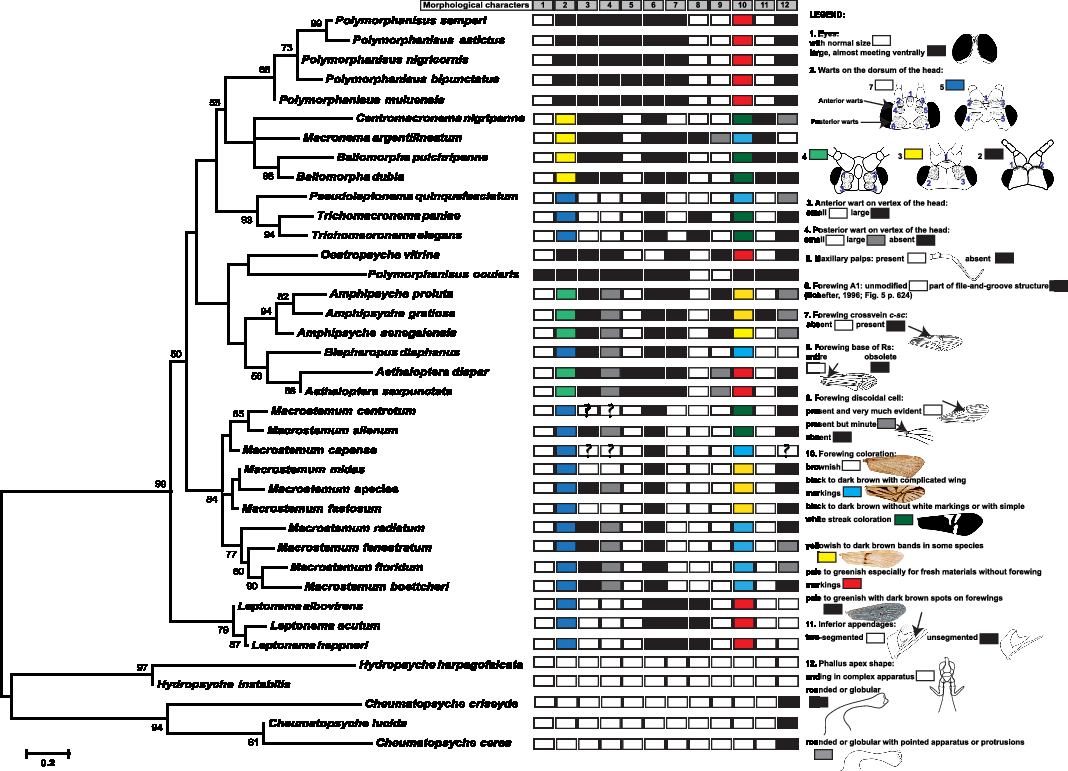
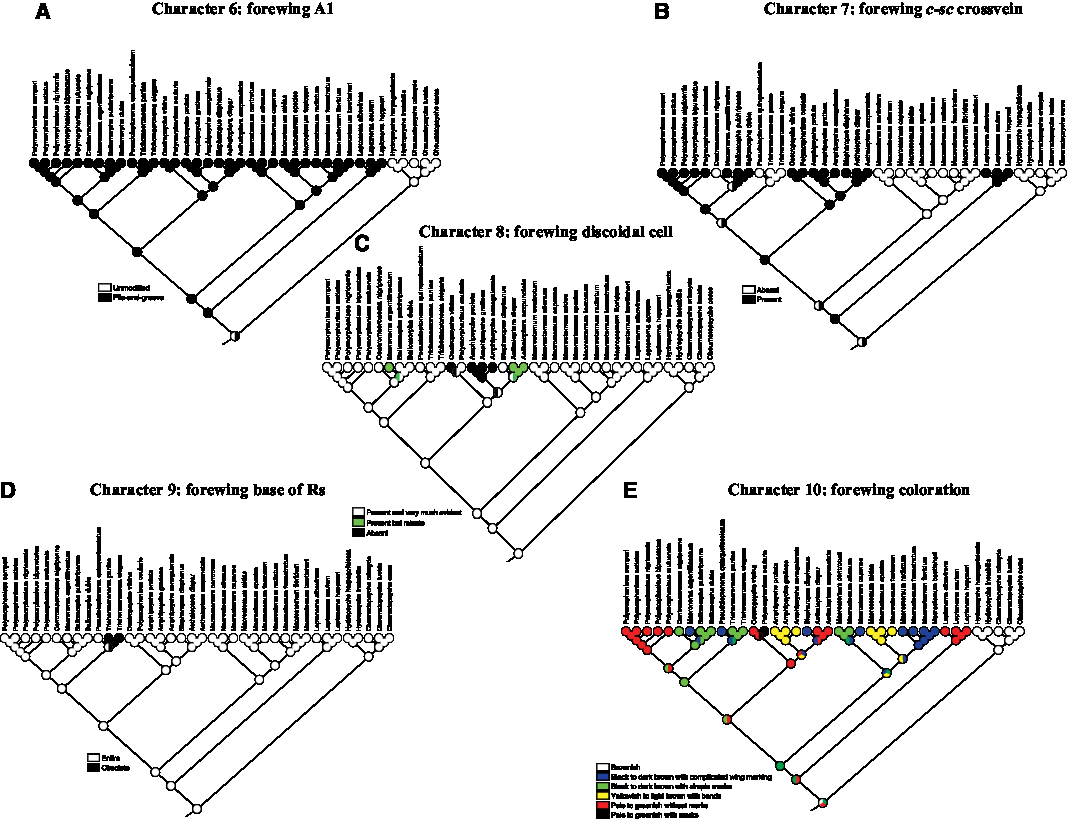
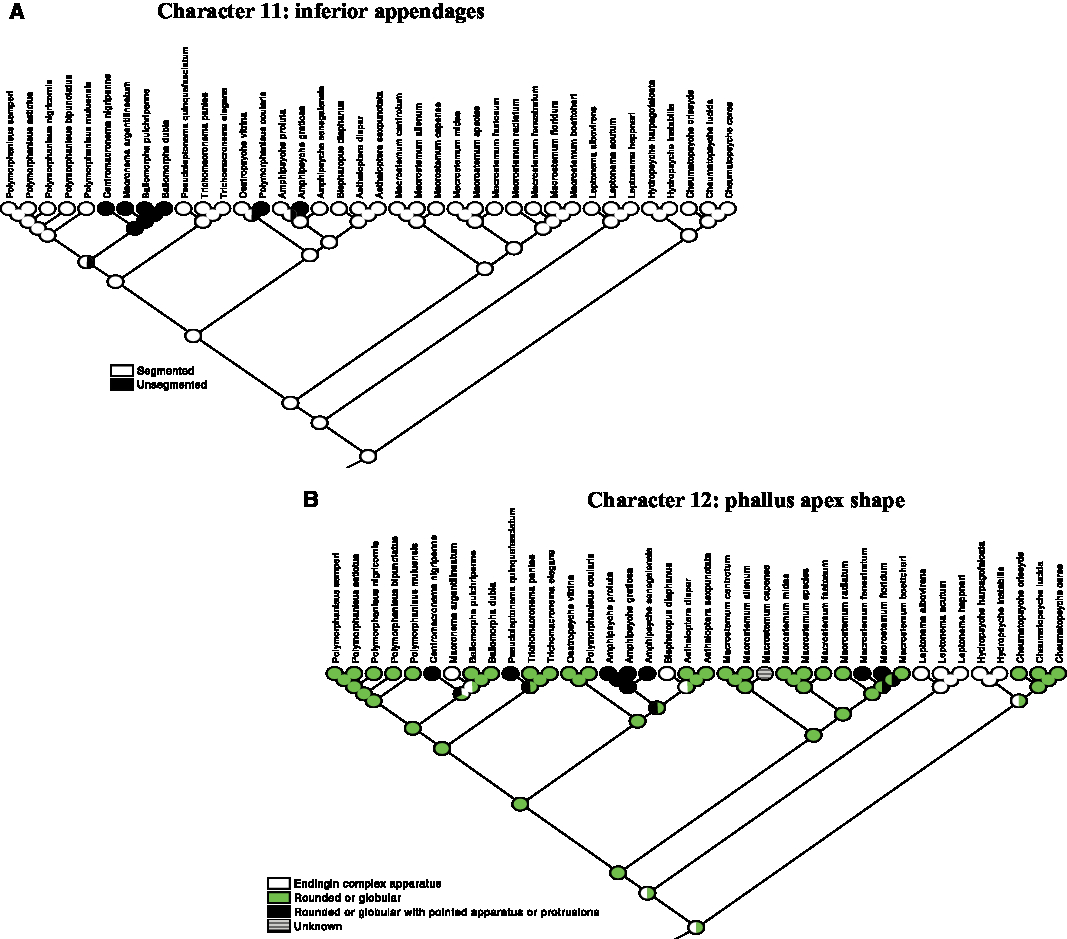
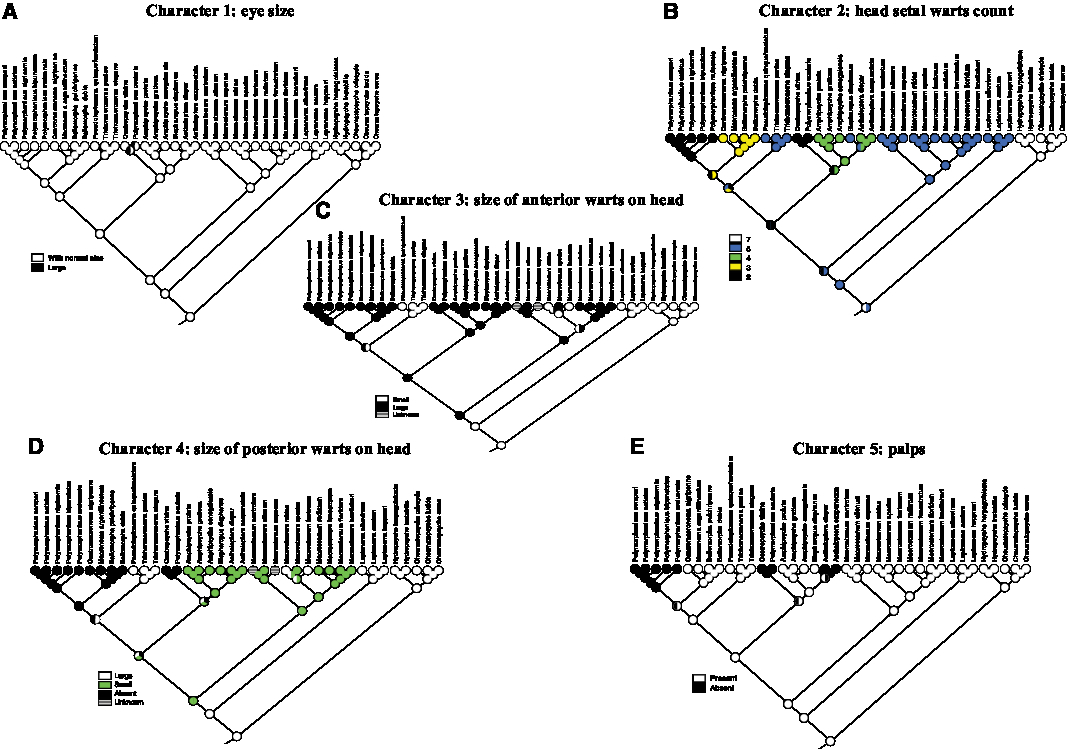
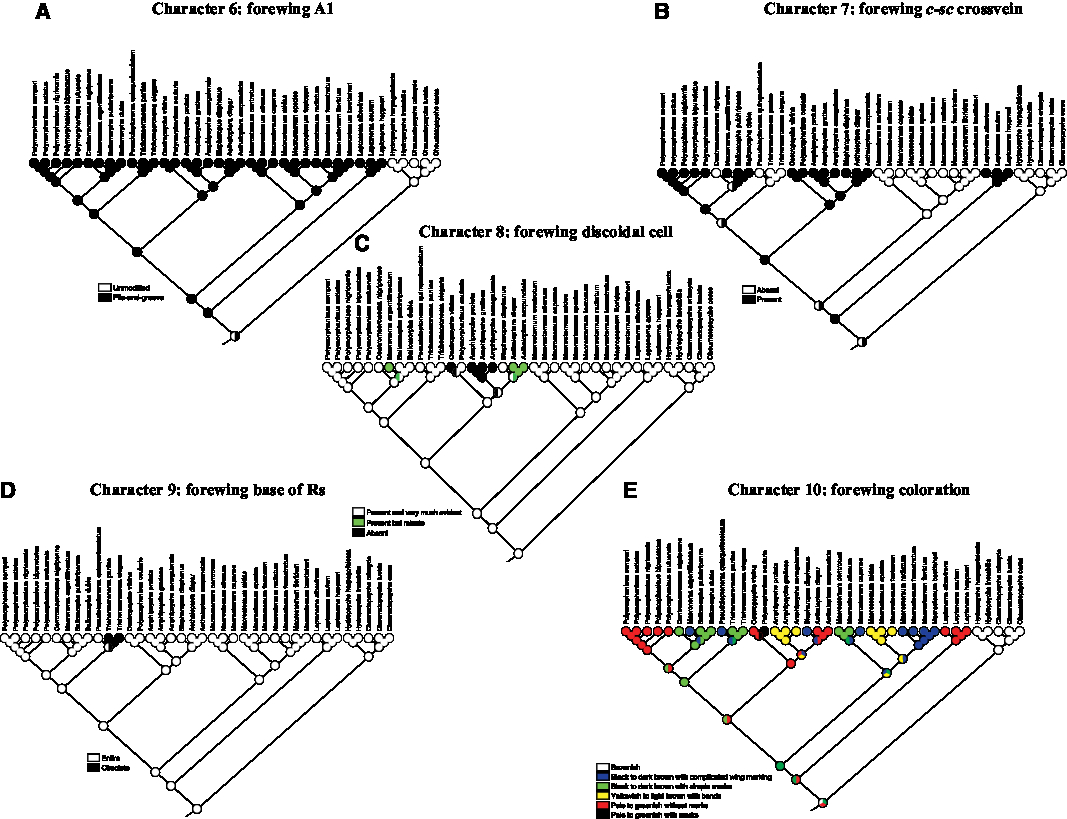
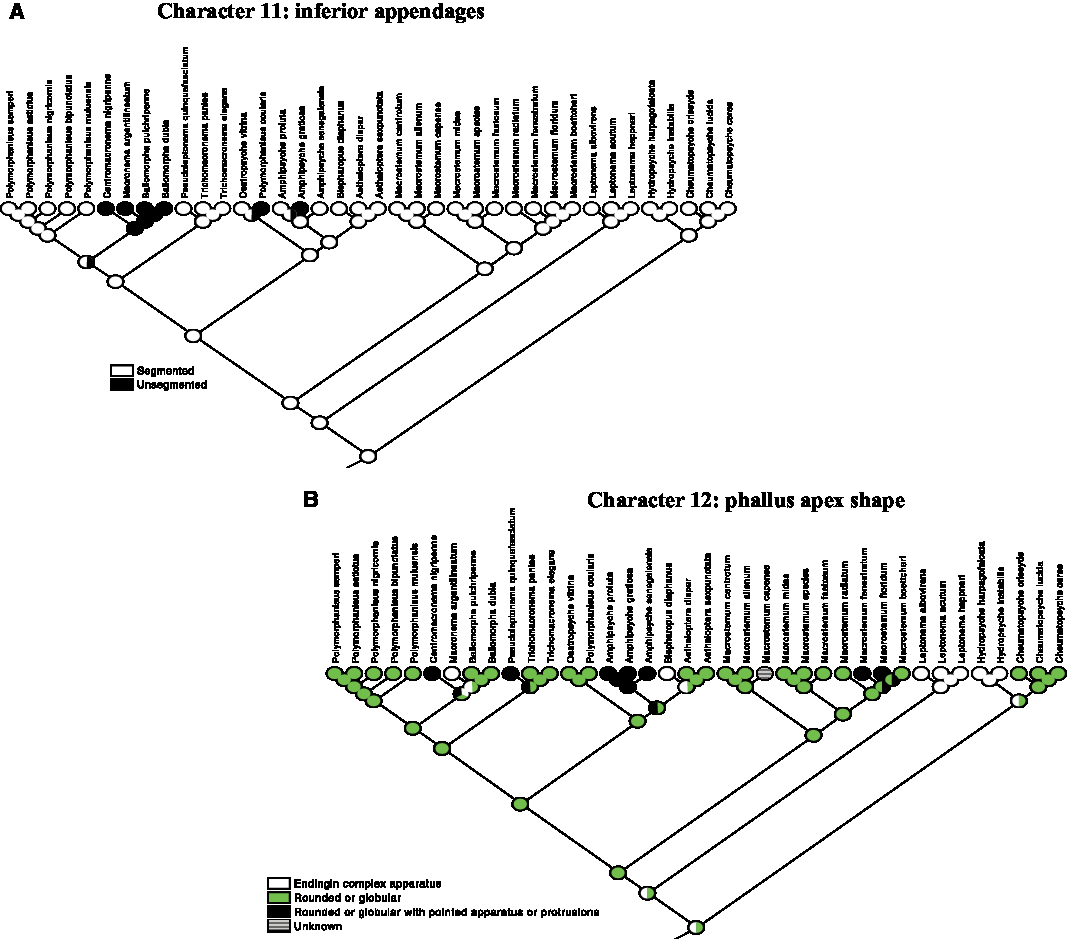
Twelve morphological characters were mapped to show their evolution in the subfamily (Fig. 4). Five morphological characters from the adult head (Fig. 5), five from wing venation (Fig. 6), and two characters from the male genitalia (Fig. 7) were included in the analysis. By tracking their development on the D2 phylogeny, the following morphological character transformations can be seen:
Twelve morphological diagnostic characters of Macronematinae plotted for phylogenetic analyses.
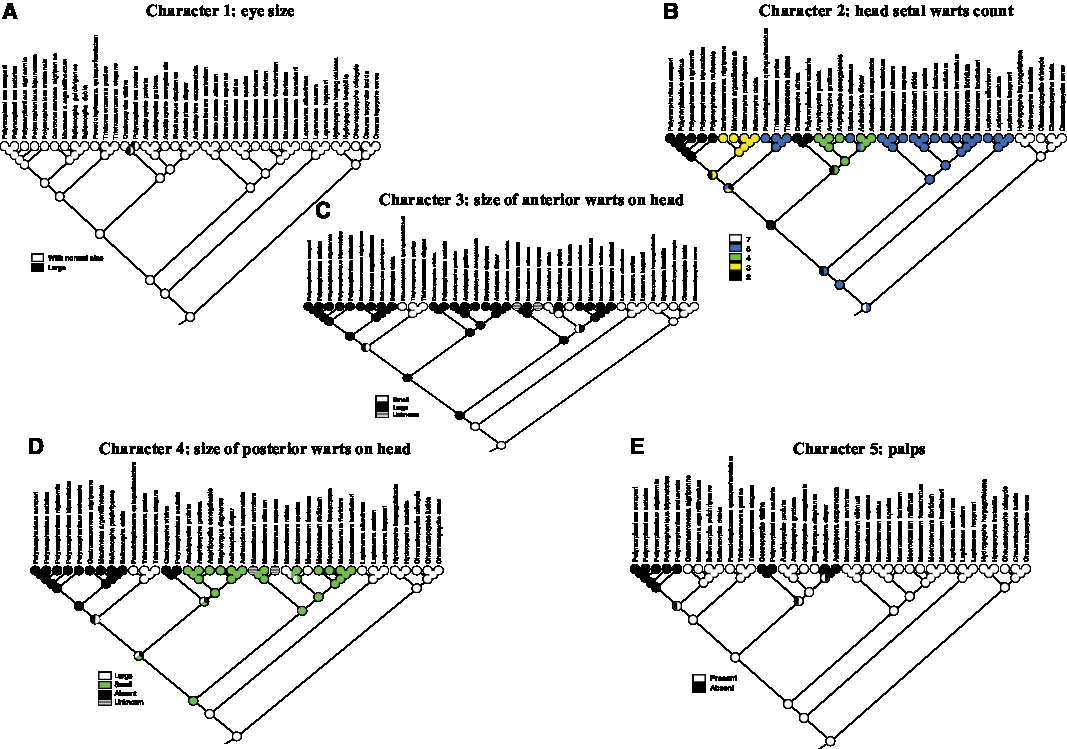
Interpretation of five morphological characters in the head portion for Macronematinae based on the consensus D2 phylogeny (Supplementary Fig. S1). A, Eye size; B, head setal warts count; C, size of anterior warts on head; D, size of posterior warts on head; E, palps.
Interpretation of five morphological characters in the forewing venation and markings for Macronematinae based on the consensus D2 phylogeny (Supplementary Fig. S1). A, Forewing A1; B, forewing c-sc crossvein; C, forewing discoidal cell; D, forewing base of Rs; E, forewing colouration.
Interpretation of the male genitalia characters for Macronematinae based on the consensus D2 phylogeny (Supplementary Fig. S1). A, Inferior appendages; B, phallus apex shape.
Character 1 (Fig. 5A) – Large eyes evolved in one of the six species of Polymorphanisus examined in this study, P. ocularis, suggesting that the character may have evolved once in an ancestor of these species.
Character 2 (Fig. 5B) – The seven setal warts of the heads of outgroup Hydropsychinae species were not observed in Macronematinae. Five setal warts are generally found throughout the subfamily, including the basal lineage Leptonema, all Macrostemum species, Blepharopus, and the sister genera Pseudoleptonema + Trichomacronema. A reduction to four setal warts occurred in parallel in weakly related Amphipsyche and Aethaloptera (Fig. 5B, but not in Blepharopus, weakly supported sister to Aethaloptera). A further reduction to three setal warts occurred in the ancestor of the monophyletic group of Baliomorpha, Centromacronema, and Macronema. The greatest reduction occurred in parallel in distantly related Oestropsyche and Polymorphanisus. Thus, the phylogenetic analysis shows that this character evolved from numerous warts to few. In Macronematinae alone, the ancestral five head setal warts decreased to varying degrees at least five times, to only two in the lineages Polymorphanisus and Oestropsyche (Fig. 5B).
Character 3 (Fig. 5C) – The small anterior head setal wart of outgroup Hydropsychinae species was retained in only six distantly related species of Macronematinae, with large warts having evolved multiple times in Macronematinae. Even though the species Macrostemum centrotum and M. capense were both not examined due to the unavailability of species, based on phylogenetic tree, we can see that the species should probably be possessing small anterior warts on the head (Fig. 5C).
Character 4 (Fig. 5D) – Large posterior head setal warts evolved multiple times in Macronematinae, becoming large in basal Leptonema, two species of Macrostemum, and in Pseudoleptonema + Trichomacronema (Fig. 5D).
Character 5 (Fig. 5E) – Maxillary palps were lost at least three times in the lineages of Aethaloptera, Oestropsyche + Polymorphanisus ocularis, and the monophyletic clade with all other studied Polymorphanisus species (Fig. 5E).
Character 6 (Fig. 6A) – A forewing vein A1 file-and-groove system for coupling the fore and hind wings into a single airfoil was described in detail for Macronematinae by Schefter (Reference Schefter1996) and especially Stocks (Reference Stocks2010). In comparison with the coupling system in outgroup Hydropsychinae, it is a probable synapomorphy for the subfamily. According to Stocks (Reference Stocks2010), it is functionally analogous to the mechanism in Integripalpia families Helicopsychidae, Leptoceridae, and Molannidae.
Character 7 (Fig. 6B) – Presence of c-sc crossveins near mid-length in Macronematinae forewings occurs in basal Leptonema and seven of the remaining 11 studied genera of the subfamily. They were not observed in three lineages deep in the phylogeny: Centromacronema, Pseudoleptonema + Trichomacronema, and Macrostemum (Fig. 6B). Absence of these crossveins in outgroup Hydropsychinae suggests that they evolved in the ancestor of Macronematinae and were subsequently lost independently three times.
Character 8 (Fig. 6C) – A large forewing discoidal cell is evident in all species of the outgroup Hydropsychinae and most species of Macronematinae. A small discoidal cell evolved independently in distantly related Aethaloptera, Macronema, Macrostemum fenestratum, and Pseudoleptonema quinquefasciatum. Similarly, the absence of a forewing discoidal cell is apparently a convergence in distantly related Amphipsyche, Oestropsyche, and Protomacronema.
Character 9 (Fig. 6D) – Obsolescence of the base of the forewing Rs vein occurred only in the species Trichomacronema paniae, a diagnostic character of the genus.
Character 10 (Fig. 6E) – No species of Macronematinae share the brown forewing colour scheme of outgroup Hydropsychinae species. Similar colour patterns appeared independently in various Macronematinae lineages. The black forewings with markings are seen in Blepharopus, Pseudoleptonema, Macronema, and 12 species of Macrostemum. The black forewings without markings or with simple white streaks are observed in Baliomorpha, Centromacronema, Protomacronema, Trichomacronema, and three species of Macrostemum. The yellow to light brown colour is found in Amphipsyche and seven species of Macrostemum. The pale to green colour with or without dark spots occurs in Aethaloptera, Leptonema, Oestropsis, Polymorphanisus, and Synoestropsis. Although there is no clear pattern in the general evolution of wing markings, we can notice that wing pattern is consistent within the genera or species groups of the subfamily.
Character 11 (Fig. 7A) – The two-segmented inferior appendages (ia) are the ancestral state of the subfamily, as seen in outgroup Hydropsychinae species. They each became unsegmented in one or more of the ways discussed by Nielsen (Reference Nielsen1957) at least three times independently in the lineages Amphipsyche gratiosa, Polymorphanisus ocularis, and Centromacronema + Macronema + Baliomorpha.
Character 12 (Fig. 7B) – Unrelated genera Baliomorpha, Blepharopus, and Macronema, all relatively recently evolved, retained the pointed or narrowing shape of the apex of the phallus seen in species of outgroup Hydropsychinae. All three studied species of Amphipsyche and nine of the 22 studied species of Macrostemum have a rounded or globular phallic apex with a pointed complex apically, although these two genera also are only distantly related. All other species of Macronematinae, including all of the older lineages, have the rounded or globular phallic apex without a pointed complex, suggesting that this may be the shape from which the superficially similar form evolved independently.
Discussion
This first molecular and morphological phylogenetic study with the largest dataset to date covering 16 genera (out of 17 considering that Pseudoleptonema and Trichomacronema are not synonyms) in Macronematinae not only validated previous known taxonomic relationships based on morphological traits but also uncovered new evidence for some of the phylogenetic relationships within the subfamily. Further, the consensus D2 phylogeny revealed the mouthpart and head setal-wart-number characters to have an interesting evolutionary history in Macronematinae.
In molecular phylogeny, we have used two genes: nuclear 28S ribosomal RNA D2 and mitochondrial COI gene. The D2 phylogeny better explained phylogenetic relationships among genera compared with the COI. The former provides several correspondences with the morphology-based phylogeny previously inferred (Barnard Reference Barnard1980; Flint et al. Reference Flint, McAlpine and Ross1987). It is known that COI gene is better suited to discriminate between closely related species (Hebert et al. Reference Hebert, Cywinska, Ball and Dewaard2003) and might not provide enough resolution among genera. However, other than for Polymorphanisus, we confirmed the monophyly of each genus with strong support by the D2 sequences (Fig. 1) and with the possible exception also of Macrostemum by the COI sequences (Fig. 2). This study also further confirms the validity of genus and species relationship when combining molecular and morphological analyses.
The basal position of the genus Leptonema to other Macronematinae group was confirmed in our molecular phylogenies based on D2 and COI genes (Figs. 1–2, clade B), consistent with the morphological findings by Flint et al. (Reference Flint, McAlpine and Ross1987). Morphological characteristics such as longer second segment of maxillary palp, longer head posterior warts, larval proventriculus with only simple spines, and an extremely primitive wing venation compared with that of the other genera of Macronematinae, along with reference to other genera of Hydropsychidae (e.g., Smicridea), led Flint et al. (Reference Flint, McAlpine and Ross1987) to this same conclusion for the phylogenetic position of Leptonema.
Synonymy of the genera Pseudoleptonema and Trichomacronema is not suggested from our data. The D2 and D2-COI results showed a Pseudoleptonema and Trichomacronema clustering as one clade (Figs. 1, 3, lineages E and F); however, this clustering of the two genera might not be true since only one representative from the genus Pseudoleptonema was used. It is possible that the inclusion of additional species of Pseudoleptonema might show two distinct clades, as we found in the COI tree. The COI phylogeny revealed two clearly distinct clades of the genera Pseudoleptonema and Trichomacronema with high bootstrap supporting values 100 (Fig. 2, clade E) and 86 (Fig. 2, clade F), respectively, and both 100 posterior probabilities in Bayesian inference (Fig. 2, clades E and F). Even though the phylogenetic relationships among these genera cannot be clearly resolved due to low support, the two distinct clades with high supporting values indicate that monophyly or synonymy of these two genera is unlikely. Thus, the suggestion of Oláh (Reference Oláh2013) that the genus Trichomacronema should be synonymised with Pseudoleptonema cannot be supported with our molecular data. Furthermore, morphological and ecological differences have been reported for these two genera (Schmid Reference Schmid1964). Schmid (Reference Schmid1964) noted that Pseudoleptonema and Trichomacronema have different habitats and morphological traits, as indicated by dense pilosity of the adult body and legs and flatness of the tibiae. For adults, forewing venation is different, with the base of Rs entire in Pseudoleptonema, but obsolete in Trichomacronema (Barnard Reference Barnard1984). Thus, in our opinion the two genera Trichomacronema and Pseudoleptonema should remain valid.
The paraphyletic relationship of the clades M. ulmeri + M. hyalinum + M. erichsoni (Fig. 2, clade J; group NT) with other Macrostemum species might be influenced by their geographical location. Based on taxonomic history, Ulmer (Reference Ulmer1907) synonymised Macrostemum with Macronema, recognising two groups of Macronema. The first group included species distributed in the Neotropics and all currently placed in the genus Macronema; the other group includes species more widely distributed and all currently placed in the genus Macrostemum. Flint and Bueno-Soria (Reference Flint and Bueno-Soria1979) divided the Neotropical species of Macronema into a “M. hyalinum group” (cosmopolitan) and a “M. percitans group” (exclusively Neotropical) based on wing colour pattern and the shape of male genitalia. All the species of the “M. hyalinum group” are currently placed in Macrostemum, making the genus Macronema endemic to the Neotropical region. Following this taxonomic history and because of the difference in wing colour pattern plus the evidence that the species did not cluster in our phylogenetic analyses (Figs. 1–2), we agree that Neotropical Macrostemum and Macronema are distinct genera.
This study also raises a question that should be answered in future studies: should the species of Macrostemum be subdivided into subtaxa? The distinct phylogenetic clusters (Figs. 1–3), geographical distributions, and wing patterns exhibited by the three Oriental groups suggest that such a revision may be useful. Flint and Bueno-Soria (Reference Flint and Bueno-Soria1982) resurrected the genus Macrostemum, redefining it according to strongly marked membrane patterns on the wings. The colourful and distinct wing patterns are useful for easy recognition of species of Macrostemum (Flint et al. Reference Flint, Holzenthal and Harris1999) and may also be helpful to explain its phylogeny, as found in the sister taxon of Trichoptera, the Lepidoptera (Schachat and Brown Reference Schachat and Brown2015). In Lepidoptera, the darkly pigmented transverse bands in the wings are called fasciae, which are interspersed between lighter pigmented areas, called interfascial areas, corresponding to the ground colour. The trait of fasciae or transverse bands is found to be a primitive wing pattern element in Lepidoptera and a character that was found to be homologous for some families in the order (Schachat and Brown Reference Schachat and Brown2015). In Trichoptera, these wing patterns of alternating dark-and-light bands specifically common to the genus Macrostemum are helpful to identify species since few differences are found in the genitalia. Our results showed that there can be species groups under the genus Macrostemum based on the geographical location; and for those distributed in the Oriental region, wing pattern can be a basis to separate the species groups (Figs. 1–3). The importance of analysis of a well-represented Macrostemum species such as distributed in Afrotropical region may also give an answer to the suspected subgroups of this genus.
This study using molecular data and demonstrating paraphyly in the genus Polymorphanisus supports the suggestion by Barnard (Reference Barnard1980) that this is not a cohesive genus. Our molecular analyses showed two clades of the genus Polymorphanisus (Figs. 1–2, clades C and G) and was even supported by the analysis using combined D2-COI dataset (Fig. 3). The additional species from the genus Polymophanisus can give further answers into the suspected paraphyly of the genus. However, the result using D2, COI, and combined trees and in all the inferences performed (maximum likelihood and Bayesian inference) agrees to the findings that were initially proposed using morphological characters. The revision of the Old World Polymorphanisini by Barnard (Reference Barnard1980) divided the genus Polymorphanisus into two species groups based on the relative positions of forewing veins M1 and M2, and the ventral proximity of the male eyes. He established the P. nigricornis group having male eyes separated ventrally and the P. ocularis group having eyes almost meeting ventrally (Barnard Reference Barnard1980). Our molecular and morphological results supported the separation of the two species groups (Figs. 1–3, clades C and G) suggesting that the P. ocularis group (Figs. 1–2, clade G) deserves independent generic status.
Our molecular phylogenetic analyses also provide further understanding of several closely related taxa in Macronematinae. Our analysis of several important morphological characters aided in understanding the synapomorphies of clades such as Centromacronema + Baliomorpha +Macronema (Figs. 1–3, clade D), and Amphipsyche + Protomacronema (Fig. 2, clade I). According to our morphological analysis, we can say that synapomorphies of the clade Centromacronema + Baliomorpha + Macronema include having unsegmented inferior appendages of the male genitalia and presence of three head setal warts. Analysis of the hypothesised sister relationship of Amphipsyche and Protomacronema was not possible for D2 because of lack of fresh material of the latter. The COI analysis indicated a sister relationship with weak support in maximum likelihood but high posterior probability in Bayesian inference (Fig. 2, clade I). We agree that the absence of a forewing discoidal cell and the presence of elevated head carinae on the larvae are synapomorphies that lend credence to the hypothesised sister group.
Based on our molecular phylogenetic findings, the monophyly of the tribes established by Lestage (Reference Lestage1936) was not supported for either Polymorphanisini or Macronematini (Figs. 1–3). The monophyly of Macronematini was questioned by some researchers based on the differences in larval morphologies and retreat (case) types (Gibbs Reference Gibbs1973; Scott Reference Scott1975; Barnard Reference Barnard1984). The genera Macrostemum, Amphipsyche, Protomacronema, and Blepharopus were suggested to be grouped together based on the larval and adult morphologies wherein the raised carina of the larval head is the most noticeable character (Scott Reference Scott1975; Flint and Wallace Reference Flint and Wallace1980). This suggestion of a close relationship of these genera was also supported by our D2 phylogenetic tree plus the genus Aethaloptera, although the latter relationship has very low bootstrap support ( < 50). The very low bootstrap value can be because of the use of only a single gene, and increasing the number of genes may improve phylogenetic accuracy (Cummings et al. Reference Cummings, Otto and Wakeley1995; Rokas et al. Reference Rokas, Williams, King and Carroll2003). However, despite the low bootstrap value, this is the first report using molecular data consistent with the initial morphological findings by Scott (Reference Scott1975) and Flint and Wallace (Reference Flint and Wallace1980) involving species of Macronematinae. Barnard (Reference Barnard1984) once emphasised that Macronematini lacks diagnostic characters while stating that Polymorphanisini is almost certainly monophyletic. According to Scott (Reference Scott1975), aside from the loss of mouthparts in adults, Polymorphanisini is also recognised by the loss of the stridulatory organ on the head and prothoracic legs in larvae. Our morphological analysis using the adult characters, such as wing venation and the male genitalia, also cannot support the monophyly of these tribes using adult morphological characters. Further morphological study of all the stages (including larval and pupal) might provide a stronger basis for the establishment of tribes, because we can say that the mouthpart character alone is not sufficient to maintain the current tribes.
Our interpretation of the consensus D2 phylogeny showed that palps in mouthparts of Macronematinae were lost three times during evolution (Fig. 5E). Only the four genera belonging to Polymorphanisini sensu Lestage (Reference Lestage1936) do not have palps. The palps (maxillary and labial palps) function as sensory organs (Ljungberg and Hallberg Reference Ljungberg and Hallberg1992). A study using a locust species, Schistocerca gregaria Forskål, showed a significant change in the dietary balance of the insect by removal of the palps, with the changes including food quality recognition and fat body accumulation (Mordue Reference Mordue (Luntz)1979). Studies on the feeding mechanism of the species in Macronematinae could further explain the behavioral implications for the absence of mouthparts, as suggested by the locust experiment by Mordue (Reference Mordue (Luntz)1979). Also, it could also help in understanding their habitat since it was noted that species of Polymorphanisini inhabit fairly large rivers, though not necessarily fast-flowing (Barnard Reference Barnard1980), unlike other Macronematinae species. When it comes to evolutionary development, a study by Doumpas et al. (Reference Doumpas, Jékely and Teleman2013) regarding the development of insect maxillary palp in the fly species Drosophila Fallén (Diptera: Drosophilidae) revealed that the gene Wnt6 is required for maxillary palp development. They stated that loss of the gene Wnt6 may have led to the loss of maxillary palps in Hemiptera evolution (Doumpas et al. Reference Doumpas, Jékely and Teleman2013). Further analysis of the genomes of Macronematinae species may confirm whether Wnt6 gene is also the one correlated with the loss of mouthparts in some species in Macronematinae.
In this study, we showed that Macronematinae head setal wart evolution is towards a decreasing number of warts (Fig. 5B). Head setal warts are unique in Trichoptera and the number of head setal warts can be used to distinguish particular Trichoptera families, genera, and species (Holzenthal et al. Reference Holzenthal, Blahnik, Prather and Kjer2007). Oláh and Johanson (Reference Oláh and Johanson2007) emphasised that the distribution and pattern of setal warts are important taxonomic criteria at the family level but the presence of setal wart types better explains the evolutionary trend than does the pattern alone. We also suggest that the number of setal warts is useful in phylogenetic analysis as it explains synapomorphy of the clades, such as Centromacronema +Baliomorpha + Macronema in our molecular phylogenetic analysis of Macronematinae (Figs. 1–3). In some species such as Cephalopsyche Arefina-Armitage and Armitage (Odontoceridae), the head displays sexual dimorphism in the shape and number of setal warts (Arefina-Armitage and Armitage Reference Arefina-Armitage and Armitage2010). Another instance is the species of Petrothrincidae, wherein the genera Petrothrincus and Gyrocarisa were separated based on the shape of head setal warts (Weaver Reference Weaver1997) and supported by molecular data (Johanson et al. Reference Johanson, Malm and Espeland2017).
Our interpretation of the consensus D2 phylogeny showed that reduction and loss of the forewing discoidal cell is synapomorphic in Macronematinae (Fig. 6C). This is consistent with the structure of forewing venation of “primitive” Trichoptera which shows a bifurcating Rs and M veins forming a distally well-developed discoidal cell (Ross Reference Ross1956; Schmid Reference Schmid1989).
Regarding the forewing c-sc crossveins, the trend was found to be in contrast with the trend in other insect groups, with “primitive” wing groups as having a large number of crossveins and a tendency to have fewer crossveins in more derived groups. Our findings for an acquisition of c-sc crossveins is the first investigation of the evolution of crossveins in Macronematinae.
When it comes to the wing pattern of species under the subfamily, we cannot establish the trend of the flow of evolution (Fig. 6E) but we can say that this can be a good character to delineate species or species groups, but one should be careful about using these patterns in higher-level phylogenetic analysis. Historically, for the genus Macrostemum, when it was still a synonym of Macronema, many species groups were proposed based on wing pattern and some structure of the male genitalia for the species with known males (Ulmer Reference Ulmer1907; Flint Reference Flint1978; Flint and Bueno-Soria Reference Flint and Bueno-Soria1979). We can clearly see here the importance of wing markings in Macronematinae, although they have been disregarded in some other Trichoptera families.
The analysis of fossil caddisflies with evident male genitalia showed that the fossil species possessed two-segmented inferior appendages (Liu et al. Reference Liu, Zhnag, Yao and Ren2014). This is consistent with our result for Macronematinae that unsegmented inferior appendages is the derived state (Fig. 7A). According to Oláh and Johanson (Reference Oláh and Johanson2008), two-segmented inferior appendages are usually united at least by a membrane, but mostly by an unpaired sclerite, the basal plate, located at the bottom of the genital chamber. In some other Trichoptera families, on the other hand, an unsegmented inferior appendage is fused with segment IX and the clasping function is taken over by the hooked paraprocts or partially by cerci. We found that the unsegmented inferior appendages are present only in the clade Centromacronema + Macronema + Baliomorpha, and the species Amphipsyche gratiosa and Polymorphanisus ocularis (Fig. 7A). Morphologically, the inferior appendages are different in these groups, with the clade Centromacronema +Macronema + Baliomorpha having straight unsegmented appendages but Amphipsyche gratiosa as well as some species of Amphipsyche have a narrowing area located near the apex; this is sometimes confusing because the narrowing portion looks like a segmental division. The species Polymorphanisus ocularis has also different inferior appendages, appearing as broad gonopods (Barnard Reference Barnard1980). These three types of unsegmented inferior appendages probably have evolved independently and could have different functions.
This first phylogenetic study of Macronematinae showed consistencies in the findings of previous hypothesis of some genera under the subfamily. Future analysis with well-represented additional species from different biogeographical regions in Macronematinae plus additional markers may give an answer or a stronger support to many unresolved topologies in this study.
Conclusions
This first molecular and morphological phylogenetic analyses of Macronematinae covering all the genera except the genus Leptopsyche found that (1) the genus Leptonema is the basal clade in Macronematinae, (2) all Macronematinae genera are monophyletic except for Polymorphanisus and possibly Macrostemum, (3) the genera Pseudoleptonema and Trichomacronema should not be synonymised leaving the current valid genera count into 17, (4) the clade Centromacronema + Baliomorpha + Macronema is supported by the synapomorphies of the presence of three head setal warts and unsegmented inferior appendages of the male genitalia, (5) the genera Amphipsyche and Protomacronema are most closely related by the absence of a forewing discoidal cell, and (6) two tribes (Macronematini and Polymorphanisini) are not supported. Based on our interpretation of the consensus D2 phylogeny, it is suggested that the absence of mouthparts and forewing discoidal cell, presence of forewing c-sc crossveins, black or yellowish-brown forewings, unsegmented inferior appendages, and fewer head setal warts are synapomorphies in Macronematinae. We also emphasise the importance of the wing markings in the species of Macronematinae, but only for species-level phylogenetic analyses, not for higher-level phylogenetic studies. Furthermore, our results highlight the implications of head setal warts as informative for inferring the phylogeny of Macronematinae. This first molecular and morphological analysis of Macronematinae sheds light on some questions raised by previous studies and also poses some future directions concerning relationships still needing to be resolved and some morphological characters that may be meaningful for inferring phylogeny of the group.
Acknowledgements
We sincerely thank Patrik Barcelos (National Institute of Amazonian Research, Manaus, Brazil) for his useful discussions and suggestions regarding Trichoptera phylogeny throughout this study. We also thank Karl Kjer (Rutgers University, New Brunswick, New Jersey, United States of America), Ralph Holzenthal (University of Minnesota, Minneapolis, Minnesota, United States of America), Paul Frandsen (Brigham Young University, Provo, Utah, United States of America), and Xin Zhou (China Agricultural University, Beijing, China) for useful sequences made available to us for this study. We particularly thank Chitchol Phalaraksh (Chiang Mai University, Chiang Mai, Thailand), Decha Thapanya (Chiang Mai University), and Nisarat Tungpairojwong (Khon Kaen University, Khon Kaen, Thailand) for providing Thailand Trichoptera specimens for this study. This work was supported by a Korea University Special Research Grant (2017) to Y.J.B. and a grant (NRF-2017R1CB1010741) to J.H.K. from the Basic Science Research Program, through the National Research Foundation of Korea, which is funded by the Ministry of Science, Information and Communication Technology, and Future Planning.
Supplementary material
To view supplementary material for this article, please visit https://doi.org/10.4039/tce.2019.57