Scholarly literature on popular songwriting in the United States during the first half of the twentieth century is burgeoning. Yet the field is faced with serious methodological problems that are only starting to be addressed. Approaches developed for classical, folk, and more recent popular music (of an era when the recording has become king)—as well as those for media, cinema, and theater studies—are useful but inadequate. A new amalgam is required.
Tin Pan Alley—the urban music-publishing business of the early twentieth century—was oriented toward both the sale of sheet music for amateurs to sing and play at home and a diverse world of professional performers in a quickly shifting spectrum of forums, including vaudeville, musical comedy, operetta, restaurants, nightclubs, ballrooms, recordings, piano rolls, radio, and motion pictures. The musical culture of Tin Pan Alley was not exclusively written, oral, live, or mediated, but a fascinating combination of all of them. Partly as a consequence, the songs were written with adaptability incorporated into their structure. This versatility has aided their endurance as active repertoire.
Keeping these factors in mind, the current study represents a move toward integrating the examination of print and recorded texts through a history and analysis of one centrally important song, “Some of These Days.” As this sketch will illustrate, Tin Pan Alley material cannot be studied effectively—nor can its nature and value be understood—without looking at the interaction of print and performance cultures.
“Some of These Days,” with words and music by Shelton Brooks, first became a song hit in 1910 and has been widely recorded in the ensuing hundred years, not least in its role as the theme song for singer Sophie Tucker during a career that lasted to the end of her long life in 1966. The piece has been hailed by many critics as perhaps the most important song in the early stylistic development of the corpus variously called popular standards, classic American popular songs, the Great American Songbook, or songs of Broadway, Hollywood and Tin Pan Alley.Footnote 1 Although praised by Alec Wilder as “derived from none of the popular song elements then current,” Brooks's song was foreshadowed by an important precursor: “Some o’ Dese Days,” an obscure 1905 publication with words and music credited to Frank Williams issued by Attucks Music Publishing, a company devoted to the output of African American songwriters.Footnote 2 Williams's earlier composition shares with Brooks's later song both its title phrase and its opening melodic gesture—this motif being identified by Wilder as one key to the popularity of “Some of These Days.”Footnote 3 In 1966 sheet-music historian James J. Fuld revealed the close resemblance of the two songs, but little attention has been paid to this similarity.Footnote 4 The mystery of their relationship, however, marks only the beginning of the long and complicated biography of Brooks's song, which encompasses numerous revised print editions and an intricate performance tradition. The song has been hailed in the literature as the first modern standard and acclaimed for an entirely vernacular lyric, an original musical plan, and an affective power based partly on its emotional ambivalence. Yet further research, presented in this article, challenges and complicates all of these claims.
My approach of examining both print editions and recordings of Tin Pan Alley songs has precursors in popular works such as Will Friedwald's Stardust Melodies or the NPR consumer guide by Max Morath, as well as in the more scholarly approaches of Charles Hamm to the youthful works of Irving Berlin and of Peter C. Muir to early commercial blues.Footnote 5 Nevertheless, by and large, analyses of popular standards tend to concentrate on either printed editions or recordings, rarely combining the two sources of evidence.Footnote 6 For this study, I examine nine distinctly separate print editions of “Some of These Days” (along with six additional but derivative editions), ten performances by Sophie Tucker, and thirty-six recordings by other singers, three of which are partial renditions. The print editions date from 1910 through 2000, and the recordings range from 1911 through 2006. These editions and performances, covering such a long span of time, give testimony to the song's enduring appeal and its status as a popular standard—and constitute part of its complicated role in U.S. culture.Footnote 7
Three closely related points emerge from this study. First, popular standards supply an opportunity to complicate “great man” versions of history (and the analyses that support those histories). Following the terminology of Bruce Kirle in his discussion of American musical theater—and therefore in analogy with the stage works that spawned many of these standards—popular songs can be viewed as “works-in-process . . . open and fluid,” with the “text,” as set onto paper by the original creators, ever under revision, particularly by performers who act as cocreators.Footnote 8 Second, anyone familiar with the Great American Songbook takes these phenomena for granted: Performers and arrangers change music and lyrics, audiences (including other performers) become familiar with these variants through live shows and recordings, and sometimes one of these performance-tradition variants becomes accepted as the definitive version of the song—in which case, and rather paradoxically, a return to the printed version can be perceived as a kind of revisionism. What is less often noted is that printed texts, too, may change over different editions. There is an ongoing cross-fertilization between publisher and publisher, performer and performer, and publisher and performer. Mundane as these observations may be, they inspire my third point: The study of popular standards quickly raises the thorny problems of ontology and value.
Regarding ontology: What is “the song”? Is it the version printed, or the version played and sung? In their comments on classic American popular songs, scholars often confuse the two, perhaps unwittingly. A simple example, which can serve here as an introduction to these problems, is the commentary on another popular standard, “I Can't Give You Anything but Love,” with lyrics and music credited to Dorothy Fields and Jimmy McHugh. In his analysis of this 1928 song, Philip Furia states: “Fields creates a Damon Runyon character . . . [who,] in the chorus, . . . switches from ‘kid’ to ‘baby,’ placing the harshly tender tag over two kicking notes.”Footnote 9 What Furia describes does indeed occur throughout most of the recorded versions of the song. It is less prominent in the sheet music, however, because in the initial three instances of the refrain's five uses of the word “baby,” that word is set on three notes rather than two, with the first syllable not “kicking,” as Furia would have it, but, rather, gliding: “ba-aby.” At least in part, Furia seems to be, perhaps unintentionally, analyzing the song not as published, but as it has been rewritten by performance tradition. Such examples highlight problems of both ontology and authorship, indicating the link between the two issues: Furia credits the songwriters with three effective moments in the song, but his praise would be more appropriately directed to the community of performers who altered the text.Footnote 10
Regarding value, Friedwald hints at the crucial issue when he claims that “the classic American song is the most flexible form of music. . . . One can interpret [such a song] . . . in any tempo, in any time signature, in any style.”Footnote 11 This capaciousness, he implies, is not only intrinsic to the songs’ nature but also the root and source of their value. Morath puts it more strongly: “The inherently collaborative relationship between songwriter and performer invited the kind of innovation that allowed these songs to find their best expression.”Footnote 12 The performance tradition helped inspire innovative songwriting, and the result is a body of songs that easily allow performance variations. Fixed in print, the songs satisfy. Simultaneously, however, these printed texts also reflect, in subtle and obvious ways, the practice of allowing deviations by numerous performers, both amateur and professional. This internal dynamic— central to any understanding of this song genre—contributes to both the songs' use value and their aesthetic value.
A third problem addressed by the present study is the relative neglect of popular standards that predate 1920 by evaluative analysts and many singers who, through their selection of songs, imply the formation of a canon. Indeed, both performance repertoire and critical writings emphasize songs written from 1924 onwards. A few examples will suffice to make the point. Allen Forte begins his two analytic tomes with “Somebody Loves Me” and “Fascinating Rhythm.”Footnote 13 Rock-era singers who exploit the catalog similarly reach back no further: Linda Ronstadt begins with “What'll I Do,” and Rod Stewart starts with “It Had to Be You.”Footnote 14 All of these songs date from 1924.
Yet, despite the delimitations of some scholars and performers, dozens of standards predate 1920. Although, in America's Songs, Philip Furia and Michael Lasser state that “‘Some of These Days’ is the first American popular song that clearly deserves to be called a ‘standard,’” the oft-performed “Bill Bailey, Won't You Please Come Home” (1902) is almost as well represented in the discographies of the singers who helped define the canon of the Great American Songbook.Footnote 15 Numerous other early-twentieth-century songs, especially of the 1910s, also flourish in this repertoire. The styles and careers of these early songs can help the critical historian pinpoint those aspects that make classic American popular songs valuable.
Williams, Brooks, and the Origins of “Some of These Days”
Frank Williams—the writer of the 1905 “Some o’ Dese Days”—is an elusive figure fated to bear a name so commonly found that efforts to identify him will probably remain speculative. Because his song was published by Attucks Music, a company founded as an outlet for black songwriters, it is safe to assume that Williams was African American. Therefore, I assume he was the same as the lyricist Frank B. Williams who published a series of songs from 1903 to 1922 with prominent African American collaborators and was given an obituary in Variety in 1942.Footnote 16 This brief item reads, in full: “Frank B. Williams, 73, blind lyricist, who wrote the words for ‘Just One Word of Consolation,’ of which the Bing Crosby recording is a big seller on the jukeboxes, died in Harlem Hospital, New York, Feb. 6.”Footnote 17 The song mentioned is a semi-high-class ballad, borrowing from the genteel tradition of songs for the refined home, with a vague and sentimental lyric, and it was the greatest popular song success for Williams and his frequent composer/collaborator Tom Lemonier.Footnote 18
I can attribute with certainty five songs to Frank B. Williams: “My Dahomian Queen” (1903; with J. Leubrie Hill); “If Ma Babe Could See Me Now” (1905); “Just One Word of Consolation” (1906); “Make Believe You Love Me (For a While)” (1913); and “You're Up Today and Down Tomorrow” (1913; all of these last four with Tom Lemonier). This group includes both sentimental parlor ballads and, by contrast, other lyrics that are in the blackface-comedy tradition of “Some o’ Dese Days.” There is also one further song from a “Frank Williams”—the name given, as with “Some o’ Dese Days,” without the middle initial and therefore of less certain attribution—“Poor Bird of Paradise” (1922; with George Krause). Although all of these songs are thoroughly conventional, subtle internal evidence suggests that this last-mentioned work, as well as “Some o’ Dese Days,” are by the same lyricist who is credited with the Frank B. Williams songs. The “voice” in all seven songs seems the same—admittedly, a matter of complex factors that are difficult to identify precisely. Technically, the skill level is comparable. They all display a grasp of prevailing conventions, alongside good ideas and interesting word choices. For example, in “Some o’ Dese Days, the locution “supption” is unusual and colorful; in “Make Believe You Love Me,” the first verse's gambit of “I know your heart is mortgaged” and the rhythms of “I may be crazy, daffy, dippy, looney or insane” are engagingly flippant; in “Just One Word of Consolation,” the triple rhyme of the title phrase with “situation” and “meditation” creates interest. These admirable touches, however, are combined with uneven execution; for instance, in “Consolation,” the casual “often helps the situation” is followed by the awkward poeticisms of “when distress o'er shadows thee.” Viewed schematically, the contents of these certainly-and-possibly Frank B. Williams lyrics share an overall concern with reaching, striving, yearning—with inflation versus deflation, whether in the form of despair versus hope or lowly status versus puffed-up vanity.
In contrast to Williams's obscurity, Shelton Brooks was for decades a prominent singer, comedian, and songwriter, and his renown has resulted in a reasonable amount of secondary material in the historical record. An appropriate representative of the bustling, polyglot world of popular music that produced the Great American Songbook, Brooks was the product of a complex background. Canadian, born in 1886 “of a black mother and a Native American father” (as Errol G. Hill and James V. Hatch report), an organist (like his parents), Brooks emigrated to Detroit in 1901, began to break into show business, and at some undetermined point found his way to Chicago.Footnote 19 There, according to Bernard L. Peterson, Jr., the neophyte participated in the Pekin Stock Company, an African American–owned and –managed venture that, from 1906 to 1908, employed more than thirty actors and, astoundingly, produced original farces and musical comedies every two or three weeks.Footnote 20
A hub for African American show business during this period, Chicago's Pekin Theatre, and the Chicago show business world that fed and supplanted it, supplied aspiring songwriter and performer Brooks with ideal conditions for practicing his craft: intensive practice and face-to-face peer interaction. As Brooks would say near the end of his life, discussing ragtime piano styles, “We were all working away together.”Footnote 21 This “working away together” seems to have been partially responsible for the development of the innovative “Some of These Days,” because evidence of this process is suggested in every stage of the song's early evolution, as detailed below. From these dynamic interactions arose a song that would eventually prove, through long-lasting international use, to be world-class art.Footnote 22
The pre-existence of “Some o’ Dese Days” complicates standard tales of the origins of Brooks's “Some of These Days.” One story, found in at least two variants, recounts that Brooks “was in a river-front dive in Cincinnati one night when he heard a couple quarreling. Suddenly the girl jumped up, exclaimed, ‘Some of these days you're going to miss me,’ and ran out of the place.”Footnote 23 In a related version, Brooks claimed, “One time I heard a woman shout in the street to her lover—‘You gonna be sorry, baby, some of these days!’”Footnote 24 Jack Burton, in relating the Cincinnati restaurant anecdote, reports: “That night he [Brooks] sang the song in his own act.”Footnote 25 These stories—at least one of which definitely (and the others probably) stem from Brooks himself—are most likely colorful show-business inventions. Nevertheless, the legends yield some analytic insights—both as a reminder that Brooks's primary vocation was as a singer/comedian and as a reinforcement of the claim, central to Furia's discussion, that the language of the lyric is “thoroughly colloquial” and representative of everyday conversational style. Indeed, the title phrase, although hailed by Furia as “oddly idiomatic” and “slangily skewed,” was common enough.Footnote 26 For example, it turns up during the nineteenth century as the title of both an African American spiritual and a British folk song. It was prevalent, too, in turn-of-the-century Chicago. For instance, a database search through the Chicago Tribune for 1910 turns up eight examples, none related to the song.
Judging by internal evidence, however, the origins of Brooks's “Some of These Days” must relate to Williams's “Some o’ Dese Days.” A comparison of the two refrains, for example, reveals significant points of similarity, described in detail below. (Examples 1 and 2 give the verses and refrains of both songs.) In the absence of any indications of shared acquaintanceships or direct interaction between Williams and Brooks, four explanations of these similarities are possible: (1) Williams's song came first, was created, notated, and published, and then Brooks saw or heard it and consciously or subconsciously borrowed from it. (2) Brooks's song came first and was performed but remained unpublished for some years, during which time Williams heard it and borrowed from it. (3) There was a third song or group of songs that used these verbal-melodic patterns, current in black show business of the time and from which both Williams and Brooks drew.Footnote 27 (4) One of the songwriters wrote an original song that led to a group of new songs from which the second songwriter drew. In this last scenario, once again, precedence is hard to ascertain.
Frank Williams, “Some o’ Dese Days.” New York: Attucks Music, 1905.

Shelton Brooks, “Some of These Days,” William Foster edition, arranged by Will[iam H.] Dorsey. Chicago: William Foster, 1910.

The very existence of these four possible origin tales for “Some of These Days” tells us a great deal about the development of the classic popular song style: It emerged from a series of complex social interactions that complicate the notion of authorship. This pair of songs, in fact, offers an example of the oral (and aural) processes that shape U.S. show business performance material—processes that exist in an uneasy relationship to the contingencies of capitalism; to its handmaiden, copyright law; and to the canon-forming historical narratives favored within its ideology. As Muir puts it, “The commercializing process tends to encourage simplistic notions of authorship—and there is something in us that likes that, too, for we like heroes,” thus inclining us toward celebrations of individual authors.Footnote 28 The truth about creative dynamics, however, often lies closer to the complex phenomena of collaborating, half-forgetting and half-remembering, inspiring, borrowing, stealing, giving—indeed, a confluence of multiple, often untraceable influences.
Before the first publication of “Some of These Days,” Brooks had the song arranged by William H. Dorsey, an African American pianist and music director of the Monogram Theatre, a Chicago motion picture and vaudeville house. Dorsey, according to material in The Freeman quoted by Lynn Abbott and Doug Seroff, “went into the business of arranging songs,” with Brooks as “one of his first clients.”Footnote 29 Brooks and Dorsey would have been part of the same black Chicago show business circles. Burton further reports that Brooks “spent $35 of his own money to have a thousand copies printed.”Footnote 30 If true, this publication presumably was the William Foster edition, “arranged by Will Dorsey,” given in Example 2.Footnote 31 This short-lived edition (discussed below), rarely found today, differs from the more widely disseminated version published later in 1910. Between the two lies Sophie Tucker's adoption of the song into her repertoire, an oft-repeated bit of popular music lore.
In her autobiography, Tucker reports that, with her popularity building during her stay in Chicago, she highhandedly spurned song pluggers. Her longtime maid, dresser, and stage assistant, Mollie Elkins—herself a veteran of African American show business—reprimanded her:
One day Mollie came and stood in front of me, hands on hips, and a look in her eye that meant she had her mad up.
“See here, young lady,” said she, “since when are you so important you can't hear a song by a colored writer? Here's this boy Shelton Brooks hanging around, waiting, like a dog with his tongue hanging out, for you to hear his song. And you running around, flapping your wings like a chicken with its head chopped off. That's no way for you to be going on, giving a nice boy like that the run-around.”
“All right. I'll hear his song,” I promised. “You tell him.”
“You can tell him yourself,” said Mollie. And she brought him in.
The minute I heard “Some of These Days” I could have kicked myself for almost losing it. A song like that. It had everything. Hasn't it proved it? I've been singing it for thirty years, made it my theme song. I've turned it inside out, singing it every way imaginable, as a dramatic song, as a novelty number, as a sentimental ballad, and always audiences have loved it and asked for it. “Some of These Days” is one of the great songs that will be remembered and sung for years and years to come, like some of Stephen Foster's.Footnote 32
This narrative displays complex social hierarchies, separations, and connections in the Chicago show-business world of the era. Brooks was lucky and canny to appeal successfully to Elkins; Elkins plays a pivotal role as middle agent between Brooks and Tucker; and Tucker plays a prominent role as “salesman” for the song (and thus for Brooks) to the public—and, possibly, to the sheet music industry, for publishing rights for the piece were soon transferred from Foster to a more powerful publishing house.Footnote 33
After Foster's first edition, the larger company of Will Rossiter bought the rights to “Some of These Days” and issued the 1910 edition that is most frequently found in collections.Footnote 34 Brooks's only earlier publication, the 1909 “You Ain't Talkin’ to Me,” had been issued by Rossiter as well. Jasen and Jones state that this earlier sheet music edition had not been successful; they further infer that for this reason Rossiter did not issue the first edition of “Some of These Days.” Moreover, Jasen and Jones imply that the reason Rossiter eventually picked up “Some of These Days” was because Tucker included it in her repertoire and began to plug it—which is, indeed, the likeliest scenario.Footnote 35 Rossiter had the deep pockets to finance a publicity campaign and probably helped secure numerous performances by vaudeville artists.
Tucker, however, was not solely responsible for spreading the song. Typically, Rossiter's cover design left a space that could be filled in with photographs of different performers as they were recruited to feature the song. Besides Tucker, other vaudeville acts whose pictures appear on copies of the Rossiter 1910 sheet music include Blossom Seeley; Willa Holt Wakefield; Beulah Dallas; the Courtney Sisters; the boy-and-girl team of Knight and Dreyer; George Austin Moore; Mabel Bunyea, then-partner of Melville Gideon, who collaborated on songwriting with the young Cole Porter in the late 1910s; and Carl McCullough, who shared the December 1910 bill with Tucker at Chicago's American Music Hall when the latter returned there, undoubtedly with “Some of These Days” in her repertoire.Footnote 36 These connections again point to the complex web of personal and business interactions through which performance materials and styles were shared by members of the show business community. Such social-professional networks provided a setting in which the establishment of “text,” “authorship,” “influence,” and “innovation” sometimes becomes highly complex.
“Some o’ Dese Days” versus “Some of These Days”
Examples 1 and 2 give the music and lyrics for Frank Williams's 1905 “Some o’ Dese Days” and Shelton Brooks's 1910 “Some of These Days”—the first edition, issued by William Foster. Clearly, the two refrains have in common general traits as well as specific melodic and lyrical gestures. Some of these shared aspects are featured in many Tin Pan Alley songs of the era, as Nicholas E. Tawa has outlined: the strophic form of verse-refrain, with two sets of lyrics for the verse and one for the refrain; the key of G; the common time meter; the presence of a piano introduction and “till ready” vamp.Footnote 37
Other shared aspects, however, are specific to these two songs. In addition to their similar titles, the opening melodic gestures that accompany those titles are essentially identical, dominated by the compelling motif of B A-sharp B A, with the first three notes first heard as pick-ups that mark the transition from verse to refrain. Admittedly, as Tawa points out, “Some of These Days” appears late in a chain of several songs from 1895 to 1910 that feature “three long-held tones” at the conclusion of the verse, “acting as an anacrusis to the ensuing chorus melody.”Footnote 38 Thus, this compelling aspect of the melody was an example of a then-current convention. Nevertheless, Williams and Brooks heighten the suspense of this melodic technique by using chromatic vacillation.
Following the initial motif, the first stanzas of both refrains follow similar patterns. In both instances, the second phrases have five syllables starting with “you'll” and ending in “me, honey.” Then the title words are repeated, along with all or part of the corresponding initial motif, and the first section ends with another five-syllable phrase. The second halves of both refrains present variations on the initial motif. At their conclusions, both lyrics return to the title phrase, preceded by the word “yes” and starting the phrase on the second beat of the penultimate measure.
Beyond their beginnings and, to an extent, their endings, however, the songs diverge. One important aspect of Brooks's “Some of These Days” is the form of its refrain. It is, as James R. Morris describes, “ABCD, with each section introducing new melodic ideas, avoiding the traditional practice of repeating previously heard material.”Footnote 39 Morath echoes Morris and Wilder in praising this trait as “highly unusual for a Tin Pan Alley song,” but such structures were not as unprecedented as such statements suggest.Footnote 40 For the era ending in 1910, Tawa finds the ABCD structure in the refrains of 7 percent of waltz, march, and rhythmic songs.Footnote 41 In my own survey of 170 songs of 1908, I find that thirty-four (or 20 percent) have refrains that do not repeat melodic material exactly, that is, that are ABCD or AB or can most productively be viewed as nonsectional. One well-known example is the waltz “Sunbonnet Sue.” Although not highly prevalent, the use of nonrepeating or ABCD refrain structures was well within the popular songwriter's range of choices during that era. Nevertheless, the ABCD structure of the refrain of “Some of These Days” is notable, if not for any uniqueness, then for the manner in which the form contributes to the emotional impact of the song, as shown below.
Furthermore, several aspects that the two songs share are more crucial than the short description above indicates. The opening phrase of Brooks's refrain sets a pattern for many elements that recur throughout the song—not least being that the initial melodic motif, although never exactly repeated after being used twice in the first eight measures, is twice imitated at differing pitch levels in the final section of the song (cf. mm. 47 and 49), thus helping to unify the whole. In addition, as often in popular songs, the opening title statement creates a pervasive influence on the song's overall design. Stephen Banfield points out that songwriters often use “a title to govern the melopoetic structure of a whole song.”Footnote 42 “Some of These Days” provides a fine example of this principle. Although there is little exact repetition in the melody of the refrain, the initial phrase establishes short four- or five-syllable phrases as the hallmark of the lyric and, because the setting is syllabic, of the melody. Such short phrases are used with remarkable persistence throughout the refrain, helping to create the snappy “telegraphic” effect that Furia celebrates as an admirable hallmark of the Tin Pan Alley style.Footnote 43
Part and parcel of these short phrases are the repeated instances of a long note ending for each short phrase: a half note or whole note tied to the ensuing measure's quarter note. This pattern figures in the opening statement and recurs at the end of all but one of the subsequent phrases. As is common with this repertoire, singers most frequently turn the ends of these long notes into rests—a chance to breathe. Further, these “gaps” in the melodic line become opportunities for various fill-in phrases in the accompaniment—sometimes including riffs or the call-and-response patterns typical of African American music. This effect is a canny touch on Brooks's part—a strong indication of how he shaped the composition to performance practices.
In Tucker's performances, from her 1927 version to renditions in the 1950s, these gaps are usually filled by the accompanying instruments with anticipatory soundings of the upcoming melodic phrase, allowing Tucker to vary the written melody as she fills in the “response” or “echo.” Some other renditions use the spaces for a variety of half-spoken interjections by the singer: Bobby Darin (1959), “Ah, play it, Lips!”; Vicki Carr (1969), “mm-mm-mm-mm” and “tch-tch-tch-tch-tch-tch”; Alberta Hunter (1982), “Bound to miss it” and “I'm talkin’ to ya!”; and so forth. Thus the pattern of phrasing set up by the incipit of the refrain becomes an important enabler of stylistically crucial performance practices.
The differences between “Some o’ Dese Days” and “Some of These Days” are as notable as their similarities. Williams freights his lyric with heavy dialect in the tradition of blackface entertainment—indeed, far heavier than in the two other minstrel-tradition songs attributed to Frank B. Williams. By contrast, Brooks, although staying casually colloquial, avoids dialect. This element supports Furia's interpretation of “Some of These Days” as a symbol of a then-current process, “the complete integration of the ‘coon’ song and the romantic ballad.”Footnote 44 The almost startling contrast of diction between the two lyrics serves as a useful example of an overall, long-range trend away from the extremes of dialect in Tin Pan Alley style.
The songs reveal another bellwether contrast as well. The 1905 song has a verse of thirty-two measures and a refrain of sixteen measures; for the 1910 song, the proportions are reversed. This difference can be seen as representative of the era's shift in emphasis and emotional weight from the verse to the chorus. As noted by Charles Hamm and others, this process eventually led to the verses being omitted from the majority of performances of popular standards.Footnote 45
A major difference between the two songs is the greater emotional depth of “Some of These Days” compared to its predecessor—and, in light of this factor, the greater length of Brooks's chorus is revealed as more than a mere technical point. The refrain has time and space sufficient to generate musical power and dramatic development. In fact, David A. Jasen and Gene Jones suggest that Brooks's song “packs more honest emotion than any other song of its time. Its lyric is a stream-of-consciousness mix of defiance and hurt set to the music of a cantor's wail. . . . It is about the contradictory feelings of a jilted lover.”Footnote 46 In the first half of the refrain, the singer concentrates on predictions of the deserting lover's impending regret. The second half of the lyric, however, introduces a series of quickly shifting topics that create the stream-of-consciousness aspect noted by Jasen and Jones. As the song reaches its midpoint, the singer illogically jumps to the present tense to lament her own loneliness, and then, in an emotionally elliptical transition, falls to brooding about how the sweetheart “had his way.” Then she jumps back to the future tense to foresee how she will grieve over his absence, before suddenly returning to the initial prediction that he will miss her. Thus the song presents four emotional shifts in the space of sixteen measures of music and eight lines of lyric.
The music supports this disoriented, distraught, stream-of-consciousness flow—the emotional vacillation that facilitates the song being performed as a dramatic monologue. The ever-unfolding musical material of the ABCD-structured refrain contributes to the depiction of frequent changes of emotions and trains of thought. Because of what Tawa dubs the “extreme chromatics” of the melody, heard in the initial phrase and echoed at four later moments, the melody bears a poignancy that is redolent, as Jasen and Jones state, of cantor-like Jewish laments and, perhaps, the then-developing blues.Footnote 47 The refrain's harmonic choices also exist in a powerful melopoetic symbiosis with the lyric. As Tawa exults, “the avoidance of the home key . . . is extraordinary. . . . Amazingly, the music does not get back to the home key until the last two measures!”Footnote 48 Because, as Wilder puts it, “it never ceases to move harmonically,” the music's disoriented step-by-step search for “home” adds to the affective momentum.Footnote 49
Williams's “Some o’ Dese Days” shares with Brooks's song a modicum of the same qualities of disequilibrium, defiance, and hurt. In “Some o’ Dese Days,” the interrupted flow of logic is seen three-quarters of the way through both verses. To paraphrase: “Because I am not rich or well-traveled” sets up the expectation of “therefore she rejects me”; actually, it is followed by “but instead all I have is love for her.” This elliptical train of thought conveys some of the same sense of mental confusion as does the refrain of Brooks's “Some of These Days.” The depressive stance, the vulnerability, of the protagonist expressed in the first verse and part of the second is alleviated by the defiant stance that dominates the short refrain. Through a contrast of verse and refrain, Williams creates a mixture of emotions similar to that in Brooks's refrain. Taken by itself, however, the brief refrain of Williams's “Some o’ Dese Days” is uncomplicated by the dramatic vacillations of the protagonist of Brooks's “Some of These Days.”
Whereas Williams's 1905 “Some o’ Dese Days” is less fully developed emotionally than Brooks's song, its mere existence disproves Wilder's claim that “Some of These Days” “derived from none of the popular song elements then current.”Footnote 50 The stroke of genius represented by “Some of These Days” was not solely the product of an isolated innovator—that heroic figure familiar from Romantic-era ideology—represented here by Brooks. Rather, the song's achievement is better viewed as the culmination of a process of influence involving talents often anonymous or at least, like Williams, mostly invisible to later generations.
The Print Tradition of “Some of These Days”
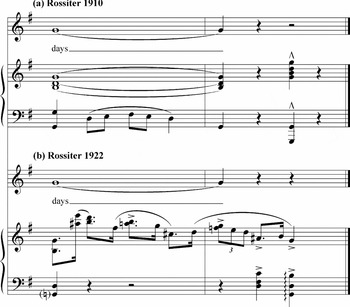
During its years under copyright, “Some of These Days” went through four major editions, each with its own distinctive piano part.Footnote 51 (Compare Examples 2 through 7.) Following the two editions of 1910 by Foster and Rossiter discussed above, Rossiter published a revised edition in 1922. This version was reissued several times throughout the 1920s, with various covers advertising that decade's shifting entertainment formats: records, radio, and talking pictures. In 1937 Jerry Vogel Music issued a shiny, silver-colored “Anniversary Edition,” and this swing-era arrangement remained standard into the 1950s, being replicated for at least two plain-cover editions, seemingly using the same plates.
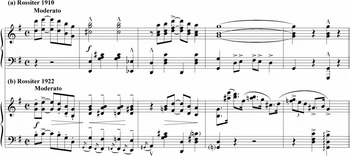
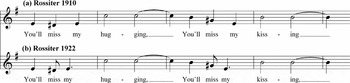
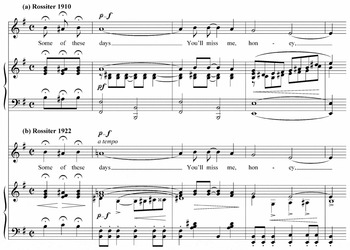
These four editions show significant musical variants. Most obviously, the meter is changed from common time to cut time (see Example 3). The 1922 edition introduces syncopations not present in the earlier editions and that were dropped for the 1937 and subsequent versionsFootnote 52 (see Examples 4 and 5; these dotted rhythms prevail throughout all the analogous passages in this edition). The accompaniments also demonstrate an increased fullness. Finally, over the span of the four editions the harmonies become increasingly enriched (see Example 6; and compare also with Example 2, mm. 22–26).
Shelton Brooks, “Some of These Days,” the piano introductions of the 1910 and 1922 Rossiter editions, mm. 1–4. (Chicago: Will Rossiter, 1910; Chicago: Will Rossiter, 1922.)

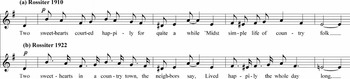
Shelton Brooks, “Some of These Days,” the start of the vocal line of the verses of the 1910 and 1922 Rossiter editions, mm. 7–10.

Shelton Brooks, “Some of These Days,” detail of the refrains of the 1910 and 1922 Rossiter editions, mm. 33–35.

Shelton Brooks, “Some of These Days,” the start of the refrains of the 1910 and 1922 Rossiter editions, mm. 23–26.

The second ending of the refrain is a point that reveals interesting changes in vernacular musical styles.Footnote 53 A “barbershop chord” concludes the Foster edition (Example 2, mm. 55–56). Muir points out that this device is found in about one-sixth of popular songs of the era, but is even more characteristic of early commercial blues.Footnote 54 Therefore, this seemingly unimportant detail perhaps illustrates the connections between, on the one hand, African American musicians such as Brooks and Dorsey and, on the other, the simultaneous evolutions of both the blues and the classic American popular song.
By the time of the 1922 edition, the barbershop style did not enjoy the same vogue as it had twelve years earlier.Footnote 55 The cutting edge of popular music was now represented by “novelty” keyboard pieces, a piano-roll–influenced style that enjoyed a golden era in Chicago, the hometown of both songwriter Brooks and publisher Rossiter. As Jasen and Jones point out, “from 1919 to 1921, the four best roll artists in the world—[Charlie] Straight, [Zez] Confrey, [Max] Kortlander, and [Roy] Bargy—were all in Chicago, trying to outplay and outsell each other.”Footnote 56 Once again, proximity, interaction, and rivalry created a widely popular, albeit short-lived, artistic innovation—a type of syncopated piano music that for many at the time appeared to be central to jazz. For the 1922 edition, Rossiter eliminated the barbershop chord of the 1910 arrangement and substituted a novelty-styled second ending (compare the two Rossiter endings in Example 7). This Jazz Age arrangement brings “Some of These Days” into a new stylistic orbit, demonstrating the influence of performance practice on print editions. After the 1920s, the novelty piano genre dissipated and changed, and in the 1930s the novelty-style coda in “Some of These Days” disappears along with the rest of the 1922 arrangement. Through such details, editions of “Some of These Days,” with their various permutations, almost act as a capsule history of Tin Pan Alley over a fifty-year span.
Shelton Brooks, “Some of These Days,” the second endings for the refrains of the 1910 and 1922 Rossiter editions, mm. 53–54.

Each of the earlier three editions features a slightly different lyric (along with occasional, consequent alterations in the details of the melody), as can be seen by comparing the Foster text in Example 2 with the following Rossiter variants:Footnote 57
Rossiter 1910, Verse 1:
Verse 2:
Rossiter 1922, Verse 1:
Verse 2:
It is impossible to ascertain which, if any, of these musical and lyrical variations originated with or were approved of by Brooks, although in one instance (discussed below), a reasonable hypothesis can be deduced. The Rossiter 1910 edition might represent a more polished, definitive version of what Brooks wanted, but—and perhaps more probably—may alternatively represent changes made by the staff of Rossiter, one of the nation's leading popular song publishers, independently of Brooks's input.
Among these editions, the verses, in particular, manifest many differences, as can be seen by comparing the texts in Example 2 with later variants. As Jasen and Jones suggest, in either form the verse “is musically and lyrically ordinary, and it is a perfect setup for the surprising, minor-keyed outburst of the chorus.” They point out that the changes to the verse in the Rossiter 1910 edition represent an increased formality: “The square lyric in the verse of the second (Rossiter) edition is a revision of the folksier original version, and it is just right.”Footnote 58 In the 1910 Rossiter version, the word “’midst,” in particular, connotes such old-fashioned formality. Both 1910 versions of the verse have moments of melopoetic awkwardness, where they do not “sing” easily: Foster's “her little heart just melted down” and “to the depot he ran with vim”; Rossiter's “when the lad told girlie” and “her little heart with grief ’most broke.” In the Rossiter verse 2, the verb tenses become confused: The past tense “he reached” is followed by the present “he rushes,” swiftly followed by a return to past tense with “he heard.” All such factors imply a difficulty in fitting words to melody in these sections of the song.
In both the Foster and 1910 Rossiter editions, the heroine—the speaker of the refrain—is transformed between the repetitions of the chorus from a passive character, hurt and emotionally clinging, to a person of independent action. In the 1910 Rossiter version, this element is magnified through the use, in verse 2, of the phrase “show him two can play this game” and the manner in which the set-up phrase (“this loving sweet refrain”) intensifies the irony that informs the repeat of the refrain. Through these means, the song switches definitively to an endnote of defiance. In that context, the emphasis in the refrain's second half on the general sentiment of “I will miss you” becomes biting irony.
In these verses both the Foster and 1910 Rossiter editions depict the creation of a New Woman. She rebels against the stay-at-home fate dictated by traditional female roles. Steaming away on a train, that powerful conveyer and symbol of modernization, she announces with cutting irony that the worm has turned. No more will she be the underdog, pathetically missing her man: “Two can play that game,” indeed. Tucker's initial recording of the song—on a four-minute Edison cylinder, allowing more time than the up-and-coming format of the ten-inch disc—includes the second verse. Therefore she narrates the entire story of the transformation of this “little girlie.” The happy resemblance of the blossoming persona of Sophie Tucker to the New-Woman-in-development character in “Some of These Days” was almost certainly part of the song's initial appeal. As she relates in her autobiography, Tucker left home, hearth, parents, and baby (having already separated from her husband) and set out to conquer the world with a sense of defiance that matches that of the protagonist of “Some of These Days.”
The 1922 Rossiter revised edition presents a significantly altered version of the two verses. It represents an improvement in word setting—the awkward passages mentioned above have been rewritten—but a considerable attenuation of the defiant elements of the lyric. The song no longer depicts the creation of a New Woman. The center of the emotional action of the verses shifts to the man who leaves, and the parted couple ends by reuniting, offering a particularly unsatisfying and forced lead-in to the repeat of the refrain. Although the whole experience has weakened the hero's smug self-confidence, and therefore it still offers a modicum of ironic reversal, there is nevertheless only the barest hint of the turning-of-the-tables implied in the Foster edition and even more strongly conveyed in the 1910 Rossiter verses.
The 1910 Rossiter verse reappeared in the 1937 Jerry Vogel edition, which also restored some other, more minor details altered in 1922. Judging by the copyright-assignment information, this new edition was prompted by the song coming up for copyright renewal—as was standard at the time, not by the publisher but by Brooks, the original author—and the songwriter's reassignment of the rights to Vogel. Rossiter, of course, retained copyright ownership for the distinctive features of the Jazz Age edition. Although Jasen and Jones state that “Brooks tinkered with the lyric of later editions”—specifically that he made changes in the 1922 version—the most likely implication of the series of events in the late 1930s is that the changes in the 1922 Rossiter edition were wrought not by Brooks, but by the publisher.Footnote 59 Whether because of Brooks's artistic choice or copyright restrictions, however, the late 1930s edition reverts to the 1910 lyric, and that version remains prevalent in the ensuing decades.
The Performance Tradition of “Some of These Days”
The print and recorded versions of “Some of These Days” studied here show ten major and twenty-five smaller variations in the words, along with one common melodic variant. Of these, seven points—some large and some small—will serve to illustrate the complexity of the interrelationships among print and performed variations. Most of these variants appear early in the song's history and inevitably open fields of speculation on the origins of different details, with the cast of suspects including Brooks, Dorsey, Foster, the Rossiter staff, Tucker, and various performers.
The details of Shelton Brooks's own rendition must remain hypothetical (for the songwriter seems to have never recorded his most famous ballad), but they are suggested by other sources. The famous passage from Tucker's autobiography, quoted above, strongly implies that Brooks auditioned the song for the singer at their initial meeting. This initial contact with the composer's performance may explain the complex relationships between Tucker's recording and the two 1910 printed versions.
A small point, but one that tells a great deal about the transformations of “Some of These Days,” involves three recordings by Tucker of the verse. All are clearly based on the 1910 Rossiter—except, significantly, in the fifth and (to a lesser extent) the sixth lines. In the 1927 recording, for instance, she sings, “She said, ‘You know I love you, honey, I love you best of all / So, baby, don't go away.’” In favoring “I love you, honey” over “it's true I love you,” Tucker's phrase appears to be a variation of the Foster verse. This variant is particularly important because lines 5 and 6 are the only spots in which Tucker consistently strays from the 1910 Rossiter verse lyrics—and, significantly, in a manner that recalls the earliest print source. One possible inference is that she learned the verse from Brooks himself—based on some unnotated Brooks verse or on the Foster edition, and before the lyric was altered for the 1910 Rossiter edition—somehow retaining this detail even while otherwise adopting the Rossiter print as the foundation for her renditions.
There is another, more major, aspect of the Foster edition that contrasts with the 1910 Rossiter version, picked up by Tucker and other performers, that also hints at Brooks's own rendition of the song. Although standard print editions of “Some of These Days” focus on short groups of four or five notes and syllables, the Foster edition features two points that shake off the confinements of that pattern, on the six-syllable lines “I know it will grieve me” and “you've always had your way.” Such variation in the phrase patterns allows the singer to be more relaxed and conversational, and, potentially, the added notes and syllables facilitate the introduction of further syncopations. Again, these lines may provide a trace of Brooks's own performance of the song. Subsequently, the inclusion of “always” appears only occasionally, although examples span the years from 1911 to 2002.Footnote 60 More importantly, the larger general principle operates widely among most recorded versions: Varying the song's phrases, usually by adding syllables and notes, permits a play of rhythmic and verbal patterns. This potential for variability of phrase density, revealed in a comparison of the two earliest editions of the song, is crucial in making the song easy for performers to adapt in an improvisatory fashion.
Tucker's 1911 recording introduces to the song's history another method for escaping the strict confines of the short lines—one that also increases the vernacular nature of the diction—namely, the employment of “gonna” to indicate the many future-tense predictions of the singer-protagonist.Footnote 61 In this, her first recording, she repeatedly substitutes “you gonna” for “you'll.” In her later recordings, Tucker reinstates “you'll” at judiciously selected junctures, thereby creating a variety of phrase patterns. In this artistic choice, most subsequent recording artists follow her lead. Almost every performance examined (with only four exceptions) uses “gonna” at some point. Although the word is never seen in a print edition, yet its employment follows from the general principle sketched out by the Foster edition, which supplies a model—and thus an implicit permission—for varying the number of syllable-notes within each phrase away from the strict four-or-five pattern.
An equally major point of departure for Tucker and other singers lies in the penultimate line of the refrain. Both 1910 print editions give the line as “You'll miss your little baby.” The 1910 Rossiter edition, however, features a para-textual variant as a banner at the top of the cover: “You'll Miss Your Little Dad-Dad-Dad-Dad-Dad Some Of These Days.” This remarkable example implies the simultaneous circulation of two texts—one for sheet music and one for performance.
Indeed, Tucker, in her 1911 Edison cylinder recording, ignores the option of “baby” and sings two variants of the “daddy” idea: “You'll miss your little da-ha-da-ha-da-ha-da-ha-da-ad, daddy” (on her first chorus) and “Gonna miss your little da ah-da-ha-daddy” (for the second refrain). This version goes against the logic of the song, because, as the verses make clear, the singer of the refrain is supposed to be a woman. In the same year, the all-male American Quartet utilized both options. For the first refrain, a solo rendition by Billy Murray that begins with verse 1 uses “You'll miss your little baby.” For the second refrain, a smoothly rehearsed quartet arrangement that is not preceded by a verse, the four singers conclude with “You'll miss your little da-da-da-da dada.” Clearly, the performance tradition for the “daddy” variant was strong and concurrent with the use of the “baby” line.
Both the 1910 Rossiter cover and Tucker's 1911 cylinder make a choice, clearly deliberate, to stick with the notion that a woman is singing “You'll miss your daddy,” when (as will be seen) the simple substitution of “I'll miss my” would make the song more consistent in its narrative. Why? The replacement of “baby” with “daddy” is one aspect. The syllables of “daddy” are made into proto-scat through fragmentation and repetition. Although “baby” can be treated similarly, perhaps the gingival stop of the “d” sound was easier to project in the unamplified theaters of the teens.Footnote 62 If so, this variant offers another instance in which performance experience influenced changes in the text.
One explanation for the “daddy” line may be that Brooks himself sang the piece as a male performer, emphasizing the refrain as a personal message, rather than within the story context created by the lyrics of the verses.Footnote 63 During their audition meeting, Brooks might have passed the “daddy” version of the line on to Tucker, along with the fragmentation and extension of the word as “dad-dad-dad-dad-dad” or some such variation; and somehow, perhaps via either or both of their renditions, it was conveyed to the designer of the 1910 Rossiter cover. Thus, this moment in the print tradition of “Some of These Days” may in fact provide a glimpse of Brooks's experience as a performer. Such a close relationship between performing experience and compositional practice is central to the tradition of the classic American popular song.
The 1922 Rossiter edition transplants the “daddy” notion from the cover to the actual score itself, along with a concomitant slight alteration of the melody, but rationalizes it in a manner appropriate for the female “voice” established by the verses. Now it is “I'll miss my little dad-dad-daddy.” As Jasen and Jones note, this change seems to be a clear acknowledgment of (and even a partial capitulation to) the performance tradition.Footnote 64 Although it rationalizes the correspondence between the verses and the refrain, the shift from “You'll miss your little baby/daddy” to “I'll miss my little daddy” does diminish the assertiveness of the singer-protagonist. This weakening of the woman's defiant stance goes along with the alterations in the verses and other small changes in this edition.
Although the 1937 Jerry Vogel edition returns to “You'll miss your little baby” for its longstanding tenure as the authoritative text, the print tradition does eventually return to “I'll miss my dad-dad-daddy.” For example, the March 1944 edition of The Army Hit Kit of Popular Songs, a military songbook periodical, features the refrain of “Some of These Days,” printed in the key of E-flat apparently for the first time. This version uses the 1922 Rossiter lyric—although the copyright is clearly credited to Jerry Vogel Music—including the “dad-dad-daddy” line. Further, in the more recent period during which the song has entered public domain, the “baby” and “daddy” options alternate in various fakebooks issued by the Hal Leonard company. In these instances, the ghost of a performance practice originating long ago haunts the print tradition.
By the time of her 1926 recording, Tucker had her own distinctive variant for the refrain's penultimate line, versions of which she would use for the rest of her career: “Gonna miss your big, fat mama—your mama.” This phrase continues and even expands upon the assertiveness of the original, furthered in this case by the boldness of Tucker's self-description. Performers usually vary the lyrics and melody of “Some of These Days,” but even within that flexible framework, this penultimate point holds a notable potential for a frisson of excitement and freedom. Female singers sometimes employ Tucker's variants: “big, fat mama” and “red-hot mama.” Other colorful variants include Alberta Hunter's “little long-tall, brown-skin, seal-skin”; Bobby Darin's “thin, little,” “boney, little” and “brown-eyed” daddy; Chris Crosby's “ever-lovin’, swingin’, sweet daddy”; and Keeley Smith's “jellybean mama.”
Male singers almost always use “little daddy” or variants on it. Certain recordings of the 1930s blur the boundaries between the syllables of “daddy” and the commonly used scat syllables beginning with “d”: those of the Mills Brothers, Ike Hatch, Milt Brown, and, perhaps most strikingly, Bing Crosby, who ends his 1932 recording with “You'll miss your little da-dee, dah, doo-dah-dee-doodle, dwoe, tdwee, wee, wee, wee, wee, wee-ee.” Such performances illustrate the proto-scat potential in the song's device, dating back at least to the Rossiter edition in the summer of 1910 and possibly farther back to Brooks's own performance practice, of fragmenting and elongating “daddy.”
Among the ways Rossiter changed the Foster edition, a particular one bears a complicated relationship to the song's performance tradition—and to its oft-praised status as, in Furia's description, “thoroughly colloquial” and, in Morris's word, “vernacular.”Footnote 65 The Rossiter 1910 edition “rationalizes” the phrases, forcing the six-note “I know it will grieve me” to consolidate into the five-note “I know ’twill grieve me,” presumably so it will match the pattern that dominates the rest of the refrain. The contraction thus introduces an archaic, almost Shakespearian tone to the text.
Although both Tucker and the American Quartet adhere to the “’twill” line in their 1911 recordings, by the 1920s new variations had become prevalent. Tucker, in her 1926 recording, had settled on a version that she would use thereafter: “You know it's gonna grieve me.” From then on, most singers substitute variants including “it will,” as in the Foster edition, or “it'll.” “You know” also holds the majority—for although the 1910 editions’ “I know” does eventually recur, this version is in the minority. Significantly, however, a few recordings do closely adhere to the Rossiter-derived print editions. Even while some recording artists of the 1950s such as Louis Armstrong and Bobby Darin drew primarily from the performance tradition, others, such as the Mellomen, Maurice Chevalier, and Rosemary Clooney, retrieved the “I know . . . ’twill” version from the sheet music—a particularly clear example of how popular standards exist in a tension between performed variants and sheet music texts. They are simultaneously both folk and auteur works, fluid and fixed.
There is one further commonly found way in which singers vary the refrain of “Some of These Days” to make it sound more vernacular and conversational: the alteration of “hugging” and “kissing” to “huggin’” and “kissin’.” A majority of the renditions studied effect this change.Footnote 66 This relaxed rendering—with its possibly rural or African American connotations—is clearly felt by performers to be appropriate to the song. Nevertheless, this detail is not found in any of the print editions examined, not even in latter-day fakebook versions during the song's public-domain period. It has remained a purely oral tradition, persisting even in otherwise highly print-influenced renderings such as the recordings by the Mellomen and Clooney. Thus neither print-influenced nor performance-influenced versions exist in isolation, but always in a dynamic back-and-forth flow of reference.
Another prevalent variation—primarily musical—occurs only as a performance tradition. More than one-third of the non-Tucker performances examined for this study use a melodic variant for the title phrase that first appeared on Tucker's 1911 cylinder recording. Tucker utilized it as a climax-building element for her second refrain, a practice continued by many later singers. In this performance-tradition variant, the singer replaces the initial B A-sharp B A melodic gesture with the phrase shown in Example 8.Footnote 67 The words become “Some of these da-a-ays” or “Some of these days, days, days.” Tucker uses this melodic variation intermittently into the late 1930s—but, interestingly, not later. By then, however, other performers had taken it up, and it is heard in examples ranging from Ike Hatch in 1936 through to Bobby Darin and Leon Redbone recordings during the rock-and-roll era. Here is an instance where the performance tradition—represented by Tucker or some other figure behind her, such as Brooks himself—has acted as a co-definer of “the song,” as it is commonly conceived of by professionals.
“Some of These Days,” a commonly found performers’ melodic variation of mm. 23 and 27.

From Mixed Emotions to Pure Defiance
“Some of These Days” offers the singer a wide range of emotional options, which can be worked out through many of the variations detailed here or through other means. The song not only permits the mixture of what Jasen and Jones describe as “defiance and hurt,” but also self-pity and self-assertion, pleading and threatening, defeat and victory, vulnerability and bluster.Footnote 68 As time went on, certain performers changed all or some of the phrases that establish the beloved's act of desertion and the singer-protagonist's loneliness. Such renditions thereby become tougher—more defiant, self-asserting, threatening, or victorious. This historical shift is paralleled—almost predicted—in the printed verses of both 1910 editions, which trace the increased self-assertiveness of the “little girlie.”
One choice made by performers can serve as an indication of their emphasis either on the singer's pain or on the impending regret of the beloved. In all printed versions, as the refrain's second half begins, the singer bewails, “I feel so lonely.” (See, for instance, Example 2, mm. 38–39.) The singer-protagonist's sudden statement of vulnerability is a pivotal moment in the song, crucial to its emotional trajectory. Nevertheless, the shift to the present tense at this point makes little sense, particularly in printed editions where the first verse makes it clear that the “little girlie” has not yet been deserted. If the performer omits the verse, of course, as was increasingly common, then the possibility of the singer's abandonment prior to the song's beginning becomes more believable. Nevertheless, the first half of the refrain exclusively emphasizes predictions for the future, so the sudden use of the present tense still comes as a jarring change. The easiest, most logical solution to this grammatical disjunction would be to change the line to “I'll feel so lonely.” Interestingly, none of the print editions makes that small change, and only one recording I have examined does so.Footnote 69 Odd though the choice may seem, retention of the present tense does reinforce the overall depiction of a distraught state of mental confusion caused by strong emotional forces.
Tucker always retains the line “I feel so lonely” at the start of stanza 3. So do nineteen of her peers (56 percent of the potential candidates). Fifteen singers, however, representing 44 percent of the non-Tucker performances, change this line to variants of “You'll feel so lonely” or, more commonly, variants of “You're gonna feel lonely.” These and other changes shift the emotional weight of the song toward resilient self-assertion and, potentially, vindictiveness directed at the absconding beloved. Several performances eliminate the singer-protagonist's vulnerability altogether.Footnote 70 Therefore, when we take into account Jasen and Jones's high valuation of the song due to its “stream-of-consciousness mix of defiance and hurt” and “contradictory feelings,” we must also calculate into our equation many performers’ tendency to shift the emotion toward toughness.Footnote 71 The song allows—even encourages—such changes.
“Some of These Days” as a “Modern” Song
Furia and Lasser claim that “Some of These Days” is the “the first American popular song that clearly deserves to be called a ‘standard,’” partly because it is “a distinctively modern song.”Footnote 72 Supporting this opinion are the number of recorded performances and their wide chronological and stylistic spans. Nevertheless, it is worth noting that many of these renditions place the song within a nostalgic context, alluding to the overall era of vaudeville or specifically to Sophie Tucker. Indeed, the singer-song connection was already an object of nostalgia as early as 1920, when a human interest news column in the Chicago Tribune asked: “In the Wake of the News—Do You Remember ‘Way Back When’ we medical students went to the Kedzie Theater to hear Sophie Tucker sing ‘All Alone’ and ‘Some of These Days’?—P.M.M. of Meekin, Ill.”Footnote 73 Although Brooks's song was only nine years old, the doctor already expressed nostalgia for his prewar youth, symbolized by Tucker and her association with “Some of These Days.” Tucker's relationship to the song was highlighted on the covers of all sheet music editions I have examined from the 1920s. Even before 1930, she was using the song as the capstone for a nostalgic monologue about her own career—a function the song would repeatedly fill for her during the next four dec ades.
Other singers, too, allude to Tucker and her history with the song, through various means: introductory monologues; addressing Tucker in absentia (“You'll miss me, Sophie,” Maurice Chevalier; “Oh, do it, Sophie,” Bobby Darin); or dramatic context, as when Barbra Streisand depicts a fictionalized version of a vaudeville performer during her 1967 television special The Belle of 14th Street. These historical allusions, however, do not simply relegate the song to the past. Such performances give the impression of deliberately mining the “shock value” of the contrast between the song's age and its continuing emotional and stylistic validity—or adaptability. Thus, “Some of These Days” has both what Furia describes as “the timeless quality of a standard” and the specifically dated quality of an old relic.
Indeed, the fact that “Some of These Days” easily permits changes such as those demonstrated here is itself an indication of its “modern,” innovative quality. The song allows for such performance alterations through long “gaps” in the melody, which can be filled with instrumental or vocal interjections; texts that suggest variant choices (for instance, “baby” or “dad-dad-daddy”); and short phrases that leave room for elaboration and, further, are lyrically often almost independent of each other in terms of rhyme or flow of emotions. This intrinsic adaptability became a crucial characteristic of the popular standards repertoire. Within the Tin Pan Alley tradition, “Some of These Days” and other pre-1920 standards were in the vanguard in developing that elusive trait.
“Some of These Days” typifies the popular standards that represent a rich heritage partly because they are poised at the juncture of musical cultures—folk and classical, amateur and professional, live and mediatized. So far, analysts tend to ignore either what singers do with the songs or the print editions—or the critics blithely conflate the two. These oversights do not do the material justice, for the style of classic American popular songs developed within a complex interaction of print and performed versions. The history of “Some of These Days” offers a clear example of this process.