Introduction
The accurate detection and identification of parasites has relevant implications for many areas, including conservation, systematics, epidemiology and disease control (Gasser, Reference Gasser, Kennedy and Harnett2001). Parasites have been identified traditionally on the basis of morphological features and host and parasite characteristics (Anderson et al., Reference Anderson, Chabanaud and Willmott2009; Gibbons, Reference Gibbons2009). However, the limited morphological features suitable for taxonomic identification and the frequent difficulty in assessing complete life cycles or knowledge of alternative hosts, have favoured the use of molecular techniques as a powerful tool to address some of these questions (Dorris et al., Reference Dorris, De Ley and Blaxter1999; Gasser, Reference Gasser, Kennedy and Harnett2001; Jones et al., Reference Jones, Brown, Harris, Jones, Symondson, Bruford and Cable2012). Nematodes are among the most abundant group of parasites, with over 20,000 species currently described, of which at least one-third are found in vertebrates (Anderson, Reference Anderson1984, Reference Anderson2000). Although traditional morphological identification methods are still necessary and routinely used, molecular techniques have been implemented successfully for diagnostic and taxonomic purposes. For example, in Strongyloides stercoralis and S. fuelleborni, both infecting humans with different levels of severity (Speare, Reference Speare and Grove1989; Dorris et al., Reference Dorris, Vincy and Blaxter2002), molecular identification allows an accurate diagnosis of the infecting species that would otherwise be impossible using a morphological approach (Hasegawa et al., Reference Hasegawa, Hayashida, Ikeda and Sato2009). Adult specimens or larval stages isolated from faeces or from the host digestive tract or other organs are the material commonly used (Honisch & Krone, Reference Honisch and Krone2008; Hasegawa et al., Reference Hasegawa, Hayashida, Ikeda and Sato2009; Jones et al., Reference Jones, Brown, Harris, Jones, Symondson, Bruford and Cable2012). However, the latter imply the sacrifice of the host, with clear negative consequences in conservation, especially in the case of endangered wildlife species.
On the other hand, nematodes show a wide variety of life cycles and transmission paths (Anderson, Reference Anderson2000). Monoxenous nematodes can have several intra-host larval stages that use the blood or lymphatic systems to migrate within the host (Anderson, Reference Anderson2000). In heteroxenous species, tissue samples from different hosts, such as muscle, fat bodies or coelomic cavities, can contain advanced larval stages. In this respect, the use of tissue samples to detect the presence of parasites might provide additional information regarding their life cycle (Anderson, Reference Anderson2000). The collection of blood and tissue samples is a routine procedure for many wildlife studies (Harris et al., Reference Harris, Carranza, Arnold, Pinho and Ferrand2002; Pinho et al., Reference Pinho, Ferrand and Harris2006; Perera & Harris, Reference Perera and Harris2010). The use of the polymerase chain reaction (PCR) allows the detection of parasites even when the amount of parasite DNA is minimal (Gasser, Reference Gasser, Kennedy and Harnett2001; Harris et al., Reference Harris, Maia and Perera2011; Maia et al., Reference Maia, Harris and Perera2011; Jones et al., Reference Jones, Brown, Harris, Jones, Symondson, Bruford and Cable2012), being potentially an optimal solution for the detection of parasite infections in these larval stages. Moreover, once the protocol is optimized, the method is a cheap and fast technique.
In this study we analyse tissue samples of several lacertid lizard species from the Iberian Peninsula and Balearic Islands to assess the presence of nematode parasites. Specific primers for nematodes were used to amplify and sequence a region of the 18S ribosomal RNA gene. The final objective was to evaluate the validity of routine screening of tissue samples to detect nematode parasites, and to use these sequences to place them in a taxonomic and phylogenetic framework.
Materials and methods
Collection and examination of lizards
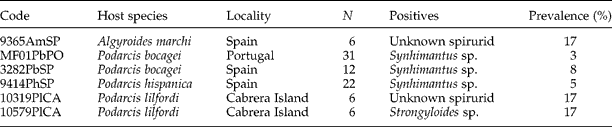
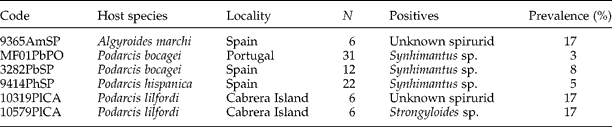
Tissue samples (fragments of tail tips of length 2–5 mm) from four species of lacertid lizards (Algyroides marchi, Podarcis bocagei, P. hispanica and P. lilfordi) from the Iberian Peninsula and Balearic Islands were included in the study. In total, 76 tissue samples preserved in 96% alcohol were used for the molecular analysis (see table 1 for more details).
Taxonomic identity and prevalence (%) of nematodes from lacertid hosts and localities included in the present study; N, number of hosts examined. Positives are based on sequences retrieved from molecular screening.
Molecular analysis
DNA was extracted from tissues (approximately 2 mm of tail tip) using the standard saline method (Sambrook et al., Reference Sambrook, Fritsch and Maniatis1989). Six hundred microlitres of lysis buffer (0.5 m Tris, 0.1 m EDTA, 2% sodium dodecyl sulphate (SDS), pH 8.0) and 5–20 μl of proteinase K (25 mg/ml) were added to small pieces of tissue and incubated at 56°C overnight. Then 300 μl of ammonium acetate (7 m; pH 8.0) was added and centrifuged for 15 min at 14,000 rpm at − 4°C. The supernatant was transferred to new Eppendorf tubes with 600 μl of ice-cold isopropanol, frozen from 3 h to overnight, and centrifuged for 15–30 min at 14,000 rpm at − 4°C. After discarding the supernatant, 1000 μl of ice-cold 70% ethanol was added to the precipitate and it was centrifuged for 15 min at 14,000 rpm at − 4°C. The supernatant was discarded and tubes were left for any remaining ethanol to evaporate at room temperature. Samples were finally hydrated with 50–100 μl of ultra-pure water at ambient temperature in an agitator. Detection of nematodes was made using the nematode-specific primers Nem_18S_F and Nem_18S_R that target the 18S small subunit rRNA gene, designed by Floyd et al. (Reference Floyd, Rogers, Lambshead and Smith2005). These primers have been used previously to amplify DNA of other nematodes infecting reptiles (Hasegawa et al., Reference Hasegawa, Hayashida, Ikeda and Sato2009; Jorge et al., 2011). PCRs were performed in a final volume of 20 μl, including: PCR buffer at 1 × concentration, MgCl2 at 1.5 mm; deoxynucleoside triphosphates (dNTPs) at a concentration of 0.2 mm for each nucleotide; primers at 0.5 μm each; bovine serum albumin (BSA) at 0.4 μg/μl (Roche Applied Science, Manheim, Germany); and Taq DNA polymerase (Invitrogen, Paisley, Scotland) at 0.025 units/μl; 2 μl of DNA template was used. The PCR reaction consisted of an initial denaturation step of 3 min at 94°C; followed by 35 iterations of the cycle: 30 s at 94°C, 30 s at 54°C and 1 min at 72°C; and a final extension at 72°C for 10 min. Negative and positive controls were run with each reaction. In some cases, conditions used produced unspecific bands, but a clear, single thick band was always obtained in positive samples. The positive PCR products were purified and sequenced by a commercial sequencing facility (Macrogen Inc., Seoul, Korea).
Six positive samples were successfully sequenced for the 18S rRNA region. Sequences were BLASTed in GenBank in order to assess their possible identity. The most similar published sequences were aligned with those obtained in this study and included in the phylogenetic analysis. Data were aligned using ClustalW (Thompson et al., Reference Thompson, Higgins and Gibson1994) implemented in the software Geneious 5.4.4 (Drummond et al., Reference Drummond, Ashton, Buxton, Cheung, Cooper, Duran, Field, Heled, Kearse, Markowitz, Moir, Stones-Havas, Sturrock, Thierer and Wilson2010). The sequences generated in this study were deposited in GenBank with the numbers JQ771745–JQ771750.
Two different phylogenetic approaches, maximum likelihood (ML) and Bayesian inference (BI) were conducted. ML was carried out using TREEFINDER (Jobb et al., Reference Jobb, Von Haeseler and Strimmer2004). The most appropriate substitution model under the Akaike information criterion (AIC) was estimated using the option ‘model selection’ implemented in the same software. Support for the ML tree nodes was obtained using the bootstrap option with 1000 replicates. Bayesian analysis (BI) was implemented using MR-BAYES v.3.1 (Huelsenbeck & Ronquist, Reference Huelsenbeck and Ronquist2001) with parameters estimated as part of the analysis. The analysis was run for 1 × 10⁶ generations, saving one tree each 100 generations. The log-likelihood values of the sample point were plotted against the generation time and all the trees prior to stationary were discarded, ensuring that burn-in samples were not retained. Remaining trees were combined in a 50% majority consensus tree, in which frequency of any particular clade represents the posterior probability (BPP, Huelsenbeck & Ronquist, Reference Huelsenbeck and Ronquist2001). Parastrongyloides trichosuri and Thelazia sp. were used as outgroups for rooting the Strongyloides and Spirurida phylogenetic trees, respectively.
Results
In total, six nematode sequences were recovered using molecular screening of isolates from tail tissue samples: one sequence related to Strongyloides, three sequences of Synhimantus and two more sequences, related to Gongylonema sequences from GenBank (table 1). Due to the taxonomic and genetic differentiation among the parasite species found, the dataset was split and analysed separately in two groups: one containing the parasites of the order Rhabditida (genus Strongyloides), and the other grouping the ones included in the order Spirurida. Final datasets included 807 bp and 937 bp, respectively. The best models of evolution were GTR +G+I (generalized time reversible model (GTR) with rate variation among sites (+G) and a proportion of invariant sites (+I)) and TVM +I+G (transversional model (TVM) with rate variation among sites (+G) and a proportion of invariant sites (+I)) for the Strongyloides and Spirurida datasets, respectively.
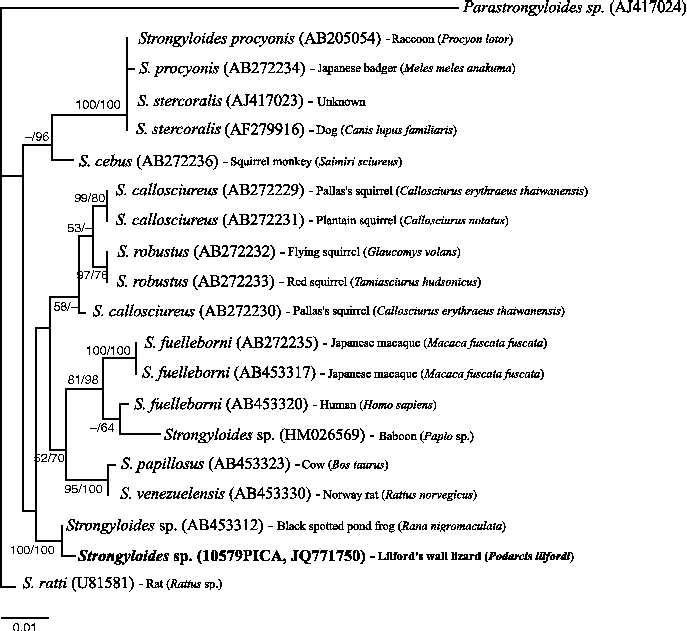
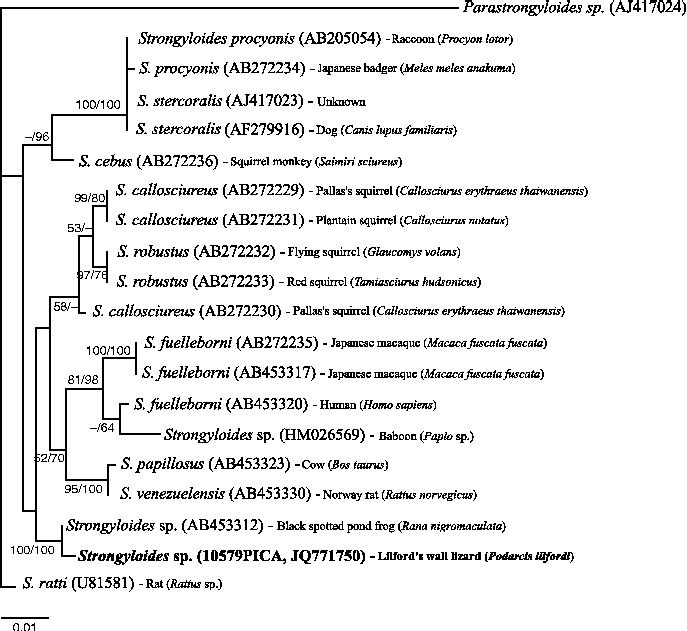
Regarding Strongyloides, a single new sequence was identified in the study (table 1). This sequence, obtained from P. lilfordi hosts from Cabrera Island, groups in the phylogenetic tree in a clade that includes the other Strongyloides species from a non-mammal host, an amphibian (fig. 1). However, no other sequences of Strongyloides infecting reptiles were available to be included in the analysis.
Phylogenetic tree of the genus Strongyloides showing the relative position of Strongyloides sp. from Podarcis lilfordi obtained in this study (in bold). Topology of the tree corresponds to the maximum likelihood (ML) analysis based on an 807 bp 18S rRNA fragment. Numbers separated by a slash near the nodes represent the bootstrap support (BP) values for the ML analysis, and the Bayesian posterior probability values (BPP), respectively. GenBank accession numbers (in parentheses) and host are given for each sequence included.
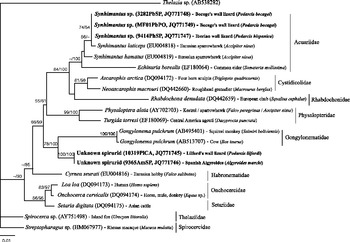
Regarding the order Spirurida, three parasite sequences obtained from P. hispanica and P. bocagei were found in a single clade together with several species of the family Acuariidae (Synhimantus laticeps, S. hamatus and Echinuria borealis, fig. 2), which parasitize birds of prey. Despite the fact that the three new sequences are from different host species and localities, they are identical. Finally, two other spirurid sequences, both identical, were obtained from P. lilfordi and A. marchi isolates (fig. 2). In our phylogenetic analysis these sequences are sister taxa to Gongylonema pulchrum, although they were clearly genetically distinct from all previously published species (see fig. 2).
Phylogenetic tree of members of the order Spirurida showing the relative position of the samples of lacertids obtained in this study (in bold). Topology of the tree corresponds to the maximum likelihood (ML) analysis based on a 937 bp 18S rRNA fragment. Numbers separated by a slash near the nodes represent the bootstrap support (BP) values for the ML analysis, and the Bayesian posterior probability values (BPP), respectively. GenBank accession numbers (in parentheses) and host are given for each sequence included.

Discussion
The genus Strongyloides contains more than 40 species of parasitic monoxenous nematodes (Grove, Reference Grove1989) that mainly infect mammals, and more occasionally reptiles, amphibians and birds (Dorris et al., Reference Dorris, Vincy and Blaxter2002; Viney & Lok, Reference Viney and Lok2007). Among reptiles, although snakes are the group most commonly infected (Pereira, Reference Pereira1929; Holt et al., Reference Holt, Cooper and Needham1979; Dos Santos et al., Reference Dos Santos, Carlos, Paduan, Kadri, Barrella, Amarante, Ribolla and Da Silva2010), geckos (Hemydactylus mabouia, Rodrigues, Reference Rodrigues1968) and lacertids (Podarcis pityusensis, Roca & Hornero, Reference Roca and Hornero1992) have also been reported as hosts. The screening of tissue samples in this study has revealed the presence of Strongyloides in a new host, the lacertid lizard P. lilfordi. This sequence forms a clade with Strongyloides sp. infecting Rana nigromaculata, and separated from the rest of the samples of this genus, all of them parasitizing mammals. The lack of sequences from other Strongyloides species infecting reptiles prevents confirmation of host-specificity within this group. However, an assessment including a short fragment (323 bp) in GenBank available for a species infecting a snake (S. ophididae, accession number EU287935, Dos Santos et al., Reference Dos Santos, Carlos, Paduan, Kadri, Barrella, Amarante, Ribolla and Da Silva2010 – analysis not shown) indicates that the two sequences available from Strongyloides species infecting reptiles and the one from Strongyloides sp. infecting frogs are part of the same clade. Strongyloides has a monoxenous cycle, in which infecting larval stages reach a new host by penetrating into the skin, migrate to the lungs using the bloodstream and finally move to the oral region and intestinal tract where the larva become adult and lay eggs. Alternatively, eggs or infecting larval stages can reach a new host through the oral route, by consumption of contaminated food and faeces or even by cannibalism (Anderson, Reference Anderson2000). Although tongue-flicking inspections and consumption of food and faeces containing infective larvae are the most probable transmission modes of Strongyloides in P. lilfordi, cannibalism in this species is relatively common, as happens in other insular systems (Pafilis et al., Reference Pafilis, Meiri, Foufopoulos and Valakos2009 and references within) and thus can play an important role in the transmission of this parasite.
Regarding spirurid parasites, two groups were obtained. One included three samples identified as Synhimantus, while the other two did not match any known species of spirurid. Synhimantus nematodes are parasites of birds (Honisch & Krone, Reference Honisch and Krone2008; Chabaud, 2009). In the Iberian Peninsula they have been reported in birds of prey (Sanmartín et al., Reference Sanmartín, Álvarez, Barreiro and Leiro2004; Honisch & Krone, Reference Honisch and Krone2008). Invertebrate species are the most common intermediate hosts (Anderson, Reference Anderson2000), although a possible role of reptiles as paratenic hosts has also been suggested (Birova & Calvo, Reference Birova and Calvo1977). Our study reports for the first time this genus of nematode in two reptile species, P. hispanica and P. bocagei. Phylogenetically, they are part of the clade that includes the other two sequences available in GenBank, S. laticeps and S. hamatus, isolated from the Eurasian sparrow hawk (Accipiter nisus). Considering that the presence of Synhimantus has been widely reported in birds of prey (Sanmartín et al., Reference Sanmartín, Álvarez, Barreiro and Leiro2004; Acosta et al., Reference Acosta, Hernández, Gutiérrez, Martínez-Cruz, Hernández, Buffoni and Martínez-Moreno2010), that lizards feed on their intermediate hosts (arthropods) (Salvador, Reference Salvador1997 and references within), and that they are at the same time common prey of hawks (Gil-Delgado et al., Reference Gil-Delgado, Verdejo and Barba1995; Salvador, Reference Salvador1997), it is plausible that the isolates from the lizards belong to Synhimantus parasites. In fact, the sequences obtained in Podarcis are highly similar to S. laticeps infecting sparrowhawks. However, we cannot exclude the possibility that we detected another Synhimantus species found in other potential predators, such as owls, and for which GenBank sequences are not available. Our screening also revealed the existence of a new clade of spirurid parasites that includes two sequences from P. lilfordi and A. marchi isolates. This clade is related to the parasites of the genus Gongylonema, spirurid parasites infecting mammals and birds (Anderson, Reference Anderson2000 and references within). However, as far as we know, no members of the family Gongylonematidae have been found to infect reptiles. Paratenesis is a common phenomenon in the transmission of spirurids, and third-stage larvae of several species have been found in tissues of numerous vertebrates that ingest infected intermediate host species, generally invertebrates (Anderson, Reference Anderson2000). Since most lizard species feed mainly on arthropods and are also common prey of small mammal and bird species frequently infected by spirurids (Salvador, Reference Salvador1997; Anderson, Reference Anderson2000), it is probable that they may be paratenic hosts for these parasite groups. Second- and third-stage larvae of spirurids can be found in the coelomic cavity, muscle and fat bodies of the intermediate host (Anderson, Reference Anderson2000). The positive results obtained from the isolates included in this study suggest that lizards might be more frequent paratenic hosts than currently thought. Traditional screening methods may fail to identify these paratenic hosts due to the small amount and size of the eggs and larval stages.
In this study and other recent assessments of reptiles (e.g. Jones et al., Reference Jones, Brown, Harris, Jones, Symondson, Bruford and Cable2012), the use of molecular methods have clearly been shown to be complementary to traditional screening techniques, although some technical aspects need to be optimized. First, the 18S rRNA gene is, in general, highly conservative at the specific level (Honisch & Krone, Reference Honisch and Krone2008; but see Hasegawa et al., Reference Hasegawa, Hayashida, Ikeda and Sato2009). The development of additional faster-evolving markers will increase the resolution and quality of the data obtained, for a more precise identification of the parasites. Second, the use of alternative molecular techniques can help to optimize both time and effort. For example, the implementation of multiplex PCR techniques using specific primers is useful to screen several groups of parasites in a single PCR run, greatly reducing the costs. Additionally, the method might fail to detect parasites, either because they were not amplified by the primers or because they were infecting other tissues than the ones screened. Comparing screening based on faeces versus different tissue sources would be useful to assess the latter aspect, while screening with several different primer pairs would help address the former. Finally, the GenBank database is still incomplete for many groups. So, although several parasite groups have been analysed intensively and a large number of sequences are available, there is a very limited number of sequences available for others, especially species with low importance for public health or with no economic significance. In consequence, the molecular identification of some groups, such as the new spirurid lineage infecting lizards reported in this study for the first time, is difficult. The value of this type of screening study therefore lies not only in the identification of parasites per se, but also in building a database of known hosts and localities against which future assessments should be compared.
Acknowledgements
This study was supported by a Fundação para a Ciência e a Tecnologia (FCT) project to D.J.H. (PTDC/BIA-BDE/74349/2006). A.P. is supported by a FCT postdoctoral fellowship (SFRH/BPD/26546/2006), and J.P.M.C.M. by a FCT PhD grant (SFRH/BD/74305/2010). Samples from Algyroides were obtained under the programme Seguimiento de Anfibios y Reptiles de España (SARE) financed by the Spanish Herpetological Society and the Spanish Ministry of Environment. Thanks to the colleagues from CIBIO who helped in the sampling, especially to A. Kaliontzopoulou, M.A. Carretero and E. García-Muñoz.