Implications
Feeding strategy for growing animals can be used to produce animals with higher BW and lean body mass and with lower feed consumption. The early life fast growth rate is accompanied by a number of problems – namely, increased bodyfat deposition, high incidence of metabolic disorders and high mortality. In growing rabbits, feed restriction has been used to reduce the incidence of post-weaning digestive disorders such as the epizootic rabbit enteropathy syndrome and digestive diseases such as diarrhoea and caecal impaction. Feed restriction reduces growth during the period of restriction, whereas during the re-alimentation period after restriction, a compensatory growth occurs and feed conversion improves. There is a moderate effect of feed restriction on carcass composition and dressing out percentage.
Introduction
Studies on feed restriction have focussed on differences in commencement, duration and intensity on growth, meat quality and health. The early life fast growth rate of rabbits causes a number of problems such as high incidence of metabolic disorders connected with high mortality and morbidity. De Blas (Reference De Blas2013) stated that the weaning stage is a critical phase of development of digestive disorders, presumably caused by insufficient development of digestive enzymatic capability at an early age. Gidenne et al. (Reference Gidenne and Feugier2009) observed a favourable impact of mild feed restriction on the digestive health of young rabbits, which sharply reduced mortality and morbidity. It might be assumed that the basis for metabolic disorders is during early life when the relative growth is maximum. It is a period of high metabolic activity of the small intestine and restriction strategy leads to changes in the digestive physiology of rabbits affecting feeding behaviour including caecotrophy, reduction of digesta rate passage and modification of caecal microbial activity pattern (Gidenne and Feugier, Reference Gidenne, Combes and Fortun-Lamothe2009).
The application of feed restriction within the first 3 weeks after weaning is associated with a lower incidence of post-weaning digestive troubles – particularly epizootic rabbit enteropathy (Boisot et al., Reference Boisot, Licois and Gidenne2003). A drawback of feed restriction is growth reduction during the restriction period. Nevertheless, re-alimentation partly compensated for the loss of weight during restriction compared with ad libitum feeding (AL; Tůmová et al., Reference Tůmová, Skřivanová and Skřivan2003; Gidenne et al., Reference Gidenne, Combes, Feugier, Jehl, Arveux, Boisot, Briens, Corrent, Fortune, Montessuy and Verdelhan2012). Feed restriction might improve feed efficiency (Dalle Zotte et al., Reference Dalle Zotte, Rémignon and Ouhayoun2005; Martignon et al., Reference Martignon, Combes and Gidenne2010) as a result of better faecal digestibility during the restriction period or shortly after restriction (Ledin, Reference Ledin1984a and Reference Ledin1984b). Moreover, this improvement of feed efficiency might be associated with the morphological and physiological changes in the intestine in the restricted rabbits, which had a longer small intestine (Oliveira et al., Reference Oliveira de, da Silva, Araújo, da Silva, Bento and da Silva2012) and a longer retention time (Gidenne and Feugier, Reference Gidenne, Combes and Fortun-Lamothe2009). However, Martignon et al. (Reference Martignon, Combes and Gidenne2010) revealed that the morphology of ileal villi and crypts were not affected by feed restriction.
French rabbit breeders widely practice post-weaning intake limitation on 80% AL (Gidenne et al., Reference Gidenne and Feugier2009). On the other hand, a systematic research conducted in broiler chickens revealed the high positive effect of a short and severe feed restriction (Plavnik and Hurwitz, Reference Plavnik and Hurwitz1985). The early feed restriction is applied a week after hatching with 1-week duration on maintenance feed allowance. Because of positive results in poultry and other animal species, studies on the application of 1-week severe restriction has also been initiated in growing rabbits (Tůmová et al., Reference Tůmová, Skřivanová and Skřivan2003 and Reference Tůmová, Zita, Skřivanová, Fučiková, Skřivan and Burešová2007). Results of these studies showed compensatory growth, reduced feed intake, improved digestibility of nutrients when a 1-week severe restriction period was applied in the 2nd week after weaning. However, there is lack of data about the effect of this short restriction on the morphology and physiology of gastrointestinal tract (GIT). Therefore, the present study was focussed on the effect of AL and two feed levels on maintenance allowance (50 and 65 g rabbit per day) applied for 1 week on performance, gastrointestinal morphology and physiological parameters during the restriction and during the re-alimentation periods.
Material and methods
Experimental animals and design
Two experiments using Hyplus rabbits at the weaning age of 35 days were carried out. The experiments were approved by the Ethics Committee of the Central Commission for Animal Welfare at the Ministry of Agriculture of the Czech Republic. Experiment 1 was a balance trial oriented on digestibility of nutrients, in which 30 rabbits (male and female ratio 1 : 1) were placed in individual cages with separation of urine and feaces. The floor density was 0.15 m2/rabbit. In the second experiment, 195 rabbits were used for growth, feed intake and GIT measurements. Rabbits were housed in commercial wired cages (three rabbits per cage) with floor density of 0.16 m2/rabbit. This experiment was divided into two parts. In the first part, growth and feed intake were measured in 36 cages and rabbits were weighed individually each week until the end of the experiment. Feed consumption was recorded daily for each cage. In the second part of the experiment, rabbits from 29 cages were weighed weekly, and from the age of 49 days rabbits were used for GIT measurements. The same experimental design was used in both the experiments.
Rabbits were randomly divided into three experimental groups: group 1 (AL) where rabbits were fed AL; group 2 (R1) where rabbits were restricted from 42 to 49 days of age and received 50 g of the same feed (29% of AL, 0.48 MJ DE) daily; and group 3 (R2) where rabbits were restricted at the same age and were fed 65 g feed (37% of AL, 0.62 MJ DE) daily. In the 1st week after weaning, all the rabbits were fed AL.
In addition, after the restriction time, all the groups were back to AL feeding until the end of the experiment (at 70 day of age). The animals were fed manually at 0830 h. Composition of the experimental feed mixture is illustrated in Table 1. Water was available AL. A 12-h photoperiod was used (light was turn on at 0730 h). A temperature of 15°C to 17°C and relative humidity of 55% to 60% were maintained during the entire experimental period.
Ingredients and chemical composition of the experimental diet

a Composition of vitamin and mineral supplement: vitamin A 1 200 000 i.u., vitamin D3 200 000 i.u., alfa tokoferol 5000 mg, vitamin K3 100 mg, vitamin B1 200 mg, vitamin B2 700 mg, vitamin B6 400 mg, vitamin B12 2 mg, niacin 5000 mg, calcium panthotenate 2000 mg, choline 60 000 mg, biotine 20 mg, folic acid 50 mg, antioxidant 10 000 mg, diclazuril 100 000 mg, DL- methionine 100 000 mg, L-lysine HCL 25 000 mg, cobalt 30 mg, copper 800 mg, iron 2700 mg, iodine 50 mg, manganese 1900 mg, zinc 4400 mg, selene 7 mg. Vitamin and mineral premix supplied per kilogram of feed mixture.
b As-fed basis.
c Calculated according to the table of ingredients (De Blas and Wisemann, Reference De Blas and Wisemann2010).
Digestibility of nutrients and caecal fermentative activity
The faecal apparent digestibility (experiment 1) was measured individually in all rabbits in each group. Nutrient digestibility was determined as a coefficient of total tract apparent digestibility using the method of Perez et al. (Reference Perez, Lebas, Gidenne, Maertens, Xiccato, Parigi-Bini, Dalle Zotte, Cossu, Carazzolo, Villamide, Carabaño, Fraga, Ramos, Cervera, Blas, Fernandez, Falcao, Cunha and Bengala Freire1995). There were three collection periods: the first was during feed restriction between days 42 and 49, the second was during the subsequent week after feed restriction (49 to 56 days) and the third was from the age of 56 to 63 days. During the collection period, faeces samples from all the animals were collected daily in plastic bags and stored at −18°C until analysis.
The caecal fermentative activity (experiment 2) was measured using eight samples from each group. GIT measurements were taken in slaughtered rabbits at 49, 56, 63 and 70 days of age. Samples were collected after slaughtering at 0900 h; therefore, time of fasting could have varied among groups. The caecal contents were diluted with distilled water (1 : 2), and total volatile fatty acid (VFA) concentration was determined by titration after steam distillation. The VFA molar concentration was estimated by gas chromatography at 140°C, using a column of Chromosorb WAW with 15% SP 1220 and 1% H3PO4 (Supelco, Bellefonte, PA, USA). VFA total quantity represents C2 acetic acid, C3 propionic acid, C4 butiryc acid and C5 valeric acid in mmol/l of water. Lactic acid was assayed by the microdiffusion method as indicated by Conway (Reference Conway1957). In brief, lactate was converted to acetaldehyde using cerium (IV) sulphate and acetaldehyde (lactate oxidation product), which was trapped in 0.01M semicarbazide HCL in microdiffusion chambers.
GIT measurements
Characteristics of the GIT were determined in rabbits in the second part of experiment 2. After restriction, from 49 days onwards, eight rabbits from each group were slaughtered at 0900 h, at weekly intervals until the age of 70 days. The rabbits selected for GIT measurements were slaughtered at similar weight at the given age to detect differences between feeding regimes. Immediately after slaughtering, rabbits were eviscerated and the lengths of the small intestine and large intestine as well as the caecum were measured. The small intestine was measured from the duodenum to the junction of the ileum, caecum and colon. The large intestine included the proximal and distal colon, and the length of the caecum was measured without the appendix. The full caecum was removed and weighed, and subsequently the caecal contents were removed and weighed and the pH was measured (pH meter 3510; Jenway, UK). In the small intestine, the height of villi and depth of crypts were determined. At the same time, the liver was weighed. Subsequently, two samples of ∼1 cm2 in size were taken from each rabbit, one from the centre of the liver parenchyma and one from the duodenum 20 cm under the stomach. The samples were fixed with a 4% Bouin solution for histological analysis. All the samples were collected within 30 min after slaughtering and they were fixed for 1 week. The samples were processed by standard histological methods: 3- to 5-μm-thick slices were excised from each sample, and subsequently the slices were stained with haematoxylin–eosin (HE). The prepared samples were evaluated in a light-microscopic picture using a Nikon Eclipse E600 microscope (Nikon Corporation Instruments Company, Tokyo, Japan). The diameter of the hepatocytes, the length of villi and the depth of crypts were measured using the NIS-Elements version 3.0 software.
Chemical analysis
In feed mixture and faeces samples, dry matter content was determined by drying the samples of feed and faeces at 105°C to a constant weight. AOAC (2005) procedures were used to determine the CP (954.01), starch (920.40) and ash (942.05) contents. Ether extract was determined according to procedure 920.39 of AOAC (1995). The NDF content was determined as described by Mertens (Reference Mertens2002), and the analyses of ADF and ADL were carried out according to procedure 973.18 of AOAC (2000). Crude fibre content was measured as described by Van Soest et al. (Reference Van Soest, Robertson and Lewis1991).
The blood serum samples obtained by blood centrifugation (1000 g for 10 min) were stored at −70°C for further analysis. Gamma-glutamyltranferase (GMT, as an indicator of liver function) was biochemically determined in serum using Bio-La-test gamma-glutamyltransferase – GMT L250 kit (Erba Lachema, Brno, Czech Republic) on XL – 200 analyser (Erba Mannheim, Mannheim, Czech Republic). Catalytic concentration of GMT was measured according to Persijn and Vanderslik (Reference Persijn and Vanderslik1976).
Statistical analysis
Data of the experiments were processed by ANOVA using ANOVA procedure (SAS Institute Inc., 2003). Growth and feed intake were analysed by one-way ANOVA. The significance of difference among groups was compared using the Sheffe test on the level of significance P<0.05. Data of nutrient digestibility and GIT characteristics were statistically analysed by two-way ANOVA with feeding regime and age interactions. The statistically significant differences (P<0.05) in rows are indicated by a different superscript.
Results
Growth performance
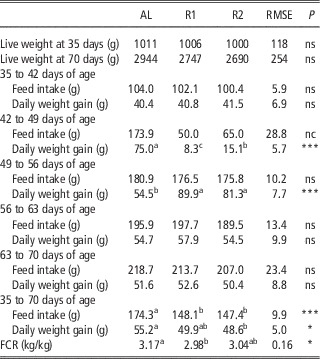
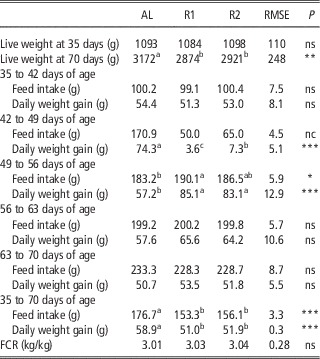
The results of both the experiments are given in Tables 2 and 3. In the first experiment, live weight at 70 days of age was not significantly affected by the feeding regime. Compared with the first experiment, final live weight of the AL group in the second experiment was significantly higher than the restricted groups (R1 and R2). Live weight of the restricted groups reached 91% in R1 and 92% in R2 of the AL group. Feed intake in experiment 1 differed significantly only during the week of feed restriction. Feed intake during the entire experiment was significantly higher in rabbits of the AL group, whereas in both the restricted groups it was reduced to 85%. In the second experiment, in the 1st week of re-alimentation, rabbits in the R1 group consumed more feed (P<0.05) than the others in the AL group (+4%). There were no significant differences in feed intake between AL and R2; however, rabbits in the R2 group consumed 2% more feed. Feed intake did not vary among groups in the last 2 weeks of the experiment. Over the entire experimental period, feed intake was significantly reduced in both the restricted groups (87% in R1 and 88% in R2).
The effect of ad libitum (AL) and restricted feeding on live weight, feed intake and daily weight gain of individually housed rabbits (experiment 1)

R1=50 g of feed per day and rabbit; R2=65 g feed per day and rabbit; restriction period from 42 to 49 days of age; FCR=feed conversion ratio; ns=non-significant; nc=non-calculable for zero variance of feed intake in restricted groups.
a,b,cValues within a row with different superscripts differ significantly at P<0.05.
*P<0.05, ***P<0.001.
The effect of ad libitum (AL) and restricted feeding on live weight, feed intake and daily weight gain of group housed rabbits (experiment 2)

R1=50 g of feed per day and rabbit; R2=65 g feed per day and rabbit; restriction period from 42 to 49 days of age; FCR=feed conversion ratio; ns=non significant; nc=non-calculable for zero variance of feed intake in restricted groups.
a,b,cValues within a row with different superscripts differ significantly at P<0.05.
*P<0.05, **P<0.01, ***P<0.001.
A detailed overview of growth expressed as daily weight gain (DWG) showed that in both the experiments feed restriction in the 2nd week of the experiment significantly affected DWG. In experiment 1, DWG in the R1 group dropped to 11%, although feed intake was reduced to 29% of the AL group. In the R2 group, DWG decreased to 20% when feed intake was reduced to 37% of the AL group, whereas in the week after feed restriction DWG in R1 and R2 increased significantly to 166% and 128%, respectively, compared with the AL group. In the 2nd week of re-alimentation, only rabbits in the R1 group had a higher DWG (+5%). In spite of the compensatory growth, DWG during the entire growing period was reduced to 90% and 87%. Trend in growth of rabbits in the second experiment was mostly the same as in the first one. During the restriction period, DWG was reduced to 5% in R1 rabbits and to 10% in R2 rabbits; however, in the 1st week of full feeding, DWG reached 148% in the R1 group and 145% in the R2 group in comparison with the AL group. From the 2nd week of the re-alimentation period, DWG did not differ in the AL and restricted groups; however, during the entire experimental period it was 87% and 88% in R1 and R2, respectively.
In the first experiment, the feed conversion ratio (FCR) of the restricted groups improved (94% in R1 and 96% in R2). The FCR in the R1 group was better (P<0.05), and there was no significant difference between the R2 and AL groups. Similarly, in the second experiment, no significant differences were found and FCR did not differ among groups. It is interesting to mention that in both the experiments, no mortality was observed.
Digestibility of nutrients
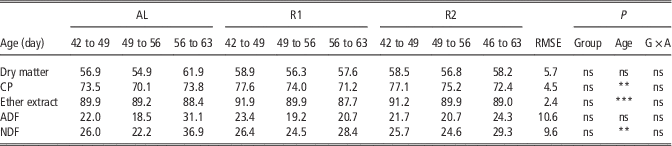
None of the digestibility coefficients was significantly affected by the interaction between feeding regime and age of rabbits (Table 4). Similarly, the feeding regime alone had a little effect on these coefficients. However, digestibility of CP was significantly decreased with advancing age in the restricted groups (−8% and −6% in R1 and R2, respectively), whereas in the AL group it was the lowest between 49 and 56 days of age. Digestibility of ether extract also decreased with increasing age (P<0.001) in all the groups (−2% in AL, −5% in R1 and −3% in R2). Regarding fibre digestibility coefficients, NDF fibre was significantly influenced by advancing age of the rabbits. The highest values were detected at 63 days of age. The highest improvement was observed in the AL group (+42%) but the lowest (+8%) was detected in the R1 group v. 14% in the R2 group.
The effect of ad libitum (AL) and restricted feeding on total tract apparent digestibility (CTTAD) of the experimental diet in fattening rabbits (%)

R1=50 g of feed per day and rabbit; R2=65 g feed per day and rabbit; restriction period from 42 to 49 days of age; G×A=group and age interaction; ns=non significant.
**P<0.01, ***P<0.001.
GIT measurements
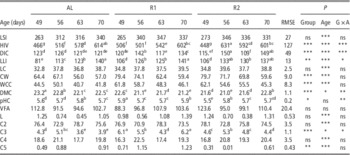
Length of the small intestine (Table 5) was significantly increased with increasing age (+29% in AL, +27% in R1 and +21% in R2). The fastest development was observed between 49 and 56 days of age in restricted rabbits (+28 in R1 and +26% in R2). Overall, restricted rabbits had longer small intestines (+5% in R1 and +7% in R2). The interaction between feeding regime and age was significantly detected in villi height. The significantly highest and the lowest villi heights were observed in rabbits of the R2 group at 49 (448 µm) and 56 days (631 µm), respectively. At the same age, villi height in the AL group varied up to 10%, and in the R1 group it did not differ. Villi height increased with advancing age of the rabbits (P<0.001). The feeding regime affected villi height significantly where the maximum villi heights were determined in the R2 group. The depth of crypts was affected by the interaction between feeding regime and age (P<0.001), as well as by feeding regime (P<0.001) or age (P<0.001). Deeper crypts were noted in the restricted groups compared with the AL group. Interactions between the feeding regime and age showed that, in AL group, the depth of crypts did not vary with advancing age, whereas in both the restricted groups the depth increased in the 1st week of re-alimentation (+18% and +31% in R1 and R2, respectively). In the 2nd week of AL feeding, the depth of crypts decreased, and in the last week of the experiment it increased again; however, these changes were not as high as in the 1st week after restriction.
The effect of ad libitum (AL) and restricted feeding on intestinal parameters and caecal fermentation activity of fattened rabbits fed the experimental diet

R1=50 g of feed per day and rabbit; R2=65 g feed per day and rabbit; restriction period from 42 to 49 days of age; G×A=group and age interaction; LSI=length of small intestine (cm); HIV=height of intestinal villi (µm); DIC=depth of intestinal crypts (µm); LLI=length of large intestine (cm); LC=length of caecum (cm); CW=caecum weight (g); WCC=weight of content of caecum (g); DMC=dry matter of content of caecum (%); pHC=pH of caecum; VFA=volatile fatty acid (mmol/g); L=lactic acid (mol/100 mol); C2=acetate (mol/100 mol); C3=propionate (mol/100 mol); C4=butyrate (mol/100 mol); C5=valerate (mol/100 mol); ns=non significant.
a,b,c,d,e,fValues within a row with different superscripts differ significantly at P<0.05.
*P<0.05, **P<0.01, ***P<0.001.
The results showed a significant interaction between the feeding regime and age with regard to the length of the large intestine, as well as there was a significant effect of the individual factors on this parameter. Interactions revealed the shortest large intestine in AL rabbits at 49 days of age (81 cm) and the longest at 70 days in the same group (140 cm), whereas it was 141 cm in the R1 group. The highest increase in large intestine length with increasing age (P<0.001) was observed in the AL group (+72%), more than double in comparison with the R1 (+33%) and R2 (+29%) groups. The differences showed that the large intestine grew rapidly with advancing age; however, in the end of the restriction period, both restricted groups showed 30% longer large intestines compared with the AL group. Length of the caecum also increased significantly with advancing age (+18%, +13% and +12%). Weight of the caecum was significantly affected by age and group. The caecum weight was significantly higher in the restricted groups. The caecum was also heavier (P<0.001) at 49 and 56 days of age. There was a similar tendency for the weight of the caecum content; it was the lowest in the AL group and at the age of 63 and 70 days. Significant interactions were detected in dry matter of caecal contents. The highest dry matter content (P<0.05) was observed in the AL group and in terms of age at 49 days. The significant interaction between feeding regime and age revealed the maximum pH values of the caecum in the R1 group at the end of the restriction period. The significant interaction of feed restriction and age on caecal fermentation activity was not observed. The feed restriction did not significantly affect the total VFA concentration or the VFA molar proportions, except for propionate (P<0.001) and valerate (P<0.01) proportions that were higher in R1 rabbits. Age had a great effect on VFA molar proportions.
Presumably, feed restriction plays an important role in determining liver characteristics (Table 6). The liver percentage was significantly higher in restricted rabbits, 12% to 13%. Regarding the effect of age, the highest liver percentage was found at 56 days of age. Major modifications were detected in hepatocyte diameter. As expected, hepatocyte diameter was enlarged (P<0.001) with increasing age (+27% in AL, +31% in R1 and +21% in R2). Nevertheless, when the effect of feeding regime was found, the largest hepatocytes were detected in the R1 group. The interaction between feeding and age revealed the biggest changes in hepatocyte diameter in rabbits of the R1 group (+18%), whereas in the AL and R2 groups the growth was 13% and 11%, respectively. Regarding liver function, GMT values were not affected by the feeding regime, but they were significantly decreased with advancing age. The reduction was the lowest in the AL group, 24%. In both the restricted groups, GMT decreased by about 40%. Moreover, there was a significant interaction between feeding regime and age. The highest activity of GMT was observed in the AL group at 49 days of age, whereas the lowest activity of GMT was observed in the restricted groups at the same age. From the age of 56 days, there were no differences among groups.
The effect of ad libitum (AL) and restricted feeding on liver characteristics of fattened rabbits

LW=liver weight (g); LP=liver percentage (%); HD=hepatocytes diameter (µm), GMT=gamma-glutamyltranferase (µkat/l); R1=50 g of feed per day and rabbit; R2=65 g feed per day and rabbit; restriction period from 42 to 49 days of age; G×A=group and age interaction; ns=non-significant.
a,b,c,d,e,fValues within a row with different superscripts differ significantly at P<0.05.
*P<0.05, **P<0.01, ***P<0.001.
Discussion
Growth performance
Results of the present study showed that rabbits in the restricted groups in both experiments reached 90% to 93% of the final live weight of the AL group. Decrease in the final weight of restricted rabbits indicated that restricted rabbits under the short intensive restriction were not able to compensate for the final weight. These results are in correspondence with the results of Ledin (Reference Ledin1984a) who reported that a short restriction period induced weaker compensatory growth. Similarly, Gidenne et al. (Reference Gidenne, Combes, Feugier, Jehl, Arveux, Boisot, Briens, Corrent, Fortune, Montessuy and Verdelhan2012) elucidated that slaughter weight of restricted rabbits remains 5% to 10% below that of the AL group when applying different restriction methods. Trends in live weight in both experiments were similar, although in the second experiment lower variability in final live weight led to significant differences. Differences in final weight in both the experiments might be related to moderate differences in microclimate because individual and group-caged rabbits were placed in two rooms. In addition, final weight might be affected by feeding behaviour of individual and group-caged rabbits (De Blas and Wisemann, Reference De Blas and Wisemann2010).
Compensatory growth is usually supported by higher feed intake; however, in the present study, feed intake and FCR were reduced by 4% to 6% (individually caged rabbits) or not affected (group-housed rabbits). Differences in feed consumption might be related to the modifications in feeding behaviour (Gidenne et al., Reference Gidenne, Combes, Feugier, Jehl, Arveux, Boisot, Briens, Corrent, Fortune, Montessuy and Verdelhan2012). A detailed evaluation of growth revealed, nevertheless, that growth was modified mostly during the feed restriction period and in the 1st week of re-alimentation. Feed restriction, 50 or 65 g feed/day for 7 days, was assumed to be a maintenance level. Restricted rabbits daily consumed 0.48 or 0.62 MJ DE; however, DWG of restricted rabbits was reduced from 5% to 20%, which probably indicated that these low levels of feed intake were above maintenance. In the 1st week of re-alimentation, restricted rabbits showed a high compensatory growth whose DWG was +28% to 65% higher compared with rabbits in the AL group. The compensatory growth was not associated with feed intake, which was similar to the AL group. Therefore, it might be assumed that in this type of feed restriction, compensatory growth is not related to overfeeding, which is in contrast with the observation of Knudsen et al. (Reference Knudsen, Combes, Briens, Coutelet, Duperray, Rebours, Salaun, Travel, Weissman and Gidenne2014) who applied 25% feed intake reduction for 4 weeks. They elucidated that compensatory growth was about 30% and overfeeding 14%. In addition, in the present study, more severe restriction was responsible for a higher compensatory growth. Based on the results of the present study and previous studies, it might be assumed that compensatory growth might be affected by the method of feed restriction and the status of the digestive physiology. One of the important criteria for compensatory growth could be better nutrient digestibility during the restriction period and in the beginning of re-alimentation period. This is because feed intake of restricted rabbits remains below the intake of the AL ones.
Digestibility of nutrients
The effect of feed restriction on apparent digestibility was minor (Table 4). It is clear that digestibilities of CP (+2%) and ether extract (+5%) in restricted rabbits were not significantly higher during the restriction period and in the 1st week of re-alimentation compared with the AL rabbits, which might be related to short feed restriction. Significantly higher CP digestion was found by Gidenne and Feugier (Reference Gidenne, Combes and Fortun-Lamothe2009) for restriction on 60% and 70% of AL; however, lower restriction intensity did not affect CP digestibility. A higher digestibility of CP and ether extract observed in the present study might be assumed to be beneficial for compensatory growth. Contrast results might be explained by different feed composition, which probably plays a key role (Gidenne et al., Reference Gidenne, Combes, Feugier, Jehl, Arveux, Boisot, Briens, Corrent, Fortune, Montessuy and Verdelhan2012). Neither ADF nor NDF digestibility was influenced by feed restriction, which is in agreement with the data obtained by Gidenne and Feugier (Reference Gidenne, Combes and Fortun-Lamothe2009) who applied different feed restriction intensity and duration. Digestibility coefficients decreased with advancing age, which is in agreement with our previous findings (Tůmová et al., Reference Tůmová, Skřivanová and Skřivan2003 and Reference Tůmová, Zita, Skřivanová, Fučiková, Skřivan and Burešová2007). Mainly in restricted rabbits, the highest digestibilities of CP and ether extract were observed during the restriction period when rabbits presumably compensated low nutrient intake from feed. Decreasing digestibility with advancing age was associated with gut maturity and changes in the intestines (De Blas and Wisemann, Reference De Blas and Wisemann2010). Based on the results of the present experiment and the literature, it might be indicated that digestibility of nutrients is moderately affected by the duration of feed restriction even if the restriction is severe. Improvement in digestion might have originated from physiological changes in the intestine (enzyme secretion, mucosa absorption, etc.), and, for instance, due to a longer retention time of digesta particles in the caeco-colic segment (Gidenne and Feugier, Reference Gidenne, Combes and Fortun-Lamothe2009; Gidenne et al., Reference Gidenne, Combes, Feugier, Jehl, Arveux, Boisot, Briens, Corrent, Fortune, Montessuy and Verdelhan2012).
GIT measurements
An interesting finding in the present study was the improvement of intestinal morphological and physiological characteristics in growing rabbits due to short feed restriction (Table 5), which might be involved in better digestion and compensatory growth following feed restriction. It is well known that the small intestine is the most important organ for the digestion and absorption of nutrients. The small intestine was not significantly longer in restricted rabbits. There was also a modification in the intestinal villi due to the interaction between age and feeding regime. Villi height increased with advancing age and it, in average, was the highest in the R2 group, whereas the depth of crypts did not change with advancing age in the AL group and in restricted rabbits, and it increased in the 1st and 3rd weeks of re-alimentation. Increase in villi height and depth of crypts with advancing age is associated with gut development (Gidenne et al., Reference Gidenne, Combes, Feugier, Jehl, Arveux, Boisot, Briens, Corrent, Fortune, Montessuy and Verdelhan2012). In contrast, Martignon et al. (Reference Martignon, Combes and Gidenne2010) revealed that villi height and crypt depth were not affected by a 25% feed restriction from 28 to 53 days of age. The contrast among results might be explained by the significant interaction between feeding regime and age in the present study. Martignon et al. (Reference Martignon, Combes and Gidenne2010) measured villi parameters at 36 and 52 days of age, which was during the restriction period. Lower height and depth of villi in their study are in agreement with the results of the present study at 49 days of age. In Table 5, villi measurements were increased mainly in the R2 group in the re-alimentation period. Morphological changes were also detected in the large intestine and the caecum, which were longer in restricted rabbits at the end of restriction period, as well as during the entire re-alimentation period. The enlargement of the large intestine during the restriction (+30%) and the re-alimentation periods indicates that this part is important for the support of compensatory growth and also may be related to enhancement of defence mechanisms. In addition, there was a higher digesta content in the caecum in restricted rabbits; however, the dry matter content of digesta was lower. Overall, these measurements support a theory of longer retention time of digesta in the caecum of restricted rabbits observed by Ledin (Reference Ledin1984a and Reference Ledin1984b) and Gidenne and Feugier (Reference Gidenne, Combes and Fortun-Lamothe2009). Whatever feed restriction, age or the group×age interaction, the caecal levels of total VFA or the VFA molar proportions were within the range of the values reported by Gidenne (Reference Gidenne1997) and García et al. (Reference García, Gidenne, Falcao-E-Cunha and De Blas2002). The VFA molar proportions differ significantly according to age, which is probably associated with the relationships among ages, intestinal microflora and fermentation parameter (Padilha et al., Reference Padilha, Licois, Gidenne, Carré and Fonty1995). Moreover, some differences in VFA in the present study might be affected by the modification of feeding behaviour of the AL and restricted groups (Gidenne et al., Reference Gidenne, Combes, Feugier, Jehl, Arveux, Boisot, Briens, Corrent, Fortune, Montessuy and Verdelhan2012).
Liver is an early developing organ and feed restriction has an important effect on its growth. Very fast liver development in the 1st week of full feeding led to an increase in the liver percentage in both the restricted groups, and these results are in accordance with the findings of Ledin (Reference Ledin1984a and Reference Ledin1984b), Tůmová et al. (Reference Tůmová, Skřivanová and Skřivan2003 and Reference Tůmová, Zita, Skřivanová, Fučiková, Skřivan and Burešová2007) and Oliveira et al. (Reference Oliveira de, da Silva, Araújo, da Silva, Bento and da Silva2012). The largest values of the liver percentage were observed in the R1 group (+27%) compared with (+17%) the R2 group in the 1st week of re-alimentation, which probably indicated that in this period the priority was given to the development of internal organs, which is associated with higher growth intensity. Knudsen et al. (Reference Knudsen, Combes, Briens, Coutelet, Duperray, Rebours, Salaun, Travel, Weissman and Gidenne2014) assumed that the relative liver weight in the re-alimentation period is a response to the increase in functional demand such as glycogen storage. Results of the present study indicated that liver size modification was related to the diameter of hepatocytes. Interactions in hepatocyte diameter revealed no differences in this measurement among groups at the end of feed restriction (49 days of age). However, at the end of the experiment, the largest hepatocyte diameter was observed in rabbits of the R2 group. Generally, feed restriction increased hepatocyte diameter. On the other hand, Makovický et al. (Reference Makovický, Dudová, Tůmová, Rajmon and Vodková2011) demonstrated that early feed restriction (between the 8th and 14th day of age) in broiler chickens decreased hepatocyte diameter. This reduction of hepatocyte size was associated with induced steatosis in chickens (Makovický et al., Reference Makovický, Dudová, Tůmová, Rajmon and Vodková2011) and rats (Grattagliano et al., Reference Grattagliano, Vendemaile, Caraceni, Domenicali, Nardo, Cavallari, Trevisani, Bernardi and Atomare2000). It is possible to assume that restricted feeding does not cause steatosis or affect liver function in rabbits, which can reveal GMT concentration. GMT activity has been presented as a clinical marker of hepatobiliar diseases and is correlated with oxidative stress (Okerman, Reference Okerman1994). Lower GMT activity in restricted rabbits show lower oxidation stress and it might be assumed that feed restriction had no negative effect on liver function. This assumption is confirmed by the findings of van Harten and Cardoso (Reference Van Harten and Cardoso2010 and Reference Van Harten and Cardoso2012) who did not reveal any differences in hepatic glucogenic enzymes or hepatic glucogenesis of restricted and AL rabbits.
Conclusions
Overall results of the present study show that 1-week intensive feed restriction close to maintenance level induced compensatory growth for 2 weeks, decreased feed intake and altered morphological and physiological characteristics of the GIT. It might be assumed that compensatory growth in this type of feed restriction is associated with the development of internal organ such as small and large intestines, caecum and the liver during the restriction period and their fast growth in the 1st week of the re-alimentation. Digestible area in the small intestine is increased by increasing the villi height and depth of crypts, which leads to improved digestibility even after a short feed restriction period. The present study provides new data of the effect of short feed restriction in growing rabbits; however, there are some aspects of digestion that need further research.
Acknowledgements
The study was supported by the Ministry of Education, Youth and Sports of the Czech Republic (Project No SV 13-59-21320) and Ministry of Agriculture of the Czech Republic (Project No. MZe 0002701404). The authors thank Ms Jane Diesel, a director of Inlingua Language Training Centre Cape Town, for her language assistance with this paper.