Introduction
John Dower in, Embracing Defeat, quotes Prime Minister Yoshida Shigeru as saying, ‘You think you can make Japan a democratic country? I don't think so’ to which Colonel Charles Kades, of General Headquarter's (GHQ) Government Section, responded, ‘We can try’.Footnote 1 What the Prime Minister and the Colonel both overlooked is that Japanese activists had already charted a course for a liberal democratic order decades before the arrival of the American occupiers. Despite the assertion that Japan could not become a democratic country and the assumption that it had never been one, the ideas of domestic reformers had been broadcast to a large audience, not as ‘pie-in–the-sky’ possibilities, but as feasible programmes.
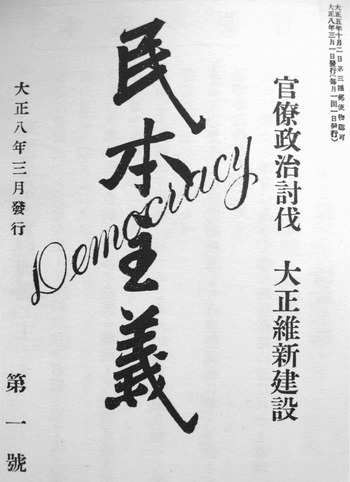
The iconoclastic journalist, Miyatake Gaikotsu, provided one such blueprint. In 1919, as editor of Minpon shugi, a magazine that also carried the English title Democracy blazoned across its cover (see Figure 11), he outlined the benefits that democracy might provide in a post-World War I world. Decades later, Japanese people faced a new postwar struggle, not as victors but as the vanquished.Footnote 2 Gaikotsu, writing in 1945 in a postwar Tokyo that was now the capital of an utterly defeated country, once again turned to reflect on democracy in his booklet-length essay, Amerika-sama.Footnote 3 Although the circumstances were vastly different, victory and defeat in world wars had opened paths to new possibilities. In this study, I examine Gaikotsu's writings in Democracy as prescient prescriptions that he revisits in Amerika-sama at the point they begin to be played out, in some instances only partially and at times for ill as well as for good, in occupied Japan. What is striking about these reflections is the continuity of prewar past and postwar present. Although Amerika-sama is Gaikotsu's final published work it is a representative expression of many programmes he and likeminded activists attempted to put into practice from the late nineteenth century until they were suppressed during the wartime years.
Gaikotsu's prewar and postwar political publications are a small part of his immense and diverse writings. As one of the main creators of modern Japanese mass journalism he wrote and published work that demonstrated that culture, society, and politics were inseparably intertwined. From the 1880s to the 1950s, his authored treatises, reference works, and lectures ranged from discussions of sexual terminology used in Yoshiwara demimonde to tracts on democracy.Footnote 4 Here focus is on incidents in his career which were central to shaping the sensibility behind his prewar prescriptions for democratizing Japan. The recommendations found their strongest expression in Democracy, published at the peak of the prewar movement for suffrage expansion. In Gaikotsu's last original essay, Amerika-sama, he considers the prospects for Japan's democratic future under the irresistible political influence of the United States government and waves of American-inspired social and cultural changes.Footnote 5
Bearding the State: Gaikotsu's early attempts at social levelling
Kimoto Itaru, author of the authoritative biography of Gaikotsu, notes that the journalist and social critic appeared largely unconcerned with America and Americans throughout most of his career. The only notable exception to this was a late–in-life interest in collecting postcards illustrating ‘Japanese-American Goodwill’ (Nichi-Bei shinzen). Even this collection of images of Commodore Perry, Townsend Harris, Harris's mistress, Okichi, the black ships, and ‘peace dolls’ formed but a small 300 card sub-set in Gaikotsu's massive collection of 28,000 images depicting scenes from Japanese life.Footnote 6 Although Gaikotsu did not make America central to his prewar writings on domestic society and politics, he persistently worked toward the individual liberation and social levelling that he believed had arrived with the American occupiers at war's end. His punning reference to being ‘half-American’ in the opening pages of Amerika-sama is made in jest and smacks of the bitterness of becoming deracinated within one's own homeland.Footnote 7 But the claim also attests to Gaikotsu's positive identification, if not with the occupiers personally, at least with their ideas on democratization and demilitarization.
The identification is not surprising given the pattern of Gaikotsu's combative work for social and political equality during the half century before the US occupation forces came ashore. Gaikotsu saw the ‘bloodless revolution’ brought by the Americans as one that would achieve what he and likeminded allies (a diverse group that over his career was joined by journalists, professors, politicians, and popular entertainers), had failed to accomplish.Footnote 8 Before 1945, Gaikotsu's repeated actions to break barriers at the top and bottom of society inevitably landed him in court and occasionally in prison. The most famous (or infamous) among these acts, mocking of the Meiji emperor on the occasion of the bestowal of the Constitution in 1889, resulted in the heaviest prison penalty given Gaikotsu for breaking prewar taboos.
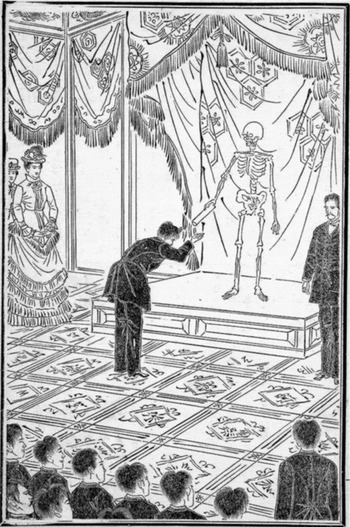
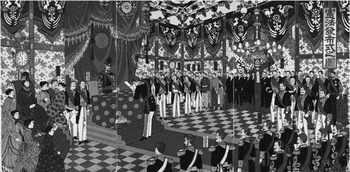
The 4 March 1889 edition of Gaikotsu's Tonchi kyōkai zasshi (Journal of the Society of Ready Wit) came out on the heels of the promulgation of the Imperial Constitution carrying a print of a naked skeleton on a raised dais handing down a set of ‘rules for study’ (kenpō, a homonym that could also mean ‘constitution’) to an awaiting commoner. The picture (Figures 1 and 2), a joint effort by Gaikotsu and the illustrator, Adachi Ginkō, carried the caption ‘Promulgation Ceremony for the Sharpening of Ready Wit Law’. Despite the dissimulating title, there was no mistaking the message of the black and white image. At the time of its appearance Japan was flooded with commemorative coloured illustrations of the Meiji emperor, in full western military regalia in an almost identical pose. The insulting print, in a magazine with a circulation in the thousands, angered officials who immediately halted its circulation and began preparing charges against Gaikotsu and the Journal of the Society of Ready Wit staff members for disruption of public order and lese majeste.
Promulgation Ceremony for the Sharpening of Ready Wit Law.

Meiji Constitution Promulgation Ceremony, nishiki-e or colour print of the Meiji Emperor bestowing the Constitution.
Source: MIT Visualizing Cultures Web Site, http://ocw.mit.edu/ans7870/21f/21f.027/throwing_off_asia_01/ [accessed 21 September 2010].

What angered officialdom was exactly what made Gaikotsu's satire so effective, namely its combination of unrestrained visual and verbal puns. Within days of the emperor's gift to his subjects, Gaikotsu confronted the central government and imperial institution declaring that he, Gaikotsu, whose self-adopted name meant skeleton, was as qualified as any emperor to come up with governing rules. The image itself depicted the Constitution as a dubious gift from the past presented from the dead hands of a naked emperor-like figure. The accompanying text also took actual articles from the Meiji Constitution and represented them but as if viewed in a distorting fun house mirror. As T. Fujitani notes:
. . . while Article II of the Meiji Constitution stated that ‘the Imperial Throne shall be succeeded to by Imperial descendants according to the provisions of the Imperial House Law,’ Miyatake [Gaikotsu's] Article II read, ‘The headship of the Society shall be succeeded to by Gaikotsu's descendants, as established by Dr. Scatterbrain (tonkyō hakase).Footnote 9
The cartoon, even without the mocking commentary, was guaranteed to inflame the authorities and start a fire under Gaikotsu's growing readership. And that was the point, for these intentionally inflammatory views were precisely those held by the then 23 year-old Gaikotsu. As he would write in Amerika-sama over a half-century later, he early on regarded the imperial mystification project as a bogus exercise carried out by members of the educated class to divide and control society. As for the new Meiji Constitution, he considered it more backward looking than progressive because it legally reinforced what he considered to be a basically unjust system that had been fabricated in the shadows like a magic trick on a massive scale.Footnote 10
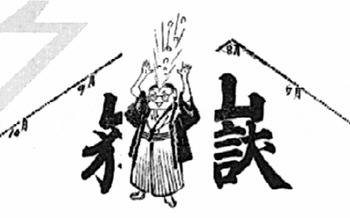
Gaikotsu in manga cartoons was often depicted with steam erupting from his ears or the top of his head (Figure 3). But if he was angry about the shape of Meiji politics, he was not puffed up with sombre moral outrage. His brand of journalism, radically playful and playfully radical, presented the entire system of emperor absolutism as a laughably silly pretension, albeit one with deadly serious social and political consequences. Regarding the emperor and his manner of speaking Gaikotsu observed, ‘Isn't his face just the same as the average human face? So why doesn't he speak in a reasonable manner?’Footnote 11 The inflated language that the emperor, court, and officials used to try to create distance between themselves and inferiors captured the hollowness of the effort and made a wonderfully burstable-target for Gaikotsu's satire.
Gaikotsu depicted as cartoon figure, circa 1900.

For his mocking of the emperor's constitutional charade Gaikotsu received an initial sentence of three years in prison and a 100 yen fine; the cartoonist Adachi received a one-year term. On appeal and reconsideration, a higher court decided that three years was not good enough for Gaikotsu so tacked on an extra month. Gaikotsu served every day of this term and appeared to value the experience as an opportunity for meditating on life and how it should be lived. His very lack of freedom liberated him from mundane concerns, but it did not seem to induce penitence of any kind whatsoever. He never appeared to engage in regretful ‘reflection’ (hansei) that often appears the point of punishment in Japan, whether administered by teachers, courtroom judges, prison officials, the media, or general public. Whether writing before or after the war, there is not the slightest whiff of regret for his alleged crimes. If anything, he came away from incarceration only more dedicated to living according to his own lights. He later reflected that ‘prison was a time of sincere happiness’. It provided a monkish existence that enabled Gaikotsu to study day and night, cultivate his spirit, and grow physically stronger thanks to the lean diet and the absence of sake that in normal circumstances played hell with his digestion.Footnote 12
More than the benefits of the prison regimen, he was grateful for the opportunity to spend time in jail because it clarified where he stood within a system of social controls. As he put it:
If it hadn't have been for that experience, I probably would have ended up simply as a straightforward optimistic and natural born muckraker—a moderately satirical journalist. Instead I went to prison. Thereafter I felt that I could not allow rule by those despotically arrogant bureaucrats. I had to put all my strength into fighting them through newspapers and magazines. There were just no extenuating circumstances that could keep me from using journalistic attacks to fight the nastiness of the factional bureaucrats and capitalists. Today, I from time to time seem to be known as some kind of eccentric holdover from the early modern era. But that eccentric quality was at least partially provided thanks to the Meiji state.Footnote 13
In Amerika-sama he also notes of his prison life that ‘in resisting another level of bureaucratic oppression, I was able to attain a new level of misanthropy’.Footnote 14 It was misanthropy not directed at humanity in general but precisely focused on society's authoritarian creators of oppressive myths, such as that of the imperial institution.
Gaikotsu temporarily muted his advocacy of democratization and demilitarization after his release from prison in 1896. Until 1898 he worked to re-establish himself financially in the Osaka publishing world. His first attempt failed spectacularly as he ran up debts of thousands of yen in trying to establish Japan's first mass circulation magazine dedicated to domestic antiques. Although he would later ironically call himself ‘half-American’, Gaikotsu at this time was seriously concerned that Japanese art objects were being lost to Americans and other foreign collectors as his compatriots rushed to faddishly embrace everything western. His attempt to fight the trend through publishing led to debts that anaemic sales of the antiques magazine failed to offset. When bills became impossible to pay, Gaikotsu simply fled to Taiwan where he worked on and off for the colonial newspaper, and even tried chicken farming in Taipei. He also kept his hand in publishing in Japan. While still interested in esoteric subjects such as antiques and preserving Japan's artistic heritage, he also contributed anonymously to publications dedicated to erotic prints (shunga) and accounts of the demimonde world (karyūkai).Footnote 15
Gaikotsu, with less than a yen in hand, slipped back into Japan in 1900. For several years thereafter he survived by peddling stone rubbings made in Taiwan, hawking newspaper advertising space, and other odd jobs. Thanks to funding from a rich and influential friend, he began to rebound dramatically in 1903 with publication of the Osaka-based Kokkei Shinbun (Humour News), his first in a series of wildly popular magazines dedicated to satire, sex, and challenging the prevailing political and social orthodoxy.
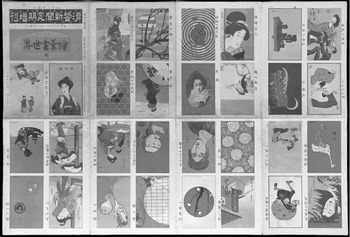
The magazine combined muckraking with sex and embedded in both striking visuals, drawings, prints, and even photographic covers to make its satirical points. During its eight years in print beginning in 1901, the small staff of writers and illustrators working under Gaikotsu's direct guidance took on fake medicines promoted as cures for tuberculosis, police extortion, and bribery of high officials. These were humorously skewered in articles that appeared alongside risqué drawings and photographs (Figure 4). The magazine's A-4 size, equivalent to a soft-back notebook somewhat smaller than an American newsweekly such as Time or Newsweek, was foldable and fitted easily in the hands. It was sold at major train stations, most notably Osaka's central Umeda Station, from which it was distributed far beyond the Kansai region. It became such a staple item that hawkers would include it in their call, ‘Bentō, milk, Kokkei Shinbun!’Footnote 16
Postcard supplement.

Gaikotsu's return to financial health also marked his return to political activism in support of socialism and suffrage expansion. With circulation of individual issues of Humour News reaching up to 80,000 readers and generating tens of thousands of yen in profits by the mid-1900s, he felt comfortable in channelling funds to socialist publications, such as the quickly banned Kassatsu (Life and Death, 1907) and the more resilient Heimin Shinbun (Commoners’ Press). During the late Meiji years he associated with Sakai Toshihiko, Ōsugi Sakae, Kōtoku Shūsui, and other anarchists and socialists. He was also connected with these groups, in the mind of the police authorities, who listed Gaikotsu among leftist ideologues requiring surveillance. Despite his place among those people ‘possessing dangerous thoughts,’ his devotion to publishing satirical forerunners to Japan's contemporary weekly magazines (shūkan-shi) enabled him to escape the heavier persecution suffered by advocates with narrower, more focused political programmes in support of anarchism and socialism.
This does not mean that Gaikotsu enjoyed any kind of special immunity from official harassment. Authorities repeatedly halted publication and distribution of Humour News and Gaikotsu and his staff paid fines on 16 different occasions during the life of this journal alone. He also remained on the Home Ministry's list of persons requiring surveillance from 1908 to 1915 and was re-listed periodically thereafter. To cope with routine harassment intended to destroy the financial capacity of a magazine company to publish, he retained consulting attorneys for his more successful publishing ventures. He benefited from legal defence teams headed by such famous lawyers as Hanai Takuzō, and the head of the Osaka Bar Association. But having a ready legal defence only partially explains Gaikotsu's ability to avoid the heavier penalties suffered by his fellow critics on the left. Given his unrestrained criticism of the state or its particular representatives, including individuals within the Home Ministry and the police apparatus, his long-term survival as a public figure is something of a mystery. Perhaps his success resulted from a combination of good timing and help from influential friends.Footnote 17
In the short term, however, he suffered from official harassment intended to silence his critiques of state power. After serving a three-year prison term for lese majeste, he was repeatedly jailed for short periods between 1904 and 1910 for articles that allegedly insulted public officials (for example, by explicitly naming police officials whom he asserted accepted bribes), contained sexually explicit language or images that were deemed injurious to public morals, or too plainly presented his democratic beliefs. The basis for this last offence can be seen in his essay, ‘Socialism and Me’, in the 28 February, 1910, issue of Osaka Kokkei Shinbun or Osaka Humour News.Footnote 18
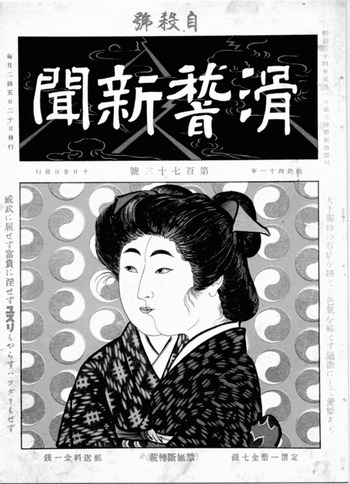
This new magazine was an incarnation of the old Humour News, established after the original published its ‘suicide edition’ in October 1908, an outcome prompted by constant official harassment and sabotage of the magazine's operations (Figure 5). In the final edition of Humour News, Gaikotsu wrote that, as with people so with magazines, all good things must come to an end. But in his ‘suicide note’, he also made clear that the Kokkei Shinbun was still a very good thing indeed. Despite unceasing official harassment that was prompting its demise, the magazine's circulation had never been higher and was still growing month after month. Gaikotsu compared it with a flower in robust full bloom, one that he would now cut rather than let go to seed. The suicide edition was as calculated as it was dramatic. Within days of its death, one of Gaikotsu's associates launched the new Osaka Humour Magazine that continued the original's satirical tone and basic format.Footnote 19
the cover of the Humour News “Suicide Edition”.

Nevertheless, the transition was more than a publicity stunt. Stepping away from running the popular weekly gave the ever restless Gaikotsu time to explore new publishing ventures and become more directly involved in politics. He partially clarified the nature of those politics in the aforementioned ‘Socialism and Me’ (Wagahai to shakai shugi). In this essay, he explained that the public and the authorities perceived him to be a socialist because he seemed to be lighting the socialists’ way with his publications and boosting socialism from behind (shiri oshi) by providing publishing support for the Osaka Commoners’ News (Osaka Heimin Shinbun). But, he declared, ‘I am absolutely not a socialist!’ because ‘extreme socialism, in other words anarchism or communism, is marvellous in theory but at bottom is impossible to practice’. What he advocated instead was adopting aspects of socialism that would make Japan's constitutional monarchy, ‘another philosophically splendid idea’, better by extirpating some of the evils currently plaguing the system.Footnote 20
After this temperate, if mildly sarcastic beginning, in modest proposal fashion Gaikotsu ripped into the present dismal state of politics and the utterly corrupt nature of Meiji politicians. He extended the indictment to party hacks, cabinet ministers, government bureaucrats, the oligarchs (genrō), and the aristocracy. He accused individuals within these groups of taking bribes, buying elections (in the case of party politicians), being concerned exclusively with their own fame and special interests, and living lives of wasteful luxury and sexual indulgence. As for Gaikotsu's angry comment on sexual indulgence, this does not arise from a narrow sexual morality. As his writings on sex make clear, he found all manner of sexual expression normal and healthy. What bothered him is that venality at the political top created harrowing economic conditions for the factory hands and farmers at society's bottom. The political leaders’ concern with self-enrichment and personal fame before all else had created a growing gap between rich and poor because the real work of governing was simply not being done.
What he advocated as a first step is precisely what American occupational authorities later promised to provide in 1945: Freedom of speech to point out the flaws in the current system and the removal of party politicians, political bureaucrats, the Privy Council, aristocrats, and all others associated with it. If these steps are not taken, Gaikotsu ominously suggested, the system will right itself by other means. The essay earned Gaikotsu another prison sentence, this time two months in jail for disrupting public order.Footnote 21 Again, he caught the attention of prosecutors by a critique that came too close to suggesting that the imperial institution and the politicians and bureaucrats dependent on the Meiji constitutional order might be replaced by some better system.
Gaikotsu's critique of Japan's military institutions was part and parcel of his condemnation of Japan's overall political system after the Russo-Japanese War. This was an undoubtedly popular war despite the high cost in blood and treasure. But Gaikotsu pressed his compatriots to consider what had been gained and what had been sacrificed. As he would make even more explicit in Amerika-sama in 1946, he saw Japan's prewar army and navy as artifices that did not provide social or political benefits, but simply enforced inequality and bogged the nation down in fruitless foreign entanglements. Part of what galled Gaikotsu was the puffed up arrogance of military leaders who benefited from the sacrifices of the poor and politically impotent who lacked voting rights to resist taking part in wars not of their making. He made this clear in publishing an essay in 1908 on ‘The Poor, the Rich, and War’, (‘Hinpu to sensō’) that argued that the poor were but instruments in fighting the battles of the rich. Gaikotsu was indicted for publishing the essay, but acquitted when the judge declared that the argument was not one that necessarily disturbed public order.Footnote 22
In Humour News Gaikotsu published the lyrics of the singer and songwriter Soeda Azembō's popular (and officially banned) ballad, ‘Socialist Bugle Song’ (Shakai rappa-bushi), to poetically make the same anti-military point in the context of wider social injustices:
From that hairpin adorning the locks of the nobleman's mistress
What so brilliantly shines?
Perhaps diamonds?
No, no
Just the greasy sweat from a darling peasant's head
Among those worldly gentleman who love their liquor
What so brilliantly sparkles?
Perhaps champagne?
No, no
Just the bloody tears from the darling factory girl's eyes
And decorating the jutting breasts of state ministers and generals
What so brightly glitters?
Maybe the Medal of the Golden Pheasant?
No, no
Just the whitened skulls of our darling soldier boys.Footnote 23
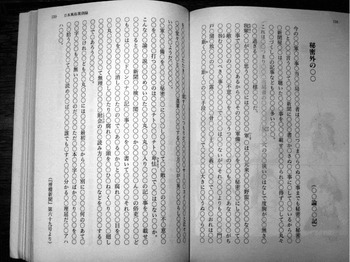
For Gaikotsu the burdens imposed by the military establishment were not just tragic, but also wasteful, delusion-inducing, and plainly stupid. He boldly made this argument in Humour News in the very midst of the Russo-Japanese War when he published a special page in seven issues of the magazine on ‘Japan-Russia News’ (‘Nichi-Ro Shinbun’). In this feature he fastened on issues large and small to make fun of the war fever that seemed to have swept Japan. In an essay in March 1904, he attacked the war machine and its penchant for suppressing the free flow of information and free speech in a clever verbal and visual presentation that mocked military censorship. The circles in the following excerpts represent words that have supposedly been blacked out by censors (and see Figure 6):
Today's 00 military 00 authorities 000000 have taken it upon 000000 themselves 000 to 000 classify as 000 secret 000 even the 0000000 least interesting 0000 news. What is 0000 classified 00000 as 0000000 secret 0000 cannot be written up 0000 in 00000 the press 0000 and 00000 what the journalist 00000 hears 00000 cannot 00000 run 0000 in 0000 the papers. As a result 00000 there are 00000 many 00000 articles 00000 loaded with 00000 black circles. Simply put 00000 this seems 00000 to be 00000 because 00000 the authorities are 0000 tight 0000 assholes 0000 short 00000 on 00000 nerve.Footnote 24
Gaikotsu concludes the essay by noting that, in war, a ‘barbaric’ pursuit by any standard, the authorities make all kinds of strained excuses supposedly to keep information from the enemy, but the real aim is to keep readers in the dark. But as anyone who can read between the black circles can see, the charade never really works.Footnote 25 It was a view he repeated thereafter and elaborated upon in the 1920s in discussions of militarism as ‘massive thievery’.Footnote 26
Gaikotsu's parody of censorship, “Beyond Secrecy. . . .”

After release from jail Gaikotsu returned to his campaign of criticizing the existing political scheme. He moved from words to deeds by actually running for a seat in the Lower House on two occasions, in 1915 and 1917. But these campaigns were more political performance art than serious attempts at becoming a politician. While continuing to point out what is wrong with the current electoral system, Gaikotsu did not come off as a genuinely viable candidate. The campaigns were, nonetheless, extremely popular with the public. In rallies in his second run, Gaikotsu charged admission (albeit the entrance was waived for journalists and the poor) and routinely sold out large halls filled to standing room only. The crowds came to listen to Gaikotsu and Itō Chiyū, a professional raconteur (kōdanka) and Gaikotsu's close friend since they had become acquainted in prison in 1890, give rousing speeches asserting that rival candidates took bribes, bought votes, and stood out for their stupidity and incompetence.Footnote 27
Gaikotsu and People-as-Foundation democracy (Minpon shugi): The Taishō past as postwar prologue
Gaikotsu's campaigning was a shrewd media attempt to shine light on corruption, but did not represent, except in a negative way, Gaikotsu's own core political beliefs. These values, advocating unfettered freedom of expression and uncompromising social equality, become clearer and positively expressed, as Gaikotsu became more deeply involved in campaigns for suffrage expansion and Yoshino Sakuzō's Japanese version of democracy (Minpon shugi or ‘people as the base-ism’). But it was not simply the intellectual strength of ideas that prompted Gaikotsu and his compatriots to turn to more direct political action. The 1918 rice riots, massive protests that in urban areas explicitly demanded a broadening in political participation, created an opening to implement democratic reforms.Footnote 28
The protests brought thousands of urban residents to the streets to hold ‘citizen's rallies’ that produced resolutions indicting rule by Prime Minister Terauchi's ‘transcendent cabinet’. In many cases attempts to suppress the rallies forced the protesters into the streets where they attacked police boxes, broke up or burned down the offices of major trading companies, ransacked rice wholesalers, and vandalized agencies that symbolized big government-big business collusion and suppression of commoners’ rights. The motives for these protests were mixed as were the targets of the protesters’ attacks. But in major urban protests, one message that was not complicated was that the massive uprisings, collectively, represented the possibility of moving from abstract arguments for wider popular political involvement to actual realization.
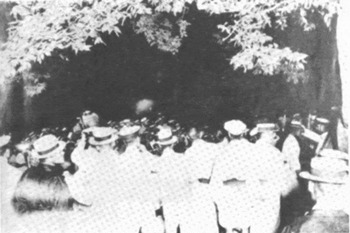
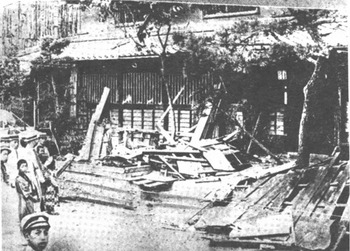
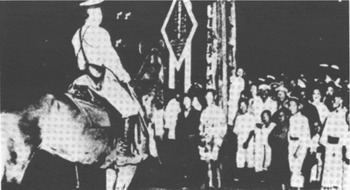
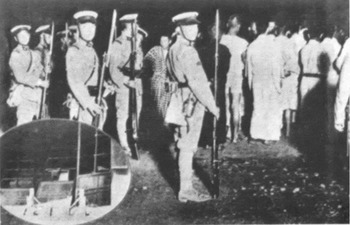
The message was not lost on Gaikotsu. As marches, vigils, speech rallies, and violent rioting spread from outlying fishing and farm villages into Osaka, Kyoto, and major cities in the Kansai region during late July and early August 1918, he decided to push things along in Tokyo by calling a citizens’ assembly to convene in Hibiya Park in the very heart of the nation's capital. The advertisement for the rally, an advertisement openly paid for by Gaikotsu which carried his name, appeared in the Tokyo Asahi Shinbun on 10 August, 1918, and immediately brought the police to his home demanding a retraction. They also placed him under house-arrest to prevent his appearance in the park. In the end, the retraction did not appear in the Asahi and, despite Gaikotsu's absence and the lack of any kind of formal programme, a range of speakers, from factory workers to political organizers, spontaneously mounted the park's bandstand to address thousands of Tokyoites gathered at Hibiya on 14 August. The impromptu speeches excoriated the despotic actions of the Terauchi government and the collusion of interests that kept workers and their families impoverished while big companies prospered. At last the police moved in to shut down the rally, but the attempts at suppression only pushed the crowd into the streets. Thus began several days of rioting in Tokyo that resulted in widespread property destruction, injuries, and the imposition of martial law (see Figures 7, 8, 9 and 10).Footnote 29
Citizens' rally in Hibiya Park, Tokyo, 13 August 1918.

The Heishinkan real estate agency in the aftermath of the Kobe city riots, August 1918.

Mounted military police (kenpeitai) confront protesters during the Nagoya city riots, August 1918.

Infantry troops mobilized for riot suppression in Kyoto, 12 August, 1918.

Gaikotsu's direct participation in mass rallies continued, albeit in more peaceful circumstances, after the 1918 riots. In January 1919, he attended a Reimei-kai or New Dawn Society rally for suffrage expansion at the invitation of the liberal economist, Fukuda Tokuzō. In 1918, Fukuda, along with Yoshino Sakuzō, professor of politics at the Tokyo Imperial University, established the group with the aim of creating an organization to promote wider political participation and check despotism in accord with postwar Wilsonian democratic principles. At the 1919 Dawn Society rally, Fukuda introduced Gaikotsu to Yoshino, the originator of ‘People-as-Foundation democracy’.
Unlikely as it may have been, the two men from greatly different backgrounds and experiences (one an outsider journalist infamous for both socialist politics and pornography and the other a liberal professor and insider at the nation's most prestigious national university), ‘hit it off’ immediately. From this time forward they became lifelong friends who shared near-familial connections through the marriage of Gaikotsu's adopted daughter to Yoshino's younger brother. But more than family ties, it was their shared ideas about democracy that formed the original basis for their collaborative work. Gaikotsu joined Yoshino in rallies for expanded political participation and spoke on his own for suffrage expansion at mass gatherings in Hibiya Park. He also attempted to do for People-as-Foundation democracy what he had earlier attempted to do for socialists in Osaka, namely, provide a journalistic voice to engage more deeply a mass audience in support of the movement.
In March 1919 Gaikotsu published the first issue of the magazine Democracy, the intended organ for a new political party, the Democratic Party (Minpon-tō) (see Figure 11).Footnote 30 As it turned out, the first edition was the last. Gaikotsu decided that he could not afford to publish future issues after sales of the inaugural edition were banned, extant issues confiscated, and the Head of the Police Bureau strongly hinted that future issues would face the same fate.Footnote 31 Added to the likelihood of ongoing official repression, a more fundamental problem came about when the Home Ministry rejected the application to form a new party. The official prohibition of party organization came down after the first edition had appeared and in effect took away the political organization that the journal Democracy had been created to support. Although the journal was short-lived, it provided a clear expression of the ongoing discourse on political reform alongside practical plans for democratic liberalization. The magazine's articles by Japanese political and economic thinkers were also prescient in their advocacy of the fundamental political and social transformation that would later be implemented by American occupation forces in 1945.
the cover of Democracy, March 1919.

The concept of grassroots engagement was central to both prewar and postwar Japanese democracy. To harness the popular energy so evident in the rice riots and other mass actions, Gaikotsu realized the importance of direct communication with his audience. His previous experience in publishing weekly magazines that combined humour, salaciousness, and political muckraking had proved to be a personally enriching formula that suggested an excellent route for engaging the wider public in a nascent political campaign. This strategy was prominently and explicitly stated on the inside cover of Democracy in a section titled, ‘This Journal's Fundamental Principles’:
This journal avoids rarefied expression in favour of the common and conventional to make it easy for the multitude of citizens to understand. In selecting articles, this journal places the emphasis on practical problems instead of philosophical issues or research theory.Footnote 32
The medium was declared on the inside cover; the remainder of the journal's contents concentrated on the message. Focus was on outlining the aims of the Democratic Party and explicating concepts basic to democratic reform. As promised in the opening ‘Fundamental Principles’, the theory was clearly expressed and easy to understand. It also appeared alongside specific reforms, some quite detailed, that promised to broaden political freedoms and assure economic rights.
The selection of these themes was no accident. The end of World War I, the fall of Imperial Germany, and the explosion of protests for popular rights and leftists movements internationally suggested that a global opportunity for fundamental political change had finally arrived. At home, the rice riots underlined the demand that economic or ‘livelihood rights’ were inseparable from more abstract political freedoms. Gaikotsu took this post-1918 era, one marked by the Allied victory, as providing a new opportunity to reset both the domestic and international political agendas, an approach he would take after 1945 to describe a postwar period of new possibilities after World War II.
The Democratic Party's international policies might have been drafted by MacArthur as he contemplated Japan as a nation that would forever foreswear the use of military force. In the ‘Democratic Party Platform’, the end of the Great War is seen as a fresh beginning, bringing an era of ‘eternal peace’:
In accord with global trends, we will establish eternal peace founded on justice and human morality. We will abolish militarism and expansionism. We shall work to create a volunteer army. We shall grant the right of self-rule to peoples of different ethnicity within Japanese territory.Footnote 33
This plank had long been a part of Gaikotsu's advocacy of equal rights and equal duties for all citizens, an end to military conscription, and self-determination for all nations. In a complementary article, the journalist Ōba Kakō, provided the specifics for a military force that would be part-time and voluntary. He replaced compulsory service with the principle of ‘free labour for military men’ and argued that the ideal situation would be to demand no more than a six-hour working day for active duty personnel, after which they could spend a maximum of three hours in other employment. They would not be required to wear military uniforms or bear weapons during their time spent outside the base so would not stand out as a special or especially intimidating group. Ōba argued that this would be far healthier than the existing draft system that took young men in their prime and isolated them from society for two years with nothing but a steady round of military drills. The system provided nothing of benefit to society but fed the militarism that had appeared so thoroughly discredited by the German collapse.Footnote 34
The ‘Democratic Party's Platform’ called for similarly sweeping reforms in areas that bore exclusively on the domestic political order. These again reflected the escalation of demands for broader political rights evident in Japan especially since the promulgation of the Japanese constitution in 1889. They also mirrored the distinctive tenor of postwar times in combining demands for abstract rights with improvements in the material quality of citizens’ lives. The macro-level benefit brought by the wartime boom, generated by a strong increase in industrial orders and corporate profitability, had been offset by the micro-level loss in workers’ real wages caused by rampant inflation and a regressive tax policy. The growing gap between the nouveau riche (narikin) and the urban poor had contributed to rice riots and demands voiced at citizens’ rallies for the gap to be closed.
The starting point for all domestic reforms was universal suffrage for both men and women. The ‘Platform’ mandated that: ‘All men and women above the age of twenty and free of mental defect shall have the right to vote for representatives and public servants (today's bureaucratic officials) and to stand for election to these offices’.Footnote 35 In dismantling the system of central appointments, the new party also advocated that every prefectural governor, district head (gun-chō), and all other officials—without exception—be publicly elected. To prevent abuses of power, all elected officials might also face recall and dismissal from office based on a majority-vote mandate.Footnote 36 To understand the people's will, a government organized by the Democratic Party would assure that the ‘. . . rights of free speech, assembly, and association shall be recognized’.Footnote 37 Existing laws, such as the Newspaper Law, a measure that allowed the state to hobble the freedom of the press by banning distribution and requiring monetary fees and compulsory registration, would be abolished. Likewise, the Peace Police Law that regulated and often banned political rallies would be rescinded. Labour unions would also be permitted and the right to orderly strikes recognized. In replacing repressive laws, a new legal code would guarantee impartial respect for the legal rights of all citizens. Artificially created classes of aristocrats would be eliminated and neither they nor the rich would be above the law. In adjudicating disputes, the jury system would be instituted to effect the principle of legal equality.Footnote 38
Gaikotsu and the drafters of the ‘Platform’ realized that promises of expanded freedoms would have little chance of realization without improvement in the economic basis of daily life. During the rice riots a new expression that called for ‘livelihood rights’ (seikatsu-ken) was voiced by speakers at mass rallies and appeared to be even more important than demands for expanded political freedoms. It was a theme taken up by editorial writers and social commentators thereafter and had a prominent place as the second major plank in the ‘Platform’. In this provision, the party organizers asserted that ‘We seek to insure the right of the people's livelihood as inviolable. . . .’ They proposed to accomplish this by setting a workers’ minimum wage and fixing a maximum tenancy rate for farmers. In addition, the platform's drafters proposed that the state shoulder the responsibility for social relief for the handicapped, infirm, orphaned, and aged.Footnote 39
The ‘Platform’ also discussed how economic stability might be maintained and considered how taxes could be raised to support ‘livelihood rights’. To assure equal access to the nation's staple, domestically grown rice, the Democratic Party would establish price controls to fix the maximum price on this commodity. The party also proposed additional price controls for other essential goods. To equalize the taxation system, the ‘Platform’ called for eliminating all indirect and consumer taxes (taxes on luxury goods excepted) and replacing these with a graduated income tax. This would abolish all indirect levies on salt, sugar, tobacco, soy sauce, kerosene, woven goods, and transit duties; in other words, all regressive taxes on the general population would be eliminated. Of course, squeezing the rich would not begin to pay for the guarantee of ‘livelihood rights’ promised by the party's founders. To cover the shortfall, they therefore proposed ‘gradually’ moving to ‘nationalize land and the means of production’.Footnote 40
With regard to nationalization, Gaikotsu's idea of democracy clearly had more in common with socialism than with Yoshino's People-as-Foundation democracy. But it also foreshadowed some of the fundamental reforms introduced during the post-1945 years of occupation. Although farmland was not nationalized after 1945, ownership was effectively reformed in a land-to-tiller programme that eliminated the dominant agrarian landlord class and virtually ended exploitative tenancy. Likewise, the postwar dissolution of the prewar zaibatsu worked a fundamental change that diluted corporate ownership, although the later formation of conglomerates (keiretsu) amounted to a retreat from a change that might have been as significantly transforming as the land reform programme.
Other changes recommended in Democracy were later made mandatory in MacArthur's Constitution. Article 9, the no-war clause, had appeared in 1919 in the form of the Democratic Party's advocacy to put an end to militarism and expansionism, and the Japanese state's recognition of the autonomy of regional neighbours. Likewise the party's platform in 1919 presaged the 1946 constitution's assurance of fundamental human rights, the elimination of the peerage, and the institution of universal suffrage for men and women, and a guarantee of freedom of speech and assembly, expressed in Articles 11, 14, 15, and 21. Even ‘livelihood rights’, a provision only vaguely supported in the American Constitution's promise to ‘promote the general welfare,’ appeared in a form that more closely matched the concrete recommendations in the ‘Platform’. Articles 25, 26, 27, and 28 echoed the changes recommended in 1919 that would require the state to provide social welfare and public health, free education, fix minimum wages, and allow free unionization and collective bargaining. In fact, most of the reforms which Gaikotsu and his colleagues had recommended, from making all local offices elected posts to elimination of the conscription system, found expression in SCAP-mandated reforms and the Constitution revision carried out by the American occupiers. In 1919, however, there was no external force to ram through these changes. It therefore proved easy for the Home Ministry to bottle up Gaikotsu's and his colleagues’ recommendations for political reform by ordering an immediate halt to the distribution of the first and last issue of Democracy.Footnote 41
Peace dividends and wartime responsibility
In 1945, the Ministry of Home Affairs continued to exist in form, but the political purge directed by MacArthur's Supreme Command Allied Powers (SCAP) had begun to remove officials who were resistant to reform. This shift made the democratization and demilitarization that Gaikotsu had advocated before war's end suddenly appear possible. On 10 September, 1945, MacArthur issued a first directive on civil liberties that opened a way for Gaikotsu to express thoughts long bottled-up during the war years. The directive's second point reads:
The supreme commander [sic] for the Allied Powers has decreed that there shall be absolute minimum restrictions upon freedom of speech. Freedom of discussion of matters affecting the future of Japan is encouraged by the Allied Powers, unless such discussion is harmful to the efforts of Japan to emerge from defeat as a new nation entitled to take a place among the peace-loving nations of the world.Footnote 42
Although some of the directive's other clauses prohibited criticism of the Allied Powers, this message fostered an environment that encouraged Gaikotsu to criticize the past and, once again, propose new ideas for the future. By the spring of 1946, he had readied Amerika-sama for publication and was eager to give his views of the dramatic change in the nation's prospects by contrasting these new possibilities with what had seemed unassailable just a few months before. The advertisement for the seventy-page essay first appeared in the Tokyo Asahi Shinbun, one of the city's major daily newspapers, next to the ‘Tensei jingo’ (the perennially popular Vox Populi) column on 23 April, 1946. It proclaimed that the new publication marked ‘the eighty year-old gentleman's rejuvenation’ and was ‘a chronicle to welcome the new era of bloodless revolution’. The initial run of 5,000 copies that went on sale from 3 May quickly sold out.
Gaikotsu introduction in Amerika-sama finds the silver lining in defeat. It merits quoting at length, for it also broaches the issue of responsibility for the war which had just ended:
The bureaucrats and the zaibatsu combined to spur the reckless ambitions of the militarists, and those militarists have destroyed our country. Yet, the result today is that military defeat has made Japan a tremendously fortunate nation and brought our people great happiness. If by a one in a million chance our side had won, the militarists’ overbearing attitudes and actions would have known no bounds. The same would have extended to the bureaucrats and zaibatsu. Together they would have been insufferably arrogant. But it is not just a question of attitude, of course. Popular oppression would have grown. The Japanese people would have had to forebear their posturing, the shoulders jutting into the wind, the strutting about rattling sabres. Atop all of this, we would have been compelled to bear increased military conscription and multiplying military expenditure as well as support the wild ambition of forcing ‘eight corners of the world under a single roof’. We would have had to plan and carry forward expansionism and territorial aggrandizement.Footnote 43
Although the war had just ended and few in devastated Japan could foresee an immediate peace dividend, or the benefits that decades later would be derided as the undeserved fruits of a ‘free rider’ nation, Gaikotsu was clear that the end of wartime waste and thievery would facilitate an immediate improvement. He detailed the benefits by pointing out that demilitarization meant that no longer would 80 per cent of national taxes be required for military spending. Demobilization and demilitarization also meant the end of the army's and navy's ability to hold citizens in their thrall. The military bureaucracy would be eliminated and with it the need for munitions plants, military bases, and naval ports. No longer would the lives of countless thousands of young men (people in their prime from the families of farmers, craftsmen, and entrepreneurs) be squandered for unproductive military purposes.Footnote 44
At the end of this litany of benefits found in defeat, Gaikotsu declared, ‘Namu Amerika-sama!’ By using a phrase similar to those widely used to express reverence for Buddhas and bodhisattvas, he urged all Japanese people to appreciate the great benefactor in a manner befitting the sudden deus ex machina reversal of fortune that was transforming Japan.
In looking for silver linings in the dark state of Japan in early 1946, Gaikotsu did not neglect assessing responsibility for the war and the resulting national disaster. A history lesson accompanied the celebration of the American occupiers’ transformative power to democratize and demilitarize. It sought to ascertain causes in an autopsy-like fashion so as to assure no recurrence of the militaristic disease that wrought such widespread suffering. In setting out responsibility, Gaikotsu touched on such issues as the raping of civilian women, atrocities in China, and abuse of POWs. All of these would later become lingering controversies frustrating Japan's return to the status of a ‘normal nation’.Footnote 45 But his primary focus was on what had happened within Japan and the active agents who had made it happen. He found that formal political responsibility rested with the central government's political leaders, party officials and bureaucrats, and the military. Yet, responsibility went beyond just officialdom. In Gaikotsu's view, it could also be found in four specific groups and individual representative members from the press, big business, opinion-makers, and publishers.
As an innovative publisher and media entrepreneur himself, Gaikotsu found it impossible to forgive Japan's largest newspaper companies, the Asahi, Mainichi, and Yomiuri, and to a lesser extent the Keizai Shinbun Company, for the powerful role they played in supporting the 15-year war. He accused them of willingly propagating the ‘national unity’ (kyokoku itchi) and ‘a hundred million hearts as one’ (ichioku isshin) propaganda that put self-sacrifice before all else, including individual morality and freedom of speech.Footnote 46 Although defenders of the mainstream press might claim that they could do nothing other than comply with wartime press restrictions, Gaikotsu saw this as a weak argument that failed to capture the Japanese fifth estate's genuine enthusiastic and persistent support for war. He condemned the willingness to follow the official wartime line, not because it was false but because it held a powerful sway over the public's perception of the war that was lost before it began, and by misleading citizens about Japan's grim course even when it became obvious that the struggle was futile. He was particularly animated by newspaper owners like Shōriki Matsutarō, head of the Yomiuri newspaper company, recommending that he should be tried as a war criminal for his incitement of war fever. For a time it appeared that this might actually come about when MacArthur added Shōriki to the list of war criminals and had him briefly imprisoned. In the end, however, he never came to trial and, during the Occupation, was able to regain control of his powerful publishing and sports empire. In this respect, he appreciated his return to freedom and the new political situation in which his enterprise now existed, and his flagship newspaper soon adopted editorial positions that endorsed conservative politics and close US-Japan ties.Footnote 47
Gaikotsu's recommendations for zaibatsu dissolution, as with his advocacy for press reform, were only partially reflected in the policies which SCAP independently planned and carried out. In Amerika-sama Gaikotsu argued that Mitsui, Mitsubishi, and Yasuda had worked closely with the bureaucrats and militarists in pursuing a reckless war and that the only possible reform was to see these conglomerates completely broken up. He accused the companies and their directors of lacking any kind of moral compass aside from seeking profits and that their amorality had helped create an unprecedented tragedy for the Japanese people. He pointed the hollowness at the core of these companies by citing Mitsui's attempt to cheat even the Japanese military by procuring goods from enemy forces in the midst of fighting in China.Footnote 48
As capital was the root of the zaibatsu evil, he advocated confiscating zaibatsu assets and letting them ‘wither away’, starved of financial resources. It was a position that was also evident in SCAP rhetoric, although by the late 1940s Cold War exigencies made it one that Washington no longer considered to be viable as international Realpolitik. Gaikotsu's prescription insisted that government bureaucrats could not be allowed to oversee the dissolution. The likelihood of collusion that would protect big business interests meant that the reform should be carried out by a new genuinely democratic government that had no history of being beholden to the exploitative prewar zaibatsu. This meant ‘nothing other than relying on the methods of the socialists and communists that rejected capitalism’.Footnote 49 In this recommendation for remaking the business world, he broke with his prewar view that socialism or communism were systems that were theoretically ideal but totally impractical.Footnote 50
Although Gaikotsu did not name names in his recommendations for the zaibatsu, he had no similar compunctions when it came to indicting opinion-makers for their role in creating a national war fever. He was particularly keen on seeing justice meted out to Miyake Setsurei and Tokutomi Sohō. In 1888, the year before Gaikotsu went to prison for lese majeste, Miyake had already begun to advocate the special nature of Japanese nationalism and the need to expand the nation's influence in Asia. As a journalist and leading thinker among those who sought to challenge Western imperialism by asserting Japan's regional leadership, Miyake organized the Society for Political Education (Seikyōsha) and oversaw its mass publications Nihonjin (The Japanese) and its later incarnations as Ajia (Asia, 1891) and Nihon oyobi Nihonjin (Japan and the Japanese, 1907). This last publication, which stayed in print for decades up to 1944, gave intellectual justification and respectability to what Gaikotsu considered an ideology that made for rape, pillage, and death. He particularly disliked Miyake's enthusiasm for the navy's ‘southern advance’ into the South Sea Islands. In recounting the brutality of Japanese troops toward local women in colonial and war zones, he noted that the modern history of such barbarity could be tracked back to Japanese intervention in these Pacific islands.Footnote 51
Miyake died in 1945 while Gaikotsu was in the midst of writing Amerika-sama. The death perhaps accounts for Gaikotsu's cutting short his criticism of an enemy no longer on the field. Tokutomi Sohō, however, was still around safely enjoying his last years in retirement in his retreat at the Atami hot springs resort. Of Tokutomi, Gaikotsu wrote, ‘He is the man I despise above all others’.Footnote 52
Gaikotsu's bitterness towards Tokutomi had a long history. Intermittently since the 1890s, he had criticized Tokutomi's role as a government publicist and propagandist. In Omoshiroi hanbun (Half in Jest) and Kōshi geppō (Public and Private Monthly), two of Gaikotsu's most popular publications, he mocked Tokutomi's transformation of The People's Friend (Kokumin no tomo) and other publications into little more than organs for expressing the views of oligarchs such as Yamagata Aritomo. Tokutomi played a similar role as semi-official propagandist for Japanese adventures overseas. Following the annexation of Korea, he established a Japanese daily newspaper, the Keijō Nippō, in Seoul in 1910, to provide all the news permitted by the Japanese colonial administration. He had also headed various patriotic literary associations and for such services to the state had received the Order of Culture in 1943.
In short, Tokutomi combined in his single career much of what Gaikotsu found profoundly objectionable in the relationship between the journalist and the state. Gaikotsu specifically cites Tokutomi's crimes of wielding wide influence through mass publications and using this power to limit free speech. He also noted that he had become a parasitic promoter of the baseless imperial system and its ideology that enforced destructive lese majeste laws at home and brutal wars abroad. This Tokutomi had accomplished by slandering Japan's wartime enemies by understating their strengths and thereby prolonging sacrifices that had produced nothing. Gaikotsu concludes his list of Tokutomi's crimes by declaring that the latter's 21 February, 1945, editorial in the Mainichi, a call for the nation's children to rise up and sacrifice themselves for the emperor, alone merited the death penalty. Given such feelings, it is not surprising that in settling accounts Gaikotsu comments, ‘The fact that Amerika-sama [sic] has issued an arrest order for this Sohō as a war criminal is a cause for a good deal of my recent happiness’.Footnote 53
Gaikotsu also condemned, albeit to an outer ring of hell, Japan's major mass media publishers, Kōdansha (a major publisher of books and periodicals), Shufu no tomo sha (best know for the periodical, Housewife's Friend), and Bungei Bunshū sha (a publisher of magazines and journals aimed at middle-brow and a higher reading audience). He deemed magazines such as Kodansha's Kōdan Club (Story Club) as liable for postwar prosecution for whipping up extreme nationalism and creating all kinds of popular humbug about the world beyond Japan's borders. He equated some of the directors of these firms as no better than ‘profiteers’ deserving to be treated as war criminals. He expected the occupation authority to impose sanctions that would force the companies out of business.Footnote 54 This did not go according to his predictions, but as with the nation's major newspapers, the leading magazine and book publishers soon embraced new editorial policies that promoted SCAP-approved democracy and opposed everything deemed feudalistic.
And what of the emperor's responsibility for the war? Although Gaikotsu and many others had suffered directly under the lese majeste laws and judged manipulation of the imperial myth to be the root cause of Japan's destruction, he did not hold the Shōwa emperor personally responsible. His comparative generosity on this issue stemmed from two reasons.
Gaikotsu first of all did not wish to make the abstraction of the imperial political institution any more important than it already was by prosecuting an actual person. As he wrote in Amerika-sama, the imperial institution and its supporting agencies, including the Privy Council, continued to be viable. In fact, all of the Japanese government's early postwar official drafts of a new postwar constitution were uniform in rejecting any change in the emperor's political position as sacrosanct and fundamental to the nation's national polity. The key drafters of these early versions presented the possibility of passively and actively resisting fundamental changes in the emperor-centred structure. Major drafts proposed leaving the Meiji Imperial Constitution largely intact and changing it through interpretation and application.
This kind of half-way reform was an anathema to Gaikotsu. He had always considered the emperor no more than a person, one descended not from the gods but, according to evolutionary theory, from the same simian ancestors as everyone else. To place ultimate responsibility for the war on him would be to give added credence to the notion of his divinity, which Gaikotsu consistently deemed laughable. More practically, it might give forces keen on preserving the imperial institution a powerful symbol around which resistance to real reforms might be built. Gaikotsu's recommendations for the future of the Imperial house agreed with that of the former Ambassador to Japan, Joseph C. Grew, MacArthur, and other SCAP policymakers, who saw making the person of the emperor a martyr as a counterproductive step that would only sow the seeds of resistance to fundamental political and social reform.
Gaikotsu's second but no less important reason for his recommendation of leniency towards the emperor was his insistence that the Japanese people generally take responsibility for the war and what it had wrought. In Amerika-sama, Gaikotsu endeavours to pinpoint groups and individuals within society that had led the war effort. Yet at the end of his essay, he emphasizes a shared national responsibility for the war. Yes, the bureaucrats, militarists, zaibatsu, propagandists, and even the emperor had pivotal roles in creating, mythologizing, and enforcing the prewar system. Yet people from all walks of life not only acquiesced but enthusiastically supported the war effort. Gaikotsu simply could not allow the emperor to become the sacred scapegoat whose blood would wash away the wider responsibility for the war. In his eyes, there were few if any ‘good Japanese’ free of war-guilt.
This view was at odds with others who had suffered alongside Gaikotsu in advocating free speech and free political association in prewar Japan. It was also strenuously opposed by the Japan Communist Party (JCP). In an article in the 13 February, 1946 Asahi Shinbun, JCP leader Nosaka Sanzō demanded that the emperor bear full responsibility for the war. The Shōwa Emperor had already renounced any claim to divinity in an earlier announcement carried in all the newspapers on New Year's Day 1946, but Nosaka deemed this insufficient, given that the emperor was as guilty as the military establishment that had carried out imperial policies.Footnote 55
Gaikotsu responded directly to Nosaka's advocacy by pointing out the need to make a distinction between a tool and the evil or good uses to which it might be put. After all, the imperial institution itself was a fabricated centre of spirituality, constructed in its present form only since the Meiji Restoration.Footnote 56 It had been used since the late-nineteenth century to suppress free speech, destroy careers, and even execute opponents who were perceived as threats to its Oz-like façade of ineffable power. But to execute the little man behind the pretence would only give the structure more importance than it deserved.
Gaikotsu countered demands that the emperor be treated as a war criminal by arguing that the disposition of the monarchy be one of the first democratic acts of a newly and thoroughly enfranchised public. The people, and only the people, should be allowed to decide if the imperial institution should continue. Political bureaucrats, those who had cultivated and manipulated the prewar imperial mystique, must be kept completely out of the decision. Although Gaikotsu himself had served ‘nearly five years in prison’ for lese majeste-related crimes, he did not side with those calling for the emperor to be treated on the same basis as military leaders open to accusations of war crimes. In fact, he advocated that, if the popular vote decided that the imperial institution should be removed from government, he hoped it would still continue to exist.Footnote 57 But he was equally firm in arguing against the mystification of the emperor and creating a gap that made him separate and above the people.Footnote 58 Church and state must be made separate, and even holidays, if originating in fabricated imperial holy days, must be replaced by others arising from genuinely popular traditions or out of secular consideration for the public's need for rest and recreation.Footnote 59
In categorizing the various camps and their positions on the fate of the emperor and the emerging constitutional order, Herbert Bix has observed:
Up to 1947 the real constitutional quarrel in occupied Japan had pitted supporters of the kokutai, centred on the court group and old guard politicians, against a small number of Japanese reformers who wanted a ceremonial monarchy and a genuine civil society but laced the political power to achieve those goals on their own. Thanks to GHQ, the reformers won, leaving the extremes of the debate isolated: Communists on the left and die-hard protectors of the kokutai [distinctly Japanese national polity] on the right. . . .Footnote 60
According to this categorization, Gaikotsu and the GHQ were in the mainstream regarding what should become of the imperial institution. For Bix, this outcome was decidedly a cup half-empty, in that it left the emperor on the throne, ‘. . . unindicted, unrepentant, and protected as well as crippled by the new constitution’.Footnote 61 Gaikotsu appeared to have no such reservations as long as the imperial institution was stripped of any real political power then it could pose no threat of the kind that had led to despotism, expansionism, and wartime devastation.
Conclusion: brilliance and blind spots
Gaikotsu possessed a remarkably clear vision of Japan's past and future. He did not view the country as emerging from a ‘dark valley’ at the end of 1945 nor did he see it heading towards an untroubled future thereafter. To suggest that there was a ‘dark valley’ meant that the Meiji Imperial Constitution was a good start that had somehow fallen into a deep crevice that led to dictatorship at home and aggression abroad and away from the upward path of a ‘normal’ democratic country. For Gaikotsu, the beginning was as bad as the end. For that reason he had attempted during the Taishō years to change the course set by the Meiji constitutional order by organizing a new political party, one that put democracy first. The recommendations in Democracy resulted from his direct experience of living under the Meiji political and legal order. He recommended changes tantamount to rewriting the Meiji Constitution of 1889 because what developed from that system was inherent in its origins. In other words, the constitution was a peculiar seed, one tended by self-interested bureaucrats and militarists and protected by a fabricated irrational myth, capable of producing only one kind of fruit. Thanks to American occupiers, this old system was now being uprooted. But the destruction of the old was not enough. A new system would thrive only if it were based on free speech, an assumption of basic human equality, broad political participation, and the end of Japan's war-making capacity—changes he advocated as ardently in 1945 as he had in 1919.Footnote 62
To finally realize these ends, Gaikotsu came up with two lists recommending what should be abolished and what should be reformed. Alongside political bureaucrats, militarists, and zaibatsu, he placed the peerage system, House of Peers, inheritance laws, and Privy Council, on his list for elimination. Abolishing the system of the hereditary elite, and wealth-inheritance laws that protected their property, was a basic step. After that it would be necessary to remove specific institutions, such as the Privy Council that manipulated the imperial myth for partisan and extra-legal purposes. According to Gaikotsu's recommendations, all laws relating to religious rites, in other words those that compromised the divides separating religion, the state, and the imperial institution, would also be necessary.Footnote 63
His list for reform contained only a single item: the constitution. His recommendation actually went beyond reform in the sense that it called for virtually abolishing the fundamentally flawed document that had governed Japan up to 1945. He had mocked its ideological basis when it had been promulgated in 1889 and he called for its complete renovation now. For Gaikotsu, the constitution ‘is the first and most important law’. It would provide the basis for freedom of speech and safeguards against the return of the people and processes responsible for the prewar emperor system. Gaikotsu was not, of course, among those advising the writers of the postwar constitution. Nevertheless, most of what he recommended actually appeared in the final document which was formally adopted in 1947.
Of course many of the ideas he advocated were in the air in the flurry of popular and press debate about how to reshape a new political world. But there is no denying that Gaikotsu had his fingers on the pulse of what many of his fellow citizens wanted in the way of a demilitarized and democratic society. The longevity of the ‘MacArthur Constitution’ attests to this. Although political professionals, in the bureaucracy and the organized parties, spoke of it as ‘reeking of butter,’ not only in its un-Japanese syntax but in many of its liberal ideas, the Japanese people embraced the document and have not yet amended a single word, despite repeated and continuing attempts by conservatives to do so.
He exerted his support of a liberal constitution from outside the activities of postwar organized parties. During the first decade of the postwar period, one that overlapped with the last decade of his life, Gaikotsu was aged, and often sick. But it was not only his advanced age, 88 at the time of his death in 1955, that kept him from a more direct role in organized politics, he also tended to be dismissed by some leftist political commentators who saw him as an old guard humanitarian without a strong understanding of ‘scientific Marxism’. He was judged to have engaged in a kind of ‘epochal heroism,’ that was closer to anarchism or anarcho-syndicalism than proper socialism based on a Russian model. During his last years, Gaikotsu was considered a lion in winter from a dwindling pack of prewar activists whose individualism combined with a love of Japanese culture to prevent them from advocating more than a brand of ‘tepid socialism’ (bion-teki).Footnote 64 He was, however, given high marks by socialist commentators for foreseeing as early as 1911 the rise of militarists to a dominant position in Japanese politics and the danger of the Tokkō secret police force as a force for domestic repression.Footnote 65
The partisan estimation by political professionals did not diminish the wider public's appreciation of Gaikotsu's clarity about what needed to be done, and how the political system might work now that war was over, is remarkable. But neither Gaikotsu nor anyone else writing in 1945 and 1946 could accurately foretell even the immediate future. Given the many unpredictable factors arising from the international tensions between America and the nations perceived as being part of a unitary communist bloc, little could be said with absolute certainty, perhaps aside from the obvious observation that Japan's place in the new international alignments would not be a primary concern of American Realpolitik.
Some shifts came earlier than expected. Gaikotsu, for example, was particularly surprised by the crackdown on labour beginning with MacArthur's banning of a general strike on 31 January, 1947, and the steps leading to the purge of communists from government by 1950. Although he had always doubted the workability of leftist economic ideas and disagreed with the JCP's demand that the Shōwa emperor take personal responsibility for the war, he could hardly have welcomed SCAP-directed actions against the left. These were far too reminiscent of the policies of the old prewar Japanese government.Footnote 66
In Amerika-sama, Gaikotsu expressed his clear awareness of the likelihood of problems born of America's disproportionate influence on Japanese social, economic, and military policies. His joy at being ‘half-American’ pointed up the unresolved problem of Japanese sovereignty. From his standpoint, the territory of Japan existed as did Japanese people, but he also pondered how they could claim any significance if their ‘political autonomy is gone?’.Footnote 67 He did not answer this question, but did argue that there are steps the Japanese people must take for themselves if their national existence is to have any meaning. While welcoming to various degrees the American occupiers’ power to reform the political bureaucrats, militarists, zaibatsu, and outlying supporting groups, Gaikotsu argued that both the new constitution and the reconstructed educational system must be made in Japan.
In the end, neither the constitution nor the educational system was wholly recreated by the Japanese people free of powerful American influence. Nevertheless, Gaikotsu took some satisfaction because at the very least the ‘political bureaucrats, militarists, and zaibatsu’ did not dominate the redesigned systems that emerged. Furthermore, the constitutional changes and reformed educational system met his demands for respect for freedom of expression and protection of individual human rights. He also understood that Americans, Japan's ‘honourable guests’ during the early postwar years, would not be around forever. The occupational authorities might propose, but the Japanese people would sooner or later be the ones to interpret and enact, constitutional and educational reforms.
For Gaikotsu, the situation in 1946 and the future outlook amounted to a collection of mixed blessings. At the end of Amerika-sama he reflects on how language suddenly changed. Words that were fashionable just a few months earlier—terms such as ‘the front’, ‘controlled economy’, ‘selfless patriotic service’, ‘thousand stitch belt’, ‘a hundred million hearts beating as one’ ‘military evacuation order’, ‘give birth for the motherland’, ‘B-29’—were now gone. New terms—‘war criminal’, ‘feudalism’, ‘the tragedy of war’—had come to replace them. He saw this as a basically positive change. He notes that, ‘In years to come, we may pick a single word from these lists and look it over carefully. It will make a wonderful subject for conversation. The conversational tone will be of horror, anger, shock. And perhaps we will laugh, too.’Footnote 68
Despite the optimistic tone, he was not entirely pleased about the transfer of power from Japanese militarists to the American military, nor was he entirely confident that the old system would not creep back. He took heart in noting SCAP's move to abolish 240 rightist groups that during the prewar and wartime years had advocated ‘nationalism, violence, militarism, expansionism, emperor-centred nationalism, and the like’.Footnote 69 Members of these groups had created an ideology that maintained that Japan as a national entity was uniquely different and superior. He predicted that crushing such groups meant that their ideas would also disappear. But he caught himself to say, ‘Rather, on second thought, I hope that this will happen’.Footnote 70 The comment was an important qualification. It reflected his worries about the continuing participation of the same political bureaucrats who had supported prewar military expansion in the reformed postwar cabinet. At the same time, it captured the variability of a political future that would be shaped by the power of domestic prewar forces to influence postwar generations of Japanese political leadership. It also foresaw Japan's compliant place, in Gaikotsu's words, a position of ‘semi-domination’ (han shihai ka), in meeting the government of the United States’ vacillating need for cooperation in new, international adventures.Footnote 71