Patients undergoing maintenance haemodialysis (MHD) face a high risk of poor prognosis and mortality(Reference Johansen, Chertow and Gilbertson1). Given its substantial healthcare costs and morbidity, screening and identifying modifiable risk factors associated with mortality are critical to optimise patient care and outcomes.
Several studies have highlighted a paradoxical association between a higher BMI and improved survival among MHD patients(Reference Ladhani, Craig and Irving2,Reference Kalantar-Zadeh, Streja and Kovesdy3) . However, BMI lacks the ability to distinguish fat distribution. It has been suggested that subcutaneous and central fat have different effects on disease and prognosis, potentially surpassing BMI in determining the health risks(Reference Stefan4–Reference Chen, Arthur and Iyengar7). Triceps skinfold thickness (TSF)(Reference Nickerson, Fedewa and Cicone8) and waist-to-hip ratio (WHR)(Reference Cameron, Magliano and Söderberg9) emerged as effective and economical anthropometric measures for assessing subcutaneous fat and central fat, respectively. While numerous previous studies have demonstrated a correlation between abdominal obesity and an elevated mortality risk among haemodialysis patients(Reference Postorino, Marino and Tripepi10–Reference Yang, Zhang and Lan12), data on subcutaneous fat in relation to mortality risk are limited, with few studies reporting a negative or null correlation(Reference Huang, Tighiouart and Beddhu13–Reference Araújo, Kamimura and Draibe16). Additionally, there exists a notable disparity in TSF distribution between men and women(Reference Li, Yin and Chen17), and the aforementioned studies did not account for this difference(Reference Huang, Tighiouart and Beddhu13–Reference Araújo, Kamimura and Draibe16). Thus, it remains unclear whether sex differences affect the role of TSF in the prognostic assessment of MHD patients. Furthermore, the data for effect modification of the relationship between TSF and all-cause mortality are scant.
To address the above knowledge gaps, the current study aimed to evaluate the relationship between sex-specific TSF with mortality risk and explore the potential modifiers of the association between TSF and mortality risk.
Materials and methods
Study population and design
The study design and some of the findings have been previously published(Reference Yang, Zhang and Lan12,Reference Yang, Qin and Li18) . Briefly, the study enrolled 1302 prevalent dialysis patients from January 2014 to December 2015 from eight haemodialysis centres in Guangdong, China (Nanfang Hospital, Guangzhou Red Cross Hospital, the First People’s Hospital of Foshan, Huadu District People’s Hospital of Guangzhou, Jinan University First Affiliated Hospital, the Third Affiliated Hospital of Southern Medical University, Nanhai District People’s Hospital of Foshan and the Second People’s Hospital of Shenzhen). The study was designed to evaluate nutritional status and its impact on the prognosis of patients undergoing MHD.
Inclusion criteria encompassed patients aged over 18 years, prevalent dialysis patients receiving haemodialysis for more than 3 months and with a normal oral dietary intake (not receiving enteral or parenteral nutrition). Exclusion criteria included hyperthyroidism, acute infection, liver cirrhosis, multiple organ failure, serious gastrointestinal disease, cognitive disorder and advanced malignant tumour.
This study was conducted according to the guidelines laid down in the Declaration of Helsinki, and all procedures involving human subjects/patients were approved by the Medical Ethics Committee of Nanfang Hospital (NFEC-201210-Y5). Written informed consent was obtained from all subjects/patients.
Anthropometric measurements
Anthropometric measurements were performed by trained research staff following standardised protocols, as recommended by the Kidney Disease Outcomes Quality Initiative guideline(Reference Kopple19). All measurements were conducted after a dialysis session when the patients were at dry weight. BMI was calculated as weight/height squared (kg/m2). Waist circumference was measured over the unclothed abdomen at the midpoint of the lower ribs and iliac crest in the midaxillary line. Hip circumference was measured around the widest part of the buttocks. WHR was defined as the ratio of waist circumference to hip circumference.
Mid-arm measurements, including TSF and mid-arm circumference (MAC), were performed on the non-arteriovenous fistula arm. MAC was measured at the midpoint between the acromion and the olecranon, which was located after bending the arm to a 90° angle at the elbow. TSF thickness was measured at the mid-point of the posterior line between the olecranon and the tip of the acromion. TSF thickness was measured three times per participant, and the mean measurement was used for analysis. All measurements were recorded to the nearest 0·1 cm. Mid-arm muscle circumference was calculated from MAC and TSF using the formula: mid-arm muscle circumference (cm) = MAC(cm)–π × (TSF(mm)/10). Inter-rater reliability for triceps skinfold and MAC was evaluated among investigators on thirty patients using Bland–Altman plots (online Supplemental Table 1).
Assessment of covariates
Data on socio-demographic characteristics, disease history, current medications and lifestyle information were obtained following a standard operating procedure during the baseline interview. Pre-dialysis blood tests were performed for biochemical indicators, including serum albumin, blood urea nitrogen (BUN), C-reactive protein (CRP), TAG, total cholesterol, Ca, phosphate and Hb. Kt/V was calculated using urea kinetic modelling formulas: Kt/V = –ln (R – 0·008 × t) + (4–3·5 × R) × UF/W, where R is the ratio of post-dialysis to predialysis serum urea nitrogen; t is time of dialysis in hours; UF is the amount of ultrafiltration (in L) and W is post-dialysis weight (in kg)(Reference Daugirdas20).
Outcomes
The primary outcome of interest was all-cause mortality, which was defined as deaths due to any reason. Survival data including date and cause of death was obtained by death certificates from hospitals, telephone follow-up as well as linking to the national mortality surveillance system from the Chinese Center for Disease Control and Prevention via national identification number of the participants(Reference Liu, Wu and Lopez21).
All patients were followed until death, transfer to kidney transplantation, peritoneal dialysis, loss to follow-up or the end of study on August 2023.
Statistical analysis
Population characteristics are presented as mean (sd) or median (interquartile range) for continuous variables and counts (proportions) for categorical variables by sex-specific TSF quartiles. Comparison of baseline characteristics was performed by χ2 test for categorical variables and ANOVA tests or Kruskal–Wallis tests for continuous variables.
Shapiro-Wilk’s normality test was used to detect the normal distribution of the data. The distribution of TSF was found to be significantly skewed (P < 0·05). We performed restricted cubic spline Cox regression analyses to test for linearity and explore the shape of the relation between natural log-transformed TSF and all-cause mortality risk. The relation of sex-specific TSF with all-cause mortality was estimated using Cox proportional hazards models (hazard ratio (HR) and 95 % CI). As there was a notable difference in TSF distribution between men and women, we also examined the relations of TSF with all-cause mortality separated by sex. Model 1 was adjusted for demographics (centres, age), lifestyle factors (smoking and alcohol intake), history of disease (diabetes mellitus, hypertension, cardiovascular disease) and laboratory values (albumin, TAG, total cholesterol, CRP, Ca, phosphorus) and dialysis duration and Kt/V. Model 2 was adjusted for variables in model 1 plus anthropometrics (BMI, mid-arm muscle circumference, WHR). The proportional hazards assumption was tested by the Schoenfeld residuals test, and no significant deviation from proportionality in hazards over time was detected (P > 0·05).
Possible modifications on the relationship between TSF and all-cause mortality were assessed for variables including age, diabetes mellitus, history of CVD, BMI, WHR, serum TAG, CRP and serum albumin levels. Each subgroup analysis adjusted, if not stratified, for the covariates in model 2.
A two-tailed P < 0·05 was considered to be statistically significant in all analyses. The results of the subgroup analyses were interpreted as exploratory. R software (version 4.1.3, http://www.R-project.org) was used for all statistical analyses.
Results
Baseline characteristics of participants
As illustrated in the flow chart, of the 1302 participants (shown in online Supplemental Fig. 1), the following participants were excluded: two participants enrolling twice; eight participants receiving peritoneal dialysis; 163 participants having a dialysis duration < 3 months; eighteen participants with missing data for TSF or BMI; thirty-four participants with missing data on CRP and forty-three participants with missing data on other covariates. The characteristics of the included (n 1034) and excluded (n 268) participants are shown in online Supplemental Table 2. The final sample consisted of 1034 participants.
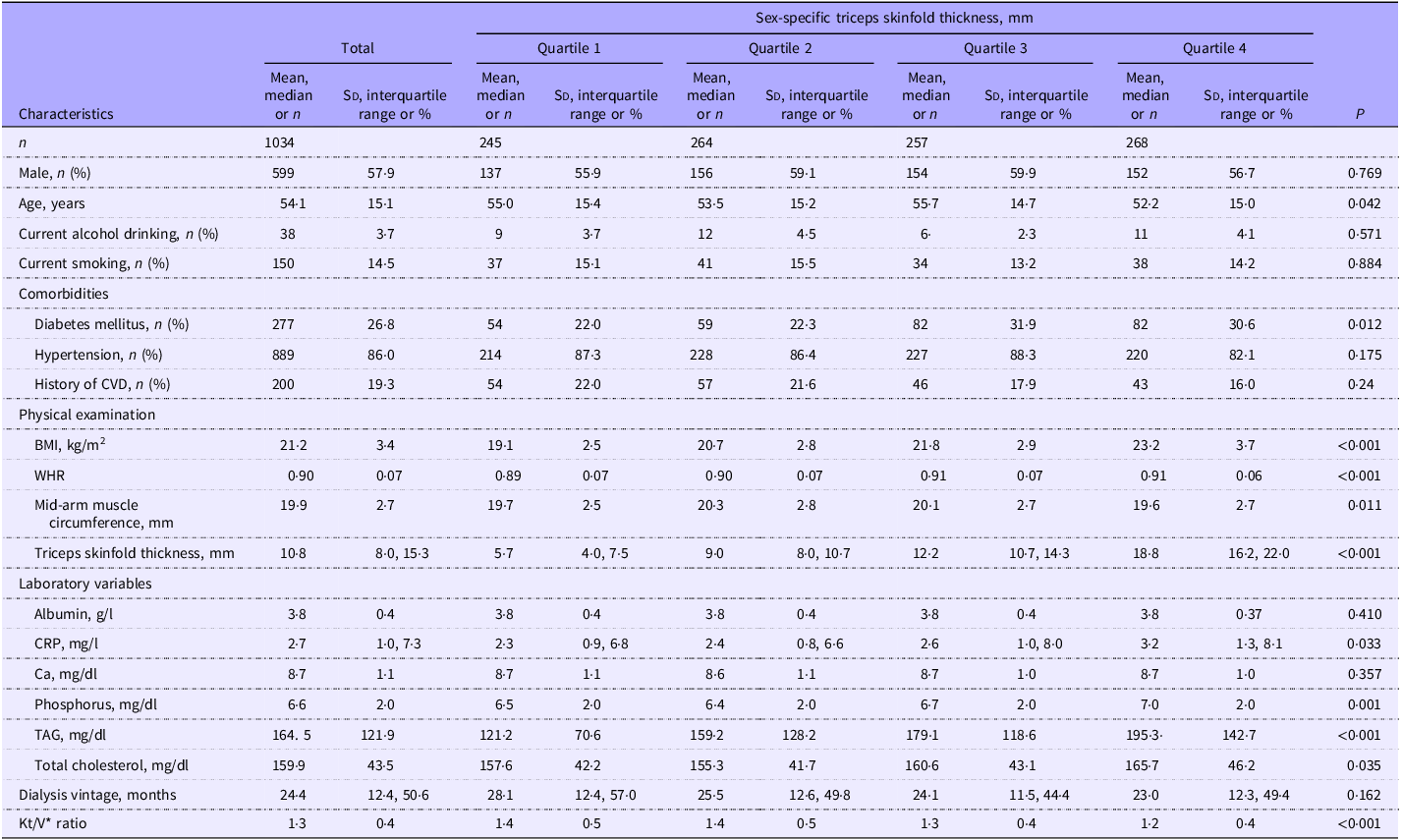
Baseline characteristics of participants were presented by sex-specific TSF quartiles in Table 1. The mean age of the study population was 54·1 (15·1) years; 599 (57·9 %) participants were male. The average BMI and WHR were 21·2 (3·5) kg/m2 and 0·90 (0·07), respectively. The median (interquartile range) of TSF was 9·7 (6·3–13·3 mm) in males and 12·7 (10·0–18·0 mm) in females. The distribution of TSF was displayed in online Supplemental Fig. 2.
Population characteristics by sex-specific triceps thickness skinfold quartiles

Data are expressed as mean ± sd, median (interquartile range) or n (%).
BUN, blood urea nitrogen; CRP, C-reactive protein; WHR, waist-to-hip ratio.
* Kt shows effective urea clearance and duration of dialysis, and V represents the volume of distribution of urea in the body, calculated as Kt/V = –ln(post-BUN/pre-BUN–0.0083t) + (4–3.53post-BUN/pre-BUN) × UF/postweight, where t is effective dialysis time and UF is ultrafiltration.
In males, the median (interquartile range) TSF values across Quartiles 1 to 4 were 4·5 (3·7, 5·8) mm, 8·0 (7·0, 8·7) mm, 11·0 (10·0, 12·0) mm and 16·3 (14·3, 18·7) mm, respectively. Corresponding values in females were 7·7 (5·7, 8·7) mm, 11·3 (10·3, 12·0) mm, 15·0 (13·8, 16·3) mm and 21·0 (19·6, 24·0) mm. Participants in the higher quartile of TSF were younger, more likely to have diabetes mellitus, and had higher waist, WHR, CRP, phosphorus, TAG, total cholesterol levels and lower mid-arm muscle circumference and Kt/V. The baseline characteristics by sex are also presented in online Supplemental Table 3 (males) and online Supplemental Table 4 (females).
Association of TSF with all-cause mortality among MHD patients
During a median follow-up of 4·4 years (interquartile range, 2·4–7·9 years) (5031 person-years), there were 548 (53·0 %) deaths. The leading causes of death were CVD death (297 (28·7 %)) and infection-related death (104 (10·1 %)).
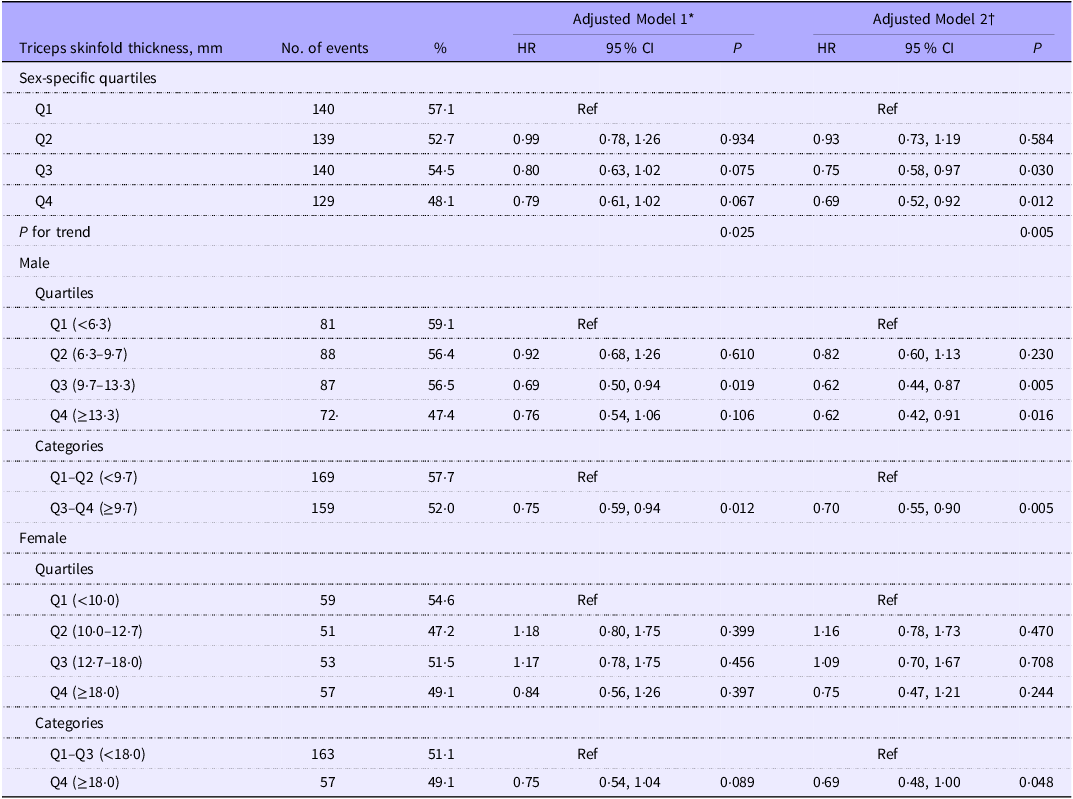
Overall, TSF was inversely associated with the risk of all-cause mortality in MDH patients (Fig. 1). When TSF was assessed as sex-specific quartiles, compared with those in the first quartile, the adjusted HR (95 % CI) in quartile 2, quartile 3 and quartile 4 were 0·93 (0·73, 1·19), 0·75 (0·58, 0·97) and 0·69 (0·52, 0·92), respectively (P for trend = 0·005). In male participants, when compared with those in quartile 1–2, a significantly lower risk of all-cause mortality was found in quartile 3–4 (≥9·7 mm; HR: 0·70, 95 % CI: 0·55, 0·90). However, among female participants, those in quartile 4 (≥18 mm; HR: 0·75, 95 % CI: 0·47, 1·21) tended to have lower all-cause mortality, but the HR did not reach statistical significance in comparison with those in quartile 1 (<10mm). As the HR in the quartiles 1–3 were similar, we defined the participants in quartiles 1–3 (<18 mm) as the low TSF group and those in quartile 4 (≥18mm) as the high TSF group. Compared with those in the low TSF group, those in the high TSF group showed a significantly lower all-cause mortality risk (HR: 0·69, 95 % CI: 0·48, 1·00) (Table 2).
Relationship of triceps skinfold thickness with the risk of all-cause mortality among total population (A), males (B) and females (C) based on restricted cubic splines. *Adjusted for dialysis centres, age, sex, smoking, alcohol drinking, diabetes mellitus, history of CVD, hypertension, albumin, C-reactive protein, TAG, total cholesterol, calcium, phosphorus, dialysis vintage, Kt/V, BMI, waist-to-hip ratio and mid-arm muscle circumference.

The association between triceps skinfold thickness with the risk of all-cause mortality

* Model 1 adjusted for age, dialysis centers, diabetes mellitus, hypertension, history of CVD, smoking, alcohol drinking, dialysis vintage, Kt/V ratio, albumin, TAG, calcium-phosphorus product and C-reactive protein.
† Model 2 adjusted for model 1 plus BMI, waist-to-hip ratio and mid-arm muscle circumference.
The relationship between sex-specific TSF and CVD mortality, infection-related mortality and non-CVD mortality were also analysed. The similar trends were found (online Supplemental Table 5).
Stratified analyses by potential effect modifiers
Stratified analyses were performed to assess the relationship of TSF with mortality risk in various subgroups. None of the variables, including age, diabetes mellitus, history of CVD, BMI, WHR, serum albumin, TAG and CRP, significantly modified the relationship of TSF with mortality risk in males (shown in online Supplemental Fig. 3) and females (shown in online Supplemental Fig. 4) (P for interactions ≥ 0·05).
Discussion
To our knowledge, this is the first prospective study to demonstrate the association of sex-specific TSF with mortality risk during a median follow-up of 4·4 years among MHD patients. We found that increased TSF is associated with lower all-cause mortality, and the association was stronger in men as compared with women.
A few prior studies have evaluated the relationship between TSF and the risk of all-cause mortality among MHD patients, yielding inconsistent results. In the Haemodialysis Study, where the mean TSF was 16·3 mm, a significant association was found between high TSF and reduced all-cause mortality(Reference Huang, Tighiouart and Beddhu13). Similarly, a study involving 242 MHD patients in Serbia (mean: 10·1 mm for men and 15·4 mm for women) demonstrated that TSF was associated with all-cause death (per 1 mm increment, HR: 0·95; 95 % CI: 0·92, 0·98)(Reference Stosovic, Stanojevic and Simic-Ogrizovic15). In contrast, the National Institutes of Health–sponsored Nutritional and Inflammatory Evaluation in Dialysis (NIED) Study, with a mean TSF of 17·5 mm, did not find a significant relationship between TSF and all-cause mortality(Reference Noori, Kopple and Kovesdy22). Rodrigues et al. reported that TSF was not associated with mortality risk in 173 older MHD patients (>60 years)(Reference Rodrigues, Santin and Brito14). However, most of the previous studies were conducted in Western populations with higher TSF than Asian populations and characterised by small sample sizes, a short duration of follow up or potential bias (no adjustment for BMI or WHR). Importantly, the effect of sex on the association of TSF with mortality risk was not examined. The present study, with a large sample size, a long follow-up period and comprehensive adjustment of major traditional risk factors, prospectively observed the association between TSF and the risk of all-cause mortality in Asian MHD patients.
Our study has revealed a noteworthy correlation between higher TSF and a reduced risk of all-cause mortality among MDH patients. The underlying mechanisms linking TSF and all-cause mortality are not fully elucidated, but it is biologically plausible. First, a higher TSF may signify better nutritional reserves, which may confer survival advantages during chronic illness(Reference Ikizler, Burrowes and Byham-Gray23). Furthermore, TSF is a well-recognised indicator of subcutaneous adipose tissue and peripheral fat distribution, which have several metabolic benefits. Subcutaneous fat plays an important role in storing energy and may act as a buffer against ectopic fat deposition(Reference Neeland, Poirier and Després24). Adiponectin, an adipokine predominantly secreted by subcutaneous adipose, exhibits anti-inflammatory properties and enhances insulin sensitivity(Reference Turer and Scherer25). Additionally, compared with visceral depots, subcutaneous fat may release lower concentrations of potentially harmful metabolites, such as IL-6, TNF-α and free fatty acids(Reference Klöting and Blüher26). Nonetheless, it is crucial to note that further research is warranted to validate and expand upon our findings.
In this study, the inverse association between TSF and all-cause mortality was stronger in men as compared with women, which may be due to the sex differences in body fat distribution. Women typically have a greater total body fat mass and are more prone to accumulate subcutaneous fat, whereas, men are more likely to accumulate visceral fat, which is associated with adverse health events(Reference Stefan4,Reference Lovejoy and Sainsbury27) . It has been reported that for any given waist circumference, women have more subcutaneous fat than men(Reference Power and Schulkin28). In the present study, men had significantly lower TSF values than women (10·4 v. 14·2 mm). This lower TSF may indicate a greater vulnerability to the impact of reduced subcutaneous fat on poor outcomes in men. However, future studies are needed to verify our results and further explore the underlying mechanisms regarding this topic.
In our study, we observed that the MHD patients had relatively low TSF values but demonstrated a higher WHR when compared with the general population in China. In this study, the mean (s d) of TSF was 12·0 (6·1) mm, and the median (interquartile range) was 10·8 (8·0, 15·3) mm. The mean WHR was 0·90 (0·07). In comparison, data from the China Health and Nutrition Survey (CHNS) study indicated that the general population had higher TSF values (mean 14·3 mm) and a lower WHR of 0·85(Reference He, Yang and Wang29). This disparity in fat distribution emphasises the importance of investigating the relationship between fat distribution patterns and poor outcomes in MHD patients. TSF is related to subcutaneous fat and WHR indicates visceral fat, which is associated with an increased risk of cardiovascular disease and poor outcomes(Reference Yang, Zhang and Lan12,Reference Stefan, Schick and Häring30) . As such, we speculated that the combination of low TSF and high WHR may implicate an unfavorable fat distribution pattern. Therefore, the assessment of both TSF and WHR may be crucial in predicting the risk of all-cause mortality and stratifying preventive and treatment strategies for individuals at risk of poor outcomes.
Several limitations in our study deserve to be mentioned. First, the current study cannot exclude potential residual confounding from unmeasured factors. Second, there were no direct measurements of adiposity (e.g. computed tomography, magnetic resonance tomography or dual-energy X-ray absorptiometry) in this study. Given the high cost, lack of availability and radiation hazard of these tools, they are not feasible for epidemiological studies and routine clinical use. TSF is a simple, cheap and easy anthropometric index for evaluating subcutaneous fat and has been validated in several populations(Reference Nickerson, Fedewa and Cicone8,Reference Yin, Cui and Lin31) . Third, anthropometric measurements were assessed only at baseline and the change in TSF was not considered during the follow-up. Fourth, MAC was measured only once. However, the investigators were well-trained and had a good command of the research protocol and standard operating procedures. Finally, this study was conducted in the south of China, where the population has a relatively lower BMI level(Reference Ricks, Molnar and Kovesdy32). Therefore, the results are not generalisable to other ethnic groups.
Conclusions
In conclusion, this study found that increased TSF was associated with a lower risk of all-cause mortality and the association was stronger in men as compared with women. Our study highlighted that, in addition to BMI, TSF can serve as a valuable and practical anthropometric measure to predict the mortality risk among MHD patients.
Supplementary material
For supplementary material/s referred to in this article, please visit https://doi.org/10.1017/S0007114525000741
Acknowledgements
We thank the participants, investigators and staff for their contribution to this study.
This work was supported by the National Key Research and Development Program of China (2021YFC2500200); Key Technologies R&D Program of Guangdong Province (2023B1111030004); Clinical Research Program of Nanfang Hospital, Southern Medical University (2019CR021; 2023CR038); Clinical Research Program of Southern Medical University (LC2019ZD005; LC2024NF003); National Natural Science Foundation of China (82470760) and President Foundation of Nanfang Hospital, Southern Medical University (2022H013).
Study concept and design: Y. Y., Y. H. and M. L.; data acquisition: Y. Y., Y. H., Q. Z., C. X., J. W., X. L., Y. K., Q. W., Y. L., S. H., Y. L., A. L., F. L., X. Q., Y. L.; data analysis: Y. Y., Y. H.; data interpretation: all authors; draft manuscript: Y. Y., Y. H.; manuscript review: all authors. All authors contributed important intellectual content during manuscript drafting or revision. All authors read and approved the final manuscript.
The authors declare that they have no competing interests.