


Introduction
During the classification of materials excavated from the Roman villa of Collet in north-eastern Spain, several fragments of decorated pottery were identified as belonging to the rim of a large ceramic vessel. Some 230mm in diameter, the vessel possessed a horizontally arranged handle with artistic detail of a two-headed serpent. Rows of semi-circles incised over the body of the serpent mimic scales; together with the circles incised over the rim, these details indicate that this was a piece that held value beyond its basic function as a ceramic container. Based on the use of snake-like forms, this article argues that the ceramic vessel is linked to the cult of the Thracian/Phrygian god Sabazios. Though not widely attested in the Iberian Peninsula, evidence of this cult has also been found at the nearby sites of Empúries and Tolegassos in chronologies contemporary to those of Collet (Tremoleda & Casas Reference Tremoleda and Casas1997–1998: 41–81).
The identification of the decorated vessel at Collet raises several questions: did a cult of Sabazios exist in the western provinces of the Roman Empire during the Augustan period (27 BCE–14 CE)? If so, where did the cult flourish; was it widespread in rural areas or is the case of Collet an exception? And in the specific coastal setting of Collet, from where could the cult have come?
With the aim of resolving these questions, a detailed analysis of the different ceramic fragments was undertaken. This included assessment of formal features and materials with the aim of elucidating the typology of the vessel, as well as identifying its potential place and chronology of production and function. Compositional analysis using optical microscopy and x-ray diffraction helped define the characteristics of the ceramic paste, while evaluation of the chronostratigraphic context from which the fragments were recovered helped determine its chronology and last use. Finally, consultation of available literature provided contextualisation, revealing other instances where objects related to the cult of Sabazios have been documented in similar chronological and territorial contexts. In the presentation of the results of these analyses, we show that the significance of the vessel from Collet extends beyond its material or typological characteristics, as it permits discourse around how and when cults spread and were implemented in novel territories. Thus, the vessel provides a window into the religious sphere of the Roman empire that allows us to broaden our understanding of Romanisation and its peculiarities.
The Roman villa of Collet
The Roman villa of Collet sits above the Bay of Palamós, on the coastal shore of the ancient territory of the ciuitates of Gerunda and Emporiae, 40 linear km south of the Roman city of Emporiae (present-day Empúries, L’Escala) and 45km south-east of the city of Gerunda (present-day Girona) (Figure 1). The site enjoys a privileged position overlooking the bay and is located on a rocky outcrop some 20m high. Although the site was identified at the end of the nineteenth century, it was not explored until the beginning of the twenty-first century, when a series of archaeological excavations began. Initial exploration of the lower part of the outcrop found Roman pottery linked to the villa (Burch et al. Reference Burch2015) and was followed, from 2015 onwards, by excavations of the Roman villa itself.
Location of the Roman villa of Collet (based on ICC: http://srv.icgc.cat/vissir3/).

To date, five phases of activity have been defined at the villa (Bouzas et al. Reference Bouzas and Martín Minguijón2023: 166–67) (Figure 2). The earliest phase, at the end of the second or at the beginning of the first century BCE, comprises part of a rural settlement of Italic ground plan, consisting only of a cella vinaria (wine cellar), with more than 20 documented dolia holes (Bouzas et al. Reference Bouzas, Forn and Gurri2024a: 235), and a horreum (warehouse), of which several postholes have been documented (Bouzas et al. Reference Bouzas2024b). Few such examples of these rural establishments have been recorded in the Girona area, where they were precursors for Roman villas. In the second phase, during the first decades of the first century BCE, a Roman villa of Italic ground plan (with two towers framing the southern façade) and a markedly productive character was founded. This building remained in use for a long period of time. In the Augustan period, a bread oven, a tegulae kitchen and a modest thermal complex were added (Bouzas et al. Reference Bouzas and Martín Minguijón2023: 167–75).
Plan of villa architecture from the Augustan period. The red circle marks the location where the ceramic fragment decorated with a snake was found, just outside the east wall of the villa (source: Universitat de Girona). Brown: rooms with clay floors; pink: rooms with opus signinum flooring; orange: ceramic elements; blue: surface of the water reservoir dating from the Augustan period (figure by authors).

At the end of the first century CE the site underwent radical changes: the villa and its Augustan additions were demolished and a large volume of earth was brought into the site, which was used as a platform for the construction of a new villa. This new building had multiple rooms, many of which were paved in opus signinum (ceramic fragments in a lime mortar base), structured around a central courtyard and a large porticoed space on the southern, marine façade. In later alterations some of the floors were replaced by more luxurious surfaces such as mosaics or opus sectile (made with various inlaid materials) (Bouzas et al. Reference Bouzas and Martín Minguijón2023: 167–75). Finally, around the fourth century CE, some residential spaces were abandoned, with one used for an individual burial (Bouzas et al. Reference Bouzas and Martín Minguijón2023: 167–75).
Materials and methods
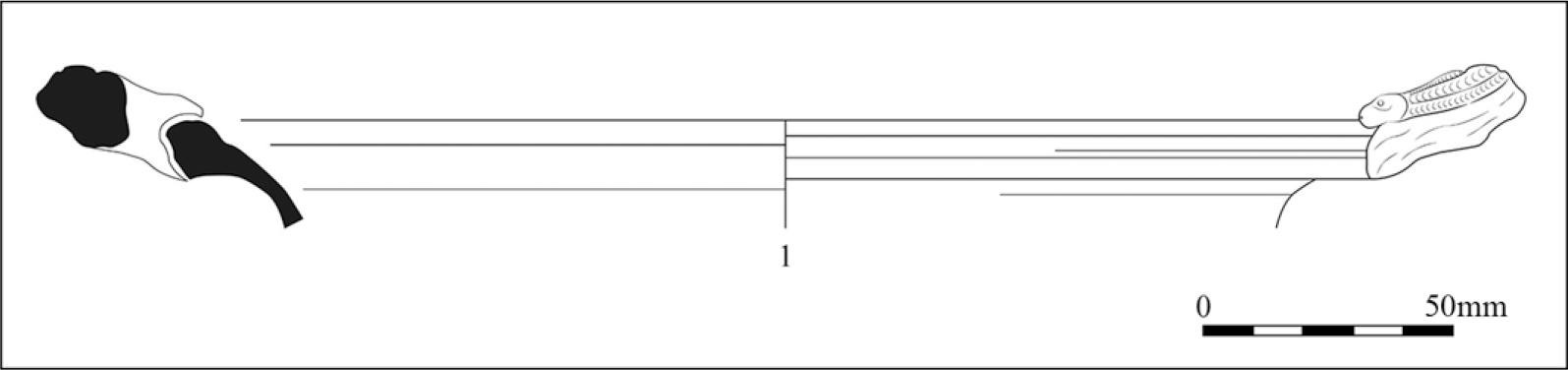
Analysis of the fragments proceeded on two levels: physical and chronostratigraphic. The chronostratigraphic study assessed the material, shape and decoration of the piece, comparing these elements with available literature to establish its type. Determination of chronology also drew on the analysis of site stratigraphy. Production of a technical drawing, following traditional archaeological methods (Figure 3), is complemented by the creation of a 3D model using the Agisoft Metashape software version 1.5.2 (Figure 4).
Drawing of the vessel fragment (source: Universitat de Girona).

3D reconstruction of the Sabazios vase piece, which is 160mm long (source: Universitat de Girona).

Analysis of mineral inclusions in ceramic paste can reveal raw material use and, potentially, supply strategies. Direct observation of the sample was first undertaken with a Motic SMZ-171 binocular loupe (×10 to ×100) equipped with a Moticam Pro 252A camera. Textural characteristics and the percentage mineralogical composition of the paste were obtained through the measurement of the size and compositional count of all grains visible in the optical field at four different points of the sample. A mineralogical analysis was also conducted using powder x-ray diffraction with a Bruker AXS D8 Advance Powder RX diffractometer from the Technical Research Services of the University of Girona.
Results
Typology
The recovered ceramic fragments preserve part of a rim and handle, each topped with a snake’s head. The shape of the piece and the arrangement of the handles indicate that this was a large vessel. The rim has an everted lip with an irregular, somewhat almond-shaped cross-section (Figure 3). The handle has a rich, but coarse, punch decoration depicting a snake with a head at both ends of the handle, where it meets the rim. The body of the handle, which has an irregular cross-section, is profusely decorated with small semi-circular incisions that are intended to imitate the scales of a reptile. The snake heads have a somewhat schematic appearance, but incised eyes can be recognised and a moulded line, at the point where the handle meets the rim, represents the mouth (Figure 4).
In terms of shape, the rim and handle are broadly comparable with the C3 form in the typology established by Amand (Reference Amand1984) based on examples of vessels associated with the cult of Sabazios from the regions of Germania and Belgica, some of them also feature snake motifs, particularly given the projected dimensions of the vessel and the presence of incised decoration. Yet, the apparent absence of pouring spouts is inconsistent with the C3 typology and the decoration is more similar to the fragments documented at Carnutum (Austria) (Amand Reference Amand1984: 49). It should be noted, however, that the examples presented by Amand are probably later than the Collet fragments, dating to the third century CE, and that their production is identified with workshops in northern Gaul (Amand Reference Amand1984: 21–56).
The fact that the body of the vessel is not preserved prevents a more precise typological assessment, yet the fragments likely derive from a large vase with an everted rim and two raised handles decorated with snake heads where each handle meets the rim. Though some elements resemble ceramic vessels documented in Roman Gaul, perhaps indicating a shared tradition, the Collet fragments cannot be confidently ascribed to an existing type.
Composition
Analysis of the paste with a binocular magnifying glass shows that it is a compact, well-polished, red-paste ceramic with a low proportion of mineral inclusions. These mainly consist of medium to coarse sand (average 0.5mm, maximum observed 1.25mm), which is evenly distributed throughout the piece and is made up of sub-angular to sub-rounded grains of irregular to ellipsoidal geometry, mostly quartz. Biotite and muscovite plates of mica are also present, the latter more scarce. All the paste (internal and external face and core) has white subspherical nuclei (0.5 to 1mm in diameter, often with a cavity in the centre), which seem to correspond to secondary zeolites, possibly analcime, formed by the alteration of calcium carbonate fragments during firing.
In addition to the components of the degreasing agent already identified with the magnifying glass (quartz, biotite, muscovite) application of x-ray diffraction indicates the presence of feldspars (plagioclase) (Figure 5). Peaks similar to analcime are also detected, probably deriving from calcium carbonate added to the paste as a slip coating prior to firing. Similarly, the ceramic fragment shows traces of a white slip in which the same detrital mineral components can be identified as in the paste (quartz, biotite, muscovite) but of a much smaller size (≤0.2mm).
Diffractograms of the sampled ceramics. Note that each uses a different scale (source: Universitat de Girona).

The characteristics of the paste are not particularly useful for defining a geographic origin for the vessel. The composition of the paste is compatible with local production but differs from the paste used to produce dolia at a nearby workshop, known as Collet Est (Bouzas et al. Reference Bouzas, Járrega and Rueda2024c). The possible presence of calcium carbonate, as analcime, could also be indicative of production elsewhere, as the use of beige or white slips has not been detected at either Collet Est (Burch et al. Reference Burch2015) or Ermedàs, near Girona (Castanyer et al. Reference Castanyer2018). Instead, the type of paste, the mineral inclusions and the potential use of white slip suggest that the Collet vessel has an African provenance, although it must be stressed that evidence for the cult of Sabazios in Africa is scarce and no comparable ceramic forms have been found there (Baeza Reference Baeza and Carbonell2023: 285–88). In fact, there is only evidence of a single vessel of Tunisian origin, of undetermined date, held at the Romisch-Germanischen Zentralmuseum, where, among other iconographic elements such as a frog and a salamander, a snake also appears, and it is associated with Sabazios (Ripoll Reference Ripoll1988: 307).
Chronology
The fragments were recovered from the southernmost part of area 1.1.L, marked with a red circle on Figure 2. This area shows a first phase of use as a working area that was levelled, through deposits of earth, in the Augustan period for the construction of an oven, possibly a bread oven (Bouzas et al. Reference Bouzas, Forn and Gurri2024a: 236). The area was then levelled again in the High Imperial period, around 70 CE, for the construction of the new imperial villa.
Ceramic materials from the Augustan period were found among the material from the fill that created a circulation level for the construction of the oven, including undetermined Baetican amphorae, Tarraconense amphorae (Pascual 1 type) (Miró Reference Miró1988: 70–77), fragments of grey Emporitan pottery, Campanian B pottery, specifically an individual of the Lamb 5 dish type (Morel Reference Morel1981: figs. 2252, 2254, 2255, 2257, 2258), and even a shapeless fragment of terra sigillata Italica (red-coated ceramic ware). This chronology is confirmed by material from the levels related to the use of the oven, in which the ceramic fragments under study were documented. Finds from this context are also identifiably Augustan, including a cup of terra sigillata Italica (Conspectus 33; Ettlinger et al. Reference Ettlinger1990: 110–11), dated to the first half of the first century CE, and tarraconense amphorae type 2/4 (Miró Reference Miró1988: 78–90), slightly more recent than the Pascual 1 amphorae from the construction level. Abundant common Roman pottery also confirms an Augustan date. Thus, the levelling platform used to create the oven and the first level of use, where the vessel fragment with the snake-head handle was deposited, must date from the Augustan period. The vessel was therefore already broken and buried in the Augustan period, so it must date from this period or from a time immediately preceding it.
Discussion: the cult of Sabazios and its presence in the Iberian Peninsula
The cult of the god Sabazios, originating with the Thracians/Phrygians of the Balkan peninsula, had a rather limited diffusion in the Roman world and became an intimate cult practiced only in domestic settings. An example can be found in a house in Pompeii (II.I.12), where a domestic area was adapted for the practice of mystery cults. A small brick altar was documented at one end of the peristyle, the garden. Two terracotta vessels decorated with iconography typical of the cult of Sabazios, such as snakes and toads, among other elements, were associated with it (Jashemski Reference Jashemski1979: 135–37).
In general terms, the cult of Sabazios is difficult to identify and it can therefore be identified only through its characteristic objects, namely the bronze hands called ‘sabazeas’, a few triptych-like plaques or a particular set of ceramic bowls with characteristic iconography. In all cases, the iconography is markedly syncretic and difficult to understand for the uninitiated, suggesting the objects were visual supports for a mainly oral ritual.
Evidence for this cult in Iberia is sparse, confined largely to the extreme north of the peninsula, except for a piece of furniture found in l’Alcúdia (Elche). Specifically, it is a small bust, which has been interpreted as typical of Sabazios, made of bronze and thought to have been used as a decorative fitting on a piece of furniture (Almagro Reference Almagro1956: 212). A bronze hand found in Cartagena seems to have come from a ship (Alonso & Pinedo Reference Alonso and Pinedo2003: 248) and the Sabazea attribution of the so-called Cueva Negra de Fortuna cave in Murcia is contested (Alvar Reference Alvar2023: 317–19). Despite the limited assemblage, an iconographic association between the cult of Sabazios, the hands of Sabazios and snakes can be observed. Two types of snakes can be distinguished, one more realistic and the other less so, depicted with a crested head (Berndt-Ersöz Reference Berndt-Ersöz2018: 161–64). Although rendered in a ceramic medium and not linked to a bronze hand, the snake heads from Collet would fall into the realistic type.
A jar with snake-shaped appliqués was found in the Roman city of Vareia in northern Spain. This piece comes from a similar chronological context to the fragments found at Collet and, although its attribution to Sabazios cannot be confirmed, it features snakes that are similar in form (Luezas Pascual Reference Luezas Pascual2023: 260–61). However, the type of clay and slip used in the Vareia piece are quite different to those analysed here.
In the north-east of the Iberian Peninsula, and more specifically in Empúries and its nearby territory (Tremoleda & Casas Reference Tremoleda and Casas1997–1998), ceramic vessels of varied shapes have been found with characteristic applied decoration featuring representations of snakes, lizards and frogs/toads, generally described as ‘serpent-ware’ and ‘snake vessels’ or ‘Schlangentöpfe’. Such vessels have been found at Empúries, specifically a whole jar and two fragments of other jars; at the site of Tolegassos, where another whole jar and a small circular vessel decorated with snakes were found; and at the site of Camp de la Gruta (Torroella de Montgrí) where the central part of a handle was found, decorated in the same way as the fragments found at Collet (Tremoleda & Casas Reference Tremoleda and Casas1997–1998).
Vessels of this type, by themselves, are not indicative of the cult of Sabazios, as they are more common in Mithraic cults. In fact, most have been attributed to this cult and are abundant in military contexts in the Rhaetian Limes in Germany (Joly et al. Reference Joly2010: 176). They have also been found in local domestic genii cults, without any connection to Mithras or Sabazios (Vámos Reference Vámos and Bíró2009: 337–38) and even in ‘sorcery’ contexts (Joly et al. Reference Joly2010). Therefore, the vessels themselves do not presuppose a definitive attribution to a cult and context is key for such assessments. Attribution of the vessels from the north-east of the Iberian Peninsula, including the one from Collet, to the cult of Sabazios stems from the discovery of a set of plaques attributed to this god that were found in a tomb in an Emporitan necropolis dated to the Augustan period or the beginning of the first century (Almagro Reference Almagro1955: 126; Reference Almagro1956: 206–12). These embossed bronze plaques (originally silver-plated) formed a triptych; a representation of Sabazios surrounded by symbols alluding to his cult with two hinged plaques representing the Dioscuri (‘sons of Zeus’, Castor and Pollux), although only one survives. Such portable triptychs are relatively common in this cult (Lane Reference Lane1985: catalogue numbers: n. 79, 80, 81, 82 & 87) and possibly belonged to priests who used them to propagate the rites of the god. A sculpture in Rome depicts a priest of Attis wearing one of these triptychs on his chest to facilitate his work of conversion (Vermaseren Reference Vermaseren1977: catalogue number: n. 249). Thus, it seems likely that an itinerant priest of Sabazios operated in Empúries, perhaps having arrived from the eastern provinces of the Empire. The small number of vases that survive, principally at Empúries and Tolegassos, suggest that the spread of the cult was limited, though the fragments from Collet indicate that it found its way into rural establishments as well as cities. In the case of Collet, cult influence may have come from the nearby ancient city of Emporiae, where the triptych was found in an Augustan tomb, and was probably incorporated within the sacra privata (religious rites observed privately within the domestic sphere). Such rites are archaeologically represented at various rural sites in the territory of the ciuitates of Emporiae and Gerunda and include the domestic cult of the lares gods, documented in the lararium of the Roman villa of Vilauba (Castanyer & Tremoleda Reference Castanyer and Tremoleda1999: 105–11) and in a small votive altar in the rural settlement of Casa del Racó (Burch et al. Reference Burch and Agustí1995: 95–107).
Despite its rarity, the Iberian serpent-ware suggests a continuity in the practice of the cult of Sabazios from the Augustan period at least until the beginning of the second century CE (Tremoleda & Casas Reference Tremoleda and Casas1997–1998). The function of the vessels is not clear, but in complex iconographies, such as the Empúries plaque, they appear to be linked to the altar and their use as a vessel to collect sacrificial blood has been proposed (Rescigno Reference Rescigno2010: 269 & note 6).
Conclusions
Examination of material excavated at the Roman villa of Collet in north-eastern Spain identified several fragments of a large vessel, the handle of which was embellished with two snake heads. Vessels with similar decorations have been found in the Roman city of Emporiae and the Roman villas of Tolegassos and Camp de la Gruta and, together with a triptych depicting the god himself, attest to the Iberian presence of the cult of Sabazios. Derived from an Augustan-period context, the Collet vessel provides an early rural example of Iberian serpent-ware, suggesting that although the spread of this cult was limited in this region of the Roman Empire, its influence was felt beyond urban settings. This small but diffuse influence is echoed in the provenance of the vessel, which may lie beyond the territory of the ciuitates of Emporiae and Gerunda. Thus, the vessel from Collet suggests that apparently minor cults were not confined to restricted areas but could have constituted extensive cultic networks within the wider Roman Empire.
Funding statement
This research was conducted under the scientific collaboration agreement between the Ajuntament de Calonge i Sant Antoni and the Universitat de Girona (ref. R036/18). The fieldwork and consolidation works were funded by the Diputació de Girona (grant no. 2025/3889) and the Generalitat de Catalunya under the quadrennial research programme 2022–2025 (grant no. ARQ0001SOL-199-2022). Additionally, this work forms part of the project ‘Diacronía de los territorios y paisajes de Emporion/Emporiae y Gerunda durante la Antigüedad’ (grant no. PID2023-148337NA-I00), funded by the Ministerio de Ciencia, Innovación y Universidades.
Data availability statement
Data available on request from the authors.
Author contributions: CRediT categories
Marc Bouzas Sabater: Conceptualization-Equal, Formal analysis-Equal, Investigation-Equal, Project administration-Equal, Writing - original draft-Equal, Writing - review & editing-Equal. Josep Burch Rius: Conceptualization-Equal, Formal analysis-Equal, Project administration-Equal, Writing - original draft-Equal, Writing - review & editing-Equal. Elisabet Moner Coll: Data curation-Equal, Writing - review & editing-Equal. Carles Roqué Pau: Investigation-Equal, Methodology-Equal, Software-Equal. David Vivo Codina: Project administration-Equal, Writing - original draft-Equal, Writing - review & editing-Equal.




 Open access

