Background
In 2011, the American College of Surgeons Oncology Group (ACOSOG) Z0011 trial reported that axillary lymph node dissection (ALND) provides no disease-free survival benefit in women with one to two sentinel lymph node (SLN) metastases treated with lumpectomy and adjuvant whole breast radiotherapy.Reference Giuliano, Hunt and Ballman 1 The trial reported a 5-year overall survival of 91·8% with ALND versus 92·5% with SLN biopsy, and a 5-year disease-free survival of 82·2% with ALND and 83·9% with SLN biopsy. Following this publication, surveys on surgical patterns have confirmed that it has been a practice changing trial, with less ALND being performed.Reference Gainer, Hunt and Beitsch 2
Patients were eligible for inclusion to Z0011 if they had T1-T2 invasive breast cancer amenable to lumpectomy; tumour <5 cm; no multifocal disease; no palpable nodes; no more than two positive sentinel nodes; no matted nodes or gross extracapsular extension (ECE); oestrogen receptor (ER) positive or negative; no neoadjuvant treatment. The trial closed early due to poor accrual, with 891 (47%) of the targeted 1,900 patients recruited. In addition, of those patients actually enrolled, the majority were low risk for recurrence—64% were older than 50, 68% had clinical T1 tumours, 77% of tumours were ER positive, 60% had only one SLN and 96% received adjuvant systemic therapy (58% chemotherapy, 46% hormone therapy). The trial protocol specified that patients receive standard whole breast radiotherapy using tangential fields. However, considering the radiation oncologists could not be blinded as to whether a patient had SLN biopsy alone versus ALND, there has been speculation surrounding the radiotherapy fields actually used in the trial. A recent publication on the radiation field design in the ASOCOG Z0011Reference Jagsi, Chadha and Moni 3 reported that some patients received no radiotherapy at all (11%), and a review of a random selection of case files of those that did receive radiotherapy, showed that most patients received tangential fields alone (81·1%), whereas others received direct nodal irradiation via a third field (18·9%), raising doubt about the validity of the Z0011 findings.
Currently, patients with four or more positive lymph nodes (LNs) following ALND receive adjuvant supraclavicular fossa (SCF) nodal irradiation as standard. Historically, patients with one to three involved nodes following ALND fell into a grey area, as it was not known whether adjuvant radiotherapy was of benefit to this group. An Early Breast Cancer Trialists Collaborative Group meta-analysis, published in 2014,Reference McGale, Taylor and Correa 4 revealed that adjuvant nodal irradiation in patients with one to three positive LNs, post mastectomy, provided reduction in both locoregional recurrence and breast cancer mortality. More recently, there is also some evidence from the AMAROS trialReference Donker, van Tienhoven and Straver 5 (Radiotherapy or surgery of the axilla after a positive sentinel node in breast cancer) suggesting that axillary radiotherapy can be an alternative to surgery in low-risk SLN-positive patients, with lower rates of lymphoedema in the radiotherapy arm at 5 years. However, the trial reporters also advise that if treatment of the axilla is indicated for a positive sentinel node, ALND remains the present standard.
In our practice, we have noted that there is a lack of consensus on the treatment of patients with clinically node-negative breast cancer (as assessed by examination and ultrasound) but one to two positive SLNs. Although some surgeons opt for ALND in this setting, others treat as per Z0011 without further surgery, and so the question arises as to whether the latter patients should then receive definitive nodal irradiation either to the lower levels of the axilla or to the entire axilla and SCF. We felt that an international survey of radiation oncologists would answer how these patients are currently being managed across radiotherapy centres worldwide.
Materials and Methods
We conducted a short survey, sent via post, with responses accepted via post, email attachment or fax. The first three questions related to hypothetical scenarios where a patient had a positive sentinel node and no further axillary surgery based on the Z0011 trial results. Respondents to this survey were asked what type of radiotherapy field they would offer in each of our three hypothetical scenarios—standard tangents versus high tangents (where the upper border of the breast field is extended so that axilla levels I and II are covered) versus tangents with full axillary and SCF nodal irradiation, or, whether they would use a specific nomogram, such as those from the MD Anderson Centre or Memorial Sloan Kettering, which are available online (https://www.mskcc.org/teaser/prediction-tools-01), to estimate the patients risk of recurrence and direct their treatment decision.
Scenario 1: We presented a patient who fulfils the Z0011 eligibility criteria, was well represented in the Z0011 trial, and is at low risk of recurrence [T1, ER+, no lymphovascular invasion (LVI), one SLN, no further ALND].
Scenario 2: This patient also fulfils the eligibility criteria, however, was not well represented in the trial and is at higher risk of recurrence (T1, ER−, high grade, LVI, one SLN).
Scenario 3: This patient did not fulfil the eligibility criteria due to gross ECE, and is at high risk of recurrence (one SLN with gross ECE, ER+, low grade, T1, no LVI).
Question 4 asked respondents if they would inform patients that they are receiving additional nodal irradiation if definitive axillary surgery was not performed in the setting of a positive sentinel node.
Centres with radiotherapy departments were identified via the International Atomic Energy Agency’s (IAEA) Directory of Radiotherapy Centres via their website (IAEA.org). We excluded centres with less than four linear accelerators, on grounds of practicality, limiting potential numbers from thousands to less than 200. For the United States, the IAEA website did not list individual institution names, therefore cancer centres were identified via the American College of Surgeons website (www.facs.org), limiting centres contacted to those that were National Cancer Institute-approved comprehensive cancer programmes and academic institutions.
Surveys were sent in English to a named physician specialising in breast radiotherapy, identified via the hospital website (53% of surveys). Where no physician name or contact was available (47% of surveys), the survey was sent generically to ‘Consultant Radiation Oncologist, Breast Specialist’ at the hospitals main address. In total, 179 institutions were contacted in 18 countries (Australia, New Zealand, Japan, Singapore, United States, Canada, United Kingdom, Ireland, France, Germany, Switzerland, Belgium, Denmark, Norway, Sweden, Italy, Spain, Austria). Responses were entered onto an Excel spreadsheet, with simple calculations performed on the data. Results are reported in both absolute number and percentage.
Results
Study population
Of the 179 centres surveyed, 73 (41%) responded. In three centres we received responses from three different radiation oncologists, and from 11 centres we received responses from two radiation oncologists. There was a single responder from the remaining 59 centres. Respondents represented 90 consultant radiation oncologists from 11 countries. A total of 82 responses (91%) were from physicians who treat at least 100 breast cancer patients per year.
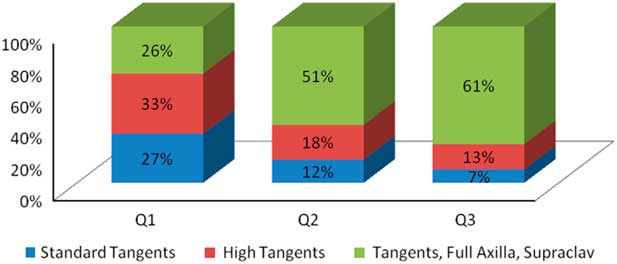
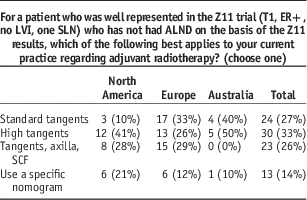
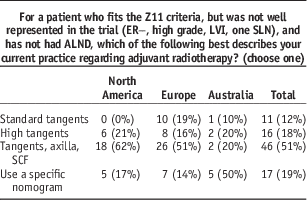
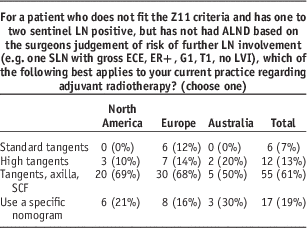
Tables 1, 2 and 3 outline the questions asked and responses received. Figure 1 shows the radiotherapy fields offered in each scenario.
Representation of responses for each scenario as outlined in questions 1, 2 and 3.

Responses to Scenario 1

Abbreviations: ER, oestrogen receptor; LVI, lymphovascular invasion; SLN, sentinel lymph node; ALND, axillary lymph node dissection; SCF, supraclavicular fossa.
Responses to Scenario 2

Abbreviations: ER, oestrogen receptor; LVI, lymphovascular invasion; SLN, sentinel lymph node; ALND, axillary lymph node dissection; SCF, supraclavicular fossa.
Responses to Scenario 3

Abbreviations: LN, lymph node; ALND, axillary lymph node dissection; ECE, extracapsular extension; G1, grade 1; ER, oestrogen receptor; LVI, lymphovascular invasion; SLN, sentinel lymph node; SCF, supraclavicular fossa.
For Scenario 1, only 27% of respondents would use standard tangents alone, in spite of the fact that the patient is eligible for Z0011 and was well represented in the trial. In total, 33% would treat with high tangents, whereas 26% would treat with tangents and the full axilla/SCF (Table 1). For Scenario 2, only 12%, with 0% in North America, would use standard tangents alone, whereas half (51%) would add axillary/SCF irradiation (Table 2). Not surprisingly, for Scenario 3, where the patient did not fulfil the eligibility criteria, the majority (61%) would offer tangents with axillary/SCF irradiation (Table 3).
Question 4 was phrased as follows: ‘If you use anything other than the standard tangents described in the original Z0011 trial, do you inform the patient that you are modifying the radiotherapy treatment based on an opinion that the patient was undertreated surgically?’. Only 93% (n=84) answered this question, which may have been related to how the question was phrased. In total, 51% (n=43) advised that they would inform the patient that the radiotherapy treatment is being modified in order to treat the LNs. Two mentioned in their comments that they would not use the word ‘undertreated’, and two mentioned that they would discuss with the surgeon to request ALND or they would consider enrolling the patient on a clinical trial. In total, 20% commented that they would re-discuss the patient in the multidisciplinary team setting and ask the surgeon to proceed with ALND.
In total, 18 respondents commented that patients with one to two positive SLN usually have ALND in their centres and that in these scenarios they would consider re-discussing the option of surgery. Four of the respondents mentioned that they would consider entering these patients in a clinical trial, with several making reference to the UK POSNOC study (Positive Sentinel Node: adjuvant therapy alone versus adjuvant therapy plus Clearance or axillary radiotherapy), which has recently opened (www.posnoc.co.uk).
In the 14 centres where we received a response from more than one radiation oncologist we noted differences in proposed radiotherapy treatments offered by individual physicians within the same centre. For example, three radiation oncologists working in the same centre provided three different answers to question 1 (high tangents, use nomogram, full axillary/SCF irradiation).
Discussion
The management of the axilla in patients with clinically node-negative breast cancer and one to two positive SLNs is a challenge in today’s practice. We must ask ourselves two questions: first, do we need to definitively treat the axilla? Second, if the answer is yes, are patients best treated with surgery or radiotherapy?
Several randomised trials have addressed the first question. The NSABP (National Surgical Adjuvant Breast and Bowel project) B-04 trialReference Fisher, Jeong and Anderson 6 randomised 1,079 patients, from 1971 to 1974 with clinically node-negative breast cancer to radical mastectomy (i.e., with ALND) versus mastectomy and axillary irradiation versus mastectomy alone, and found that there was similar survival in each arm at 25 years follow-up. The authors also noted that most events occurred after 5 years, indicating the need for long-term follow-up particularly in patients with good prognosis. This should be borne in mind when considering applying early results of clinical trials to our current practice. On the other hand, it is also worth noting that NSABP B-04 is an older study, with outcomes in current practice being improved with the use of systemic treatment reducing locoregional recurrence rates.Reference McBride, Allen and Woodward 7
Another trial randomised 435 patients with clinically node-negative primary breast cancer to breast conservative surgery without axillary treatment or with axillary radiotherapy, with low rates of axillary recurrence in both arms.Reference Veronesi, Orecchia and Zurrida 8 In the Z0011 trial,Reference Giuliano, Hunt and Ballman 1 891 women with a primary tumour <5 cm, clinically node negative with one to two positive SLNs (haemotoxylin and eosin detected metastasis, no gross ECE, no matted nodes) were randomised to axillary clearance or no further surgery, with all patients to receive adjuvant tangential radiotherapy to the breast. The rate of axillary recurrence was very low in both arms, with many considering this to be a practice changing trial. However, there has been some criticism of the study, particularly in relation to the lack of radiotherapy quality assurance in the trial. In 2013, a meta-analysis by Glechner et al.Reference Glechner, Wöckel and Gartlehner 9 indicated similar 5-year survival and regional recurrence rates between patients treated with ALND or SLN biopsy, suggesting that SLN only could be an alternative for a selective group of patients. Notably, prognostic tumour characteristics varied among the three study populations analysed. In addition, the IBCSG 23-01 trial,Reference Galimberti, Cole and Zuffida 10 (International Breast Cancer Study Group) reported that ALND could be safely omitted in patients with SLN micrometastases, with no adverse effect on survival after a median follow-up of 5 years.
The recently published AMAROS trialReference Donker, van Tienhoven and Straver 5 looked at the second question, showing promising results for radiotherapy as an alternative to surgery in low-risk patients, and with lower rates of lymphoedema. The study, however, was underpowered due to the small number of events, and with follow-up being relatively short at only 5 years, there are concerns that the lymphoedema rates in the radiotherapy arm may increase with longer term follow-up. In addition, the original report stated that in patients with high-risk disease (i.e., axillary disease that necessitates treatment), the standard management of the axilla remains surgery.
Currently in our centre, all cases of early-stage breast cancer who are clinically node negative, as assessed by clinical examination and ultrasound of the axilla, but have a positive sentinel node on pathology are discussed at the multi-disciplinary team meeting and a decision regarding how to treat each patient is reached. We have noticed a lack of consensus as to how these patients are best managed. We conducted this survey to inform ourselves as to how these patients were being treated at radiotherapy centres worldwide and to determine if there is any consensus internationally.
A recent publication showed that the average response rate of physicians to mailed surveys has traditionally been demonstrated to be only 5458%, and among oncologists varied from 31 to 61%.Reference Martins, Lederman and Lowenstein 11 At 41%, the response rate to this survey was within this range. We have received responses from large academic institutions including Memorial Sloan Kettering (United States), the BC Cancer Agency (Canada), The Royal Marsden (United Kingdom), along with smaller more provincial centres and feel that our results are representative of current interpretations as to appropriate axilla management. We emphasise that the results of this survey are purely descriptive and are not intended to change practice.
Another potential limitation of our study includes the assumption that the clinicians contacted to complete the survey understood the definition of ‘high tangents’ as including the lower levels of the axilla in the radiotherapy tangent field. This was based on the fact that those contacted were specialists in breast radiotherapy, however, it may have been prudent to include this definition in an appendix to the survey in order to avoid any potential confusion.
The St Gallen International Expert consensus meets yearly to discuss controversies in early breast cancer management. The 2015 report,Reference Coates, Winer and Goldhirsh 12 published after our surveys were collected, acknowledged that recent studies have shown that disease control and survival are improved when radiotherapy fields were extended to include regional LNs in patients with node-positive disease,Reference Whelan, Olivotto and Ackerman 13 , Reference Poortmans, Struikmans and Collette 14 and so the Panel was in favour of at least some regional nodal radiotherapy if the axillary LNs were positive. For those with positive nodes who had breast-conserving surgery, only 5% of the Panel thought that breast-only radiotherapy would be sufficient. In the case of women who have one to two macrometastases following breast-conserving surgery and SLN biopsy, a majority of the Panel would accept omission of ALND particularly if the radiotherapy were planned to use high tangents.
Although there have been published guidelines on the management of the axilla from some countries including North America (American Society of Breast Surgeons), the United Kingdom (Association of Breast Surgery Consensus Statement) and the Netherlands (Dutch Breast Cancer Guideline), there remains uncertainty. Specifically, the American Society of Breast Surgeons state ‘further decision-making regarding use of axillary radiation in-lieu of ALND needs to be made in the context of a multi-disciplinary discussion that takes into account specific patient and cancer characteristics and treatment goals’. In addition, the UK association of breast surgeons reported that ‘no consensus was reached on the management of patients with one or more of the following characteristics: pre-menopausal status, T2 tumours, lymphovascular invasion or extranodal spread’.
Responses to our survey reflect the sentiment that, in node-positive disease, most radiation oncologists feel that standard whole breast radiotherapy is insufficient, with the majority opting for some form of regional nodal irradiation. In our survey, only 12% of the radiation oncologists who responded would use the standard tangents described in the Z0011 trial if the patient fit the trial eligibility criteria but was not well represented. Even if the patient was well represented this figure increased to only 27%. As expected, for those who do not fit the Z0011 criteria (e.g., extranodal extension), the majority (61%) of radiation oncologists would give comprehensive radiotherapy to the axilla SCF. It is worth noting that there are ongoing trials looking to answer how the axilla should be managed. 15 – 18
Conclusion
This survey illustrates the lack of consensus regarding the management of the axilla in patients with clinically node-negative breast cancer but a positive sentinel node and who has not had ALND, even in the setting of micrometastases and favourable tumour and LN characteristics. Although trials are still exploring the best treatment for this group of patients, both local and international guidelines are needed to standardise management outside of the clinical trial setting. These should be based on an individual’s prognostic factors, according to the best available evidence.