Introduction
Since the onset of the 2000s, many Chinese multinational enterprises (CMNEs) have emerged as strong global competitors (e.g., Huawei, Xiaomi, PopMart, and TikTok), albeit still in small numbers when compared with MNEs from developed economies. Both state-owned and privately-owned CMNEs have been internationalizing with a goal to become strong players in the global market, even amid the geopolitical tensions, economic decoupling, and trade wars that characterized the mid-2020s, which have made international growth uniquely challenging (Cui, Vertinsky, Wang, & Zhou, Reference Cui, Vertinsky, Wang and Zhou2023; Witt, Reference Witt2019; Witt, Lewin, Li, & Gaur, Reference Witt, Lewin, Li and Gaur2023). This global expansion strategy, which is supported by the Chinese government, has faced resistance and counteractions from some governments, such as the US (Grosse, Gamso, & Nelson, Reference Grosse, Gamso and Nelson2021; Tung, Zander, & Fang, Reference Tung, Zander and Fang2023). Zhou, Prud’homme, and Liu (Reference Zhou, Prud’homme and Liu2025: 1) identify ‘the evolution of stigma’ that CMNEs face in European and North American markets. From the 1980s to the early 2010s, CMNEs faced ‘latecomer stigma’ (Zhou et al., Reference Zhou, Prud’homme and Liu2025: 1), which is the stigma that arises from perceived low product quality, copycat behavior, and other latecomer disadvantages. But this stigma has been superseded by a ‘geopolitical stigma’, which arises from threats to European and North American economic and political leadership. A consequence of this underlay is that, given the challenges that CMNEs have encountered, they have internationalized in ways dissimilar to European and North American MNEs (Ramamurti & Hillemann, Reference Ramamurti and Hillemann2017).
In this introduction paper of the special issue ‘Understanding Contemporary Chinese MNEs: Extending and Challenging International Business Theory’, we address a key question: Under the new realities of the 2020s, how can CMNE research advance IB theory? There are at least two reasons for studying CMNEs. First, they have become increasingly important global players, many of which are now globally competitive. Whether their strategies align with or diverge from those of European and North American MNEs is, in itself, an intriguing question. Second, CMNEs often face stronger geopolitical tensions than many traditional MNEs. How they navigate these challenges is of both theoretical interest and practical relevance, since other MNEs are not insulated from geopolitics either.
Indeed, the challenges confronting CMNEs differ for internal and external reasons, which give rise to distinct forms of a liability of foreignness, liability of emergingness, and liability of Chineseness along the history of the internationalization of Chinese firms in the last three decades (Cooke, Wu, Zhou, Zhong, & Wang, Reference Cooke, Wu, Zhou, Zhong and Wang2018; Oh, Zeng, & Oh, Reference Oh, Zeng and Oh2024; Quer, Claver, & Rienda, Reference Quer, Claver and Rienda2017; Sun, Peng, Ren, & Yan, Reference Sun, Peng, Ren and Yan2012). For instance, CMNEs are often state-owned or have state support and can be dominant in the construction and mining industries. Therefore, the notions of statism and state capitalism are relevant to interpreting CMNEs’ business strategies and operations (Wood & Wright, Reference Wood and Wright2015). However, given the liability of Chineseness, political connections might be particularly consequential to CMNEs (Kalasin, Cuervo-Cazurra, & Ramamurti, Reference Kalasin, Cuervo-Cazurra and Ramamurti2020; Li & Meyer, Reference Li and Meyer2025; Mariotti & Marzano, Reference Mariotti and Marzano2020), especially for state-owned enterprises (SOEs) (Cuervo-Cazurra & Li, Reference Cuervo-Cazurra and Li2021); however, while such connections can facilitate foreign expansion through favorable diplomatic ties or policy initiatives such as the Belt and Road Initiative (BRI) (Li, Meyer, Zhang, & Ding, Reference Li, Meyer, Zhang and Ding2018), state ownership may also trigger legitimacy concerns and stakeholder distrust in host countries, shaping SOEs’ entry strategies abroad (Meyer, Ding, Li, & Zhang, Reference Meyer, Ding, Li and Zhang2014).
The rapid rise of CMNEs creates opportunities to expand our understanding of this complex phenomenon (Cooke & Wood, Reference Cooke, Wood and Y. C.2020). Scholars have investigated diverse topics related to CMNEs (e.g., Delios, Reference Delios2016; Su, Kong, & Ciabuschi, Reference Su, Kong and Ciabuschi2022; Wei & Bu, Reference Wei and Bu2019), but extant research has primarily employed established theories derived from the experiences of developed country MNEs to understand CMNEs. We question whether this theoretical base can fully explain the phenomenon of CMNEs (e.g., Park & Roh, Reference Park and Roh2019). As such, we align with calls to ‘develop indigenous theory based on the distinctiveness of local contexts’ (Bruton, Zahra, Van de Ven, & Hitt, Reference Bruton, Zahra, Van de Ven and Hitt2022: 1). The need for novel conceptualization is especially salient because important differences exist in geopolitical business environments and resource endowments between developed economy MNEs and CMNEs (Luo & Van Assche, Reference Luo and Van Assche2023; The Economist, 2019; Tung et al., Reference Tung, Zander and Fang2023).
Given the current politico-economic context and rising technological rivalry on a global scale, it is important to consider how CMNEs offer a unique opportunity to reconsider our theoretical base for understanding MNEs. Aside from expanding our understanding of CMNEs, investigating this group of firms can provide insights into MNEs from other emerging economies. Much prior research conflates findings from CMNEs as generalizable to emerging market MNEs (EMNEs). However, some studies of CMNEs emphasize particularism and overemphasize the uniqueness of CMNEs (see Alon, Child, Li, & McIntyre, Reference Alon, Child, Li and McIntyre2011). We hold neither the universalism view nor the particularism view. Yet, we simply believe that focused research is necessary to understand CMNEs under the new realities and theorize based on those insights. With this goal in mind, our Introduction and the articles included in the special issue contribute to making IB research more relevant to global business realities in the 2020s (Buckley, Doh, & Benischke, Reference Buckley, Doh and Benischke2017), while developing new theoretical insights connected to CMNEs. In relation to CMNEs, such a research agenda is important for enriching our understanding of IB and MNEs, especially during a critical period in global politics and IB.
Theoretical Perspectives of CMNEs
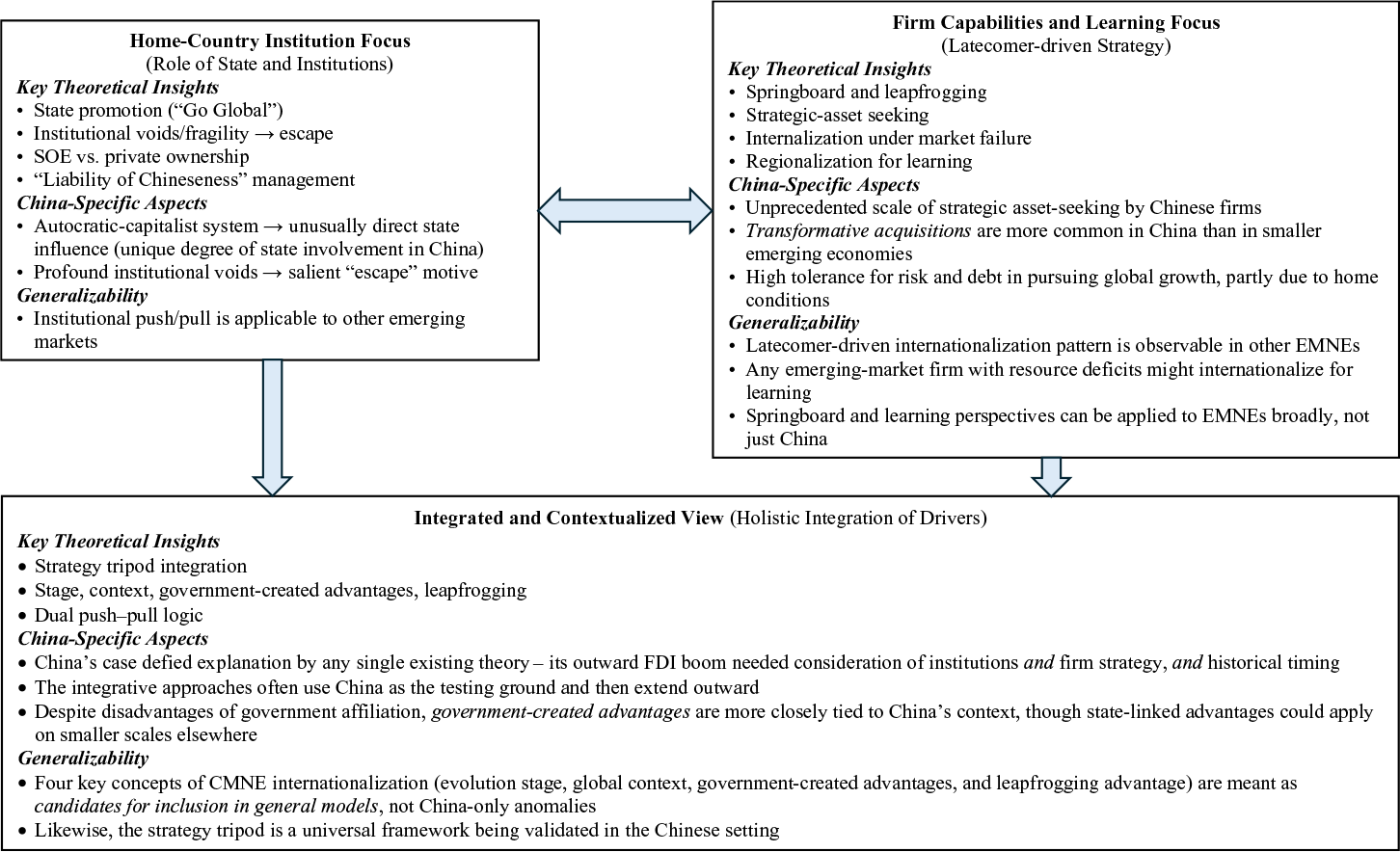
A wide range of theoretical perspectives has been used in the study of MNEs, some of which are more relevant to the internationalization of CMNEs than others. In this section, we synthesize nine key perspectives into broader thematic categories, highlighting how some emphasize home-country institutions while others focus on firm capabilities and learning, and we discuss integrative insights. This approach reveals why earlier studies stressed certain aspects, such as state ownership and strategic asset seeking, and clarifies which insights are specific to China and which are generalizable. As Deng (Reference Deng2012) observed, early research on Chinese outward foreign direct investment (OFDI) clustered around a ‘latecomer’ perspective and the role of the state. Such an approach also supports a critical argument that CMNEs constitute a distinct phenomenon worth theorizing – albeit one that also enriches broader EMNE theory (Ramamurti & Hillemann, Reference Ramamurti and Hillemann2017). In this section, we first present two primary themes of CMNE theorization, i.e., 1) home-country institutional influences on CMNE internationalization as a macro-level theorization that focuses on the external driving forces, and 2) firm capabilities, learning, and latecomer strategies, which examines firm-level driving forces for internationalization. We then present an integrative view of different perspectives and argue for the distinctiveness of CMNEs.
Home-Country Institutional Influences on CMNE Internationalization
One set of theoretical perspectives highlights how China’s unique institutional context has shaped CMNEs’ internationalization. Many early CMNEs were SOEs that followed the government’s ‘Go Global’ mandate. Related research emphasized home institutions and the role of the state and domestic institutional constraints (Deng, Reference Deng2012). These perspectives argued that formal and informal home-country institutions are decisive in OFDI, such as in Peng, Wang, and Jiang (Reference Peng, Wang and Jiang2008), who introduced the institution-based view. Other research showed how CMNEs enjoyed government support that provided ‘government-created advantages’ for competing abroad, while simultaneously facing bureaucratic hurdles and underdeveloped market institutions at home (Ramamurti & Hillemann, Reference Ramamurti and Hillemann2017). Meanwhile, work by Ramasamy, Yeung, and Laforet (Reference Ramasamy, Yeung and Laforet2012) identified a dichotomy in foreign direct investment (FDI) motivations: SOEs tended to invest abroad for resource security, whereas privately owned enterprises (POEs) were market-seeking. This dichotomy illustrates the state’s influence on the internationalization of Chinese firms.
Aside from the state, weak home institutions can push firms outward. The institutional escapism perspective argues that firms expand abroad to ‘escape’ unfavorable conditions in their home market. Luo, Xue, and Han (Reference Luo, Xue and Han2010) and later Shi, Sun, Yan, and Zhu (Reference Shi, Sun, Yan and Zhu2017) develop the concept of institutional fragility, describing how uneven progress in China’s institutional reforms creates internal frictions. Burdensome bureaucracy, corruption, or weak legal protections at home increase the appeal of investing in countries with strong institutions. However, CMNEs are pushed by home constraints but also pulled by opportunities in foreign markets.
The scale of state ownership and the formidable level of government coordination of economic activities make the resulting theory on CMNEs somewhat China-specific. Although other emerging economies have SOEs and weak institutions, China’s combination of a politically centralized economic system and the unique nature of its reforms is distinctive. Moreover, as another layer of uniqueness, Chinese firms must also face the legitimacy challenge identified as a ‘liability of Chineseness’. Consequently, legitimacy-building strategies are prominent to align with host institutional norms (Lee, Choi, Xiao, Lew, & Park, Reference Lee, Choi, Xiao, Lew and Park2024). As such, institution-based perspectives on CMNE internationalization must consider how home institutional conditions both push and pull Chinese firms toward OFDI. That said, we must also consider firm-specific differences in how CMNEs leverage or internalize home country-based advantages as well as their own capabilities (Wang, Hong, Kafouros, & Wright, Reference Wang, Hong, Kafouros and Wright2012).
Firm Capabilities, Learning, and Latecomer Strategies
A second set of theories explains Chinese OFDI through the lens of firm-specific motivations and capabilities. A secondary theme in this set of theories is CMNEs’ latecomer status. A consistent approach in this stream is that CMNEs expanded abroad not to exploit existing firm-specific advantages (FSAs), but to compensate for what they lacked. Lacking cutting-edge technology, brands, and managerial know-how, Chinese firms turned to outward investment to acquire these resources, in the same way that incoming FDI into China also contributed to the same organizational gains amongst domestic companies in China. The springboard perspective holds that international expansion serves as a ‘springboard’ to obtain critical assets (Luo & Tung, Reference Luo and Tung2007). Moreover, counter to internationalization theory, many CMNEs engaged in leapfrogging moves such as large-scale acquisitions in developed country markets to rapidly overcome their latecomer disadvantages (Li, Fan, Kumar, & Ananthram, Reference Li, Fan, Kumar and Ananthram2024; Li, Prashantham, Zhou, & Zhou, Reference Li, Prashantham, Zhou and Zhou2022). This form of FDI enabled CMNEs to level the playing field with established MNEs, as these firms pursued foreign strategic assets to compete better globally (Li et al., Reference Li, Fan, Kumar and Ananthram2024; Li, Shapiro, Peng, & Ufimtseva, Reference Li, Shapiro, Peng and Ufimtseva2022; Luo & Tung, Reference Luo and Tung2007).
Closely related is the organizational learning perspective. CMNEs enter foreign markets to absorb advanced knowledge and transfer these learnings back to the domestic market (Lee, Choi, & Xiao, Reference Lee, Choi and Xiao2021). Foreign subsidiaries and acquired units become ‘schools’ for CMNEs to learn R&D, management practices, and other needed capabilities. Foreign market exposure enhances a CMNE’s absorptive capacity and fosters innovation (Lee et al., Reference Lee, Choi and Xiao2021). Such learning-driven internationalization is argued to be key to CMNEs’ rapid growth (c.f., Cooke et al., Reference Cooke, Wu, Zhou, Zhong and Wang2018; Lyles, Tsang, Li, Hong, Cooke, & Lu, Reference Lyles, Tsang, Li, Hong, Cooke and Lu2022). This pattern is not unique to China, as many other EMNEs have also acquired European and North American companies for technology or brands.
Another angle on capability-building is provided by extensions of internalization theory. Buckley et al. (Reference Buckley, Clegg, Cross, Liu, Voss and Zheng2007, Reference Buckley, Clegg, Voss, Cross, Liu and Zheng2018) applied internalization to identify how capital market imperfections in China and special ownership advantages motivated CMNEs’ FDI (Buckley et al., Reference Buckley, Clegg, Cross, Liu, Voss and Zheng2007, Reference Buckley, Clegg, Voss, Cross, Liu and Zheng2018). Notably, Buckley’s study concluded that Chinese FDI determinants were like those of developed-country MNEs, reducing the need for new theorizing.
Rugman and Li (Reference Rugman and Li2007) argued that Chinese firms indeed lacked strong proprietary advantages (or FSAs) and instead leveraged country-specific advantages to enable international expansion. Given this view, the focus for international expansion was on culturally close markets where the liability of foreignness was low (Lu, Ma & Xie, Reference Lu, Ma and Xie2022; Rugman & Li, Reference Rugman and Li2007). Again, CMNEs placed a high priority on knowledge acquisition, which is reasonable given their limited technological FSAs. However, as CMNEs closed competitive disadvantage gaps, this motivation and form of FDI decreased in intensity (Lu et al., Reference Lu, Ma and Xie2022; Rugman & Li, Reference Rugman and Li2007).
In summary, these perspectives portray Chinese companies as proactive agents striving to overcome latecomer disadvantages through international expansion. These theories underscore novel behaviors like leapfrogging internationalization that deviate from Uppsala-rooted internationalization patterns. Yet, at the same time, many of these ideas are not entirely unique to China, and they can be applied to other emerging markets that face capability gaps. What sets CMNEs apart is the scale and speed of this behavior, as facilitated by ample state support and the coordination and size of CMNEs, which is a consequence of China’s market size.
Integrative Perspectives and the Distinctiveness of CMNEs
Recent work has moved toward integrative frameworks that combine firm-level and institutional factors (c.f., Cooke et al., Reference Cooke, Wu, Zhou, Zhong and Wang2018). These approaches strive to explain Chinese MNEs’ internationalization by looking at a configuration of multiple influences. One example is the strategy tripod framework (Pe et al., Reference Peng, Wang and Jiang2008), which argues that a complete explanation of international strategy requires joint consideration of firm resources, industry conditions, and institutional factors. Gaur, Ma, and Ding (Reference Gaur, Ma and Ding2017) support this argument by reinforcing the integrative view that no single factor is sufficient to explain CMNEs’ FDI. The strategy tripod perspective thus answers the call to go beyond one-dimensional explanations and acknowledges that CMNE behavior results from an interplay of firm, industry, and institutional elements, which more accurately captures the complexity of market competition in China in the 2000s.
Interestingly, Ramamurti and Hillemann (Reference Ramamurti and Hillemann2017) do not attribute the uniqueness of CMNEs to an amorphous idea of ‘Chineseness’. Instead, they identify four analytically useful variables behind Chinese MNEs’ distinctive patterns. These four are the firm’s evolution stage, the global context, government-created advantages, and leapfrogging advantages. Crucially, none of these four factors is inherently exclusive to China – they may also characterize other emerging-market MNEs and thus could be incorporated into a generalized internationalization theory. Importantly, however, it is the confluence of the four found at the same point in time in China that could well be the unique defining feature of CMNEs.
Given this overview, the question remains: why are CMNEs a distinct phenomenon worth theorizing? The argument is simply that CMNEs combined a unique set of circumstances, in terms of an unprecedented context of high growth rates, a set of substantially large companies, as tied to substantial institutional distances between home and host markets, and perceptual and other challenges to internationalization, all in an environment in which technological progress was accelerating. These contextual features vary considerably from the 1970s to 1990s, when markets were relatively more stable, technological progress was increasing but with fewer game-changing innovations, and international business flows were from developed markets to developed markets where institutions were similar, or from developed markets to less-developed markets, where incumbent advantages overcame institutional deficiencies. Given this overarching set of circumstances, alongside the evidence that has been accumulated to date, it is reasonable to argue that CMNEs are a context worthy of more acute and potentially more unique theorizing. The goal, as always, should be to understand a phenomenon better, but also to hopefully learn boundary conditions, such as which lessons apply to all MNEs or to other MNEs from emerging economies.
Figure 1 illustrates our arguments in this section in a conceptual model of how these themes interconnect: home-country institutional forces and firm-specific drivers jointly shape the aggressive internationalization strategies of CMNEs, which in turn enable these firms to overcome latecomer disadvantages and evolve at an unprecedented pace into competitive global players.
An analytical framework of synthesized institutional and firm–level drivers of CMNE internationalization

Contributions From This Special Issue
Building on the theoretical foundations of prior literature on CMNEs, this special issue, consisting of eight empirical papers in addition to this introduction paper, aims to continue extending the theoretical and empirical frontiers in this field. The eight papers cover various topics from different theoretical angles using several methods for data collection. These papers highlight key aspects crucial to understanding CMNEs, including the political landscape, power relationships, corporate capabilities, and corporate social (ir)responsibilities and performance.
For instance, Guan, Liu, Young, and Zhang (Reference Guan, Liu, Young and Zhang2025) propose a micropolitical model that explains how CMNE subsidiaries use internal political strategies to persuade multi-level decision makers at headquarters to approve OFDI. Zou, Ghauri, and Song (Reference Zou, Ghauri and Song2025) adopt a biomimetic perspective to demonstrate how emerging-market hybrid SOEs (EM-SOEs) manage stakeholder relationships in international markets through long-term sustainability strategies. Jean, Kim, Cavusgil, and Chen (Reference Jean, Kim, Cavusgil and Chen2025) address the phenomenon of online de-internationalization and identify how key internal and external factors, including political networking and technological opportunism, affect the disruption of Chinese export firms’ digital platforms. Liu, Zhu, Wei, and Wu (Reference Liu, Zhu, Wei and Wu2025) explore how the breadth and depth of political connectivity differ and uncover that they have conflicting effects on Chinese firms’ OFDI activities.
Li (Reference Li2025) extends the springboard perspective and demonstrates that market-seeking internationalization strategies strengthen the dynamic capabilities of large Chinese manufacturers and eventually promote digital transformation. Oh, Zeng, and Oh (Reference Oh, Zeng and Oh2024) examine how media coverage of corporate social irresponsibility affects the likelihood of completing an acquisition deal, particularly for SOEs or countries with high institutional standards. Cui, Lew, Khan, and Lu (Reference Cui, Lew, Khan and Lu2024) reveal how Chinese high-tech firms realize innovation-based internationalization through a three-stage process of overseas venture incubation, parenting, and spin-off, shedding light on the role of the parent firm. Finally, Wang and Xiao (Reference Wang and Xiao2025) theoretically model and empirically test how pressure from home and local governments, and firm-level capabilities such as the organizational tendency to pursue strategic assets and digitalization capabilities, influence corporate social performance and competitive advantage.
Even with their diverse topics and methodologies, these eight papers share critical commonalities. Most notably, institutional complexity and relationships with governments are pivotal factors in determining CMNEs’ strategies and actions. Political connectivity – whether in the home country or in foreign markets – appears as a recurrent theme in several of the eight studies (e.g., Guan et al., Reference Guan, Liu, Young and Zhang2025; Liu et al., Reference Liu, Zhu, Wei and Wu2025; Wang & Xiao, Reference Wang and Xiao2025; Zou et al., Reference Zou, Ghauri and Song2025). Similarly, a few papers (e.g., Cui et al., Reference Cui, Lew, Khan and Lu2024; Jean et al., Reference Jean, Kim, Cavusgil and Chen2025; Li, Reference Li2025) underline the importance of organizational learning, capability development, and technological adaptation in driving cross-border expansion. Other papers (e.g., Oh et al., Reference Oh, Zeng and Oh2024; Zou et al., Reference Zou, Ghauri and Song2025) point out the growing need for effective stakeholder management and legitimacy as CMNEs operate in an increasingly closely monitored international environment. These collective insights are significant because they illuminate how CMNEs respond to institutional pressures while simultaneously pursuing strategic autonomy, thereby blending the conventional dichotomies of state and market, control and flexibility, and exploration and exploitation.
Although the empirical patterns observed in these papers are congruent with phenomena exhibited in incumbent MNEs, these studies also emphasize noticeable differences specific to CMNEs. First, in the Chinese context, the roles of state ownership structure and political embeddedness are much more prominent, as evident in the disproportionate influence and multidimensional political connectivity of SOEs described by Liu et al. (Reference Liu, Zhu, Wei and Wu2025) and Zou et al. (Reference Zou, Ghauri and Song2025). Second, Chinese firms have a propensity to operate within a unique ideological and institutional framework where party-state logic and commercial incentives coexist, which creates distinctive tensions and opportunities, such as the need to build internal coalitions (Guan et al., Reference Guan, Liu, Young and Zhang2025) or the management of dual legitimacy expectations (Oh et al., Reference Oh, Zeng and Oh2024; Wang & Xiao, Reference Wang and Xiao2025). Third, the learning mechanism presented by Li (Reference Li2025) and Cui et al. (Reference Cui, Vertinsky, Wang and Zhou2023) suggests that Chinese firms are likely to pursue an experimental way of internationalization, as opposed to the more systematic approach used by European and North American MNEs. Finally, geopolitical risk is more evident for CMNEs as both a constraint and a facilitator, especially in politically sensitive industries or countries.
These studies extend the main arguments developed in this introduction paper by highlighting how CMNEs challenge, expand, and sometimes strengthen extant IB theories. First, they suggest that the universality of existing theoretical frameworks may be called into question when applied to firms that are deeply politically embedded and ideologically distinct. Second, they compel scholars to develop more elaborate and nuanced explanations of how political, institutional, and technological distance influences internationalization strategies (see Jean et al., Reference Jean, Kim, Cavusgil and Chen2025; Liu et al., Reference Liu, Zhu, Wei and Wu2025; Oh et al., Reference Oh, Zeng and Oh2024). Third, the papers underline the importance of non-market strategies and stakeholder logics and serve as a bridge connecting IB research with the political economy and business ethics literature (e.g., Oh et al., Reference Oh, Zeng and Oh2024; Wang & Xiao, Reference Wang and Xiao2025; Zou et al., Reference Zou, Ghauri and Song2025). Fourth, these studies depict CMNEs as active innovation agents that are reshaping the landscape of global competition and emphasize their gradual evolutionary characteristics. In this vein, this special issue contributes to a pluralistic and context-sensitive understanding of 21st-century internationalization processes. But more could be done, as we outline in the next section.
Extending Theories of CMNEs – Suggestions for Future Research
The global environment became increasingly complex for CMNEs in the 2020s, as driven by escalating geopolitical tensions, economic protectionism, technological rivalry, the decoupling of major economies, and a global landscape characterized by heightened state intervention (Cui et al., Reference Cui, Vertinsky, Wang and Zhou2023; Tung et al., Reference Tung, Zander and Fang2023; Witt, Reference Witt2019). Globalization encountered substantial challenges. These dynamics reshaped the international strategies of CMNEs, forcing them to reconsider their approaches to global markets and adapt to the rise of protectionist policies. These tensions, however, also catalyze innovation and diversification as CMNEs build resilient and adaptive strategies. In response, leading Chinese firms adopted new or revised business models to become more competitive internationally, primarily through emerging technological leadership or deeper cost advantages. For instance, companies such as Huawei and SMIC were impacted by US sanctions on technology exports, leading them to seek alternative markets and invest heavily in domestic R&D to reduce their reliance on foreign technologies (Kong, Liu, Narayan, & Sharma, Reference Kong, Liu, Narayan and Sharma2024). These strategic shifts reflect CMNEs’ need to mitigate geopolitical exposure and strengthen technological self-sufficiency. This context posed challenges for CMNEs seeking to expand abroad (Beattie, Reference Beattie2024).
Similarly, a major consequence of decoupling and protectionism is the fragmentation of global supply chains, which forces companies to choose between aligning with US-based or China-based ecosystems. Decoupling also increases costs for CMNEs, as they must navigate a complex and fragmented global economy (Tse, Meyer, Pan, & Chi, Reference Tse, Meyer, Pan and Chi2024). In response, firms adopted strategies such as building redundancies into their supply chains, localizing production, and forming joint ventures in politically neutral regions. At the same time, many CMNEs have demonstrated exceptional speed in internationalizing, often scaling into global markets within a few years. BYD’s expansion into 70 countries from 2021 to 2025 is but one example. This global expansion is frequently driven by digital capabilities, manufacturing scale, or strong outbound policy support, unlike the slower and state-guided expansion of traditional SOEs.
These actions highlighted CMNEs’ strategic recalibrations made in response to institutional and political pressures. The consequence is a substantial opportunity for researchers to engage with this phenomenon to advance research on the international strategies and the business models of CMNEs. Questions of theoretical note include: What will be the critical factors that affect CMNEs’ ability to transform into global leaders in the future? What are the key characteristics of international business model innovation in CMNEs? How do CMNEs differ from MNEs from other countries of origin, including other EMNEs? How can CMNEs improve their image and reputation to encapsulate themselves as being innovative and socially responsible?
Following this, to extend our knowledge of CMNEs and develop robust theorization, we identify five related themes for future research. They are: 1) International strategy in the context of international sanctions and intensifying geopolitical tension; 2) Technological distance; 3) Language distance; 4) Ideological distance; and 5) Adopting an integrated approach to researching ‘distance’ (see Table 1). We also indicate the theoretical perspectives through which these five themes can be examined. Although the suggested theoretical angles are not new to IB per se, they have either not been well used in IB (e.g., transnational social spaces, realism and pragmatism) or applied to CMNEs (e.g., dynamic distance).
Future research on CMNEs: Themes and research questions

Source: Developed by the authors.
Given the rapid development of the IB landscape and the emerging business models and international strategies of CMNEs, it is critical that we engage with these theoretical lenses to conceptualize recent developments related to CMNEs. Such an endeavor will complement existing theories related to CMNEs (see Theoretical perspectives of CMNEs) and extend our theoretical insights to CMNEs. In other words, while early theories on CMNEs focused on why CMNEs internationalize and what factors influenced their internationalization strategy, we now encourage scholars to examine in-depth how CMNEs operate in the complex IB environment, and what this means for theorization that is distinct to CMNEs, but may also have implications for MNEs from other countries of origin, especially emerging economies.
CMNEs in the Context of International Sanctions and Geopolitical Tensions
Theme 1: CMNEs in complex crises: Implications for capabilities and networks
CMNEs have faced international economic sanctions amid intensified geopolitical tensions in the 2020s (Cui et al., Reference Cui, Vertinsky, Wang and Zhou2023; Germann, Rolf, Baines, & Starrs, Reference Germann, Rolf, Baines and Starrs2024; Luo & Van Assche, Reference Luo and Van Assche2023; Melin, Sosa, Velez-Calle, & Montiel, Reference Melin, Sosa, Velez-Calle and Montiel2023; Meyer, Fang, Panibratov, Peng, & Gaur, Reference Meyer, Fang, Panibratov, Peng and Gaur2023). However, constrained by both external and internal factors, CMNEs have responded differently to address issues arising from international sanctions. That said, there remain opportunities to better understand how CMNEs have developed dynamic organizational capabilities and strategies to overcome the adverse impacts of international sanctions and how doing so can heighten their vulnerability (Cui et al., Reference Cui, Vertinsky, Wang and Zhou2023; Witt, Reference Witt2019).
Teece, Pisano, and Shuen (Reference Teece, Pisano and Shuen1997: 516) define dynamic capabilities as a firm’s ‘capacity to renew competencies so as to achieve congruence with the changing business environment’ by ‘adapting, integrating, and reconfiguring internal and external organizational skills, resources, and functional competencies’. Dynamic capability theory emphasizes organizational adaptability and organizational learning in rapidly changing and precarious business environments to sustain and develop critical resources (Zahra, Petricevic, & Luo, Reference Zahra, Petricevic and Luo2022). It is highly relevant to study CMNEs in the context of international sanctions because sanctions are usually imposed on short notice but remain in place for a long period, with their knock-on effects felt long after they are lifted. The pronounced impact sanctions have on the business environment means that MNEs need to reconfigure their intangible and tangible assets, as well as strategies, to survive and thrive.
Although dynamic capability theory has been increasingly applied in IB research (e.g., Forsgren & Yamin, Reference Forsgren and Yamin2023; Pitelis & Teece, Reference Pitelis and Teece2010; Teece, Reference Teece2014; Zahra et al., Reference Zahra, Petricevic and Luo2022), much of the scholarship has focused on how MNEs can develop their dynamic capabilities globally in times of stability (Dunning & Lundan, Reference Dunning and Lundan2010). This scholarship has yet to be expanded to examine how CMNEs can adapt to a turbulent business environment by developing capabilities to identify risks, build competencies, and generate new resources in the context of international economic sanctions. We call for research examining the challenges CMNEs face in operating in sanctioned environments and how they manage them. Importantly, what corporate dynamic capabilities are required to manage in the context of international sanctions and other critical situations?
International sanctions and other geopolitical tensions tend to disrupt MNEs’ existing social networks and transnational social spaces, with direct and indirect impacts on their businesses (Cooke & Wood, Reference Cooke, Wood, Geppert, Bozkurt and Dörrenbächer2026). Transnational social spaces represent the playing field where members of transnational communities interact. MNEs engage in a dynamic interplay with competing governments and other institutional actors, including transnational actors, thereby producing and reproducing global social relations; at the same time, each actor seeks to advance its own specific agendas (Burmester, Reference Burmester, Bozkurt and Geppert2021). In the context of international sanctions and other geopolitical tensions, it is in the interests of CMNEs to rebuild their business networks and transnational social spaces. Anecdotal evidence concerning CMNEs in the 2020s suggests rapid and intriguing changes to their business models in response to potential and realized sanctions. Scholars can let their research be guided by the overarching question: How can CMNEs adapt and/or recreate their international networks and transnational social spaces to sustain their businesses?
CMNEs through the Lens of Distance
The concept of distance is central to IB research (Cuervo-Cazurra & Genc, Reference Cuervo-Cazurra and Genc2012; see also Hutzschenreuter, Kleindienst, & Lange, Reference Hutzschenreuter, Kleindienst and Lange2016; Kostova, Beugelsdijk, Scott, Kunst, Chua, & van Essen, Reference Kostova, Beugelsdijk, Scott, Kunst, Chua and van Essen2020 for reviews). Ghemawat (Reference Ghemawat2001) consolidated distance into four dimensions in the CAGE model: cultural, administrative, geographic, and economic. More than 20 years after CAGE and nearly 40 years after the initial ideas of cultural distance were promoted, the notion of ‘distance’ has expanded in several ways in the IB field. Institutional distance (see Kostova et al., Reference Kostova, Beugelsdijk, Scott, Kunst, Chua and van Essen2020 for a review), refined measures of cultural distance, corruption distance (Godinez & Liu, Reference Godinez and Liu2015), psychic distance (Dikova, Reference Dikova2009), language distance (Vidal-Suárez & López-Duarte, Reference Vidal-Suárez and López-Duarte2013), and technological distance (Wang & Zhao, Reference Wang and Zhao2018) are all part of the distance universe of concepts.
Institutional distance has been the most examined dimension. It has been featured from numerous angles, such as a historical perspective (Kedia & Bilgili, Reference Kedia and Bilgili2015), from the perspective of formal versus informal institutional distance (Golesorkhi, Mersland, Randøy, & Shenkar, Reference Golesorkhi, Mersland, Randøy and Shenkar2019), for headquarters-subsidiary relationships (Li, Jiang, & Shen, Reference Li, Jiang and Shen2016), for ownership strategy (Du & Boateng, Reference Du and Boateng2015; Eden & Miller, Reference Eden and Miller2004), and for MNE performance (Trąpczyński & Gorynia, Reference Trąpczyński and Gorynia2017). Recently, there has been a wave of new thinking, theorizing, and empirical inquiry within IB that challenges how we understand distance. Here, we highlight what we argue to be the three most important and under-examined dimensions of distance – technological distance (Belderbos, Du, & Slangen, Reference Belderbos, Du and Slangen2020), language distance (Michalski & Śliwa, Reference Michalski and Śliwa2021), and ideological distance (Kempf, Luo, Schäfer, & Tsoutsoura, Reference Kempf, Luo, Schäfer and Tsoutsoura2023; Mallinson, Reference Mallinson2021) – in the context of understanding CMNEs.
Theme 2: Technological distance
Technological innovation has taken a great variety of forms, as evidenced by the first three industrial revolutions. However, what is unprecedented in the Fourth Industrial Revolution (Industry 4.0) is the speed of breakthroughs and the novel applications of digital technology, and the distance this rapid technological development is creating across countries with consequent political, economic, and social implications. The concept of technological distance is not new. For example, Gilsing, Nooteboom, Vanhaverbeke, Duysters and Van Den Oord (Reference Gilsing, Nooteboom, Vanhaverbeke, Duysters and Van Den Oord2008) argued that ‘the technological distance between partners, a firm’s network position (centrality) and total network density’ are three important dimensions in understanding the ‘innovation potential of a firm’s alliance network’.
When we consider technological distance, we can see that at the national level, there has been a widening digital distance between technological lagging countries and those that are advanced, and those that are advancing rapidly, in digital technology. Indeed, and unsurprisingly, the latter are racing ahead with new applications on one spectrum. But for the former, nations are still struggling to close the digital divide.
At the international level, the technological acquisition and technological application strategies of several IT CMNEs, such as Huawei, Tencent, and TikTok, have raised serious concerns in certain polities, leading to political interventions that present formidable challenges to their embeddedness in some of their key host countries. These actions challenge their credibility as global firms, especially in terms of a heightened discourse of China Threat. The semiconductor industry and the electric vehicle industry have also been in a period of rapid technological expansion (Germann et al., Reference Germann, Rolf, Baines and Starrs2024).
These phenomena bring to the fore several issues that warrant close examination. For instance, one of the important common assumptions in the literature is the need for EMNEs to go global to develop or acquire technology and catch up to MNE incumbents. Many EMNEs have used international expansion to secure technological leadership and/or internalize the ability to dominate the production of specific technologically advanced products (Fu, Fu, Romero, & Pan, Reference Fu, Fu, Romero and Pan2021). This means that prior theories for CMNEs’ motivation for internationalization, which leverage the learning and catching-up theme, are inadequate to capture CMNEs’ strategies and practices when they have become global technology leaders. How does a global leadership position in technology and the production of technology-intensive goods, and the resultant political complications, constrain (or enable) technology sharing across national boundaries, leading to new patterns of technological distance, which, in turn, substantially alter the international competitive landscape? How are CMNEs mobilizing their technological leadership to generate market and non-market resources?
Contemporary media in the 2020s increasingly drew attention to an escalating ‘Technology Cold War’ between China and the United States (The Economist, 2019). This so-called Technological Cold War leads to a fragmentation and divergence of the global digital ecosystem, thus potentially creating multiple incompatible digital systems that make strategic alliances and M&As more difficult and even ungainly to manage (c.f. Chen, Chen, & Dondeti, Reference Chen, Chen and Dondeti2020)? Will the proliferation of (incompatible) digital systems lead to a deepened fragmentation of the global market, challenge existing technological monopolies, and present challenges to digital governance? What implications does a ‘Technology Cold War’ (Tung et al., Reference Tung, Zander and Fang2023) or ‘techno-nationalism’ (Capri, Reference Capri2024) with combined ‘geopolitical, economic, national security, and ideological considerations’ (Luo, Reference Luo2021: 550) present to conceptualizing geopolitics, political institutions, and the political behavior of CMNEs in IB?
Theme 3: Language distance – More than linguistics
Language distance influences MNE activities in several ways, such as acting as a deterrence to cross-border acquisitions to avoid risk (Vidal-Suárez & López-Duarte, Reference Vidal-Suárez and López-Duarte2013) and by being a barrier to headquarters-subsidiary relationships. Notably, language distance encompasses not just linguistic differences. Language is politically and socially constructed. As such, language serves as a means to convey political discourse and management ideology, thereby creating power and exerting control at the macro level. At the micro level, language is a manifestation of organizational politics and hierarchy, as well as technical superiority (Tenzer & Pudelko, Reference Tenzer and Pudelko2017). Language barriers and distance affect organizational trust, employees’ identities, and knowledge transfer (Tenzer, Terjesen, & Harzing, Reference Tenzer, Terjesen and Harzing2017).
Recent work has highlighted how perceived language superiority does not go unchallenged. Gaibrois and Nentwich’s (Reference Gaibrois and Nentwich2020) study found that while having a strong command of English may bring perceived privileges to native English-speaking managers and administrative staff, especially as compared to non-English-speaking local service staff and migrant service staff, this hierarchy of privilege is increasingly being contested. Where employees are multilingual, some companies impose an official corporate language, albeit such a policy may bring more problems than it solves, not least because it goes against the spirit of diversity, equality, and inclusion (e.g., Sanden, Reference Sanden2020).
The persistent dominance of other languages in specific regions, such as Latin America, challenges assumptions of English universality. It can also directly and indirectly impact FDI choices (Mazouz, Wood, Yin, & Zhang, Reference Mazouz, Wood, Yin and Zhang2021). The rise of China has led to an increased use of Mandarin as a language of business (Kang, Reference Kang2017). A theme in the linguistics literature is that translation between languages is, at best, challenging, and in some languages, there are no direct translations for certain words and phrases (Ciuk, James, & Śliwa, Reference Ciuk, James and Śliwa2019). In turn, these forms of language distance may, for example, impact the level of misalignment between marketing and markets, or lead to breakdowns in daily workplace communications (Ciuk et al., Reference Ciuk, James and Śliwa2019).
Moreover, as with culture, languages are fluid. The uneven evolution of a given language worldwide poses challenges in translation. Even if English is a global language, there remain limits in terms of its ubiquity, given the continued vitality and growth of other world languages, the challenges of communication around the framework of a single language, and indeed, relative changes in the demographic and economic position of English-speaking countries (Fouskas, Roy-Mukherjee, Huang, & Udeogu, Reference Fouskas, Roy-Mukherjee, Huang and Udeogu2020; Westney, Piekkari, Koskinen, & Tietze, Reference Westney, Piekkari, Koskinen and Tietze2022).
As such, there is scope to extend the research on language distance using CMNEs. Examining the use of language in CMNEs across levels and settings can help extend the current literature on language in IB. For example, how does the language used by international political players shape the perceptions and reputations of CMNEs and create or enlarge other distances that may advantage or disadvantage CMNEs? How do perceived language distance and other distances, as a result, affect non-Chinese employees’ psychological wellbeing, motivation, performance, and intention to stay with a CMNE? What can CMNEs do to address setbacks caused by language distance? How can CMNEs mobilize language to reduce other types of distances? How does language distance influence the development and implementation of strategies, structure, and processes in CMNEs?
Theme 4: Ideological distance
The role of ideological distance, including political and cultural values and religious beliefs, has not been well-studied in the IB literature compared to other dimensions of distance. Ideological distance is a critical dimension that has led to formidable barriers to CMNEs in their globalization efforts and in implementing their IB strategies. We discuss the related research implications.
First, CMNEs may find it difficult to undertake FDI due to ideological distance. Kempf et al. (Reference Kempf, Luo, Schäfer and Tsoutsoura2023: 150) found that investors’ political ideology influenced international capital allocation, with the example of ‘syndicated corporate loans and equity mutual funds’, in that ‘ideological alignment on both economic and social issues’ played an important role and led to ‘variation in bilateral investment’. How can CMNEs overcome the barrier of ideological distance?
Second, reflecting the Chinese cultural values of pragmatism and the political approach of realism in managing international relations (Lewin & Witt, Reference Lewin and Witt2022; Li, Shapiro, et al., Reference Li, Shapiro, Peng and Ufimtseva2022; Luo, Reference Luo2021; Meyer & Li, Reference Meyer and Li2022), CMNEs’ philosophy and approach to managing international relations and business challenges are distinct from those of other MNEs. This difference can be used to call into question their legitimacy by those who hold different values and approaches. The role of the Chinese State in international economic expansion has been used to question the motives and legitimacy of CMNEs (e.g., Zhou et al., Reference Zhou, Prud’homme and Liu2025). For example, Lewin and Witt (Reference Lewin and Witt2022: 266) argue that China’s BRI ‘is, at its core, a political initiative that plays out domestically and internationally’. The BRI addresses the problem of slow domestic economic growth and domestic overcapacity, while advancing China’s geopolitical ambitions and positions (Sutherland, Anderson, Bailey, & Alon, Reference Sutherland, Anderson, Bailey and Alon2020).
Meyer and Li (Reference Meyer and Li2022: 555) argue that the current geopolitical landscape and ‘external disruptions call for a reassessment of theories regarding the nature of global strategy and the interaction between businesses and their political environment’. They suggest that ‘the international relations perspectives of realism, liberalism, and constructivism help explain the nature of the disruptions, and hence can inform strategy scholarship in explaining and examining strategic responses to such external disruptions’. Meyer and Li’s (Reference Meyer and Li2022) arguments are apt for CMNE research. Realism and pragmatism may offer significant explanatory power to advance theories concerned with interpreting CMNEs’ international strategies, corporate behaviors, business models, problem-solving approaches, and performance.
Third, CMNEs may find it difficult to embrace some of the values promoted by European and North American countries, such as LGBT+, as it is not a social value widely shared or legally protected in China, but it is nonetheless tacitly tolerated and quietly accommodated in China. As such, CMNEs may not prioritize promoting human resource management policies and practices found in different parts of the world. Similarly, CMNEs may adopt management policies and practices that are not common in a host country, provided they are not opposed there (Cooke et al., Reference Cooke, Wu, Zhou, Zhong and Wang2018).
The ideological distance between China and other countries, and between CMNEs and MNEs of other countries of origin, suggests that scholarly research on MNEs may be best advanced by shifting debates away from normative assumptions about values. For example, a popular assumption in IB research is that corruption is endemic in less developed countries and negatively affects MNEs. A logical question that follows is: ‘How can MNEs mitigate corruption in developing countries’? However, many developed country MNEs have been found guilty of engaging in corrupt behavior; the definition of corruption varies across institutional and societal contexts, and the cost of corruption or anti-corruption may be disproportionately borne by less developed countries rather than MNEs. Therefore, we may ask: ‘Are MNEs victims or tacit participants in corruption activities’? (Cooke, Wang, & Wood, Reference Cooke, Wang and Wood2022). Another popular assumption is that ‘state intervention is a typical phenomenon of autocratic regimes’. However, state intervention exists in democratic regimes, as well. If, for instance, we adopt a pluralistic view rather than a dichotomist view, and avoid normative assumptions about what is best: we can begin from the point that good and bad governance can be found in both democratic and autocratic regimes. We can then raise the better question of identifying what works and what does not work in different regional and national settings from a values or assumption-agnostic perspective and then ask, why it does or does not work, and what can be learned from it.
Theme 5: Adopting an integrated and dynamic approach to researching ‘distance’
Integrated and systemic thinking is an advantageous approach when many phenomena are, in one way or another, interrelated (Kay, Leih, & Teece, Reference Kay, Leih and Teece2018). In a broad sense, institutional approaches may encompass not only formal institutions but also informal ones (Dilli, Elert, & Herrmann, Reference Dilli, Elert and Herrmann2018). Informal institutions include a wide range of embedded behaviors around culture and language. Formal institutions can vary greatly from country to country, as do the institutions related to the technological environment (Kafouros, Wang, Piperopoulos, & Zhang, Reference Kafouros, Wang, Piperopoulos and Zhang2015).
Distance is not static. It evolves and changes. Moreover, different types of distance interact with one another, creating new dynamics and generating interactive effects. Therefore, the core dimensions of distance need to be investigated at multiple levels. For example, at the macro level, language distance may encompass the political discourse used in political campaigns, which may affect the perceived investment environment and the subsequent opportunities host countries offer to foreign firms. Shifts in the relative influence of language can occur alongside economic and demographic changes. At the micro level, such changes can include the dominant language within an MNE, as well as variations between the MNE’s official language and the language of its office culture. These differences in language can privilege or disadvantage certain groups of employees, leading to internal conflicts and psychological distance, which are topics that remain underexplored in the IB field.
We hence call for an integrated and dynamic approach to examine the intersectionality and compounded effects of the types of distance at multiple levels as they evolve and interact with one another. Institutional distance, cultural distance, corruption distance, technological distance, psychic distance, and so forth have been largely studied in parallel, leaving their interactive effects poorly understood. For instance, is it reasonable to ask how technological distance manifests itself as language distance and institutional distance? That said, defining and measuring distances remains a challenging task for IB researchers (Kostova et al., Reference Kostova, Beugelsdijk, Scott, Kunst, Chua and van Essen2020). However, there have been efforts to create better measures (see Simon & Sick, Reference Simon and Sick2016, for methods of measuring technological distance). Nevertheless, theorizing and measuring the compounded effects of distance will be challenging.
The related questions are many. For example, will distance always result in a diminished capacity to overcome local challenges or lead to reductions in the probability of FDI? Other questions include: Will linguistic and historical ties help overcome other distances (e.g., Grande & Teixeira, Reference Grande and Teixeira2012)? Will the technological distance between the two economies provide a strong incentive for Chinese outward FDI to narrow it? Will narrowing the digital distance be beneficial in fighting corruption and thus reducing the corruption distance? Or will this have countervailing effects, such as intensifying the degree and pace of technological rivalry between CMNEs and their international counterparts? How may we better theorize the connected nature of these questions and underlying phenomena related to CMNEs, with generalizable implications for MNEs? We encourage researchers to investigate these and other research questions (see Table 1).
Conclusion
This introduction paper links contemporary developments in CMNEs and their global business environment to implications for IB theory. Numerous opportunities exist to develop novel theories and extend existing ones. The context of rapid technological innovation, coupled with intense geopolitical tensions and trade wars, puts pressure on CMNEs to innovate in their technologies, strategies, and business models. We ask scholars to more deeply consider whether theories used in prior research on CMNEs, such as springboard and learning theories, remain relevant in the 2020s wave of CMNE international expansion.
We ask this question because several key contemporary challenges have been confronting CMNEs’ international expansion and operations. These challenges are interrelated and have compounded effects. As such, these challenges are leading to long-term strategic responses from CMNEs, supported by one another and the State. We extend these ideas to illustrate how future research can deepen this line of enquiry by engaging directly with the contexts of international sanctions and geopolitical tensions in which CMNEs operate. Moreover, the technological distance, language distance, and ideological distance between China and other countries may impact CMNEs. We encourage IB scholars to continue to advance our understanding of CMNEs at this critical juncture by endeavoring to capture the latest steps in this rapidly changing phenomenon and connect this to indigenous theory development or phenomenon-inspired theory extensions.
Acknowledgements
The authors are grateful for the support and guidance from the MOR EIC Prof. Xiao-Ping Chen, as well as from all contributing authors and reviewers of the special issue. Maoliang Bu also acknowledges financial support from the National Natural Science Foundation of China (No. 72072088), the Fundamental Research Funds for the Central Universities, and the Nanjing University International Collaboration Initiative.
Fang Lee Cooke (Fang.Cooke@monash.edu) is a distinguished professor at Monash Business School, Monash University, Australia. She is a Fellow of the Academy of the Social Sciences in Australia. She has a long-standing research interest in emerging economies and has published extensively on strategies and practices of multinational enterprises. She is Co-Editor-in-Chief of Human Resource Management and International Business Review, Consulting Editor at the Journal of World Business, and a Senior Editor of MOR.
Maoliang Bu (bumaoliang@hotmail.com) is a full professor at Nanjing University and an adjunct professor at the Hopkins-Nanjing Center, which is part of Johns Hopkins University School of Advanced International Studies. His extensive research has been published in several leading academic journals, including the Journal of International Business Studies (JIBS), Strategic Management Journal (SMJ), and Journal of Comparative Economics. Prof. Bu currently serves as the Deputy Editor for Business & Society and as the Consulting Editor for Journal of International Management.
Jeoung Yul Lee (jlee@em-lyon.com) is professor of International Business at emlyon business school and Bayu Chair Professor selected by the Chongqing Municipality Education Commission. He is currently the Lead Guest Editor of a Journal of International Business Studies (JIBS) special issue, and serves as Associate Editor of The International Journal of Human Resource Management, Journal of Business Research, and Consulting Editor of JIBS. His nine papers have been published in the UTD24/FT50 journals, such as the JIBS, Journal of Management, Research Policy, and Human Resource Management.
Byung Il Park (leedspark@hufs.ac.kr) is a professor of International Business at the College of Business, Hankuk University of Foreign Studies (South Korea). His research focuses on multinational corporation (MNC) strategy, corporate social responsibility of MNCs, and small and medium-sized enterprises. He has published more than 80 papers in international journals, such as the Journal of World Business, International Business Review, Journal of International Management, Corporate Governance: an International Review, Journal of Business Research, Industrial Marketing Management, and Asia Pacific Journal of Management. He is a Consulting Editor for Entrepreneurial Business and Economics Review and serves as an Editorial Advisory Board Member for International Business Review.
Andrew Delios (andrew@nus.edu.sg) is a Provost’s Chair Professor and Vice-Dean at NUS Business School. His research focuses on strategy and international business, particularly within the context of emerging economies. A Fellow of the Academy of International Business, he has served as President of the Asia Academy of Management and held editorial roles at several leading management journals. He has authored 8 books and 100 journal articles, with his work appearing in journals such as the Academy of Management Journal, PNAS, Strategic Management Journal, and Journal of International Business Studies.