INTRODUCTION
Marine shell artifacts such as beads and ornaments hold particular interest for archaeologists. As portable works of art, the age, origin, and distribution of specific types of shell artifacts provide information on human mobility and the emergence and maintenance of long-distance exchange networks (Hughes and Bennyhoff Reference Hughes and Bennyhoff1986; Arnold Reference Arnold1992; Claassen and Sigmann Reference Claassen and Sigmann1993; Trubitt Reference Trubitt2003; d’Errico et al. Reference d’Errico, Vanhaeren, Barton, Bouzouggar, Mienis, Richter, Hublin, McPherron and Lozouet2009; Smith et al. Reference Smith, Cherkinsky, Hadden and Ollivier2016). In western North America, marine shell beads of the genus Olivella (=Callianax) that originated in the Pacific Ocean are regularly recovered from archaeological sites several hundred kilometers inland from their coastal origin (Bennyhoff and Hughes Reference Bennyhoff and Hughes1987; Hughes and Milliken Reference Hughes and Milliken2007). Direct dating and stable isotope provenance studies of Olivella beads suggest that far-reaching exchange networks that consisted of multiple trade routes and redistribution centers were established by the early Holocene (Vellanoweth Reference Vellanoweth2001; Eerkens et al. Reference Eerkens, Herbert, Rosenthal and Spero2005, Reference Eerkens, Rosenthal, Spero, Shiraki and Herbert2007, Reference Eerkens, Rosenthal, Spero, Stevens, Fitzgerald and Brink2009, Reference Eerkens, Rosenthal, Stevens, Cannon, Brown and Spero2010; Erlandson et al. Reference Erlandson, Macko, Koerper and Southon2005; Fitzgerald et al. Reference Fitzgerald, Jones and Schroth2005; Bottman Reference Bottman2006; Smith et al. Reference Smith, Cherkinsky, Hadden and Ollivier2016;). In addition to providing evidence of interaction between coastal and interior peoples, Olivella bead styles have proven to be excellent indicators of time periods and cultural phases (Bennyhoff and Hughes Reference Bennyhoff and Hughes1987; King Reference King1990; Groza et al. Reference Groza, Rosenthal, Southon and Milliken2011).
Radiocarbon (14C) dating of marine materials, including marine shell beads, is complicated by a variety of factors. It is well established that the marine carbon reservoir is depleted in 14C relative to the atmosphere, necessitating separate atmospheric and marine calibration curves (Stuiver and Polach Reference Stuiver and Polach1977; Stuiver et al. Reference Stuiver, Pearson and Braziunas1986). Variations in coastal geology, ocean circulation, upwelling, and freshwater inputs, among other factors, result in localized deviations from the global marine 14C reservoir. Corrections for these local offsets, termed ΔR, are used by archaeologists and radiocarbon researchers to calibrate 14C dates of marine materials. As archaeologists seek ever-greater chronological precision, it is imperative that all sources of dating error are evaluated carefully.
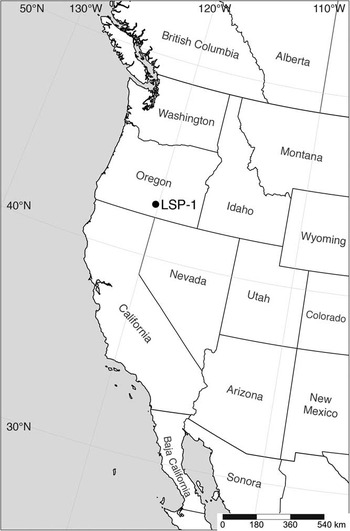
Previously, we addressed the questions of the age and origins of a collection of Olivella shell beads that had been recovered from the LSP-1 Rockshelter in south-central Oregon, USA (Figure 1), located 400 km inland from the Pacific Coast of North America (Smith et al. Reference Smith, Cherkinsky, Hadden and Ollivier2016). This included direct dating of beads by accelerator mass spectrometry (AMS), as well as stable isotope analyses to identify the stretches of coastline from which the shells originated (following Eerkens et al. Reference Eerkens, Herbert, Rosenthal and Spero2005, Reference Eerkens, Rosenthal, Spero, Shiraki and Herbert2007, Reference Eerkens, Rosenthal, Spero, Stevens, Fitzgerald and Brink2009, Reference Eerkens, Rosenthal, Stevens, Cannon, Brown and Spero2010). Our previous study indicated that the O. biplicata beads from LSP-1 were manufactured from shells that originated along the northern portion of the source region, i.e., from northern California to British Columbia, and dated to the early Holocene, making them the oldest known marine shell beads in the northern Great Basin region (Smith et al. Reference Smith, Cherkinsky, Hadden and Ollivier2016).
Study area and location of the LSP-1 Rockshelter.

In this paper we expand upon and re-examine the incremental carbon (14C and δ13C) and oxygen (δ18O) isotope data from two of the O. biplicata shell beads from the LSP-1 collection to explicitly address two common problems in dating marine shell trade goods: (1) the source region is large, in this case spanning of 2000 km of coastline, therefore there is uncertainty regarding the appropriate specification of ΔR; and (2) the 14C activity within individual specimens is variable. In this study we present additional 14C dates for the two shell beads to better characterize the intrashell variability in 14C. We discuss approaches for specifying ΔR that appropriately reflect the range of variability in the source region. Finally, we demonstrate a Bayesian approach to calibrating the shell dates, inspired by the “wiggle-matching” strategy commonly used for series of samples with known deposition rates, such as tree rings (Christen and Litton Reference Christen and Litton1995). In the case of marine mollusks, the growth geometry of the shell is used to define a sequential relationship among incremental 14C samples, while stable isotope sclerochronology is used to define the deposition rate. We conclude that while intrashell variability and uncertainty in ΔR are significant sources of dating uncertainty for Olivella beads, and likely other marine shell trade goods as well, the precision of the calibrated dates can be drastically improved by modeling.
Sample Treatment and Measurement Methodology
As previously described by Smith and colleagues (2016), the beads were manually cleaned and placed in an ultrasonic bath for 40 min to remove superficial contaminants, sonicated with dilute HCl for 15 min to leach surface contamination, and then rinsed in ultrapure (MilliQ) water and dried at 105°C.
We collected carbonate samples for δ13C and δ18O analyses by drilling in transects following the shell’s visible growth lines. Gastropod shells grow in a closed curve that increases its dimensions continuously as it revolves around a fixed axis (Raup Reference Raup1961). New layers of shell form on the interior surface and extend beyond the margins of previous layers, producing terrace-like growth increments that allow the shell to grow in thickness, as well as length, with shell accretion slowing as the animal ages. In absolute terms, the oldest portion of a gastropod shell is the outer surface of the apex, and the terminal edge of the lip is the youngest.
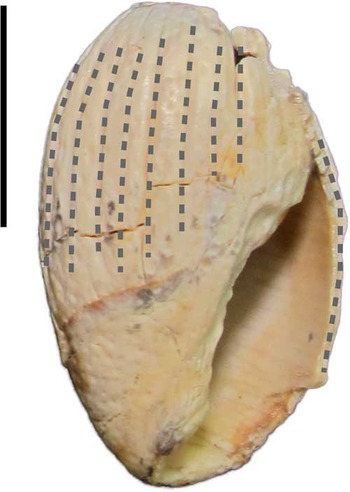
The first transect was drilled along the edge of the lip, and represents sea surface temperature (SST) conditions in the months prior to collection. Additional transects consisted of shallow troughs drilled from the surface at 1–2-mm intervals around the entire circumference of the body whorl of the shell, following the shell’s visible growth lines (Figure 2). Carbonate samples were drilled using a Dremel tool with a 0.5-mm carbide drill bit, and ranged from 0.8 to 2.8 mg in size. The samples were reacted under vacuum with 100% H3PO4 to recover CO2. Stable isotope ratios were measured on a Thermo Fisher MAT-253 stable isotope ratio mass spectrometer with a dual-inlet system and results are expressed with respect to PDB, with an error of less than 0.1‰. The error is quoted as one standard deviation and reflects both statistical and experimental errors.
Stable isotope sample transects on Olivella biplicata bead UGAMS-21826 shown in gray dashed lines. Solid black bar shown for scale (1 cm).

The first round of carbonate samples for AMS dating was collected after δ13C and δ18O samples were drilled, but before the stable isotope measurements were completed. Thus, the original sampling locations were not dependent on the stable isotope profiles. Approximately 15 mg of carbonate powder was drilled from the surface of each of three ontogenetic landmarks: (1) the lip of the shell, representing shell growth that occurred late in the life of the organism; (2) the spire region, representing shell growth that occurred relatively early in its life; and (3) a point approximately midway between the lip and spire. The resulting dates were previously reported by Smith and colleagues (2016).
A second round of carbonate samples for AMS dating was obtained from archived, excess sample material from the initial sampling transects. These samples ranged in size from 0.5 to 2 mg, and were selected to target local δ18O maxima and minima observed on the stable isotope profiles. The samples were reacted under vacuum with 100% H3PO4 to recover CO2. The resulting CO2 was cryogenically purified from the other reaction products and catalytically converted to graphite (Cherkinsky et al. Reference Cherkinsky, Culp, Dvoracek and Noakes2010). Graphite 14C/13C ratios were measured using the NEC 500 kV Tandem Pelletron accelerator mass spectrometer at the Center for Applied Isotope Studies (CAIS), University of Georgia, USA. The sample ratios were compared to the ratios measured from oxalic acid I (NBS SRM 4990). Carrara marble (IAEA C1) was used as the background, and travertine (IAEA C2) was used as a secondary standard. Size-matched background, primary, and secondary standards were prepared for the small carbonate samples. All 14C dates have been corrected for natural isotope fractionation using the measured stable carbon isotope ratio.
RESULTS AND DISCUSSION
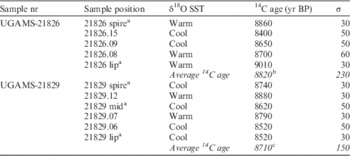
In our initial study we reported 2–3 14C measurements per shell; in the present study, we report 5–6 measurements per shell, presented in Table 1.
AMS for O. biplicata shell beads from the LSP-1 Rockshelter.

a Previously reported in Smith et al. (Reference Smith, Cherkinsky, Hadden and Ollivier2016).
b
T=125.1; critical value
 $\left( {\chi _{{0.05}}^{2} } \right)\!=\!9.5$
.
c
T=97.5; critical value
 $\left( {\chi _{{0.05}}^{2} } \right)\!=\!11.1$
.
The R_Combine() function in OxCal 4.2 (Bronk Ramsey Reference Bronk Ramsey2009) was used to calculate the weighted average age for each bead (Table 1). The function also implements the Ward and Wilson test (Reference Ward and Wilson1978) to test for internal consistency among groups of dates. Both beads exhibit significant intrashell variability in 14C, differing by as much as 600 yr within bead UGAMS-21826, and 360 yr within bead UGAMS-21829. In both cases the distribution of 14C dates was greater than expected based on the Ward and Wilson test statistics (see Table 1 footnote), therefore the standard deviation is listed as the measure of uncertainty for the weighted average age rather than weighted error, which is much smaller.
Researchers have reported intrashell variability on the scale of centuries in many areas including off the coast of Peru (Jones et al. Reference Jones, Hodgins, Dettman, Andrus, Nelson and Etayo-Cadavid2007, Reference Jones, Hodgins, Etayo-Cadavid, Andrus and Sandweiss2010), southern California (Culleton et al. Reference Culleton, Kennett, Ingram and Erlandson2006), Chesapeake Bay (Rick and Henkes Reference Rick and Henkes2014), and the Gulf of Mexico (Hadden and Cherkinsky Reference Hadden and Cherkinsky2015, Reference Hadden and Cherkinsky2016). Aquatic mollusks build their calcium carbonate shells largely, though not exclusively, from dissolved inorganic carbon (DIC) in the surrounding water (Tanaka et al. Reference Tanaka, Monaghan and Rye1986; McConnaughey and Gillikin Reference McConnaughey and Gillikin2008), therefore variability in 14C in short-lived aquatic mollusk shells is typically assumed to reflect the 14C content of the local DIC. The variability observed could reflect a combination of environmental factors such as upwelling, freshwater inputs, or carbon recycling, or life-history factors such as mobility or mode of feeding (e.g., Ingram and Southon Reference Ingram and Southon1996; Forman and Polyak Reference Forman and Polyak1997; Hogg et al. Reference Hogg, Higham and Dahm1998; Ulm Reference Ulm2002; Yoneda et al. Reference Yoneda, Shibata, Morita, Hirota, Suzuki, Uzawa, Ohshima and Dodo2004, Reference Yoneda, Uno, Shibata, Suzuki, Kumamoto, Yoshida, Sasaki, Suzuki and Kawahata2007; Culleton et al. Reference Culleton, Kennett, Ingram and Erlandson2006; Jones et al. Reference Jones, Hodgins, Dettman, Andrus, Nelson and Etayo-Cadavid2007; Rick et al. Reference Rick, Henkes, Lowery, Colman and Culleton2012; Hadden and Cherkinsky Reference Hadden and Cherkinsky2016). However, shell carbonate precipitated by marine organisms frequently is not in exact isotopic equilibrium with dissolved bicarbonate. Metabolic or “vital” isotope effects in marine mollusks are understood poorly, but are thought to reflect the contribution of respired CO2 to the shell (Tanaka et al. Reference Tanaka, Monaghan and Rye1986; Gilliken et al. Reference Gillikin, Lorrain, Meng and Dehairs2007).
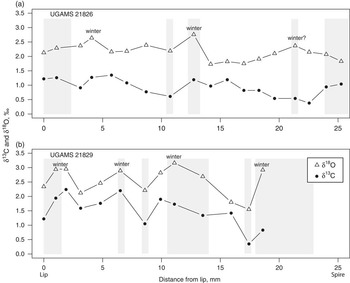
Eerkens et al. (Reference Eerkens, Herbert, Rosenthal and Spero2005, Reference Eerkens, Rosenthal, Stevens, Cannon, Brown and Spero2010) demonstrated that Olivella faithfully records a SST signal in its aragonitic shell. δ18O within modern Olivella shells from California reflect seasonal fluctuations in SSTs, with shell growing during the cooler months (winter) being more enriched in 18O, while shell growing in the warmer months (summer) is relatively depleted in 18O. Within individual Olivella beads (Figure 3), the oldest 14C ages coincide with warmer periods (Table 1), suggesting seasonal upwelling as a possible source of 14C-depleted water. Off the California coast, upwelling brings cold, 14C-depleted water to the surface during the summer months (Huyer Reference Huyer1983). Upwelling tends to peak in the summer off the Oregon coast as well, but also occurs sporadically throughout the year depending on the timing and intensity of strong northerly winds (Piner et al. Reference Piner, Hamel, Menkel, Wallace and Hutchinson2005). A parcel of newly upwelled water will warm quickly through interaction with the atmosphere, thus reducing the δ18O of shell precipitating in this water, while the 14C content of the upwelled water is conserved as it warms (Jones et al. Reference Jones, Hodgins, Etayo-Cadavid and Andrus2009). Alternatively, or in addition, seasonal inputs of terrestrial runoff may introduce 14C-depleted carbon dissolved from geologic sources, such as Tertiary marine sediments along the coastal range, or from the limestone-containing Myrtle Group or Otter Point Formation (Walker and MacLeod Reference Walker and MacLeod1991).
Sequential δ13C and δ18O data for (a) UGAMS-21826 and (b) UGAMS-21829. The stable isotope data are presented in order of ontogeny; the grey bars indicate the positions of the 14C samples with respect to the stable isotope profiles.

Selecting ΔR
The choice of ΔR is a potentially large source of dating uncertainty for marine shell, particularly for objects that were traded over great distances. O. biplicata are intertidal species found along the eastern Pacific coastline (Figure 1), from British Columbia to Baja California (Morris Reference Morris1966:99). The marine reservoir in this region is characterized by highly variable 14C activity due to a large extent to variability in ocean upwelling (Kennett et al. Reference Kennett, Ingram, Erlandson and Walker1997; Jones et al. Reference Jones, Hodgins, Dettman, Andrus, Nelson and Etayo-Cadavid2007, Reference Jones, Hodgins, Etayo-Cadavid, Andrus and Sandweiss2010; Culleton et al. Reference Culleton, Kennett, Ingram and Erlandson2006). Rapid environmental changes from the last glacial to interglacial transition (14–9 14C kyr BP) have been linked to long-term fluctuations in the marine reservoir in this region as well (Kovanen and Easterbrook Reference Kovanen and Easterbrook2002).
Previously, we concluded that UGAMS-21826 and UGAMS-21829 likely originated in estuarine environments in the northern extent of the species range, from northern California/southern Oregon, or perhaps farther north (Smith et al. Reference Smith, Cherkinsky, Hadden and Ollivier2016). The calibrated dates in that publication were based on local ΔR values within the source region (e.g., 290±35 14C yr for northern California following Ingram and Southon [Reference Ingram and Southon1996]), but did not account for the range of possible ΔR values for the source region as a whole.
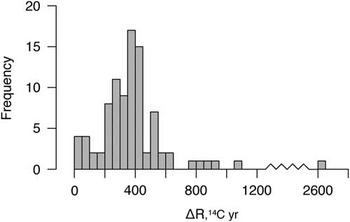
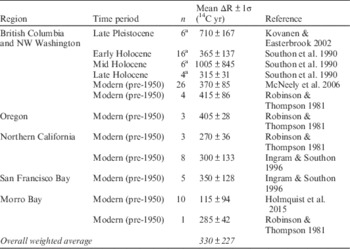
For this study we compiled ΔR data for the entire source region, from British Columbia to northern California, summarized in Table 2. ΔR values that were estimated from 14C measurements of known-age, modern (pre-bomb) marine materials were updated using the Marine13 calibration curve (Reimer et al. Reference Reimer, Bard, Bayliss, Beck, Blackwell, Bronk Ramsey, Buck, Cheng, Edwards, Friedrich, Grootes, Guilderson, Haflidason, Hajda, Hatté, Heaton, Hoffmann, Hogg, Hughen, Kaiser, Kromer, Manning, Niu, Reimer, Richards, Scott, Southon, Staff, Turney and van der Plicht2013); those estimated from paired terrestrial and marine samples from archaeological or geological contexts were recalculated using an online application (Reimer and Reimer Reference Reimer and Reimer2016). The frequency distribution of the individual estimates of ΔR for the region is presented in Figure 4.
Frequency distribution of published ΔR data for the shell bead source region.

Spatiotemporal variability in ΔR along the northwest coast of North America.

a Number of terrestrial/marine sample pairs.
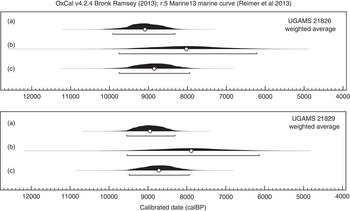
We compared the results of several specifications for ΔR that we believed were appropriate representations of our prior knowledge, each of which produced slightly different but overlapping calibrated age ranges (Figure 5). The first, and most traditional, approach was to specify a normal distribution for ΔR centered on the weighted average and standard deviation of published reservoir offsets for the region. This specification for ΔR resulted in relatively narrow posterior probability distributions, and the oldest mean calibrated ages (Figure 5a). However, the weighted average is not necessarily an unbiased measure of the central tendency of ΔR for the region as a whole, nor over geologic time, because sub-regions and time periods are not represented equally in the regional dataset.
Weighted average 14C ages of Olivella beads calibrated using three different specifications for ΔR: (a) N(330, 227); (b) U(11, 2639); and (c) U(0, 1100). Brackets indicate 95% probability regions, and open circles indicate the mean of the distribution.

An alternative approach is to use an uninformed prior for ΔR, an intentionally vague uniform distribution that assumes all values within the entire range of possible values are equally probable (Bronk Ramsey and Lee Reference Bronk Ramsey and Lee2013). The limits of this distribution were chosen to cover the full range of reservoir offsets reported for the region (Figure 4). This approach is sensitive to extreme outliers in the regional ΔR dataset which, in this case, resulted in wide and flat posterior probability distributions for the calibrated age ranges and the youngest mean calibrated ages (Figure 5b).
Finally, we tested a uniform distribution for ΔR over a more limited range in order to exclude the extreme outliers in the regional dataset. The limits were chosen based on natural breaks in the frequency distribution of local ΔR values as determined from Figure 4. This approach is something of a compromise between the normal distribution and the uninformed prior for ΔR in that it reduces the influence of outliers in the regional ΔR dataset, without specifying an expected value. Consequently, the results of this specification were intermediate between those from the normal and uninformed priors (Figure 5c). For these reasons, we chose this prior in the following section on modeling the shell bead dates.
This exercise highlights three important points for archaeologists working with marine-influenced 14C dates: (1) there may be multiple, objectively “correct” ways of specifying ΔR; (2) the choice of ΔR is partly subjective; and (3) the modeler’s choice of ΔR influences the shape and central tendency of the posterior probability distribution for the calibration. The mean and the precision of the calibration are especially sensitive to the choice of ΔR.
Modeling the Shell Bead Dates
A common approach to handling intra-shell variability in 14C is through averaging, either by calculating the average of multiple measurements, as in the previous section, or by making a single measurement on a time-averaged bulk sample (Culleton et al. Reference Culleton, Kennett, Ingram and Erlandson2006). In this section we describe a Bayesian approach inspired by the wiggle-matching strategy most commonly used for tree ring dating (see also Helama and Hood Reference Helama and Hood2011).
The coiled geometry of gastropod shells serves as the basis for modeling the ages of the shell beads as a sequence. Isotopic signals, including 14C, recorded in the exterior of the apex and spire regions of the shell represent the isotopic conditions experienced during the early life of the animal, while those recorded in the outer lip region reflect conditions later in life. In true calendar years, the oldest portion of a gastropod shell is the exterior surface of the apex, and the lip is the youngest. This sequence of shell deposition is the rationale for a sequential Bayesian model for incremental 14C measurements on gastropod shells.
14C measurements for each bead were modeled in OxCal 4.2 (Bronk Ramsey Reference Bronk Ramsey2009) using the Sequence( ) function. The sequence model can be constrained further if information regarding the rate of deposition is known. For example, the lifespan of the species could be used to limit the duration of the sequence. In our example, the deposition rates are known from stable isotope sclerochronology. Figure 3 can be used to approximate the gap in calendar years between 14C sample positions. If local δ18O maxima are assumed to correspond to winter growth, and local minima to summer growth, each sequence spans approximately 3–4 yr of shell growth, with a gap of ≤1 calendar yr between 14C sample points. These were specified using the Interval( ) and Gap( ) commands, respectively. As discussed in the previous section, we specified a uniform prior for ΔR, from 0 to 1100 14C yr, based on the natural breaks in the frequency distribution of local ΔR values. This prior was specified independently for each 14C measurement to allow the offset to fluctuate over the course of each sequence.
The modeled end-boundary is interpreted as the death of the organism (Figure 6). The unmodeled (Figure 5c) and modeled (Figure 6) calibrations account for uncertainty in reservoir offsets using the same specification of ΔR, and both approaches yield similar measures of central tendency. The spread of the distribution reflects the precision of the calibrated date, with narrow ranges corresponding to more precise calibrations. Modeling the 14C measurements as a sequence improves the precision of the calibrated age while still accounting for large uncertainty in ΔR and intra-shell variability in 14C. For UGAMS-21826, the 95% probability distribution for the unmodeled calibration ranged from 9990–7880 cal BP (Figure 5c), a spread of over 2000 yr. In comparison, the modeled end-boundary age for the same bead ranged from 8950–8330 cal BP (Figure 6), a spread of 620 yr. Modeling improved the precision for individual dates within the sequence also, with an average spread of 1470 yr for the unmodeled dates and 640 yr for the modeled dates. The precision gained through modeling was less pronounced for UGAMS-21829, but still substantial. The 95% probability range for the unmodeled calibration (Figure 5c) had a spread of 1450 yr, compared to 1120 yr for the modeled calibration (Figure 6). In both cases, modeling incremental 14C shell dates as a sequence resulted in a more precise age estimation compared to calibrating the weighted average 14C age.
Modeled ages for Olivella shell beads from the LSP-1 Rockshelter UGAMS-21826 and UGAMS-21829. Likelihood probability distributions are shown in outlines, and the modeled posterior probability distributions are shown as filled areas. Brackets indicate 95% probability regions, and open circles indicate the mean of the distribution.

Archaeological Implications
Direct dating of Olivella shell beads is an essential tool for validating established shell bead chronologies (e.g., Groza et al. Reference Groza, Rosenthal, Southon and Milliken2011; Vellanoweth Reference Vellanoweth2001) and for investigating the antiquity of exchange of goods between the coast and the interior (Erlandson et al. Reference Erlandson, Macko, Koerper and Southon2005; Fitzgerald et al. Reference Fitzgerald, Jones and Schroth2005; Vellanoweth et al. Reference Vellanoweth, Ainis, Erlandson and Thomas-Barnett2014; Smith et al. Reference Smith, Cherkinsky, Hadden and Ollivier2016). However, in some cases there is an inherent limit on the effective precision that can be achieved by 14C dating, regardless of precision of the measurement itself (Taylor and Bar-Yosef Reference Taylor and Bar-Yosef2014:161). Intrashell variability in 14C, combined with challenges of correcting for reservoir offsets, can severely limit the effective precision of 14C age determinations on Olivella shell beads, and of shell bead chronologies, by extension.
Previous studies of Olivella bead ages were based on single 14C measurements. In this study, multiple measurements revealed variability in 14C on the order of centuries within individual beads, which contributed to large uncertainty in the calibrated ages. It is not clear whether the scale of variability observed in this study is typical for this artifact type, or throughout the species range. However, it is possible that the effective precision of direct dating of Olivella beads may be lower than was indicated by previous studies. The shell bead chronology developed by Groza and colleagues (2011), for example, defines bead style periods as short as 65–200 yr on the basis of direct dating by AMS. The variability observed within individual Olivella beads in this study, on the order of centuries, suggests that this level of temporal resolution may be illusory.
CONCLUSIONS
Marine shell is a notoriously problematic class of archaeological material to date because of variability in marine carbon reservoirs across space and over time, even over extremely short time scales. Archaeologists rely on databases of published ΔR values to correct for these local offsets. However, in many cases, particularly those involving marine shell trade goods, the source region is not known precisely. In such cases, ΔR should be specified in a manner that accounts for the full range of possible reservoir offsets in the source region. This type of dating uncertainty has not been explicitly addressed in the archaeological literature, although it limits the precision that can be achieved by direct dating.
Intrashell variability in 14C is a source of dating error that has been studied more extensively. We advocate sequential or incremental sampling of marine shell when possible in order to (1) quantify the magnitude of variability and (2) facilitate a model-based approach to improving the dating precision for problematic taxa, such as Olivella, wherein the dates are modeled as an ontogenetic growth sequence constrained when possible by additional data related to the shell deposition or growth rate.
ACKNOWLEDGMENTS
AMS dating and isotopic analyses were conducted at the University of Georgia’s Center for Applied Isotope Studies. Funding for this project was provided by the Lakeview BLM District, the Great Basin Paleoindian Research Unit (GBPRU), and a Scholarly and Creative Activity Grant from the UNR College of Liberal Arts. Tobin Bottman (Oregon Department of Transportation) provided a copy of his thesis and Jelmer Eerkens (University of California, Davis), Jon Erlandson (University of Oregon), John Barron (USGS), and Tony Krus (Scottish Universities Environmental Research Centre Radiocarbon Dating Lab) provided helpful feedback about our data. Excavations at LSP-1 were supported by the Lakeview BLM and the GBPRU and were conducted by UNR undergraduate and graduate students. The manuscript was greatly improved by the comments of two anonymous reviewers.