Introduction
Approximately 650,000 New Zealand (NZ) adults (21%) were smokers in 2009 (Ministry of Health., 2010). In March 2011, the NZ government committed to the ambitious goal of reducing the prevalence of current smokers to less than 5% by 2025 (Health Promotion Agency, 2011). Furthermore, they want to achieve this for all population groups despite significantly higher prevalence amongst Māori (indigenous New Zealanders) at 45%, Pacific peoples (31%) and those living in the most deprived neighbourhoods (38%) (Ministry of Health., 2009b). Māori and Pacific peoples are over-represented among the lower socio-economic population compounding the barriers to quitting (Ministry of Health, 2006). In the year to July 2012, Quitline, New Zealand's national and largest smoking cessation provider, supported over 60,000 quit attempts: 20.5% made by Māori clients and 5.3% by Pacific clients (Quitline, 2012). If these were single attempts by unique clients, at most 8% of Māori smokers and 7% of Pacific smokers aged 16–64 (based on 2009 population estimates (Ministry of Health, 2010) used Quitline services in the last year.
In order to bring about a proportionately larger decrease in smoking prevalence for Māori and Pacific peoples by 2025, more effective strategies for prompting cessation among these groups are needed. Understanding what motivates Māori and Pacific peoples to stop smoking could inform policy and interventions, and enhance cessation advice. There have been few representative studies of attitudes and knowledge of smoking cessation amongst Māori and Pacific people (Cowie et al., Reference Cowie, Glover, Scragg, Bullen, McCool and Gentles2013; Glover, Reference Glover, Banwell, Ulijaszek and Dixon2013; Glover & Kira, Reference Glover and Kira2012; Grigg, Waa, & Bradbrook, Reference Grigg, Waa and Bradbrook2008; Nosa et al., Reference Nosa, Glover, Watson, Paynter, Stephen, Tutini, Seve-Williams, Taumoepeau and Saafi2013). Two of the studies reported that health and cost were the two main reasons for Māori quitting smoking. However, both studies pre-date many advancements in tobacco control in NZ such as the extension of smoking bans to all school environments (2004), and hotel bars and clubs (2004), the subsidisation of nicotine replacement products from 2000 and provision of government-funded cessation support from 1999. Bupropion (in 2009) and Varenicline (in 2011) also became heavily or partly subsidised.
Glover (Reference Glover, Banwell, Ulijaszek and Dixon2013) found that 25% of her Māori participants wanted to stop smoking to be a better role model and so ‘walk the talk’ as the participants put it. Integrity (walking the talk) is highly valued in Māori and Pacific cultures and expected of leaders (Turia, Reference Turia2012) and role models such as health workers, teachers (Watson et al., Reference Watson, Glover, McCool, Bullen, Adams and Min2011), parents and even older siblings. This is the theme of our paper which builds on and updates the earlier work of Broughton and Lawrence (1993), and Glover (Reference Glover, Banwell, Ulijaszek and Dixon2013), while also incorporating Pacific people's motivations for quitting.
Glover (Reference Glover, Banwell, Ulijaszek and Dixon2013) used an holistic model of health based upon Māori beliefs – Te Whare Tapa Wha (the four-sided house) to analyse Māori smoking. The model illustrates that ill-health, or in this case addiction, results from an imbalance in the holistic system incorporating the physical, mental and emotional, spiritual and family/wider social environment. Another ecological model that understands addiction as resulting from a complex interplay of personal, social and environmental factors is West's PRIME (Plans, Responses, Impulses/Inhibitory forces, Motives and Evaluations) theory (West & Hardy, Reference West and Hardy2006) which posits that addiction results from an imbalance in the motivational system. Given that the aim of this paper was to identify and discuss what motivates Māori and Pacific people in NZ to quit smoking, West's theory appeared most relevant. West defines motivation as ‘the system of forces that energise and direct our actions’. The five elements: Evaluations (beliefs), Motives (wants), Impulses and Inhibitory forces (urges), Responses (initiating, modifying or stopping) and Plans (expectations plus commitment) are tossed about by basic internal drives and emotions all affected by external stimuli and information moment to moment. West's Evaluations and Motives, that is why people think they should quit and why they want to quit in addition to their intentions (West's Plans) aligns with what Māori call ‘the talk’ and ‘the walk’, what people actually do, is the Response triggered by a sufficiently powered Impulse/Inhibitory force. In this paper, we examine the reasons Māori and Pacific give for stopping smoking against the reasons that had driven them to quit in the past (the walk). A further aim is to inform health professionals’ communications with smokers and mass media campaign messaging.
Method
An exploratory qualitative design was chosen due to the dearth of research focusing on Māori and Pacific peoples’ quitting behaviour and the need for detailed information to enable more in-depth analysis. Qualitative research is useful for understanding the phenomenon of smoking cessation behaviour within its social context.
A purposive sampling frame was used to ensure participants were Māori or Pacific Island, male and female current smokers from a range of ages (age 16–26, >26). Māori were recruited to obtain representation from across the country (Auckland, Canterbury, Hawke's Bay, Tokoroa and Waiarapa). Pacific peoples were grouped according to Pacific ethnicity (i.e. Cook Island, Samoan, Tongan and Niuean) and were recruited from Auckland. In recognition of cultural differences the Samoan groups were gender specific. To ensure focus group conduct was culturally appropriate the researchers and research assistants were matched as much as possible to the ethnicity and age of the group participants. For example, Māori groups had a Māori facilitator.
Locally based focus group facilitators identified and contacted community groups to recruit at least six people per focus group who met the sampling frame from their membership. Community group contacts were provided with a community information sheet and those who agreed to recruit participants were asked to sign a community group consent form and all participants signed an individual consent form. Community groups were paid $200 for their assistance and for participation by their members in focus groups. Some groups were comprised of individual participants (i.e. not participating as part of a community group). These participants were recruited in a number of ways including word of mouth, via community or research team member contacts, and through advertising in suburban newspapers. Participants recruited as individuals received a $25 retail voucher for their participation.
Twenty-nine focus groups were run between September 2009 and February 2010 and were conducted in a variety of settings including health services premises; the University of Auckland campus; a church site following a Sunday service; a sports clubroom; community centre rooms; school premises; in the evening in a tent erected for a kava ceremony; another took place on a weeknight at a participant's home; another at a community recruiter's house; and another at a workplace.
Two researchers or research assistants ran each group, one as the facilitator and one as a scribe. All group discussion was audio recorded, transcribed and then the transcript was checked against the audio by the scribe. All Māori transcripts were read and coded independently by a research assistant and the senior Māori researcher (MG) and all the Pacific transcripts were independently read and coded by a research assistant and the senior Pacific researcher (VN). Discrepancies between coders were discussed. A detailed report describing the methodology is available from the authors (Glover et al., Reference Glover, Nosa, Watson and Paynter2010).
Prior to the study participants were told that: Tobacco smoking affects the health and well-being of more Māori and Pacific Island people compared to other New Zealanders. The study will identify how tobacco control programmes can make their services more relevant for Māori and Pacific Island smokers. This study will help us understand what triggers Māori and Pacific people who smoke to stop smoking, and how to better support them to do this.
Focus group exercises
A number of guided exercises were used to facilitate participant discussion. This paper reports on data generated by two of the exercises. A full report was produced for the funders (Glover et al., Reference Glover, Nosa, Watson and Paynter2010). The analysis presented here was not included in the earlier report.
In order to visualise and prompt discussion about motivations to quit and whether or not motivation changes over time all participants were invited to recall past quit attempts and their reason for, and age at, each attempt, and write each quit attempt and any associated relapse they could recall on a sticker provided. Participants who had never attempted quitting were encouraged to think of times they had stopped even if only temporarily. The stickers were placed chronologically on a large wall chart with a row for each participant. Participants were then invited to discuss any patterns they observed.
In a second exercise, each group was provided with a set of 19 cards with a reason for stopping smoking printed on each. These reasons were found in the literature on smoking cessation and agreed upon by the research team. Two Māori-specific cards – Tino rangatiratanga (Māori having control over Māori matters) and Tino rangatiratanga (making one's own choices by not being controlled by a drug) were provided for the Māori groups and correspondingly, an equivalent ‘Making one's own choices’ (i.e. not being controlled by a drug) card was used for the Pacific groups. Where necessary, information on the back of the cards assisted understanding and clarified the intended meaning. Blank cards were provided to all groups for additional reasons they thought were missing. Each group was asked to discuss amongst themselves and rank the cards from the most to least important reason for stopping smoking for their community (e.g., for the Tongan community). If consensus was elusive groups were encouraged to give multiple cards the same rank order. The facilitator encouraged discussion of the reasons for the ranking order. At the conclusion of each focus group exercise the scribe took photos of the finished chart and rankings.
Ethics approval was granted by the University of Auckland Human Participants Ethics Committee.
Data Analysis
Sticker chart data was entered into an Excel Spreadsheet. A frequency count of past reasons for quitting for each sub-group (Māori, Pacific) resulted in an ordered list. A general inductive approach (Thomas, Reference Thomas2006) was used to analyse the transcribed discussion about the exercises. The discussion was divided into themes and commonalities within each of the categories, e.g. reasons for stopping smoking, methods of stopping smoking. These were then used to support and validate the ranking exercise results. Quotes were drawn from the text to illustrate key themes. Preliminary results were discussed at three meetings (a Māori cessation providers meeting, a national tobacco control conference, a seminar for Pacific and Māori stakeholders) as a validity check.
Construction of plots
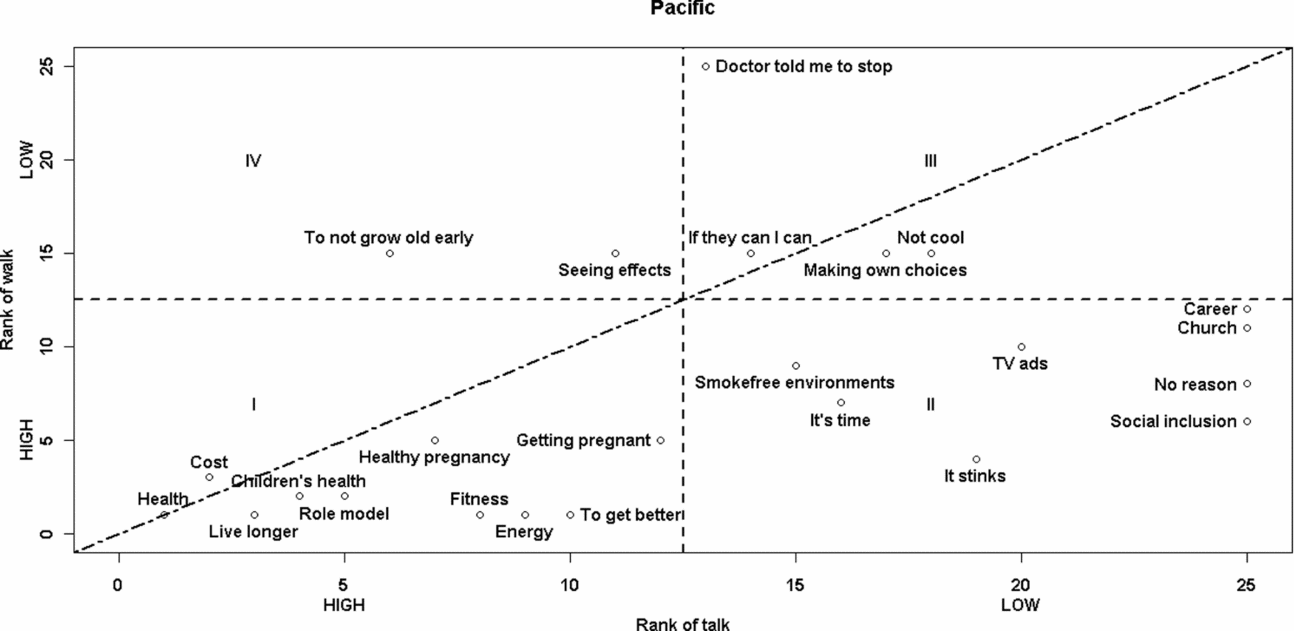
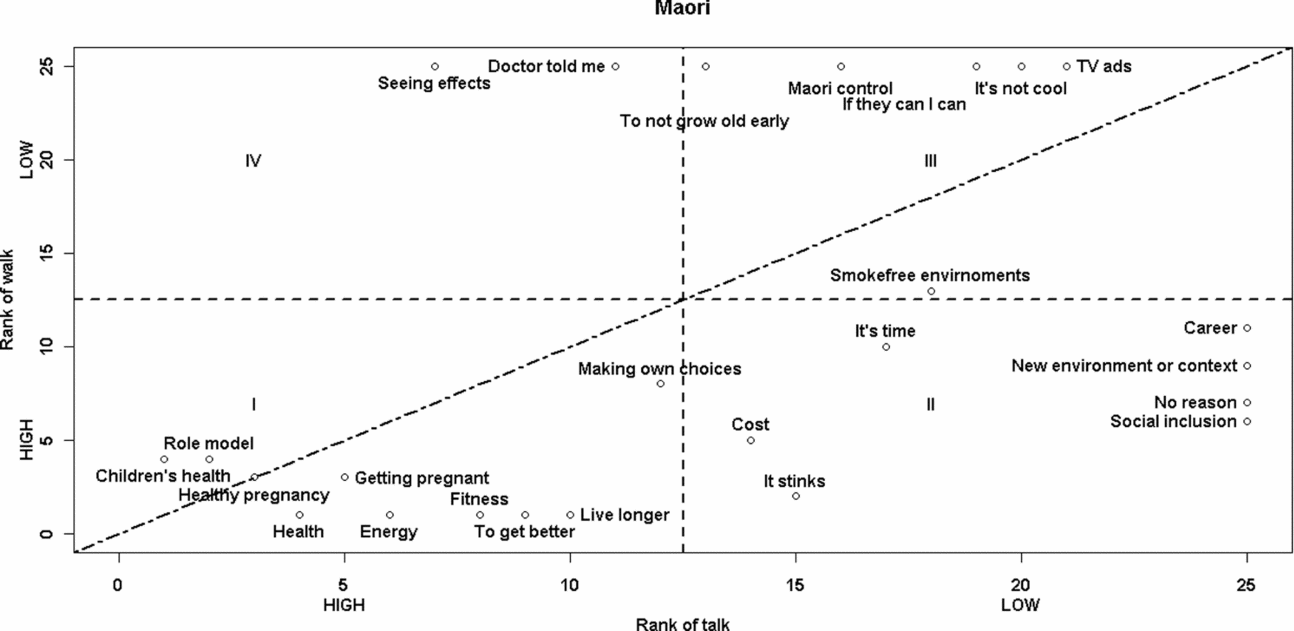
The reasons participants gave for past quit attempts (the walk) were plotted against the ranked list of reasons for quitting (the talk) as follows: The talk and walk lists were put side by side, with the highest rank first and lowest last (e.g., for Pacific on the talk list ‘To stay healthy’ was ranked first; Cost was ranked second). For the walk list, ‘Health’ was the most frequently cited reason for having quit previously; ‘Family’ was second. To stay healthy matched to Health, the first coordinate point in walk-talk space of (1, 1) i.e. so Health was plotted at (1, 1). Going down the talk list, Cost was next, but it did not match to Family on the walk list, instead Cost was third on the walk list so Cost was plotted at (1, 3). Next on the talk list was ‘To live longer’ which was ranked third. It had no exact counterpart so it was matched to Health (rank 1) because (To live longer) is part of health in general. We then plotted (To live longer) at point (3, 1). All reasons were assigned a coordinate in this way.
Where an item in the talk list did not match any of the items in the walk list, the item's rank was taken as its x-coordinate and it was given a rank of 25 for its y-coordinate. The number 25 is somewhat arbitrary but because the maximum number of items in either list is 21, 25 can be taken as the lowest rank to graphically represent outliers. The x-y points (walk on the y-axis and talk on the x-axis) were then plotted in a scatter graph. Horizontal and vertical lines were plotted through 12.5th rank (i.e. half-way) of each axis splitting the graph into four approximately equal quadrants. The quadrants were labelled I (High talk-High walk), II (Low talk-High walk), IV (High talk-Low walk), and III (Low talk-Low walk). Graphs were plotted using R software (version 2.10.1).
Results
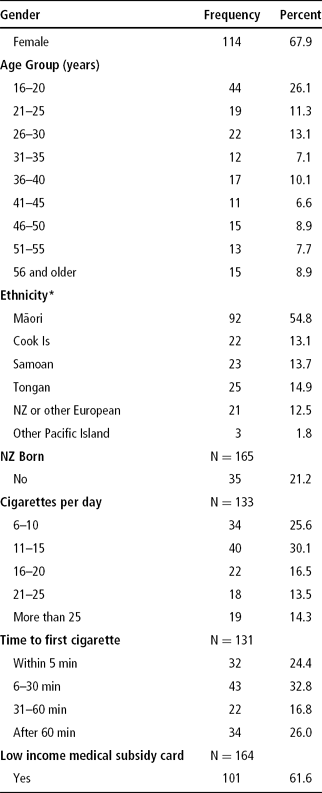
Overall, 168 people who were current or ex-smokers participated in the study (Table 1). Most participants were female (68%), and most identified as Māori (n = 92, 55%) or Pacific (n = 73, 43%). About half the participants were less than 30 years of age, with more than a quarter (28%) being between 16–20 years old. Almost 62% were eligible for a low income medical subsidy card (used to obtain cheaper medications and Doctor's fees).
Demographic and smoking profile of participants (N = 168).

* Unless otherwise indicated and participants could nominate more than one ethnicity.
We found two sets of motivating self-reported reasons to stop smoking. The reasons participants thought people should stop smoking (the talk) and the reasons participants recalled for why they had stopped smoking in the past (the walk) are plotted in Figure 1 (Pacific Island people) and Figure 2 (Māori).
Pacific ranked talk (what they say) vs. walk (what they do) reasons for quitting smoking.
Māori ranked talk (what they say) vs. walk (what they do) reasons for quitting smoking.
Main reasons cited by Māori participants included: stopping smoking for their health, for their children and for pregnancy. That is, the reasons Māori participants ranked as highly effective motivators for Māori to quit aligned with their recalled reasons for their own previous quit attempts. Pacific participants also walked the talk when it came to quitting for their health, for their children and for pregnancy. Pacific participants also ranked cost as an important reason to quit and as a frequent reason triggering past quit attempts.
Health
The health theme included: wanting to have better health generally, but also to get better when ill, to have more energy and be fitter and to live longer. Poor current health was the main reason for quitting smoking. In these situations, quitting was often temporary, for the duration of the illness.
I was in hospital and the doctor said to me that if I wanted to live longer then I should stop smoking. But it was about a week after I was discharged from hospital that I went back to smoking again. (Pacific male)
Children's health
Quitting smoking for children and to be a better role model for children was the highest ranked reason to quit for Māori participants and it was high for Pacific Island participants as well.
Because I love my children. . . .If I die now, who will take care of my children? (Pacific male)
Pregnancy
Having a healthy pregnancy and to assist good fertility was the second most important theme for Māori and the fourth for Pacific. For some participants this included stopping smoking for the benefit of their unborn child and for others stopping smoking during pregnancy was due to experiencing morning sickness.
All the ads about smoking during pregnancy kind of put me off. I didn't want my kid, my son, to come out deformed or something, with something wrong with him. (Pacific female)
I was put off it. . .Yuck. Every time I wanted to smoke it just made me vomit. (Māori female)
Cost of smoking
Cost was one of the most frequently cited reasons for stopping smoking for Pacific participants. They said smoking was too expensive and it adversely impacted on the family budget.
I wasn't saving, I just, and I was just not meeting the rent. Just that risk of losing the house if you don't cut down on it. (Pacific female)
I stopped because there were too many children and it was hard with my income, so it was hard to smoke. (Pacific male)
Māori did not think cost was prohibitive enough to motivate Māori to stop smoking (low-talk) but they did cite it as a trigger to quit when recalling their own past quit attempts (high-walk).
It stinks and it's time
That smoking smells and has other unpleasant aesthetic effects, was ranked low as a perceived reason motivating both Māori and Pacific people to quit, but it was cited frequently as an actual reason participants had quit in the past.
It stinks is up there. . . for me. Because it does. . . I'd even put that at the top. . . I can't even smell it now. . .But, like, I can smell it on other people. (Māori female)
The concept that ‘it's time’ to quit similarly was not ranked highly as a perceived motivation to quit, yet it came up frequently as a reason for past quit attempts. ‘It's time’ seems to mean that some smokers had an epiphany of sorts and for unarticulated reasons had strong resolve to stop smoking. However other participants were unsure of the meaning.
What does that mean, it's time? (Māori male, Focus group 24)
I've had about 20 of those times, that's the problem. (Māori female, Focus group 23) . . . So there is no when is it time. (Māori male, Focus group 23)
Discussion
What is unique about this paper is the focus on Māori and NZ resident Pacific peoples. The contrast found between the perceived rank of reasons for quitting and the reasons given for actual past quit events and the method used to illustrate this is also unique. Only a few reasons for each ethnic group both ranked highly as reasons people should quit and were frequently cited as triggering past quit attempts. The mismatch of the other reasons can be explained using West's PRIME theory. That is, the ranked reasons given for why people should stop smoking probably reflects beliefs (evaluations). Cessation campaign messaging and health promoters ‘often focus on creating a sense of duty, a belief that one ought to quit for the sake of one's health, the health of one's family or because smoking is in some sense ‘bad’’ (Smit, Fidler, & West, Reference Smit, Fidler and West2011). These promoted reasons would be more salient and easier to recall. But as Smit et al. (Reference Smit, Fidler and West2011) found, duty was not predictive of later quit attempts. Other components of motivation such as having a desire to quit (motives) and intention (plans) to stop are important and potentially more important for cessation promotion campaigns to focus on developing in people. Their finding that duty was less predictive of quit attempts may however be culturally mediated. In populations with strong expectations of duty to family, the tribe, the village, the church and community, duty could be a more powerful motivator than Smit et al. (Reference Smit, Fidler and West2011) found.
In this study we found that some of the duty reasons (the talk) for quitting were highly aligned with reasons participants recalled as triggering their past quit attempts. That is, participants appeared to walk the talk for at least the most highly ranked reasons for quitting.
It is not surprising that health was found to be one of the most highly ranked reasons motivating and triggering quitting. This is consistent with local and global literature (Ministry of Health., 2009a; Reid, Pipe, Riley, & Sorensen, Reference Reid, Pipe, Riley and Sorensen2009). Although in this study health was not ranked first by Māori, it was the most frequently reported trigger for quit attempts. The actual trigger, however, was illness and wanting to return to health. Suffering an illness or being diagnosed with a serious illness acting as a trigger to quit has also been found for Australian Aboriginal and Torres Strait Islanders (Lindorff, Reference Lindorff2002). A period of illness therefore, such as a chest infection represents an opportunity to offer cessation support.
Quitting for children was perceived to be a strong motivator for both Māori and Pacific participants and they cited it frequently as a reason for quitting in the past. This has also been found among Native Hawaiians who reported that family members and the well-being of family members, particularly children were a strong reason to stop smoking (Kaholokula, Braun, Santos, & Chang, Reference Kaholokula, Braun, Santos and Chang2008).
For Māori, walking the talk was highest for not smoking in pregnancy which is promising given the very high prevalence of smoking among Māori women of child-bearing years (52%, Ministry of Health, 2012). Despite this many Māori women continue to smoke through their pregnancy (45%, Dixon et al., 2009). This may reflect inadequate cessation support for Māori pregnant women (Glover, Reference Glover2012). Quitting for pregnancy was ranked lower for Pacific which may be due to a lower prevalence of smoking when pregnant (33%, Ministry of Health, 2012) compared to Māori or a lower awareness of the risks of smoking when pregnant amongst Pacific women (Erick-Peleti, Paterson, & Williams, Reference Erick-Peleti, Paterson and Williams2007). Antenatal and post natal programmes that target Pacific communities (i.e. pregnant women, their families and partners) need to ensure their clients are informed about the risks for both mother and baby caused by smoking in pregnancy and that some of these risks have ongoing effects into childhood and beyond such as increased respiratory illness and glue ear, intellectual and behavioural effects, increased risk of cancer, obesity and even smoking initiation (Glover, Kira et al., Reference Glover, Banwell, Ulijaszek and Dixon2013). Support and cessation options need to be offered to pregnant women who smoke.
Trying to save money prompted quit attempts amongst Pacific participants and they also ranked cost as an important reason to quit. Māori, however, gave cost a low ranking as a reason for quitting. However, in this study it was a frequent trigger to quit. Using West's PRIME theory of motivation (West & Hardy, Reference West and Hardy2006), we would expect cost to be an effective trigger of quit attempts as the cost of tobacco impinges immediately on the smoker as opposed to the threat of future health consequences.
One of NZ's primary strategies (ABC) to prompt and support cessation is to have all healthcare professionals: Ask every patient at every visit if they smoke; give Brief advice to quit if they do smoke and offer Cessation support (Ministry of Health., 2007). Our results found that not only was advice from a doctor to quit, ranked low as a reason why you should quit, it also was one of the lowest cited triggers for any previous quit events. In a previous study of pregnant Māori smokers, 82% had been advised to quit smoking by a health professional but few (21%) felt influenced by the advice (Glover & Kira, Reference Glover and Kira2012). Further research is needed to understand if downplaying the influence of doctors reflects an attitude towards doctors and their role in prompting health behaviour change.
One component of NZ's tobacco control programme has been prevention of smoking uptake by youth. This includes social marketing campaigns, such as the Smoking Not Our Future campaign, which seek to denormalise smoking and frame smoking as uncool. In our study, ‘It's not cool’ was not ranked as a motivating or triggering factor for quitting. This could be because ‘it's not cool’ is no longer a concern of our predominantly older participants or ‘it's not cool’ is more of a rational, subjective judgement not necessarily associated with emotion and thus devoid of influence at the time of decision (Loewenstein, Reference Loewenstein1996). Loewenstein (Reference Loewenstein1996) and others have argued for more recognition and use of the emotional load experienced at the time of decision (Bazerman, Tenbrunsel, & Wade-Benzoni, Reference Bazerman, Tenbrunsel and Wade-Benzoni1998; Loewenstein, Reference Loewenstein1996; O'Connor et al., Reference O'Connor, De Dreu, Schroth, Barry, Lituchy and Bazerman2002).
In contrast, ‘It stinks’ was a relatively important factor in triggering actual quitting but was not a highly ranked reason why a person should quit smoking. ‘It stinks’ probably has a greater emotional load, because it relates to personal hygiene and can be associated with stigma, shame and embarrassment. Campaigns with the primary purpose of triggering quit attempts should include more emotionally loaded reasons for quitting such as ‘it stinks’.
There are several limitations to this study. It was a qualitative study asking participants to retrospectively recall reasons for quitting in the past. One of the reasons why we found a difference between the two sets of reasons could be explained by Bazerman et al. (Reference Bazerman, Tenbrunsel and Wade-Benzoni1998) who propose that the more reasoned should (reasoned wants) will dominate (over impulsive wants) when individuals are more reflective, as in a focus group setting. Social desirability bias in the group process could have also effected the rank order of some reasons, such as ‘it stinks’. Using a plot graph to represent the correlation between two different sets of qualitatively derived data could be misconstrued as implying a quantitative result. This is a new methodology and therefore warrants caution in interpretation. Further, retrospectively recalled actual reasons for quitting by individuals is not directly comparable with a group's ranking of reasons perceived to be important for their demographic group. Recent advances in neuroscience find that what is articulated in focus groups responses can be different to internal emotional responses (Falk, Berkman, & Lieberman, Reference Falk, Berkman and Lieberman2012) so trying to tease out what people say they think motivates people as opposed to what has motivated people in practice is an important distinction. Finally, Māori men were under-represented. Slightly more Māori women (63%) participated reflecting the higher smoking prevalence rates for them compared to Māori men.
We conclude that motivational messages encouraging Māori and Pacific people to stop smoking should draw from the identified high walk-high talk reasons: to have a healthy pregnancy, to maintain health, to get better when ill, for fitness, cost, to live longer, for children's health and to be a good role model for children. After these reasons, the reasons given for actual quit events should be given more importance than the perceived reasons why people should quit.
If campaigns want to trigger quit attempts, they should focus more on emotionally important, immediate reasons impinging on smokers: such as having a bout of the flu, shortness of breath, a health scare, the cost, the immediate risk to the unborn child and children's illnesses associated with exposure to second hand smoke. The distasteful, personal hygiene aspects of smoking such as the stink could be creatively employed as an effective trigger to quit also. However, care would be needed in campaign development so as not to belittle or alienate smokers.
Acknowledgements:
Deepika Sonia, Dentist and Public Health student for reviewing an early draft. Jane Stephen, Raina Tutini and Jade Le Grice for interviewing, transcribing and initial analysis of their data.
Financial support
This work was supported by the Ministry of Health (contract 08-T01).
Conflict of interest
None.
Ethical standards
The authors assert that all procedures contributing to this work comply with the ethical standards of the relevant national and institutional committees on human experimentation and with the Helsinki Declaration of 1975, as revised in 2008.