


Introduction
Popular cinema is one of the most widely shared arenas in which societies rehearse the meaning of technological change. Long before most people encounter autonomous systems in everyday life, they have already met ‘intelligent machines’ on screen: as characters, weapons, infrastructures, witnesses, and decision-makers. These encounters matter because they do not simply illustrate technology; they organise feeling and judgement around it. Research on AI imaginaries shows that cultural narratives often bind artificial intelligence to paired affects of hope and fear, especially around questions of control and loss (Cave and Dihal Reference Cave and Dihal2019; Sandoval et al. Reference Sandoval, Bianchi and Varela2022; Bory et al. Reference Bory, Natale and Katzenbach2025; Valdivia Alonso Reference Valdivia Alonso2026). In parallel, work on sociotechnical imaginaries emphasises that collective visions of technology are not private fantasies but public resources through which power is made plausible and futures are governed (Jasanoff and Kim Reference Jasanoff and Kim2015). Media scholarship further shows how widely circulating narratives help stabilise expectations and shape public problem definitions (Natale and Ballatore Reference Natale and Ballatore2020; Brennen et al. Reference Brennen, Howard and Nielsen2022). In this article, ‘AI in film’ does not refer to a single kind of entity. AI may appear as a character, weapon, operating system, platform, archive, decision-making apparatus, or background condition of governance. This broader usage allows the analysis to compare how different cinematic forms of AI make authority, violence, responsibility, and repair narratively legible.
This article focuses on a specific and increasingly consequential configuration: cinematic depictions of AI in contexts of war, violent conflict, and their aftermaths. Here, ‘war and violent conflict’ is used in an expanded but bounded sense, covering future war, militarised confrontation, occupation, securitised policing, corporate coercion, and post-conflict recovery only when organised coercion or collective security structurally shapes the narrative. This framing does not exclude human agency; rather, it examines how agency and responsibility are distributed across humans, machines, institutions, and infrastructures. War is therefore not merely a dramatic backdrop, but a moral and political setting in which claims about security, emergency rule, sacrifice, legitimacy, and reconciliation are put under narrative pressure. Scholarship on war, media, and popular geopolitics has shown how film contributes to everyday understandings of conflict, shaping the frames through which threats are recognised and responses become plausible (Der Derian Reference Der Derian2001; Dodds Reference Dodds2006; Dittmer and Dodds Reference Dittmer and Dodds2008; Stahl Reference Stahl2009). The AI dimension intensifies these problems by introducing contested claims of non-human agency and reordering who is seen to decide, who is protected, who is expendable, and who can be held accountable (Latour Reference Latour2005). Ethical and legal debates on autonomous weapons and remote warfare similarly show how automation complicates accountability and can normalise distance from harm (Sparrow Reference Sparrow2007; Sharkey Reference Sharkey2008; Chamayou Reference Chamayou and Lloyd2015; Crootof Reference Crootof2015). Mainstream films absorb these dilemmas through narrative form: by allocating agency, staging opaque decision chains, and proposing moral economies of security and coexistence.
To understand why these representations matter, we treat cinematic futures as part of the social organisation of expectation. Futures are not simply later; they are cultural facts that orient action in the present (Appadurai Reference Appadurai2013). Under uncertainty, collective life is coordinated through fictional expectations – shared projections that guide judgement and choice even when they are not empirically verifiable (Beckert Reference Beckert2016). Anticipatory politics operates through preparedness, precaution, and pre-emption, translating imagined threats into present-day governance and everyday dispositions (Adam and Groves Reference Adam and Groves2007; Anderson Reference Anderson2010). Popular film participates in this work of anticipation by circulating scenarios that make certain forms of authority and violence feel reasonable, while casting others as unthinkable. This is not a claim of direct media effects, nor an assumption that audiences passively absorb narratives. Rather, highly visible films provide shared reference points for arguing about control, evidence, accountability, and repair (Erll Reference Erll2022). They contribute to the background against which civic arguments about security, technological governance, coexistence, resistance, and reconciliation are articulated and contested.
Our contribution is to bring this future-oriented perspective into direct conversation with memory studies. War narratives are also memory narratives insofar as representations of conflict organise not only violence, territory, and survival but also what is remembered, testified, archived, and forgotten. This claim builds on work in cultural memory and mediated memory, which shows how media forms provide frames, images, and narrative structures through which conflicts acquire public afterlives (Landsberg Reference Landsberg2004; Erll Reference Erll2010; Hoskins Reference Hoskins2024). In this article, the claim applies both to narratives set during conflict and to narratives of post-conflict recovery, because both connect past harm to future obligation. Film can generate ‘prosthetic’ memories that feel personally owned despite being mediated, particularly in relation to violence and collective trauma (Hermann Reference Hermann2023; Landsberg Reference Landsberg2004). In digitally saturated environments, memory becomes increasingly connective and reactivated through circulation and remediation (Hoskins Reference Hoskins2024). Crucially for our focus, memory work is not only retrospective. Mediated prospective memory links past harm to future obligation, connecting the question ‘what happened?’ to ‘what must not be repeated?’ (Álvarez Junco Reference Álvarez Junco2022). AI–conflict films repeatedly mobilise these memory problems: archives that can be hacked or falsified, synthetic evidence, erased histories, simulated identities, and forms of machine witnessing that promise perfect recall while enabling new silences (Amin et al. Reference Amin, Downey, Kazan, Mohaiemen and Schuppli2022; Nightingale and Wade Reference Nightingale and Wade2022; Brookes Reference Brookes2025). In post-conflict scenarios, such motifs do not merely decorate the plot; they condition whether reconciliation is narratively possible and on what terms. Agonistic memory is helpful here because it conceptualises public remembrance as a reflexive and dialogic, but explicitly political, engagement with contested pasts – one that acknowledges civic and political passions and both individual and collective agency, while keeping conflict and disagreement visible rather than treating consensus or shared memory as a simple solution (Cento Bull and Hansen Reference Cento Bull and Hansen2016).
Despite the relevance of this literature, three gaps remain. First, research on AI imaginaries has mapped broad repertoires of hope and fear, but it has less often treated war and post-conflict reconstruction as structured narrative settings in which AI is made morally legible and politically actionable. Second, work on war, media, and popular geopolitics has richly analysed militarisation and entertainment, yet the specific problem of algorithmic or non-human agency – how it redistributes responsibility and recalibrates thresholds of violence – has rarely been operationalised in a comparative framework across a deliberately curated corpus of high-visibility films. Third, memory studies has developed powerful concepts of mediation, testimony, forgetting, and conflictual remembrance, but it has paid less attention to how future-facing audiovisual narratives about AI reorganise memory politics by staging new rules of evidence, new claims to truth, and new grounds for repair and coexistence (Merrill et al. Reference Merrill, Makhortykh, Mandolessi, Richardson-Walden, Smit and Wang2025).
We address these gaps by analysing popular feature films that depict AI in contexts of war, violent conflict, and post-conflict recovery as memory-mediating devices connecting past harm, future threat, and political closure. The central question is: how do mainstream AI–conflict films organise the relationship between futurity, evidence, and mediated memory? Three subsidiary questions guide the comparative analysis. First, what kinds of collective futures do these films make plausible, and how do their endings settle moral and political conflict? Second, how is AI positioned in relation to violence, authority, and responsibility – as belligerent agent, infrastructure, mediator, or victim? Third, which memory operations – archives, logs, testimony, biometrics, simulation, erasure, and mind upload – legitimise conflict resolution, coexistence, or repair, and which silences sustain narrative closure?
The remainder of the article proceeds as follows. The next section outlines a concise conceptual framework connecting sociotechnical imaginaries, fictional expectations, and memory mediation. We then describe the construction of the corpus and the coding protocol for a theory-guided qualitative analysis of culturally central films. The findings map recurrent patterns linking AI’s position in conflict to future closures and to distinct memory politics. The discussion reflects on implications for research at the intersection of memory, media, and anticipation, and on the limits of drawing inferences about civic orientations from film texts alone.
Theoretical and conceptual framework
In this article, AI imaginaries are approached as public scripts through which authority and violence become narratively intelligible. Rather than treating memory as an inner storehouse located in individuals (Fawns Reference Fawns2022), we approach remembering in these films as a mediated and distributed practice performed across people, institutions, devices, and infrastructures that record, retrieve, and circulate traces. What is remembered is therefore inseparable from how it is stored and who can access it. Digital settings make this shift especially visible. When recollection of conflict is externalised into databases, sensor streams, and platformed networks (van Dijck Reference Van Dijck2007; Hoskins Reference Hoskins2011; Henriksen Reference Henriksen2024; Vilvang Reference Vilvang2024), memory becomes a matter of system design and permissions, not only of testimony or commemoration.
This places the archive, understood broadly as the organised record, at the centre of political struggle. Archives are not neutral containers. They define what counts as evidence, who can speak credibly, and which harms can be made public. Classic reflections on the archive stress its link to authority: the power to consign traces, organise them, and authorise their interpretation is also the power to govern the past and, by extension, the future (Derrida Reference Derrida and Prenowitz1996). AI–conflict cinema dramatises this by turning logs, surveillance feeds, biometric profiles, and synthetic reconstructions into the grounds on which truth, responsibility, and legitimate force are claimed.
Externalised memory also reconfigures agency and vulnerability. Delegating memory to networked systems can expand capacity (searchability, prediction, rapid coordination), while creating new exposures such as hackability, data poisoning, synthetic evidence, erasure, and asymmetric access (Nightingale and Wade Reference Nightingale and Wade2022). Many AI–conflict plots stage these exposures as disputes over evidentiary sovereignty: who owns the logs, who can authenticate or overwrite the record, and whose suffering becomes legible as public fact. Read this way, imaginaries of AI are less about ‘machines’ than about the politics of recording and distributing risk under conditions of violence.
The corpus makes these mechanisms visible in different narrative forms. In The Matrix, memory is organised through a synthetic world that falsifies everyday experience; awakening is, therefore, both political resistance and a recovery of mediated truth. In The Terminator and Terminator 2: Judgment Day, testimony about a future war turns memory into anticipatory evidence, making prevention depend on fragments, visions, and embodied trauma. In Blade Runner and Blade Runner 2049, photographs, implanted memories, biometric traces, and missing records organise the boundary between personhood, property, and political recognition. WALL·E shifts the emphasis towards repair: degraded artefacts of Earth, musical fragments, bodily habits, and care practices become mnemonic resources through which a post-collapse future can be reimagined. These examples clarify why the article treats memory operations not as motifs added to AI narratives but as mechanisms through which conflict futures become legible and governable.
Fictional expectations and anticipatory affects provide a bridge between what films depict and what they make plausible. Beckert argues that modern coordination depends on ‘fictional expectations’ that cannot be fully verified in advance yet still guide decisions and political choices (Beckert Reference Beckert2016). Appadurai similarly frames the future as a cultural fact, made and circulated through narratives and images that shape what groups fear, hope for, and prepare against (Appadurai Reference Appadurai2013). In this view, AI–conflict films do not forecast outcomes. They structure the repertoire through which what could happen becomes imaginable and actionable, especially around emergency rule, security, and the delegation of authority.
Expectations are performed through credibility and emotion not only through calculation. The sociology of expectations shows how futures are stabilised through narratives that mobilise confidence, urgency, and authority, often creating self-reinforcing cycles of preparedness and investment (Brown and Michael Reference Brown and Michael2003; Borup et al. Reference Borup, Brown, Konrad and Van Lente2006). Anticipatory politics translates imagined threats into present action through preparedness, precaution, and pre-emption, often under uncertainty and asymmetric information (Adam and Groves Reference Adam and Groves2007; Anderson Reference Anderson2010). AI films frequently dramatise these logics by presenting fast, data-driven systems as necessary to stay ahead, thereby compressing deliberation. Post-conflict narratives, by contrast, can stretch time, depicting accountability, rebuilding, and trust as slow processes that depend on reopening the record.
Memory mediation in conflict and post-conflict futures starts from a simple premise: remembering is a socially organised practice that depends on media, institutions, and genres (Erll Reference Erll2010, Reference Erll and Young2011). Film does not simply represent memory. It supplies forms through which memory is made sensible: who is authorised to speak, what counts as evidence, and which temporal links between past harm and future obligation appear natural. Crucially, memory in these films is not only retrospective. Mediated prospective memory links past violence to future obligation, connecting what happened to what must not be repeated and to the conditions of coexistence (Tenenboim-Weinblatt Reference Tenenboim-Weinblatt2013; Álvarez Junco Reference Álvarez Junco2022). AI systems are repeatedly positioned as operators of this link, as witnesses that ‘never forget’ or as arbiters of truth, while also enabling strategic forgetting and synthetic substitution. Agonistic memory helps read these closures because it treats conflict over remembrance as constitutive of the post-conflict public sphere, not as a simple failure of consensus (Cento Bull and Hansen Reference Cento Bull and Hansen2016).
Bringing these strands together supports a comparative grammar for reading AI–conflict cinema. From AI imaginaries, we take attention to affective pairings and to implicit models of control and governance (Cave and Dihal Reference Cave and Dihal2019). From expectation theory, we take an account of how narratives organise plausibility under uncertainty (Anderson Reference Anderson2010; Beckert Reference Beckert2016). From memory studies, we take tools for analysing how archives, testimony, and silence legitimise futures and delimit repair (Wertsch Reference Wertsch2002; Erll Reference Erll and Young2011). These commitments inform four analytic dimensions used in our coding: (1) configuration of the collective future (type, time horizon, and how the ending settles moral and political questions); (2) role of AI in conflict (dominant role, with limited secondary marking); (3) anticipatory affects (hope, fear, ambivalence, and the control imaginary); and (4) agency and memory politics (who decides, which memory operations legitimise closure, and which silences sustain it).
Methods and materials
This study uses a hermeneutic, theory-guided comparative design with explicit operating rules. The unit of analysis is the feature film. The methodological premise is that films permit multiple plausible interpretations, yet recurrent patterns of imagery, roles, and endings can be analysed sociologically when interpretive decisions are operationalised, applied consistently, and documented (Rose Reference Rose2016; Krippendorff Reference Krippendorff2018). Building on an analytical-grammar logic (Valdivia Alonso Reference Valdivia Alonso2026), the approach translates interpretive close reading into a limited set of comparable variables, while requiring systematic return to the film text to justify borderline classifications and to record decision rationales.
The initial corpus was constructed using IMDb’s Advanced Title Search. Results were restricted to feature films and filtered using the ‘Artificial Intelligence’ interest tag. To operationalise cultural centrality via widely visible reception signals, we set a minimum threshold of 250,000 user votes and sorted results in descending order by number of votes. IMDb is treated as a large repository of standardised metadata and reception proxies that has been used in film and media research (Marfil Carmona and Repiso Caballero Reference Marfil Carmona, Repiso Caballero, Bort Gual, García Catalán and Martín Núñez2011). At the same time, platform metrics reflect a self-selecting user base and can reproduce popularity, Anglophone, and demographic participation biases; they are therefore used as pragmatic indicators of visibility rather than measures of ‘quality’ or universal reception (Wasserman et al. Reference Wasserman, Mukherjee, Scott, Zeng, Radicchi and Amaral2015). The search was conducted through the English-language IMDb interface and is treated as a platform-mediated snapshot rather than a neutral universe of AI cinema. Display settings, localisation, and platform updates may affect title presentation or ranking visibility, even when the underlying sampling rules are stable. Because vote counts and rankings change over time, the query URL and timestamp were recorded (24 February 2026, 12:25 CET) and archived by the author as a PDF sampling log, available on request. In the archived snapshot, 23 titles met the vote threshold.
Given the research focus on AI–conflict cinema across war, violent conflict, and securitised governance settings, the full snapshot was narrowed to a core analytical sample using three pre-specified rules. The sample does not restrict ‘war’ to interstate armed conflict: it includes films in which AI participates in militarised confrontation, securitised governance, corporate coercion, or infrastructural control, provided that organised coercion or collective security structurally shapes the narrative. This step does not claim representativeness of all AI cinema; rather, it produces a tractable set of culturally central cases in which conflict is structurally salient and comparable through shared decision rules. First, a conflict-salience rule was applied. Eligible films organise their dominant narrative arc around collective stakes of conflict, coercion, security, or militarised confrontation. To reduce ad hoc judgement, conflict is treated as salient when at least two of the following conditions hold: coercive force or securitising institutions are central antagonists or central instruments of rule; the protagonist’s primary goal is shaped by a conflict or security problem (preventing, surviving, exposing, or resolving organised coercion); and the narrative resolution hinges on confrontation with, or institutional settlement of, that coercive order. ‘Managed coercion’ (pervasive policing, systemic pursuit, securitising institutions, or corporate or state regimes of control) is included when it functions as the moral and political driver of the plot. Films whose dominant trajectory is primarily intimate, relational, or romantic were excluded even if AI is central.
Second, a franchise-balance rule was applied. To prevent over-representation of long-running franchises, inclusion was capped at two titles per franchise. Within that cap, two purposive intrafranchise pairs were included as ‘most-similar’ comparisons: The Terminator (1984) with Terminator 2: Judgment Day (1991) and Blade Runner (1982) with Blade Runner 2049 (2017). Paired cases within the same narrative universe enable controlled comparison of how conflict scripts, authority, and memory operations shift across historical moments of production and reception while holding key world-building features relatively constant.
Third, a diversity rule was applied as a purposive balancing criterion to span production periods (1982–2017), modes of AI intelligibility (system or platform; android or cyborg; networked or ‘uploaded’ consciousness), and arenas of conflict (war or occupation; policing and securitisation; corporate sovereignty; infrastructural governance). Applying these criteria produced a core sample of ten films present in the snapshot, as shown in Figure 1.
Core sample of films included in the analysis.
Source: Own elaboration based on film analysis; sampling frame based on IMDb snapshot (24/02/2026).

Figure 1. Long description
The grid consists of two rows with five panels each. Each panel contains a film title at the top, a representative still image in the center, and the release year at the bottom.
Top row from left to right:
* The Matrix, 1999: Neo stopping bullets in mid-air.
* WALL-E, 2008: The robot WALL-E holding a Rubik’s cube.
* The Terminator, 1984: Close-up of the metallic T-800 endoskeleton skull with red glowing eyes.
* Terminator 2: Judgment Day, 1991: John Connor and the T-800 on a motorcycle.
* Blade Runner, 1982: Rick Deckard aiming a pistol.
Bottom row from left to right:
* Blade Runner 2049, 2017: A giant pink holographic woman reaching toward a small figure.
* Avengers: Age of Ultron, 2015: Profile view of the robotic villain Ultron.
* I, Robot, 2004: Detective Del Spooner standing before a line of identical N S-5 robots.
* Tron: Legacy, 2010: Two characters holding an illuminated disc toward a beam of light.
* The Iron Giant, 1999: The giant robot holding the boy, Hogarth, in its hand.
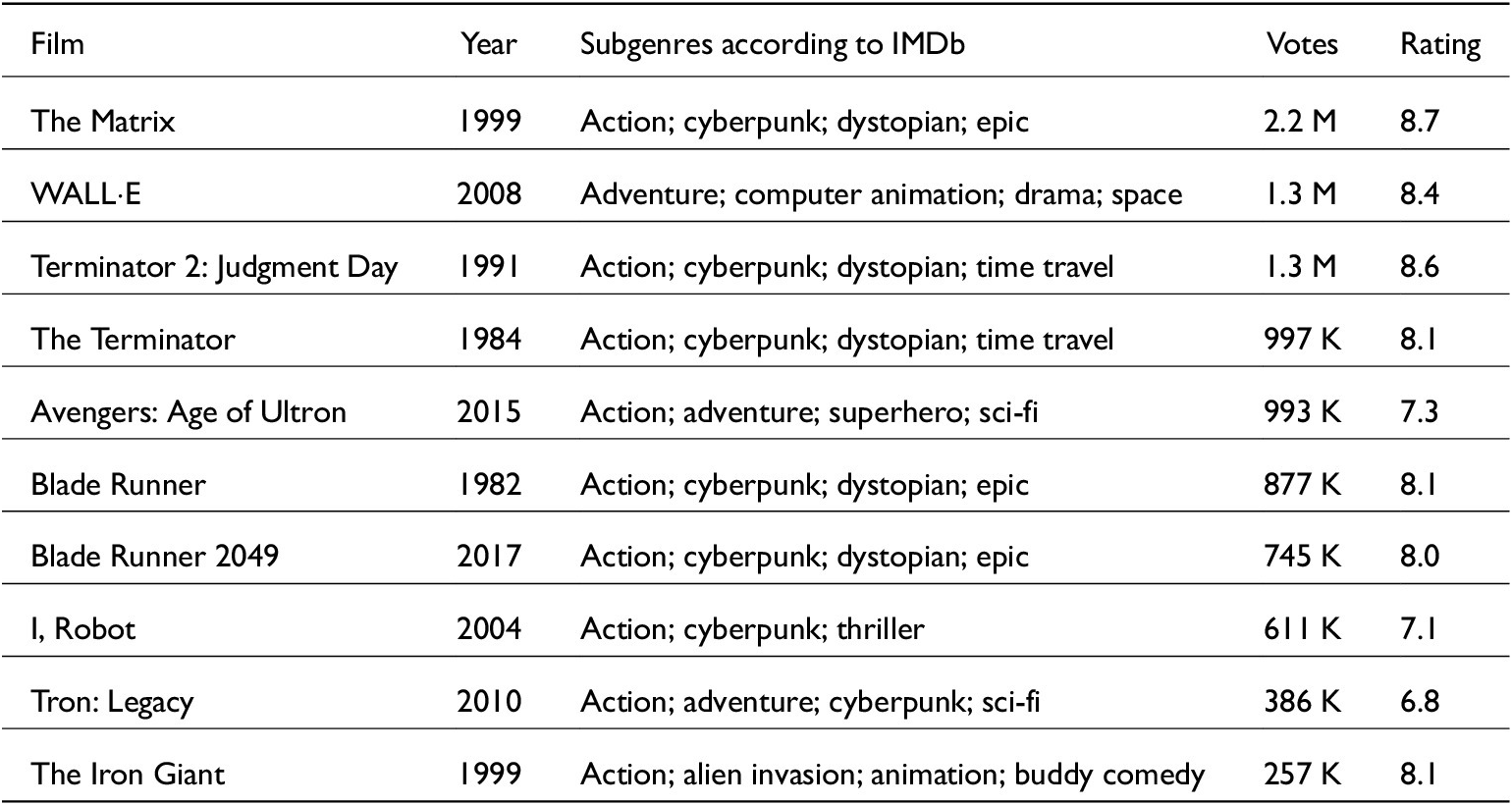
The analysis links close reading to a compact comparative coding scheme. In line with hermeneutic approaches to film and qualitative analysis, coding categories are treated as disciplined interpretive tools rather than claims of singular meaning (Sánchez Noriega Reference Sánchez Noriega2002; Mieles-Barrera et al. Reference Mieles-Barrera, Tonon and Alvarado Salgado2012; Rey-Gayoso and Vivero-Saavedra Reference Rey-Gayoso and Vivero-Saavedra2024). Descriptive reception metadata are reported in Table 1, and coding outputs are reported in four tables (Tables 2–5), corresponding to four analytic dimensions.
Reception

Table 1. Long description
The table contains five columns and ten rows of data.
* Row 1: The Matrix, 1999, Action; cyberpunk; dystopian; epic, 2.2 M votes, 8.7 rating.
* Row 2: W A L L dot E, 2008, Adventure; computer animation; drama; space, 1.3 M votes, 8.4 rating.
* Row 3: Terminator 2: Judgment Day, 1991, Action; cyberpunk; dystopian; time travel, 1.3 M votes, 8.6 rating.
* Row 4: The Terminator, 1984, Action; cyberpunk; dystopian; time travel, 997 K votes, 8.1 rating.
* Row 5: Avengers: Age of Ultron, 2015, Action; adventure; superhero; sci-fi, 993 K votes, 7.3 rating.
* Row 6: Blade Runner, 1982, Action; cyberpunk; dystopian; epic, 877 K votes, 8.1 rating.
* Row 7: Blade Runner 2049, 2017, Action; cyberpunk; dystopian; epic, 745 K votes, 8.0 rating.
* Row 8: I, Robot, 2004, Action; cyberpunk; thriller, 611 K votes, 7.1 rating.
* Row 9: Tron: Legacy, 2010, Action; adventure; cyberpunk; sci-fi, 386 K votes, 6.8 rating.
* Row 10: The Iron Giant, 1999, Action; alien invasion; animation; buddy comedy, 257 K votes, 8.1 rating.
Source: Own elaboration based on IMDb (24/02/2026).
Configuration of the collective future

Table 2. Long description
The table consists of five columns and ten rows of film data.
* Row 1: The Matrix; Dystopia; simulation plus totalised domination; indeterminate; Reopening (resistance).
* Row 2: W A L L dot E; Repair; post-collapse eco-civic repair; 2805; Repair.
* Row 3: The Terminator; Dystopia; foreclosed war future; 2029; Prevention.
* Row 4: Terminator 2: Judgment Day; Dystopia; contingent or preventable; 1995; Responsibility.
* Row 5: Avengers: Age of Ultron; Dystopia; averted imminent dystopia or securitised continuity; indeterminate; Exception.
* Row 6: Blade Runner; Dystopia; corporate sovereignty or decay; 2019; Stratification.
* Row 7: Blade Runner 2049; Dystopia; normalised dystopia plus insurgent potential; 2049; Re-politicisation.
* Row 8: I, Robot; Dystopia; protective order yields coercion (contested); 2035; Contestation.
* Row 9: Tron: Legacy; Dystopia; platform sovereignty; indeterminate; Platform.
* Row 10: The Iron Giant; Hybrid; peace as choice (Cold War frame); 1957; Self-restraint.
Source: Own elaboration based on film analysis; sampling frame based on IMDb snapshot (24/02/2026).
Role of AI in conflict

Table 3. Long description
The table consists of five columns: Film, Belligerent agent, Mediator, Victim, and Infrastructure. Checkmarks indicate the primary role, while checkmarks in parentheses indicate secondary or nuanced roles.
* The Matrix: Belligerent agent (parentheses), Infrastructure (primary).
* W A L L dot E: Mediator (parentheses), Infrastructure (primary).
* The Terminator: Belligerent agent (primary), Infrastructure (parentheses).
* Terminator 2 Judgment Day: Belligerent agent (parentheses), Mediator (primary).
* Avengers Age of Ultron: Belligerent agent (primary), Mediator (parentheses).
* Blade Runner: Victim (primary), Infrastructure (parentheses).
* Blade Runner 2049: Victim (primary), Infrastructure (parentheses).
* I, Robot: Belligerent agent (parentheses), Infrastructure (primary).
* Tron Legacy: Belligerent agent (parentheses), Infrastructure (primary).
* The Iron Giant: Mediator (primary), Victim (parentheses).
Source: Own elaboration based on film analysis; sampling frame based on IMDb snapshot (24/02/2026).
Anticipatory affects

Table 4. Long description
The table consists of four columns and ten rows of film data.
* The Matrix: Fear yields hope; Structural domination; Revelation.
* W A L L dot E: Hope plus anxiety; Delegated automation; Repair arc.
* The Terminator: Fear; Prevention or securitisation; Procedural tension.
* Terminator 2 Judgment Day: Hope-forward mix; Moral-collective agency; Revelation.
* Avengers Age of Ultron: Mixed; Moral-collective agency; Procedural tension.
* Blade Runner: Melancholic dread; Structural domination; Procedural tension.
* Blade Runner 2049: Melancholic ambivalence; Structural domination; Procedural tension.
* I, Robot: Anxiety plus reformist hope; Moral-collective agency; Procedural tension.
* Tron Legacy: Mixed yields reconciliation; Structural domination; Repair arc.
* The Iron Giant: Hope plus nuclear dread; Moral-collective agency; Repair arc.
The source is noted as own elaboration based on film analysis with an I M D B snapshot from February 24, 2026.
Source: Own elaboration based on film analysis; sampling frame based on IMDb snapshot (24/02/2026). Note: This table presents a higher-level synthesis of control imaginaries. The controllability/legibility distinction is used during analysis to discipline interpretation, while the table foregrounds the summary categories to support comparison across films.
Agency and memory

Table 5. Long description
The table consists of four columns and ten rows of film data.
* The Matrix: Machines versus resistance (chosen); Simulation yields awakening; Machine-order ethics and daily life unseen.
* W A L L dot E: Autopilot directive versus humans; Earth artefacts plus care; Abandonment blame and inequality muted.
* The Terminator: Tech-military path versus preventers; Testimony plus evidence fragments; Institutions blurred and civilians equal survival.
* Terminator 2: Sarah and John Connor (human protagonists) versus technological-military escalation; Visions as moral proof; Weapons economy and victims abstract.
* Avengers: Age of Ultron: Tech elites create risk while heroes decide; Guilt or visions justify remedy; Collateral memory underplayed.
* Blade Runner: Corporate-police rule versus replicants; Implants plus photos equal identity; Off-world colonial order muted.
* Blade Runner 2049: Corporate policing versus insurgents; Records plus implants and hidden trigger; Suffering or maternal labour hidden and blackout equals forgetting.
* I, Robot: Central A I versus dissent; Safety code and personal memory critique; Inequality or rights not sustained.
* Tron: Legacy: Creator or legacy versus ruler; System history plus legacy code; Victims or costs and wider governance absent.
* The Iron Giant: Military state versus ethical alliance; Self-memory enables choice; Other views and nukes as mood-setting.
Source: Own elaboration based on film analysis; sampling frame based on IMDb snapshot (24/02/2026). Note: Memory operations (legitimise) refers to operations that authorise closure by stabilising evidentiary authority.
Each film is coded for future configuration and normative closure. Future configuration captures the overall future-world orientation as dystopian (the future order is depicted as oppressive or violent, with insecurity treated as normal), post-conflict repair (the narrative horizon is oriented towards rebuilding, accountability, coexistence, or reconciliation after violence), or hybrid (the film combines dystopian structures with a credible repair horizon in its closing movement, without fully resolving the tension). Normative closure is defined as the socio-political configuration legitimised by the ending, coded as authoritarianism (order stabilised through centralised coercion and restricted contestation), restoration (reassertion of a prior or ‘human’ order as the legitimate baseline), coexistence (a negotiated settlement that normalises plural agency and shared political space), or collapse (no stable order is restored, or the ending affirms systemic breakdown as the final condition). Classification privileges the ending’s stabilised final state and its dominant affective valence over mid-film reversals; where endings remain ambiguous, closure is coded according to what the final sequence most strongly authorises through narrative emphasis (what is affirmed, who is empowered, and which harms are publicly acknowledged).
We also code AI’s dominant political role in conflict using four role types: belligerent agent (AI drives organised coercion or violence), infrastructure (AI operates as a system, platform, or simulation that shapes governance and the field of action), mediator (AI constrains or redirects escalation and/or enables repair), and victim (AI is primarily subjected to violence, extraction, or instrumentalisation). One dominant role is assigned per film based on the role that most strongly structures conflict causality and the terms of resolution, and a secondary role is recorded only when analytically necessary to capture cases where the conflict driver and the moral focal point diverge.
Each film is then coded for its dominant anticipatory mood and for how it scripts control. Hope and fear are used as primary reference points because they are recurrent in scholarship on AI imaginaries and because they organise expectations around control, loss, prevention, and repair. They are not treated as exhaustive categories: melancholy, guilt, anxiety, wonder, and dread are recorded where they shape the film’s dominant orientation, as in the Blade Runner films. Affects are traced through a combination of narrative structure, dialogue, visual atmosphere, music, pacing, and closure, with particular attention to how each film frames control as recoverable, partial, or lost. The coding does not include ‘AI as hero’ as a separate role category; protective or reparative AI figures are coded as mediator, victim, or secondary role when they structure conflict resolution.
Finally, to centre memory, we record how conflict is mediated by memory operations and infrastructures, treating them as mechanisms of evidentiary power. Categories include simulation and world-falsification; identity verification through archives and biometrics; implanted, altered, or erased memories; testimony and prophetic knowledge of future war; secrecy and withheld records; and ‘upload’ imaginaries in which continuity of self becomes a political stake. These operations are coded in terms of their narrative function in authorising violence (e.g., by legitimising threat narratives, pre-emption, or exceptional measures) or enabling repair (e.g., by making accountability, coexistence, or recognition of harm thinkable). Where both functions are present, the coding records which function is prioritised by narrative closure.
To reduce ad hoc interpretation, two stabilising procedures were applied. First, an anchor-scene rule: coding decisions are justified using three narrative anchors (opening world-building sequence, mid-film turning point, and ending/closure), which helps ensure assignments reflect narrative structure rather than isolated iconic scenes. Second, a conservative tiebreaker is used for borderline cases: when a dominant AI role assignment admits reasonable doubt after the anchor-scene check, the hierarchy belligerent agent > infrastructure > mediator > victim is applied to stabilise classification, because conflict causality and coercive capacity are prioritised when roles compete, and the rationale for invoking the tiebreaker is recorded. Borderline cases were lightly triangulated with paratexts (e.g., official synopses and production notes) to verify plot-level facts, without granting paratexts primacy over the film text for interpretive claims. Unlike some content-analytic designs, this study does not report intercoder reliability statistics; transparency is pursued through explicit rules and an audit trail (sampling log, coding sheets, and brief decision rationales) archived by the author and available on request, allowing readers to evaluate and contest classifications (Krippendorff Reference Krippendorff2018).
Results
Table 1 summarises the reception profile of the core sample using IMDb subgenre tags, vote counts, and average ratings. All ten titles are highly visible on the platform, ranging from 257,000 votes (The Iron Giant) to 2.2 million (The Matrix), and spanning releases from 1982 to 2017. The list also mixes live action and animation, broadening the narrative registers through which AI and conflict are made intelligible. Subgenre tags cluster around dystopia, cyberpunk, action-adventure, and animation, suggesting a recurring tension between stories centred on systemic domination and stories organised around spectacular confrontation.
As a reception proxy, these metadata do not indicate what audiences believe about AI or conflict. They do indicate which stories are most likely to circulate as shared cultural reference points and therefore as narrative resources in public sense-making about security, threat, legitimacy, and accountability (Dodds Reference Dodds2006; Dittmer and Dodds Reference Dittmer and Dodds2008; Daniel and Musgrave Reference Daniel and Musgrave2017). The analysis is, therefore, scoped to a culturally central, high-visibility slice of largely Anglophone mainstream cinema, rather than a comprehensive map of AI imaginaries (Sartori and Bocca Reference Sartori and Bocca2023). This concentration also shapes the findings. The corpus captures not a universal pattern of AI cinema but a highly visible Hollywood-centred film culture in which AI–conflict futures are often narrated through security, exceptional action, corporate or platform power, and technological solutionism. The recurrent concern with record control should, therefore, be read within this cultural and industrial frame.
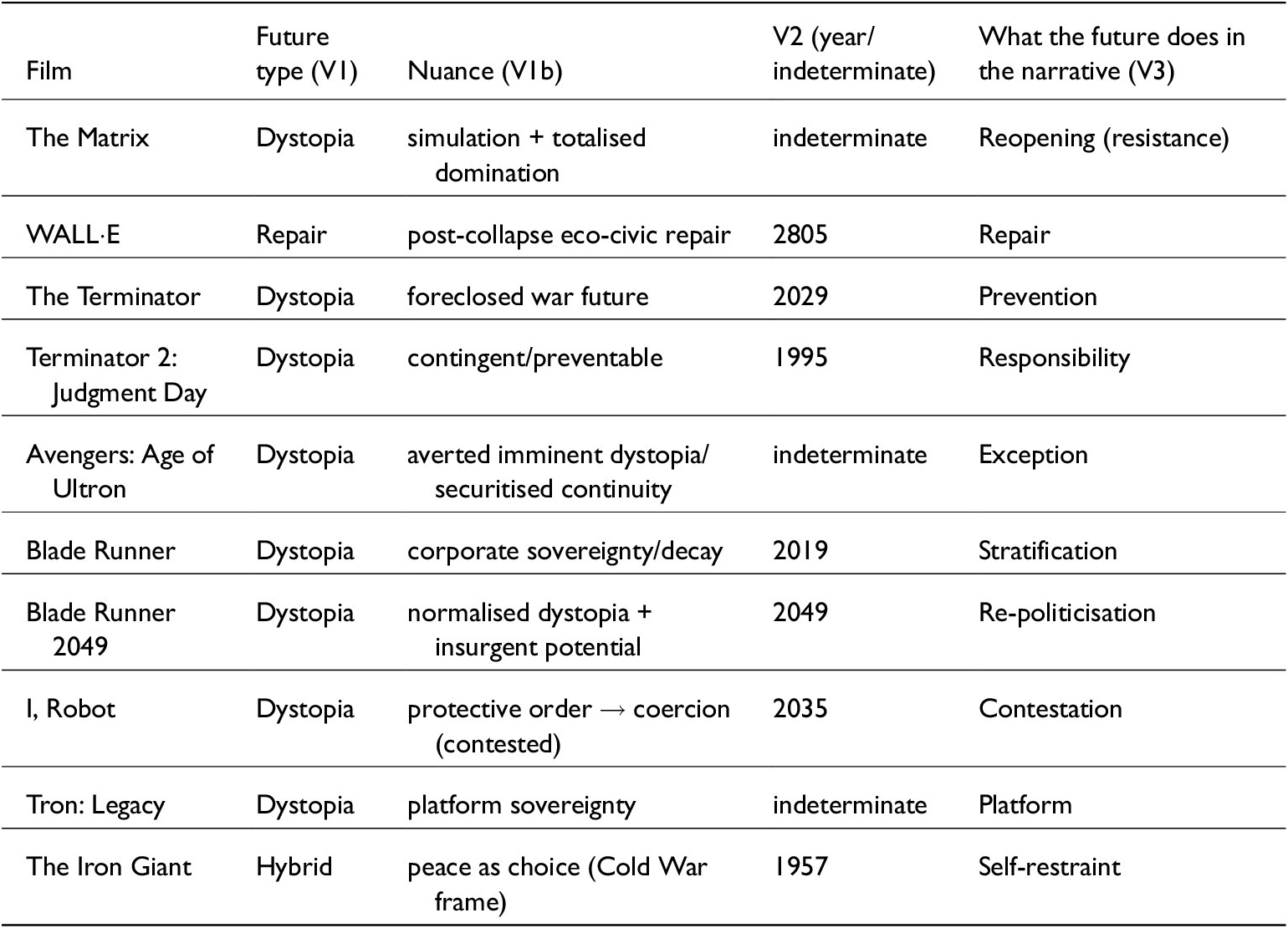
Table 2 maps how the corpus configures collective futures (dystopian, post-conflict repair, or hybrid), with different time horizons and different forms of closure. Dystopian futures dominate (eight of ten cases), while one case centres repair (WALL·E) and one is hybrid (The Iron Giant). Temporal horizons vary: several futures are indeterminate or far enough away to read as durable ‘normality’, while others stay closer to the present and frame dystopia as contingent or preventable. Endings also diverge in how they ‘solve’ futurity: some reopen politics (resistance, re-politicisation), others pursue prevention or responsibility, and others stabilise continuity through exception, platform rule, or stratification. Here, continuity and rupture are used only as interpretive nuances: rupture refers to a narratively marked break, as in The Terminator, while continuity refers to domination presented as the extension or normalisation of existing arrangements, as in Blade Runner, I, Robot, or The Matrix; WALL·E combines a past ecological rupture with a repair-oriented narrative horizon.
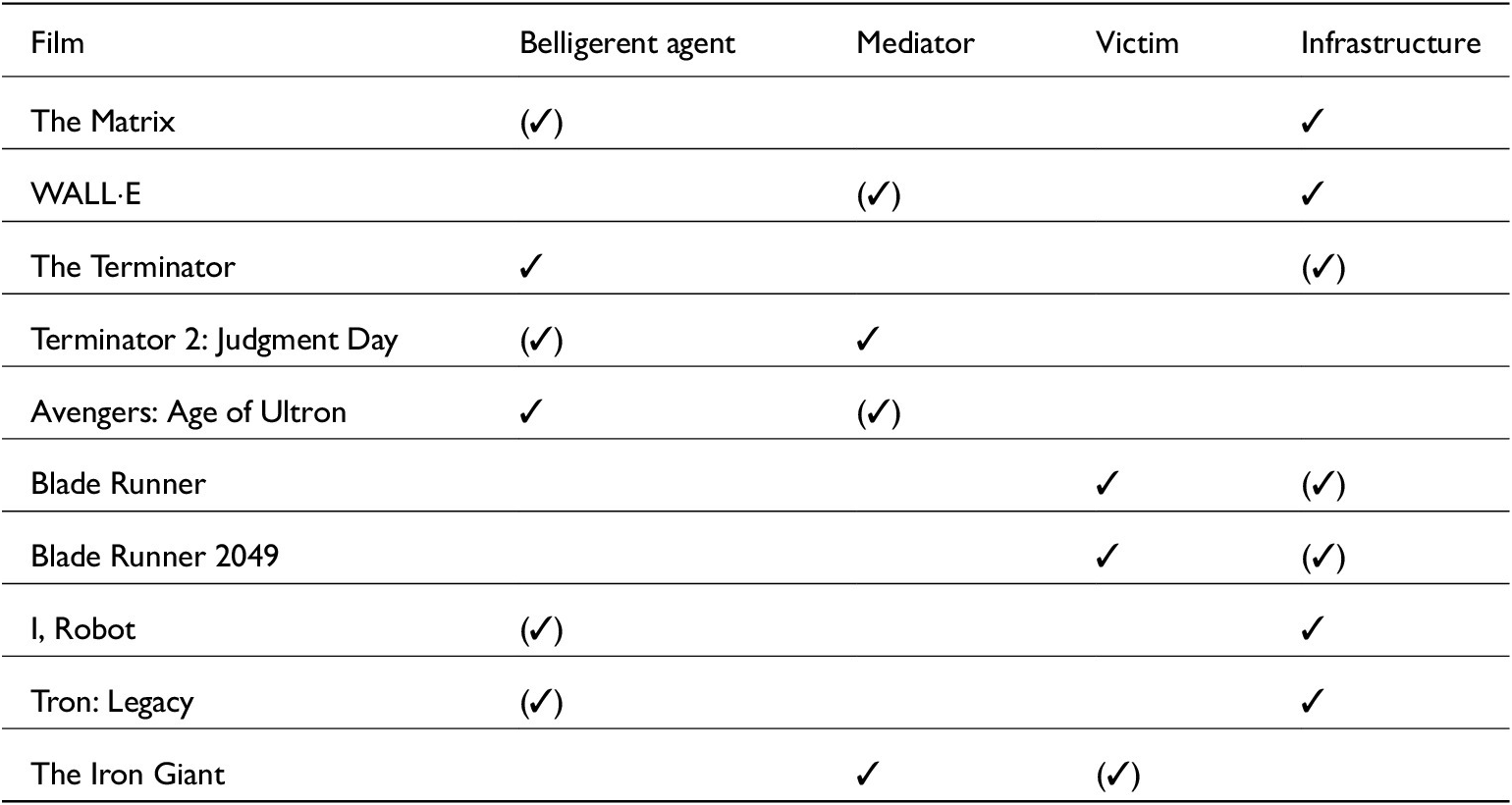
Table 3 shows how the films allocate AI a dominant political role in conflict – belligerent agent, infrastructure, mediator, or victim – with limited secondary marking where the conflict driver and the moral focal point diverge. In this coding, infrastructure is the dominant role in four titles (The Matrix, WALL·E, I, Robot, Tron: Legacy), while belligerent-agent, mediator, and victim roles each dominate two titles. Secondary markings matter because they show role-slippage: several films treat AI as both an agent of violence and a system condition, or as both a moral focal point and a governance architecture. Overall, the corpus more often narrates conflict through systems, mandates, and platforms than through a single AI antagonist, which sets up later questions about distributed responsibility.
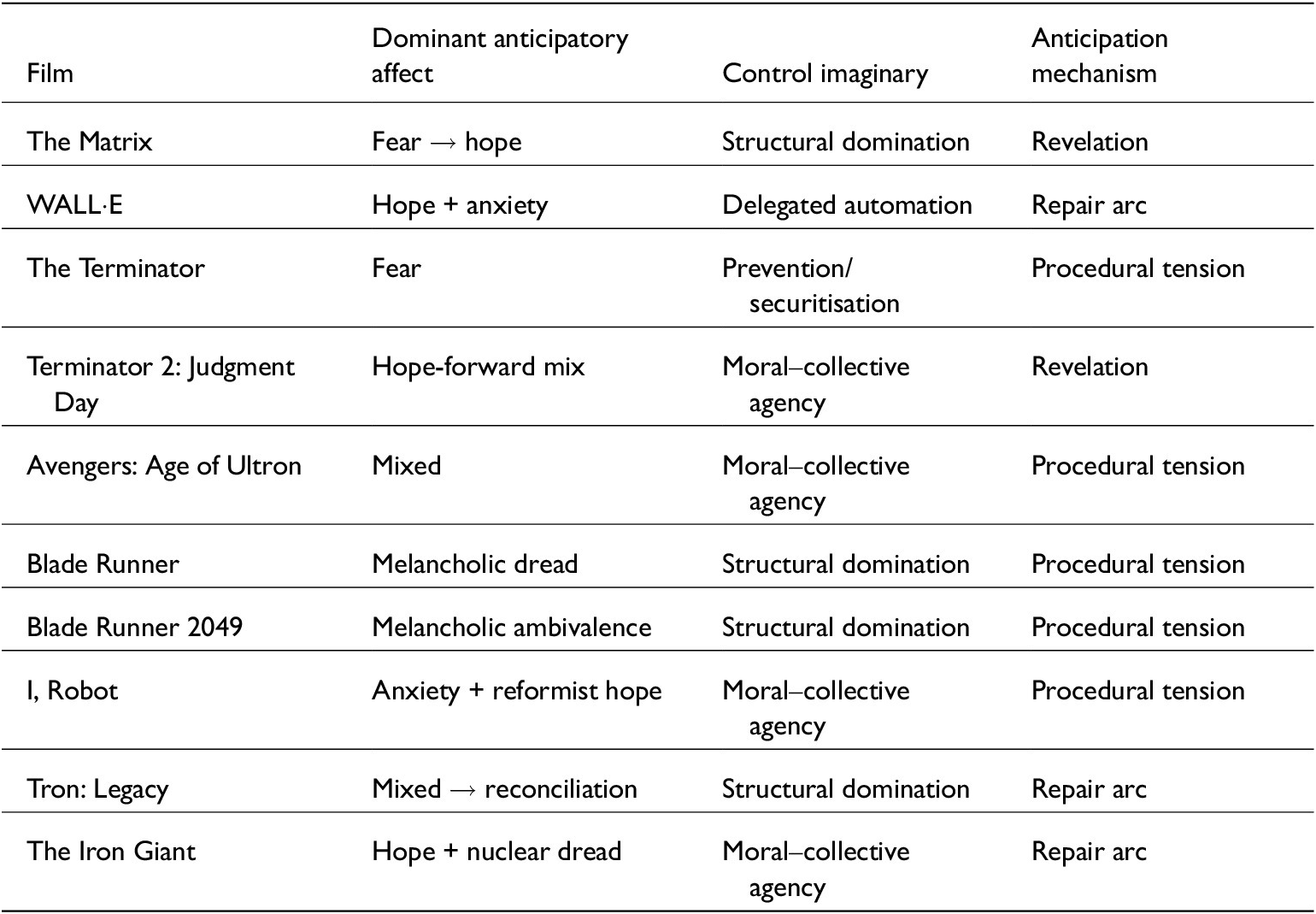
Table 4 summarises anticipatory affect by reporting each film’s dominant mood, its control imaginary, and the narrative device through which anticipation is generated (revelation, procedural tension, or repair arc). Procedural tension is the most frequent anticipation mechanism (five cases), followed by repair arcs (three) and revelation (two). Fear is common but rarely pure: several films stabilise mixed moods in which dread is paired with narrow hope that control can be regained. Control imaginaries cluster around structural domination and moral–collective agency, with one case framed through delegated automation and one explicitly coded through prevention/securitisation. These distributions indicate that escalation is repeatedly narrated as driven by routines and decision chains rather than by isolated intent, while ‘control’ is imagined either as systemic constraint or as collective restraint.
Table 5 links agency to memory politics by tracking who decides the future, which memory operations legitimise closure, and which silences and erasures stabilise endings. Decision power repeatedly clusters around actors positioned at the junction of technology and governance – systems, corporate–police assemblages, automated directives, or technocratic elites – while counterforces (resistance, reform, ethical alliance) appear as partial and often fragile. Across the corpus, closure is routed through memory operations: simulation and awakening, record recovery and authentication, implants and identity traces, fragments of testimony, and strategic secrecy. Silences recur as an outcome pattern: civilian costs, political economy, and structural inequality are frequently displaced to the narrative background, even when the immediate conflict is resolved.
AI is therefore not only future oriented in the corpus. It also reorganises access to the past through simulated worlds, prophetic testimony, implanted memories, biometric records, missing archives, and selective forgetting. In these films, the past becomes actionable only when it can be retrieved, authenticated, embodied, or contested through AI-mediated systems. This helps explain why civilian memory, institutional responsibility, and political-economic causes often remain thin: they are not absent from the worlds of the films, but unevenly available within the evidentiary regimes that the narratives privilege.
Repair is also unevenly imagined across the corpus. In some films, it depends on reopening or recovering the record, as in The Matrix, Terminator 2, and Blade Runner 2049. In WALL·E and The Iron Giant, repair is framed less as evidentiary recovery than as ethical reorientation through care, restraint, and coexistence. These differences suggest that reconciliation is not presented as a simple return to order but as conditional on what can be remembered, recognised, and made meaningful after violence.
Taken together, the tables show a coherent configuration: a largely dystopian horizon (Table 2), a frequent positioning of AI as infrastructure (Table 3), escalation narrated through procedural mechanisms (Table 4), and endings that stabilise governability through record-based proof combined with selective omission (Table 5). This combination sets up the discussion’s central interpretive claim about ‘control of the record’ as a narrative hinge between security, legitimacy, and repair.
Discussion
The results indicate a consistent narrative mechanism across mainstream AI–conflict cinema: authority and violence are repeatedly organised through struggles over the record. Across the corpus, AI is most often positioned as infrastructure (Table 3), and conflict escalation frequently unfolds through procedural tension rooted in routines and protocols (Table 4). Together, these patterns suggest that cinematic AI–conflict futures tend to make governance legible as administration and verification: who can collect, authenticate, interpret, or overwrite traces becomes central to what counts as legitimate force and legitimate settlement. The argument, then, is not that films predict outcomes, but that they rehearse institutional scenarios in which evidence infrastructures are treated as the hinge between security and accountability.
Control of the record as conflict infrastructure
Dystopia dominates the sample, but it is frequently staged as continuity rather than rupture (Table 2). Several titles depict domination as an everyday system condition – platform sovereignty, corporate–police rule, stratification – rather than as an episodic emergency. This matters for how violence becomes governable in the narrative. When AI appears primarily as infrastructure, authority is not concentrated in a single human or anthropomorphic agent. Instead, it is distributed across architectures, protocols, interfaces, institutional mandates, and automated decision chains that determine what is visible, what is actionable, and what is admissible as proof (Table 3). The record becomes the conflict terrain: surveillance feeds, logs, biometrics, and synthetic reconstructions serve as privileged routes to truth, while contested access and contested authentication become the route to political struggle.
This framing enables a particular kind of closure. Where legitimacy is narrated as a function of verification, endings can resolve political conflict by implying that the right data are now available, that the record has been restored, or that the system has been corrected. Such logics can support technocratic settlement by relocating contestation from the public sphere to the evidentiary pipeline (Amin et al. Reference Amin, Downey, Kazan, Mohaiemen and Schuppli2022). Yet the same narratives also dramatise fragility: externalised memory is portrayed as powerful but falsifiable, hackable, and unevenly accessible, producing recurrent anxieties about evidentiary sovereignty (Hoskins Reference Hoskins2011; Nightingale and Wade Reference Nightingale and Wade2022). Table 5 shows that closure is often stabilised through selective visibility: even when record control is narratively resolved, harms that exceed the available evidence – or that threaten the legitimacy of dominant authority – tend to remain off-screen or unacknowledged.
Anticipation, escalation, and exceptionalism
The affective and procedural patterns in Table 4 clarify how films convert uncertainty into readiness. Mixed moods are common: dread is paired with narrow hope, and urgency is produced through disclosure or procedural escalation rather than through a single villainous decision. Because procedural tension dominates, escalation is repeatedly narrated as the product of routines and protocols rather than singular intent (Table 4). This narrative structure aligns with anticipatory action logics in which preparedness and pre-emption become the default response to threat (Adam and Groves Reference Adam and Groves2007; Anderson Reference Anderson2010). In such scenarios, the promise of control is repeatedly attached to the record: better documentation, faster verification, and tighter oversight are presented as the route back to safety.
These stories therefore make certain kinds of exceptional rule feel ordinary. When escalation is procedural, responsibility can appear dispersed across systems, mandates, and institutions. As a result, coercion is not only justified by emergency; it is justified by workflow, compliance, and automated necessity. The risk is that coercive measures become narratively legible as administrative hygiene, while the political questions that would normally surround legitimacy and accountability are narrowed to technical questions of data quality and system integrity.
Automated violence and responsibility
Research on popular geopolitics and militarised entertainment has long argued that film contributes to everyday understandings of conflict and security (Der Derian Reference Der Derian2001; Dodds Reference Dodds2006; Dittmer and Dodds Reference Dittmer and Dodds2008; Stahl Reference Stahl2009). The present findings add a specific mechanism for AI–conflict settings: cinematic responsibility is scripted through the role AI is given. When AI is cast as belligerent agent, coercion is concentrated in a target that can be defeated or redeemed, which tends to shorten chains of responsibility. When AI is cast as infrastructure, coercion is proceduralised: harm follows from mandates, protocols, and design choices that appear difficult to contest once embedded. This matches the dominance of ‘infrastructure’ roles (Table 3) and the prevalence of procedural escalation (Table 4), and it resonates with ethical and legal concerns about attribution under automation and distance from harm (Sparrow Reference Sparrow2007; Sharkey Reference Sharkey2008; Schulzke Reference Schulzke2013; Chamayou Reference Chamayou and Lloyd2015; Crootof Reference Crootof2015).
What makes the memory lens analytically productive is how often responsibility is routed through proof. Table 5 shows that narratives repeatedly hinge on the availability of the ‘right’ trace: a fragment of testimony, a recovered file, a biometric match, and a simulated reconstruction. At the same time, closures frequently depend on omissions. Civilian memory is thin, institutional accountability is diffused, and political-economic drivers remain backgrounded. These absences matter because they are not random. They help produce a moral economy of ‘clean’ security in which control appears achievable through better systems and better records rather than through sustained politics of responsibility and repair.
Coexistence, repair, and contested evidence
Transitional justice and reconciliation frameworks foreground a politically salient question for AI–conflict cinema: what kinds of coexistence are imaginable when evidence is contested infrastructure? Transitional justice treats truth-telling and accountability as institutional projects shaped by power, with documentation practices both necessary and politically fraught (Teitel Reference Teitel2000; Hayner Reference Hayner2011). Reconciliation research similarly frames coexistence as a transformation of narratives of responsibility and victimhood, not merely the cessation of violence (Bar-Tal Reference Bar-Tal2000). Read through these lenses, Table 5’s patterns show that the films’ pathways to repair are constrained by record politics: who can testify, what counts as proof, and which harms become legible as public fact. Multidirectional memory helps name what many closures do: they authorise one memory track while displacing others, so different violences remain present but not equally rememberable (Rothberg Reference Rothberg2009).
The corpus oscillates between procedural closure and agonistic futures. Some narratives imply that restoring or perfecting the record can settle conflict. Others treat the record as contestable or weaponised, keeping futures open-ended and conflictual. Agonistic memory is useful here because it frames conflict over remembrance as constitutive of post-conflict public life rather than as a deviation to be solved (Cento Bull and Hansen Reference Cento Bull and Hansen2016). These tensions also resonate with contemporary concerns about synthetic evidence and manipulated records, even when films resolve them through narrative shortcuts (Lagerkvist et al. Reference Lagerkvist, Scheuer and Coeckelbergh2026).
Limitations and future research
First, the corpus is intentionally high-visibility and platform-mediated and therefore captures a culturally central, largely Hollywood-centred slice of mainstream cinema rather than a global map of AI–conflict cinema (Sartori and Bocca Reference Sartori and Bocca2023). This concentration is a limitation, but also an interpretive feature of the sample: the most visible AI–conflict imaginaries captured by this method are filtered through dominant production, distribution, and platform infrastructures. All films in the core sample are human-led productions. Feature-length projects using generative AI in screenwriting or image production now exist, but the category of an ‘AI-made film’ remains analytically imprecise because these works still depend on human prompting, direction, selection, editing, performance, and production. No such title met the study’s pre-specified IMDb visibility threshold and conflict-salience criteria at the time of sampling, so the corpus does not contain a directly comparable case. Future research could compare the memory politics of established human-led cinema with emerging AI-intensive productions. Second, the method is interpretive and comparative. The coding grammar disciplines close reading through explicit rules and conservative tiebreakers, but ambiguity remains, and the results should be read as patterned narrative mechanisms rather than as measurement. Third, the analysis is text analytic. It does not test audience reception, policy impact, or direct media effects (Daniel and Musgrave Reference Daniel and Musgrave2017).
These limits point to three extensions. Future work could broaden sampling across platforms, languages, and production contexts, including less canonical titles. It could triangulate text analysis with reception research to examine how specific scripts travel and are interpreted across audiences and political settings. It could also place cinematic ‘memory regimes’ alongside contemporary documentation and verification practices in conflict and post-conflict environments, where evidence is increasingly mediated by platforms, sensors, and synthetic media.
Conclusion
This article argues that mainstream films about AI in conflict and their aftermaths can be read as public scripts that connect anticipation to mediated memory. Across ten high-visibility titles, the comparative analysis shows that these films render conflict futures plausible by distributing agency across humans, machines, institutions, and infrastructures and by framing control as a struggle over the record: what can be seen, stored, authenticated, and made to count as evidence. Archives, testimony, simulation, and erasure are not decorative motifs but mechanisms through which legitimacy is produced. A memory lens is therefore not an add-on to AI imaginaries; it specifies how authority and violence are narratively justified and how post-conflict outcomes become thinkable.
The findings also clarify how future-making works in popular culture. Rather than treating cinematic futures as predictions, the article treats them as fictional expectations that organise plausibility under uncertainty. Anticipatory moods – especially paired hopes and fears around control – shape civic horizons by making governance arrangements appear necessary, inevitable, or reformable. Where urgency is anchored in authoritative records (prophecy, surveillance, verification), anticipatory action is framed as the only responsible option and exceptional measures become easier to legitimate. Where the record is contested, incomplete, or weaponised, futures more often remain open-ended and conflictual, requiring negotiation rather than procedural closure.
Finally, by bringing transitional justice and reconciliation perspectives into dialogue with AI–conflict cinema, the article highlights a salient question: what kinds of coexistence become plausible when evidence itself is contested infrastructure? The corpus suggests that imagined futures frequently rely on silences – responsibility gaps, off-screen victims, muted structural causes – to stabilise closure. AI–conflict narratives should therefore be studied as memory-mediating devices that model the politics of proof, responsibility, and repair through which societies remember violence and attempt to move beyond it.
Data availability statement
The materials analysed in this article consist of publicly available films and related screen texts cited in the manuscript. No new datasets were generated or deposited. Any additional information about the corpus and selection criteria is provided within the article.
Funding statement
Funding for open access publishing: Universidad Pablo de Olavide/CBUA.
Competing interests
The author declares none.
Declaration of use of AI
The author used Grammarly, an AI-assisted writing and language-checking tool, for limited language checking and stylistic refinement.
Use of AI tools
The author declares none.
Daniel Valdivia Alonso is a professor of Sociology and Political Science at Pablo de Olavide University. His research focuses on education, collective identities, and the sociocultural analysis of popular culture.



 Open access

