Introduction
This article addresses an empirical puzzle that stems from the variation in the use of litigation to pursue social and political goals among environmental nongovernmental organizations (ENGOs) in France since 1975. Existing theory suggests that the relationships that civil society groups have with public authorities can be a key factor in explaining which groups are willing and able to turn to judicial venues to influence policy making and which are not. Scholars who have examined groups’ interactions with governments have tended to argue that “outsider” groups—that is, those without direct access to decision makers in other political arenas—have more freedom to litigate than “insider” groups, which might be wary about threatening good relationships with policy makers (Coglianese Reference Coglianese1996; Kagan Reference Kagan2001; Morag-Levine Reference Morag-Levine2003; Soennecken Reference Soennecken2008). This is particularly the case where state–civil society relationships are governed by a neo-corporatist logic. In contrast with pluralist systems of civil society–state interactions, where interest groups compete for access and influence in policy making, many western European states have long been characterized by a different model of governance, one that values close cooperation between state organs and peak civil society organizations and where consensus decision making and civil society involvement in policy implementation are the norm. In these types of neo-corporatist political systems, we would expect “insider groups” to be particularly reluctant to jeopardize their relationships with government partners by taking them to court.
In France, however, the data presented here suggest that the opposite logic characterizes legal mobilization activity in the area of environmental policy: groups that are closest to the government tend to turn to the courts more often. This research shows that the two civil society associations that have had among the most privileged access to the Ministry of the Environment in terms of involvement in policy making and receiving public funding for their work, France Nature Environnement (FNE) and Ligue pour la Protection des Oiseaux (LPO), have also regularly taken cases to the Conseil d’Etat—the highest administrative court in France—which directly challenge the decisions of the ministry. Why have groups that have privileged access to policy makers turned to the Conseil d’Etat more than “outsider” groups?
This article tests a number of explanations put forward in the legal mobilization literature and finds that the answer to this question is twofold. First, the legal opportunity structure that shapes who has access to courts in environmental law in France is also dominated by a neo-corporatist logic that privileges policy “insiders.” Second, this research suggests that the best explanation for legal mobilization activity may sometimes lie in the dynamic interaction between the structural features that shape access to the legal system, on the one hand, and an organization’s structure and internal attitude toward the law, on the other. This builds on a growing body of work that argues that paying due attention to the influence of agent-level characteristics within a particular legal and political setting can offer better explanations for when and why groups turn to courts than focusing on external, structural factors alone (Epstein, Kobylka, and Stewart Reference Epstein1995; Alter and Vargas Reference Alter2000; Edelman, Leachman, and McAdam Reference Edelman2010; Vanhala Reference Vanhala2011b; Doherty and Hayes Reference Doherty2014).
The first section of the article reviews the literature on how neo-corporatist governance may influence the propensity of civil society groups to litigate. The second section offers an analysis of new empirical data about litigation by French environmental associations in the Conseil d’Etat. The third section surveys competing theoretical explanations for legal mobilization and tests these approaches with evidence from the French case. The research finds that a neo-corporatization of the standing rules has meant that policy insiders are also more likely to mobilize the law. It also suggests that in this case the presence of legal resources within an organization and a decentralized organizational structure facilitate legal mobilization. Financial resources, on the other hand, did not seem to matter as much as previous research has suggested. The article concludes by offering a consideration of what lessons can be drawn from this research and suggestions for the direction of future research.
Literature Review
Political scientists have often traced the turn to the courts by groups “disadvantaged” in traditional political arenas. Early studies, relying mainly on case studies of the American civil rights movement, argued that “outsider” groups lacking influence over members of the executive, legislative, or regulatory bodies were more likely to turn to the courts to pursue their policy goals. Early examples of this research (Vose Reference Vose1959; Cortner Reference Cortner1968) included studies of interest group litigation in housing discrimination cases in the segregated South throughout the 1950s. This research found that groups lacking access to the executive and legislative branches of the government consequently seek redress through the courts. This early research found that groups use litigation as a last resort after the breakdown in social relationships or the absence of relationships in the first place (see also Macaulay Reference Macaulay1963; Galanter Reference Galanter1983; Elickson Reference Ellickson1991). However, this characterization was challenged by Olson (Reference Olson1990), who found that legal and political resources were more important than exclusion from policy-making processes in explaining the use of litigation by groups. She showed how the courts can be used by powerful groups to enforce gains won politically. In a similar vein, Epstein and her coauthors (e.g., Epstein Reference Epstein1985; Epstein and Rowland Reference Epstein1991; Epstein et al. Reference Epstein1995) have shown that groups might turn to the courts to provide a counterbalance to competing claims, to act as agenda setters, or to maintain victories achieved in other policy arenas. Coglianese (Reference Coglianese1996) found that in relationships between interest groups and the US Environmental Protection Agency (EPA), the interest groups with the most extensive, long-standing relationships with the EPA tended to be the ones most likely to litigate against the agency’s regulations. He found that this type of litigation in many instances is often just another round of an ongoing process of bargaining. In short, as a result of this research, the idea that political disadvantage explains litigation activity by groups in the United States was largely overturned two decades ago.
The idea has nonetheless reappeared as the study of legal mobilization outside of the United States has blossomed in the last decade. For those examining legal mobilization in other jurisdictions, the role of civil society–state relations has reemerged as a key explanatory factor accounting for the ways in which groups mobilize rights (or fail to). This research has helped to nuance the “political disadvantage” thesis. Alter and Vargas (Reference Alter2000, 472) found some evidence to suggest that in the use of European litigation strategies, “the greater the political strength of a group, and the more access the group has to the policy-making process, the less likely a group is to mount a litigation campaign.” Soennecken (Reference Soennecken2008) similarly found that in Germany, groups advocating for the protection of refugees were unlikely to use the courts because they achieved their goals through their political relationships. Morag-Levine (Reference Morag-Levine2003) argues that the presence of both group-level partnership-centered relationships and the national culture of state–civil society cooperation shapes the likelihood of groups bringing political issues to court. Relying on case studies of conservationist organizations in the United States and Israel, Morag-Levine found that taking this political relational perspective can help to elucidate why some campaigners are more tolerant of conflict with state institutions and hence more willing to litigate against government authorities.
A weakness of the political relationship hypothesis is that its underpinning assumptions have largely been based on research on legal mobilization dynamics in the United States, Canada, and, to a lesser extent, Israel and the United Kingdom (Israël Reference Israël2009). To varying degrees, these are all states with a pluralist model of interest group–state relationships, and as Epstein et al. write, the very idea of “‘interest group litigation’ is steeped in the pluralist tradition” (Reference Epstein1995, 105). As Morag-Levine (Reference Morag-Levine2003), Soennecken (Reference Soennecken2008), and Anagnostou (Reference Anagnostou2014) convincingly show, the findings based on these studies may not be pertinent for other types of systems. They suggest that comparative research, both across organizations and across jurisdictions, is needed to assess rigorously the influence of political relationships on the willingness of groups to turn to the courts across different types of political systems.
Sociolegal scholars who have looked beyond the Anglo-American world have argued that the broader institutional contexts that formalize political relationships between the state and civil society groups might influence the likelihood of turning to the court in a more hegemonic way. In contrast to pluralist systems like the United States and the United Kingdom, where civil society groups are seen to be free to use their resources to exert influence in the policy process, corporatist systems in Europe contain a few select interest groups that are often formally incorporated into the governance process. Schmitter (Reference Schmitter1974, 93) proposed that “corporatism can be defined as a system of interest representation in which the constituent units are organised into a limited number of singular, compulsory, non-competitive, hierarchically ordered and functionally differentiated categories, recognised or licensed (if not created) by the state and granted a deliberate representational monopoly within their respective categories in exchange for observing certain controls on their selection of leaders and articulation of demands and supports.” Soennecken (Reference Soennecken2013) argues that policy areas dominated by a neo-corporatist logic, where groups are formally included in the formulation and implementation of policy, may be less likely to see mobilization of the law through the courts by collective actors. She suggests that “[neo-corporatism] creates such a powerful system of accommodation, collaboration and compromise, it may make litigation by groups (in whatever form) to resolve conflicts or to push agenda items not simply unlikely but ‘superfluous and inappropriate.’ … In contrast, pluralist societies, such as the United States, are considered much more ‘litigation prone’ because there, groups have not been offered such a ‘social partnership’ and must continuously compete for the state’s attention to realize political goals, often in an adversarial fashion” (44).
In sum, on the basis of existing theory about state–civil society relationships in neo-corporatist settings, we would expect groups that are incorporated in policy making to be less likely to turn to the courts than other groups. A case study of the French environmental movements allows us to explore this proposition.
The French Case
Szarka (Reference Szarka2000, 89) writes, “In France, neo-corporatism has characterised and shaped core components of environmental policy.” An extensive body of critical research documents the institutionalization of the French environmental movement within the formal political system, particularly since the establishment of the Ministry of the Environment in 1971. Fillieule (Reference Fillieule2003, 16) traces this neo-corporatist relationship back to the “slow and difficult birth of the administration of the Ministry for the Environment.” The ministry received neither the administrative and financial means nor the political legitimacy to require other ministries to act. In the early 1970s, the ministry relied on environmental groups as allies in political conflicts against other ministries (agriculture, industry, economics and finance) as well as industrialists and locally elected officials. In turn, certain environmental groups were granted special access to policy consultations and public subsidies to help fund their work (Fourcade Reference Fourcade2011). According to Élisabeth Joly-Sibuet and Pierre Lascoumes, “It is possible to talk of exchange of service between the state apparatus and the associations. In effect, on the one side associations were given official recognition and institutional legitimacy sustained by the granting of the right to take collective legal action, legal and financial support. On the other, they were expected to provide assistance to the democratic process” (cited in Fillieule Reference Fillieule2003, 74).
This dynamic also plays out on the local level. Hayes (Reference Hayes2002) shows that in France the decentralization of a formerly centralized state created even more opportunities for environmentalists to develop partnerships with state authorities. Fillieule concludes from this that “the relative pacification of the environmental movement can then be related to its co-optation by the state” (Reference Fillieule2003, 11).
This neo-corporatist arrangement between state authorities and environmental groups was formalized through the procedure known as the agrément, originally introduced in the Environmental Protection Law of 1976. The purpose of this procedure is to select certain associations (associations agréees) that are then granted special access to the state’s policy-making procedures. The range of privileges associated with the agrément was expanded in 1995 by what is known as the Barnier Act (law no. 95-101 of February 2, 1995; named after the then–minister of the environment, Michel Barnier) on the reinforcement of the protection of the environment. The organizations chosen for this special recognition by the state had to meet several criteria regarding how representative they were, whether their functioning was compliant with legal regulations, whether their financial situation was in order, and whether their activities lay in the broader interest and in the interest of the environment. The privileges conveyed by the agrément as established by the 1976 Environmental Protection Act and the Barnier Act include, for example, access to policy issue networks, automatic right to participate in a wide range of national consultative bodies, and representation on regional and local committees. The agrément also leads to the allocation of public subsidies (Szarka Reference Szarka2002).
France’s environmental movement is composed of a rich and varied mix of individual activists, grassroots groups, and professional organizations.Footnote 1 In the 1960s, associations emerged to protect nature and oppose developments such as ski resorts, transport projects, and urban and coastal developments (Fillieule Reference Fillieule2003). In the 1970s, French branches of transnational environmental associations were founded as part of a new wave of environmentalism. Today, the leading associations include World Wide Fund for Nature (WWF France), Greenpeace France, FNE, and LPO (Lequenne Reference Lequenne1997; Szarka Reference Szarka2002; McCauley Reference McCauley2007; Lebel and Desforges Reference Lebel2009; Nicolino Reference Nicolino2011).
Two of these groups were founded in the 1970s. WWF France was founded in 1973 and Greenpeace France was founded in 1977. Both of these organizations are linked to transnational organizations but have predominantly had domestic policy issues as their primary focus. FNE and LPO are homegrown French organizations with long histories, and their federated governance structures mean that they are each connected to about 3,000 groups operating at the regional and local levels (McCauley Reference McCauley2007). FNE was founded in 1854 and was previously known as the Federation Française des Societies de Protection de la Nature. LPO, founded in 1912, is devoted to the protection of birds and their habitats and has been a part of the worldwide organization Birdlife International since 1993.
Exploring the approach to legal mobilization taken by these four organizations allows us to understand the conditions under which groups may be more or less likely to mobilize the law in France. Rather than being seen as representative of all environmental NGOs in France, these groups should be understood as peak organizations. If they cannot litigate for particular reasons relating to that peak status (more finances, greater voice in policy making, etc.), then that can help us glean some generalizable lessons.
The data for this research were gathered from several sources. First, the Conseil d’Etat’s database of legal decisions was used to determine organizational participation before the Conseil d’Etat, and an original data set of approximately 200 cases was compiled. Second, the qualitative research relied on documentary evidence from NGOs (including annual reports, strategic plans, and press releases), literature on French social movement organizations and environmental policy, and media reports of key developments. Third, semistructured interviews between December 2011 and June 2012 with 15 individuals including lawyers, legal scholars, policy officers, and campaigners who worked in or with the NGOs examined here helped to inform this research. Interviews lasted from 1 to 3 hours, and interview quotes are fully anonymized because of the small number of individuals involved in this field. Interview quotes have been translated from French by the author.
The Puzzle: Legal Mobilization by ENGOs
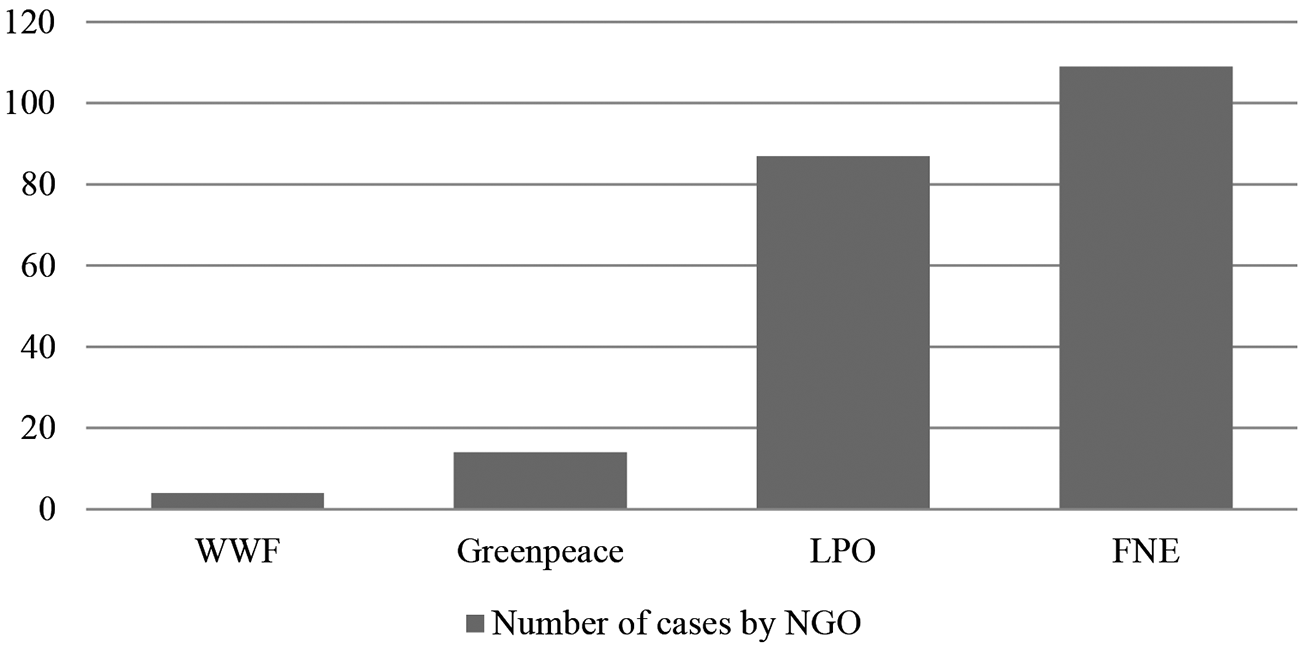
This section presents the overall record of legal mobilization before the Conseil d’Etat of the environmental groups examined here.Footnote 2 The Conseil d’Etat is France’s supreme administrative court; it has the power to review the decisions of government and is accessible to individual and collective actors. Figure 1 shows the breakdown of the number of cases taken by each group to the Conseil d’Etat.Footnote 3 Overall, between 1975 and 2010 the ENGOs examined here appeared before the Conseil d’Etat 214 times.Footnote 4 WWF took four cases, Greenpeace appeared 14 times before the Conseil d’Etat, and LPO and FNE were the most active, appearing 87 and 109 times, respectively.
Legal mobilization in the Conseil d’Etat by NGO, 1975–2010. Source: Compiled by the author from the Conseil d’Etat Jurisprudence Database. Additional information on cases is available from the author.

The administrative decisions being challenged in the Conseil d’Etat by these groups have been made by a wide range of governmental authorities: they range from local authorities to the Ministry for Agriculture to the Finance Ministry to the governmental authorities responsible for France’s overseas departments and territories. However, the large majority of appearances these groups made before the Conseil d’Etat (85%) concerned a challenge to a decision that the Ministry of the Environment was responsible for or was involved in.Footnote 5 This is significant: it is precisely the authority that has the power to grant these groups access to policy-making processes and public subsidies that has been the most challenged in the Conseil d’Etat.
Of course, counting cases in this way is a relatively crude measure of an NGO’s willingness to use strategic litigation. Some cases can be relatively routine and decided quickly and may not cost very much. Others require a much more substantial investment of time and money. The significance of these cases varies enormously as well.Footnote 6 However, because this research examines cases that have reached the highest administrative jurisdiction in France, it is safe to assume that each case, however routine, is of at least some minimum level of importance in terms of environmental policy making and the power of public authorities. The discussion below highlights some of the key trends and important cases to illustrate how legal mobilization has mattered.
France Nature Environnement
FNE is the most litigious of the groups studied here both before the Conseil d’Etat for the period covered here and more generally. For example, in 2013 the group litigated 155 cases across different jurisdictions: 70 before the administrative courts, 56 in the criminal courts, and 29 in the civil courts. FNE’s caseload over the years has been extremely diverse, including more routine litigation and complex cases that have lasted years and taken the group to the European Court of Justice (ECJ), which is the supranational court system of the European Union.Footnote 7 Of FNE cases before the Conseil d’Etat, 25% concerned the regulation of the duration of the bird hunting season. Twenty percent of FNE cases were challenges to decisions by the Ministry of the Environment and the prime minister authorizing development and infrastructure projects. These included cases opposing decisions to develop, for example, roads, tunnels, a technology park, and three cases decided in 1992 challenging the creation of Euro-Disneyland. Just under 5% of FNE cases before the Conseil d’Etat concerned challenges related to nuclear facilities and radioactive waste storage.
Just over 5% of FNE cases concerned challenges to decisions permitting the development of genetically modified (GM) maize. These cases were taken in a broader context of the politicization of GM products. The 1990s and 2000s witnessed high-profile and popular campaigns against GM food across Europe. In France, groups and individuals, such as José Bové, who destroyed GM crops, used their criminal trials to raise their concerns about genetically modified organisms (GMOs) and received extensive coverage in the media (Hayes Reference Hayes2006). The Conseil d’Etat cases included several requests to refer the issue to the ECJ for interpretation of Directive 2001/18 EC on the deliberate release into the environment of GMOs. These decisions were handed down in 2008 and 2009 and were part of a broader societal and political discourse about GMOs. The government ultimately relied on the directive’s “safeguard” clause in September 2011 to enact a suspension on the development of GMO corn in France.
Another highly politically charged area in which FNE has litigated concerns challenges to local government’s decision making about what can be considered an “environmental group” for the purpose of being a partner in policy making and policy implementation. In the mid-1980s the group took a number of prefects to court for granting hunting groups official status as civil society partners under environmental protection laws. The long-standing animosity between hunting groups and nature conservation groups, and its expression in legal activity, has cut right to the core of who is and is not an insider in environmental policy making in France.
Ligue pour la Protection des Oiseaux
Seventy-seven percent of the cases taken by LPO challenge decisions of the Ministry of the Environment on the hunting dates for certain species of birds each year. The fact that this litigation is relatively routinized does not mean that it is not consequential. With France’s long history of high levels of contention between hunting groups and conservationists, this litigation, in fact, had profound consequences in French society and on the legal and political relationship between France and the European Union (Szarka Reference Szarka2000; Cichowski Reference Cichowski2007). In 1979 the Birds Directive (79/409/EEC) banned the hunting of migratory birds during their reproductive season. The directive has been fiercely resisted by hunters in France through mass demonstrations, political campaigns, the establishment of a single-issue political party Chasse, Pêche, Nature, Tradition, and general flouting of the directive’s provisions (Szarka Reference Szarka2000). In the early 2000s, LPO took a series of cases (with other organizations such as the Anti-hunting Union and the Association for the Protection of Wild Animals) in which it requested the Conseil d’Etat to make a referral to the ECJ for interpretation of the Birds Directive regarding the period of the hunting season in several of its “routine” cases. In a significant legal victory for LPO, the ECJ found that the opening and closing dates of the hunting season could not be decided by government authorities simply on the basis of the interests of the hunters. In these cases LPO enlisted the ECJ (via a request to the Conseil d’Etat for a referral) as a supranational ally against the decisions of the Ministry of the Environment.
The remaining cases taken by LPO have concerned issues such as methods of hunting, challenges to habitat destruction, as well as disputes over major infrastructure projects. For example, in 1989, LPO contested the decision to build a bridge between the Ile de Ré and the mainland, and in 2009 a delegation of LPO participated in a request to annul the decision to develop the Notre-Dame-des-Landes Airport.
Greenpeace
While Greenpeace has taken a smaller number of cases than LPO and FNE, it has nonetheless been involved in a number of high-profile cases. Five of the 14 cases it has taken before the Conseil d’Etat concerned nuclear facilities or the handling or control of nuclear material or radioactive waste. Two cases concerned GMOs (including a referral to the ECJ), two cases concerned challenges to the development of the Mont Blanc tunnel after a 1999 fire, and two cases concerned the export of broken-down or asbestos-ridden ships. One of these cases, over the export of Le Clemenceau, a decommissioned aircraft carrier, to India, had a number of knock-on effects including protests in India over the environmental justice concerns of shipping hazardous materials to the developing world and a decision of the Supreme Court of India refusing permission to the ship to enter its waters.
WWF France
WWF appeared before the Conseil d’Etat on only four occasions in the period examined here. Three of these cases concerned challenges to infrastructure development including water diversion schemes in the Saône and the Allier rivers and the building of a dam in Serre de la Fare. The environmental associations contesting the latter won their case, and the project was abandoned.Footnote 8
In summary, the variation in the quantity of cases is not driven simply by a number of routine cases for those organizations that have turned to the courts more often. All of these groups, except for WWF France, have taken cases to the ECJ via references by the Conseil d’Etat. This alone is an enormously time-consuming and expensive endeavor that challenges the very authority of the French government in the realm of environmental policy making. This litigation activity thus presents an interesting puzzle in light of existing theory on neo-corporatism and state–civil society relationships. Both FNE and LPO have had a good degree of access to the French Ministry of the Environment, hold important positions within policy networks, and are involved in program partnerships (Szarka Reference Szarka2000; McCauley Reference McCauley2007). They have privileged positions in terms of access and influence in policy making. And yet, counterintuitively, they are more present in the courtroom than groups like Greenpeace, which explicitly reject partnering with governments and thus, according to existing theory, have less to fear in terms of jeopardizing political relationships. The next section explores why this is the case.
Explaining Variation in Legal Mobilization
This section lays out a series of hypotheses, derived from the literature on legal mobilization, that account for why an NGO might or might not turn to the Conseil d’Etat. It categorizes the hypotheses as lying at either the level of the opportunity structure or the organizational level. The discussion highlights what evidence we should look for in testing these explanations.
Legal Opportunity Structure
First, much of the recent literature on social movements and their interaction with law and courts has deployed the notion of legal opportunity or legal opportunity structures (LOS), to account for why some civil society groups embrace legal tactics and others eschew them (e.g., Hilson Reference Hilson2002; Andersen Reference Andersen2006; Vanhala Reference Vanhala2012; Doherty and Hayes Reference Doherty2014). The focus is on the institutional incentives and constraints that shape a group’s ability to sue. There are disagreements as to what constitutes part of the LOS and what does not (see Vanhala Reference Vanhala2012, 527), but at the eye of this scholarly storm there is a consensus that the legal stock matters. Legal stock constrains the ways in which social movement organizations can articulate their claims if they want to be successful in the courtroom (Andersen Reference Andersen2006). This leads to the first hypothesis:
Hypothesis 1: Groups that operate in a policy field with a larger body of relevant and specific legal stock will be more likely to mobilize the law than groups that operate in areas where law is less developed.
Scholars also agree that the regulations that limit or allow access to courts—the standing rules that regulate who can bring cases—are crucial in determining who mobilizes the law and who does not (Börzel Reference Börzel2006; Wilson and Rodriguez Cordero Reference Wilson2006; Evans Case and Givens Reference Evans Case2010). This leads us to the second hypothesis:
Hypothesis 2: Groups that operate in a policy field where the standing rules are more liberalized are more likely to mobilize the law than groups that operate in areas where standing is more restricted.
If the LOS has mattered in the case of French ENGO mobilization of the law, we can assess this using two types of evidence. The first is information on the stock of available law—the amalgam of constitutional, statutory, administrative, common, and case law—that these groups can rely on. The second concerns information about standing rules—the regulations that determine who has the right to sue. In addition to these data, there needs to be evidence to show that the groups are aware of the available legal stock and standings rules (Cichowski Reference Cichowski2007; Vanhala Reference Vanhala2012).
Organization-Level Attributes: Framing, Financial Resources, Legal Resources, and Organizational Form
One of the critiques of opportunity structure approaches is that they cannot generally account for variation across groups that operate within the same context (Vanhala Reference Vanhala2011a). As Edelman et al. (Reference Edelman2010, 661) argue, “organizational-level variables help explain why tactical variation occurs between organizations in the same movement field—even when those organizations experience the same institutional pressures.” This article focuses on four different types of organization-level factors: framing processes, financial resources, legal resources, and organizational structure or form.
For organizations to turn to law, they first need to perceive their problems as ones that can be addressed by the law. Scholarship on framing theory offers a useful analytic tool. Frames have been defined as schemata of interpretation. Snow et al. (Reference Snow1986, 464, 466) argue that “by rendering events or occurrences meaningful, frames function to organize experience and guide action, whether individual or collective. … What is at issue is not merely the presence or absence of grievances, but the manner in which grievances are interpreted and the generation and diffusion of those interpretations.” Frames will permeate all aspects of an organization, including its goals and its strategies in achieving those goals. In terms of legal mobilization, scholars have argued that collective meaning frames and their organizational implications can influence the likelihood that a group will participate in legal venues (Pedriana Reference Pedriana2006; Vanhala Reference Vanhala2009). The way in which groups frame law may influence their perceptions about the appropriateness of using legal tools. This leads to a third hypothesis:
Hypothesis 3: Groups that frame the problems they seek to address through a legal lens will be more likely to rely on legal tools, including litigation. Groups that are skeptical of law or perceive it as serving only elite interests will be less likely to litigate.
Evidence about organizational framings of law can be found in groups’ public documents and in the private statements of organizational insiders. If framing matters, then groups that see a strong legal framework as an important part of addressing environmental problems will be the ones more likely to turn to the courts. The evidence will allow for an examination of how lawyers have understood and acted on their organization’s conception of the law and what the environmental legal framework offers. It is important to distinguish between an “organization’s conception of law” on the one hand and attitudes within an organization toward litigation on the other. The former might include a positive disposition to the existence of a strong legal framework, which might manifest as a commitment to lobbying for legislation but may not extend to support for the use of litigation by the group itself.
Scholarship has consistently shown that over time and across jurisdictions, the level of financial resources civil society groups possess influences the likelihood a group will turn to law. Galanter (Reference Galanter1974) in his landmark study of litigation by “repeat players” found that the “haves” tend to come out ahead. However, beyond the purely financial, scholars have also pointed to the role of other “resources,” such as in-house lawyers, that may help to explain a group’s propensity to litigate (McCann Reference McCann1994; Silverstein Reference Silverstein1996; Kostiner Reference Kostiner2003; Edelman et al. Reference Edelman2010; Lejeune Reference Lejeune2011; Barnes and Burke Reference Barnes2012; Vanhala Reference Vanhala2012). Epp (Reference Epp1998, 17) found that across policy areas and across countries, “Combining rights consciousness with a bill of rights and a willing and able judiciary improves the outlook for a rights revolution, but material support for sustained pursuit of rights cases is still crucial.” Epp argues that a “support structure”—consisting of organizations committed to establishing rights, lawyers, and access to money—is a necessary condition for a rights revolution. Another comparative study by Börzel (Reference Börzel2006) found that environmental groups in Spain and Germany with strong organizational and financial resources stand a better chance of successfully exploiting legal opportunities than groups with weak resources. In order to begin to disaggregate financial and legal resources, this is broken down into two additional hypotheses:
Hypothesis 4: Groups with greater access to financial resources will be more likely to mobilize the law than groups with less financial resources.
Hypothesis 5: Groups that possess greater legal resources will be more likely to mobilize the law than groups that have less legal resources.
If “resources” matter in explaining which groups have turned to the courts in France, we should be able to assess this using several types of evidence. The first is the financial resources of groups and the second is the existence of lawyers within an organization and the duration over which a group has had an in-house lawyer. If resources matter, then those groups with significant financial resources and with in-house lawyers should be the ones appearing more often before the Conseil d’Etat than groups with less access to financial and legal resources.
Finally, another group-level factor that may matter is the organizational structure of a group. In social movement studies, scholars have found that the form a group takes may influence the tactics it uses to mobilize (Olson Reference Olson1965; Alter and Vargas Reference Alter2000). Existing theory would suggest that centralized groups with narrow mandates are better able to navigate the legal sphere whereas decentralized groups with broad constituencies will be subject, it is theorized, to the “Olsonian logic of collective action” and hence less able to mobilize (Alter and Vargas Reference Alter2000, 474). This leads to the final hypothesis:
Hypothesis 6: Groups that are more centralized will be more likely to mobilize the law than decentralized groups.
To explore if organizational structure mattered in groups’ decisions to mobilize the law, we can look at the organizational structure of each group and trace the influence this may or may not have on the willingness and ability of groups’ leaders to mobilize in the Conseil d’Etat.
Evidence
This section uses the hypotheses developed above to explore the empirical evidence in the French case. This qualitative research helps tease out an explanation for why incorporated groups make the most active litigants.
Legal Stock
The evidence lends partial support to the hypothesis that groups that operate in a policy field with a larger body of relevant and specific legal stock will be more likely to mobilize than groups that operate in areas where law is less developed. Morand-Deviller (Reference Morand-Deviller2010) notes that, in France, the discipline of environmental law had its origins in administrative law but that over the last three decades, environmental matters have grown in importance in other areas such as civil and criminal law. Without surveying the full range of environmental protections and policy instruments (see Lascoumes Reference Lascoumes2007; Halpern Reference Halpern2011), this section highlights some key markers over time in the development of environmental protection laws.
The earliest broad-ranging protections for nature were introduced in French law in the law of July 10, 1976 (no. 76-629). Along with a host of other provisions, this law established the environmental impact assessment procedures that consider the risks and consequences of development projects on the environment. These procedures were further developed at the European level and were strengthened by the transposition of relevant directives through the 1990s and 2000s. In particular, the Birds Directive (79/409/EEC; 1979) and the Habitats Directive (92/43/EEC; 1992) have been noted as playing an important role in creating legal rights and prompting environmental groups to turn to national courts to enforce EU law (Braud Reference Braud2002; Cichowski Reference Cichowski2007; Berny Reference Berny2011). The substantive content of these two directives also helps to explain the variation we see in the French case. The focus on birds and habitats privileges groups that include the protection of species and conservation such as LPO and FNE in terms of their ability to mobilize the law. One NGO lawyer noted the extent to which they rely on EU environmental law:
Often, I think that in at least half of our cases we note that something does not respect European Community law. So in 2011 we undertook a case on environmental impact assessments. We said in that case “this does not respect the [European] directives of 1995.” Three days ago I launched a case on environmental evaluations [impact analyses] and the same thing: the European law argument comes into it. We really have mastered European environmental law because we know very well that everything flows from that, and often even at the national level there are decisions where we immediately go and check “does this respect European Community law?” (Interview, June 13, 2012)
The evidence here supports hypothesis 1 that groups that operate within an area with a larger body of legal stock will be more likely to mobilize the law. Much existing sociolegal research and critical legal scholarship questions whether the existence of law is enough to mobilize groups. Certainly, the adoption of new protections in the late 1970s played some role in encouraging groups to turn to the courts as there is no evidence of similar types of cases before the 1976 protections came into effect. However, none of the major pieces of environmental law examined here have “opened the floodgates” in terms of legal mobilization by environmental associations. Certainly some pieces of legislation, for example, the EU Birds and Habitats Directives, have been identified as being particularly useful for organizations that take cases in those policy areas. This can at least partially explain the variation we see in the French case; but the quiescence of WWF France, which is also concerned with conservation and species protection, is notable. There are a number of cases in which WWF France could have become involved in birds protection or habitat protection but did not. The data here suggest that law alone is not enough to account for legal mobilization activity, nor can it fully explain the variation across groups.
The Neo-corporatization of Standing
The evidence complicates the picture presented in hypothesis 2, which suggests that groups that operate in a policy field in which standing rules are more liberalized are more likely to mobilize the law. In fact, the design of standing rules since 1995 has meant that not all groups are treated in a similar fashion in terms of access to justice. There has been a neo-corporatization of the right of NGOs to sue.
French courts in general—administrative, civil, and criminal—have long taken a broad view of NGO standing. This does not help us explain the variation we see among the groups here as it would apply to all of them. However, since the adoption of the 1976 environmental protection laws and the Barnier Act in 1995, the legal opportunity structure has in fact begun to differentiate among environmental interest groups. The feature of the agrément (discussed above) that is particularly relevant for this case study concerns the extension of neo-corporatist governance to the legal standing of these groups. Beyond just privileged access to political decision making, these groups are also granted special status when it comes to accessing justice.Footnote 9
Before the adoption of the Barnier Act, standing decisions depended on two factors. The first was whether the legal action related to an association’s area of interest. The act contested by the association had to be based on legislation that had a direct link with the organization’s field of activities (Rass-Masson Reference Rass-Masson2006, 20). This proved to limit some organizations’ ability to take cases. LPO—which until recently had had a narrow mandate focused on birds—was, for example, excluded from taking certain cases relating to habitats because of strict judicial interpretations of the association’s mandate.
The second factor was the geographical dimension to locus standi. France is a decentralized state represented at the central level by the government and at the regional and departmental levels by prefects. Regions, departments, and municipalities have jurisdiction over local issues and are also delegated certain responsibilities by the state. The contested act had to correspond to the geographical area of action (proximité géographique) mentioned in the statutes of the association that makes the appeal (Rass-Masson Reference Rass-Masson2006, 20). This changed with the adoption of the Barnier Act: groups that are recognized under the agrément no longer have to show their geographic proximity to the issue as long as it is in their field of action. Some lower administrative authorities showed reluctance to implement this in the immediate period after the adoption of the law, but the Conseil d’Etat upheld this requirement in 1999 (CE 8 février 1999, Fédération des Associations de Protection de l’Environnement de la Nature des Côtes d’Armor, no. 66, p. 6).
Associations agréees, in addition to their extensive privileges in policy-making processes, now benefit from being able to act in a legal capacity as defenders of the public interest in areas of environmental protection. They can act as a plaintiff in instances in which there has been direct or indirect harm to collective interests and a violation of any environmental law that these recognized groups have the objective of defending. A unique feature of French environmental law is the fusing of civil and criminal processes whereby if a criminal case is being prosecuted an association agréee can join the case as a plaintiff (Papadopoulou Reference Papadopoulou2009). NGO lawyers pointed out that the agrément saves time and resources in terms of not having to make the case for an organization’s interest each time it appears before the tribunal:
This article has the object of giving administrative recognition to the ability of associations to seize judicial processes. … What this means is that when you want to take environmental litigation and you have this administrative recognition, your right to act in the case is presumed. You don’t have to spend hours showing why you should be allowed to take a case. It really facilitates access to judges. (Interview, June 14, 2012)
On criminal actions, it’s true that we have to emphasize that in France we are much luckier than other European countries because we, the associations, have relatively easy access to the judge. Normally in law you have to show that you suffered a harm, a direct and personal harm, which is very restraining. But in France for associations, especially environmental protection associations but also consumer associations, for years and years we have been able to just say that every environmental infraction, if we are an environmental protection organization, causes us indirect harm. And that gives us very, very wide access to the judge … but we know we are lucky compared to other countries. … This wide access we’ve had it since 1995 in my opinion. (Interview, June 13, 2012)
Another lawyer was somewhat more cynical about the reasoning behind the wide access granted to NGOs:
The idea is a bit funny: give power to NGOs to make authorities respect legal texts. That’s to say that if I am a political authority, if I’m the government, and I don’t respect a European directive … but if I give the power to associations to make political authorities respect the texts, in the final calculation it is the judge who holds the government to account. … Take for example local politicians, with a category of the population like hunters, or those working in agriculture, or developers; they can say “it’s not my fault, it’s the fault of associations, it’s the judges’ fault.” In some ways it is a system that is a little hypocritical, or ambiguous, or very sophisticated. (Interview, December 2, 2011)
The evidence here requires a reconsideration of hypothesis 2, which stated that groups that operate in a policy field in which standing rules are liberalized are more likely to mobilize the law. This hypothesis was deduced from previous research that has assumed that the standing rules in a particular policy area will be uniform. That is, all groups will face the same institutional incentives and constraints. In the French case, the neo-corporatization of standing rules has meant that groups are treated differently in terms of access to justice. As discussed above, existing theory would lead us to expect that neo-corporatist policy relationships would dampen an organization’s interest in pursuing law because of a fear of jeopardizing the access granted in political processes. However, the French case shows that the neo-corporatist arrangement may in fact promote legal mobilization by certain groups if that neo-corporatist logic is extended to the governance of standing rules. In France, the institutionalization of the right to take collective legal action as part of the agrément has not only granted certain groups special access to the courts but may also have played a role in raising awareness of the use of administrative courts as a part of a group’s normal activities.
Framing
Hypothesis 3 suggests that a group’s framing processes will influence the likelihood that it will use litigation: if a group views the problems it seeks to address as legal ones, we would expect it to be more likely to turn to the courts than groups that might be skeptical about law. There is some support for this when looking at the French case, but it is not clear-cut: FNE is particularly interested in improving and deploying the environmental legal framework compared to the other groups. Greenpeace is somewhat skeptical about what the law can offer, which helps to explain its relatively low levels of litigation. The evidence on the other two groups is less clear-cut in terms of how their framing processes influence the turn to law. This section discusses each group briefly in turn.
FNE has been a keen proponent of the legal framework, and much of its work is focused on developing legal texts that can be used to achieve better environmental outcomes. One lawyer that had worked with FNE describes the organization’s general approach to the law: “At FNE we use criminal law and we use civil law; we really use legal tools, much more than other associations in fact. It’s true that it really is our specialty. … We’re pretty known for that. For taking litigation in cases where there isn’t another association that is acting for example. And our specific approach is that we take legal action on lots of subjects” (interview, June 13, 2012). Another lawyer who had worked closely with FNE articulated what he saw as the organization’s primary role:
What is our role? In fact, we are a challenge to established authority, so it’s simply that we are interested in the effectiveness of legal texts. So there are entire parts of law that would never have been implemented, that would never have led to jurisprudence if it wasn’t for the use of law by associations. … So, if you look at it from a political angle, the subtlety of the French system, that is also very ambiguous, that’s to say there are many, many legal texts but there are relatively few that function. At the same time, we put into the hands of associations the power to seize the courts to make those texts work. (Interview, December 2, 2011)
LPO’s attitude toward using law has changed in the last few years, though generally it has also been relatively favorable of a robust legal framework at both the national and supranational levels. LPO also offers an example of how a change in the framing of an organization’s mission vis-à-vis the law can increase the likelihood of turning to the courts. In 2012 the organization expanded its official areas of interest to ensure that it would be able to act in legal cases that it felt were of direct relation to its mission, but which tribunals had interpreted in a restrictive way to limit their standing: “So we have cases that are brought to us that are broader than the theme of birds. So we realized that the fact that we are no longer just about birds posed a problem in terms of litigation. … So in one case the tribunals interpreted our statutes in a very strict way. [By broadening our mandate to include environmental protection] we are now more free to work on the broad range of subjects that interest us and are about birds in a broader sense” (interview, June 18, 2012).
Greenpeace as an organization has an alternative framing of what the law is and what it can achieve. While appearing in a relatively small number of cases before the Conseil d’Etat, the group does nonetheless engage with the law. However, it differs from the other organizations discussed here in that it is often engaged in criminal law after nonviolent direct action protests. Greenpeace’s reluctance to use the law has been attributed by several research participants to the culture of action within the organization and the time scales of justice. For example, one participant noted about Greenpeace that “there is a mistrust of judges. In general the justice of men is too slow: it’s not adapted to the climate emergency, to the ecological emergency etc. But like I said that is changing. I’m fighting a lot—not against them but with them—to try to convince the organization to use more proactive law” (interview, June 14, 2012).
The evidence about the influence of framing processes at WWF is a little more ambiguous. WWF has been understood both internally and externally as an organization that does not use litigation in France. Said one participant from the organization, “WWF is not an organization that wants to undertake a lot of litigation. For at least the last 10 years the object has been to undertake nature protection programs” (interview, June 7, 2012). According to a participant from outside the group, the organization at one point considered increasing its use of proactive litigation and then changed course for reasons related to the fiscal nature of the organization. In 2004 it became a foundation rather than an association under French law:
So, WWF recently, in about 2003 … asked themselves “would it not be in our interest to use the law proactively?” So they began to do it slowly, and now I can say they have stopped completely. This policy of using law was stopped almost as soon as it had started. … It’s not their culture in fact. … In French law there are two types of organizations: associations and foundations. And they went to see a lawyer that was specialized in fiscal law who told them “financially it would be better if you were a foundation.” Except the only problem is that foundations don’t have the automatic right to participate in legal processes; that’s reserved for associations. So they lost, without necessarily wanting to, the ability to appear before tribunals. (Interview, June 14, 2012)
While WWF might be supportive of a robust legal framework for nature protection, this has not led to a focus on the use of legal tools.
Perhaps unsurprisingly, it is possible to draw some links between groups that frame law as an effective tool for environmental protection and a greater propensity to litigate, on the one hand, and more limited action by those groups that are more skeptical of the law, on the other. This reticence has stemmed either from the fact that law and litigation jars with their general approach to achieving social change (as in the case of Greenpeace) or because the group privileges other modes of action (such as WWF).
Financial Resources
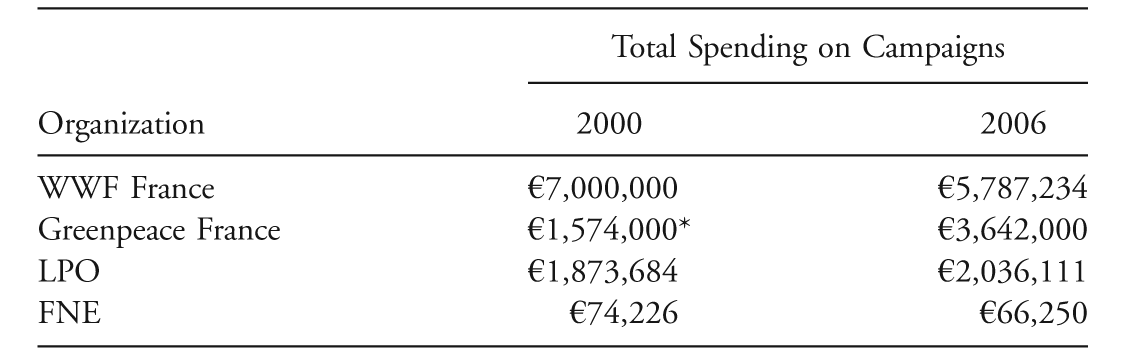
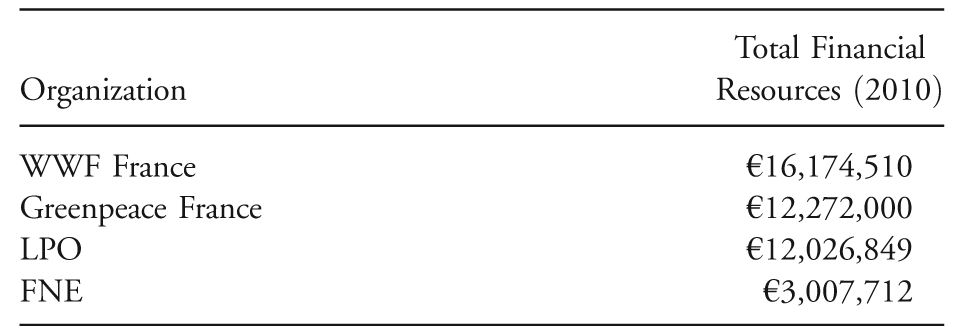
The evidence in the French case completely counters the predictions of hypothesis 4 that “groups with greater access to financial resources will be more likely to mobilize the law than groups with less financial resources.” Table 1 shows the amount each group spent on its campaigns in 2000/2001 and 2006. Table 2 shows variation in financial income ranging from €3 million for FNE to €16 million for WWF for 2010. By all of these measures the findings run counter to our theoretical expectation. The wealthiest group, WWF, is the least litigious in the Conseil d’Etat, whereas the least wealthy group, FNE, is the most litigious. This suggests that other factors matter more than finances in explaining the variation in legal mobilization in this case. It is worth bearing in mind, however, that these groups are generally the largest and wealthiest NGOs in France (Szarka Reference Szarka2002; McCauley Reference McCauley2007; Nicolino Reference Nicolino2011), and so the findings may not be generalizable to the whole population of environmental groups in France.
NGO Campaign Spending: 2000/2001 and 2006

Source. Compiled by the author from McCauley (Reference McCauley2007) and from Greenpeace Rapport D’Activités, 2001, and Rapport Général du Commissaire aux Comptes, 2007.
* Data for Greenpeace for the year 2000 were not available, so the figure here is from 2001.
NGO Financial Resources: 2010

Source. Compiled by the author from the financial accounts of each NGO.
Legal Resources
This research finds limited support for hypothesis 5, which suggests that groups that possess greater legal resources will be more likely to mobilize the law. One limitation here is that the measures for assessing a group’s framing of law on the one hand and the measures to assess its legal resources on the other tend not to be mutually exclusive in the organizational setting. For example, the existence of a large legal team may signal a generally positive disposition toward using the law in achieving an organization’s goals, but this is not necessarily the case. Furthermore, the presence of lawyers within an organization might lead to an increased likelihood of framing problems through a legal lens, but there is no consensus in the literature that this is necessarily true (Edelman et al. Reference Edelman2010; Vanhala Reference Vanhala2012). This discussion focuses on the presence and role of lawyers whereas the discussion of framing above focused on their interpretations of their organizations’ orientation toward law. Together these allow us to begin to assess when and why an organization may become a part of a broader “support structure” (Epp Reference Epp1998).
FNE has had a legal network of in-house lawyers and volunteers since 1995. At the time of writing, in addition to two in-house lawyers at the national organization, there are also a number of lawyers within local organizations with whom they regularly collaborate: “We have lawyers that work with our local associations. So I think there are about 18 lawyers employed. So for us, as we work at the national level, we often help local associations that don’t have a lawyer. When they do have a lawyer we work with the lawyers: we help train them so that after they can help their associations. It’s really a pyramid system” (interview, June 13, 2012). The organization also had a network of about 70 lawyers who work on a pro bono basis for the group. Looking at both the attitudes toward law in the organization and the commitment of resources to hiring in-house lawyers and developing an extensive legal network, it is clear that FNE has developed a pro-law culture, and this has shaped the use of legal tactics.
LPO has employed a lawyer since 1990 and currently has two lawyers working in-house. One participant noted, “We have always had a vocation to undertake litigation, and we used to put a lot in the hands of outside lawyers, but not always, and not always successfully. … But we didn’t necessarily always have the time to find them. … It became obvious that we would need to be able to manage a certain number of cases ourselves” (interview, June 18, 2012). Another participant noted that the recent broadening of LPO’s mission could also influence the group’s litigation activity:
When the association started, it was really about the protection of birds. Now, we have two lawyers in the association. One has been here for 20 years and really works on litigation on birds, hunting, and protected species. And little by little in fact we began litigation on habitats. … And just recently we changed the statutes of the association, so now we are an association that does nature protection. So we will stay focused on birds, but in terms of litigation we can work on everything. So if we want we could work on waste, on water. These are legal actions that we haven’t done yet, or only a few in any case. (Interview, June 18, 2012)
Lawyers became involved in Greenpeace in a more institutionalized manner after the 1985 bombing by the French authorities of the Rainbow Warrior, one of Greenpeace’s ships that was protesting against the country’s nuclear testing in French Polynesia (interview, June 14, 2012). According to one lawyer who has worked with the group, proactive litigation began to be considered more seriously by the organization around 1995: “So they took a proactive case which led to jurisprudence. The group attacked Jacques Chirac’s decision to restart nuclear tests in the Pacific. The case was destined to fail, that’s clear, but it was a proactive approach. That was, to my knowledge, the first or one of the first proactive legal cases. … Now they accept the idea but …” (interview, June 14, 2012). Greenpeace did increase the number of cases it was involved in after this period. However, the range of cases it has taken to the Conseil d’Etat on a proactive basis has been relatively limited in terms of policy area (compared to their sphere of action overall). A lawyer from another NGO also attributed Greenpeace’s limited number of legal actions to a lack of resources: “I think that the number of legal actions by Greenpeace are relatively limited in France in fact. Well, they are more well known, they do big protests, but in the legal arena and even in lobbying. … I think they have fewer human resources and fewer lawyers and so they work less in that domain” (interview, June 13, 2012).
The nature of in-house legal staff in the WWF is very different from that in FNE, for example. The lawyer at WWF was employed in the early 2000s in the first instance as someone to take care of contracts and the legal structure of the organization. She began working at the time that the organization became interested in the potential for a Constitutional Charter for the Environment and hence became involved in lobbying and legal work related to the passage of the charter. However, in her interview she noted that very little attention is devoted to proactive litigation: “Because we are a foundation, and not an association, in law it is much less easy to undertake litigation. But that’s not a problem because for WWF litigation was never part of its way of acting for nature. The organization has always used nature protection programs and lobbying. And that’s why we have had a few legal actions, because we can still litigate. But some organizations have taken 100, 200, 300 cases. Us? Not at all, we’ve had four or five cases” (interview, June 7, 2012).
In summary, this research finds no clear-cut evidence in terms of whether the presence of in-house lawyers means an organization is more likely to channel organizational activity into legal avenues.
Organizational Structure
Finally, this research counters the expectations of hypothesis 6 that groups that are more centralized will be more likely to mobilize the law. Instead, this research finds the exact opposite: decentralized groups were more litigious in the Conseil d’Etat. Both FNE and LPO, as mentioned above, are federated organizations with local and regional groups as well as a national-level organization (McCauley Reference McCauley2007; Berny Reference Berny2013).
A decentralized organizational structure is advantageous in taking cases to the administrative tribunals for two reasons. First, before the adoption of the Barnier Act and the inclusion of presumed standing for environmental associations, the geographic proximity requirement to achieve standing meant that the contested issue and the geographic operation of an organization had to overlap. This meant that a local organization could contest only local decisions and a national-level organization could contest only decisions that operated on the same geographic scale. Groups that are federated like FNE and LPO were thus able to pursue legal challenges at all levels. This flexibility contrasts significantly with groups like Greenpeace, which are small and concentrated at the national level and hence have historically been disadvantaged in terms of access to the lower courts. The second advantage of decentralized governance in terms of legal mobilization is that cases are brought to the organizations’ attention from across the country in a bottom-up manner, and decisions can be made as to which is the best case on which to litigate an issue and which is the best forum in which to challenge a decision (interview, June 13, 2012).
In short, decentralization, rather than creating a collective action problem as predicted in existing theory, in fact multiplied opportunities to access justice. The interaction between this agent-level characteristic in operation with the legal opportunity structure helps to explain why FNE and LPO have been more likely to mobilize the law than Greenpeace and WWF over time.
Conclusion
This research makes two contributions to existing theory on legal mobilization. First, it offers a nuanced illustration of when and why we might see policy “insiders” turn to the courts under neo-corporatist governance. The regulations governing organizational access to judges for environmental protection associations changed dramatically over the time period documented here. The adoption of the Barnier Act in 1995, which grants quasi-automatic standing for groups that are recognized by the administrative authorities through the agrément, effectively neo-corporatized access to justice for ENGOs. This has resulted in a paradox from the viewpoint of existing theory. Scholars who have studied litigation activity in neo-corporatist countries have argued that civil society–state relationships in these contexts tend to have a dampening effect on civil society groups’ likelihood of turning to the courts (Morag-Levine Reference Morag-Levine2003; Soennecken Reference Soennecken2013). In France, an opposite logic is in operation: insider groups that are formally recognized by administrative authorities and granted special access in decision making are also privileged in terms of their ability to take collective legal action. While this article has focused on administrative cases, this privileged position in terms of access to justice applies in the field of criminal law as well (Fourcade Reference Fourcade2011).
A second contribution this article makes concerns the challenge of accounting for variation across groups that are situated within the same set of institutional constraints and incentives. This research found that FNE and LPO were much more present before the Conseil d’Etat, and interview data suggest that these groups are generally more amenable to using legal tactics. This is best explained by the interaction between group-level characteristics—such as organizational form and the way in which a group framed the law—with the legal opportunity structure. The decentralized governance structures of FNE and LPO facilitated historical access to the courts because of standing requirements related to geographic proximity and the ability of these organizations to identify potential cases in a bottom-up manner. While lawyers played some role in promoting litigation within these organizations, the influence of legal professionals in channeling activity into legal spheres is not clear-cut.
One surprising result is that financial resources did not seem to matter as much as previous research has suggested. The fact that WWF, the wealthiest ENGO studied here, litigates the least and that FNE, the least wealthy of these groups, litigates the most suggests that while finances may be a necessary condition for the use of legal tactics, it is not the driving force for the variation among these groups. This echoes the findings of Wilson and Rodriguez Cordero (Reference Wilson2006, 327), who suggested that “the resources necessary to pursue the legal path effectively are thus contingent on the rules that guide access to and the cost requirements of the court.” It also suggests that further research that differentiates financial resources from legal resources in terms of their explanatory power is needed.
These findings shed new light on legal mobilization theory. For parsimonious explanations, theory should be able to account for the turn to the courts both within and outside pluralist-style political systems. Thus far there has been a consensus that (at least in Europe) the culture of civil society–state relationships is an important background condition that shapes the ways in which groups might think about using the law. This research finds that groups in neo-corporatist systems, where the authority to govern is shared between state and civil society to some extent, not only may be interested in using the law but may be encouraged to do so by the regulatory environment. This challenges existing understandings of the role of neo-corporatist political culture’s impact on legal mobilization and speaks to wider debates about the spread of adversarial legalism in Europe (Kagan Reference Kagan1997, Reference Kagan2007; Kelemen Reference Kelemen2011).
These results, while based on a narrow case study, nonetheless raise a number of important questions that scholars interested in legal mobilization might consider in future research. First, how does the interaction of context and agent-level characteristics shape legal mobilization propensities? Most research on legal mobilization has tended to focus on one or several of the factors examined here, but rarely is the interaction between variables explored in a systematic way. For example, the research presented here and in previous work (Wilson and Rodriguez Cordero Reference Wilson2006) has suggested that given the right legal opportunity structure, financial resources may not matter as much in mobilizing the law in some jurisdictions as they have in the United States. If the rules on standing, the cost rules, and the potential rewards of litigation align in the right way, it may sometimes even be profitable for groups to turn to the courts (Farhang and Spencer Reference Farhang2014).
A second question that arises from this work is, what are the mechanisms that shape how legal resources matter? This research and much previous work by those with expertise in organizational studies show that the impact of legal staff on an organization’s propensity to litigate is not clear-cut. Furthermore, other variables such as legal consciousness within the organization or access to a large network of pro bono lawyers in lieu of in-house legal staff may also matter. Research that disaggregates the various features of “legal resources” and examines the ways in which they might or might not shape the turn to the courts would contribute to our understandings of why and when resources of different types may matter.
Finally, there are interesting questions to be explored by students of NGOs at the international level who focus on transnational networks and diffusion. On the one hand, it would be reasonable to expect that a group that has a longer history as part of an international network or organization, such as Greenpeace, might be more likely to use law than “homegrown” domestic groups because of their exposure to the use of legal tactics by sister organizations in other jurisdictions where litigation has been a normal course of action. On the other hand, one might expect that internationally linked groups are less interested than domestic groups in engaging with domestic law or transforming the national legal opportunity structure. Future research might explore these dynamics in more detail in order to offer an account of the extent and limits of diffusion of legal tactics across and within transnational NGOs.