





Introduction
Sovereignty is never complete, always an ongoing process. Sub-Saharan Africa is undergoing an urban revolution. Not only does the continent currently boast the fastest rate of urbanization on a rapidly urbanizing planet (Watson Reference Watson2014; van Noorloos and Kloosterboer Reference van Noorloos and Kloosterboer2018), but the nature and structure of African cities are also being transformed by the resulting social divisions accompanying the rise of an urban ‘middle class’. While the nature, breadth and even existence of this middle class are all subjects of fierce debate (Lentz Reference Lentz2015; Sumich Reference Sumich2018; Southall Reference Southall2020; Manuel Reference Manuel2023), most analysts agree that one of the primary material bases and marks of status for anything resembling a middle class in much of sub-Saharan Africa is land and housing (Sumich Reference Sumich2018; Gastrow Reference Gastrow2020; Mercer Reference Mercer2020; Sumich and Nielsen Reference Sumich and Nielsen2020). The growing demand for status-appropriate housing feeds into what Gastrow calls a political ‘aesthetic imagination of good urbanism’ employed by many governments to transform their cities by drawing on collective visions of the desired social order (Reference Gastrow2017: 378). This vision is (painfully) apparent in the spectacular symbols of urban transformation rising throughout the continent, the new cities such as Eko-Atlantic, or the gleaming towers of Luanda as it vies to be the Dubai of Africa (Croese Reference Croese, Bekker, Croese and Pieterse2021). However, one of the most profound, if banal, examples of urban transformation is the gated community, whose presence is inescapable from the Cape to Cairo.
In urban studies, it is commonly asserted that the explosive growth of gated communities in Africa is a result of soaring inequality and insecurity as the state retreats and outsources its responsibilities to private actors, the hallmarks of contemporary neoliberalism’s assault on the ‘right to the city’ (Davis Reference Davis1992; Caldeira Reference Caldeira2000; Low Reference Low2003; for a critique see Nielsen et al. Reference Nielsen, Sumich and Bertelsen2021). Sumich (Reference Sumich2023) has written elsewhere that such a focus discounts the utopian aspects that have long fuelled projects of enclaving. Additionally, there is the danger of reinforcing underlying normative functionalism in urban studies concerning what a city is and what it is supposed to do (Tomás Reference Tomás2022). In his penetrating analysis of Luanda, Tomás (ibid.: 93) argues that the postcolonial is characterized by a conflation between the ruling party and, by extension, the state it commands and the people, as encapsulated by the famous slogan ‘MPLA é o povo – e o povo é o MPLA’ (MPLA are the people, and the people are the MPLA). The unity of party and people is taken for granted – if one is a member of another party, or simply outside the orbit of the MPLA, then they are, by definition, not the people.
Many studies of sovereignty, following Agamben, locate at its core the ability of the state (or sovereign) to deprive its subjects of life itself (Humphreys Reference Humphreys, Nugent and Vincent2007). With this definition, a gated community, regardless of the presence of armed guards, may seem an odd site in which to study processes of transformative sovereignty. Building from a mafia-run taxi system in Siberia, Humphreys argues that a definition of sovereignty drawing from Schmitt and Agamben ‘fails to take account of what ordinary participants bring to the relation. Their everyday life “throws in” its own exigencies and excitement’ (ibid.: 433). In the following, we examine a similarly ‘localised form of sovereignty’ (ibid.: 420) through the example of a gated community in Maputo, Casa Jovem. Humphreys traces the various ways in which people shape their social knowledge and history to build something outside the direct purview of the state. Instead, in Casa Jovem, we explore the ways in which people try to build a localized form of an idealized sovereign order that the state has long promised but has never actually managed to bring about. Rather than focusing on violence, we are primarily concerned with the dynamic interaction brought on by the tensions of adapting to this vision of transformative sovereignty. Engaging with this idea of transformative sovereignty is a way to express elevated social status and belonging, as it has long drawn from the experiences and aspirations of only certain segments of the population, many of whom have been privileged since at least the early revolutionary period. However, it also replicates the far more halting and contradictory process of actually constructing a social world, no matter how localized, and harks back to the question that has haunted every major project of social engineering: how do you incorporate people into building your dream if they don’t share your vision of utopia?
Much as in Angola, in Tomás’s description, transformative sovereignty was manifested in Mozambique through a revolutionary nationalist project that engaged in a top-down attempt to knit stratified and differentiated populations together, to overcome a long history of segregation. Rural areas were to be ‘modernized’ and cities would be detached from racialized hierarchies and spatial separations of the past to create a new form of nationalist intimacy – what Tomás terms ‘wholeness’ in relation to the urban social fabric (Reference Tomás2022: 211). It is the top-down creation of this sense of wholeness, and the social vision and experiences it privileges, rather than solely the ability to inflict violence (although violence often plays a central role) that animates localized efforts of sovereign transformation. However, this project grew from certain kinds of distinction (Bourdieu Reference Bourdieu1984). Latent forms of exclusion were manifest in even the most radically inclusive forms of transformative sovereignty.
Shortly after liberation, transformative sovereignty was primarily expressed through a utopian programme of social and infrastructural engineering (Sumich Reference Sumich2018; Reference Sumich2023; Zawangoni Reference Zawangoni2007). In the rural areas, a ‘new man’ would be created who would then transform scattered hamlets into ‘cities in the bush’. In the urban areas, the ‘new man’ would free cities from the festering rot of their colonial legacy and transform the former bastions of oppression into pinnacles of the new society. The original utopian vision of this project collapsed in the face of gross cultural insensitivity, civil war (1976–92) and economic crisis (see Hall and Young Reference Hall and Young1997; West Reference West2001; Buur and Sumich Reference Buur and Sumich2019; Sumich and Bertelsen Reference Sumich and Bertelsen2021; Sumich Reference Sumich2021). However, the legacies of such a vision – however fragmented and disjointed they may be – live on in what Tomás calls ‘the skin of the city’: a porous, permeable but durable barrier that stretches and contracts as it divides interior from exterior, included from excluded (Reference Tomás2022: 6). The flexibility of such dividing lines is especially salient in a context where the firmly stratified residential zones of the colonial period are gradually breaking down: it is now not uncommon to see stately villas, whose swimming pools and manicured lawns are hidden from view by high walls, loom over the houses of the poor, or to see the gated communities whose comfortable homes and seemingly limitless amenities cater to the upper middle class straddle informal markets (for a broader discussion of such ‘micro-enclaves’, see Bertelsen Reference Bertelsen2021).
In the following, we discuss the ways in which the ‘right to the city’ and urban citizenship itself are not the result of the autonomous individual, so fetishized in liberal political thought, but rather occur through a project of sovereignty. Nor does it seem that these kinds of projects are restricted to Maputo. In Kinshasa, De Boeck (Reference De Boeck2011) documents the ways in which urban plans resuscitate old colonial ideals to popular acclaim. Low (Reference Low2003) traces how American gated communities are underpinned by an imaginary of a previous time of prosperity and security. Zhang (Reference Zhang2010) shows the ways in which programmes of urban housing restructure forms and ideals from the Chinese Communist Party for a new era. As argued by Nielsen et al. (Reference Nielsen, Sumich and Bertelsen2021) enclaving is a migratory aesthetic of the imagination that can take root in numerous different settings and locales. One of the major factors that distinguishes these processes, however, is the ideological vision that is being activated and the ways in which a city is reshaped when the promise of transformative sovereignty fades and crumbles, when security is precarious and the ‘right to the city’ becomes ever more elusive. To illustrate our argument, we first offer a condensed discussion of the role of housing in social engineering projects in Mozambique. The rest of the article explores these issues through an in-depth examination of Casa Jovem.
Housing as social engineering, then and now
Housing has been central to Mozambique’s social and moral order since at least the colonial period (for a detailed discussion, see Morton Reference Morton2019; Sumich and Nielsen Reference Sumich and Nielsen2020; Sumich Reference Sumich2023). However, as with almost all other commodities in the colonial period, a house’s type, style, amenities and furnishings were tightly restricted by more comprehensive processes, formal and informal, of racial segregation (Morton Reference Morton2019; Reference Morton2022; Penvenne Reference Penvenne1995). Unsurprisingly, when Mozambique gained its independence in 1975, Frelimo, which had proclaimed itself a revolutionary socialist party, promised to completely transform housing practices across the nation to eradicate the legacy of colonial inequality. The truly utopian heights of this ambition were to be seen in rural areas, where the peasantry was to be concentrated in centralized communal villages, the foundation of the previously mentioned ‘cities in the bush’ (Hall and Young Reference Hall and Young1997; West Reference West2001; Chichava Reference Chichava2013). In her description of the USSR, Buck-Morss commented: ‘The Herculean task of the socialist collective was to rebuild the world … The reality behind this production fantasy was state coercion’ (Reference Buck-Morss1995: 19). As there was also a strong element of state coercion, communal villages have received significant attention in Mozambican historiography and are usually portrayed as one of Frelimo’s more grievous errors of the revolutionary period (Bowen Reference Bowen2000; Chichava Reference Chichava2013). It is true that the communal villages did alienate rural populations in some areas of the country and did ignore any alternative social vision they may have had. The fact that many were repurposed versions of the despised ‘aldeamentos’, the fortified villages the colonial state built as a counter-insurgency measure during the liberation war, is only too apropos. However, the problem was not simply the authoritarian and modernizing conception of communal villages; the fact that people were forced to live there was compounded by the fact that they rarely, if ever, provided the promised benefits (West Reference West2001). Infrastructure broke down, social services never appeared, shops were empty, and food was scarce (ibid.). Communal villages were supposed to be developmental, socio-economic focal points that would bind the nation together. In a similar manner to Luanda in Tomás’s analysis (Reference Tomás2022: 211), these were sites that promised a form of national wholeness but resulted in a myriad of dysfunctions, which increased fragmentation.
The push and pull, the ways in which centralizing efforts often, intentionally or not, increase fragmentation, has been a common feature of transformative projects over the years. Shortly after independence in 1975, the new Mozambican government, despite all its pronouncements to the contrary, continued the colonial practice of trying to sort different social and professional categories into particular neighbourhoods: there was a bairro (neighbourhood) for soldiers, one for teachers, specific compounds for ministers and cooperates, foreign fellow travellers who came to aid in the construction of a new society (see Tomás Reference Tomás2022 for a similar discussion in Luanda). This was even the case for one of Frelimo’s more celebrated urban policies: the redistribution of housing. Shortly after independence, most of the Portuguese settler population, along with many south Asians and other relatively privileged sectors of the population, left the country, effectively abandoning what was known as the ‘cement city’, the well-appointed core reserved for those at the apex of the colonial social order (Morton Reference Morton2022). The cement city was characterized by tall apartment buildings and spacious single-family homes well served by infrastructure and the shops and restaurants that catered to the lucky few. After independence, the Black residents of the far less salubrious bairros streamed in to take possession of the homes of their former colonial masters with the blessing of the new government. As Morton (Reference Morton2019) documents in his study of Maputo, this unintentionally stoked social divisions, privileging the lifestyles of white-collar workers while undermining the economic activities (beer brewing, carpentry, petty trade, etc.) on which so many residents of the bairros depended (ibid.).
After the official abandonment of socialism in 1989–90, these emergent cleavages were only intensified by capitalist reforms and privatization, such as when the housing stock was sold off at nominal prices. This tended to allow an emerging middle class to take control of the houses in which they resided and even acquire more. In fact, this became a significant basis for such a class, due to the increased demand for housing by the UN peace mission in the country from 1992 onwards and the influx of NGOs and international organizations that caused rents and housing prices to soar (see Jenkins Reference Jenkins, Bekker and Therbon1990; Sumich and Nielsen Reference Sumich and Nielsen2020). The contrast between public and private was stark. One would enter a decaying building of peeling, crumbling concrete with water dripping through cracks in the walls, walk past mailboxes still waiting for a postal service that had not existed for decades, and pass lifts that had not functioned since the late 1970s. Individual homes in these buildings, especially in the largely privileged areas of the ‘concrete city’, however, were calm enclaves of the aspirations that it seemed, for a time, capitalism may provide for, at least for the chosen few. They were generally beautifully presented and immaculate, with mementoes of family life lovingly displayed next to high-quality consumer goods imported from South Africa, Europe and Asia. In its first iteration, Frelimo attempted to transform the face of the city by taking sovereign control of the housing stock, to ensure equality and justice from above. The second iteration of revolutionary transformation transferred sovereign control to the individual householder, effectively giving state blessing to growing inequality while trying to ensure the formation of a more autonomous, class-based urban subject. While both reforms were undoubtedly transformative, neither achieved its stated goal (see Sumich and Nielsen Reference Sumich and Nielsen2020). House prices and rents continued rising at an alarming rate, and the children of the original beneficiaries were effectively priced out of the market. These are the circumstances behind urban fragmentation and the growth of gated communities in Maputo, which now number more than eighty (Mazzolini Reference Mazzolini2016). These are interesting developments, because, as noted by Chipkin (Reference Chipkin2013), gated communities are a way in which capitalist property rights are both mitigated and sustained by forms of non-capitalist collective ownership. In some ways, gated communities in Mozambique recall both forms of socialist collective ownership and a collective, if highly class-based, form of identity formation. We will tell this story by focusing on one such development: Casa Jovem.Footnote 1
Casa Jovem
Casa Jovem is a condominium in the newly developed area of Costa do Sol, in what was previously the outskirts of Maputo. The story of Casa Jovem is contentious, as we shall see. It was founded by Erik Charas, who also launched Mozambique’s first free weekly newspaper, @Verdade. From nightly news broadcasts to pub debates, few can agree whether Charas is an idealistic visionary, a well-intentioned figure whose plans went tragically awry, or a con artist presiding over a pyramid scheme.
Casa Jovem was launched in 2010 and marketed as a response to the lack of housing in the city. The project targeted a specific camada social (social layer) of middle-class young professionals, mainly under forty years of age. Members of this group are central to the current hegemonic urban discourse in Mozambique. They should have high levels of education and at least relatively secure, well-paying jobs. Such features mark them out as exemplars of the modern city. Reality, though, often paints a very different picture. Despite their own best efforts and often privileged background, many are still forced to live far from the city and their jobs in self-built houses in areas with little or no infrastructure, in rented (and very expensive but decaying) apartments in the city centre, or with their parents even though they have children of their own.
The project started with sponsorship by the Joaquim Chissano Foundation, whose founder was the country’s president from 1986 to 2005, and was implemented by Charas Ltd. The initial design of Casa Jovem was composed of around 2,000 units in buildings of four to seven floors. However, the backers soon expanded their aims and in 2012 the project launched phase 2, which included villas: this was a far more ambitious goal of building self-contained, detached and terraced houses. It is now the largest post-independence private housing project built in Maputo. The marketing of Casa Jovem also focused on a social component, and it was publicized as a revolutionary venture to create affordable housing close to Maputo city centre, even if it was still aimed at members of one of Mozambique’s more privileged groups. Prices were initially kept low as Charas negotiated favourable mortgage terms with the Banco Comercial e de Investimentos (BCI), much lower than the normally prohibitive interest rate, averaging around 34 per cent, that was usually charged by Mozambican banks.
However, the original partnership behind Casa Jovem soon ran into difficulties. The critical stance of @Verdade newspaper towards the ruling party, Frelimo, is often thought to be part of the reason why the Joaquim Chissano Foundation backed out of Casa Jovem. It is also possible that the growing political tension between Charas and Frelimo was one of the reasons that the BCI ended its relationship with Casa Jovem and no longer provided favourable mortgages. While the first ninety-six houses in Casa Jovem were completed in 2012, the loss of support from the BCI seriously jeopardized Casa Jovem’s ability to deliver houses on time (or, in some cases, at all). As Charas explained to us, the project was soon radically restructured. Instead of building houses for clients who paid after the completion of each agreed-upon stage, clients either had to pay for the entirety of the house or had to build it themselves. Despite the teething issues, many prospective buyers still hoped that Casa Jovem offered a new direction for home ownership. It soon became apparent, though, that not everyone agreed on what that new direction was or what the project had promised.
This lack of agreement concerning the overall direction of Casa Jovem has troubled the project since the beginning. Even Charas initially had a very different vision for what Casa Jovem would be:
The city was obviously growing, but the municipality did not have any idea what to do with it. All they ever think of is toll booths. They put toll booths everywhere, blocking all the commuting routes. It costs MZN40 [approximately US$0.60] each way, and often there are just two open lanes. It can take thirty minutes to an hour of waiting to get through. The land where Casa Jovem is now is situated before a toll booth, so you can get to the city and back without passing one, and that makes it attractive, but the municipality was not doing anything with the land. The land was not parcelled out. There were no real services or infrastructure. People would just come, build something and negotiate their own services, a tap here, an electricity connection there, but nothing more significant. Originally, I was not thinking about a gated community but rather an extension of the city. Something like Coop 2 [referencing Coop, a famous urban neighbourhood closer to the centre of the capital], but with 16,000 residences, with apartment buildings, some houses, a mix.
The way he described it, his original goal was something like a libertarian utopia where, by working through high-ranking members of the state and their close associates, he could escape Mozambique’s decaying sovereign order (or recreate a form of sovereignty in his own image) through urbanization freed from the ‘dead hand’ of the state. However, his vision for a new form of urbanism and what appealed to prospective buyers were not the same. In fact, a gated community – in the classic sense of an estate surrounded by walls – was, as he expressed it, the furthest thing from his mind; he had no desire for walls at all. He envisioned Casa Jovem to be a neighbourhood that would emerge and organically gentrify the area. However, clients who bought the first flats felt unsafe living in buildings surrounded by a large construction site and a nearby low-income bairro. They demanded security and fencing. This demand, combined with the slow pace of implementation of the project and the fact that Charas could deliver houses only in stages, forced him to bow to residents’ wishes and build walls around the newly delivered apartments, completing its transformation into a walled enclave and, ironically, securing their capitalist property rights through collective, non-capitalist forms of organization and control.
Chipkin argued:
Not only are townhouses (under sectional-title) phenomena of a concession to collectivism in modern capitalism, not only are they new urban constellations that preview a post-suburban landscape, but in the South African context they are also important sites of post-Apartheid community – even when these forms of community are not easily recognisable from the promise, say, of non-racialism. (Reference Chipkin2013: 237)
As we shall see, this is similar to the situation in Maputo, although a vision of an emerging middle class has taken the place of race. This vision similarly struggles to fulfil its original promise.
The attractions
Taking a similar line as Chipkin, Tomás argues that the appeal of gated communities in Luanda is not simply restricted to issues of crime and security but also reflects the reconfiguration of property rights, access to infrastructure and the desire for ‘good living’ (Reference Tomás2022: 158). Security – or at least the appearance of security – is a significant concern for many residents of gated communities. Still, Tomás’s general observations are equally applicable to Maputo, since the notable attractions mentioned by residents involved in either investing, buying or renting in Casa Jovem are related to: (1) price; (2) location; (3) type of building material; (4) security; and, for those buying or residing in the villas, (5) having a household garden located in the city.
Casa Jovem allowed many inhabitants to own new houses closer to the city. Both apartments and villas in the development were far more affordable: prices ranged from US$25,500 to US$134,250 (in 2010), depending on the house size (one to four bedrooms). Flats and villas are far cheaper than a new apartment in the city centre, where the minimum price would be US$104,000. One woman described her reasons for moving to Casa Jovem to Manuel as follows:
I was sick and tired of renting apartments in the city. The buildings are old with no lifts and rotten water pipes. In my last apartment, water would flow into the bathtub if I opened the kitchen tap. That was too much. A friend living in Casa Jovem told me to come and visit. She emphasized how the buildings were new and modern, everything worked well, and how safe it was. I am single, and I live alone. I am delighted here and paying slightly less than I was paying at 24 de Julho avenue [a centrally located street downtown]. (Woman living in a two-bedroom apartment)
With the completion of Maputo’s ring road, Casa Jovem is now even closer to the city, and this ability to mitigate the capital’s notorious traffic problems has wide appeal, as explained by a neighbour of Manuel in an informal conversation:
I have a bigger house in MatolaFootnote 2 with a garden full of fruit trees. I enjoy my house there. However, I could not continue to live in Matola. The traffic was horrible. Every day I would spend about two hours in traffic on each journey. The stop at the toll gate was the worst. My kids would have to wake up at 4 a.m. to reach their school at 7 a.m., and they would only be back at the house at 8 p.m. I could not live like that any more. One day I just told my wife, let’s move to Casa Jovem. The house was not completely ready yet, but we managed to do so [complete it] while living here. (Owner of a three-bedroom villa with a self-built annexe with an extra room and bathroom, living with his wife and five young people – offspring and nephews)
In addition to enjoying less traffic, many residents often spoke of a sense of security in Casa Jovem and an overall sense of a good quality of life. Some residents told Manuel:
The good thing about living here and so close to the sea is that you can walk for ten minutes with your flip-flops and grab fresh fish for dinner. I no longer freeze fish. This is a good quality of life. (Owner of a villa living with his wife and three sons aged under ten)
This is a safe place. Children can play freely and be outside until late, and we do not need to worry. (Divorced woman living with her two children)
Have you seen yesterday’s post on the WhatsApp group: a kid’s bicycle has been left alone on the pavement for three days? Someone took a picture of the bike and asked the parents to grab the bicycle. Where else do you think this could happen? In no time, someone would have taken the bicycle. (Member of the Casa Jovem Residents’ Commission)
The sense of security provided something approximating ‘the right to the city’, even if only for the relatively privileged camada social to which Casa Jovem catered. It was not entirely clear, though, how much this sense of safety was largely symbolic. When asked, Charas just laughed and said the security was an illusion. Anyone could hop over the walls, and the walls would do little to stop a thief who was already inside. The guards are supposed to take down everyone’s details and licence plates and check with the house that they say they are visiting, but, in practice, this rarely happens. According to Charas, ‘[T]he walls make one feel secure, and if you feel secure, then you transmit a sense of security.’
A sense of security that is perhaps more symbolic than real may be emblematic of the wider issues that plagued the entire project. In a manner similar to previous attempts on a grand scale, such as those of the socialist period, urban transformation was to be achieved through a process of sovereignty – or, more accurately, a project of sovereign order – although this time scaled down to the neighbourhood level. Again, despite the grand rhetoric, the project had no universalizing pretensions but focused entirely on a favoured social group, one that consolidated its privilege in the socialist period and later became well represented in the ‘middle class’. For Charas, this was the fabled young professionals, but especially those of his own social background, the children of well-established largely mixed-race families that came from the privileged residential areas of Maputo. The prominence of such people was so visible that in certain circles Casa Jovem was known as condomínio dos mulatos (mixed-race gated community). This designation was not solely an ethnic marker; it also referred to issues of social class. Such families, whose relatively elite status dates back to the colonial period, have accumulated social capital that gives them a certain level of respect and status in society. The status of the initial owners and residents of Casa Jovem set the tone regarding the profile of its residents. As a consequence, there is a perception among both residents and outsiders that Casa Jovem residents share social traits that have long been associated with urbanity in Mozambique – that is, refined manners and courteousness.
Indeed, the role of the ‘young professional’ (as exemplified in the set of images in Figure 1) is analogous to Frelimo’s socialist ‘new man’, which attempted to create a new social subject, free of the degradation and poverty of the past (Vieira Reference Vieira1977). While the socialist ‘new man’ who would selflessly dedicate himself to the collective has faded in the misty reaches of time, the idea lives on – although now this would mean men and women who are professionals with an income that allows for two cars and who would happily inhabit houses that are designed for nuclear families with no more than two children, with predefined domestic aesthetics and ways of organizing and occupying the space. The advertisements in Figure 1 are as much a statement of the fabled class-based social traits that signify ‘true’ urbanity as anything else; thus, they cater to a small social segment – those who could conceivably achieve something along the lines of this ideal. In fact, many of the people who would have the sufficient social and material capital to enter the ranks of ‘young professionals’ also come from families connected to Frelimo that have a long history of trying to build the ‘new man’ (see Sumich Reference Sumich2018).
Casa Jovem publicity posters and advertisements. Sources: <https://www.facebook.com/Casajovem/photos/pb.100021606925511.-2207520000./573073496061316/?type=3&locale=pt_BR>; <https://www.facebook.com/Casajovem/photos/pb.100021606925511.-2207520000/535931493108850/?type=3>; <https://www.facebook.com/photo?fbid=241382392563763&set=pb.100021606925511.-2207520000>; <https://www.facebook.com/photo/?fbid=241382325897103&set=pb.100021606925511.-2207520000>.

Figure 1. Long description
The collage consists of four distinct images. The first image (a) shows a family of five posing together in front of a Casa Jovem poster. The second image (b) features a promotional poster with the text ‘Casa Jovem O Pulsar Da Cidade’ and an arrow pointing to ‘Novo Produto VIVENDAS F3’. It includes illustrations of houses and a list of features such as living room, dining room, two bedrooms, one bedroom with a private bathroom, one shared bathroom, an open kitchen, and a backyard with parking. The third image (c) displays a modern living room with a sofa, coffee table, and decorative items. The fourth image (d) shows a bedroom with a bed, a chair, and framed pictures on the wall. The images collectively promote the Casa Jovem housing project.
These advertisements promote Casa Jovem in ways that construct and reconstruct the ideal Mozambican – in this case, urban, modern professionals who embody what is thought to be ‘proper, modern urbanism’. However, as in the socialist era, today’s prototype of the ‘new man’ seems disconnected from everyday experiences and ways of living, even if such a vision retains considerable attraction for its target demographic.
Casa Jovem’s original appeal was based on its promise to provide dignified urban living. This was supposed to be the natural condition for many members of a ‘middle class’, as exemplars of the capitalist incarnation of the ‘new man’, despite the precariousness and difficulties of day-to-day life they routinely experience. While urbanity, class, education and professionalism are at the core of definitions of who should live there and how, as with other projects of transformative sovereignty, the development affected change but did not achieve its stated goals. In fact, the failure to provide what was promised has again bred conflict rather than the hoped-for homogeneity.
Dreams and detachments
After the initial 100 flats were built, in-fighting among Casa Jovem’s management led the project to declare bankruptcy. The promise of affordable housing started to resemble a pyramid scheme, and housing again became detached from the promise of autonomy or the achievement of a form of middle-class prosperity. In fact, prospective residents who had already invested in Casa Jovem were left with no house, no refund, and, due to the sheer number of court cases, little hope of redress. The situation was slightly different for the villas. There, the project management allowed owners to continue building independently rather than relying on Casa Jovem. Despite these ongoing difficulties, the management currently attempts to project an air of optimism. When a real estate agent is giving a tour of Casa Jovem, one would never guess anything is amiss. An infectiously enthusiastic sales agent will show a prospective resident the various types of houses to suit many budgets, family sizes and circumstances, all the while assuring the prospective buyer that the rooms will appear far bigger when the bare concrete is covered and appliances are installed (which is true). One might be quoted a price of US$50,000 for a house, but then one needs to pave the road oneself, pave the gutters and sort out the infrastructure, and it ends up costing something like US$100,000 (prices as per 2022).
Charas himself acknowledges numerous difficulties when speaking with us and wonders if it might be easier just to keep the land, wait for the city to grow and then sell up for a considerable profit. He has been forced to cannibalize his original vision many times. Currently, 400 units are occupied, and he has plans for Casa Jovem to reach about 850 houses, but this still falls short of the original goal (which he called a billion-dollar business). It is not clear if he would be able to fulfil even his scaled-down ambitions, something that became apparent as he outlined the various problems with former partners who have gone their own way and with people who bought houses and did not receive what they felt they had paid for. According to Charas, there are many reasons for this, including broader issues with financing; he claims to have been blacklisted by the banks and says they will not extend credit any more. There is also, as he sees it, a problem with the unrealistic expectations of his clients. Charas stressed that buying a house, as with sovereignty itself, is a process, not a one-off event, and the people who are patient and willing to work with him will receive everything they are entitled to in the end. Despite everything, though, he still displays flashes of his older grand ambitions when he speaks of turning the remaining land into a commercial zone with a mall or perhaps a new university.
Many other architects in Maputo had far less faith in Casa Jovem and harboured considerable doubts about Charas’s ability to realize a form of urban sovereignty, through either Casa Jovem or a new university, however scaled down the attempts may be. Senhor Golfinho, an architect based in Maputo who also designed gated communities, agreed with the reasons behind Casa Jovem. That was not the problem, according to him.
Look, it was not always a scam. It was a great idea, but it was too much for Charas to administer, and he kept amassing more and more capital. Still, it was not about the funds per se but about management, and this was sorely lacking, and so it degenerated into what is now basically a pyramid scheme. This is not really all that new. Many similar things have happened to co-ops throughout the years. The idea is good, and the people are willing, but they cannot administer the projects.Footnote 3
Another architect told Sumich that he simply did not take Casa all that seriously. ‘Prices there are low, but getting a house is the first question, and then the quality of the house is the second. You can see houses with cracks going all the way up the wall.’
Charas’s goal of securing ‘the right to the city’ through autonomy, of building the city through his own efforts, faced several challenges, as highlighted above. From wanting to create an expansion of the city to having a gated community, from a project of affordable dream housing to simmering feuds with partners and banks that delayed the project, increased costs (even if Casa Jovem is still cheaper than other major developments) forced many to build their own houses. While Casa Jovem was a materialization of detachment from the wider city, it was also an attempt to create a form of intimacy, where young middle-class professionals could live together free from the tumult of the capital. In some ways it was a capitalist, class-based version of the previous goals of revolutionary nationalism and the intimacy that was supposed to engender, even if only in microcosm. It is also, as we shall see, a microcosm of the failures of these projects.
Challenges of living together
We have argued that the ‘right to the city’ and even urban citizenship itself depend on sovereignty, particularly a utopian, transformative conception of sovereign order. While that has failed for the nation as a whole, one sees its fragmented legacy in projects such as Casa Jovem, where again one must cede individual rights for the collective good. However, as the transformative project fragments, so does sovereignty. It is no longer clear whose vision and whose style of living – whose collective good – projects such as Casa Jovem are supposed to champion. A localized vision of sovereignty falls prey to many of the aspects that undermined the previous nationalist version. Whether the status of ‘young professional’, the capitalist ‘new man’, is a resource to be activated or a habitus to be lived is not clear. Nor is it entirely clear whether it is a habitus that can be lived outside aspirational advertisements, or who has the legitimate authority to define exactly what a young professional should be. Utopian efforts to create intimacy through shared membership of a particular camada social falter when those in question do not necessarily share similar visions of life, collective good or living together. The mismatch of expectations and ideals happens at various levels: project planning and its actual implementation, diversity in modes of living and existence, and access to infrastructure.
Casa Jovem was supposed to be a refuge for a modern middle class, where they could escape the crumbling infrastructure and wildly varying models of ‘proper’ urban comportment of the wider city. However, that promise was half-built at best. For those inhabiting this half-built enclaved utopia, it soon became apparent just how socially diverse their camada social was and how little bound them together without the presence of some sort of urban other, such as the wider population. Conflicts simmered over practices such as throwing litter on the floor or outside the bin and endless disputes concerning sewage pipes and other services.
Everyday living at Casa Jovem also brings diversity and signs of the impossibility of a joint vision of the collective good. This can be seen in fights over who gets a house and why, and in conflicts over the ways in which houses are built and how that affects one’s neighbours. Some villa owners have gone beyond the original blueprint and have erected balconies that overlook their neighbours’ homes. These are, unsurprisingly, unpopular with the neighbours, who claim that anyone standing on such a balcony has a clear view of their garden and can see through the windows into their house as well.
Tomás argues that the ‘skin of the city’ can stretch, as it tried to do in the socialist period, or in a more contemporary and restricted fashion, such as encompassing the residents of Casa Jovem. It can also recede, pulling back from the city to specific zones, neighbourhoods or even individual apartments in a shared building (Tomás Reference Tomás2022: 92) or individual houses in a gated community. The modernizing ethos of previous Mozambican urban projects lives on, but its reach and legitimacy are being severely challenged. Ferguson’s (Reference Ferguson1999) cultural dualism can be used as a lens to understand the dichotomous scenario in Casa Jovem. The condominium has been framed as a modern construct for the contemporary nuclear families in the city. However, ‘urban’ models of living are not universally accepted by residents; many also practise what many long-established urbanites consider a ‘rural’ form of inhabiting the city. Clashes in kinship ideology and ideas of ‘local knowledge’, the cosmopolitan versus the ‘traditional’, play out through the built environment. The mismatch between the poster of the nuclear ‘modern, urban family’ marketed by Charas and how families are actually organized reveals nuances that are not considered by the management of Casa Jovem – and, indeed, broadly held stereotypes about what it means to be urban in Maputo. Some houses that are three-bedroom households have more than seven residents, as one resident told Manuel:
This condominium is well located. I was tired of facing Matola’s traffic jam. However, the houses are small. Four of my children are teenagers and live at home. Also, I have the duty of hosting my nieces and nephews from Inhambane so they can study here. It was the same for me; I came to study here for secondary school and my uncle let me stay with him. (Married man living with his wife, sons, daughters, nephews and nieces in Casa Jovem)
Tensions within Casa Jovem extend far beyond family size and disagreements about what constitutes an urban as opposed to a rural milieu. There are also challenges concerning the day-to-day management of the gated community. Clashes among neighbours emerge concerning the diversity of lifestyles. Dogs off leads and dog fouling are a constant topic of contention. There was an incident of a dog biting a resident, and another of a dog that almost killed another dog. These incidents have enraged some residents to the extent that they have suggested killing dogs who are not on leads if they feel in danger.
Casa Jovem is a new development and, as such, is not linked to the existing centralized sewage network; thus, it relies on septic tanks. Some owners and residents have directed their sceptic tanks directly to the ditch that drains rainwater to the sea to avoid floods. As faecal waste from the sceptic tanks directed to the drain is not adequately treated, the ditch is not clean and exposes people to health-related problems. The lack of infrastructure and disputes over who should pay for improvements are a major source of disagreements both among neighbours but also between the residents, the manager of the project and the management of the condominium.
These sorts of difficulties in achieving the collective good, ‘the tragedy of the commons’, are widely known by architects and planners. As Tiago, an architect, mentioned to Sumich:
In my job, you see the absolute worst in people. Some people just refuse to pay their share. It’s usually the richest ones that are the stingiest. They think you can wait everyone else out, that everyone else will eventually cave in and pay for everything themselves. People try all sorts of strategies – walls of shame in apartment buildings listing those who have not paid. Lifts that only work with a key are only available to those who pay for maintenance. One gated community came up with quite a clever thing – if you have paid your fees, you can go through the main gate, where a guard opens and closes the gate for you with all pomp and dignity. If you have not paid, there is a separate gate that is much smaller and that you must open yourself. The humiliation seems to be quite effective. Though free riders are always a problem, it happens every time.Footnote 4
As demonstrated by Figure 2, similar issues exist in Casa Jovem. The picture illustrates a set of houses. On one side, they have agreed to pay to have the road paved; on the other side, at least one, for whatever reason, has refused. Casa Jovem arose from the failure of previous projects of sovereign transformation to achieve their goals. In the face of this failure, localized sovereign projects appeared like focal points throughout the city to insulate favoured social groups from a feared downward spiral of neglect and decay in the urban fabric. Yet, as with so many cases in the past, efforts to avoid fragmentation also cause fragmentation; the very disorder the walls were meant to protect against is now trapped inside.
Paved road left unfinished due to the lack of contributions from some of the home owners. Photograph by Jason Sumich, July 2022.
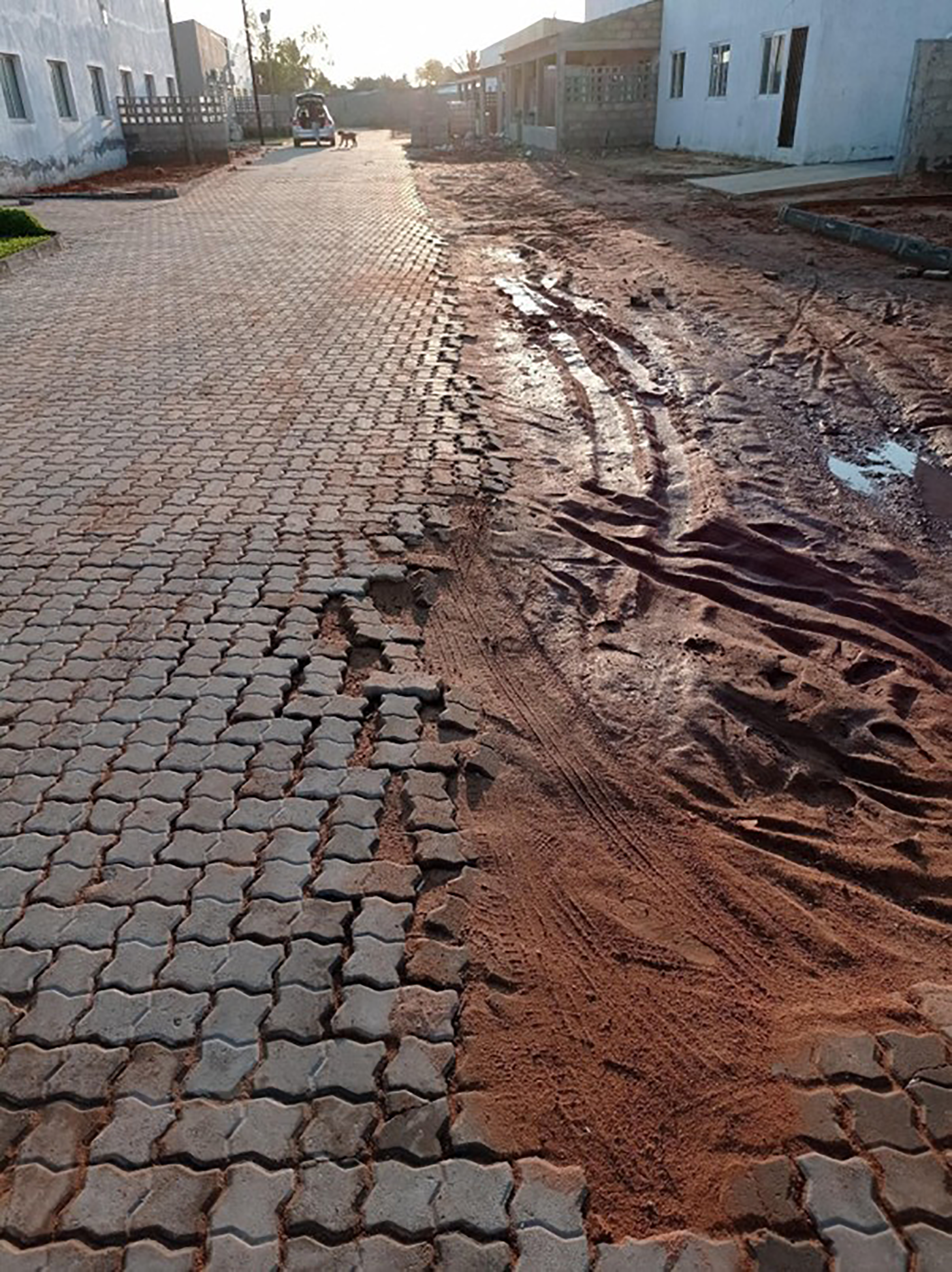
Figure 2. Long description
A paved road with hexagonal tiles on the left side is left unfinished, with a muddy section on the right side. The muddy area shows tire tracks and puddles of water. Buildings and a vehicle are visible in the background.
Conclusion: sovereignty’s afterlife
As argued by Tomás, many debates dealing with the impact of how ‘neoliberalism’ fuelled urbanization in the global South have, unfortunately, focused on what analysts felt was present in other cities in the world but lacking in cities in this region, as opposed to what was actually there (Tomás Reference Tomás2022). This is perhaps especially important in discussions concerning the ‘right to the city’ and what, if anything, this right could be based on. In Maputo, a right to the city, as understood through urban citizenship or even citizenship itself, is not guaranteed through a liberal conception of an autonomous individual but through a relationship to a project of sovereignty. This was once a utopian project of sovereign transformation, one that promised to bind the fragments of the nation together into a new, cohesive whole, a form of nationalist intimacy.
Although many aspects of this project have collapsed, its afterlife lingers on, influencing the terms of debate and ideas of what is proper and possible in the present; idealized efforts to create a localized form of sovereign ‘wholeness’ ironically tend to fall prey to many of the same issues that undermined the project’s revolutionary incarnation. Despite this, it is this afterlife that provides the contours for the ‘skin of the city’ as it retracts and expands with the changing currents of inclusion and exclusion over time. This is not unique to Maputo; the afterlife of grand political projects continues to shape cities all over the world. The difference is the vision being activated and the history upon which it draws.
In this way, Casa Jovem embodies older utopian hopes while selling itself as the face of a new Maputo, where educated, young professionals and their 2.4 children live in peaceful dignity detached from the surrounding chaos. And while elements of this vision are new, its residents and managers are trapped in a social dynamic of inclusion and exclusion, promise and failure, sovereignty and domination that has repeated itself, in different guises, again and again.
Charas wanted to create his own vision of a city for those he felt are – or at least should be – the urban subject par excellence: the young professional. While Charas’s vision was phrased in the vocabulary of contemporary, aspirational capitalism, he was deploying a very similar logic, a top-down project of social engineering. Once again, if members of a social group with supposedly shared interests could be detached from the destructive influences of the outside world, the ever present legacy of past degradation, then a perfect, all-encompassing nationalist intimacy based on a clear vision of the collective good would emerge in its place. Casa Jovem also faced similar problems. To be ‘the people’ one needed a relationship with the project of transformation; to be outside this orbit excluded you from the ‘people’ by definition. However, while it was clear who are not the people (everyone who is not a young professional), it never became totally clear who are the people – or, more accurately, what they were supposed to become after being detached from their previous precariousness. Is sovereign transformation a resource to be activated or a collective effort to transform social relations permanently? And can it ever actually achieve this goal? The inability to answer these questions means that every effort to centralize and fix a social identity to an infrastructural space – i.e. Casa Jovem as the home of the young professional – only causes more fragmentation. Charas’s vision of contemporary urbanism was interpreted in a myriad of different ways even among the limited number of young professionals to which Casa Jovem caters. It could be a good place to raise a family, a good place to host rural nieces and nephews, a good place to buy for an investment, a good place to set up a base for people smuggling – interpretations are legion. Did modern urban living entail an apartment, a bungalow, where you add a storey and build a balcony so you can peer into your neighbour’s kitchen? It depends on who you ask. These conflicts over meaning may endanger specific projects, such as Casa Jovem, but the overall logic will survive. In fact, the failures of transformative projects of sovereignty, either for the nation or scaled down to a specific urban neighbourhood, create the breeding ground for the next project, where a ‘people’ will be spatially formed through yet a new attempt at sovereign transformation.
Sandra Manuel is a social anthropologist who works on the social analysis of the body, gender and health. She is an editor of the journal Feminist Africa.
Jason Sumich is a political anthropologist with a geographic focus on Mozambique. He has been conducting research since 2002 on issues of class formation and the legacies of utopian attempts to transform society. His monograph was published as The Middle Class in Mozambique: the state and the politics of transformation in Southern Africa (Cambridge University Press, 2018).


 Open access

