Burnout syndrome refers to the sustained response to chronic work stress (Maslach & Jackson, Reference Maslach and Jackson1981; Meier, Reference Meier1983). Although it was initially investigated in human service providers (Maslach & Schaufeli, Reference Maslach, Schaufeli, Schaufeli, Maslach and Marek1993), the scope of study has now been expanded even to students (Bakker, Demerouti, & Schaufeli, Reference Bakker, Demerouti and Schaufeli2002; Demerouti, Bakker, Nachreiner, & Schaufeli, Reference Demerouti, Bakker, Nachreiner and Schaufeli2001). Academic burnout consists of three components: emotional exhaustion, cynicism, and academic inefficacy (Schaufeli, Martez, Marques-Pinto, Salanova, & Bakker, Reference Schaufeli, Martinez, Marques-Pinto, Salanova and Bakker2002). Emotional exhaustion refers to the depletion of energy due to academic demands; cynicism indicates an apathetic and uninterested attitude towards given tasks; and inefficacy implies being incapable of achieving desirable academic outcomes (Shin, Puig, Lee, Lee, & Lee, Reference Shin, Puig, Lee, Lee and Lee2011). Academic burnout develops over time, and various psychological factors are involved in this process (Schaufeli, Leiter, & Maslach, Reference Schaufeli, Leiter and Maslach2009). School psychologists and counsellors need to pay attention to the dynamics of academic burnout because it is related to school maladaptation such as lack of interest in academic activities, depressive symptoms, and school dropout (Bask & Salmela-Aro, Reference Bask and Salmela-Aro2013; Walburg, Reference Walburg2014; Yang & Farn, Reference Yang and Farn2005).
Previous studies suggested that perfectionism, as a personality disposition, is one of the most important factors leading to burnout (Hill & Curran, Reference Hill and Curran2016; Zhang, Gan, & Cham, Reference Zhang, Gan and Cham2007). Individuals high on perfectionism tend to pursue demanding standards despite negative outcomes and are prone to blaming themselves (Blatt, Reference Blatt1995; Gilbert, Durrant, & McEwan, Reference Gilbert, Durrant and McEwan2006). Moreover, clinical perfectionism has been considered to arouse negative emotions such as guilt, shame and worthlessness (Egan, Wade, & Shafran, Reference Egan, Wade and Shafran2011; Shafran & Mansell, Reference Shafran and Mansell2001).
However, there is another view that suggests the positive aspects of perfectionism. In this perspective, adaptive perfectionism, characterised by oneʼs striving to outperform (i.e., perfectionistic striving), is distinguished from maladaptive perfectionism, which is related to worrying about being evaluated or judged by others (i.e., perfectionistic concern; Enns, Cox, Sareen, & Freeman, Reference Enns, Cox, Sareen and Freeman2001; Hewitt & Flett, Reference Hewitt and Flett1991; Hill & Curran, Reference Hill and Curran2016). In this view, adaptive perfectionism has a marginally negative or nonsignificant relationship with burnout, while maladaptive perfectionism is positively related with burnout (Hill & Curran, Reference Hill and Curran2016; Zhang et al., Reference Zhang, Gan and Cham2007). For example, Shih (Reference Shih2012) discovered that adaptive perfectionists displayed lower burnout levels and healthier patterns of engagement in schoolwork as compared to maladaptive perfectionists, leading to the latterʼs categorisation as an at-risk group. Therefore, perfectionism should be treated as a multidimensional personality trait, that is, one with both adaptive and maladaptive aspects (Hill, Hall, & Appleton, Reference Hill, Hall and Appleton2011).
As perfectionism is a relatively stable trait (Cox & Enns, Reference Cox and Enns2003; Herman, Wang, Trotter, Reinke, & Ialongo, Reference Herman, Wang, Trotter, Reinke and Ialongo2013; Nilsson, Sundbom, & Hagglof, Reference Nilsson, Sundbom and Hägglöf2008; O’Connor, Dixon, & Rasmussen, Reference O’Connor, Dixon and Rasmussen2009; Rice & Aldea, Reference Rice and Aldea2006), identifying a third variable that boosts or impedes the effect of healthy perfectionism on burnout will make a useful contribution to the development of burnout intervention plans. In this regard, previous studies suggesting that academic motivational orientations can be the mediating variables in the link between perfectionism and academic burnout are noteworthy.
Academic motivation has long been a concern of educators and psychologists, and the emergence of self-determination theory (SDT) in the early 2000s provided a new perspective on academic motivation research. According to SDT, motivation is divided into intrinsic and extrinsic motivation, and extrinsic motivation can be conceptualised as several types of regulation along a continuum of relative autonomy (Deci & Ryan, Reference Deci, Ryan and Ryan2012). The subtypes of extrinsic motivation are identified, introjected, and external regulation. Intrinsic motivation, a prototype of self-determined activity, refers to the inherent tendency to satisfy oneʼs desire for learning. Identified regulation, which is considered a form of extrinsic motivation, refers to a conscious acceptance of the behaviour as being significant in order to fulfill personally valued outcomes (Koestner & Losier, Reference Koestner, Losier, Deci and Ryan2002). Introjected regulation, another type of extrinsic motivation, comprises internalised rules or demands to pressure individuals to behave, fuelled by the possibility of attaining rewards (e.g., ego enhancement and/or pride) or avoiding punishment (e.g., guilt and/or shame; Deci, Vallerand, Pelletier, & Ryan, Reference Deci, Vallerand, Pelletier and Ryan1991; Ryan & Deci, Reference Ryan, Deci, Wentzel and Miele2016). External regulation, which represents the least autonomous form, involves the avoidance of being punished based on social norms and pressures. SDT also suggested that motivational orientations can change from extrinsic to more autonomous forms in sufficiently autonomy supportive environments (Deci & Ryan, Reference Deci, Ryan and Ryan2012).
The relationship between perfectionism and motivation has been identified by previous studies. Slade and Owens (Reference Slade and Owens1998) argued that positive aspects of perfectionism enhance the pursuit of success and lead to an approach motivational system. On the other hand, negative aspects of perfectionism are closely connected with a fear of failure, and promote an avoidance motivation system. For example, self-oriented perfectionism was proven to facilitate self-determined motivation, whereas socially oriented perfectionism hinders self-determined motivation (Miquelon, Vallerand, Grouzet, & Cardinal, Reference Miquelon, Vallerand, Grouzet and Cardinal2005). Gaudreau and Thompson (Reference Gaudreau and Thompson2010) also revealed that subtypes of perfectionism were differently related to academic motivation. Adaptive perfectionism was connected with internal motivation, whereas maladaptive perfectionism was related to external motivation.
There are also studies that have specifically examined the mediating effects of various types of academic motivation in the perspective of SDT. According to Chang, Lee, Byeon, and Lee (Reference Chang, Lee, Byeon and Lee2015) and Chang, Lee, Byeon, Seong, and Lee (Reference Chang, Lee, Byeon, Seong and Lee2016), each academic motivational orientation plays a distinctive role in the relationship between perfectionism and academic burnout. They confirmed that adaptive perfectionism negatively impacts academic burnout through intrinsic/identified motivation, while maladaptive perfectionism positively impacts academic burnout through extrinsic motivation. This implies that intrinsic/identified and extrinsic motivation would be involved in the process through which healthy perfectionism lowers burnout and unhealthy perfectionism promotes burnout respectively. However, they failed to discover the mediating effect of introjected motivation. Theoretically, introjected motivation can be more closely connected with perfectionism than any other motivational orientations. Ryan and Deci (Reference Ryan and Deci2017) proposed that individuals with introjected motivation display similar psychological dynamics to perfectionists, such as heightened ego involvement, self-consciousness and critical self-evaluation. Perfectionists who are overly self-critical for failing to achieve standards are supposed to have introjected motivation that ‘represents regulation by contingent self-esteem’ (Ryan & Deci, Reference Ryan and Deci2000, p. 62). Furthermore, it can be speculated that the vulnerability aspect of perfectionism may increase the risk of burnout. These explanations may raise doubts regarding the results of the studies by Chang et al. (Reference Chang, Lee, Byeon and Lee2015) and Chang et al. (Reference Chang, Lee, Byeon, Seong and Lee2016), which did not confirm the mediating role of introjected motivation in the perfectionism-burnout link.
Chang et al. (Reference Chang, Lee, Byeon, Seong and Lee2016) surmised that this may have been the result of analysing separate research models. Even though two aspects of perfectionism (adaptive and maladaptive), as well as the four orientations of academic motivation (intrinsic, identified, introjected, extrinsic), are interrelated, the authors left this issue out of consideration. Accordingly, the present study attempted to expand the studies by Chang et al. (Reference Chang, Lee, Byeon and Lee2015) and Chang et al. (Reference Chang, Lee, Byeon, Seong and Lee2016), especially from a methodological perspective. We tested the mediating effect of academic motivational orientations in the relationship between perfectionism and academic burnout using structural equation modelling. Unlike in previous studies (Chang et al., Reference Chang, Lee, Byeon and Lee2015; Chang et al., Reference Chang, Lee, Byeon, Seong and Lee2016), each variable was treated as a latent variable that estimates measurement error separately. Moreover, to control the covariance among variables and identify the pure effect of predictors/mediators on the outcome variable, all the motivational orientations were posited to simultaneously mediate the link between two aspects of perfectionism (high standards and discrepancy) and burnout. In addition, in contrast to the studies by Chang et al. (Reference Chang, Lee, Byeon and Lee2015) and Chang et al. (Reference Chang, Lee, Byeon, Seong and Lee2016), which carried out a cross-sectional survey, the present study employed a longitudinal design to infer the causal relationships between research variables. The participants belonged to the same age group to control for the cohort effect (Hedeker & Gibbons, Reference Hedeker and Gibbons2006).
As a measure of academic burnout, Maslach Burnout Inventory — Students Survey (MBI-SS; Schaufeli et al., Reference Schaufeli, Martinez, Marques-Pinto, Salanova and Bakker2002) is widely used. While the MBI-SS is valid for college students, there has been an attempt to develop an academic burnout scale for secondary high school students (e.g., Salmela-Aro, Kiuru, Leskinen, & Nurmi, Reference Salmela-Aro, Kiuru, Leskinen and Nurmi2009). Because high school students are different from college students in terms of cognitive, emotional and developmental aspects, an inventory is needed to take into account these attributes. In addition, sociocultural differences must also be considered when using scales (Church, Reference Church2000). In this regard, Y. Lee, Lee, and Lee (Reference Lee, Lee and Lee2009) developed a measure of academic burnout suitable for Korean students in middle school and high school. The questionnaire was drawn up based on students’ descriptions about symptoms, feelings, behaviours and thinking experienced when they felt exhausted because of their studies. It consists of five subfactors of exhaustion, incompetence, antipathy, cynicism and anxiety. The present study used this scale to study the academic exhaustion of Korean high school students.
Method
Participants
The longitudinal data were collected from 12th graders in South Korea. Participants were recruited using one-stage cluster sampling. Eight schools were sampled to achieve a fair representation of the average South Korean high school in terms of the level of academic achievement (Korean Education Statistics Service, 2016) and socioeconomic status (Seo, Woo, & Kee, Reference Seo, Woo and Kee2015). The survey was distributed to all the 12th graders of sampled schools. A total of 950 participants were followed up three times. They were the same age group (18 years old), and 43% were male. The participants completed a questionnaire on perfectionism (T1), academic motivation (T2), and academic burnout (T3). First, the last measurement point (T3) was set at 2 weeks before the entrance examination because that was when academic burnout was expected to peak. As 2 months is considered the minimum interval that can influence burnout (Martinent & Decret, Reference Martinent and Decret2015), study variables were measured at 2-month intervals. Response rates based on the number of participants at T1 were 97% at T2 (N = 921) and 95% at T3 (N = 900). There were no statistically significant differences according to gender or school in the study variables.
A detailed description of the study was provided in informed consent documents. All three measures were administrated by Koreans. The students filled in the survey during their class time and received a $5 gift certificate for their participation. For ethical clearance, this study was approved by the Institutional Review Board of Korea University, South Korea (1040548-KU-IRB-15–170-A-1).
Measures
Perfectionism
Perfectionism was measured by the Korean version of the Almost Perfect Scale — Revised (APS-R; Slaney, Rice, Mobley, Trippi, & Ashby, Reference Slaney, Rice, Mobley, Trippi and Ashby2001), translated by S. Kim (Reference Kim2005). The validity of the Korean version of the APS-R was confirmed by previous studies (i.e., S. Lee & Lee, Reference Lee and Lee2014; Park, Reference Park2009). S. Lee and Lee (Reference Lee and Lee2014) revealed that the factor structure of the Korean version of the APS-R was the same as the original version of the APS-R. Moreover, it correlated positively with Frostʼs Multidimensional Perfectionism Scale (r = .73, p < .01) and Hewitt and Flettʼs Multidimensional Perfectionism Scale (r = .62, p < .01), indicating good concurrent validity. It is composed of 23 items across three subscales: 7 items for high standards (e.g., ‘I set very high standards for myself’, ‘I have a strong need to strive for excellence’), 4 items for order (e.g., ‘I think things should be put away in their place’, ‘I like to be organised and disciplined’), and 12 items for discrepancy (e.g., ‘Doing my best never seems to be enough’, ‘I am hardly ever satisfied with my performance’). Among these three components, high standards is considered adaptive perfectionism while discrepancy is regarded as maladaptive perfectionism (Chang et al., Reference Chang, Lee, Byeon, Seong and Lee2016; Rice, Richardson, & Tueller, Reference Rice, Richardson and Tueller2014; Rice & Slaney, Reference Rice and Slaney2002; Suddarth & Slaney, Reference Suddarth and Slaney2001). As many researchers (Rice et al., Reference Rice, Richardson and Tueller2014; Stoeber & Otto, Reference Stoeber and Otto2006) have suggested that high standards and discrepancy are the main components of perfectionism, only these two factors were considered in the present study. All items were scored on a 7-point Likert-type scale ranging from 1 (strongly disagree) to 7 (strongly agree). Cronbachʼs alphas in the original study were .85 for high standards, .86 for order, and .92 for discrepancy. In the current study, the alpha coefficients were .83 for high standards and .85 for discrepancy.
Academic motivation
The Korean-Academic Self-Regulation Questionnaire (K-SRQ-A) was used to measure academic motivation. Combining the SRQ-A (Ryan, Reference Ryan2002) and Stepping Motivation Scale (Hayamizu, Reference Hayamizu1997), A. Kim (Reference Kim2002) developed and validated this scale to form a Korean academic motivation measurement. The original version of the SRQ-A classified motivation as five types: internal regulation, integrated regulation, identified regulation, introjected regulation, and external regulation. However, there were no significant differences between integrated regulation and identified regulation in A. Kimʼs (Reference Kim2002) study, which used a sample of Korean students. Thus, these two types of motivation were combined as integrated/identified regulation. A. Kim (Reference Kim2002) confirmed that the validity and reliability of K-SRQ-A was acceptable in samples of elementary, middle, and high school students. The K-SRQ-A is composed of 24 items across four subscales: 6 items for extrinsic motivation, 6 items for introjected motivation, 6 items for identified motivation, and 6 items for intrinsic motivation. All items are measured on a scale ranging from 1 (strongly disagree) to 6 (strongly agree). An example item for extrinsic motivation is ‘I study because my parents force me to’. Example items for introjected motivation are ‘I study because I do not want my teacher to ignore me’ and ‘I study because I want my friends to see me as a smart/clever student’. An example item for identified motivation is ‘I study because I can understand more complex things later in life’, and one item for intrinsic motivation is ‘I study because I find it interesting’. Cronbachʼs alphas were .82 for extrinsic motivation, .75 for introjected motivation, .84 for identified motivation, and .81 for intrinsic motivation. In this study, Cronbachʼs alphas were .85, .83, .83, and .92 respectively.
Academic burnout
The Korean Academic Burnout Scale (K-ABS) was used to measure academic burnout (Y. Lee et al., Reference Lee, Lee and Lee2009). This scale has been validated in a sample of elementary, middle, and high school students. In confirmatory factor analysis (CFA) results, the goodness-of-fit indices of the K-ABS were acceptable (non-normed fit index [NNFI] = .90, comparative fit index [CFI] = .92, root mean square error of approximation [RMSEA] = .07), showing good construct validity. Moreover, it correlated positively with effort-reward imbalance (r = .52, p < .01) and negatively with sense of control (r = -.33, p < .01), indicating good concurrent validity. The K-ABS consists of 25 items across five subscales: 5 items for exhaustion (e.g., ‘Studying or attending classes puts strain on me’), 5 items for inefficacy (e.g., ‘I do not think I have the ability to do well in academics’), 5 items for antipathy (e.g., ‘I want to live in a world where there is no studying’), 5 items for cynicism (e.g., ‘I am not sure if studying will help me in the future’), and 5 items for anxiety (e.g., ‘I am anxious even when I am studying’). The participants responded to the items using a scale ranging from 1 (strongly disagree) to 5 (strongly agree). According to Y. Lee et al. (Reference Lee, Lee and Lee2009), Cronbachʼs alphas were .90 for exhaustion, .89 for inefficacy, .89 for antipathy, .86 for cynicism, .84 for anxiety, and .94 overall. In the current study, Cronbachʼs alphas were .89, .93, .93, .90, .92, and .96 for exhaustion, inefficacy, antipathy, cynicism, anxiety, and overall, respectively.
Data Analysis
As a preliminary analysis, a series of descriptive statistics was computed using SPSS 21.0. To manage the missing data, the expectation maximisation (EM) method (Ruud, Reference Ruud1991) was employed. The EM method is an efficient iterative procedure for maximum likelihood (ML) estimation when the data are missing at random (MAR; Allison, Reference Allison2003). The results from Littleʼs MCAR test suggested that the missing data of the present study were MAR, χ2(88, N = 1,077) = 107.8, p = .075. In the next step, in order to investigate the relations between perfectionism, academic motivation and academic burnout, structural equation modelling using AMOS 20.0 was conducted. The goodness of fit of the tested models was evaluated using the chi-squared test statistic, NNFI, CFI, and RMSEA. NNFI and CFI values larger than .90; and RMSEA values of .08 or lower signify acceptable model fit (Byrne, Reference Byrne2009). In addition, to test the indirect effect of academic motivation, bootstrapping with 95% confidence intervals based on 1000 bootstrap replicates was conducted. The phantom model approach was used to estimate specific indirect effects (Macho & Ledermann, Reference Macho and Ledermann2011).
Results
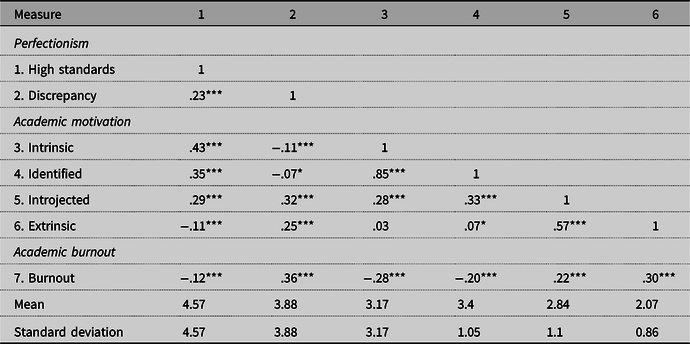
Table 1 displays the means, standard deviations and zero-order correlation coefficients for the study variables. As displayed, academic burnout had a weak negative correlation with high standards (r = -.12, p < .001) but a moderate positive correlation with discrepancy (r = .36, p < .001). Regarding motivation, academic burnout had weak positive correlations with introjected motivation (r = .22, p < .001) and extrinsic motivation (r = .30, p < .001), but weak negative correlations with intrinsic motivation (r = -.28, p < .001) and identified motivation (r = -.20, p < .001). Lastly, high standards had moderate positive correlations with intrinsic motivation (r = .43, p < .001) and identified motivation (r = .35, p < .001), and a weak positive correlation with introjected motivation (r = .29, p < .001). However, extrinsic motivation was negatively correlated (r = -.11, p < .001) to a small degree. Discrepancy had a moderate positive correlation with introjected motivation (r = .32, p < .001) and a weak positive correlation with extrinsic motivation (r = .25, p < .001). On the contrary, there was a weak negative correlation with intrinsic motivation (r = -.11, p < .001) and identified motivation (r = -.07, p < .05).
Correlations, Means and Standard Deviations Among Variables

Note: *p < .05, ***p < .001.
Before examining the research model, we checked the construct validity of three measures by conducting a CFA. As a result, the goodness-of-fit indices of all three measures were acceptable, showing good construct validity (perfectionism: NNLI = .97, CFI = .99, RMSEA = .07; academic motivation: NNLI = .94, CFI = .96, RMSEA = .09; academic burnout: NNLI = .99, CFI = .99, RMSEA = .07).
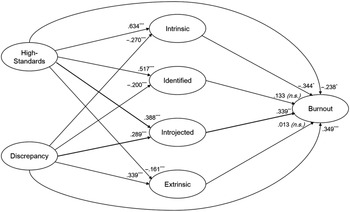
To verify the research model, the goodness-of-fit indices were checked. The results showed that research model should be modified to obtain an acceptable fit (NNFI = .87, CFI = .90, and RMSEA = .09). To improve model fit, a twofold approach was adopted: a statistical and a theoretical approach. As for the statistical approach, a modification index (MI) was considered. A total of 162 pairs of residual covariance were recommended ranging from 4.07 to 192.82. Among them, it was considered whether the modification of model was theoretically sensible or not. A final research model was specified by adding five pairs of residual covariance, which were observed variables of high standards (all three parcelling variables) and academic burnout subscales (antipathy and cynicism, antipathy and anxiety). The MI of the added residual covariance were 20.76, 25.68, 34.55, 120.35 and 190.08, respectively. The chi-square statistic was χ2(206, N = 1,077) = 1620.7, p < .001, indicating that there is significant discrepancy between observed and expected covariance matrices. However, other fit indices of the final research model (Figure 1) were NNFI = .90, CFI = .92 and RMSEA = .08, suggesting its acceptability. The results indicated that both types of perfectionism were differentially associated with burnout. High standards (T1) was negatively correlated with burnout (T3), β = -.24, p < .05, whereas discrepancy (T1) was positively correlated with burnout (T3), β = .35, p < .001. The differences in the direction of the relationship between the two types of perfectionism were also found in the paths from perfectionism to academic motivation, except for introjected motivation. In other words, high standards (T1) was positively correlated with intrinsic motivation (T2), β = .63, p < .001, and identified motivation (T2), β = .52, p < .001. On the contrary, discrepancy (T1) was negatively correlated with intrinsic motivation (T2), β = -.27, p < .001, and identified motivation (T2), β = -.20, p < .001. In addition, high standards (T1) was negatively correlated with extrinsic motivation (T2), β = -.16, p < .001, whereas discrepancy (T1) was positively correlated with extrinsic motivation (T2), β = .34, p < .001. However, the paths from both types of perfectionism to introjected motivation showed the same sign. In other words, high standards (T1) was positively correlated with introjected motivation (T2), β = .39, p < .001, and discrepancy (T1) was also positively correlated with introjected motivation (T2), β = .29, p < .001. As for the association between academic motivation and burnout, intrinsic motivation (T2) showed a negative relationship with burnout (T3), β = -.34, p < .05, while introjected motivation (T2) showed a positive relationship with burnout (T3), β = .34, p < .01. There were no significant correlations between identified motivation (T2) and burnout (T3), β = .13, ns, and between extrinsic motivation (T2) and burnout (T3), β = -.01, ns.
The structural equation modelling of relationships among perfectionism, academic motivation, and academic burnout.
Note: All paths are standardised.
*p < .05, **p < .01, ***p < .001.

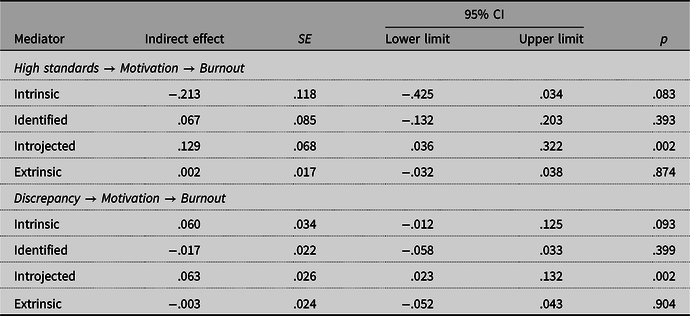
Regarding indirect effects, Table 2 presents the findings of bootstrapping analyses. The results show that indirect effects of high standards (T1) on academic burnout (T3) via introjected motivation (T2) and discrepancy (T1) on academic burnout (T3) via introjected motivation (T2) were statistically significant, 95% CI [.036, .322] and [.023, .132] respectively. Therefore, introjected motivation mediates the relationship between both types of perfectionism and burnout. In other words, both high standards (T1) and discrepancy (T1) were positively associated with introjected motivation (T2), and subsequently a higher level of introjected motivation (T2) was linked to a higher level of burnout (T3).
Results of Bootstrapping Method for Indirect Effects
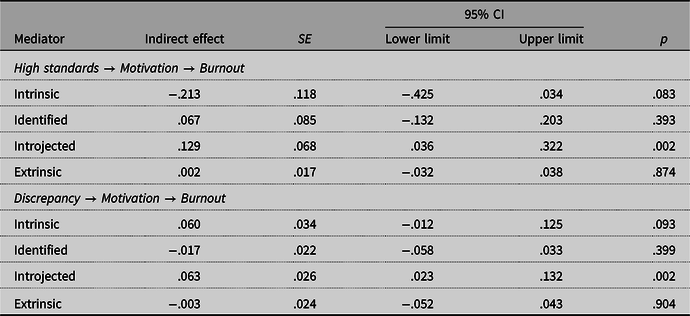
Note: SE = standard error, CI = confidence interval.
Discussion
The purpose of this study was to investigate the relationships between perfectionism, academic motivation, and academic burnout. In particular, the mediating role of academic motivation was examined. In keeping with SDT, academic motivation was classified into four orientations: intrinsic, identified, introjected, and extrinsic (Deci & Ryan, Reference Deci, Ryan and Ryan2012; A. Kim, Reference Kim2002), with each posited to simultaneously mediate the path from two types of perfectionism (i.e., high standards, discrepancy) to burnout. In addition, each variable was measured at a different time point, allowing for the analysis of longitudinal relationships. The main findings are as follows.
First, high standards and discrepancy had a direct effect on burnout, but in opposite directions, that is, a higher level of high standards was linked to a lower level of burnout, whereas a higher level of discrepancy was related to a higher level of burnout. These results are in line with previous findings that it is not the setting of high standards but perfectionistic concerns that personal high standards are not being met that lead to burnout (Chang et al., Reference Chang, Lee, Byeon, Seong and Lee2016; Hill & Curran, Reference Hill and Curran2016; Ozbilir, Day, & Catano, Reference Ozbilir, Day and Catano2015; Zhang et al., Reference Zhang, Gan and Cham2007). Although there is the view that doubts the adaptive aspect of perfectionism (Smith et al., Reference Smith, Sherry, Rnic, Saklofske, Enns and Gralnick2016), an adequate number of studies suggest that high standards lead to problematic consequences when they are accompanied by harsh self-evaluation (Rice & Ashby, Reference Rice and Ashby2007; Shafran, Cooper, & Fairburn, Reference Shafran, Cooper and Fairburn2003; Stoeber & Otto, Reference Stoeber and Otto2006). The present study confirmed that when discrepancy is controlled for, high standards lower burnout symptoms. This result would support the idea that perfectionism possesses both negative and positive dimensions (Rice, Ashby, & Slaney, Reference Rice, Ashby and Slaney2007; Slaney et al., Reference Slaney, Rice, Mobley, Trippi and Ashby2001).
Second, high standards were positively associated with intrinsic/identified motivation but negatively associated with extrinsic motivation. On the contrary, discrepancy was negatively associated with intrinsic/identified motivation but positively associated with extrinsic motivation. These results are consistent with the majority of past research (Burnam, Komarraju, Hamel, & Nadler, Reference Burnam, Komarraju, Hamel and Nadler2014; Chang et al., Reference Chang, Lee, Byeon, Seong and Lee2016; Miquelon et al., Reference Miquelon, Vallerand, Grouzet and Cardinal2005; Mouratidis & Michou, Reference Mouratidis and Michou2011; Stoeber, Davis, & Townley, Reference Stoeber, Davis and Townley2013). According to Hewitt and Flett (Reference Hewitt and Flett1991), adaptive/maladaptive perfectionists can be characterised by the level and type of motivation. They suggested that adaptive perfectionism should be related with a more intrinsic form of motivation, which entails the inherent need and striving for self-improvement, whereas maladaptive perfectionism should be associated with a more extrinsic form of motivation, which features evaluative standards established by external sources.
In the SDT framework, our findings partially support the relationship between perfectionism style and motivational orientation. In Miquelon et al.ʼs (Reference Miquelon, Vallerand, Grouzet and Cardinal2005) study, adaptive perfectionism promoted self-determined academic motivation (i.e., intrinsic/identified), whereas maladaptive perfectionism raised non-self-determined academic motivation (i.e., extrinsic/introjected). Vansteenkiste et al. (Reference Vansteenkiste, Smeets, Soenens, Lens, Matos and Deci2010) also suggested that a higher level of adaptive perfectionism is linked to a higher level of autonomous motivation (i.e., intrinsic/identified), whereas a higher level of maladaptive perfectionism is associated with a higher level of controlled motivation (i.e., extrinsic/introjected).
Considering that introjected motivation has often been classified as controlled motivation (Koestner, Otis, Powers, Pelletier, & Gagnon, Reference Koestner, Otis, Powers, Pelletier and Gagnon2008; Sheldon & Elliot, Reference Sheldon and Elliot1998), it is expected to have a negative relationship with high standards and a positive relationship with discrepancy. Interestingly, however, the present study found that both high standards and discrepancy were positively linked to introjected motivation. This finding is inconsistent with previous studies, suggesting that introjected motivation is not correlated with adaptive perfectionism (Stoeber, Feast, & Hayward, Reference Stoeber, Feast and Hayward2009) and has marginal associations with any subscale of perfectionism (Chang et al., Reference Chang, Lee, Byeon, Seong and Lee2016). In particular, Chang et al.ʼs (Reference Chang, Lee, Byeon, Seong and Lee2016) study suggested that discrepancy is supposed to be unrelated to introjected motivation because it depends on internalised standards such as self-set goals and self-evaluation, unlike introjected motivation, which is swayed by externally provided standards.
However, a few studies have found a positive relationship between perfectionism and introjected motivation (Jowett, Hill, Hall, & Curran, Reference Jowett, Hill, Hall and Curran2013; Mouratidis & Michou, Reference Mouratidis and Michou2011). In addition, Stoeber et al. (Reference Stoeber, Davis and Townley2013) discovered that adaptive perfectionism was positively associated with introjected motivation. Mouratidis and Michou (Reference Mouratidis and Michou2011) revealed that both personal standards (adaptive perfectionism) and concerns over mistakes (maladaptive perfectionism) were positively related to controlled motivation. These mixed findings suggest that introjected motivation might be more complex than it has so far appeared. Ryan and Deci (Reference Ryan and Deci2000) described introjected motivation as ‘a type of internal regulation that is still quite controlling’ (p. 62). Individuals with introjected motivation tend to seek two things: ego enhancement and the avoidance of guilt/anxiety. Accordingly, while introjected motivation represents a part of the self, it still remains an external perceived locus of causality (deCharms, Reference deCharms1968). Its ambivalent characteristics may have been responsible for our findings regarding the positive link between introjected motivation and both high standards and discrepancy.
Third, introjected motivation was the sole mediator in the relationship between both types of perfectionism (i.e., high standards/discrepancy) and burnout. Individuals with higher levels of perfectionism, either high standards or discrepancy, had higher levels of introjected motivation and, in turn, displayed higher levels of burnout. It is noticeable that the other three motivational orientations (i.e., intrinsic, identified, extrinsic) showed no significant mediating effect in the relationship between perfectionism and burnout. This result is inconsistent with previous studies that found significant mediating effects of intrinsic or identified or extrinsic motivation and refuted the mediating role of introjected motivation in the relationship between perfectionism and academic burnout (Chang et al., Reference Chang, Lee, Byeon and Lee2015; Chang et al., Reference Chang, Lee, Byeon, Seong and Lee2016). A possible explanation for these contrary findings can be the different modelling approaches used. As described above, Chang et al. (Reference Chang, Lee, Byeon and Lee2015) and Chang et al. (Reference Chang, Lee, Byeon, Seong and Lee2016) examined several mediation models separately in response to perfectionism styles and motivational orientations, whereas the present study tested the integrated model, which holds all the variables. Even though the four motivational orientations (i.e., intrinsic, identified, introjected, extrinsic) are deemed distinct variables, they coexist along a continuum of autonomy (Deci & Ryan, Reference Deci, Ryan and Ryan2012) and thus have significant correlations ranging from weak to strong. The integrated model proposed in the present study can identify the pure effect of each variable after controlling for the relationships among variables. Whether the effects of such relationships are controlled for or not may result in different outcomes.
Besides, there is empirical evidence that suggests the mediating role of introjected motivation. Miquelon et al. (Reference Miquelon, Vallerand, Grouzet and Cardinal2005) investigated whether non-self-determined academic motivation (extrinsic/introjected) mediates the path from perfectionism to psychological adjustment difficulties. Vansteenkiste et al. (Reference Vansteenkiste, Smeets, Soenens, Lens, Matos and Deci2010) also examined the mediating role of controlled motivation (extrinsic/introjected) in the relationship between perfectionism and various learning outcomes. These studies discovered that maladaptive perfectionism enhanced introjected motivation, and in turn, introjected motivation had a detrimental impact on adjustment or learning outcomes. Our result regarding the mediating role of introjected motivation in the path from discrepancy to burnout seems to complement these findings.
On the contrary, unlike the result that the direct effect of high standards on burnout was negative, the indirect effect of high standards on burnout via introjected motivation was positive. These contradictory findings require cautious interpretation in light of the growing body of research concerning the conceptual meaning and dimensions of perfectionism (Gotwals, Stoeber, Dunn, & Stoll, Reference Gotwals, Stoeber, Dunn and Stoll2012; Hill, Reference Hill2014; Molnar, Sadava, Flett, & Colautti, Reference Molnar, Sadava, Flett and Colautti2012; Powers, Koestner, Zuroff, Milyavskaya, & Gorin, Reference Powers, Koestner, Zuroff, Milyavskaya and Gorin2011). As adaptive and maladaptive perfectionism typically shows a positive correlation, research concerning the relationship between adaptive perfectionism (i.e., high standards) and burnout often produces equivocal results (Hill & Curran, Reference Hill and Curran2016; Stoeber & Otto, Reference Stoeber and Otto2006). Stoeber et al.ʼs (Reference Stoeber, Davis and Townley2013) study can provide an explanation for this as well. They found that introjected motivation mediated the relationship between adaptive perfectionism and workaholism. Adaptive perfectionists, specifically when showing a higher level of introjected motivation, displayed elevated levels of workaholism. Given that workaholism is closely associated with burnout (Taris, van Beek, & Schaufeli, Reference Taris, van Beek and Schaufeli2010), it may be inferred that if individuals with adaptive perfectionism begin being motivated by internal rewards and punishment (introjected motivation), they are likely to become workaholics and consequently experience burnout.
Implications for School Psychologists and Counsellors
Some practical implications for school psychologists and counsellors can be derived from the findings of the present study. First, we must pay more attention to the distinction between the striving for excellence and maladaptive perfectionism (i.e., excessive self-criticism and dissatisfaction with oneself). The former tends to prevent burnout, while the latter may be a risk factor of burnout. Professionals who provide educational or clinical interventions for perfectionist students should notice such delicate distinctions and guide them into adaptive aspect of perfectionism.
Second, we should consider some interventions that may change students’ motivational types. Introjected motivation leads to burnout, and even adaptive perfectionists can experience burnout when they have elevated introjected motivation. However, the structured support from teachers or counsellors can develop students’ introjected motivation into more autonomous forms of motivation (i.e., intrinsic/identified motivation). For example, high-quality relationships with teachers, including attunement, relatedness, supportiveness and gentle discipline, can help students to enhance their inner motivational resources (Reeve, Reference Reeve2006).
Third, introjected motivation may be the result of lack of psychological separation from authoritative figures such as parents or teachers (Lapsley, Reference Lapsley, Weiner and Craighead2010). These students need to discover the intrinsic value of their studies and work for themselves, and not because they are afraid of being upset by someone else. Encouraging students to move toward independence would be helpful for them to overcome such fear and self-consciousness. Therefore, we should provide support for students to complete the task of psychological separation successfully.
Limitations and Suggestions for Future Research
This study has limitations regarding interpretation and practical application that must be considered. Even though motivational orientations were classified into four theoretical types, the empirical data showed that intrinsic and identified motivation were strongly correlated. Thus, it is possible that the participants of the present study could confuse these two orientations and consequently fail to correctly identify them. This discordance between theoretical classification and empirical evidence may be responsible for misleading statistical results. Moreover, given that the participants were 12th graders who were under intense pressure owing to university entrance exams, it is possible that their responses were influenced by situational factors rather than dispositional ones. Last but not least, the conflicting results concerning the effect of high standards on burnout should be interpreted with caution. The possibility of a third variable in the perfectionism-introjected motivation or introjected motivation-burnout link requires further exploration.
Despite these limitations, the present study corroborated previous findings verifying that perfectionism styles have a close connection with motivational orientations (Burnam et al., Reference Burnam, Komarraju, Hamel and Nadler2014; Chang et al., Reference Chang, Lee, Byeon, Seong and Lee2016; Miquelon et al., Reference Miquelon, Vallerand, Grouzet and Cardinal2005; Mouratidis & Michou, Reference Mouratidis and Michou2011; Stoeber et al., Reference Stoeber, Davis and Townley2013; Vansteenkiste et al., Reference Vansteenkiste, Smeets, Soenens, Lens, Matos and Deci2010). High standards were linked to autonomous motivations (i.e., intrinsic/identified), whereas discrepancy was linked to controlled motivations (i.e., introjected/extrinsic). Furthermore, going beyond previous studies (Chang et al., Reference Chang, Lee, Byeon and Lee2015; Chang et al., Reference Chang, Lee, Byeon, Seong and Lee2016), the results of the present study suggest that introjected motivation plays a pivotal role in the relationship between perfectionism and burnout. The elevated levels of introjected motivation among perfectionists may be a factor contributing to their burnout. These results will broaden our understanding of the role of perfectionism and motivation in burnout.