This article analyzes the determinants of local institutions and distribution of political power within a constant “macro-institutional” setting. Characteristics of Brazilian municipalities related to institutional quality and distribution of land are partly inherited from the colonial histories experienced by different areas of the country.Footnote 1 The sugar cane and gold resource booms were long-term determinants of three different dimensions of current local institutions: distribution of economic power through distribution of land, quality of local government practices, and access to the justice system.
The role of institutions and initial distribution of economic power as determinants of development has received increased attention in recent years. After the work of Douglas North and Stanley Engerman and Kenneth Sokoloff, a vast array of cross-country empirical literature developed following in the footsteps of the seminal contributions of Daron Acemoglu, Simon Johnson, and James Robinson.Footnote 2 Much of this literature has evolved around the idea that the geographic pattern of development observed across countries reflects different institutional arrangements, inherited from different experiences of colonization. According to this literature, initial circumstances and geographic conditions were associated with particular paths of colonization, which in turn translated into the establishment of different types of institutions. Institutions then, through their effects on property rights, political competitiveness, and governance, led to good policies and, ultimately, development. In this view, the adoption of distinct “macro-institutions” —determined at the country level, and related to the political and judicial systems and to the enforcement of laws—would be the intervening force in the observed correlation between geography and development.Footnote 3
The geographic pattern of development within Brazil raises a series of questions in relation to the interpretation of the cross-country evidence and the conclusions of this literature. The positive correlation between distance to the equator and income per capita—often used as a motivation figure in the literature—is stronger and tighter within Brazil than across countries. The R2 is 0.56 and the coefficient on latitude is 0.053, while across countries the R2 is 0.32 and the coefficient is 0.038.Footnote 4 At the same time, the regions of Brazil shared a single colonizer and a single language, and Brazil has a very centralized federal system. The “macro-institutions” typically highlighted in the interpretation of the cross-country evidence, as well as the historical variables identified as their sources of variation, are and for the most part have always been, constant within the territory. This evidence challenges the understanding that the correlation between geography and development reflects mostly the effect of climate and endowments on the type of “macro-institutions” that were ultimately adopted at the country level.
Two non-mutually exclusive possibilities arise from this challenge. Geographic factors may be important on their own as direct determinants of long-term development, which would contradict the main consensus of the institutional literature. Or, even within a constant de jure setting, different geographic characteristics may still be associated with different de facto institutional arrangements and distributions of economic and political power, which would then be relevant determinants of local development. In this article, we focus on the second possibility. Specifically, we identify the areas of Brazil that were actively involved in two of its most important colonial episodes: the sugar cane and gold booms. These were the main periods of economic expansion during Brazilian colonial history. Both were associated with the initial occupation of certain areas and intrinsically connected with the development of extractive activities by Portugal. These booms can be delimited both chronologically and geographically, so that some municipalities can trace their origins back to a specific episode of extractive enterprise. One can then ask whether municipalities affected by the historical episodes are systematically different today.
The analysis concentrates on three municipality characteristics: the distribution of economic power, as related to the initial distribution of land; access to justice, reflected in the local availability of courts; and quality of local government practices, as indicated by an index of administrative efficiency. Our main results show that areas affected by the extractive episodes, and under stronger influence of Portugal during the colonial period, have worse outcomes today. The estimated effects of each extractive episode are consistent with the socioeconomic and political characteristics typically highlighted in the historical literature. Specifically, municipalities with origins linked to the socially polarized and oligarchic economy of the sugar cane episode are characterized by higher concentration of land. Municipalities with origins associated with the gold episode have today worse governance practices and less access to justice. In both the sugar cane and gold episodes, the negative consequences are significantly worse when the municipalities are closer to Portugal, highlighting the negative influence of the interference of the metropolis, particularly when associated with extractive activities. Quantitatively, the estimated coefficients imply that if a city in the historical mining area had not been affected by the gold boom, its index of governance today would be better by 8 percent of a standard deviation, while its index of access to justice would improve by 23 percent of a standard deviation. Similarly, if a municipality in the sugar cane boom area had not been affected by the sugar cane boom, its index of concentration of land would be lower by 63 percent of a standard deviation. Finally, we show that these colonial episodes are related to lower provision of various public goods.
Also, we contrast the results from these two major colonial extractive activities with an important postcolonial resource boom: the coffee expansion. We tentatively explore two different measures of the coffee boom, one focusing on areas where coffee production was more similar to the colonial setting, and another one including areas where coffee production was more entrepreneurial and took place long after the colonial era. We show that the effects of the early coffee boom were similar to those of the colonial sugar cane boom, but that the later coffee boom episode had no noticeable effect on current institutions.
THE SUGAR CANE AND GOLD BOOMS IN BRAZILIAN COLONIAL HISTORY
Between 1500 and 1822 Brazil was a colony of Portugal. Through most of the colonial period, Portuguese rule was characterized by the establishment of successive waves of extractive endeavors, varying in form and institutional characteristics according to the goods being demanded in Europe and the production possibilities offered by the colony. These series of colonial resource booms involved, at different historical moments and locations, the production of various commodities, such as sugar cane, gold, rubber, tobacco, cocoa, and cotton, among others.
Proximity to Portugal was an extremely important factor during the first centuries of colonization. For this reason, and because of its climatic features, the Northeast was the area first occupied by the metropolis. There was no direct and constant intervention for most of the southern part of the country, where settlers operated at the margin of the colonial enterprises supported by the metropolis. Overall, the costs and difficulties related to trade with Portugal constituted an important determinant of the degree of intervention. Arno Wehling argues that, “The physical distance between Lisbon … turned into months or years the timing of decisions … It imposed, therefore, an ‘administrative time' that delayed decisions and limited the efficacy of the government apparatus.”Footnote 5
In general, the goods that constituted valuable commodities for the Portuguese were determined by European demand. Local climatic and geographic conditions, together with distance to Portugal, determined the viability and location of the different activities in the Brazilian territory. Contrary to parts of Spanish America, there were no complex societies or densely populated areas in Brazil prior to the arrival of the Portuguese. Therefore, there was very little impact of previously existing social arrangements or labor supply on decisions regarding location of production. In this sense, both the activities developed and their location in the Brazilian territory can be understood as shocks to the economic and political history of the country. If the local institutional setting associated with the extractive activities persisted through time, it would be possible to capture its long-term effects still today.
Among the extractive activities developed by Portugal, two deserve particular attention: sugar cane plantations and gold mining.Footnote 6 We focus our analysis on these two episodes for three reasons: one, they are typically regarded as the most important ones, both in terms of economic relevance and area of influence. Two, they were characterized by an essentially extractive socioeconomic organization and an openly extractive logic. And three, they marked the initial occupation of important areas of the country.
During their most prosperous periods, both sugar cane and gold mobilized the attention of Portugal, marking the initial occupation of the Northeast and Center portions of Brazil. The metropolis committed its physical resources, labor, and institutional apparatus in a coordinated way to maximize rent extraction. Once these rents started to dwindle, even though the activity itself persisted, the mobilization of attention and resources was dismantled, and a new extractive opportunity was sought. The extractive nature of these colonial episodes is clear. Reports abound about the lack of woman and the lack of supply of basic types of food and other goods in the areas involved in both the sugar cane and gold booms.Footnote 7
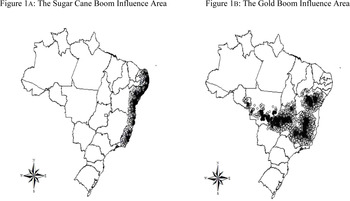
FIGURES 1A AND 1B

The Sugar Cane Boom
The initial phase of colonization took place mainly along the Northeastern coast and led to a boom in the sugar production that caused Brazil to become the main world producer of sugar by 1700.Footnote 8 Sugar cane was cultivated mainly along the stretch of land from the current state of Rio Grande do Norte down to the intermediary latitudes of the state of Bahia (“Recôncavo Bahiano”) shown in Figure 1A.Footnote 9
Following Roberto C. Simonsen, we identify the sugar boom as the period from the beginning of the effective colonization of Brazil by Portugal until 1760. This includes the height of production and profits during the “century of sugar,” from 1570 to 1670. From 1650 on the value exported started to fall and by the mid-eighteenth century, it was only 60 percent of the historical maximum.Footnote 10
The sugar economy was a plantation system built on three essential elements: “latifundio” (a large estate with a single owner), monoculture, and slave labor. Sugar cane brought the large rural estate and the patriarchal and slavery-based society to Brazil and the rest of colonial America.Footnote 11 Sugar mills displayed economies of scale; therefore, land was given to individuals who had enough funds to invest in the purchase of large numbers of African slaves.Footnote 12 In 1729 Governor Luís Vahia Monteiro wrote that, “The most solid properties in Brazil are slaves, and a man's wealth is measured by having more or fewer (…), for there are lands enough, but only he who has slaves can be master of them.”
Following closely the idea of an extractive occupation discussed by Engerman and Sokoloff, the sugar cane society was built on extreme social inequality, and very small economic and political elites with concentrated powers.Footnote 13 A typical sugar mill employed between 60 and 100 slaves. A particularly large one could have more than 200. In the eighteenth century, slaves represented more than half of the population in the Northeastern captaincies, and between 65 percent and 70 percent in the plantation areas. At the other extreme of the social pyramid, the senhores de engenho (literally, sugar mill lords, usually translated as “planters”) constituted the local landed aristocracy. They were invariably white and held a wide range of social, economic, and political powers.Footnote 14
The planter did not fully own the land and could not transmit it to heirs, yet possession of sugar mills and plantations and the position of senhor de engenho gave enormous social prestige. The planters lived opulently and had a great deal of local power but had little access to royal power. Another important factor was Portugal's focus on setting rules to ensure a constant flow of rents. In the State of Pernambuco in the seventeenth century, about 80 percent of government revenue came from various taxes on sugar production and trade, which was the only activity allowed in some areas during certain periods.Footnote 15
The polarization between landlord and slave and the dominance of the plantation system targeted at exports to Europe constituted the foundations of the social, economic, and political structures associated with sugar production. The colonial rule exacerbated the concentration of resources and the extractive nature of the sugar activity. Given the tendency towards persistence of institutions discussed in both the empirical and theoretical literatures, the effects of initial conditions may be present still today. The power of local elites can persist through the overruling of state power and de jure institutions by economic power and de facto institutions ran by the elites themselves. Landed aristocracies throughout Latin America were often a symbol of the political landscape created by the sugar cane society.
The Gold Boom
The gold mining expansion in the central part of Brazil was extremely intense and concentrated in time. In 1695 explorers made the first significant discoveries of gold in Sabará and Caeté, in the current state of Minas Gerais. Gold was also discovered in areas in the current states of Mato Grosso and Goiás after 1720 and 1726, respectively. Brazilian production peaked in 1760 and soon after started to decline, losing most of its relevance already by the end of the eighteenth century.Footnote 16
From 1700 to 1770 Brazilian gold production was roughly the same as the entire production of the rest of the Americas between 1492 and 1850, and corresponded to 50 percent of the production of the rest of the world between the sixteenth and eighteenth centuries.Footnote 17
The news of the discoveries generated a gold rush that led to an unprecedented occupation of the central part of the country. A quarter of a century after the initial discoveries, the Center-South region, which was mostly uninhabited previously, accounted for 50 percent of the colonial population.Footnote 18 The collapse of the mining economy was similarly fast. The main urban center of the region fell from 20,000 inhabitants in 1740 to just 7,000 in 1804. By then, gold production had already declined to only 12 percent of its peak value.Footnote 19
A series of regulations related to exploration of precious metals, movement of goods and people, and taxation were put in place to guarantee to Portugal an amount of rent deemed adequate.Footnote 20 To encourage exploration, individuals responsible for the discovery of new quarries had priority in the selection of a fraction of the relevant area. The remainder was allocated to other candidates through auctions and lotteries, with the size varying according to the number of slaves owned. After the initial allocation, miners were free to sell and trade their plots.Footnote 21
At least twelve distinct taxes were adopted at different moments in time, but two were the most common: the fifth (or quinto), which established that 20 percent of the gold produced belonged to the crown; and the capitation (or capitação), which charged a fixed fee per slave owned above age 12. To prevent tax evasion, individuals were not allowed to circulate gold in the form of powder. Processing of raw gold and its transformation into bars were used as a tool to enforce taxation, and therefore remained under tight control of the metropolis. For the most part gold bars could only circulate with the seal of the Portuguese Crown; that implied that the raw gold would have been melted in an official establishment (Casa de Fundição) and the requisite taxes would have been paid.
Nevertheless, despite great efforts from the metropolis, frauds were constant. As miners tried to evade taxes levied by the Portuguese Crown, the metropolis created more and increasingly oppressive devices to regulate and control production even further. The process evolved into an extremely antagonistic environment between state and civil society, illustrated by a series of anecdotal tales from colonial Brazil. The most celebrated independence movement before 1822 was the Inconfidência Mineira, a movement organized by the local elites in 1789 in the state of Minas Gerais, and planned to burst out on a day scheduled for tax collection. The movement was frustrated by the early warnings of a traitor who was rewarded with the cancellation of his debts to the crown. The efforts to smuggle gold out of the mining areas involved entire local communities. A figure that became entrenched in Brazilian popular culture is the “hollow saint” (santo do pau-oco, a hollow wooden image of a Catholic saint). “Hollow saints” were used by various religious orders to smuggle powder gold out of the colony. Because of their widespread use, in 1711 the Portuguese Crown forbade the entrance of priests without explicit authorization and the establishment of religious orders in the state of Minas Gerais.Footnote 22
The height of this tension materialized when the derrama, an additional tax raised when the aggregate amount of gold collected by the crown as one-fifth of total production did not reach a preestablished goal.Footnote 23 The derrama was raised from the entire population as a tax on virtually any type of activity—trade, ownership of business or slaves, or use of public roads—and also as a tax on wealth, based on more or less arbitrary assessments of personal assets. Tax collection when the derrama was actually installed, which might last for several months, made extensive use of the army and involved prisons, apprehension of personal assets and durable goods, and raids into private households.Footnote 24
The mining areas were peculiar in other ways. Despite the widespread use of slaves, society was not as polarized in gold areas as it was in the sugar cane areas. Technology and the scale of production implied a certain degree of horizontality in its social organization.Footnote 25 Celso Furtado noted: “(…) the mining economy in Brazil opened possibilities to people with limited resources, since exploration was not based on large and deep mines—as in the case of silver in Peru and Mexico—but on alluvium metal deposited in the bottom of rivers.”Footnote 26 Also, slaves enjoyed some degree of bargaining power because of informational advantages derived from the nature of the production technology. They could steal or hide whatever they found, and miners depended on their willingness to report discoveries for the enterprise to be profitable.Footnote 27 It became relatively common for slaves to buy their own freedom.Footnote 28
Hence, although mining also led to slavery and inequality, the social structure was less rigid and the distribution of endowments across the civil population was relatively more equal. In contrast, the availability of rents from gold coupled with the tremendous efforts of the Portuguese Crown to monitor every single step of production and trade of precious metals led to an overgrown, extremely focused and inefficient government apparatus. This apparatus was constructed entirely around the supervision and extraction of rent from one single activity: mining. The political science literature on the resource curse has repeatedly stressed the perverse effects that the possibility of rent extraction decoupled from productive activities and political representation may have. In the context of colonial Brazil, where the governing state (Portugal) was in fact formally detached from local population, these effects are likely to have been even stronger. As a consequence, the state in the gold mining regions did not function effectively in other areas and was involved in a constant struggle against civil society, leading ultimately to the development of a culture of detachment between population and state. Therefore, the implications of the gold boom are likely to be related to the effectiveness of government, the provision of public goods, and the relationship between local population and state power, which may have persisted despite being inefficient.
DATA AND EMPIRICAL ESTIMATION
The variables used to examine the impact of gold and sugar production booms are defined at the municipality level.Footnote 29 The 5,500 municipalities in Brazil are the smallest political and administrative units in the country. They have a homogeneous formal role but there are great differences in terms of administrative quality and public good provision. They have administrative autonomy, are governed by a mayor and a chamber of representatives, and are roughly equivalent to U.S. counties. Municipalities raise certain taxes, receive transfers from the federal government, and decide part of the expenditures on education, health, and infrastructure. So they have some administrative discretion but have little power to legislate and are subject to identical laws determined by centralized decisions at the country level. Finally, a municipality is a relatively small and well-defined area, so that geographic characterization is more precise. The definition, description, and sources of all the variables discussed below are presented in detail in the Appendix.
Historical Variables
We study the colonial determinants of current institutions based on the location and timing of the sugar cane and gold episodes and the distance to Portugal, which was an important determinant of the actual degree of intervention imposed by the metropolis. Municipalities involved in the gold boom are easily identified in historical accounts through the specific location of mines.Footnote 30 They were located in the states of Bahia, Goiás, Mato Grosso, Minas Gerais, and Rondônia, as represented by the darker points in Figure 1B. Municipalities involved in the sugar cane boom correspond to the coastal areas of the current states of Rio Grande do Norte, Paraíba, Pernambuco, Alagoas, Bahia and Espírito Santo, and to the region of Campos dos Goytacazes, in the state of Rio de Janeiro (darker points in Figure 1A).Footnote 31 The specific areas identified as sugar boom areas are those located less than 200 kilometers from the coast in one of the regions enumerated above and founded before the end of the sugar boom in 1760.Footnote 32
We construct two variables, gold and sugar with a value of one if a municipality was directly affected by the respective colonial resource boom. Sugar cane and gold production and processing were not entirely concentrated on these locations, and the political and social structures associated with the episodes most likely had a broader geographic influence. Therefore, in nearby districts within 200 kilometers the variables take a value of between 0 and 1 based on distance according to the functional form

where di is the distance from municipality i to the closest municipality directly involved in the respective resource boom. Municipalities beyond 200 kilometers are assigned a value of zero.Footnote 33
In addition to the indices of influence of the sugar cane and gold episodes, we use distance to Portugal (measure in 1,000 kilometers) to incorporate the active interference of the metropolis during the colonial period. To capture how Portugal's interference affected the intervention of the metropolis during the extractive episodes, we use the interaction terms between distance to Portugal and the sugar cane and gold influence functions (sugar × distance to Portugal and gold × distance to Portugal).
Institutional Variables
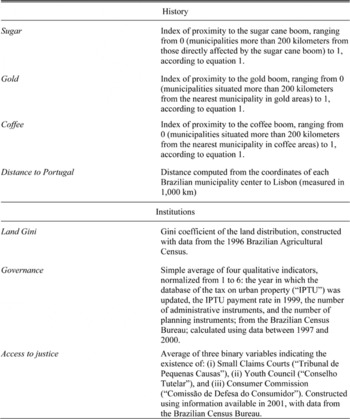
We examine the influence of the colonial booms on three modern indicators related to institutional quality and distribution of economic and political power. The first variable captures the concentration of land within municipalities. Acemoglu and Robinson point out that individuals may exert political power inside or outside political institutions.Footnote 34 Thus the concentration of economic resources in the hands of the elite acts as a source of de facto political power. Our measure of concentration is the Gini coefficient of the distribution of land in 1996 in the Brazilian Agricultural Census (land gini).
The second variable measures the quality of local administration. It captures the efficiency of the local executive in terms of administrative capacity, as reflected by its ability to provide public goods and its potential responsiveness to demands of the local population. We use an index of governance practices calculated by the Brazilian Census Bureau (IBGE) and used by the Ministry of Planning as a tool to monitor the administrative performance of municipalities. The index has various components representing different aspects of administrative capabilities at the municipality level, from efficiency in tax collection and information gathering to adoption of administrative and planning instruments.Footnote 35 It is constructed as the simple average of four qualitative indicators, normalized from 1 to 6: the year in which the database of the tax on urban property (“IPTU”) was updated, the IPTU payment rate, the number of administrative instruments,Footnote 36 and the number of planning instruments.Footnote 37 The index (governance) is calculated using data between 1997 and 2000. This variable comes close to a measure of the overall efficiency and organizational capability of the local administration. According to the literature discussed before, governments in the sugar and gold boom areas would be expected to be weaker precisely along these dimensions.Footnote 38
The third variable measures access to the justice system at the local level. There is no formal municipal judicial system in Brazil. Any court or justice commission in a municipality is either related to the local executive or to the state judicial system. Nevertheless, it is not clear why some municipalities provide different access to justice even if located in the same state and when certain types of courts are mandatory at the municipal level. In theory, mayors can be prosecuted if a mandatory court is not present in the municipality. For this reason, the existence of courts at the local level represents a de facto dimension of rule of law and of provision of access to justice. In order to capture this notion, we use an index based on the definition of access to justice proposed by the Brazilian Census Bureau.Footnote 39 The index (access to justice) varies from 0 to 3 according to the existence of courts or justice commissions. It is calculated with data from 2001, as the sum of three binary variables indicating the existence of Special Civil Tribunals (Juizados Especiais Cíveis), Youth Councils (Conselho Tutelar), and Consumer Commissions (Comissão de Defesa do Consumidor).Footnote 40
Empirical Estimation
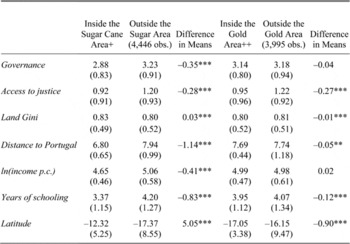
Our main goal is to analyze whether the historical episodes explain current variation in local institutions. The summary statistics in Table 1 offer comparisons of the boom areas with the rest of the country without controlling for other correlates. The sugar boom areas in 2000 had more unequal income distributions and lower quality measures of governance and access to justice. The differences in means between the sugar boom and other areas are all statistically significant. The sugar boom areas are also among the poorest in Brazil, with less educated populations. The gold boom areas generally fared better than the sugar areas relative to the rest of the country. The gold boom areas had similar shortfalls in access to justice in 2000 but had slightly more equal land Gini's and similar quality of governance to the rest of the country. The gap in schooling was not as large and there was no income gap.
DESCRIPTIVE STATISTICS: BRAZILIAN MUNICIPALITIES, 2000

+(39 obs. directly affected + 1,021 obs. indirectly affected)
++(354 obs. directly affected + 1,156 obs. indirectly affected)
* = Statistically significant at the 10 percent level.
** = Statistically significant at the 5 percent level.
*** = Statistically significant at the 1 percent level.
Notes:
Variables are index of quality of local administration (governance), indicator of the local presence of three types of courts (access to justice), Gini coefficient of the distribution of land (land Gini), distance to Portugal in 1,000 km, income per capita (ln), average years of schooling in the population aged 25 and above, and absolute value of the latitude. Municipality-level observations. Variables measured with data available between 1996 and 2000, unless otherwise noted. Areas affected by the sugar cane and gold booms defined in section, “Data and Empirical Estimation.”
Sources:
See the Appendix.
To examine the differences after controlling for other potential explanatory variables, we estimate the following equation
![\[
\begin{array}{c}
\[{Z_i} = \alpha + {\gamma ^S}{S_i} + {\gamma ^{SP}}{S_i}{P_i} + {\gamma ^G}{G_i} + {\gamma ^{GP}}{G_i}{P_i} + {\gamma ^P}{P_i} + \beta '{{\bf{X}}_i} + {\varepsilon _i}\]
\end{array}
\](https://static.cambridge.org/binary/version/id/urn:cambridge.org:id:binary:20151127043450921-0716:S0022050712000071_eqn2.gif?pub-status=live)
where i indicates municipality and Zi is the measure of governance, access to justice, land Gini, or the public good characteristic. Si is the sugar cane boom variable, Gi is the gold boom variable, Pi is distance to Portugal, Xi is a vector of geographic attributes (distance to equator, distance to coast, rainfall, sunshine, altitude, temperature, and soils, defined in the Appendix), and εi is an error term. Since municipalities in the same state can be correlated in a systematic way, standard errors in all regressions are clustered at the state level.
The vector of geographic attributes (Xi) plays an important role in our analysis. As discussed in the introduction, there is a significant correlation between institutional characteristics and geography. When compared to cross-country analyses, municipality-level data allow us to better control for the role of geographic characteristics because the geographic variation within a country is typically much larger than within a municipality.
The effect of the sugar cane episode on the institutional indicator is measured asγS + γSP P. For the governance and access to justice measures, we expect γS < 0, indicating that the sugar cane boom had a negative influence on current characteristics when the distance to Portugal is set to zero. We anticipate that the coefficient will be positive for the Gini measure. The parameter γSP captures how this effect varies with distance to Portugal. For example, when γS is negative and γSP is positive, it indicates that the sugar cane episode had a negative effect and that it became less negative for municipalities further from Portugal. Similarly, γG + γGP measures the effect of the gold boom.
COLONIAL EPISODES AND CURRENT INSTITUTIONS
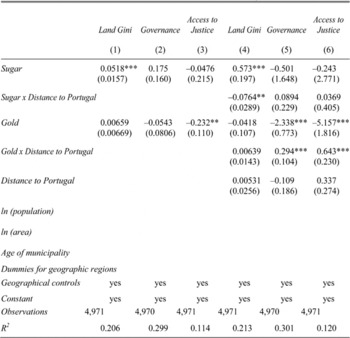
Table 2 presents the results on the long-term effects of colonial resource booms on land Gini, governance, and access to justice. In columns 1 through 3, no interaction terms are included for the distance to Portugal. The coefficient of −0.232 for the gold boom in column 3 implies that a municipality directly affected by the gold boom has an access to justice index that is 25 percent of a standard deviation below the index of a municipality not affected by the gold boom. Similarly, if a municipality is in a sugar boom area, the coefficient of 0.0518 on sugar implies that the concentration of land today is higher by 61 percent of a standard deviation.
In columns 4 to 6, the interaction terms between the resource booms and distance to Portugal imply that the estimated effects of the resource booms are strongly influenced by the extent of control Portugal exercised over the areas. When we evaluate the impact of the sugar boom on the land Gini at the mean distance from Portugal of 6.8 using the coefficients in column 4, the effect is 0.053 (0.573 − 0.076 * 6.8), which is essentially the same as the 0.052 coefficient with no interaction term in column 1. The relationship between the land Gini and the colonial sugar boom is strikingly different as the distance to Portugal changes. The effect for municipalities with a sugar boom that were one standard deviation closer to Portugal is nearly doubled in size 0.103 (0.573 − 0.076 * (6.8 − 0.65)); the effect for a municipality one standard deviation further away was virtually nil at 0.0038. Thus, it was the combination of Portugal's control and the administrative structure at the heart of the sugar areas that is driving the increased concentration of land in the modern era. Where sugar producers were not nearly so closely monitored by Portugal in the colonial period, the local producers were able to avoid structuring the institutions in the way Portugal wanted and thus the modern municipalities avoided the deleterious effects of those policies.
EFFECTS OF COLONIAL BOOMS ON INSTITUTIONAL DEVELOPMENT – OLS ESTIMATION: BRAZILIAN MUNICIPALITIES, 2000

* = Statistically significant at the 10 percent level.
** = Statistically significant at the 5 percent level.
*** = Statistically significant at the 1 percent level.
Notes:
Robust standard errors are clustered by state in parentheses. Dependent variables are index of quality of local administration (governance), indicator of the local presence of three types of courts (access to justice), and Gini coefficient of the distribution of land (land Gini). Independent variables are sugar cane boom influence index, gold boom influence index, distance to Portugal (in 1000 km), and interaction between the boom influence indices and distance to Portugal. Columns 7–9 also have population (ln), area in square km (ln), age (years since foundation), and dummies for geographic regions (S, SE, N, NE, and CW). All regressions include as additional independent variables (not shown): constant, absolute value of the latitude, distance from municipality center to the coast (in km), average water precipitation between 1931–1990 (100 millimeters per year), average sunshine during the day between 1931–1990 (100 hours per year), average altitude, average monthly temperatures in each of the 12 months of the year (degrees Celsius), and 12 dummies indicating the types of soil present in a 0.1 degree ray from the municipality's center. Municipality-level observations. Colonial resource booms variables described in section, “Data and Empirical Estimation.” Variables are measured with data available between 1996 and 2000, unless otherwise noted.
Sources:
See the Appendix.

Similar stories can be told about the impact of distance to Portugal on the relationship between the colonial gold boom and the quality of governance institutions and access to justice today. When we evaluate the impact of the colonial gold boom on quality of governance at the mean distance from Portugal of 7.69 using coefficients from column 5, the effect is −0.077 (−2.338 + 0.294 * 7.69), which is similar to the −0.0543 coefficient with no interaction term in column 2. The negative effect on governance quality for municipalities with a gold boom that were one standard deviation closer to Portugal is −0.2065 (−2.338 + .294 * (7.69 − 0.44)), while the effect for a municipality one standard deviation further away turns positive at 0.052.
In the access to justice equations, the effect of the colonial gold boom at the mean distance to Portugal is −0.212, which is similar to the −0.232 effect with no interaction term. When the gold boom municipality is one standard deviation closer to Portugal, the negative effect more than doubles to −0.495. The effect turns positive when the gold boom municipality was one standard deviation farther away.
Here again, the driving force that determined the size of the negative long-run effect of the gold boom on governance and justice institutions was strongly influenced by Portuguese control in the colonial period. Where the natives were less closely monitored, the long-run negative effects are much weaker.
Calculating the net effect of the colonial sugar boom for municipalities in the affected area, we find a positive impact on land concentration today in nearly 70 percent of the observations (with an effect of virtually zero for roughly 26 percent of the observations). The colonial gold boom led to a net negative effect on access to justice for more than half of the municipalities in the affected area, and to a net negative effect on governance for roughly half of the municipalities (in both cases, net effects are virtually zero for 40 percent or more of the municipalities in the affected areas).
The last three columns of Table 2 display the results of our main specification including various municipality characteristics as additional controls. Some of the municipalities affected by the resource booms are among the first colonial settlements of their respective areas, and have become important regional centers today. It may be the case that, because of congestion or returns to scale in the provision of public goods, institutional quality or concentration of land are affected by the size of the municipality. We therefore include two measures of size—population and area—as additional controls (ln(population) and ln(area)). It is also possible that older municipalities are intrinsically different and that this correlation is driving the results. Therefore, we also include as an additional control the age (in years) of municipalities. Also, we include controls for unobserved regional effects. The regional dummy variables are defined according to the official classification of Brazil into North, Northeast, Center-West, Southeast, and South.
The effect of the colonial resource booms and their interaction with distance to Portugal remain qualitatively similar for the case of land Gini and governance. For the case of access to justice, the coefficient remains negative, but loses statistical significance (column 9). The point estimates are consistent with the main results, but they are no longer precisely estimated.
EXTENSIONS
The Coffee Expansion: A Postcolonial Resource Boom
The coffee boom is often seen as the third main “commodity cycle” in Brazilian history. However, the coffee experience was very different from the sugar cane and gold booms. First, the coffee expansion took place at a much later stage (nineteenth century) and over an area previously occupied. Second, its expansion extended well after Brazilian independence.Footnote 41 And third, the organization of production followed more closely a spontaneous and entrepreneurial logic, and not an extractive one. Therefore, the coffee boom is not the same type of initial institutional shock as the sugar cane and gold episodes. Nonetheless, coffee became a major economic activity by the end of the nineteenth century and changed the economic and political landscape of the newly independent country, and coffee is closely associated with the industrialization process and the political changes brought by the republic in 1889.
In this section, we do not intend to fully examine the long-term consequences of the coffee boom in Brazil.Footnote 42 We simply try to account for the coffee influence in our regressions as a robustness check for our main results, and contrast the effects of this postcolonial activity with the effect of the colonial resource booms discussed before.
In the beginning of the coffee expansion—during the monarchic period (1822–1889)—the neighboring areas in the states of Rio de Janeiro and São Paulo along the Paraiba Valley were the main coffee producers. Until the mid-nineteenth century, São Paulo occupied a secondary position but became increasingly dominant from 1850 onwards.Footnote 43 In the early decades of the twentieth century, along with the expansion of railroads, São Paulo expanded production towards the west, where coffee flourished. All these coffee regions were initially either sugar cane or food crops producers. In particular, one of the reasons why the West portion of São Paulo did not grow coffee until the twentieth century is that it became an important sugar cane producing area at the end of the colonization period.Footnote 44
Unlike sugar, coffee could be grown along with other food crops, and so the initial entry costs were substantially lower. In fact, given the length of time that coffee trees took to produce berries, the existence of alternative sources of income was essential to the survival of the new crop.Footnote 45 Also, it was a spontaneous activity as opposed to an explicit endeavor of the Portuguese Crown.
The production of coffee until 1850 was an unusual slave-based multi-culture and relied on very poor technology. All growth in production came from expansions at the extensive margin.Footnote 46 Only labor scarcity due to the end of the Atlantic slave trade and rising coffee prices induced a higher concentration of production, leading to a monoculture with improved technology in the second half of the nineteenth century.Footnote 47 In 1888 Brazil abolished slavery and the labor force of European immigrants became increasingly prevalent in coffee fields, and coffee production expanded to the West of São Paulo following the expansion of railroads.
We build two measures of the coffee influence. The first identifies municipalities directly affected by the coffee boom as those founded up to 1886, which accounts for the main producing areas before the end of slavery and proclamation of the republic. These are the center and South portions of the state of Rio de Janeiro and the East areas of São Paulo according the coffee expansion map contained in Sérgio Milliet.Footnote 48 The second measure identifies the municipalities directly affected by the coffee boom up to 1935, including areas in the West of São Paulo state that became the most important coffee producers during the first half of the twentieth century. We define both coffee influence variables in the same way as we defined the influence area of the sugar and gold booms, according to the function in equation 1.
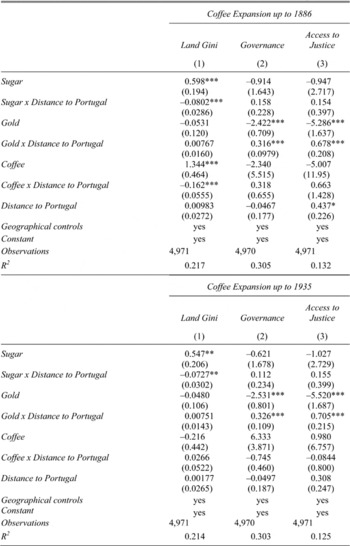
In columns 1–3 of Table 3, we show the main specification from Table 2 controlling for our first measure of the coffee influence area and its interaction with distance to Portugal. The early coffee boom experience seems to have very similar effects to the colonial sugar boom: it is associated with more land concentration, and this effect is aggravated for municipalities located closer to Portugal.Footnote 49 These results suggest that the coffee boom in the nineteenth century was somewhat similar to a colonial resource boom, which can be attributed to the fact that Brazil was recently independent and was still a slavery based society.
In columns 4–6 of Table 3, we use a broader measure of the coffee boom (up to 1935). Interestingly, this coffee boom measure and its interaction with distance to Portugal have no effect on any of the three measures of institutions. This definition of the coffee boom includes a period well after the colonization era ended, when no slave labor was used. This result suggests that the postcolonial resource boom had no negative impact on local institutions and the interaction with distance to Portugal plays no role.
It is also important to note that the sugar cane and gold results and the analysis of the effect of distance to Portugal from the previous section remain unchanged when both measures of the coffee influence variable are included in the regressions.
Public Good Provision as Institutional Development
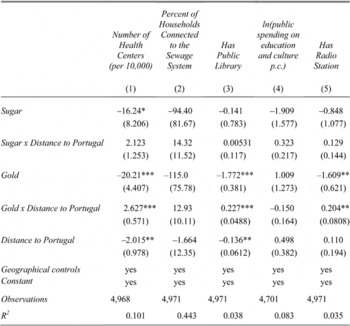
We now extend our analysis, considering the provision of public goods as indicators of overall institutional and political development, obtained from the 2000 National System of Urban Indicators, from the Brazilian Ministry of Cities. These are percentage of households connected to the public sewage system, number of health centers per 10,000 inhabitants, per capita public spending on education and culture (ln), whether the municipality has at least one public library, and whether the municipality has at least one local radio station.Footnote 50
ROBUSTNESS OF THE EFFECTS OF COLONIAL BOOMS ON INSTITUTIONAL DEVELOPMENT: THE COFFEE BOOM – BRAZILIAN MUNICIPALITIES, 2000

Notes:
* = Statistically significant at the 10 percent level.
** = Statistically significant at the 5 percent level.
*** = Statistically significant at the 1 percent level.
Notes:
Robust standard errors are clustered by state in parentheses. Dependent variables are the index of quality of local administration (governance), indicator of the local presence of three types of courts (access to justice), and Gini coefficient of the distribution of land (land Gini). Independent variables are the sugar cane boom influence index, gold boom influence index, coffee boom influence index, distance to Portugal (in 1,000 km), and interaction between the resource booms influence and distance to Portugal. Columns 1–3 coffee boom influence area is defined up to 1886, in columns 4–6 it is defined up to 1937 according to the map in Milliet, Roteiro do Café e Outros Ensaios. All regressions include as independent variables (not shown): constant, absolute value of latitude, distance to the coast (in km), average water precipitation between 1931–1990 (100 millimeters per year), average sunshine during the day between 1931–1990 (100 hours per year), average altitude, average monthly temperatures in the 12 months (degrees Celsius), and 12 dummies indicating the types of soil present in a 0.1 degree ray from the municipality's center. Municipality-level observations. Colonial resource booms variables described in section, “Data and Empirical Estimation” and coffee resource boom measures are described in section, “Coffee Boom.” Variables are measured with data available between 1996 and 2000, unless otherwise noted.
Sources:
See the Appendix.
We estimate the main specification from Table 2 for these five dimensions of public goods.Footnote 51 The results are presented in Table 4. The sugar cane episode is associated with lower number of health centers per 10,000 inhabitants. At the mean distance from Portugal, the effect of the sugar boom on the number of health centers is −1.8 (−16.24 + 2.123 * 6.8), which is a substantial effect considering that the average of this variable is 5.72. This result also varies substantially with distance to Portugal—one standard deviation closer to Portugal increases the effect to −3.18 (−16.24 + 2.123 * (6.8 − 0.65)).
The gold boom, on its turn, is associated with worse provision of different dimensions of public goods—health centers, public libraries and radio. At the average distance from Portugal, the estimated effects for health centers, libraries and radio are −0.01, −0.03, and −0.04, respectively. In all cases, a decrease in one standard deviation in the distance to Portugal also increases the effects substantially to −1.16, −0.12, and −0.13, respectively.
These results are suggestive that the deterioration in institutional quality, caused by the colonial episodes, is related to worse provision of public goods. In particular for the case of the gold boom, the results are consistent with the theoretical characterization of the rentier state as nonresponsive to public demands and detached from the local population.
EFFECTS OF COLONIAL RESOURCE BOOMS ON PUBLIC GOOD PROVISION – OLS ESTIMATION: BRAZILIAN MUNICIPALITIES, 2000

* = Statistically significant at the 10 percent level.
** = Statistically significant at the 5 percent level.
*** = Statistically significant at the 1 percent level.
Notes:
Robust standard errors are clustered by state in parentheses. Dependent variables are dummy variables for presence of radio station and public library, number of health centers per 10,000 inhabitants, percent of households connected to public sewage system, and ln of municipal spending on education and culture per capita. Independent variables are sugar cane boom influence index, gold boom influence index, distance to Portugal (in 1,000 km), and interaction between the resource boom influence indices and distance to Portugal. All regressions include as additional independent variables (not shown): constant, absolute value of latitude, distance from municipality center to coast (in km), average water precipitation between 1931–1990 (100 millimeters per year), average sunshine during the day between 1931–1990 (100 hours per year), average altitude, average monthly temperatures in each of the 12 months of the year (degrees Celsius), and 12 dummies indicating the types of soil present in a 0.1 degree ray from the municipality's center. Municipal-level observations. Colonial resource booms variables described in section, “Data and Empirical Estimation.” Variables are measured with data available between 1996 and 2000, unless otherwise noted.
Sources:
See the Appendix.
CONCLUDING REMARKS
This article investigates the long-run determinants of local institutions in Brazil. Current variation in local institutions is traced back to the colonial origins of municipalities. This approach enables us to control for a large set of geographic characteristics and to explore variation in local institutions within a constant de jure institutional setting.
Our strategy takes advantage of two features of our empirical environment. First, the most important extractive episodes in colonial Brazil (sugar cane and gold resource booms) can be seen as historical shocks to local institutional development. Both episodes were relatively well-defined in time and space and marked the initial occupation of important areas of the country. Second, the within country analysis allows the investigation of three different institutional and political characteristics of municipalities. Thus, we provide different pathways through which the influence of extractive episodes can be materialized.
We show that municipalities with origins tracing back to the sugar cane colonial episode display more inequality in the distribution of land, while municipalities with origins tracing back to the gold boom display worse governance practices and less access to justice. We also present suggestive evidence that a postcolonial resource boom—namely the coffee boom—follows the same pattern as the sugar boom shortly after the independence in the nineteenth century, but if we consider a longer postcolonial period it has no effect on local institutions today. The colonial extractive episodes are also correlated with lower provision of public goods. Our results indicate that a significant portion of the correlation between geography and development within Brazil seems to be related to the colonial history experienced by different areas of the country, and that colonial rule played an important role in determining the degree to which these negative effects are still present in the modern era.
Appendix
DESCRIPTION OF THE VARIABLES