Introduction
Traumatic brain injury (TBI) is a common neurological disorder that often has accompanying cognitive deficits. A plethora of research has focused on exploring the direct link between physiological changes to the brain and reduced neuropsychological test performance (e.g., Gale, Johnson, Bigler, & Blatter, Reference Gale, Johnson, Bigler and Blatter1995; Salmond, Chatfield, Menon, Pickard, & Sahakian, Reference Salmond, Chatfield, Menon, Pickard and Sahakian2005). The effect of motivation/effort and emotional/psychological attributes on test performance has also been investigated (e.g., Gass, Reference Gass1996; Ross, Putnam, Gass, Bailey, & Adams, Reference Ross, Putnam, Gass, Bailey and Adams2003; Sherman, Strauss, Slick, & Spellacy, Reference Sherman, Strauss, Slick and Spellacy2000). At present, however, additional factors, including the role of social context and environmental variables have been less examined. A contributing variable shown to affect cognitive test performance in various other populations is the impact of stereotyped beliefs [conceptualized as a set of widely shared positive or negative beliefs about the abilities of a group of individuals that mediate how one processes and interprets novel information (Hamilton & Trolier, Reference Hamilton and Trolier1986)]. “Stereotype threat” theory (Steele & Aronson, Reference Steele and Aronson1995), derived from social psychology, purports that in situations where a stereotype is relevant, targeted/stigmatized individuals face the threat of confirming or being judged by the negative stereotype, thus eliciting “performance pressure,” potentially interfering with test performance. To demonstrate that stigmatized individuals are negatively affected by stereotypes, researchers have used paradigms comparing test performance of a group exposed to stereotypic cues to a group receiving minimal exposure to stereotypic cues. For example, in African American stereotype threat research, individuals in one condition are informed an upcoming test is diagnostic of intelligence level (e.g., Brown & Day, Reference Brown and Day2006; Davis, Aronson, & Salinas, Reference Davis, Aronson and Salinas2006). In the other condition, the test, instead, is presented as a measure of perceptual ability, job-skill level, etc. Typically, African Americans perform better in the latter condition (e.g., Brown & Day, Reference Brown and Day2006; Davis et al., Reference Davis, Aronson and Salinas2006; Mayer & Hanges, Reference Mayer and Hanges2003), lending support to the idea that stereotypes have negative influences on presumably internal psychological states, as well as test performance. A wealth of similar research has focused its efforts on exploring the stereotype “women are poor at math”; the most common research paradigm involves informing females an upcoming math test is sensitive to gender differences, whereas participants in control groups are told of the lack of gender differences in mathematical performance (e.g., Ben-Zeev, Fein, & Inzlicht, Reference Ben-Zeev, Fein and Inzlicht2005; Brown & Pinel, Reference Brown and Pinel2003). Again, studies have demonstrated that the reduced threat group, in which stereotype cues are minimized, typically outperforms the heightened threat group.
Extending beyond the stereotype threat framework, a large body of literature encompassing various populations has verified that self-referent beliefs also impact test performance. For example, a branch of research indirectly exploring this idea has examined the effect of success or failure on subsequent test achievement. Individuals who are informed they are doing poorly on a particular task display diminished performance on subsequent tests (Douglas & Anisman, Reference Douglas and Anisman1975; Feather, Reference Feather1966; Matherly, Reference Matherly1986). Failure conditions are thought to induce a state of learned helplessness, whereby individuals believe they have little control over future outcomes (Maier & Seligman, Reference Maier and Seligman1976). Similar to this premise, Weiner (Reference Weiner1986) constructed attribution theory, asserting that negative outcomes are likely to occur in individuals making internal, stable, and global attributions for failure. Indeed, numerous empirical studies have demonstrated improved academic-task performance in conditions encouraging replacement of maladaptive self-referent beliefs (e.g., low ability) with more temporary/modifiable explanations (e.g., insufficient effort or inappropriate study strategies) (e.g., Brewin & Shapiro, Reference Brewin and Shapiro1985; Perry & Penner, Reference Perry and Penner1990; Wilson & Linville, Reference Wilson and Linville1985). Within the elderly population, several scholars have similarly focused their interventions on increasing memory self-efficacy and modifying beliefs about memory capacity, control, and stability. Compared to the control group, the intervention group showed increases in memory self-efficacy (Dellefield & McDougall, Reference Dellefield and McDougall1996), had greater feelings of control over their memory functioning (Dellefield & McDougall, Reference Dellefield and McDougall1996; Lachman, Weaver, Bandura, Elliott, & Lewkowicz, Reference Lachman, Weaver, Bandura, Elliott and Lewkowicz1992), and demonstrated improved memory performance (Dellefield & McDougall, Reference Dellefield and McDougall1996).
In sum, the literature pertaining to stereotype threat, attribution, and self-efficacy theories provides evidence that both stereotypes and individuals’ beliefs about their own abilities (including one's feeling of ability to exert control in a given situation) impact test performance. Certainly each of these constructs, independent of their impact on test performance, has been shown to be relevant to a TBI population. A plethora of research, for example, illustrates that society holds specific ideas regarding the cognitive effects resulting from a brain injury (e.g., Ferguson, Mittenberg, Barone, & Schneider, Reference Ferguson, Mittenberg, Barone and Schneider1999; Mittenberg, DiGuilio, Perrin, & Bass, Reference Mittenberg, DiGuilio, Perrin and Bass1992; Mulhern & McMillan, Reference Mulhern and McMillan2006). Empirical data also indicate that head-injured individuals exhibit a reduced sense of self-efficacy and hold an external locus of control (Kit, Mateer, & Graves, Reference Kit, Mateer and Graves2007; Moore & Stambrook, Reference Moore and Stambrook1995; Nochi, Reference Nochi1998). Furthermore, individuals with a TBI may underestimate the prevalence of cognitive problems pre-injury and reattribute benign/common cognitive symptoms to their head injury (Ferguson et al., Reference Ferguson, Mittenberg, Barone and Schneider1999; Mittenberg et al., Reference Mittenberg, DiGuilio, Perrin and Bass1992), suggesting they may have biased perceptions of their cognitive capabilities.
Despite the converging research data suggesting the underlying tenets of stereotype and attribution theories to be relevant to a TBI population, only a few studies have applied such ideas to this group of individuals and its impact on cognitive test performance. Suhr and Gunstad (Reference Suhr and Gunstad2002, Reference Suhr and Gunstad2005) found that when individuals with a mild TBI had attention called to their head injury and its potential effects on cognition, they performed worse on neuropsychological tests in comparison to a group who did not have attention called to their previous injury. The authors termed this phenomenon “diagnosis threat.” Pavawalla, Salazar, Cimino, Belanger, Vanderploeg, and Rodney (Reference Pavawalla, Salazar, Belanger, Vanderploeg and Rodney2013) demonstrated that male undergraduate students self-identified as “concussed” are particularly vulnerable to the diagnosis threat phenomenon. Ozen and Fernandes (Reference Ozen and Fernandes2011) further documented that undergraduate students with a history of concussive injury reported increased complaints of attention/memory difficulties under threat conditions. In each of these studies, control samples consisted of high-functioning undergraduate students who were unaware that study participation was related to previous head injury, thus potentially limiting overall generalizability. The current study builds upon these findings by examining the stereotype threat effect and the impact of self-referent beliefs in a clinical TBI population and investigates whether the role of social-contextual factors is relevant to this clinical population and generalizes to a “real-world” clinical testing environment. It was predicted that through reduction of negative stereotypes and enhancement of adaptive self-efficacy beliefs within a cognitive testing environment, via use of pre-test instructions (which manipulate stereotype activation and positive/negative beliefs for performance), neuropsychological test performance among head-injured individuals in the “reduced threat” condition would be higher than the “heightened threat” condition. It was also hypothesized that non–head-injured individuals would perform similarly between the two threat conditions. This study as well examined potential mediating mechanisms thought to be involved in the threat effect, including reduced self-efficacy (Chasteen, Bhattacharyya, Horhota, Tam, & Hasher Reference Chasteen, Bhattacharyya, Horhota, Tam and Hasher2005; Desrichard & Köpetz, Reference Desrichard and Köpetz2005; Spencer, Steele, & Quinn, Reference Spencer, Steele and Quinn1999), decreased motivation (Ployhart, Ziegert, & McFarland, Reference Ployhart, Ziegert and McFarland2003), heightened anxiety (Ployhart et al., Reference Ployhart, Ziegert and McFarland2003), and elevated feelings of dejection (Keller & Dauenheimer, Reference Keller and Dauenheimer2003; Marx & Stapel, Reference Marx and Stapel2006).
Method
Participants
The sample consisted of 42 individuals recruited from the Victoria, British Columbia community who sustained a TBI and 42 healthy control adults, ranging in age from 20 to 59. The TBI and control samples were each assigned to two groups (reduced and heightened threat conditions) with 21 participants in each group. Head-injured participants were restricted to those who sustained a mild-to-moderate TBI (i.e., 16 individuals with mild TBI and 5 with moderate TBI). Severity of injury was rated according to participants’ account of medical information and classified according to criteria by the American Congress of Rehabilitation Medicine and Lezak (Reference Lezak1995). Mild injuries were classified as Glasgow Coma Scale (GCS) scores 13–15, post-traumatic amnesia (PTA) less than 1 hr, and/or loss of consciousness (LOC) less than 30 min. Moderate injuries were classified as GCS scores 9–12, PTA greater than 1 hr but less than 24 hr, and/or LOC greater than 30 min but less than 6 hr. Participants with TBI were recruited through an Outpatient Neuro-Rehabilitation Unit at a local hospital in Victoria, BC, via a Psychology Clinic at the University of Victoria, through local brain injury societies, or through psychologists/physiotherapists in the Victoria region. Participants also included individuals who had previously partaken in TBI-related studies at the University of Victoria and expressed interest in future research projects. Exclusionary criteria included hearing/vision problems, significant sensory/motor dysfunction, or additional concomitant neurological conditions. An on-line newsgroup and flyers posted throughout the Victoria community served as the primary recruitment means for control subjects.
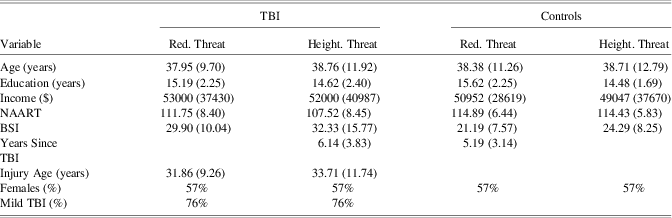
Study design consisted of a 2 (Type of injury: control, TBI) × 2 (Threat Condition: reduced threat, heightened threat) between-participants design. To reduce potential confounds, we used constrained randomization in that we matched control and TBI groups on gender and age. The control and TBI participants were then randomly assigned to reduced or heightened threat conditions. The groups did not differ in age, education, socioeconomic-status, age at injury, or length of time since injury (time post-injury was at least 6 months) based on separate two-tailed independent-sample t tests (p > .05) (see Table 1). Twenty-nine participants underwent rehabilitation (physiotherapy and/or occupational therapy), and 27 had some form of cognitive rehabilitation. These individuals were evenly dispersed across the two TBI groups (p > .05). The two head-injury groups did not differ in the number of individuals previously involved in litigation (26 individuals, evenly dispersed across the two groups) (p > .05) and no participants were currently involved in treatment or litigation related to their head injury. All data were obtained in compliance with regulations of the institutional review board of the University of Victoria, Victoria, BC.
Participant demographics

Note. Red. Threat = Reduced Threat Condition; Height. Threat = Heightened Threat Condition; Income = mean annual family income (measure of socioeconomic status); BSI = Brief Symptom Inventory (measure of depression/anxiety administered prior to experimental manipulation); NAART = North American Adult Reading Test (measure of pre-morbid intelligence).
Measures
The North American Adult Reading Test (NAART) (Blair & Spreen, Reference Blair and Spreen1989) was used to estimate pre-morbid intellectual ability [research demonstrates a high correlation between reading ability and intelligence (Crawford, Stewart, Cochrane, Parker, & Besson, Reference Crawford, Stewart, Cochrane, Parker and Besson1989)]. An overall IQ score was calculated based on the number of incorrectly pronounced words and equations outlined in Strauss, Sherman, and Spreen (Reference Strauss, Sherman and Spreen2006).
Verbal memory/learning was assessed using the Rey Auditory Learning Test–Alternate version (RAVLT; Rey, Reference Rey1964) and the Rivermead Behavioural Memory Test-Prose Recall. The RAVLT is known to be sensitive to memory deficits in TBI (e.g., Bigler, Rosa, Schultz, Hall, & Harris, Reference Bigler, Rosa, Schultz, Hall and Harris1989) and the Rivermead Behavioural Memory Test–Prose Recall (RBMT; Wilson, Cockburn, Baddeley, & Hiorns, Reference Wilson, Cockburn, Baddeley and Hiorns1989) has been used in prior stereotype threat research (Cole, Michailidou, & Jerome, Reference Cole, Michailidou and Jerome2006). Attention and working memory were assessed using Letter Number Sequencing (LNS-WAIS-III; Wechsler, Reference Wechsler1997) and the Auditory Consonant Trigrams test (ACT; Stuss, Stethem, & Pelchat, Reference Stuss, Stethem and Pelchat1988; Stuss, Stethem, & Poirier, Reference Stuss, Stethem and Poirier1987), both of which are sensitive to the sequelae of TBI (Donders, Tulsky, & Zhu, Reference Donders, Tulsky and Zhu2001; Stuss, Stethem, Hugenholtz, & Richard, Reference Stuss, Stethem, Hugenholtz and Richard1989). Suhr and Gunstad (Reference Suhr and Gunstad2005) also found a large difference in performance between stereotype threat conditions on the ACT test for head-injured individuals.
Self-reported depression/anxiety, used as a measure of baseline level of emotional functioning, was assessed using the Brief Symptom Inventory (BSI; Derogatis & Melisaratos, Reference Derogatis and Melisaratos1983). The BSI requires respondents to indicate their level of distress over the prior week on a 7-point scale. Higher scores indicate greater levels of depression/anxiety symptom severity. The somatic, cognitive, and behavioral manifestations of self-reported anxiety in response to the experimental manipulation were measured using the Beck Anxiety Inventory (BAI), which is comprised of 21 items and four response choices based on how the individual has felt over the past week. Dejection-related emotions (e.g., irritability, distress, frustration, sadness, disappointment) were assessed through use of the Positive Affect and Negative Affect Scale (PANAS; Watson, Clark, & Tellegen, Reference Watson, Clark and Tellegen1988). This questionnaire asks participants to rate their present experience of different emotions on a 5-point Likert-type scale.
A modified version of the Metamemory in Adulthood (MIA) questionnaire was used to provide a measure of self-perception of everyday memory functioning (Dixon & Hultsch, Reference Dixon and Hultsch1983). Studies have shown that the sub-scales of Capacity (measuring perceptions of memory abilities) and Change (measuring individuals’ perceptions of memory abilities as stable or subject to decline) can be used as a marker of memory self-efficacy (MSE; Hertzog & Dixon, Reference Hertzog and Dixon1994), which refers to individuals’ sense of mastery in the memory domain (Cavanaugh & Green, Reference Cavanaugh and Green1990). The modified version of the MIA has been used in a previous study to look specifically at metamemory within a head-injured population (Kit et al., Reference Kit, Mateer and Graves2007); an exploratory principal component analysis revealed the same groupings of items to those identified by Hultsch, Hertzog, Dixon, and Davidson (Reference Hultsch, Hertzog, Dixon and Davidson1988).
Self-perceived test-taking motivation was evaluated using a shortened version (six items) of the Motivation Scale of the Test Attitude Survey (TAS; Arvey, Strickland, Drauden, & Martin, Reference Arvey, Strickland, Drauden and Martin1990).
Procedure
Initial screening for inclusion/exclusion criteria was conducted over the telephone. Participants with TBI were told that the purpose of the study was to assess cognitive/emotional functioning in relation to TBI, and control participants were informed their test data would be used to determine differences between the two populations. During the telephone screening, individuals were administered the BSI and scheduled for individual testing. In-person testing consisted initially of the NAART, to assess pre-morbid intelligence. The reduced threat and heightened threat manipulations were modeled on prior stereotype threat research (e.g., Brown & Day, Reference Brown and Day2006; Davis et al., Reference Davis, Aronson and Salinas2006). The purpose of the reduced threat condition was to reduce negative stereotypes by indicating that traumatic brain injuries do not necessarily lead to cognitive deficits, and to suggest that individuals have some control over their cognitive test performance. An opposing view was presented in the heightened threat condition. After completing the NAART, participants read the experimental manipulation out-loud and were asked whether they understood the material and whether they had any questions (see Appendix 1).
Following exposure to either condition, participants were given the remaining previously mentioned questionnaires in the order of the BAI, TAS, PANAS, and MSE Scale of the MIA, and neuropsychological tests in the order of the RAVLT, ACT, LNS, RAVLT-Delayed Portion, and RBMT-Prose Recall. A manipulation check was conducted in that participants were asked through true–false questions to recall pre-test instructions. Data from nine participants who had difficulty recalling pre-test instructions were discarded (five head-injured and four non–head-injured). Finally, participants were debriefed and provided information about the true purpose of the experiment as well as educated on the effects of mild-to-moderate head injury on cognition.
Results
Preliminary Analyses
A multivariate analysis of variance (MANOVA) was conducted on background measures (age, years of education, socio-economic status, NAART scores, and Brief Symptom Inventory scores) to test for confounds associated with participant assignment to experimental conditions. The results of the MANOVA were marginally significant [Wilks’ Lambda F(15, 201.9) = 1.679; p = .057]. For this reason and because our interests were univariate in nature, follow-up analysis of variance (ANOVAs) were conducted. The TBI group endorsed a greater level of depression/anxiety as measured by the BSI [F(1,82) = 11.62; p < .01] and lower scores on the NAART [F(1,81) = 10.32; p < .01] as compared to the non-TBI group. Follow-up analyses were conducted using BSI and NAART scores as covariates in addition to analyses without their inclusion. No differences in outcomes were noted and thus only latter results are reported, so as to maintain a more parsimonious model. Before main analyses, dependent variables were examined for assumptions of normality. No distribution of scores deviated significantly from normality based on the Shapiro-Wilks test and the homogeneity of variance assumption was satisfied for all measures based on the Levene statistic. Parametric tests were thus carried out.
Data Reduction
Given the large number of dependent variables used in the study, composite variables with conceptually similar measures based on theoretical considerations and prior research were produced by creating and averaging Z-scores. A composite variable reflecting the construct of Attention was derived by combining the ACT and LNS tasks, both of which are stated to be a measure of working memory (e.g., Strauss et al., Reference Strauss, Sherman and Spreen2006), and which were also found to be significantly correlated (r = .46; p < .01). Similarly, Trial 1 of the RAVLT and the RBMT initial total score are thought to be conceptually similar (Ryan, Rosenberg, & Mittenberg, Reference Ryan, Rosenberg and Mittenberg1984), and a significant correlation was noted between them (r = .36; p < .01). They were thus combined into a composite variable termed Initial Encoding. A composite variable reflecting the construct of Delayed Recall was formulating by collapsing Trials 6, 7, and the Total score of the RAVLT, which are also thought to be conceptually similar (Vakil & Blachstein, Reference Vakil and Blachstein1993). They were additionally found to be highly correlated (Trial 6 and 7: r = .89; p < .01; Trial 6 and Total: r = .78; p < .01; Trial 7 and Total: r = .78; p < .01).
Main Analyses
The primary interest was the impact of the threat manipulation on neuropsychological test performance and emotional functioning. The influence of head-injury status and threat condition on the dependent variables was examined using General Linear Model-based ANOVAs with head-injury status (head-injured/non–head-injured) and threat condition (reduced threat/heightened threat) as between participant factors.
Performance on Neuropsychological Tests
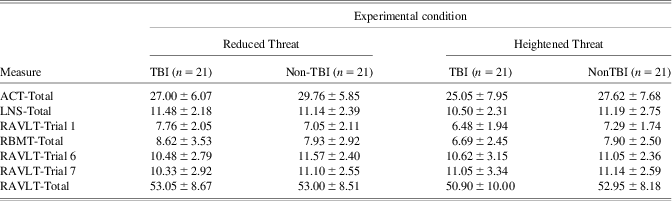
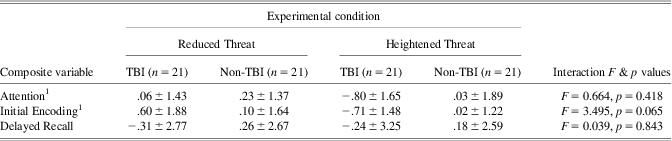
The main objective was to determine if experimental condition (heightened or reduced threat) influenced participants’ neuropsychological test scores (see Table 2). ANOVAs were performed on Initial Encoding, Attention, and Delayed Recall as dependent measures (see Table 3), using Type of injury (control, TBI) and Threat condition (reduced threat, heightened threat) as factors. No significant main effects or interactions were found. However, the analysis yielded a marginally significant interaction for the Initial Encoding variable, F(1,80) = 3.495; p = .065, ηp 2 = 0.042. Although the interaction was only marginally significant, we had a priori directional hypotheses and planned pair-wise comparisons were conducted. Simple effects were examined by t test, which showed that the head-injured reduced threat group outperformed the head-injured heightened threat group on the Initial Encoding variable, t(40) = 2.503, p = .016. No differences were noted across threat conditions for the control group, t(40) = .041, p > .967, consistent with the original hypotheses. Although a significant effect was not found for the interaction term for the Attention variable, [F(1,80) = 0.664, p = .42, ηp 2 = 0.008)], the head-injured reduced threat group trended toward outperforming the head-injured heightened threat group on the Attention variable, consistent with a priori hypotheses, t(40) = 1.801, p = .079. No differences were noted across threat conditions for the control group, t(40) = .0.556, p = .581. No significant effects were documented for the Delayed Recall variable; the TBI group performed similarly across threat conditions (t(40) = −.065; p = .949) as did the control group (t(40) = .228; p = .821).
Neuropsychological test results across groups and conditions

Note. Values represented are mean group scores (standard deviations in parentheses). ACT = Auditory Consonant Trigrams Test; LNS = Letter-Number Sequencing Test; RAVLT = Rey Auditory Verbal Learning Test; RBMT = Rivermead Behavioural Memory Test.
Neuropsychological test results for composite variables across groups and conditions

Note. The data provided in the table are the mean and standard deviations for each of the groups on the measures listed. Values are mean and standard deviation z-scores.
1 = TBI-RT > TBI-HT.
In addition to statistical significance, clinical significance was examined; clinically impaired performance, as defined by borderline scores on three or more of the abovementioned neuropsychological measures (i.e., whether task performance fell greater than 1.5 standard deviations below the mean, based on published norms for the task), consistent with the methodology used by Suhr and Gunstad (Reference Suhr and Gunstad2005), indicated that 43% of heightened threat head-injured participants and 14% of reduced threat head-injured participants exhibited impaired performance. Chi-squared analyses indicated that this represented a significant difference between groups (p < .05).
Emotional functioning, Perceptions of Stereotype Threat/Learned Helplessness and Stereotypes Surrounding TBI
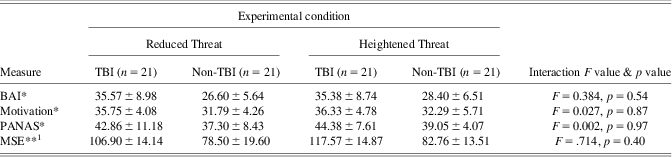
A secondary aim of the study was to determine whether measures of emotional functioning (anxiety, motivation, dejection-related emotions, and memory self-efficacy) varied in accordance with threat condition and head-injury status. The ANOVAs conducted yielded a significant head-injury status main effect, [F(1,79) = 23.11; p < .01; ηp 2 = .226] for the BAI, with the TBI group reporting a higher level of anxiety (M = 35.48; SD = 8.75) than the control group (M = 27.44; SD = 6.02). Significant effects were also found for the: (1) Motivation variable, [F(1,78) = 15.62; p < .001, ηp 2 = .167] with the head-injured group reporting a higher level of motivation (M = 36.05; SD = 4.40) than the control group (M = 31.83; SD = 5.15); (2) MSE construct, [F(1,80) = 87.66; p < .001, ηp 2 = .523] with the control group endorsing a greater degree of memory self-efficacy (M = 80.31; SD = 16.54; reverse-scored) than the TBI group (M = 112.24; SD = 15.31); and (3) the PANAS variable, [F(1,79) = 8.98; p < .01, ηp 2 = .102], with head-injured group reporting a greater degree of dejection (M = 43.62; SD = 9.48) than the control group (M = 38.20; SD = 6.51). No significant interactions were found (Table 4). Planned pair-wise contrasts, based on a priori hypotheses, indicated that the head-injured heightened threat condition endorsed lower memory self-efficacy than the head-injured reduced threat condition, t(40) = −2.38; p < .05. No other significant effects between the two threat conditions for the TBI or control groups were found.
Main and interaction effects across the two conditions for affective measures

Note. The data provided in the table are the mean and standard deviations for each of the groups on the measures listed. The Memory Self-Efficacy (MSE) variable is reverse-scored (and thus a higher value indicates a lower score of memory self-efficacy).
* = main effect (TBI>non-TBI); ** = main effect (TBI<non-TBI).
1 = TBI-RT > TBI-HT.
Mediational Analyses
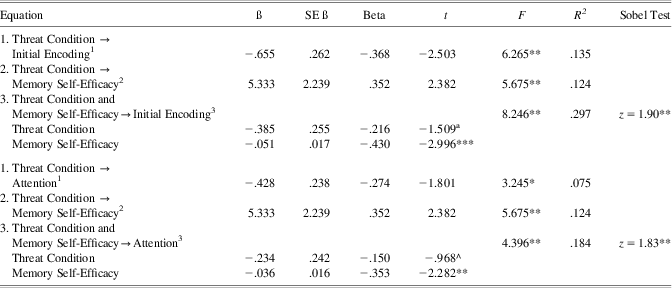
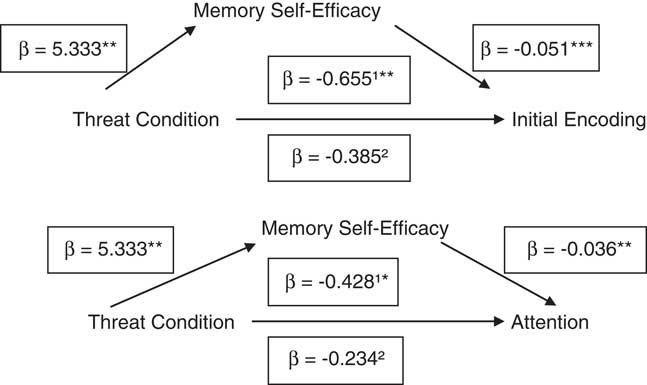
To examine mediation, three conditions, as proposed by Baron and Kenny (Reference Baron and Kenny1986), need to be present. First, a significant relationship must exist between the independent and dependent variables. Second, the independent variable must be significantly related to the mediator. Third, the mediator must affect the dependent variable when it is regressed on the independent variable and mediator. Mediation exists if the impact of the independent variable on the dependent variable is reduced after controlling for the mediator. The current statistical analyses were conducted in a regression format among the head-injured participants as it is only among these individuals that the threat phenomenon presumably operates. Based on the results previously mentioned, MSE was examined as a potential mediator between threat condition and Initial Encoding and Attention (see Table 5 and Figure 1). All three conditions outlined by Barry and Kenny (1986) were met, indicating that MSE fully mediated the relationship between threat condition and Initial Encoding. That is, the direct effect of threat condition on Initial Encoding while controlling for the effect of memory self-efficacy was not significant. Similar results were found for the Attention variable, although, as indicated previously, only a marginally significant relationship was documented between threat condition and the Attention construct. These findings were corroborated by a significant mediation effect as measured by the Sobel (Reference Sobel1982) test, which assesses the indirect effect of the independent variable on the dependent variable through the mediator.
Summary of regression results: mediating effects of Memory Self-Efficacy on the relationship between Threat condition for the TBI groups and Initial Encoding/Attention

Note.1df = 1,40; 2df = 1,40; 3df = 2,39; *p < .08, **p < .05, ***p < .01, a p = .139, ^p = .339.
Mediational analyses. 1 = ß value before the introduction of the mediator into the model. 2 = ß value after the introduction of the mediator into the model. *p < .08, ** p < .05, ***p < .01.

Discussion
The underlying premise and hypotheses driving the current study is that negative stereotypes, present within neuropsychological testing environments and in society at large, influence head-injured individuals’ beliefs about cognitive capabilities which, in turn, impact emotional status and neuropsychological test performance. Specifically, it was hypothesized that cognitive test performance and emotional status would be modified following experimental cueing of stereotypic cues and attribution-based beliefs. Indeed, nearly one-half of head-injured persons exposed to the heightened threat condition exhibited clinically impaired neuropsychological test performance as compared to approximately one-eighth of TBI individuals in the reduced threat condition. The strongest effect was found for the Initial Encoding composite variable, in which the TBI-heightened threat group obtained a significantly lower score as compared to the TBI-reduced threat group. A marginally significant effect was also demonstrated for the Attention composite variable. These findings are somewhat similar to those documented in other diagnosis threat research in non-clinical concussion populations in that significant effects were found on some, but not all, measures of cognitive functioning (Ozen & Fernandes, Reference Ozen and Fernandes2011; Suhr & Gunstad, Reference Suhr and Gunstad2002, Reference Suhr and Gunstad2005). Immediate recall measures, which comprised the Initial Encoding variable, and the ACT test, which partially comprised the Attention variable, may have been especially sensitive to the threat manipulation as success on such tasks is typically dependent upon some form or strategy of active encoding and retrieval. In comparison, less active/effortful processing is required for successful performance on the Delayed Recall composite variable (Trials 6, 7, and Total score of the RAVLT). It can be assumed that by the latter trials of the RAVLT the word list has been consolidated and success is less dependent upon active encoding strategies and effort. The above explanations are in accordance with theories postulated by researchers in learning/self-regulation literature. Seibt and Förster (Reference Seibt and Förster2004), for example, argue that negative stereotypes tend to invoke a more cautious style of responding whereas positive stereotypes induce an explorative processing style, characterized by a greater degree of perseverance in the face of obstacles. Following this line of reasoning, the reduced threat condition may have caused individuals to feel more likely to be successful on upcoming tasks, thus using more effort and strategy (although not necessarily consciously) to actively encode and retrieve the information.
No significant main effects were demonstrated between TBI and control groups on neuropsychological test scores. The nature of the sample may have contributed to the null effects. The current study focused on individuals who had sustained a mild-to-moderate TBI (with the large majority meeting criteria for mild TBI), which is known to have less marked cognitive repercussions (e.g., Reitan & Wolfson, Reference Reitan and Wolfson2000). In addition, this study was advertised as a research study examining cognitive functioning and several control participants may have be motivated to partake because they had specific cognitive concerns, and thus were not necessarily representative of a general population.
With regard to differences between TBI and non-TBI groups on affective functioning measures, the TBI group reported greater levels of anxiety and dejection-related emotions (e.g., distress, irritability, and frustration) under current testing conditions as compared to non-TBI groups, consistent with previous research literature noting heightened anxiety/dejection symptoms in individuals who have sustained a TBI (e.g., Anson & Ponsford, Reference Anson and Ponsford2006; O'Connor, Colantonio, & Polatajko, Reference O'Connor, Colantonio and Polatajko2005). Elevated symptoms of this nature may be related to the adjustment process that often occurs following TBI as well as physiological changes to the brain (Crowe, Reference Crowe2008), or may be possibly due to exposure to the testing environment itself. Results also revealed that TBI groups endorsed a greater level of motivation to perform well on neuropsychological tests. These findings can be interpreted to suggest that head-injured individuals, although eager to perform well on cognitive testing, may at the same time feel overwhelmed with the prospect of engaging in such tasks, leading to heightened feelings of anxiety/frustration and dejection. As well, current data demonstrate that the non-TBI group endorsed more positive feelings about their memory abilities. Furthermore, the reduced threat TBI group endorsed greater feelings of memory self-efficacy (i.e., had more positive perceptions regarding their memory abilities and believed their memory had changed to a lesser extent) in comparison to the heightened threat TBI group. Although consistent with one of the underlying tenets of the study, this is a potentially provocative finding given the simplistic nature of the experimental manipulation. The results suggest that beliefs about cognitive capabilities for TBI individuals can be altered, at least temporarily, through simple pre-test instructions. This is consistent with theorists’ claims that varying self-referent beliefs are activated by environmental cues (Cavanaugh, Reference Cavanaugh2000; Stewart-Williams, Reference Stewart-Williams2004) and are amenable to change (Mikulincer, Reference Mikulincer2001). Taking this a step further, mediational findings also indicate that neuropsychological test results for head-injured individuals are amenable to change due to subtle environment influences. In short, results suggest that reducing negative stereotyped beliefs and emphasizing the notion of personal control over cognitive functioning is associated with more positive beliefs about one's ability to use memory effectively, leading to enhanced neuropsychological test performance. Memory self-efficacy and internal locus of control have been previously documented as powerful determiners of affective functioning, gainful employment, and overall life satisfaction for head-injured individuals (Cicerone & Azulay, Reference Cicerone and Azulay2007; Kit et al., Reference Kit, Mateer and Graves2007; Lubusko, Moore, Stambrook, & Gill, Reference Lubusko, Moore, Stambrook and Gill1994; Moore, Stambrook, & Wilson, Reference Moore, Stambrook and Wilson1991), and it is thus relatively unsurprising that cognitive test performance is also seemingly impacted by individuals’ self-referent beliefs.
The present study, however, is slightly limited in its generalizability. Many of the TBI-participants were recruited through a pre-existing research participant pool and Outpatient Neuro-Rehabilitation Unit at a local hospital. As such, these particular individuals may have been particularly motivated to improve their cognitive skills and overly susceptible to the experimental manipulation. Additionally, the majority of participants had previously undergone neuropsychological testing and thus may have been differentially affected by the intervention. Moreover, individuals with TBI recruited for the current study were in the chronic stage post-injury, and effects for individuals in the acute stage post-TBI may differ. A further methodological limitation is that questionnaires/neuropsychological tests were administered in the identical sequence to all participants and the lack of counterbalancing creates difficulty in interpreting the found effects. In addition, it is difficult to disentangle the contribution of each component of the experimental manipulation (i.e., manipulation of stereotypic cues as well as self-efficacy beliefs), and ideally, stereotype threat and self-efficacy should have been manipulated separately.
Future research directions could include using objective measures of effort and additional neuropsychological tests so as to aid in further elucidating the stereotype threat phenomenon. Studies, as well, could focus on understanding stigmatized individuals’ views and appraisals of stereotype threat. Additional related potential lines of investigation include examining the concepts of learned helplessness and locus of control/attribution within the TBI population.
The results of this study raise awareness and suggest that social-contextual variables within a testing environment have an impact on head-injured individuals’ psychological state and neuropsychological test performance. This is the first study to examine stereotype threat and self-referent beliefs in a clinical TBI population, as well as to demonstrate its potential mediating mechanism. Based on the study's findings, it appears that individuals with a mild-to-moderate TBI may not be performing to their “organic ability level” on neuropsychological measures due to the threat effect, likely inherent to testing settings. As such, neuropsychologists and health care providers should consider an individual's knowledge/expectancies regarding the cognitive effects of TBI as well as emotional state, and attempt to factor this into interpretation of cognitive test scores. Furthermore, clinicians/researchers should consider exploring ways in which to maximize effort level and reduce stereotypic cues present within a clinical setting as head-injured individuals appear to be sensitive to explicit, as well as possibly implicit, messages present within a neuropsychological testing environment. When interacting with patients, clinicians should attempt to ward off self-defeating attitudes and minimize post-testing frustration/anxiety. Although this is rather intuitive in nature, this study is one of the first to empirically demonstrate the importance and relevance of such notions to the testing environment in a clinical TBI population.
Acknowledgements
This research was supported by a doctoral fellowship by the Social Sciences and Humanities Research Council of Canada. The authors have no conflict of interest affecting this manuscript.
Appendix 1
Reduced Threat Condition
Research has shown that individuals who have had a traumatic brain injury (head injury) usually recover fully after a period of time and perform just as well as individuals who have not had a traumatic brain injury on attention/memory tests. Research has also shown that memory and attention abilities are under the personal control of the individual. In other words, memory and attention abilities can improve with effort. The goal of the present study is to confirm the above findings. As such, you will be given several attention and memory tests.
Heightened Threat Condition
Research has shown that individuals who have had a traumatic brain injury (head injury) do not perform as well as individuals who have not had a traumatic brain injury on tests of memory and attention, even after a period of time. Research has also shown that memory and attention abilities are not under the personal control of the individual. In other words, memory and attention abilities are permanently affected, as a result of a head injury, and cannot improve with effort. The goal of the present study is to confirm the above findings. As such, you will be given several attention and memory tests.