

What if we could make people healthier, wealthier, and happier, at a relatively low cost, and without infringing on their freedom? In the past decade or so, psychologically informed policies, and especially ‘nudges’, have been trying to do just that (Thaler & Sunstein, Reference Thaler and Sunstein2008). Insights from psychology and behavioral economics have shifted the way policy-makers approach social issues such as health, wealth, nutrition, education, voter turnout, judicial decision-making, and environmentally sustainable behavior, to name just a few (Benartzi & Thaler, Reference Benartzi and Thaler1999; Johnson & Goldstein, Reference Johnson and Goldstein2003; Wansink, Reference Wansink2006; Goldstein et al., Reference Goldstein, Cialdini and Griskevicius2008; Nickerson & Rogers, Reference Nickerson and Rogers2010; Bryan et al., Reference Bryan, Walton, Rogers and Dweck2011; Danziger et al., Reference Danziger, Levav and Avnaim-Pesso2011; Dayan & Bar-Hillel, Reference Dayan and Bar-Hillel2011; Milkman et al., Reference Milkman, Beshears, Choi, Laibson and Madrian2011; Rozin et al., Reference Rozin, Scott, Dingley, Urbanek, Jiang and Kaltenbach2011; Walton & Cohen, Reference Walton and Cohen2011; Davidai et al., Reference Davidai, Gilovich and Ross2012; Allcott & Rogers, Reference Allcott and Rogers2014; Thorndike et al., Reference Thorndike, Riis, Sonnenberg and Levy2014). The evidence suggests that this shift toward behavioral policies has been quite effective. A recent comprehensive analysis has found the impact-to-cost ratio of various nudges (e.g., default vaccination appointments) to be significantly higher than the impact-to-cost ratio of more traditional policies (e.g., monetary incentives for vaccinations; Benartzi et al., Reference Benartzi, Beshears, Milkman, Sunstein, Thaler, Shankar, Tucker-Ray, Congdon and Galing2017). For example, nudging people to conserve energy by activating social norms resulted in almost twice the reduction in kWh for every $1 spent compared to a traditional educational campaign around energy-efficient consumption. Similarly, retirement saving rates more than double when employees are enrolled into a savings program that automatically escalates their contribution with every salary raise (Thaler & Benartzi, Reference Thaler and Benartzi2004). Impressive results of this kind have gained psychologists a seat at a table traditionally reserved for economists and policy advisors, as exemplified by President Barack Obama's executive order to “realize the benefits of behavioral insights and deliver better results at a lower cost for the American people” (Office of the Press Secretary, 2015).
Yet not all is quiet on the ‘nudge’ front. Policy-makers “are inevitably responsive to what people think” (Reisch & Sunstein, Reference Reisch and Sunstein2016, p. 311), and whether a potential nudge becomes reality hinges not only on its expected benefit to society, but also on its ability to garner public and legislator support. Unpopular nudges can backfire, leading people to react against what are seen as illicit attempts to shape their behavior (Arad & Rubinstein, Reference Arad and Rubinstein2018; Damgaard & Gravert, Reference Damgaard and Gravert2017; Jachimowicz et al., Reference Jachimowicz, Duncan, Weber and Johnson2018), undermine their autonomy (Dunt, Reference Dunt2014; Shaw, Reference Shaw2017), and compromise their dignity “in the way one indulges a child” (Waldron, Reference Waldron2014). Worse still, negative reactions toward specific ‘nudges’ can lead people to question the entire practice of using behavioral research in policy (Tannenbaum et al., Reference Tannenbaum, Fox and Rogers2017). For nudges to be implemented, it is imperative that they not encounter strong public resistance.
How, then, do people feel about nudges? Although highly cost-effective interventions often target automatic, non-deliberative (‘System 1’) decision processes, people are generally more suspicious of these than they are of ones that target deliberate and conscious (‘System 2’) decision processes.Footnote 1 Motivated by a concern for their autonomy and freedom of choice, people prefer policies that target processes of which they are fully aware (e.g., educational and public awareness campaigns, financial literacy programs, etc.) over those that target passive or peripheral processes that often go unnoticed or unappreciated (e.g., automatic enrollment, default options, emotionally vivid graphics, etc.; Jung & Mellers, Reference Jung and Mellers2016; Reisch & Sunstein, Reference Reisch and Sunstein2016; Sunstein, Reference Sunstein2016b). In this vein, it has been argued that people prefer policies that provide information about the best course of action (e.g., nutritional value of food options) over those (like the design of menus or cafeterias) that ‘nudge’ people into taking the healthier options (Felsen et al., Reference Felsen, Castelo and Reiner2013; Arad & Rubinstein, Reference Arad and Rubinstein2018).
Clearly, people are not categorically opposed to nudges, and some nudges are quite popular. Whereas people prefer policies that target deliberative processes over nudges, Sunstein (Reference Sunstein2016b) reports that, given the option, many people support policies that target both deliberative and non-deliberative processes over ones that are exclusively ‘System 2’.Footnote 2
Because public opinion can shape policy-makers’ decisions, it is important to understand whether surveys of public opinion indeed reflect the public's views. Do people really have deep-rooted preferences for deliberative policies over non-deliberative nudges, or are their preferences malleable, mostly a function of how people are surveyed? Are we giving nudges ‘a fair shot’?
In this paper, we argue that attitudes toward nudges are not as stable, nor as negative, as often portrayed. We suggest that previous research has inadvertently exaggerated the preference for deliberate policy interventions over ones that target non-deliberative processes (e.g., Jung & Mellers, Reference Jung and Mellers2016; Sunstein, Reference Sunstein2016b). Following a long tradition in judgment and decision-making research, we argue that the apparent preference for deliberative, ‘System 2’ policies may be largely an artifact of the way options have been evaluated. In particular, we argue that the direct contrast between the two types of intervention renders prominent the defining difference between deliberative and non-deliberative policies in ways that independent evaluation fails to do (Hsee et al., Reference Hsee, Loewenstein, Blount and Bazerman1999).
An extensive body of research has shown that different mental processes are often engaged when two options are simultaneously presented and can be directly compared (i.e., joint evaluation) as opposed to when options are presented separately, each evaluated in isolation (i.e., separate evaluation; Bazerman et al., Reference Bazerman, Moore, Tenbrunsel, Wade-Benzoni and Blount1999; Hsee et al., Reference Hsee, Loewenstein, Blount and Bazerman1999). Sometimes, when numeric values are hard to gauge, joint evaluation facilitates comparison (Hsee, Reference Hsee1996, Reference Hsee1998). In other cases, a qualitative dimension, which plays a minor role in separate evaluation, becomes more salient in direct comparison.
In one study, for example, Kahneman and Ritov (Reference Kahneman and Ritov1994) presented people with two proposed interventions, one concerning human health checkups and the other concerning the protection of an endangered animal species. When the interventions were evaluated separately, respondents expressed a willingness to pay more for the protection of the endangered animals than for people's medical checkups. But when faced with a direct choice between the two, most respondents favored free checkups for humans over protection for animals. As it turns out, the ‘humans come before (non-human) animals’ consideration played a critical role in direct comparison, but had much less force in separate evaluation.
Interestingly, while the ‘humans first’ argument comes naturally to mind when contributions to humans and contributions to other animals are jointly evaluated, it is not clear that it captures people's ‘true sentiments’. After all, substantial amounts of money are donated each year to many animal protection causes, with US$3 billion spent by animal shelters, US$1.7 billion spent on the Endangered Species Act, and over US$60 billion spent on pets in the USA alone. When people contemplate costly interventions in the absence of a direct human–animal contrast (as in the studies above), some human-related causes lose their priority over those concerning the protection of animals (see also Irwin et al., Reference Irwin, Slovic, Lichtenstein and McClelland1993; Kahneman et al., Reference Kahneman, Ritov and Schkade1999).
Similar to the pattern above, we argue that when people directly compare between deliberative and non-deliberative interventions, they are overly influenced by the contrast made salient by this comparison, which can become rather minor and largely inconsequential in separate evaluation, when policies’ actual merits loom larger. In what follows, we argue that joint evaluation highlights concerns about deliberation, freedom of choice, and paternalism and, as a consequence, reduces support for non-deliberative nudges (Mellers & Jung, Reference Jung and Mellers2016). Those same concerns, however, become rather negligible in people's minds when evaluating each policy based on its own merit. ‘Libertarian paternalistic’ nudges (Thaler & Sunstein, Reference Thaler and Sunstein2008), in other words, appear significantly less libertarian and more paternalistic in joint evaluation. A nudge that seems paternalistic in joint evaluation may not seem so when evaluated in isolation.
Studies 1A and 1B: how do people really feel about nudges?
Method
Participants
We recruited participants from Amazon's Mechanical Turk in exchange for a modest payment. As part of two longer experimental sessions, 113 people participated in Study 1A (70 females, Mage = 36.06) and 130 participated in Study 1B (62 females, Mage = 35.42).
Manipulation and dependent variables
We conducted two studies, adapting materials from Jung and Mellers (Reference Jung and Mellers2016), to examine whether the mode of evaluation (joint vs. separate evaluation) influences people's preference for policies that target deliberative (‘System 2’) over non-deliberative (‘System 1’) processes. In Study 1A, we asked participants whether they would support a new policy designed to increase enrollment in a basic medical insurance plan. We varied whether the policy involved automatic (non-deliberative, ‘System 1’ nudge) employee enrollment or an educational (deliberative, ‘System 2’) campaign about the plan's benefits:
Suppose that when you start a new job at a company, the government requires the company to [select a default policy that makes it easier to enroll in a basic medical plan. You have other options, but you need to select different options to implement them. The plan will help you enjoy the benefits of good health over the long term.] / [provide information that makes it easier to understand the benefits of enrolling in a basic medical plan. The information encourages you to enroll by explaining why the plan is designed to help you enjoy the benefits of good health over the long term.]
In Study 1B, we asked participants whether they would support a new policy designed to encourage timely payments of credit card bills. We varied whether the policy involved a full-balance payment as the default, non-deliberative (‘System 1’) option or, instead, provided information to customers explaining the benefits of making such deliberative (‘System 2’) payments:
Suppose that when you pay your credit card bills online, the government requires the credit card company to [set a default payment option that makes it easy to pay the bill in full. You can pay other amounts, but you need to specify those by selecting different options. The default policy is designed to help you enjoy the benefits of no interest fees and the advantages of excellent credit scores.] / [provide information that makes it easy to understand the benefits of paying the total amount due. The information encourages you to pay the entire bill by telling you that full payment helps you enjoy the benefits of no interest fees and the advantages of excellent credit scores.]
In each study, we randomly assigned participants to one of three conditions: two in which they evaluated either (and only) one of the policy options (separate evaluation conditions); and one in which they evaluated the two policies jointly (joint evaluation condition). Participants indicated their support for each policy on a scale ranging from –3 (certainly no) to +3 (certainly yes), with the midpoint (0) indicating a neutral attitude toward the policy.
Results
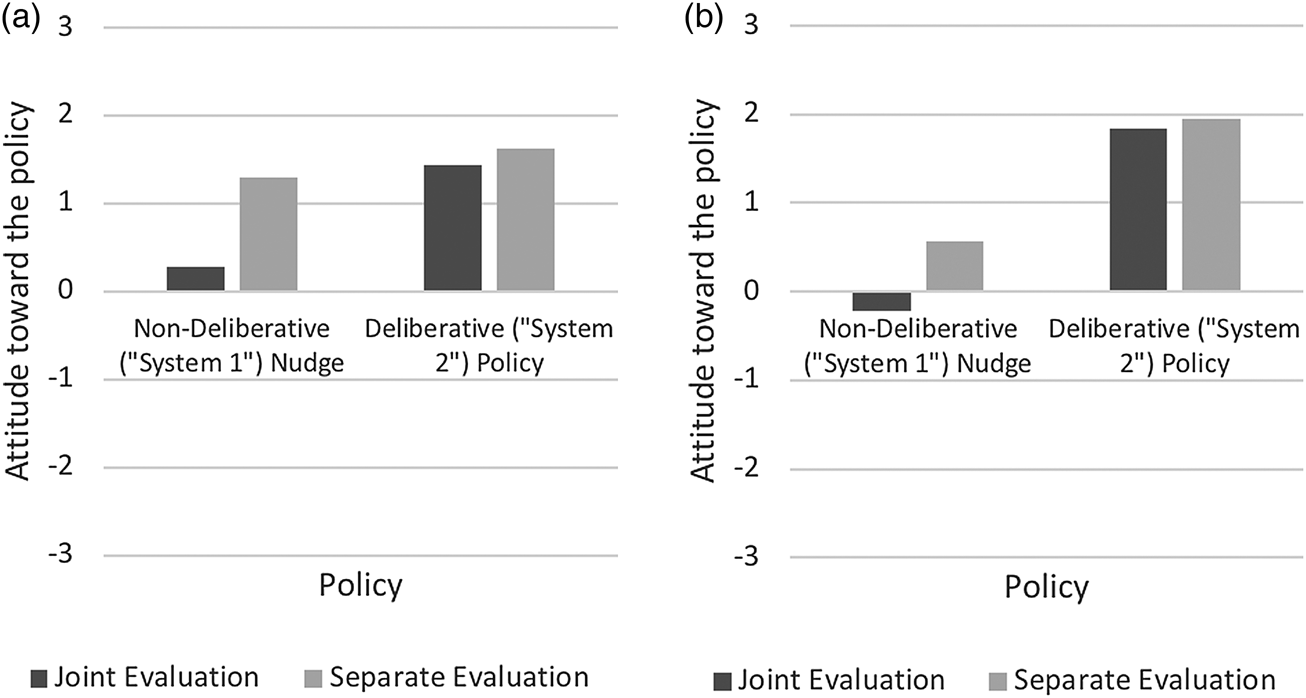
We first report the results from the joint evaluation conditions. In a direct replication of Jung and Mellers (Reference Jung and Mellers2016), we found that participants preferred policies that targeted deliberative (‘System 2’) processes over those that targeted non-deliberative (‘System 1’) processes. Participants in Study 1A were significantly more supportive of a policy that educates about the benefits of a medical plan (M = 1.44, SD = 1.63) than a policy that automatically enrolls employees into such a plan (M = 0.28, SD = 1.77), matched pairs t(53) = 3.29, p = 0.002. Participants in Study 1B were significantly more supportive of a policy that informs people of the benefits of paying their credit card bill in full (M = 1.84, SD = 1.50) than a policy that sets full-balance payments as the default (M = –0.22, SD = 2.01), matched pairs t(36) = 5.15, p < 0.0001. Replicating past findings, we found that a direct comparison of the options led participants to express significantly greater support for deliberative policies over non-deliberative nudges.
Now, what about separate evaluation? Were participants’ attitudes influenced by the mode of evaluation? As can be seen in Figures 1A and 1B, we observed a clear shift. Participants in Study 1A clearly preferred the deliberative option in joint evaluation, but they were no more likely to support it (M = 1.62, SD = 1.13) over the non-deliberative nudge (M = 1.30, SD = 1.45) when these were evaluated separately, t(57) < 1, ns. The difference in support of the two policies in joint and separate evaluation was significant, t(112) = 5.55, p < 0.0001.Footnote 3 A similar but less pronounced pattern was observed in Study 1B. While separate evaluation in Study 1B still showed a preference for the deliberative policy option (M‘System 2’ policy = 1.95, SD = 1.19; M‘System 1’ nudge = 0.56, SD = 1.99), t(91) = 4.01, p = 0.0001, this preference was significantly attenuated relative to the joint evaluation condition, t(129) = 4.78, p < 0.0001.
Participants’ support for ‘System 1’ and ‘System 2’ policies in joint and separate evaluation for policies involving basic medical coverage (A) and credit card bills (B).

What accounts for participants’ changes in preference? A closer look at the data reveals that in both studies, the mode of evaluation (joint vs. separate) diminished participants’ support for the non-deliberative, ‘System 1’ option, but had no impact on the deliberative, ‘System 2’ alternative. In Study 1A, participants judged the (deliberative) education policy to be equally favorable both in joint (M = 1.44) and separate (M = 1.62) evaluation, t(78) < 0.5, ns. In contrast, they were significantly more supportive of the non-deliberative automatic enrollment of employees in the separate (M = 1.30) than the joint (M = 0.28) evaluation, t(85) = 2.80, p = 0.006. Similarly, participants judged the deliberative policy in Study 1B equally favorably in joint (M = 1.84) and in separate (M = 1.95) evaluation, t(78) < 0.5, ns, but were marginally (albeit not statistically significantly) more supportive of the non-deliberative nudge in the separate (M = 0.56) rather than the joint (M = –0.22) evaluation, t(85) = 1.78, p = 0.078. Whereas the appeal of deliberative policies was unaltered, support for non-deliberative policy options diminished once the deliberative contrast between them was made salient.
Study 2: can nudges garner majority support?
We found that participants’ attitudes towards non-deliberative policies were affected by the mode of evaluation. Whereas deliberative policies were preferred over non-deliberative nudges in joint evaluation, this preference was lost or significantly attenuated in separate evaluation. Non-deliberative, ‘System 1’ nudges that were judged quite appealing when evaluated on their own merits lost some of that appeal when in direct comparison with seemingly ‘less manipulative’ policies targeting deliberative processes. In Study 2, instead of rating their attitude, we asked participants to indicate support or opposition to the policies.
Method
Participants
Three hundred participants from Amazon's Mechanical Turk took part in the study (230 females, Mage = 35.05).
Manipulation and dependent variables
Participants read a short paragraph describing a new policy designed to encourage people to save more toward retirement (see Jung & Mellers, Reference Jung and Mellers2016). We varied whether the policy involved a requirement to automatically enroll employees into a basic retirement savings plan (non-deliberative nudge) or a requirement to inform employees of the benefits of enrolling in such a plan (traditional deliberative policy):
Suppose that when you start a new job at a company, the government requires the company to [select a default policy that makes it easy to enroll in a basic retirement savings plan. You have other options, but you need to select those to indicate a different set of preferences. The default policy of basic retirement savings is designed to help you enjoy a comfortable lifestyle and feelings of financial security when you stop working.] / [provide information that makes it easy to understand the benefits of enrolling in a basic retirement savings plan. The information encourages you to enroll in the basic savings plan by telling you that the plan is designed to help you enjoy a comfortable lifestyle and feelings of financial security when you stop working.]
Participants were randomly assigned to one of three conditions: two conditions in which they evaluated either (and only) one of the two policies (separate evaluation conditions); and one in which they evaluated both policies at the same time (joint evaluation condition). Participants were asked whether they supported, opposed, or had no opinion about the policies.
Results
As in Studies 1A and 1B, we found that the mode of evaluation (joint vs. separate) significantly influenced policy support. In the joint evaluation condition, 89% of participants supported the deliberative (‘System 2’) policy informing employees of the benefits of enrolling in a retirement savings plan, whereas only 43% supported the non-deliberative (‘System 1’) nudge automatically enrolling employees in such a plan, χ 2(1) = 47.46, p < 0.0001. This difference, however, was significantly attenuated in the separate evaluation conditions, where 74% of participants supported the deliberative policy and 61% supported the non-deliberative nudge, χ 2(1) = 3.98, p = 0.046. As before, participants were significantly more supportive of the nudge when evaluating it based on its own merits than when comparing it to the seemingly ‘less intrusive’ alternative. Whereas support for the non-deliberative option increased from 43% in joint evaluation to 61% in separate evaluation, χ 2(1) = 6.22, p = 0.013, support for the deliberative policy actually diminished from 89% in the joint evaluation to 74% in the separate evaluation condition, χ 2(1) = 7.21, p = 0.007.
It is notable that both types of policy garnered majority support in all but one case. The majority of participants supported the deliberative policy both in joint and in separate evaluation, χ 2s > 25.00, ps < 0.0001, and supported the non-deliberative nudge in the separate evaluation condition, χ 2(1) = 4.88, p = 0.027. Only in the joint evaluation condition, when compared to the deliberative alternative, did the non-deliberative nudge fail to garner majority support, χ 2(1) = 1.75, ns. The same nudge that garnered majority support when evaluated on its own would have failed to do so in joint evaluation.
Study 3: are nudges paternalistic?
When people evaluate policies separately, their preference for deliberative policies over non-deliberative nudges is significantly attenuated, if not fully eliminated. In joint evaluation, in contrast, the deliberative versus non-deliberative nature of policies outweighs their independent merit and renders non-deliberative nudges less appealing. In the present study, we look a bit deeper into the potential causes of this shift. Specifically, we examine whether the salient tension between policies’ deliberative versus non-deliberative nature leads participants to perceive nudges as more paternalistic in joint than in separate evaluation. Because concerns about paternalism underlie people's opposition to nudges (Jung & Mellers, Reference Jung and Mellers2016) and because the non-deliberative nature of nudges looms larger in direct comparison to deliberative alternatives, we hypothesized that nudges will be perceived as more paternalistic and more restrictive of people's autonomy when directly compared to more deliberative policies than when evaluated in isolation.
Method
Participants
One hundred and twenty-three participants from Amazon's Mechanical Turk took part in the study (68 females, Mage = 40.48).
Manipulation and dependent variables
Participants read the same short paragraph as in Study 2, describing a new policy designed to encourage people to save more toward retirement. We varied whether the policy involved automatic enrollment into a basic retirement savings plan (non-deliberative nudge) or information about the benefits of enrolling in such a plan (traditional deliberative policy). Participants were randomly assigned to one of three conditions: two in which they evaluated either (and only) one of the policies (separate evaluation conditions); and one in which they evaluated both policies jointly (joint evaluation condition).
Next, participants read a short paragraph describing the difference between libertarian and paternalistic policies:
Initiatives differ in how paternalistic or libertarian they seem. On one end of the spectrum are extremely paternalistic initiatives which completely restrict people's ability to decide for themselves and restrict their freedom of choice. For example, drivers are often required by law to drive below a specified speed limit and don't have a choice of whether they want to do so or not. On the other end of the spectrum are extremely libertarian initiatives which maximize people's freedom and autonomy. Some countries, for example, don't have speed limits and drivers can freely choose how fast they wish to drive.
Participants then indicated the extent to which they deemed the proposed policy paternalistic versus libertarian on a six-point Likert scale (1 – Extremely paternalistic, 2 – Moderately paternalistic, 3 – A little paternalistic, 4 – A little libertarian, 5 – Moderately libertarian, 6 – Extremely libertarian).
Results
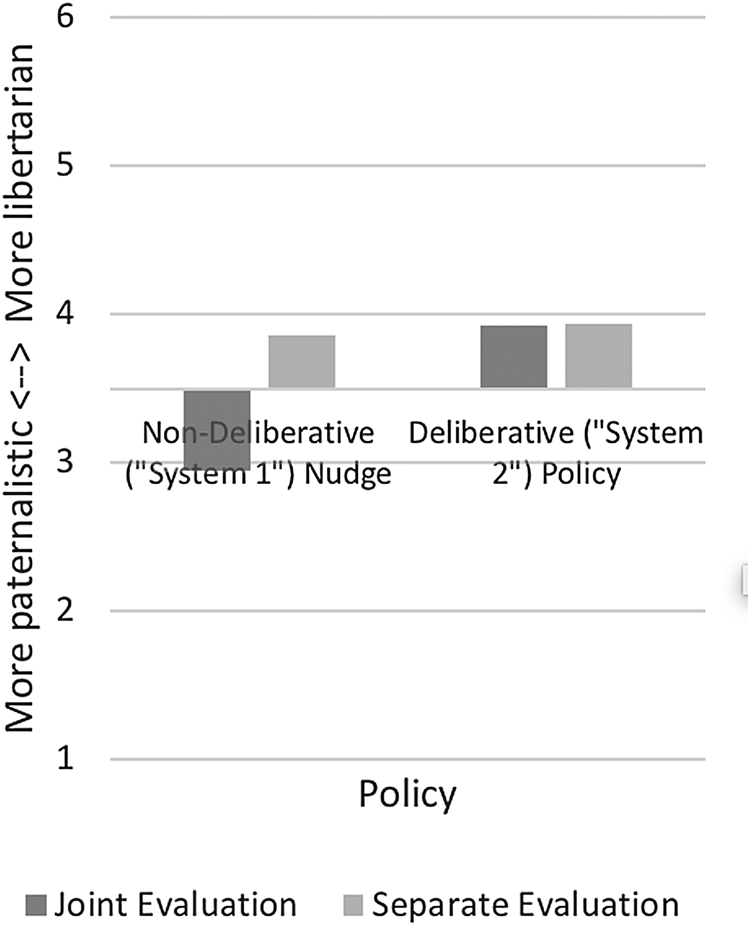
As predicted, the extent to which the nudge was deemed paternalistic depended on the method of evaluation (Figure 2). In the joint evaluation condition, participants perceived the non-deliberative nudge to automatically enroll employees into savings as significantly more paternalistic (M = 2.95, SD = 1.38) than a deliberative policy that informed employees about the benefits of enrollment (M = 3.92, SD = 1.38), matched pairs t(38) = 2.45, p = 0.019. In contrast, participants in the separate evaluation conditions – who judged each policy based on its own merits – perceived the two policies as equally paternalistic (M‘System 1’ nudge = 3.86, SD = 1.37; M‘System 2’ policy = 3.93, SD = 1.24), t(82) < 0.5, ns. The difference in paternalism judgment of the two policies in joint and separate evaluation was significant, t(122) = 13.66, p < 0.0001.
Participants’ judgments of paternalism of ‘System 1’ and ‘System 2’ policies in joint and separate evaluation (Study 3).

As before, perceptions of the nudge (but not of the traditional policy) were significantly influenced by the method of evaluation. Whereas the deliberative policy was deemed equally paternalistic in joint (M = 3.92) and in separate evaluation (M = 3.93), t(79) < 0.1, ns, the non-deliberative nudge was seen as significantly more paternalistic in joint (M = 2.95) than in separate evaluation (M = 3.86), t(79) = 2.97, p < 0.005.
Study 4: can nudges garner support in joint evaluation?
In Study 4, we examined whether explicit information about initiatives’ projected merit, or effectiveness, can garner support for non-deliberative (‘System 1’) policies even in joint evaluation, when they are typically less likely to be favored (see also Sunstein, Reference Sunstein2016b). Earlier work on joint versus separate evaluation has shown that numerical information, which is sometimes hard to gauge in separate evaluation, figures more prominently in joint evaluation, where the advantages of one option over another become transparent (Hsee, Reference Hsee1996). In this vein, because efficiency is hard to evaluate in isolation without an explicit benchmark, we expected that effectiveness information would have little influence on participants’ attitudes in separate evaluation. In contrast, because attitudes toward nudges appear rather malleable, we predicted that when directly comparing between policies whose merits are explicit, participants would prefer more effective policies regardless of whether they target deliberative or non-deliberative processes.
Methods
Participants
One hundred participants from Amazon's Mechanical Turk took part in the study (61 females, Mage = 34.82).
Manipulation and dependent variables
Participants read the same short paragraph as in Study 1A, describing a new policy designed to encourage enrollment in a basic medical insurance plan. We varied whether the policy involved automatic enrollment of employees into a basic medical plan (non-deliberative nudge) or an educational campaign about such a plan (deliberative policy). While both policies were projected to increase insurance coverage, the non-deliberative enrollment nudge was shown to be very effective (“projected to increase medical coverage by more than 40%”), whereas the deliberative information intervention was somewhat effective (“projected to increase medical coverage by almost 5%”).Footnote 4 As before, participants were randomly assigned to one of three conditions: two in which they evaluated one of the two policies (separate evaluation conditions); and one in which they evaluated both policies jointly (joint evaluation condition). Participants indicated whether they would support each policy on a sliding scale ranging from –3 (certainly no) to +3 (certainly yes).
Results
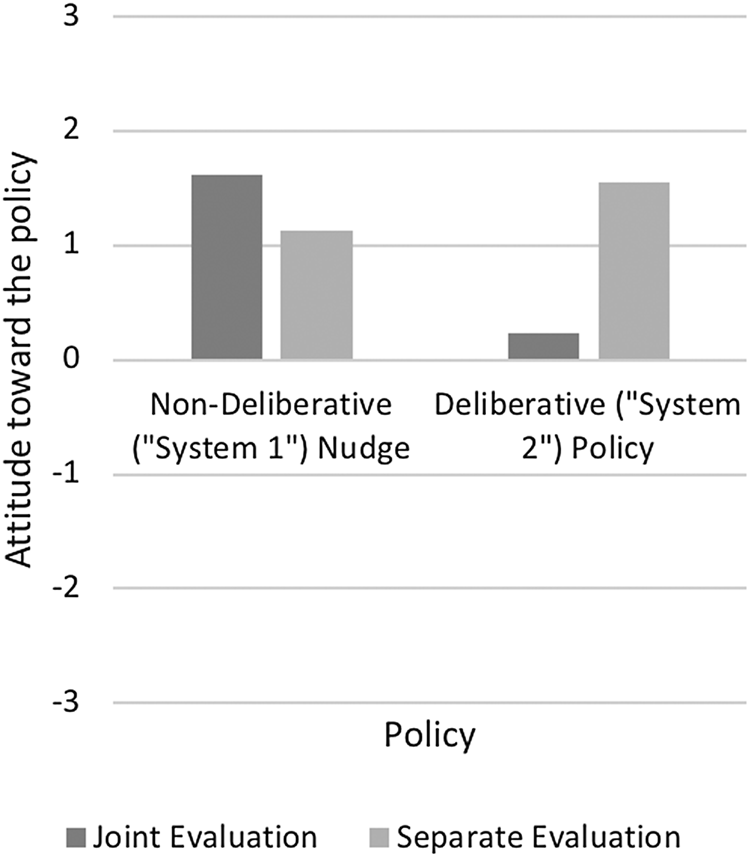
As shown in Figure 3, the proposed policies’ effectiveness information dominated participants’ judgments when the policies were evaluated jointly, but not when they were judged separately. When participants evaluated the policies separately, they were equally favorable toward both plans (M‘System 1’ nudge = 1.13, M‘System 2’ policy = 1.55), t(74) < 1.4, ns. In contrast, when they evaluated the policies jointly, participants were significantly more supportive of the highly effective non-deliberative nudge (M = 1.61, SD = 1.24) than the less effective but deliberative policy (M = 0.23, SD = 1.58), t(25) = 3.25, p = 0.003. The difference in expressed support for the two policies in joint and in separate evaluation was significant, t(99) = 11.64, p < 0.001. Because participants could easily compare the effectiveness in the joint evaluation, they were significantly more supportive of the more effective yet non-deliberative nudge than of its deliberative but less effective alternative.
Participants’ support for the more effective nudge and the less effective traditional medical coverage policy in joint and separate evaluation (Study 4).

General discussion
How do people really feel about ‘nudges’? Although past research has argued that people have a clear-cut preference for policies that target deliberative (‘System 2’) over non-deliberative (‘System 1’) processes (Felsen et al., Reference Felsen, Castelo and Reiner2013; Jung & Mellers, Reference Jung and Mellers2016; Sunstein, Reference Sunstein2016a, Reference Sunstein2016b), we find that things are more subtle. Attitudes are malleable and can be influenced by the method of evaluation – in this case, whether policies are evaluated separately or jointly. Joint evaluation tends to highlight what is salient in direct comparison, which, in the context of the present studies, was the more or less deliberative nature of policy recommendations. Indeed, we have found that non-deliberative nudges are seen as more paternalistic and more objectionable than deliberative alternatives when these are evaluated jointly, but that this is reduced or fully eliminated when they are evaluated separately.
Given the differences produced by mode of evaluation, which mode should be used to give nudges ‘a fair shot’? Or alternatively, should researchers (and policy-makers) be more concerned with attitudes expressed in joint or in separate evaluation? One could argue that joint evaluation is preferable precisely because it highlights the deliberative versus non-deliberative aspects of policies. Yet, normatively speaking, it is not clear why this highlight should prove particularly beneficial. As observed by Hsee and Zhang (Reference Hsee and Zhang2004), considerations rendered salient in joint evaluation are not always the most normatively compelling. Because joint evaluation highlights certain aspects largely independent of their normative appeal, there is unlikely to be a simple solution to which mode of presentation, joint or separate, proves to be normatively superior.
It is worth noting that policies are typically implemented in one version or another; rarely do people get to entertain multiple policy options simultaneously. Whereas policy-makers and academics may be in a unique position of ‘jointly evaluating’ alternative interventions, the general public is more often than not confronted with a specific policy, effectively engaging in ‘separate evaluation’ (Shafir, Reference Shafir, DePaul and Ramsey1999; Hsee & Zhang, Reference Hsee and Zhang2004). And because policies are ultimately experienced in isolation, attitudes elicited in joint evaluation may be less reflective of people's real experiences. Policy-makers are often in the position to directly compare several potential policies with one another, weighing their pros and cons. The general public, in contrast, is rarely in that same privileged position. People experience and react to policies in what amounts to a separate evaluation, whereas policy-makers have the uncommon experience – and responsibility – of evaluating policies comparatively.
At times, people may engage in what resembles a joint evaluation, particularly when comparing an experience to possible alternatives. For example, when contemplating an automatic enrollment policy, people may spontaneously bring to mind an alternative, such as the one about to be replaced or one in use at another institution or location. Judgments can be influenced not only by focal events, but also by counterfactuals that naturally spring to mind (Kahneman & Miller, Reference Kahneman and Miller1986). This could explain why preference for deliberative policies in our studies was significantly attenuated in separate evaluation, but not always fully eliminated. When we asked participants to evaluate fairly novel and non-deliberative interventions (e.g., default total-balance payments of bills), more familiar and less ‘intrusive’ policies may have been automatically generated. As behaviorally informed interventions grow in popularity and the public becomes more familiar with non-deliberative nudges, people may be less prone to compare them with salient deliberative alternatives, and may thus become more supportive.
Of course, nudges are not a policy-maker's panacea, and social problems will often need to be addressed with other types of policy interventions. At times, governments may impose highly paternalistic policies, as with rules prohibiting underage alcohol consumption. Other times, they resort to less paternalistic policies such as educational campaigns against underage drinking.Footnote 5 Given the growing interest in behavioral interventions, we have chosen to focus on people's attitudes toward nudges – policies that are neither fully paternalistic, nor completely libertarian (Thaler & Sunstein, Reference Thaler and Sunstein2008). Because such policies often involve an implicit trade-off between effectiveness and the concern with ‘being nudged’, people's attitudes toward them are prone to be influenced by the mode of evaluation. Yet, in cases when this trade-off is one-sided (e.g., if a nudge is seen as very ineffective or extremely offensive), people may be inclined to oppose the policy no matter how evaluation is elicited. For example, Sunstein (Reference Sunstein2016b) observes that some nudges (e.g., requiring women to see vivid in utero photos before deciding to abort a pregnancy) fail to garner majority support regardless of their effectiveness. Of course, the more pronounced people's attitudes toward a particular nudge, the less we would expect them to be affected by mode of evaluation.
Because mode of evaluation is likely to prove most consequential in cases where preferences are less pronounced, it is particularly important to understand the subtle influence of evaluation mode on matters pertinent to policy-making. Doing so could guide researchers in choosing the modes that most closely tap into how laypeople spontaneously think about their decisions in everyday life (Davidai & Gilovich, Reference Davidai and Gilovich2018), increase the ecological validity of surveyed attitudes about public policies, and form a broader and more comprehensive understanding of how people feel about nudges.
While we have focused here on deliberative versus non-deliberative processes, public policies differ on many dimensions that may be similarly influenced by joint versus separate evaluation. As shown in Study 4, policies’ effectiveness is one such dimension. For another, Hagman and colleagues (Reference Hagman, Andersson, Västfjäll and Tinghög2015) have found that people tend to support policies that benefit individual over societal well-being, whereas Cornwell and Krantz (Reference Cornwell and Krantz2014) have shown that, in separate evaluation, people are less supportive of policies that target themselves than those that target people in general. Future research can examine the influence of joint and separate evaluation on these and related findings, including, importantly, ones that involve moral judgments. Thus, while Van Zant and Moore (Reference Van Zant and Moore2015) found that moral as opposed to pragmatic considerations influenced people's support of proposed policies, it is possible that pragmatic considerations, having to do with a policy's actual impact, may play a larger role in joint compared to separate evaluation.
Finally, although it is a widely applicable concern, it is important to keep in mind that mode of evaluation is not the only way in which people's attitudes toward public policies can be shaped. Attitudes toward redistributive policies, for example, are influenced by whether economic inequality is framed as the rich having more or the poor having less (Chow & Galak, Reference Chow and Galak2012); people's perception of economic mobility is affected by whether they consider upward or downward social mobility (Davidai & Gilovich, Reference Davidai and Gilovich2015); and their support for behaviorally informed policies is significantly influenced by who they believe put the policies in place (i.e., the ‘partisan nudge bias’; Tannenbaum et al., Reference Tannenbaum, Fox and Rogers2017). These and other factors may influence attitudes in ways that interact with modes of evaluation in subtle and interesting ways. Do people spontaneously generate direct comparisons to more attractive options when faced with proposals that are less appealing to their political taste? Are politicians more likely to introduce ‘joint evaluation’ when attacking their opponents’ proposed (especially non-deliberative) policy plans?
Recent research has examined how policy-makers might increase public support for non-deliberative interventions, or ‘nudges’ (Loewenstein et al., Reference Loewenstein, Bryce, Hagmann and Rajpal2015; Steffel et al., Reference Steffel, Williams and Pogacar2016). In this paper, we discussed a simple yet non-intuitive method of increasing such support. Direct comparison between more and less deliberative policies raises the salience of deliberation and reduces support for non-deliberative interventions. But as long as they evaluate policy proposals separately and on their own merit, people seem quite willing to support what are often highly effective ‘System 1’ nudges. Assuming that what policy-makers ultimately care about are the consequences of policies, not the manner in which they are evaluated, this nuanced distinction is worth paying attention to.