Indications for and timing of pulmonary valve replacement in patients with CHD involving the right ventricular outflow tract have been the subject of ongoing discussion.Reference Geva1–Reference Tretter, Friedberg, Wald and McElhinney4 Right ventricular volume and/or pressure overload can adversely affect the pulmonary vascular bed as well as left ventricle systolic and diastolic function. These abnormalities may persist even after pulmonary valve replacement and ultimately have a negative impact on long-term outcomes.Reference Tretter, Friedberg, Wald and McElhinney4–Reference Babu-Narayan, Diller and Gheta6 Practice has shifted towards intervening in younger patients prior to symptom development, yet the ideal timing remains unclear. Considerable attention has been placed on imaging, electrophysiology, and, to some extent, exercise capacity to help risk stratify patients in whom the benefit of pulmonary valve placement will likely outweigh the surgical risk.Reference Geva1,Reference Geva2,Reference Baumgartner7–Reference Warnes, Williams and Bashore9 Exercise testing can objectively assess and quantify exercise capacity and symptomatology. Recommendations for intervention for children use percent predicted peak oxygen consumption ≤70% for decision making,Reference Geva1 but the relationship of exercise capacity as measured by cardiopulmonary exercise testing and subsequent surgical outcomes in children has not been well defined. For adult patients, a single institutional experience of 220 adults with tetralogy of Fallot undergoing pulmonary valve placement found that lower peak oxygen consumption on preoperative exercise testing was associated with increased risk of surgical mortality; in fact, on multivariable analysis, peak oxygen consumption was the only independent predictor of early postoperative mortality.Reference Babu-Narayan, Diller and Gheta6 Muller and colleagues found an association between poor exercise capacity and worse late outcomes in patients with surgically repaired tetralogy of Fallot.Reference Müller, Hager and Diller10 More broadly, adult patients with CHD who have decreased exercise capacity have a generally higher risk of adverse outcomes.Reference Diller, Dimopoulos and Okonko11–Reference Giardini, Specchia and Tacy13 A similar effect of preoperative conditioning on surgical outcomes after pulmonary valve replacement has not been well studied in children and adolescents. We hypothesised that the level of preoperative exercise capacity as measured by cardiopulmonary exercise testing in children and adolescents undergoing surgical pulmonary valve placement could be associated with surgical outcomes.
Materials and method
Patient selection
This was a retrospective cohort study, approved by the Boston Children’s Hospital Institutional Review Board with waiver of informed consent. The data that support the findings of this study are available from the corresponding author upon reasonable request. Inclusion criteria included patients aged 8–18 years who underwent pulmonary valve replacement or right ventricle to pulmonary artery conduit change as the primary surgical procedure at Boston Children’s Hospital between 2003 and 2017, who also had preoperative exercise tests within 6 months prior to surgery. Exclusion criteria included patients in whom preoperative exercise testing and imaging were not performed, performed elsewhere, and/or data were incomplete or deemed submaximal (respiratory exchange ratio < 1.00), as previously published.Reference Babu-Narayan, Diller and Gheta6 Patients were excluded when pulmonary valve replacement was part of a complex combination of procedures (e.g., additional complex TV repair/replacement, aortic valve repair/replacement, aortic root replacement, etc.). Concurrent closure of a patent foramen ovale, atrial septal defect, residual ventricular septal defect, or arterioplasty of main or branch pulmonary artery/arteries were not considered exclusion criteria.
Data
Institutional databases and medical records were reviewed for preoperative, intraoperative, and postoperative clinical and imaging data. These included (but were not limited to) date of birth, date of surgery, height, weight, body mass index, diagnosis, type of repair (pulmonary valve replacement versus conduit change), cardiopulmonary bypass time, and total hospital length of stay. Echocardiographic estimation of left ventricular size and systolic function and right ventricular size and systolic function were also recorded. Cardiopulmonary exercise test data included peak oxygen consumption normalised for body weight, percent predicted peak oxygen consumption based on standard prediction equations by Cooper and Weiler-Ravell,Reference Cooper and Weiler-Ravell14 peak respiratory exchange ratio, peak work rate and percent predicted peak work rate based on standard prediction equations from Jones or Wasserman,Reference Jones15,Reference Wasserman, Hansen and Sue16 peak oxygen pulse and percent predicted peak oxygen pulse, respiratory variables, peak heart rate and percent predicted peak heart rate, slope of the relationship of minute ventilation to carbon dioxide consumption, ventilatory anaerobic threshold, and heart rate at ventilatory anaerobic threshold. When available, MRI data on right ventricular volumes were also collected.
The primary outcome was total hospital length of stay defined as days in the hospital from day of admission to day of discharge. The primary predictor was percent predicted peak oxygen consumption. A level of 70% has been the cut-off value for mildly reduced function in clinical practice in the exercise lab at Boston Children’s Hospital, with moderate or severe exercise dysfunction ranging at values below 70%. Outcomes were compared between “better” exercise capacity defined as percent predicted peak oxygen consumption ≥70% compared to reduced exercise capacity of percent predicted peak oxygen consumption <70%. Secondary predictors included echocardiographic estimates of left ventricular function and right ventricular function, and potential confounders included age at surgery, surgical era, number of prior surgeries, and diagnosis category (tetralogy of Fallot versus non-tetralogy of Fallot).
Statistical analysis
Categorical variables are summarised using frequencies and percentages and continuous variables with medians and interquartile ranges unless otherwise specified. Relationships between the outcome total hospital length of stay and patient characteristics were evaluated using Spearman correlation coefficients, the Wilcoxon rank sum test, or the Kruskal-Wallis test. Cox proportional hazards regression was used to examine the association between total hospital length of stay and the primary predictor preoperative peak percent predicted oxygen consumption <70% versus ≥70%, first unadjusted, and then adjusted for age, era of surgery, and diagnosis of tetralogy of Fallot, with secondary analyses also adjusting for respiratory exchange ratio, MRI variables, and number of prior surgeries. Analyses were performed using SAS version 9.4, SAS Institute Inc., Cary, NC, USA.
Results
Patient characteristics
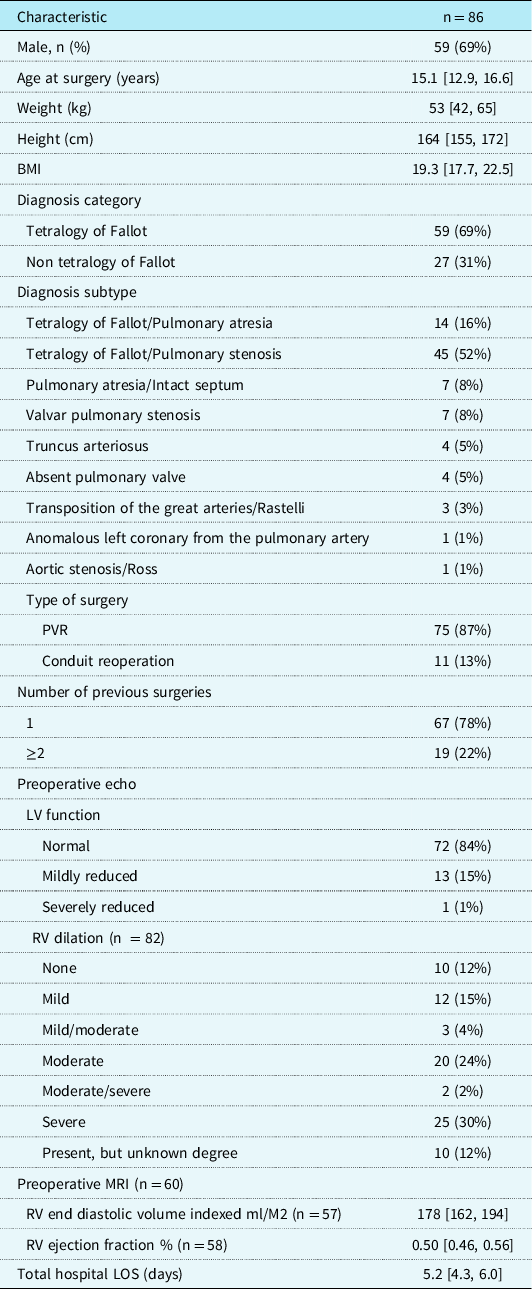
Between 2003 and 2017, 370 patients aged 8–18 years underwent pulmonary valve replacement at Boston Children’s Hospital. Of those, 90 (24%) had preoperative exercise tests. Exclusion for inadequate exercise data or respiratory exchange ratio <1.00 (n = 3) and missing imaging data (n = 1) left 86 (23%) patients meeting criteria for analysis. There was no 30-day mortality. Baseline characteristics are listed in Table 1. Median age at surgery was 15.1 years [12.9, 16.6] and 59 (69%) were male. Tetralogy of Fallot was the primary diagnosis in 59 (69%). A total of 67 (78%) had one prior surgery and 19 (22%) had more than one. Most (72 or 84%) had normal left ventricular systolic function by echocardiogram. Of the 86 patients, 4 (5%) did not have estimates of right ventricular size, 72 (84%) had mild or greater right ventricular dilation, and 10 (12%) had no dilation. Sixty patients (70%) had preoperative MRI data with an equal split of 30 (50%) patients each in the group of patients with percent predicted peak oxygen consumption <70 and the group with percent predicted peak oxygen consumption ≥70. The median indexed right ventricular end-diastolic volume was 178 ml/M2 [162, 194] (n = 57) with a median ejection fraction of 50% (n = 58).
Baseline characteristics of 86 children who underwent pulmonary valve replacement and had cardiopulmonary exercise tests at Boston children’s hospital between 2003 and 2017

Values shown are number (percent), or median [25th, 75th percentile]. BMI = body mass index, LV = left ventricle; RV = right ventricle; PVR = pulmonary valve replacement.
Median total hospital length of stay was 5.2 days [4.3, 6.0] for the whole cohort (n = 86). There was one outlier at 68.4 days, with the next longest total hospital length of stay being 15.2 days. Total hospital length of stay was 5.2 days [4.2, 6.1] for the MRI cohort.
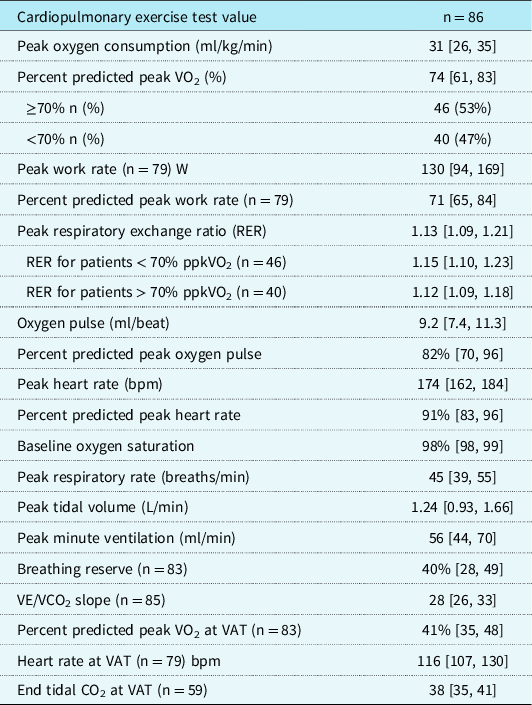
Preoperative exercise values are summarised in Table 2. Median respiratory exchange ratio for the cohort (n = 86) was 1.13 [1.09, 1.21]. Percent predicted peak oxygen consumption was ≥70% in 46 (53%) and <70% in 40 (47%). The proportion of patients with poor exercise capacity changed over time. Among patients undergoing pulmonary valve replacement between 2003 and 2007, 19 patients had percent predicted peak oxygen consumption <70 and 6 had percent predicted peak oxygen consumption ≥70. In the 2008–2011 time interval, the groups were more evenly matched, with 14 having percent predicted peak oxygen consumption <70 and 19 with percent predicted peak oxygen consumption ≥70. In the 2012–2017 time interval, only seven had percent predicted peak oxygen consumption <70 and 21 had percent predicted peak oxygen consumption ≥70. Median percent predicted peak oxygen consumption also improved over time, with earlier surgical eras having significantly lower percent predicted peak oxygen consumption compared to later. In 2003–2007 median percent predicted peak oxygen consumption was 62 [57, 68], in 2008–2011 it was 75 [60, 83], and in 2012–2017 it was 82 [70, 92], p < 0.001.
Preoperative cardiopulmonary exercise test variables

Values shown are number (percent), or median [25th, 75th percentile]. peakVO2 indicates peak oxygen consumption; VAT = ventilatory anaerobic threshold; VE/VCO2 = slope of the relationship of the ventilatory equivalent to carbon dioxide consumption.
Primary predictor percent predicted peak oxygen consumption and interactions with other variables
Associations of exercise effort with percent predicted peak oxygen consumption
The median respiratory exchange ratio for patients with percent predicted peak oxygen consumption <70% (1.15 [1.10, 1.23]) did not differ from that of patients with percent predicted peak oxygen consumption ≥70% (1.12 [1.09, 1.18], p = 0.14). When data were limited to patients who achieved a peak respiratory exchange ratio ≥1.05 (instead of 1.00), 10 patients were excluded, leaving 76 for analysis. There was still no difference in respiratory exchange ratio between groups, with a respiratory exchange ratio of 1.15 [1.11, 1.24] for percent predicted peak oxygen consumption <70% and 1.14 [1.10, 1.20] for percent predicted peak oxygen consumption ≥70% (p = 0.16).
Associations of MRI measured right ventricular size and function with percent predicted peak oxygen consumption
MRI derived indexed right ventricular end diastolic volume (n = 57) was not associated with percent predicted peak oxygen consumption (rs = 0.17, p = 0.21). Right ventricular ejection fraction as measured by MRI (n = 58) was related to percent predicted peak oxygen consumption: for those with percent predicted peak oxygen consumption ≥70, right ventricular ejection fraction was 0.52 [0.49, 0.57] versus 0.48 [0.44, 0.52] for those with percent predicted peak oxygen consumption <70 (p = 0.007). These observations are consistent with those of previous investigators.Reference Meadows, Powell, Geva, Dorfman, Gauvreau and Rhodes17
Univariable analysis of outcome total hospital length of stay
Association of baseline patient characteristics with total hospital length of stay
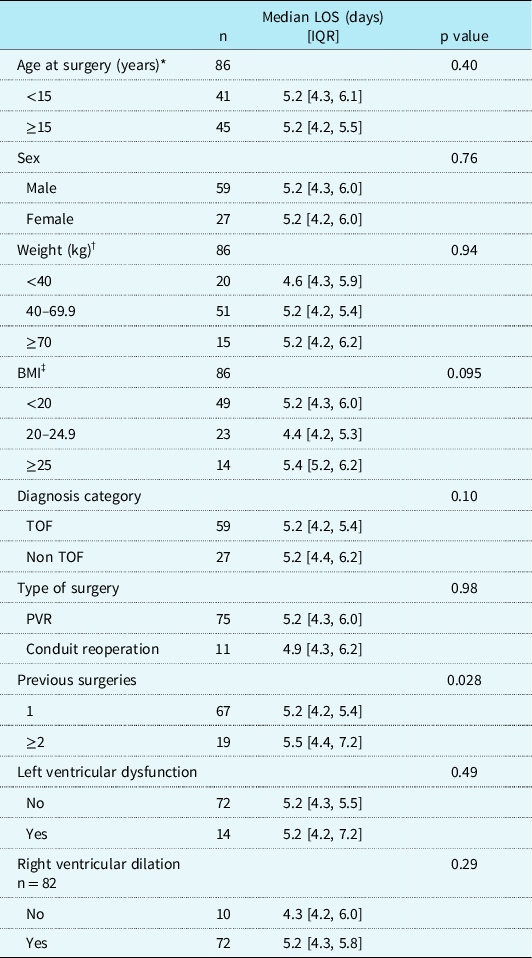
Associations between total hospital length of stay and baseline patient characteristics are summarised in Table 3. There were no significant findings other than patients with ≥2 surgeries had lower percent predicted peak oxygen consumption (61 [53, 74]) compared to those with 1 prior surgery (76 [64, 85], p = 0.002). As number of surgeries and percent predicted peak oxygen consumption are related to one another, patients with ≥2 previous surgeries also had longer total hospital length of stay (5.5 [4.4, 7.2]) versus 1 prior surgery (5.2 [4.2, 5.4], p = 0.028, Table 3). Also, patients with extremes of body mass index had longer median total hospital length of stay compared to those with a normal body mass index, but these differences did not achieve statistical significance (p = 0.095).
Relationship of LOS to baseline patient characteristics

IQR = interquartile range, shown as median [25th, 75th percentile]; PVR = pulmonary valve replacement; TOF = tetralogy of Fallot.
Spearman correlation coefficients:
* rs = −0.13 (p = 0.25);
† rs = 0.01 (p = 0.99);
‡ rs = 0.07 (p = 0.54);
Association of peak exercise variables with total hospital length of stay
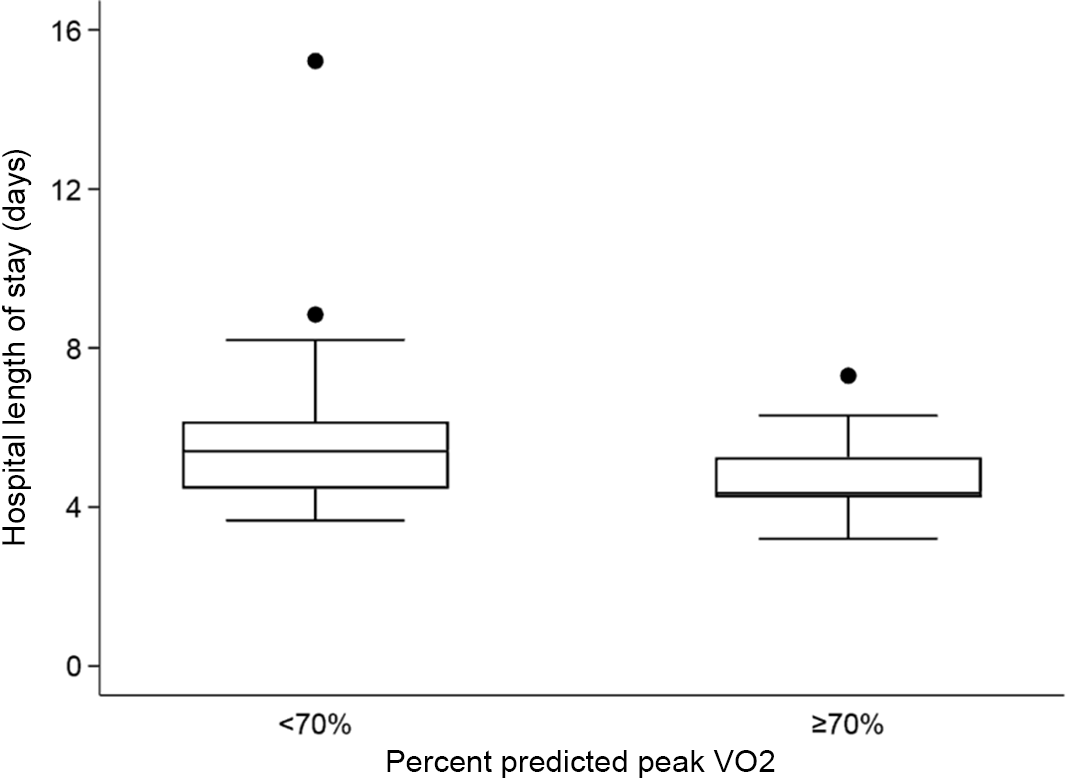
Better preoperative exercise capacity was associated with shorter total hospital length of stay (Fig 1). Median total hospital length of stay for patients with percent predicted peak oxygen consumption ≥70% was 4.4 days compared to 5.4 days for patients with percent predicted peak oxygen consumption <70% (p = 0.007). Higher percent predicted peak oxygen consumption correlated with shorter length of stay (n = 86, rs = −0.26, p = 0.018) as did percent predicted peak oxygen pulse (a surrogate for the forward stroke volume at peak exercise) (n = 86, rs = −0.23, p = 0.034) but not percent predicted peak heart rate (n = 86, rs = −0.01, p = 0.91).
Box and whisker plot demonstrates that children with better preoperative exercise capacity had shorter hospital length of stay compared to those with lower preoperative exercise capacity (n = 86, p = 0.007).

Peak respiratory exchange ratio did not correlate with total hospital length of stay (rs = 0.08, p = 0.47), even when patients with respiratory exchange ratio <1.05 were excluded from the analysis.
End tidal carbon dioxide at ventilatory anaerobic threshold (a marker of ventilation/perfusion mismatch) was recorded in 59 patients and correlated weakly with total hospital length of stay (rs = −0.26, p = 0.045). No other exercise test variable had any significant correlation with total hospital length of stay.
Association of ventricular size and function on total hospital length of stay
There was no association of echocardiographic derived ventricular size or function with total hospital length of stay (Table 3). Similarly, for the patients in whom MRI data were available, indexed right ventricular end diastolic volume (n = 57) was not associated with total hospital length of stay (Spearman correlation rs = −0.07, p = 0.63). MRI derived right ventricular ejection fraction (n = 58) was not related to total hospital length of stay (Spearman correlation rs = −0.13, p = 0.35).
Association of surgical era with total hospital length of stay
There was no association of surgical era with total hospital length of stay: 2003–2007 it was 5.2 days [4.3, 6.1], 2008–2011 it was 5.2 days [4.3, 5.5], and 2012–2017 it was 4.5 days [4.3, 5.4] (p = 0.70). Additional analysis adjusting for each individual surgical era was limited by the small sample sizes but showed a significant relationship of percent predicted peak oxygen consumption to total hospital length of stay for 2003–2007 (hazard ratio 0.37, 95% CI [0.13, 1.03], p = 0.026) and for 2008–2011 (hazard ratio 0.40, 95% CI [0.19, 0.85], p = 0.017) but not for 2012–2017 (hazard ratio 1.00, 95% CI [0.42, 2.42], p = 0.99).
Multivariable analysis for outcome total hospital length of stay
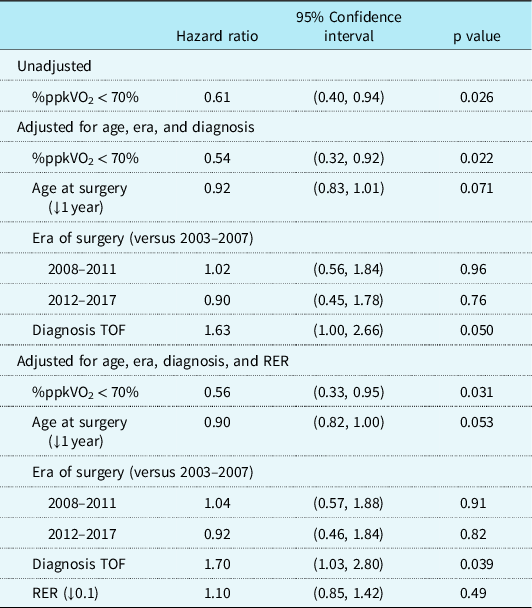
Cox proportional hazards regression was used to examine the association between total hospital length of stay and the primary predictor percent predicted peak oxygen consumption, adjusting for confounders. When evaluating length of stay and preoperative percent predicted peak oxygen consumption over a range of values from <70 to <85%, the strongest cut point was found to be <70% (Hazard Ratio 0.61 [0.40, 0.94], p = 0.026). On multivariable analysis adjusting for age, era of surgery, and diagnosis of tetralogy of Fallot, lower preoperative percent predicted peak oxygen consumption was associated with a longer hospital total hospital length of stay (hazard ratio 0.54, 95% CI [0.32, 0.92], p = 0.022, Table 4). Note that hazard ratios less than 1 indicate that the risk of a delayed hospital discharge increases as percent predicted peak oxygen consumption goes down. The relationship of lower preoperative percent predicted peak oxygen consumption correlating with longer total hospital length of stay held when respiratory exchange ratio was added to the multivariable model (hazard ratio 0.56, 95% CI [0.33, 0.95], p = 0.031) (Table 4). There was borderline association in patients with a diagnosis of tetralogy of Fallot versus other diagnoses, with shorter length of stay for patients with tetralogy of Fallot (Hazard Ratio 1.63 [1.00, 2.66], p = 0.050; Table 4) that persisted when other variables were added to the model (Tables 4 and 5).
Cox proportional hazards regression analysis adjusting for confounders between LOS and preoperative percent predicted peak VO2

%ppkVO2 = percent predicted peak oxygen consumption relative to body mass; RER = respiratory exchange ratio; TOF = tetralogy of Fallot.
Analyses of number of prior surgeries, preoperative percent predicted peak VO2, and length of stay

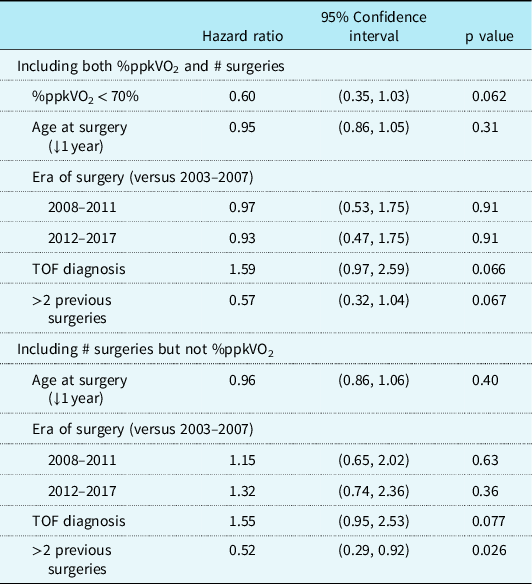
A multivariable Cox model that included age at surgery, era of surgery, and diagnosis in addition to number of prior surgeries showed an association between ≥2 prior surgeries and longer length of stay. The inclusion of both %predicted peak oxygen consumption and number of prior surgeries in the same model weakened their associations with total hospital length of stay due to the collinearity between these two variables and small sample sizes (Table 5).
Postoperative exercise test findings
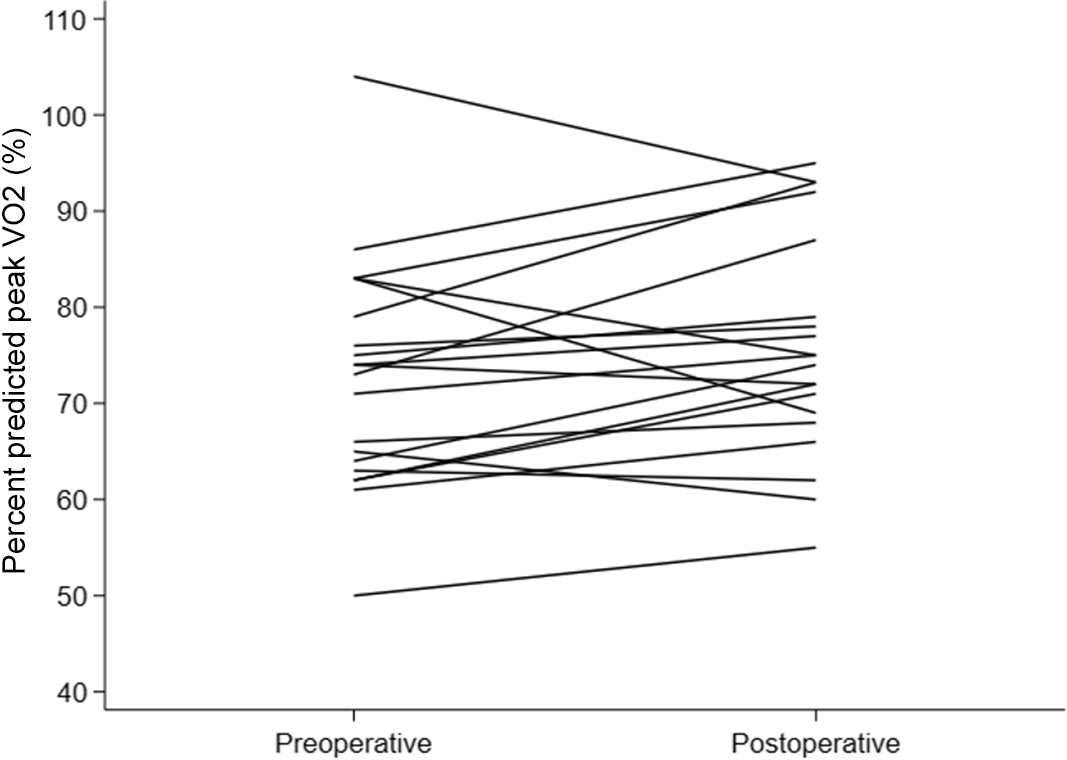
Twenty patients had both a preoperative exercise test within 6 months of surgery and a postoperative exercise test within one year after surgery. Fourteen patients showed an improvement in postoperative peak oxygen consumption, and six declined. As a group, there was no statistically significant difference in percent predicted peak oxygen consumption from preoperative to postoperative exercise tests (p = 0.10). Individual patients are plotted in Figure 2. Of note, the one patient whose percent predicted peak oxygen consumption fell from the normal range (83%) to the abnormal range (69%) was subsequently diagnosed and treated for depression. Follow-up exercise testing 19 months later showed normalisation of percent predicted peak oxygen consumption (91%) with no intervening cardiac medications or interventions.
Percent predicted peak oxygen consumption in individual patients within 6 months before and up to 12 months after surgical intervention (n = 20).

Discussion
Children undergoing pulmonary valve replacement or conduit change with better preoperative exercise capacity had better surgical outcomes as measured by total hospital length of stay. In particular, percent predicted peak oxygen consumption on preoperative cardiopulmonary exercise testing that was normal to mildly reduced (≥70%) was associated with shorter length of stay compared to those with moderate or more (<70%) reduction in functional capacity. This relationship held after adjusting for age, era of surgery, and diagnosis subtype and supports the published recommendations using percent predicted peak oxygen consumption <70% as an important marker in asymptomatic patients being considered for pulmonary valve replacement.Reference Geva1 There was also a modest association of shorter length of stay with better forward stroke volume at peak exercise as estimated by the oxygen pulse at peak exercise, but not with echocardiographic estimates of left ventricular function or right ventricular dilation at rest. Thus, reliance solely on imaging parameters for surgical decision making may neglect important prognostic indicators obtainable only from cardiopulmonary exercise testing in children.
These data are consistent with the findings from Babu-Narayan et al’s large study of adult patients with tetralogy of Fallot undergoing pulmonary valve replacement. They found that peak oxygen consumption independently predicted surgical outcomes as assessed by postoperative mortality within the first 30 days.Reference Babu-Narayan, Diller and Gheta6 Further, they found a peak oxygen consumption <20 ml/kg/min was 100% sensitive although only 56% specific predictive for early surgical mortality, with a 30% increased risk of mortality for every 2 ml/kg/min decrease in peak oxygen consumption. They concluded that cardiopulmonary exercise testing may be a useful parameter to include in the decision-making process regarding the timing of surgical intervention and may be helpful in identifying patients in need of earlier intervention. Specifically, their findings and the results of our study suggest that, in some cases, poor exercise function may reflect a right ventricle that is unable to accommodate to the cardiovascular demands of exercise. This is a phenomenon that may not be detected by imaging studies obtained at rest. Postponing intervention in these cases may be associated with an increased risk for progressive and irreversible right ventricular damage and dysfunction that could impact postoperative outcomes.
The link between a low peak oxygen consumption and poor postoperative outcomes may also be related to preoperative debilitation and deconditioning. Unlike right ventricular dysfunction, this may be reversible by exercise training programmes. Pulmonary valve replacement has been shown to improve right ventricular parameters, but pulmonary valve replacement alone does not seem to impact cardiopulmonary fitness.Reference Ho, Schamberger, Hurwitz, Johnson, Sterrett and Ebenroth3,Reference Sabate Rotes, Johnson, Burkhart, Eidem, Allison and Driscoll18,Reference Ghez, Tsang and Frigiola19 A structured exercise training programme, however, has improved exercise capacity in patients with a range of post-surgical CHDs.Reference Dallaire, Wald and Marelli5,Reference Duppen, Takken and Hopman20–Reference Morrison, Sands and McCusker23 Since exercise capacity is modifiable, serial assessment of peak oxygen consumption, and particularly pre-pulmonary valve replacement, may not only assist with clinical decision making on timing of surgery but may also identify a target for intervention prior to pulmonary valve replacement. Indeed, in “low risk” adults awaiting coronary artery bypass grafting (a common scenario in public health care systems such as Canada and Britain) there is often a delay before surgery can be completed. Thus, there has been a growing field of “prehabilitation” in adult cardiology, designed to provide preoperative interventions for modifiable factors such as physical, nutritional, and mental fitness. Early data suggest these “prehab” programs for patients with atherosclerotic disease improve postoperative outcomes.Reference Arora, Brown, Sanjanwala and McKelvie24,Reference Arthur25 Additionally, one of the modifiable factors, nutritional status, has been evaluated in young patients undergoing repair for CHD. In an analysis of 18,377 patients across 118 centres in the Society of Thoracic Surgeons Congenital Heart Database, both extremes of body mass index (underweight and overweight) were independently associated with higher risk of adverse outcomes.Reference O’Byrne, Kim and Hornik26 Our data did suggest a trend towards longer length of stay with extremes of body mass index but were not classified by Centers for Disease Control age and sex percentiles nor powered to detect differences and this relationship did not reach statistical significance. A preoperative exercise training intervention that includes nutritional optimisation merits prospective study for whether surgical outcomes can be positively affected in children with CHD such as those awaiting pulmonary valve replacement.
Our data showed that the median percent predicted peak oxygen consumption improved from 62% in the earlier surgical era to 75% and finally 82% in the more modern era, but as a cohort, we did not find that the surgical era itself predicted differences in total hospital length of stay. We attempted to analyse further by considering the relationship between percent predicted peak oxygen consumption and total hospital length of stay within each individual surgical era separately. Despite small sample sizes we identified an association between poor percent predicted peak oxygen consumption and longer total hospital length of stay for 2003–2007 and 2008–2011, but not for 2012–2017. Of note, there was a complete reversal in the relative frequency of patients with percent predicted peak oxygen consumption <70 versus ≥70 by era (19 versus 6 in 2003–2007, 14 versus 19 in 2008–2011, and 7 versus 21 in 2012–2017). As the number of patients within each era became more fit, the association of poor preoperative percent predicted peak oxygen consumption to length of stay may have been diluted by the relatively lower number of patients with poor exercise capacity. It should be emphasised that while the correlation between percent predicted peak oxygen consumption and total hospital length of stay persisted within the multivariable model, surgical era was neither associated with total hospital length of stay in the unadjusted analysis nor in the multivariable model. Changes across eras in surgical technique, intraoperative/postoperative management, or fast-tracking strategies may have impacted length of stay but would not have an effect on the association between preoperative exercise function and length of stay which remained significantly different across eras (Table 4).
One of the more notable findings in the present study was the paucity of preoperative exercise tests obtained in children despite published guidelines suggesting the utility of exercise testing. Of the 370 patients undergoing pulmonary valve replacement in our series, only 86 (23%) met inclusion criteria for a qualifying cardiopulmonary exercise test within 6 months of surgery, and only 20 (5%) had testing both before and within 12 months after repair. The limited use of cardiopulmonary exercise testing as a modality is reflected in other centres as well; for instance, Sabate Rotes et al identified 278 patients undergoing pulmonary valve replacement in their database spanning almost 40 years, of whom 76 (27%) met criteria for preoperative exercise test data, and only 17 (6%) had both pre- and postoperative exercise tests.Reference Sabate Rotes, Johnson, Burkhart, Eidem, Allison and Driscoll18 Another centre looked for any exercise test done at any time after repair of tetralogy of Fallot and found that of the 223 patients in their database between 1976 and 2016, 88 met inclusion criteria.Reference Powell, Mays and Chin27 Recognising the importance of cardiopulmonary exercise tests, there has been a push for more consistent and longitudinal use of this test for risk stratification.Reference Ho, Schamberger, Hurwitz, Johnson, Sterrett and Ebenroth3,Reference Dallaire, Wald and Marelli5,Reference Babu-Narayan, Diller and Gheta6
Additional findings were that in our cohort, diagnosis of tetralogy of Fallot itself was not associated with total hospital length of stay in unadjusted analysis but was associated with shorter length of stay in multivariable analysis. Even accounting for this difference, percent predicted peak oxygen consumption was still independently associated with the outcome. Also, patients with more than one prior surgery tended to have longer length of stays as well as lower percent predicted peak oxygen consumption. Due to the relationship between percent predicted peak oxygen consumption and number of prior surgeries, the relationship between percent predicted peak oxygen consumption and hospital total hospital length of stay weakened when number of prior surgeries was added to the model. A similar finding was noted with diagnosis of tetralogy of Fallot. With the small sample sizes, no additional analyses could be performed. It is worth noting that of these patient characteristics, only percent predicted peak oxygen consumption is potentially modifiable and represents another reason to consider a prospective study to assess the impact on preoperative exercise training on surgical outcomes.
As noted, there were few exercise tests performed preoperatively, and there were even fewer obtained after intervention. For the 20 patients with both preoperative and postoperative studies, there was no difference found between peak predicted oxygen consumption before and after intervention. Lack of improvement in exercise capacity from surgery alone is consistent with past studiesReference Ho, Schamberger, Hurwitz, Johnson, Sterrett and Ebenroth3,Reference Sabate Rotes, Johnson, Burkhart, Eidem, Allison and Driscoll18 and constitutes another argument in favour of postoperative exercise training.
Limitations
The main limitation was the small sample size from the limited number of exercise tests to review. Additionally, there may be a selection bias in the patients who did undergo preoperative cardiopulmonary exercise testing. However, the decision to obtain preoperative cardiopulmonary exercise test data was driven primarily by the availability of the technology and/or the referring cardiologist’s personal preference. The decision to refer patients for surgical pulmonary valve replacement was primarily based upon similar clinical, echocardiographic, and CMR criteria, regardless of the cardiopulmonary exercise test data. Hence, it is unlikely that clinically important biases were present in the preoperative cardiopulmonary exercise test group.
We chose to include cardiopulmonary exercise test data if the respiratory exchange ratio at peak exercise was >1.00. This is consistent with the approach employed in previously published series studying patients undergoing pulmonary valve replacement.Reference Ho, Schamberger, Hurwitz, Johnson, Sterrett and Ebenroth3,Reference Babu-Narayan, Diller and Gheta6 Other cut points have been described, some suggesting that >1.05 for young patients or even >1.09 as a more reasonable threshold for a maximal test.Reference Rhodes, Ubeda Tikkanen and Jenkins28 Thus, it is possible that some of our data reported as peak oxygen consumption were submaximal and related to effort. However, there was no difference in respiratory exchange ratio between patients whose percent predicted peak oxygen consumption was <70% and those in whom the percent predicted peak oxygen consumption was ≥70%, suggesting any effort related limitation in peak oxygen consumption would be similar between groups. Further, the relationship between lower preoperative peak oxygen consumption and longer length of stay remained even after adjusting for respiratory exchange ratio in the multivariable analysis.
With the small sample sizes, the study was not well powered to determine the extent by which percent predicted peak oxygen consumption within each surgical era impacted length of stay. The present study was also limited by the use of hospital total hospital length of stay as an indicator of surgical outcomes. While total hospital length of stay has been an accepted surrogate, it is less than ideal, especially when the larger question at hand remains optimal patient selection for pulmonary valve replacement. This will likely require a longitudinal registry that includes appropriately timed preoperative and postoperative exercise and imaging studies for development of a risk model. Additionally, the data were retrospective with the inherent possibility for missing data. Finally, combining patients undergoing pulmonary valve replacement with those undergoing conduit replacement assumes that these two groups are identical, when in fact there may be important differences, especially when considering whether the indication for pulmonary valve replacement was related to a pressure overloading versus a volume overloading lesion. Moreover, the fundamental diagnosis in this group included a wide range of lesions.
Conclusions
Preoperative exercise testing in children undergoing pulmonary valve replacement correlates with surgical outcomes, with better exercise capacity associated with shorter hospital length of stay. As options for surgical and transcatheter interventions continue to evolve, decision making on when to intervene in asymptomatic children has become increasingly complex. Exercise capacity is intriguing not only as an important decision-making tool but also as a potentially modifiable factor prior to and after pulmonary valve replacement. While cardiopulmonary exercise test variables are promising adjuncts, until cardiopulmonary exercise tests are systematically and serially performed in children, the full impact on decision making and patient outcomes will not be known.
Acknowledgements
None.
Financial support
This research received no specific grant from any funding agency, commercial, or not-for-profit sectors.
Conflicts of interest
None.
Ethical standards
This is a retrospective cohort study approved by the Boston Children’s Hospital Institutional Review Board with waiver of informed consent (IRB #P00027991). The authors assert that all procedures contributing to this work comply with the ethical standards of the relevant national guidelines on human experimentation (Belmont report) and with the Helsinki Declaration of 1975, as revised in 2008, and has been approved by the institutional committees (Boston Children’s Hospital IRB #P00027991).