Introduction
Prostate cancer (PRCA) is the second most common cancer in men worldwide, with a very large population variation in incidence. Age, ethnicity and heredity have been identified as risk factors,Reference Damber and Aus1–Reference Wigle, Turner, Gomes and Parent3 but much of the aetiology of PRCA remains unclear. PRCA is a hormone-dependent cancer, and, as in breast cancer,Reference Ekbom4, Reference Silva Idos, De Stavola and McCormack5 early life factors, specifically the intrauterine period and prenatal hormonal exposure, have been proposed to be related to PRCA in adult life.Reference Potischman, Troisi and Vatten6 Early in utero exposure to oestrogen and testosterone, which could influence the hypothalamic–pituitary–testicular feedback system through imprinting, have been proposed to be of aetiologic importance for PRCA.Reference Henderson, Bernstein, Ross, Depue and Judd7, Reference Ross and Henderson8
Birth weight (BW), a surrogate measure of foetal growth, and a marker for the intrauterine oestrogen environment,Reference Kaijser, Granath, Jacobsen, Cnattingius and Ekbom9 has been the most commonly examined birth size measure in relation to PRCA. The evidence to date, however, does not support a strong association between larger birth size and onset of PRCA despite a growing number of investigations evaluating this association since the initial record linkage studies from Sweden.Reference Ekbom, Hsieh and Lipworth10–Reference Tibblin, Eriksson, Cnattingius and Ekbom12 The earliest of these studies,Reference Tibblin, Eriksson, Cnattingius and Ekbom12 based on only 21 cases, found a strong positive association between BW and incident PRCA. Most of the subsequent larger studies (eight prospective, one case-control) found a non-significant positive association between BW and overall PRCA risk,Reference Ekbom, Hsieh and Lipworth10, Reference Ahlgren, Wohlfahrt, Olsen, Sörensen and Melbye13–Reference Platz, Giovannucci and Rimm16 no associationReference Ekbom, Wuu and Adami11, Reference McCormack, dos Santos Silva, Koupil, Leon and Lithell17 or even an inverse association.Reference Boland, Mink, Bushhouse and Folsom18 A recent report from the Swedish population-based study of men born in 1913, including 240 cases,Reference Eriksson, Wedel and Wallander19 showed a significant increase in both PRCA incidence and mortality with high BW and thus confirming their previous results.Reference Tibblin, Eriksson, Cnattingius and Ekbom12
Some findings suggest that the birth size–PRCA association is stronger among cases with aggressive PRCAReference Nilsen, Romundstad, Troisi and Vatten15, Reference Platz, Giovannucci and Rimm16 or with fatal PRCA.Reference Ekbom, Hsieh and Lipworth10 Few of the published studies have examined other birth size indicators such as birth length, head circumference or placental weight in relation to PRCA.Reference Ekbom, Wuu and Adami11, Reference Nilsen, Romundstad, Troisi and Vatten15, Reference McCormack, dos Santos Silva, Koupil, Leon and Lithell17, Reference Boland, Mink, Bushhouse and Folsom18 As BW appears to be directly associated with adult body mass index (BMI) in almost all studiesReference Oken and Gillman20, Reference Rogers21 and anthropometric measures of adult body size have been shown to be positively associated with PRCA risk, although not consistently,Reference MacInnis and English22–Reference Wallström, Bjartell, Gullberg, Olsson and Wirfält24 attained BMI may mediate the BW–PRCA association.
In this population-based nested case–control study, we examined recorded BW and other measures of birth size, adjusted for gestational age, in relation to total, aggressive and non-aggressive PRCA controlling, first, for selected perinatal and adult factors and, second, for attained BMI measured prior to diagnosis to examine whether the BW–PRCA association is independent of adult body size.
Material and methods
Study population
This case–control study was nested within the population-based Malmö Diet and Cancer (MDC) Cohort Study, a collaborative centre of the European Prospective Investigation into Cancer and Nutrition (EPIC),Reference Riboli, Hunt and Slimani25 using available birth record data from 308 incident PRCA cases diagnosed between 1991 and 2005 and 637 age-matched controls. The background population of the MDC studyReference Berglund, Elmståhl, Janzon and Larsson26 comprises all men born in 1923–1945 and all women born in 1923–1950 who were living in Malmö, Sweden's third largest city, during the recruitment and examination period 1991–1996 (n = 74,138). This population was identified through national population registries, the final cohort consisting of 11,063 men and 17,035 women (participation rate 41%). Participants were recruited through invitation by mail and advertisements in local media.Reference Berglund, Elmståhl, Janzon and Larsson26 Lack of Swedish language skills was the only exclusion criterion. Selection bias has been assessedReference Manjer, Carlsson and Elmstahl27 and indicated that the MDC cohort is representative with regard to obesity and the sociodemographic profile, although it is likely to be selected toward better subjective health.
The present analysis was restricted to PRCA incidence among 4781 men born in the cities of Malmö and Lund aged 46–73 years at study enrolment between January 1991 and September 1996. Only singleton births were included. Prevalent PRCA cases were a priori excluded. Cases were individually matched with controls (1:2) by age (1-year age bands) at enrolment of the MDC study. Because of exclusion of twin births and this leading to an uneven number of controls, some cases were matched 1:1 (n = 8) or 1:3 (n = 20). Cases were ascertained by record linkage with regional and national cancer registries and defined according to the International Classification of Diseases (ICD) 7th version code 177 and corresponding codes in later ICD versions. Additional data on tumour stage and grade, pre-diagnostic serum prostate-specific antigen (PSA) value, were obtained from the National Prostate Cancer Register (NPCR). Classification by aggressiveness based on stage and grade for the MDC study has been reported earlier.Reference Wallström, Bjartell, Gullberg, Olsson and Wirfält24, Reference Wallström, Bjartell, Gullberg, Olsson and Wirfält28 An aggressive case was defined as a tumour with one of the following characteristics: a clinical T stage of 3 or higher or tumour-positive lymph nodes (N1) or one or more distant metastases (M1) or a Gleason score of 8 or higher or a pre-treatment serum PSA value of at least 50 ng/ml; tumours were also classified as aggressive if the WHO grade was 3 and Gleason score was unavailable. In cases in which at least two of T stadium, Gleason score or PSA serum value were reported, and if none of these factors indicated an aggressive tumour, the tumour was classified as non-aggressive. Staging/grading data were unavailable or insufficient for five of the cases, leaving 303 cases for the stratified subanalysis on aggressive (n = 114)/non-aggressive (n = 189) PRCA.
Variables
We abstracted birth characteristics and maternal information from archived hospital delivery records in Malmö and Lund (Regional Archive in Scania, Sweden) using the civil registration number of the mother, which was available through record linkage to the subject. Gestational age was estimated by using information on last menstrual period and delivery date, and ponderal index (PI, g/cm3) was calculated from recorded data on BW and length. Information on parental occupation, a marker of socioeconomic status (SES) at origin, and adult characteristics, specifically educational level, own occupation and BMI (kg/m2) based on measured weight (kg) and height (cm) were obtained from the database of the cohort entry examination (1991–1996). Parental and own occupation was classified according to the Nordic Occupation Classification System29 as follows: unskilled manual worker, skilled manual, low/middle/high non-manual worker, and combined group of farmers, employers, self-employed and missing (unknown). Categories of parental occupation were collapsed further owing to small numbers in some classes. The MDC study and the nested study were both approved by the Ethics Committee at Lund University, Sweden, and participants’ informed consent was obtained.
Statistical analysis
We used conditional logistic regression analysis to examine the effect of BW and other birth measures on total PRCA risk. To examine the effects by cancer subtype, we repeated all analyses in strata of men who presented aggressive cancer (38%) and non-aggressive cancer (62%). Multivariable models included adjustment for perinatal factors, gestational age (<36, 36, 37, 38, 39, 40, 41, ⩾42 weeks), maternal age (continuous), birth order (1, 2, 3, ⩾4), parental occupation (low, medium, high, combined group) and additionally later life factors, namely own educational attainment (⩽8, 9–12, >12 years), own occupation (unskilled manual worker, skilled manual, low/middle/high non-manual worker and combined group) and adult BMI (continuous). In complementary analyses, we alternatively examined weight (continuous) and height (continuous) in the fully adjusted model. Place of birth (Malmö, 74%; Lund, 26%) and birth year (categorical, <1925, 1925–1930, 1931–35, 1936–40, 1941–45) were not significantly associated with BW (unadjusted or adjusted for gestational age), nor did the adjustment for place of birth or birth year change the risk estimates in the multivariable adjusted models. Therefore, we did not include these variables in our final analyses. To minimize loss of data in the multivariable analysis, we grouped offspring with missing data on gestational age (2.6%) as term births (39 weeks), after scrutinizing their BWs. Results from additional sensitivity analyses were not changed when births with missing gestational age were excluded. We modelled BW as continuous variable (by 100 g) and as categorical one (<3000 g, 3000–3499 g (reference), 3500–3999 g, >4000 g) to be able to detect non-linear effects. We categorized birth length (cm) and head circumference (cm) into five and four approximately equal groups, and used quartiles for placental weight (g) and PI. Missing data were generally low (⩽6%) for these birth size measures. All tests of statistical significance were two sided, and P-values <0.05 were considered statistically significant. Analyses were performed using the IBM SPSS Statistics 19 (IBM Corporation, Armonk, NY, USA) and SAS Statistical Software, version 9.2 (SAS Institute, Cary, NC, USA).
Results
Mean (± s.d.) BW and gestational age were 3550 ± 535 g and 39.3 ± 2.0 weeks, respectively. BW did not substantially differ by birth time period, that is, by 5-year birth year intervals between 1923 and 1945 (data not shown). BW was positively correlated with maternal age (r = 0.16), birth order (r = 0.24), adult weight (r = 0.12) and height (r = 0.21; all P < 0.01), but was not correlated with BMI. BW was not related to early (parental occupation) and adult (own occupation or education) SES.
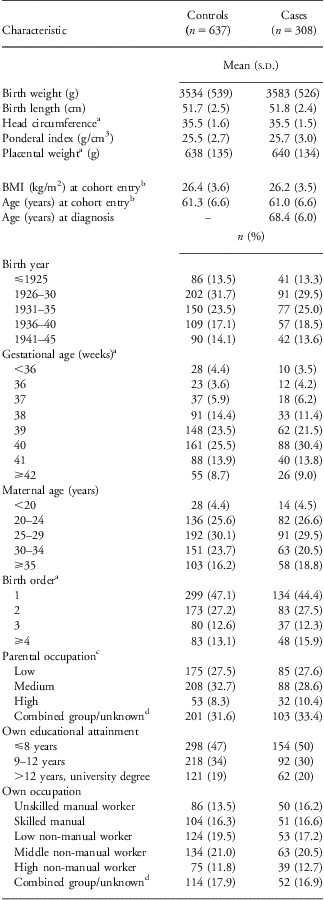
Table 1 shows the characteristics of study participants by case status. Cases had a statistically non-significantly higher mean BW than controls (3583 g, CI 3523–3641 g v. 3534 g, CI 3491–3575 g), were more likely to have high BW (>4000 g) than controls (21% v. 18%) and less likely to have BW <3000 g (9% v. 15%). The proportion of offspring with BW <3000 g was slightly lower in aggressive cancer cases (7%) than in non-aggressive cancer cases (11%). Cases did not differ from controls with regard to BMI and SES indicators (parental/own occupation, own education), nor in any other birth size indicator. Median age at diagnosis of PRCA was 68 years (range 51–81).
Perinatal and adult characteristics by prostate cancer status, Malmö Diet and Cancer Study (n = 945)

BMI, body mass index.
aPercentages are of non-missing data. Numbers may not sum to 100% due to rounding and missing data on birth length (1), ponderal index (n = 1), head circumference (n = 57), placental weight (n = 4), gestational age (n = 25) and birth order (n = 8).
bStart of follow-up (1991–1996).
cLow (unskilled manual worker), medium (skilled manual and low non-manual worker), high (middle and high non-manual worker), combined group/unknown: including farmers, employers, self-employed, missing data.
dCombined group/unknown: including farmers, employers, self-employed, missing data.
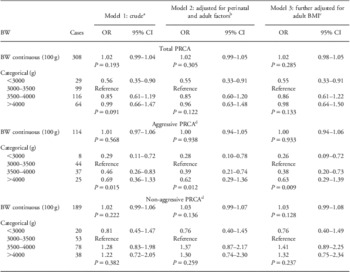
When BW was fitted as a continuous term, we observed a 2% increase in risk with each increment of 100 g [fully adjusted model: odds ratio (OR) 1.02, 0.98–1.05; P = 0.35] for total PRCA, indicating that risk did not increase in a linear manner with increasing BW (Table 2). When using categorical BW, men who weighed under 3000 g at birth had a 45% decreased risk of PRCA (multivariate OR 0.55, 0.33–0.91) compared with men with BW between 3000 and 3500 g (reference). Higher BW (3500–3999 g, >4000 g) was not associated with risk of total PRCA. The crude risk estimates were only marginally attenuated when adjusted for perinatal and adult factors. Using weight and height (both continuous) instead of BMI in the fully adjusted model did not change the OR from the model with BMI (data not shown).
ORs and 95% CIs for total, aggressive and non-aggressive PRCA by BW, Malmö Diet and Cancer Study (n = 945)

OR, odds ratio; CI, confidence interval; PRCA, prostate cancer; BW, birth weight; BMI, body mass index.
aModel 1: crude, unadjusted.
bModel 2: adjusted for gestational age (categorical), maternal age (continuous), birth order (categorical), parental occupation (categorical), educational attainment (categorical), own occupation (categorical).
cModel 3: adjusted for factors in Model 2, and additionally for adult BMI (continuous).
dAggressive PRCA (n = 114) and non-aggressive PRCA (n = 189) due to missing information on subtype in 5 out of 308 cases.
The non-linear relationship between BW and risk of PRCA was limited to those with aggressive PRCA (Table 2). When compared with men with reference BW, BW <3000 g was associated significantly with reduced risk of cancer (fully adjusted OR 0.26, 95% CI 0.09–0.72). Further, men with BW between 3500 and 4000 g had a substantially reduced risk of aggressive tumours (OR 0.38, 95% CI 0.20–0.73) compared with those with BW between 3000 and 3500 g. In contrast, among men with non-aggressive tumours, higher BW (>3500 g) appeared to be associated with increased risk of cancer, but ORs did not significantly vary from unity.
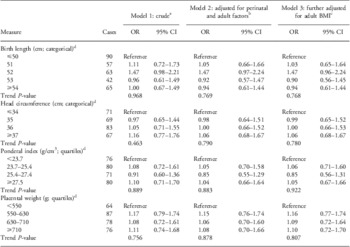
We examined other birth characteristics in relation to PRCA (Table 3). Birth length, head circumference, PI and placental weight were not associated with risk of total PRCA, aggressive or non-aggressive tumours.
ORs and 95% CIs for total prostate cancer by other birth size indicators, Malmö Diet and Cancer Study (n = 945)

OR, odds ratio; CI, confidence interval; BMI, body mass index.
aModel 1: crude, unadjusted.
bModel 2: adjusted for gestational age (categorical), maternal age (continuous), birth order (categorical), parental occupation (categorical), educational attainment (categorical), occupation (categorical).
cModel 3: adjusted for factors in Model 2, and additionally for adult BMI (continuous).
dMissing data: birth length (n = 1), head circumference (n = 57), ponderal index (n = 1), placental weight (n = 4).
Discussion
In this large nested case–control study of Swedish men born between 1923 and 1945 in the cities of Malmö and Lund, we observed a significantly decreased risk of total PRCA for men with BW below 3000 g when compared with men with BW between 3000 and 3500 g (reference) accounting for other perinatal factors and adult body size. Higher BW (>3500 g) was not associated with total PRCA risk. Results from our cancer subtype analysis indicate that the protective effect of BW below 3000 g became particularly apparent in men who presented with aggressive tumours. Notably, among men with this subtype, risk of cancer was also substantially reduced in those who were born with a BW between 3500 and 4000 g when compared with the referent. We found no evidence that other birth size indicators had an effect on risk of total PRCA or subtypes.
Our finding on BW does not corroborate the majorityReference Ekbom, Hsieh and Lipworth10, Reference Tibblin, Eriksson, Cnattingius and Ekbom12–Reference Platz, Giovannucci and Rimm16, Reference Eriksson, Wedel and Wallander19 of previous studies, indicating that larger BW tends to be associated with increased risk of PRCA. In our study, BW <3000 g was associated with a considerable decrease in risk of 45% compared with the reference category (3000–3500 g), and adjusted ORs were slightly reduced for the upper two BW categories. Only one previous reportReference Boland, Mink, Bushhouse and Folsom18 suggested a weak inverse association between BW and PRCA risk. In that US case–control study on early-onset PRCA (cases aged ⩽54 years) using similar BW categorization, but with reference category <3000 g, risk for men with BW >4000 g was reduced by 50%. However, this finding was not confirmed when applied to a second separate control group.Reference Boland, Mink, Bushhouse and Folsom18 As in our study, non-linear associations between BW and PRCA have been demonstrated in previous studies,Reference Ahlgren, Wohlfahrt, Olsen, Sörensen and Melbye13, Reference Cnattingius, Lundberg, Sandin, Gronberg and Iliadou14, Reference Eriksson, Wedel and Wallander19 yet suggesting excess risk especially among offspring with larger BW.
In the present study, we examined aggressiveness defined by stage and grade of the tumour in relation to birth size. The reduction in risk with BW < 3000 g was larger in men with aggressive tumours (n = 114) than in PRCA overall (74% v. 45%). The OR was also reduced by 62% for men with BW between 3500 and 4000 g when compared with the referent. In contrast, none of these associations were present with non-aggressive disease. To our knowledge, only two other studiesReference Nilsen, Romundstad, Troisi and Vatten15, Reference Platz, Giovannucci and Rimm16 investigated aggressiveness of incident PRCA in relation to birth size. Elevated risk estimates with higher BW categories were reported to be slightly stronger for metastatic (n = 33)Reference Nilsen, Romundstad, Troisi and Vatten15 or high stage/grade (n = 213)Reference Platz, Giovannucci and Rimm16 tumours than for overall PRCA. When comparing the highest v. the lowest (referent) BW categories, the increase in risk was 50% for metastatic tumours (RR 1.5, 95% CI 0.6–3.7)Reference Nilsen, Romundstad, Troisi and Vatten15 and 30% for high stage/grade tumours (RR 1.30, 95% CI 0.80–2.10).Reference Platz, Giovannucci and Rimm16
The somewhat disparate findings on the BW–PRCA association for total PRCA or tumour subtype, between our study and previous reports, may be partly because of differences in study design and methodology. Direct comparisons between our study and those with a positive exposure–outcome relation are limited because of differences in the categorization of BW and use of reference categories. However, this may not explain the difference in the observed risk pattern in the present study. For instance, findings from the Swedish population-based prospective study of men born in 1913,Reference Eriksson, Wedel and Wallander19 using a compatible reference group of ‘normal’ BW as in this study, indicate no effect of BW ⩽3000 g on risk of overall PRCA, but excess risk (RR 1.62, 95% CI 1.04–2.51) for those men born with high BW (>4250 g).
Moreover, relevant studies adjusted for different sets of perinatal and adult variables,Reference Ekbom, Wuu and Adami11, Reference Nilsen, Romundstad, Troisi and Vatten15–Reference McCormack, dos Santos Silva, Koupil, Leon and Lithell17, Reference Eriksson, Wedel and Wallander19 or not at all.Reference Ekbom, Hsieh and Lipworth10, Reference Tibblin, Eriksson, Cnattingius and Ekbom12, Reference Ahlgren, Wohlfahrt, Olsen, Sörensen and Melbye13 One study used a special population, that is twins,Reference Cnattingius, Lundberg, Sandin, Gronberg and Iliadou14 and the US study of Health ProfessionalsReference Platz, Giovannucci and Rimm16 relied on self-reported BW, which is known to be more prone to measurement error than those based on birth records.Reference Silva Idos, De Stavola and McCormack5 Furthermore, it has been suggestedReference Ekbom4 that the retrospective design of the latter study was likely to mask any decreased risk for PRCA in men with low BW, as it was confined to survivors, and low BW has been associated with elevated cardiovascular mortality.
Adjustment for selected perinatal and maternal characteristics, available indicators of SES, and adult size did not materially change the BW–PRCA association in our study. Specifically, gestational age did not appreciably influence this relationship, which is compatible with another report,Reference Eriksson, Wedel and Wallander19 and was in itself not associated with PRCA risk (data not shown). The latter finding contrasts two studies that observed an inverse associationReference Ekbom, Wuu and Adami11 or a non-significant positive associationReference McCormack, dos Santos Silva, Koupil, Leon and Lithell17 between 1-week increase in length of gestation and PRCA risk. Similarly, no consistent association between gestational age at birth and risk of breast cancer has been observed.Reference Potischman, Troisi and Vatten6, Reference Lahmann, Gullberg and Olsson30 In the present study, maternal age and birth order were not related to PRCA. There is only little and inconsistent evidence to date that parental age and birth order are important for PRCA risk.Reference Ekbom, Hsieh and Lipworth10, Reference Ekbom, Wuu and Adami11, Reference Nilsen, Romundstad, Troisi and Vatten15, Reference Janerich, Hayden, Thompson, Selenskas and Mettlin31, Reference Zhang, Kreger and Dorgan32
We particularly aimed at examining the impact of adult body size on the association between BW and risk of PRCA, and observed that attained BMI did not mediate this association, nor did weight and height instead of body mass. Higher BMI was not associated with increasing risk of total or subtype PRCA in this nested case–control study and is in concordance with the total cohort of men in the MDC study.Reference Wallström, Bjartell, Gullberg, Olsson and Wirfält24 Considering our finding and that of others,Reference Eriksson, Wedel and Wallander19 there seems to be a negligible, if any, impact of attained BMI at midlife or later on the early size–PRCA relationship. This may not be surprising given the rather inconsistent evidence for the association between BMI and PRCA.Reference MacInnis and English22
In our study, birth length was unrelated to risk of PRCA. In contrast, two previous studies suggested a weak association between birth length and risk of total PRCA,Reference Nilsen, Romundstad, Troisi and Vatten15, Reference Boland, Mink, Bushhouse and Folsom18 but with significant risk estimates only among men with metastatic PRCA in the Norwegian study,Reference Nilsen, Romundstad, Troisi and Vatten15 despite its small sample size (n = 33). Head circumference, PI and placental weight, an important correlate of pregnancy hormone levels, were not related to PRCA in the present study, a finding compatible with few past reports.Reference Ekbom, Hsieh and Lipworth10, Reference Ekbom, Wuu and Adami11, Reference Nilsen, Romundstad, Troisi and Vatten15, Reference McCormack, dos Santos Silva, Koupil, Leon and Lithell17
Strengths of our study include its prospective design and use of cancer registry data and perinatal information from archived hospital birth records, all of which are reducing potential bias affecting the results. Further, in contrast to previous studies, we were able to adjust for both selected perinatal and adult factors simultaneously, hence minimizing confounding. It cannot be ruled out that some confounding bias is still present, due to the lack of inclusion of other potential risk factors; yet adult risk factors other than family history, information that was not available to us, have not been clearly established for PRCA. Genetic components possibly confound the BW–PRCA association as suggested by a recent twin study.Reference Cnattingius, Lundberg, Sandin, Gronberg and Iliadou14 Confounding by SES may not have been captured entirely by the three social indicators included,Reference Lawlor, Davey Smith, Kundu, Bruckdorfer and Ebrahim33 but residual confounding in this study is less likely an issue compared with others. None of the previous studies, but one,Reference McCormack, dos Santos Silva, Koupil, Leon and Lithell17 did adjust for SES,Reference Tibblin, Eriksson, Cnattingius and Ekbom12, Reference Ahlgren, Wohlfahrt, Olsen, Sörensen and Melbye13, Reference Platz, Giovannucci and Rimm16, Reference Boland, Mink, Bushhouse and Folsom18 or adjusted for parental SES only.Reference Ekbom, Hsieh and Lipworth10, Reference Ekbom, Wuu and Adami11, Reference Cnattingius, Lundberg, Sandin, Gronberg and Iliadou14, Reference Nilsen, Romundstad, Troisi and Vatten15, Reference Eriksson, Wedel and Wallander19 Although we may have had limited statistical power for the tumour subtype analysis, the observed associations for aggressive tumours were stronger than those reported by others with smallerReference Nilsen, Romundstad, Troisi and Vatten15 or larger sample size.Reference Platz, Giovannucci and Rimm16 Overall, the total number of PRCA cases (n = 308) in our study was larger than that for the majority of other investigations,Reference Ekbom, Hsieh and Lipworth10, Reference Tibblin, Eriksson, Cnattingius and Ekbom12, Reference Ahlgren, Wohlfahrt, Olsen, Sörensen and Melbye13, Reference Nilsen, Romundstad, Troisi and Vatten15, Reference McCormack, dos Santos Silva, Koupil, Leon and Lithell17–Reference Eriksson, Wedel and Wallander19 except for three (cases n ⩾ 382).Reference Ekbom, Wuu and Adami11, Reference Cnattingius, Lundberg, Sandin, Gronberg and Iliadou14, Reference Platz, Giovannucci and Rimm16
On the basis of the overall inconsistent results of published data to date, the question remains as to how birth size and foetal growth are implicated in PRCA risk. The original hypothesis by TrichopoulosReference Trichopoulos34 that in utero exposure to estrogens would influence risk of breast cancer has been extended to androgen exposure in utero and other hormone-related cancers, including PRCA.Reference Ross and Henderson8, Reference Ekbom, Wuu and Adami11 Experimental data support the hypothesis that perinatal steroid hormone exposure influences the structure and function of the prostate gland.Reference Shibata and Minn35 Aside from high maternal oestrogen and testosterone levels, which are both associated with foetal growth and long-term susceptibility to cancer, the insulin-like growth factor-I hormone has been proposed to be of aetiologic importance for birth size and PRCA as reviewed by others.Reference Eriksson, Wedel and Wallander19 Further, factors that promote foetal growth may alter the number of stem cells and thus influence cancer risk.Reference Johnson, Springer, Bielinsky, Largaespada and Ross36, Reference Risnes, Vatten and Baker37 However, it remains to be elucidated how these suggested biological mechanisms operate precisely and specifically, and which part of the BW range is mostly affected.
In conclusion, in this study of Swedish men, we found evidence of a non-linear relationship between BW and PRCA, with strongly decreased risks especially among men with BW <3000 g and those with aggressive disease. Larger birth size (>3500 g) tended to be inversely related to overall PRCA and aggressive subtype. Our findings add to the existing evidence that this cancer in men seems to be influenced by the intrauterine environment, but in contrast to previous reports we observed that small birth size (BW) is related to reduced PRCA risk, rather than large BW being a risk factor. On the basis of our data, there is no support for a role of birth length or other birth size indicators in the development of PRCA. Because of limited statistical power, especially in the tumour subtype analysis, these findings require further replication in studies with larger sample size.
Acknowledgements
This work was supported by grants from the Swedish Cancer Society (5066-B06-02XBC and 2684-B93-05XAA) and the Swedish Medical Research Council (B93-39X-09534-03C).
We are especially grateful to Ulla Gabrielsson, former midwife at the Skåne University Hospital, Malmö, for her exceptional work in retrieval of the data from archived birth records. We thank Professor Anders Bjartell (Department of Urology, Skåne University Hospital, Malmö) for providing clinical data on cases occurring in 1991–1995 and Louise Marquart (Queensland Institute of Medical Research) for statistical assistance.