Introduction
Mindfulness meditation has become a common method for reducing stress and stress-related psychopathology. In 2017, over 14% of American adults (~14 million) used some form of meditation in the prior year, a threefold increase from 2012 (Clarke & Stussman, Reference Clarke, Barnes, Black, Stussman and Nahin2018; Clarke, Stussman, & Nahin, Reference Clarke, Stussman and Nahin2015). Mindfulness-based interventions such as Mindfulness-Based Stress Reduction (MBSR; Kabat-Zinn, Reference Kabat-Zinn1982) and Mindfulness-Based Cognitive Therapy (MBCT; Segal, Williams, and Teasdale, Reference Segal, Williams and Teasdale2018) are now implemented in in-patient and out-patient psychiatric settings as primary or adjunct treatments for stress, depression and substance abuse (Segal et al., Reference Segal, Williams and Teasdale2018; Witkiewitz, Marlatt, & Walker, Reference Witkiewitz, Marlatt and Walker2005). In addition, they are increasingly being used with other vulnerable populations, including school children. For example, researchers in the UK are undertaking an ambitious study implementing mandatory mindfulness training with tens of thousands of school children (Hayes et al., Reference Hayes, Moore, Stapley, Humphrey, Mansfield, Santos and Deighton2019).
The proliferation of mindfulness interventions in clinical and public settings corresponds with rapid growth in research on mindfulness (American Mindfulness Research Association, 2019). Although considerable research has evaluated the efficacy of manualized mindfulness interventions (e.g. MBSR, MBCT) on clinical conditions and in healthy populations, there is a dearth of reporting on contraindications (Baer, Crane, Miller, & Kuyken, Reference Baer, Crane, Miller and Kuyken2019; Britton, Reference Britton2019; Van Dam et al., Reference Van Dam, van Vugt, Vago, Schmalzl, Saron, Olendzki and Gorchov2017). As a consequence, there exist no rigorous estimates of harm following engagement in a mindfulness-based intervention (Baer et al., Reference Baer, Crane, Miller and Kuyken2019). Scientific (Baer et al., Reference Baer, Crane, Miller and Kuyken2019), as well as media (Grant, Reference Grant2018) outlets, have recently published cautionary notes about the expansion of these techniques absent valid and reliable estimates of harm.
The scientific and contemplative literature contain reports of contraindications (Lindahl, Fisher, Cooper, Rosen, & Britton, Reference Lindahl, Fisher, Cooper, Rosen and Britton2017). A well-conducted qualitative study and anecdotal reports describe severe effects such as the onset of psychosis and mania (Lindahl et al., Reference Lindahl, Fisher, Cooper, Rosen and Britton2017; Van Dam et al., Reference Van Dam, van Vugt, Vago, Schmalzl, Saron, Olendzki and Gorchov2017; Wallace, Reference Wallace2011). However, most contraindication reports follow periods of intensive or long-term practice, not the relatively modest engagement expected in public-facing programs (Britton, Reference Britton2019). Clinicians and the public are nevertheless placed in the difficult position of having to make determinations about the appropriateness of meditation interventions without all of the necessary guidance. Meta-analyses on clinical (Goldberg et al., Reference Goldberg, Tucker, Greene, Davidson, Wampold, Kearney and Simpson2018) and non-clinical populations (Khoury, Sharma, Rush, & Fournier, Reference Khoury, Sharma, Rush and Fournier2015) indicate that mindfulness interventions are effective treatments for a range of conditions. Consequently, researchers have recommended them to clinicians for treatment of stress-related symptoms (Goyal et al., Reference Goyal, Singh, Sibinga, Gould, Rowland-Seymour, Sharma and Haythornthwaite2014), but these recommendations are provided absent good data on the potential for harm.
No consensus operationalization of harm exists (Linden, Reference Linden2013; Taylor, Abramowitz, & McKay, Reference Taylor, Abramowitz and McKay2012). In randomized controlled trials (RCTs), change in groups receiving and not receiving the experimental treatment are statistically compared to determine whether rates of change are significantly different. If one group exhibits average increases in symptoms that are significantly different from another group, such a result indicates harm. However, null hypothesis testing has been criticized for statistical (e.g. detecting a significant effect is largely dependent on sample size; Freiman, Chalmers, Smith, and Kuebler, Reference Freiman, Chalmers, Smith and Kuebler1992) and practical reasons (e.g. statistical significance is not necessarily practically meaningful; Thompson, Reference Thompson2002). In addition, detecting harm based on average rates of change can be problematic because group effects may mask individual harm events that are important to understand (Thompson, Reference Thompson2002).
Thresholds for within-subject or within-group percent change (e.g. >35%) are widely used as benchmarks for treatment-response (Erzegovesi et al., Reference Erzegovesi, Cavallini, Cavedini, Diaferia, Locatelli and Bellodi2001; Revicki, Hays, Cella, & Sloan, Reference Revicki, Hays, Cella and Sloan2008). Although this approach could be used to estimate harm, it has also been criticized as arbitrary and unstandardized (Linden & Schermuly-Haupt, Reference Linden and Schermuly-Haupt2014). Statistically-grounded indices that ostensibly establish clinically significant change have been proposed as well (Jacobson & Truax, Reference Jacobson and Truax1991). After computing clinical v. non-clinical symptom population cut-offs, researchers can examine the proportion of participants moving from a non-clinical to clinical symptom level. This approach has not been widely adopted and has also been critiqued (Linden, Reference Linden2013).
Given a lack of consensus regarding how best to assess harm, one approach that addresses the concerns associated with any one operationalization is to report on multiple harm indices. By estimating harm across multiple indices, we can understand the sensitivity of an effect conditional on how harm is operationalized. For example, if the proportion of individuals who experience an increase in symptoms following treatment is relatively high but the proportion experiencing a >35% increase in symptoms is very low, concerns may be tempered. In contrast, if the proportion of individuals experiencing an increase in symptoms is relatively low but of those individuals a very high proportion experience large increases, there may be cause for concern about adverse outcomes. Similarly, harm can occur in many domains (e.g. global physical symptoms or interpersonal relationships). A comprehensive portrait of harm requires pairing estimates of multiple operationalizations of harm across different domains.
The purpose of this research is to provide clinicians and the public with quantitative estimates of harm following MBSR. Given the lack of consensus on how best to operationalize harm and prior reports that meditation may induce harm in multiple domains (Lindahl et al., Reference Lindahl, Fisher, Cooper, Rosen and Britton2017), we follow Dimidjian and Hollon's (Reference Dimidjian and Hollon2010) simple definition of harm as outcomes worse than would have been expected in the absence of treatment.
On the full sample (N = 2429), we estimate average change on two primary domains: global psychological and physical symptoms. We first assess the proportion of participants reporting elevated post-treatment symptoms. Second, following the convention that a >35% increase in symptoms is clinically meaningful, we analyze the proportion of participants reporting a >35% increase in symptoms. Third, using established clinically significant cut-offs on our measure of global psychological symptoms (Symptoms Checklist-90R Global Severity Index; SCL-90R GSI; Derogatis, Reference Derogatis1992) we compute clinically significant change (Jacobson & Truax, Reference Jacobson and Truax1991) and analyze the proportion of participants that experience clinically significant harm. Fourth, on the subset of the sample from whom we have item-level SCL-90R data (n = 521), we estimate the first three harm indices (average symptom change, proportion worsening and proportion with a >35% increase in symptoms) on five symptom domains that Lindahl et al. (Reference Lindahl, Fisher, Cooper, Rosen and Britton2017) reported to be adversely affected by intensive meditation practice: anxiety and depressive symptoms, interpersonal relations, paranoid ideation, and psychoticism.
Method
Mindfulness-based stress reduction
MBSR is an 8-week manualized program consisting of weekly 2.5-h classes and a 6-h practice day (Kabat-Zinn, Reference Kabat-Zinn2013). It is widely implemented in health care and other public settings and has been studied extensively (Crane et al., Reference Crane, Brewer, Feldman, Kabat-Zinn, Santorelli, Williams and Kuyken2017).
Data
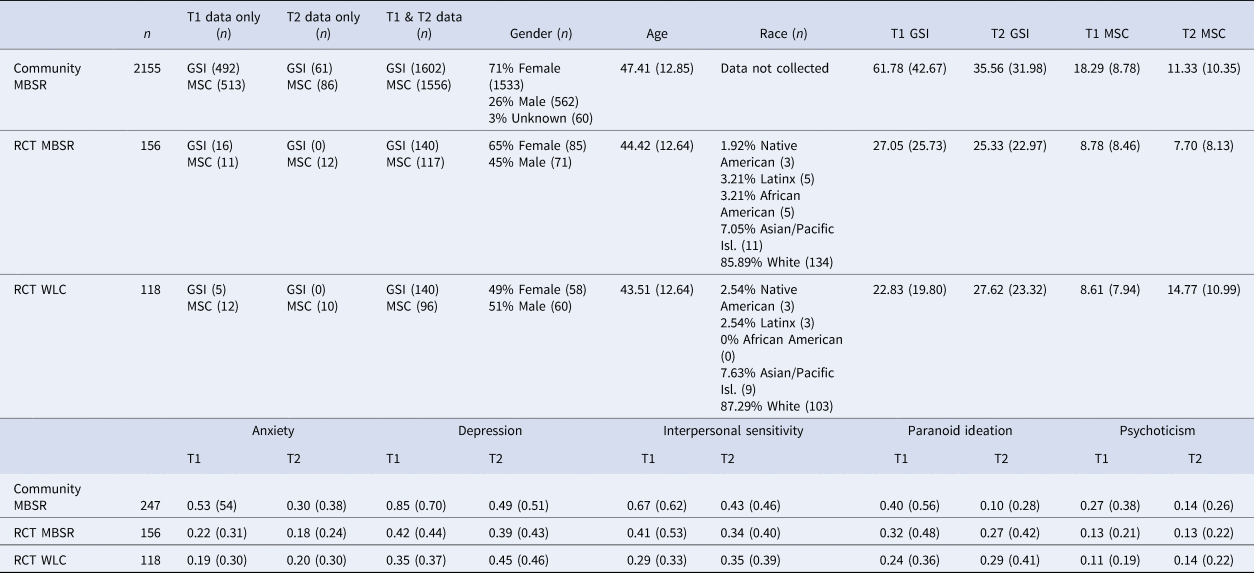
Ethics board approval was obtained in order to access community health clinic records and pair them with the RCT data (Table 1). RCT participants consented to participate after study procedures were fully explained. The community health clinic offers pay-for-service MBSR classes. Beginning in 2002, all individuals registered for MBSR were asked to complete the SCL-90R (Derogatis, Reference Derogatis1992) and the Medical Symptoms Checklist (MSC; Travis, Reference Travis1977) before and following MBSR. Completing the forms was not mandatory and did not affect the ability to participate in MBSR. From 2002 to 2013, the clinic program manager collected forms, entered the summed SCL-90R and MSC total scores into a spreadsheet, and then deleted the item-level data. For data from 2013 to 2016, trained undergraduate research assistants entered raw item-level data into a spreadsheet. We report on all participants from whom at least pre- or post-MBSR GSI and MSC data were collected between 2002 and 2016 (n = 2155). Based on enrollment data during this period, the current sample represents approximately 85% of the total number of health clinic MBSR participants.
Demographics and descriptive statistics by data type

Note: T1 = Pre-test. T2 = Post-test about 10-weeks later. Community MBSR = community health clinic data; RCT MBSR = aggregated data from three consecutive NIH-sponsored clinical trials testing MBSR; RCT WLC = aggregated data from RCT 2 and 3 that included a wait-list control group. GSI = Global Severity Index (global psychological symptoms measure of the Symptom Checklist 90-Revised; Derogatis, Reference Derogatis1992). MSC = Medical Symptoms Checklist (number of bothersome medical symptoms in the prior month; Travis, Reference Travis1977). T1 MSC data missing from RCT MBSR and RCT WLC is due to a technical error.
Because selection and demand biases may influence estimates from the community data, we include data pooled from three consecutive National Institutes of Health-funded RCTs (RCTs 1, 2 and 3; U01AT002114-01A1 and P01AT004952, respectively) that included MBSR (RCT MBSR, n = 156) and a waitlist control condition (WLC, n = 118; RCTs 2 and 3 only). These data are useful comparisons because they were collected contemporaneous to health clinic classes (i.e. 2004 to 2018) in the same city, and RCT MBSR classes were taught by the community MBSR teachers in the same physical space as community MBSR classes.
Outcome measurements
The two primary outcome measures in this study are the GSI (α ⩾ 0.95, all samples), a measure of global psychological symptom severity, and the MSC total score (α ⩾ 0.95, all samples), a measure of the number of bothersome physical symptoms across over 100 common physical ailments. We analyze harm in four ways on the GSI and three on the MSC: (1) mean group change, (2) proportion with increased symptoms, (3) proportion with a >35% increase in symptoms, and (4) on the GSI only, the proportion with clinically significant harm. For clinically significant harm analyses, we apply Schmitz, Hartkamp, and Franke's (Reference Schmitz, Hartkamp and Franke2000) statistically-formulated distribution cutoffs for the GSI; functional symptom levels (GSI < 54), moderately symptomatic (54 ⩽ GSI ⩽ 108), and severely symptomatic (GSI > 108). Participants who moved from functional to moderately symptomatic or moderately to severely symptomatic were coded as experiencing clinically significant harm.
In secondary analyses, we utilize the subset of the sample for whom we have item-level SCL-90R data (n = 521) to estimate all harm indices (except clinically significant change due to a lack of standardized cutoffs) on five symptom clusters. Symptom clusters were selected based on domains previously noted as showing increases in the context of meditation (Lindahl et al., Reference Lindahl, Fisher, Cooper, Rosen and Britton2017). Other SCL-90R clusters were less obviously relevant (e.g. phobic anxiety) and were not examined. The five clusters examined are anxiety (α = 0.84) and depressive symptoms (α = 0.89), interpersonal sensitivity (i.e. discomfort, negative expectancy and self-doubt in social relations; α = 0.84), and the more severe psychiatric symptom clusters of paranoid ideation (α = 0.70) and psychoticism (α = 0.73). Paranoid ideation assesses disordered thinking such as projective thought, suspiciousness and fear of loss of autonomy. Psychoticism represents a spectrum of symptoms from social withdrawal to acute psychotic symptoms.
Missing data approach
Community data had 2.83% and 3.99% missingness at pre-test (GSI/MSC) and 22.83% and 23.81% missingness at post-test (GSI/MSC). Of those participants missing post-test data, 2.00% dropped out of the MBSR class. RCT MBSR and WLC data had no pre-test missingness on the GSI and 9.60% and 8.47% missingness on the MSC, respectively. RCT MBSR and WLC data had 10.26% and 4.24% post-testing GSI missingness and 7.05% and 10.17% post-test MSC missingness, respectively.
Sensitivity analysis examining whether pre-test variables were significantly associated with post-test missingness showed that participation year (z = −2.41, p < 0.001) and gender (z = −2.41, p = 0.016) were negatively associated with providing post-test data (women were more likely to have missing post-test data), while older age (z = 4.25, p < 0.001) was significantly associated with the presence of post-test data. Because observed variables are related to missingness, we assume data are missing at random and appropriate for multiple imputation (Graham, Reference Graham2009). We used predictive mean matching through a multivariate imputation with chained equations procedure, imputing 50 datasets with seed set to 1981 for replicability (Buuren & Groothuis-Oudshoorn, Reference Buuren and Groothuis-Oudshoorn2011). All data processing and analyses were conducted in R v.4.0.0 (R Team, 2014).
Statistical analysis
We conducted intent-to-treat analysis based on the 50 imputed datasets. Rubin's (Reference Rubin2004) pooling rules were followed. In all regression models, age and gender were entered as covariates and data type (community MBSR, RCT MBSR, RCT WLC) was entered as the categorical independent variable of interest. We controlled for Type I error within each outcome (e.g. GSI, MSC, anxiety symptoms) with False Discovery Rate correction (Benjamini & Hochberg, Reference Benjamini and Hochberg1995).
For the analysis of average change in symptoms, we estimated a multiple regression model with post-test score as the dependent variable and pre-test score on the outcome as a covariate. For examining the proportion of participants with increased symptoms (i.e. post-test minus pre-test change > 0), we estimated a multiple logistic regression model with increased symptoms (Yes/No) as the dependent variable. For the analysis of the proportion of participants with a >35% increase in symptoms, we estimated a multiple logistic regression model with >35% increase (Yes/No) as the dependent variable (Erzegovesi et al., Reference Erzegovesi, Cavallini, Cavedini, Diaferia, Locatelli and Bellodi2001). For clinically significant harm on the GSI, we estimated a multiple logistic regression model with a one or two category increase in symptoms (Yes/No) as the dependent variable (Schmitz et al., Reference Schmitz, Hartkamp and Franke2000).
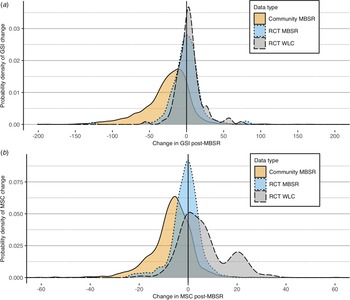
Confidence intervals (95% CIs) for point estimates of mean change were estimated using Rubin's (Reference Rubin2004) rules. Standardized mean differences with their corresponding CIs are provided as an estimate of an effect's magnitude. Point estimate CIs for proportions were estimated by bootstrapping 5000 samples of the original data, imputing 50 datasets on each bootstrapped sample, and computing an average 95% CI from the bootstrapped, imputed datasets (Schomaker & Heumann, Reference Schomaker and Heumann2018). The absolute risk reduction (ARR) – the difference in the incidents of harm in MBSR v. RCT WLC – is provided as an effect size estimate for proportions. CIs for ARRs were estimated in the same way as proportion CIs (Fig. 1).
Smoothed density plot of pre- to post-test psychological (a) and physical (b) symptoms change by data type.
Note: (a) GSI = Global Severity Index from the Symptoms Checkllist 90 Revised (Derogatis, Reference Derogatis1992). (b) MSC = Medical Symptoms Checklist total score (Travis, Reference Travis1977). 0 point = no pre- to post-test change in symptoms.

Results
Change on primary outcomes
Average symptom change
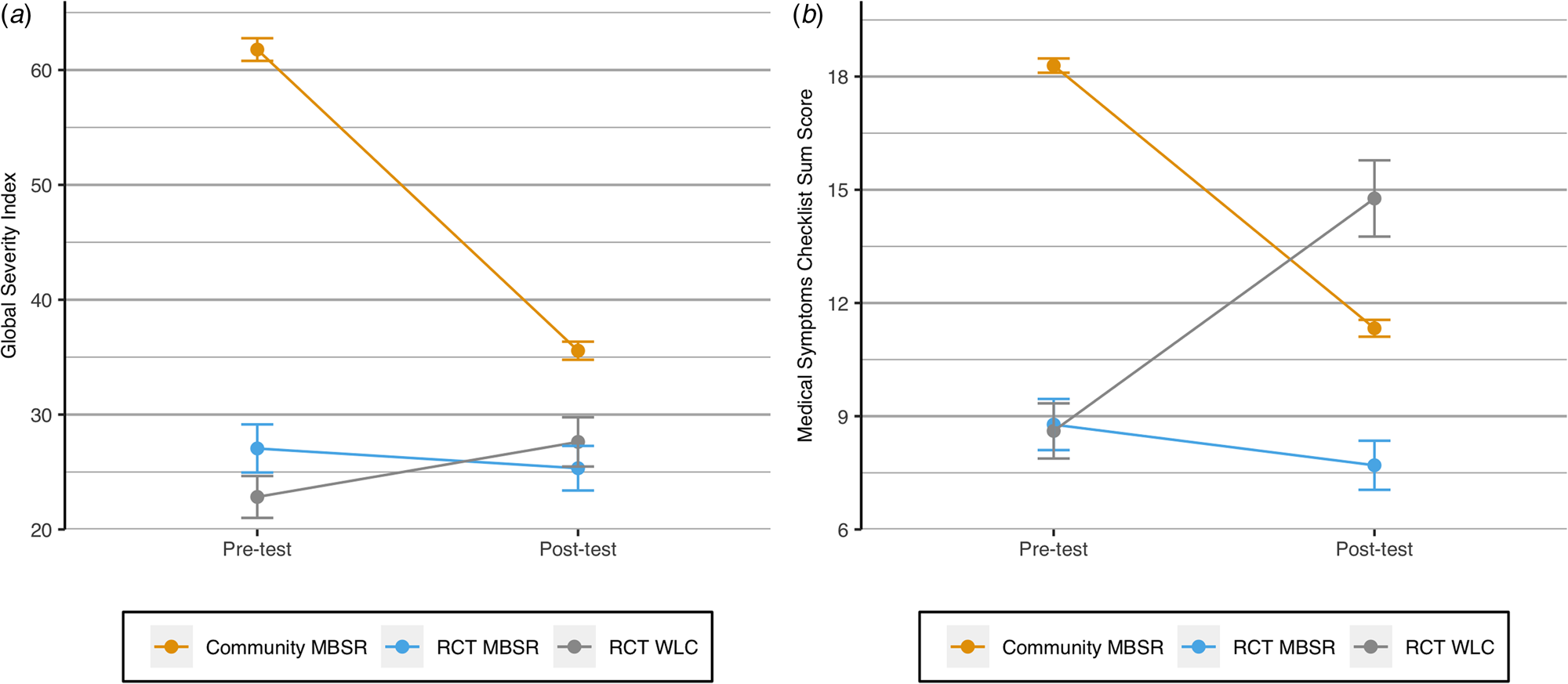
Community MBSR participants reported an average GSI reduction of 26.15 (−42.33%), compared to a 1.72 reduction in RCT MBSR (−6.36%) and a 4.75 increase in RCT WLC (+20.89%). Results from multiple regression analysis showed that predicted change in community MBSR was significantly different than RCT WLC [b = −9.74, s.e. = 2.47, t(1476) = −3.95, p < 0.001, d = −0.30 95% CI (−0.45 to −0.15)] and RCT MBSR [b = −5.93, s.e. = 2.26, t(1075) = −2.63, p = 0.014, d = −0.17 (−0.30 to −0.04)] (Fig. 2). Change in RCT MBSR and RCT WLC was not significantly different [b = −3.80, s.e. = 3.13, t(1333) = −1.22, p = 0.224, d = −0.12 (−0.31 to 0.07)].
Average change in psychological (a) and physical (b) symptoms by data type.
Note: (a) Residualized change on the Global Severity Index was significantly different in community MBSR compared to RCT WLC and RCT MBSR (standardized mean difference = −0.30 and −0.17, respectively). No significant difference was observed between RCT MBSR and WLC (standardized mean difference = −0.12). (b) Residualized change in bothersome physical symptoms on the Medical Symptoms Checklist was significantly different in both community and RCT MBSR compared to RCT WLC (standardized mean differences = −0.70; −0.74, respectively). Change in community and RCT MBSR was not significantly different (standardized mean differences = −0.22).
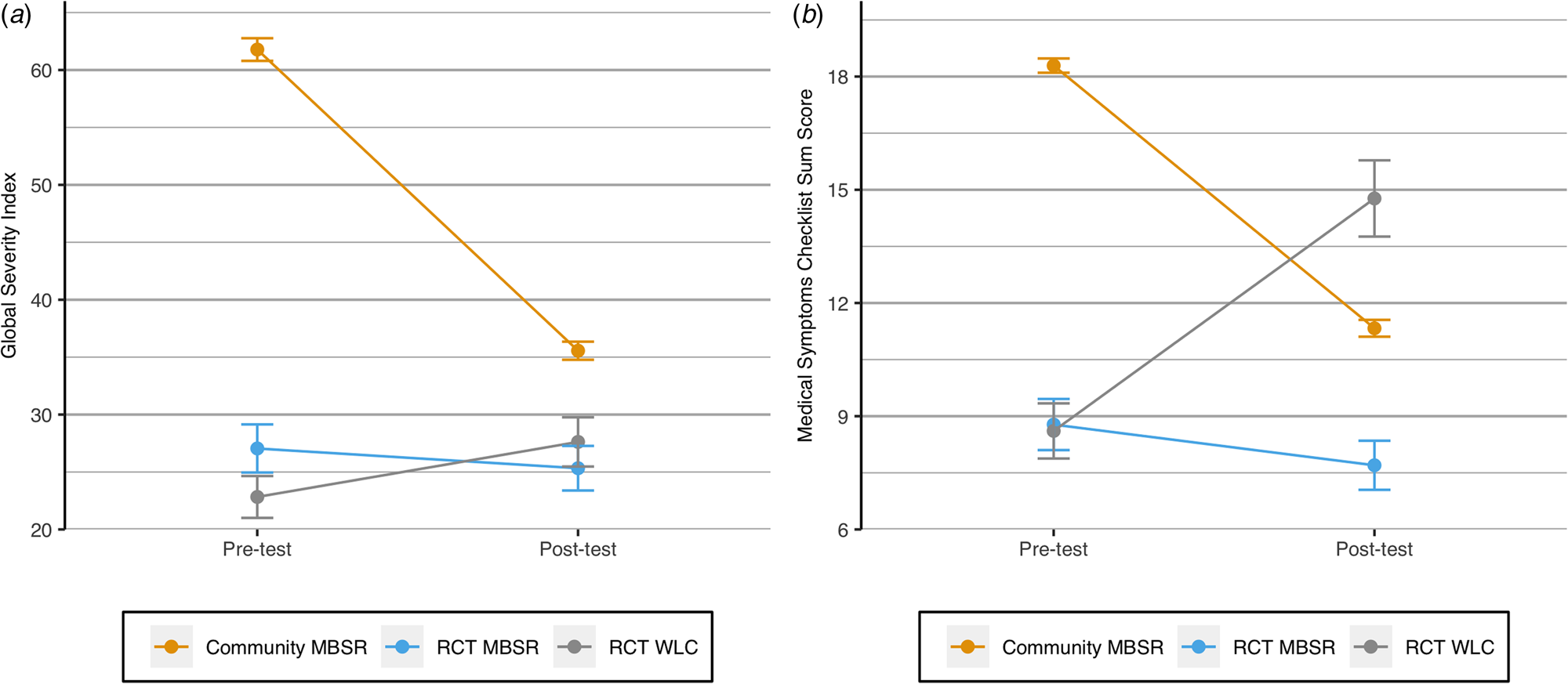
Consistent with psychological symptoms, average predicted change in physical symptoms was −6.95 (−38.00%), – 1.07 (−12.19%) and +6.15 (+71.43%) in the community MBSR, RCT MBSR, and RCT WLC groups, respectively. Change in community MBSR was significantly different from RCT WLC [b = −8.13, s.e. = 0.88, t(776) = −9.19, p < 0.001, d = −0.70 (−0.84 to −0.55)] but not RCT MBSR [b = −1.0, s.e. = 0.73, t(1914) = −1.42, p = 0.157, d = −0.09 (−0.22 to 0.04)]. Change in RCT MBSR was significantly different from RCT WLC [b = −7.09, s.e. = 1.08, t(1269) = −6.58, p < 0.001, d = −0.74 (−0.97 to −0.51)] (Fig. 3).
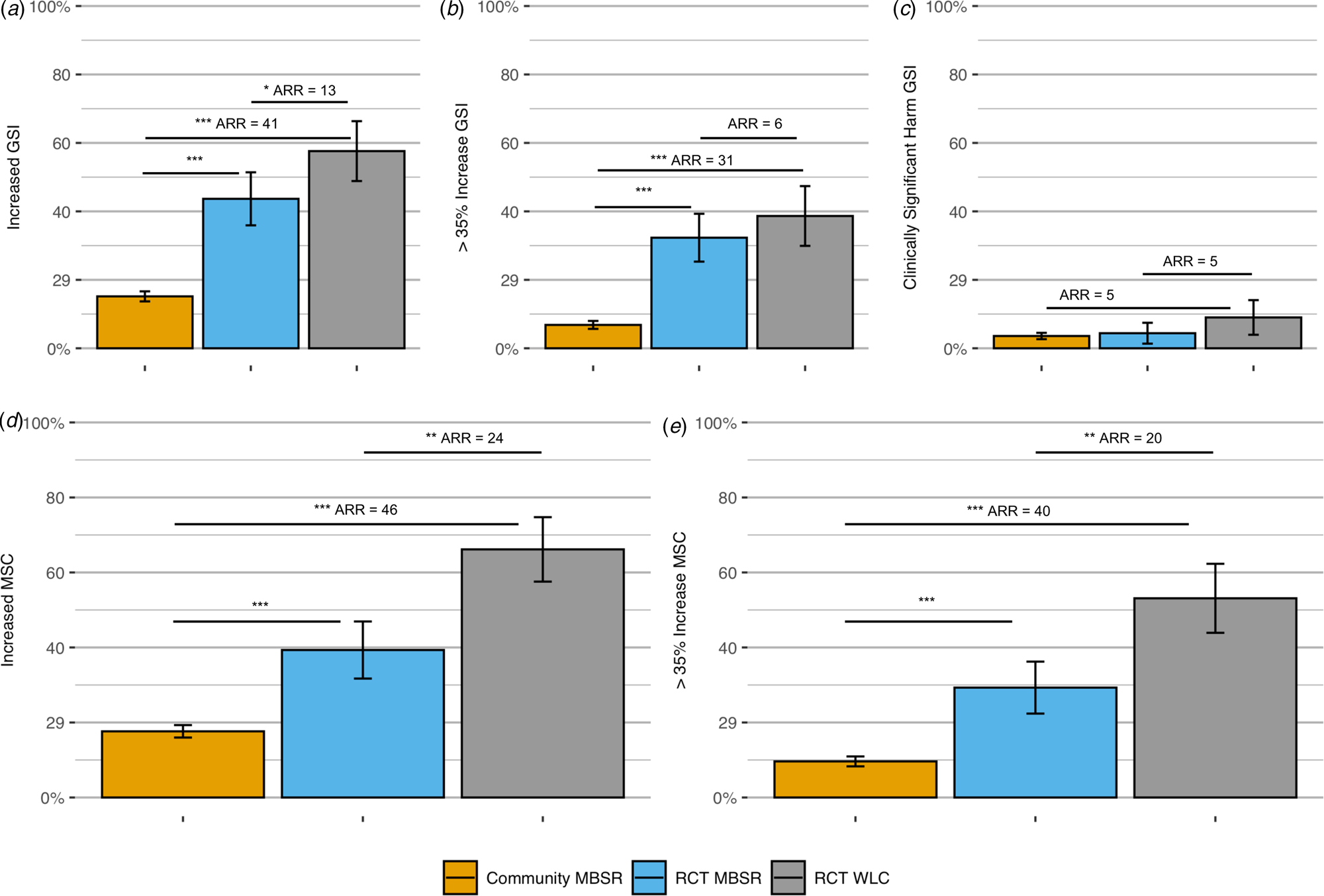
Change of psychological and physical symptom indices of harm.
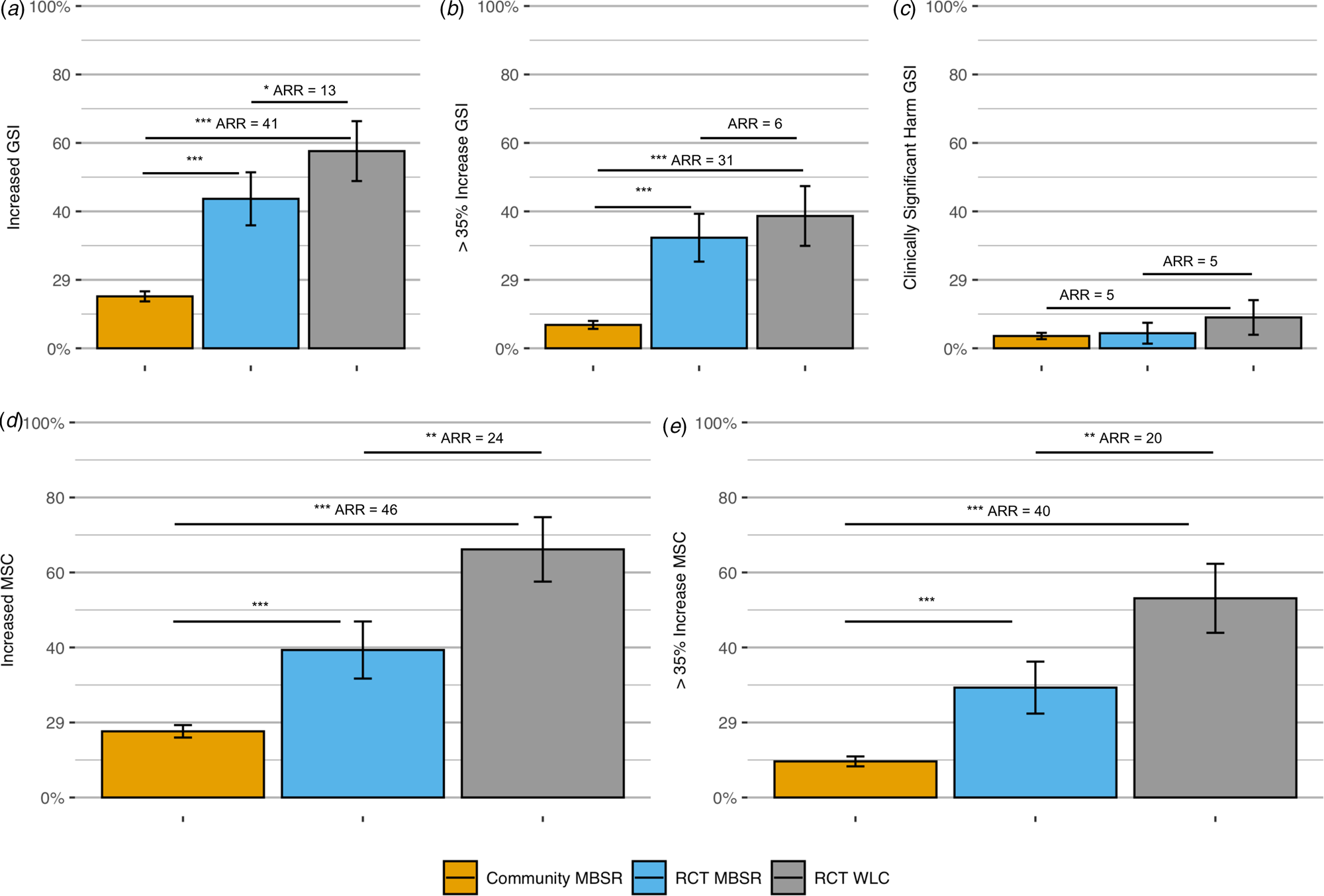
Note: GSI = Global Severity Index of the SCL-90R. MSC = Medical Symptoms Checklist. ARR = Absolute risk reduction; Error bars estimated through multiple imputations on each of the 5000 bootstrapped samples; (a) percent of the sample with increased symptoms at post-test; (b) percent of the sample reporting a >35% increase in global psychological symptoms at post-test; (c) percent of the sample reporting clinically significant change (i.e. moving from a non-clinical to clinical symptom population or from moderately to severely symptomatic); (d) percent of the sample reporting increases in bothersome physical symptoms at post-test; (e) percent of the sample reporting a > 35% increase in bothersome physical symptoms at post-test ***p < 0.001; **p < 0.01; *p < 0.05.
Proportion with increased symptoms
Among community MBSR participants, 15.17% (13.90–17.38) experienced greater symptoms at post-test compared to 43.67% (36.36–51.85) and 57.61% (48.84–66.34) of RCT MBSR and WLC participants, respectively (Fig. 2). The proportion of community MBSR participants reporting increased symptoms at post-test was significantly smaller than RCT WLC [z = −9.36, p < 0.001, ARR = 41 (32.27–49.97)] and RCT MBSR (z = −7.78, p < 0.001). The proportion of RCT MBSR reporting increased symptoms was significantly smaller than in RCT WLC [z = −2.05, p = 0.041, ARR = 13 (1.65–24.79)].
Consistent with psychological symptoms, 17.64% (16.31–19.63) of community MBSR, 39.32% (32.56–47.77) of RCT MBSR, and 66.15% (55.25–72.43) of RCT WLC reported greater physical symptoms at post-test. The proportion of community MBSR participants reporting increased symptoms was significantly smaller than RCT WLC [z = −9.83, p < 0.001, ARR = 46 (37.90–54.64)], and RCT MBSR (z = −4.23, p < 0.001). The proportion of RCT MBSR reporting increased symptoms was significantly smaller than in RCT WLC [z = −5.32, p < 0.001, ARR = 24 (12.52–36.11)].
Proportion with >35% symptom increase
In community MBSR, 6.83% (6.64–8.96) of participants reported a >35% increase on the GSI from pre- to post-test compared to 32.31% (25.71–39.69) of RCT MBSR and 38.65% (29.92–47.38) of RCT WLC participants. Community MBSR participants were significantly less likely to experience >35% increases on the GSI at post-test compared to RCT WLC [z = −9.22, p < 0.001, ARR = 31 (22.19–39.80)], and RCT MBSR (z = −9.03, p < 0.001). There was no difference between RCT MBSR and RCT WLC rates of > 35% increases in symptoms [z = −1.01, p = 0.298, ARR = 6 (−5.10 to 16.63)] (Fig. 2).
Community MBSR had the lowest proportion of participants reporting a >35% increase in physical symptoms at post-test 9.62% (9.03–11.66) compared to RCT MBSR 29.30% (23.31, 37.16), and RCT WLC 53.11% (41.20–59.60). Community MBSR had significantly fewer participants reporting >35% increases in symptoms compared to RCT WLC [z = −10.52, p < 0.001 ARR = 40 (30.79–48.99)] and RCT MBSR (z = −6.44, p < 0.001). RCT MBSR had significantly fewer participants reporting >35% increases in symptoms than RCT WLC [z = −3.55, p = 0.004, ARR = 20 (8.67–31.83)].
Clinically significant harm
Applying Schmitz et al.'s (Reference Schmitz, Hartkamp and Franke2000) framework, among the subpopulation of participants reporting functional symptom levels at pre-test, 3.59% (3.19–5.03) of community MBSR, 4.41% (1.55–7.65) of RCT, and 9.01% (4.07–14.19) of WLC reported clinically significant harm (Fig. 2). No significant differences in rates of clinically significant harm were observed between groups (ps > 0.05). The ARR relative to RCT WLC was 5 for both community (−0.09 to 10.01) and RCT MBSR (−1.03 to 10.76).
Change on secondary outcomes
Details of all secondary outcome analyses are provided in online Supplementary Materials Table S1.
Average symptom change
Average change in community MBSR was significantly different than RCT WLC on depressive symptoms [p = 0.003, d = −0.35 (−0.49 to −0.13)] and paranoid ideation [p < 0.001, d = −0.60 (−0.79 to −0.40)], but not on psychoticism [p = 0.051, d = −0.23 (−0.42 to −0.04)] or interpersonal sensitivity [p = 0.074, d = −0.19 (−0.36 to −0.03)] following error correction. No difference was observed in anxiety symptoms [p = 0.678, d = −0.06 (−0.22 to 0.10)]. There were no significant differences between RCT MBSR and RCT WLC (all ps > 0.150).
Community and RCT MBSR change was significantly different on depressive symptoms [p = 0.050, d = −0.18 (−0.34 to −0.01)] and paranoid ideation [p < 0.001, d = −0.30 (−0.48 to −0.12)], but not on psychoticism following error correction [p = 0.053, d = −0.19 (−0.42 to −0.04)]. No differences were observed on anxiety symptoms [p = 0.868, d = −0.01 (−0.17 to 0.15)] or interpersonal sensitivity [p = 0.438, d = −0.06 (−0.21 to 0.09)].
Proportion with worsening symptoms
The proportion of participants reporting greater symptoms at post-test was significantly smaller in community RCT compared to RCT WLC on depressive symptoms [p < 0.001, ARR = 30 (20.33–40.82)], interpersonal sensitivity [p = 0.015, ARR = 19 (9.36–30.78)], paranoid ideation [p < 0.001, ARR = 27 (17.61–37.35)], and psychoticism [p < 0.001, ARR = 19 (8.50–27.68)], but not anxiety following error correction [p = 0.093, ARR = 14 (4.14–23.26)]. RCT MBSR rates of increased symptoms were not significantly different than RCT WLC on any symptom cluster following error correction: anxiety [p = 0.693, ARR = 4 (−8.91 to 16.74)]; depression [p = 0.500 ARR = 7 (−4.66 to 17.90)]; interpersonal sensitivity [p = 0.150, ARR = 8 (−2.68 to 20.60)]; paranoid ideation [p = 0.054, ARR = 17 (7.33–27.00)]; and psychoticism [p = 0.321, ARR = 8 (−3.59 to 18.72)].
Community MBSR rates of increased symptoms differed from RCT MBSR on depressive symptoms (p < 0.001), but not anxiety symptoms (p = 0.093); interpersonal sensitivity (p = 0.150), paranoid ideation (p = 0.054); psychoticism (p = 0.072) following error correction.
Proportion with >35% increase in symptoms
The proportion of community MBSR participants reporting a > 35% increase in symptoms was significantly smaller than RCT WLC and RCT MBSR on all secondary outcomes: anxiety symptoms [p = 0.002, ARR = 14 (5.21–23.45); p = 0.015]; depressive symptoms [p < 0.001, ARR = 30 (21.27–39.50); p < 0.001], interpersonal sensitivity [p < 0.001, ARR = 18 (9.30–27.95); p = 0.020]; paranoid ideation [p < 0.001 ARR = 25 (15.85–35.01); p = 0.022]; and psychoticism [p < 0.001, ARR = 18 (7.70–26.30); p = 0.008], for comparisons with RCT WLC and RCT MBSR, respectively. A significantly lower proportion of RCT MBSR compared to RCT WLC participants reported a >35% increase in symptoms on paranoid ideation [p = 0.019, ARR = 16 (6.64–26.58)]. There were no other differences between RCT MBSR and RCT WLC on anxiety symptoms [p = 0.896, ARR = 3 (−9.01 to 14.69)]; depressive symptoms [p = 0.274, ARR = 7 (−4.16 to 18.45)], interpersonal sensitivity [p = 0.158, ARR = 7 (−3.34 to 17.30)]; or psychoticism [p = 0.206, ARR = 8 (−2.94 to 18.18)].
Associations of baseline symptoms, harm and drop-out
Higher baseline symptoms were not significantly associated with any index of harm on primary or secondary outcomes or with drop-out (all ps > 0.05).
Discussion
Using population health records from 2155 community MBSR participants and data from 274 RCT participants collected contemporaneously, we estimate the prevalence of multiple indices of harm following MBSR. Applying Dimidjian and Hollon's (Reference Dimidjian and Hollon2010) definition of harm as outcomes worse than would have been expected in the absence of treatment, regardless of how harm was operationalized, the harm domain assessed (i.e. GSI, anxiety), or MBSR context (community or RCT), we find no evidence that rates of harm following MBSR are significantly greater than rates of harm following no treatment. To the contrary, on many harm indices across multiple domains, community and RCT MBSR predicted significantly less harm.
We conducted 44 contrasts between an MBSR group and RCT WLC across our 22 estimates of harm, leading to an 89.53% chance of observing at least one statistically significant (p < 0.05) contrast. There was not a single contrast where MBSR led to significantly greater harm, but we observed 22 contrasts in which MBSR led to significantly lower rates of harm than no treatment. We interpret these data as strong evidence that MBSR is no more harmful than no treatment on the indices of harm we estimated. Further, this pattern of results suggests that MBSR may be preventative against increased psychological and physical symptoms.
In practical terms, our results indicate that compared to no treatment, for every 100 individuals engaged in community MBSR, 41 fewer will experience increased psychological symptoms, 31 fewer a >35% increase in psychological symptoms, and five fewer clinically significant harm. Following RCT MBSR, 13 fewer individuals will experience increased psychological symptoms, six fewer a >35% increase in psychological symptoms, and five fewer clinically significant worsening compared to no treatment over the same approximately 10-week period. Harm on bothersome physical symptoms was similar. For every 100 individuals engaged in community or RCT MBSR, 46 and 24 fewer experience increased in physical symptoms, and 40 and 20 fewer a >35% increase in physical symptoms compared to no treatment.
Global metrics of psychological or physical symptoms may mask MBSR-related harm within particular domains of distress. In the subsample of participants for whom we had item-level data, (n = 521), we, therefore, examined five psychological symptom clusters that together comprise many of the domains in which concerns about adverse effects have been reported (e.g. Lindahl et al., Reference Lindahl, Fisher, Cooper, Rosen and Britton2017). Consistent with primary outcome analyses, we find no evidence for increased harm but evidence for salutary MBSR effects. Notably, MBSR's preventative benefits were observed for some metrics of harm across domains, from anxiety and depressive symptoms to perceptions of social relationships, and on more severe psychiatric symptom domains (paranoid ideation and psychoticism).
Comparisons between community MBSR and RCT WLC should be interpreted cautiously. Community MBSR participants selected into and paid for MBSR. As a result of RCT inclusion criteria (e.g. no current psychiatric diagnosis, not currently taking pain medication), community MBSR participants had significantly higher baseline symptoms on all outcomes. Most, but not all, of the evidence that MBSR is protective against increased symptoms relative to WLC base rates were from community MBSR v. RCT WLC contrasts. We are therefore circumspect about the evidence that MBSR is protective. At the same time, because community MBSR participants were more symptomatic, these data suggest that MBSR is no more harmful than no treatment even among participants reporting higher levels of baseline psychological and physical distress. Moreover, baseline symptoms were not significantly associated with harm outcomes or drop-out.
Limitations
There a few important limitations to acknowledge. Because of sample differences, these data do not allow us to conclude that MBSR is protective against base rates of symptom increases. They also do not allow us to explore the possible mechanisms or significance behind the consistent gradation in harm when comparing community MBSR, RCT MBSR, and RCT WLC. The observed protective benefits of the community relative to RCT MBSR could be explained by selection or demand biases, or regression to the mean. It is equally plausible that RCT MBSR effects are diminished, particularly when study inclusion criteria rule out symptomatic participants. MBSR is a behavioral intervention; motivation to engage is an important component in treatment outcomes (Prochaska & Velicer, Reference Prochaska and Velicer1997). Continued research is required to understand these questions and provide insight into the true effects of MBSR.
Although secondary analyses allowed us to examine MBSR-related harm in most categories that have been highlighted as areas of concern, there are other domains in need of investigation. For example, future research should examine harm in family and work life, whether any incidents of harm are related to malpractice, or whether MBSR increases unwanted events (Linden, Reference Linden2013). Relatedly, our ability to examine the role of individual differences in harm was limited. Continued research on the impact of individual differences on harm is needed. In particular, because the community data did not include race/ethnicity, we were not able to examine the effect of race/ethnicity on harm. Lastly, the nature of our assessment methods did not allow us to investigate the possibility that some psychologically difficult experiences may reflect the intended change processes in meditation-based interventions (e.g. discomfort associated with disrupting habitual tendencies) and that individuals' interpretation of these experience may influence their impact (Lindahl et al., Reference Lindahl, Fisher, Cooper, Rosen and Britton2017).
Conclusions
As mindfulness and other forms of meditation rapidly expand in popularity, it is crucial to understand the potential for harm. We find no evidence that MBSR leads to increased incidence of harm and suggestive evidence that MBSR may be protective against the development of harm relative to no treatment. Results were consistent regardless of the operationalization of harm (e.g. a >35% increase in symptoms), the domain of harm (e.g. physical symptoms, anxiety), or the MBSR context (i.e. community or RCT). Coupled with research on the benefits of MBSR, our findings support Goyal et al.'s (Reference Goyal, Singh, Sibinga, Gould, Rowland-Seymour, Sharma and Haythornthwaite2014) conclusion that clinicians should recommend MBSR for psychological stress and physical symptoms.
Although these data provide strong evidence against claims that MBSR may increase harm on the indices we estimated, concerns about adverse meditation effects extend beyond relatively brief, manualized interventions (Baer et al., Reference Baer, Crane, Miller and Kuyken2019; Britton, Reference Britton2019; Lindahl et al., Reference Lindahl, Fisher, Cooper, Rosen and Britton2017). The current research does not shed light on the potential for deleterious outcomes during intensive mediation practice (e.g. intensive retreat). Although the number of individuals for whom such concerns are germane is small, it is nonetheless an important area for future research. However, in the most widely disseminated manualized mindfulness program, MBSR, there appears to be little cause for concern.
Supplementary material
The supplementary material for this article can be found at https://doi.org/10.1017/S0033291720002834.
Acknowledgements
We thank Katherine Bonus, Robert Gillespie, Heather Sorensen, Lisa Thomas-Prince and Margaret Kalscheur for collecting community MBSR data and Jeanette Mumford for consulting on the statistical analyses. Financial support was provided by a National Academy of Education / Spencer Foundation postdoctoral research fellowship to MJH, the National Institutes of Health (U01AT002114-01A1 and P01AT004952) to RJD, Antoine Lutz and MR, the National Center For Complementary & Integrative Health (K23AT010879) to SBG, and by generous donations to the Center for Healthy Minds. The content is solely the responsibility of the authors and does not necessarily represent the official views of the National Institutes of Health.
Author contribution
Matthew J. Hirshberg led data analysis and manuscript writing. All authors participated in the study design and writing of the manuscript as well as the interpretation of results. Melissa Rosenkranz and Richard J. Davidson were involved in the design and data collection of the NIH-sponsored trials. All authors have provided final approval of the manuscript for submission.
Conflicts of interest
Matthew J. Hirshberg is a contracted provider at the community MBSR providing clinic. Richard J. Davidson is the founder, president, and serves on the board of directors for the non-profit organization, Healthy Minds Innovations, Inc. In addition, RJD served on the board of directors for the Mind & Life Institute from 1992 to 2017. No donors, either anonymous or identified, have participated in the design, conduct, or reporting of research results in this manuscript.
Ethical standards
The authors assert that all procedures contributing to this work comply with the ethical standards of the relevant national and institutional committees on human experimentation and with the Helsinki Declaration of 1975, as revised in 2008. All participants in all of the studies included in this manuscript provided their written, informed consent before participating. All methods and procedures were reviewed and approved by the University of Wisconsin Madison Institutional Review Board.