Introduction
Cystic echinococcosis (CE), caused by the metacestode of Echinococcus granulosus, is recognized as one of the world's major zoonoses (Schantz et al., Reference Schantz, Chai, Craig, Eckert, Jenkins, Macpherson, Thakur, Thompson and Lymbery1995). Hydatid disease in farm animals causes considerable economic problems due to loss of edible livers. Significant losses of meat and milk production and fleece values from infected sheep may also occur. These losses are of special significance in countries with low economic outputs where sheep production is of particular importance (Torgerson et al., Reference Torgerson, Dowling and Abo-Shehada2001). Therefore it is justifiable to find reliable data for monitoring epidemiological aspects of disease and to prepare baseline data for future comparison. Although abattoir surveys have limitations, they are an economical way of collecting and analysing information on livestock disease, particularly subclinical conditions. Data on the prevalence of CE in intermediate herbivores provide a very reliable indicator of the extent of local environmental contamination with eggs from carnivores (Ahmadi, Reference Ahmadi2005; Christodoulopoulos et al., Reference Christodoulopoulos, Theodoropoulos and Petrakos2008).
Hydatidosis is a common disease in the Middle East, especially in countries neighbouring Iran. In Iraq, prevalence values of 4.5–44% in sheep, 3.1–26.7% in goats and 4.3–13.9% in cattle have been reported (Molan, Reference Molan1993; Saeed et al., Reference Saeed, Kapel, Saida, Willingham and Nansen2000). In Kuwait, 0.2–11.2% of sheep, 5% of goats and 32.5–40.2% of cattle (Hassounah & Behbehani, Reference Hassounah and Behbehani1976), and in Pakistan, 5.5–9.6% of cattle, 8.3% of sheep and 7.5% of goats were infected (Khan & Haseeb, Reference Khan and Haseeb1984). In Turkey, 26.6% of sheep, 22.1% of goats and 13.5% of cattle were infected with this disease (Umur, Reference Umur2003). Also, the disease has been reported repeatedly from Saudi Arabia and the Levant countries which include Lebanon, Syria, Israel, Palestinian Authority and Jordan (Abo-Shehada, Reference Abo-Shehada1993; Kamhawi et al., Reference Kamhawi, Hijjawi, Abu-Gazaleh and Abbass1995; Abdel-Hafez & Kamhawi, Reference Abdel-Hafez, Kamhawi, Andersen, Ouhelli and Kachani1997; Sadjjadi, Reference Sadjjadi2006).
In Iran, hydatidosis is caused by two species of the genus Echinococcus, namely E. granulosus and E. multilocularis. Echinococcus granulosus occurs in the entire zone of Iran, but E. multilocularis is very less prevalent and has been reported only from the north-western part of Iran (Ardabile province). Up to the present moment, E. multilocularis has not been reported from Khuzestan province (study area) and adjacent provinces. In Iran, CE is a significant endemic and/or hyperendemic disease in various species of domestic food animals such as sheep, goats, cattle and camels, with 1.5–70% prevalence in different geographical regions (Mehrabani et al., Reference Mehrabani, Oryan and Sadjjadi1999; Dalimi et al., Reference Dalimi, Motamedi, Hosseini, Mohammadian, Malaki, Ghamari and Ghaffari-Far2002; Ahmadi, Reference Ahmadi2005; Akhlaghi et al., Reference Akhlaghi, Massoud and Housaini2005; Ansari-Lari, Reference Ansari-Lari2005; Sadjjadi, Reference Sadjjadi2006; Daryani et al., Reference Daryani, Alaei, Arab, Sharif, Dehghan and Ziaei2007; Fakhar & Sadjjadi, Reference Fakhar and Sadjjadi2007). Human cases of CE are reported regularly from different regions of the country (Akhlaghi et al., Reference Akhlaghi, Massoud and Housaini2005; Ahmadi & Dalimi, Reference Ahmadi and Dalimi2006; Sadjjadi, Reference Sadjjadi2006; Rostami-Nejad et al., Reference Rostami-Nejad, Hoseinkhan, Nazemalhosseini, Cheraghipour, Abdinia and Zali2007; Ahmadi & Hamidi, Reference Ahmadi and Hamidi2008; Sarkari et al., Reference Sarkari, Sadjjadi, Beheshtian, Aghaee and Sedaghat2010), including Khuzestan province (Talaiezadeh & Maraghi, Reference Talaiezadeh and Maraghi2006; Rafiei et al., Reference Rafiei, Hemadi, Maraghi, Kaikhaei and Craig2007). The annual surgical cases of human cystic echinococcosis in Iran are reported to be 1–2 per 100,000 people and the sero-prevalence rate of the disease is 3–19% in different areas of the country (Sadjjadi, Reference Sadjjadi2006; Rafiei et al., Reference Rafiei, Hemadi, Maraghi, Kaikhaei and Craig2007; Ahmadi & Hamidi, Reference Ahmadi and Hamidi2008; Sarkari et al., Reference Sarkari, Sadjjadi, Beheshtian, Aghaee and Sedaghat2010). Of course, CE is a notifiable disease in Iran.
Adult E. granulosus has been reported from dogs, jackals and wolves throughout Iran, and the infection rate of the parasite in dogs was reported to range from 2 to 63% (Fallah et al., Reference Fallah, Taherkhani and Sadjjadi1995; Eslami & Hosseini, Reference Eslami and Hosseini1998; Mehrabani et al., Reference Mehrabani, Oryan and Sadjjadi1999; Maleky & Moradkhan, Reference Maleky and Moradkhan2000; Dalimi et al., Reference Dalimi, Motamedi, Hosseini, Mohammadian, Malaki, Ghamari and Ghaffari-Far2002, Reference Dalimi, Sattari and Motamedi2006). In a recent study on echinococcosis in farm dogs, the high prevalence (20%) of E. granulosus was reported from Khuzestan province (Eslami & Hosseini, Reference Eslami and Hosseini1998). Domestic dogs play the most important role in spreading infection in countries of the Middle East, including Iran, via contamination of the environment. In south-western Iran, there is high concentration of pastured livestock on traditional farms. Considering the lack of data on the status of CE in herbivores in Khuzestan province (south-western Iran), the present study was conducted to determine the prevalence of CE in cattle, sheep and goats, and to estimate the annual economic losses because of infection in slaughtered animals in the region, using abattoir data for the 10-year period (1998–2008).
Materials and methods
Survey of slaughtered animals
This study is a retrospective survey covering a period of 10 years from 21 March 1998 to 20 March 2008. All daily condemnation records for cattle, sheep and goats in the large complex abattoir of livestock animals, in Ahwaz (the capital of Khuzestan province, south-western Iran) were used as the sources of data from which the prevalence of liver and lung condemnations due to CE was extracted. As part of an ongoing surveillance system, each slaughtered animal was examined individually by a meat inspector (veterinarian) in the course of his or her routine duties. Diagnosis of hydatid cysts was done macroscopically either by visual inspection or palpation and, where necessary, one or more incisions were made in order to detect small hydatid cysts. The reasons for condemnation of organs, including hydatid cyst, were recorded daily on prepared data sheets. The prevalence was collected on a monthly basis. This time interval was chosen as being likely to indicate any seasonal trends.
Economic loss estimation
Direct and indirect losses were the basis of the estimation of the annual economic losses due to CE. Direct loss was calculated on the basis of condemned organs, whereas indirect losses were estimated from the percentage losses in carcass weight, milk production, fleece value and fertility caused by hydatidosis. The methodology used to estimate economic losses in the slaughtered ruminants was the same as that detailed by Polydorou (Reference Polydorou1981); Torgerson et al. (Reference Torgerson, Dowling and Abo-Shehada2001), Majorowski et al. (Reference Majorowski, Carabin, Kilani and Bensalah2005) and Sariözkan & Yalçin (Reference Sariözkan and Yalçin2009).
Statistical analysis
For analytical purposes the studied period was divided into five 2-year periods: 1998–2000, 2000–2002, 2002–2004, 2004–2006 and 2006–2008. Long-term trends in risk of CE across the 10-year period were obtained and analysed by the analysis of variance (ANOVA) test for trends, for each host and infected organ, separately. In order to calculate odds ratios (ORs) in liver and lung of the animals slaughtered over a 10-year period, the first year's OR was assumed to be 1.00 as the basis for comparison. The seasonal pattern was examined by ANOVA in infected organs for each host separately. Differences in cyst location frequencies were analysed by Student's t-test. All the statistical analyses were performed using SPSS 10 software (SPSS Inc., Chicago, Illinois, USA), and a P value of < 0.05 was considered statistically significant.
Results
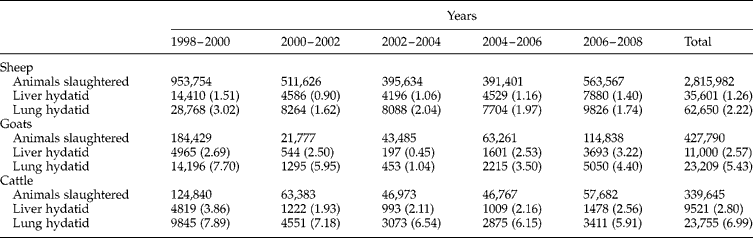
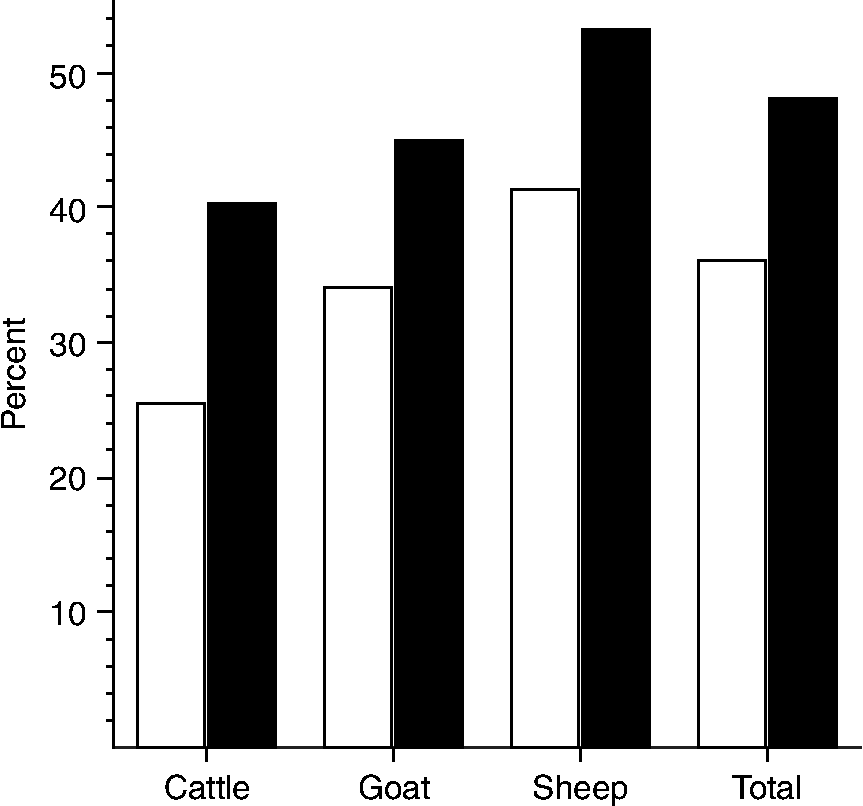
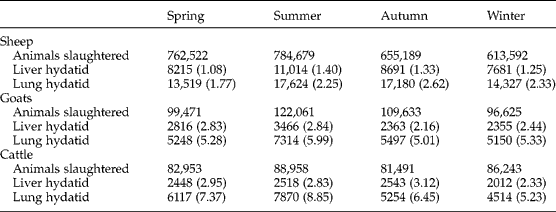
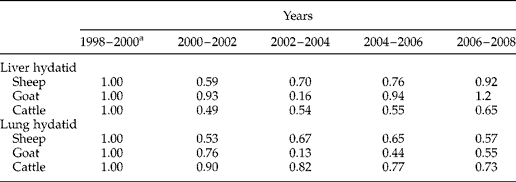
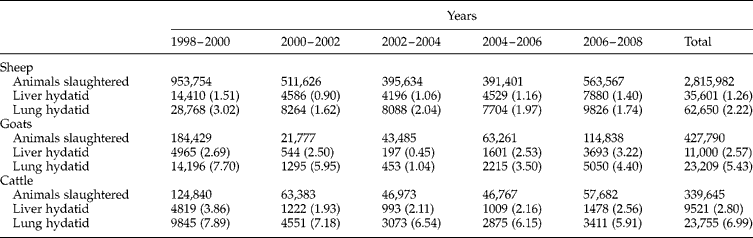
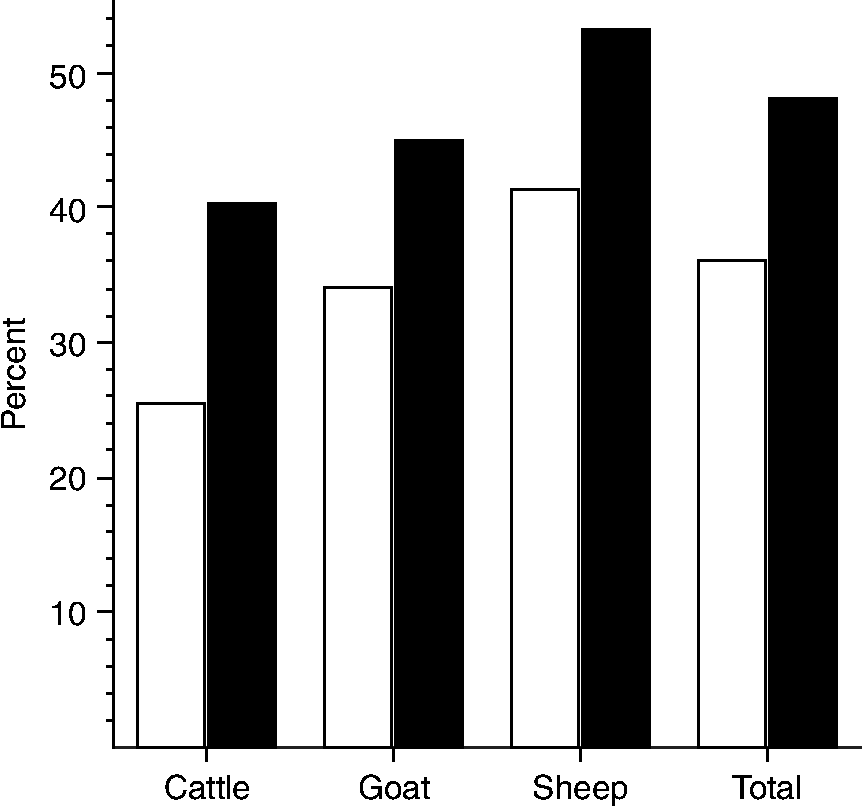
A total of 3,583,417 animals (2,815,982 sheep, 427,790 goats and 339,645 cattle) were slaughtered over a 10-year period from 21 March 1998 to 20 March 2008. The prevalence of pulmonary hydatid disease in sheep, goats and cattle was 2.22, 5.43 and 6.99% respectively; on the other hand, prevalence of hepatic hydatid disease in those animals was 1.26, 2.57 and 2.80%, respectively (table 1). The biennial prevalence rates for this parasitic infection in the 10-year period are shown in table 1. The overall trend was a significant decline in the prevalence of CE (P < 0.01), which was more remarkable in the first several years. The prevalence of liver condemnations due to CE decreased from 3.86 and 1.51% in 1998–2000 to 2.56 and 1.40% in 2006–2008 for cattle and sheep, respectively. Lung hydatidosis was more prevalent than that of livers, but similarly declined from 7.89, 3.02 and 7.70% in 1998–2000 to 5.91, 1.74 and 4.40% in 2006–2008 in cattle, sheep and goats, respectively. The total prevalence of liver and lung hydatidosis in the sheep was significantly lower than that in other livestock (P < 0.001); while the value in the goats and cattle were similar. Overall 155,555 (4.24%) livers and 228,172 (6.37%) lungs of all livestock slaughtered were condemned, and CE was responsible for 36.08% (56,122) and 48.04% (109,614) of total liver and lung condemnations in the study period, respectively (fig. 1). Lung condemnation due to CE was significantly more common than liver condemnation (P < 0.001) for each host species separately (fig. 1). The seasonal variation of CE according to prevalence of liver and lung condemnations is illustrated in table 2. Although the prevalence of hydatid disease recovered from the sheep, cattle and goats varied in different seasons, there was no statistical difference between various seasons. The overall declining trend of odds ratios (ORs) was still observed and was statistically significant (P < 0.01), however, the details varied slightly in some years (table 3).
Changes in the biennial prevalence rates (%) of hydatid disease for sheep, goats and cattle slaughtered in Ahwaz, south-western Iran from March 1998 to March 2008.
Comparison of livers (white bars) and lungs (black bars) condemned due to hydatidosis in farm animals slaughtered in Ahwaz, south-western Iran, from March 1998 to March 2008.
Frequencies and percentages of seasonal prevalence of hydatidosis in slaughtered herbivores from March 1998 to March 2008, in Ahwaz, south-western Iran.
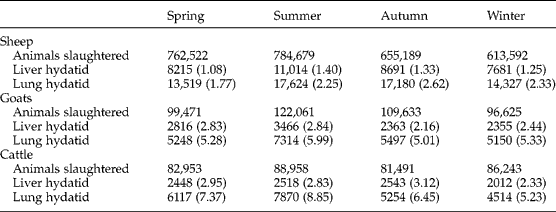
Figures in parentheses represent percentage.
Odds ratios for number of liver and lung condemnations due to hydatidosis in sheep, goats and cattle slaughtered in Ahwaz, south-western Iran from March 1998 to March 2008.
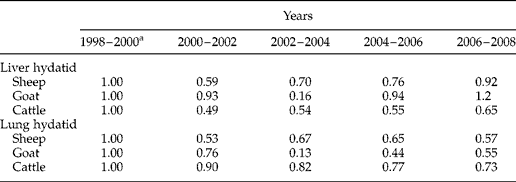
a Assuming the 1998–2000 year OR equal to 1.00 as the basis for comparison.
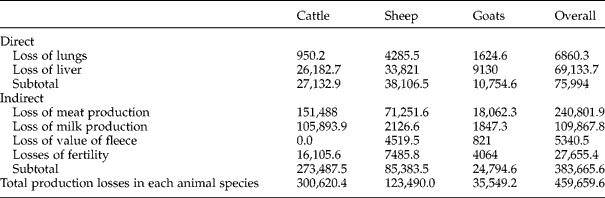
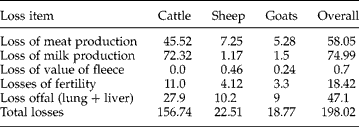
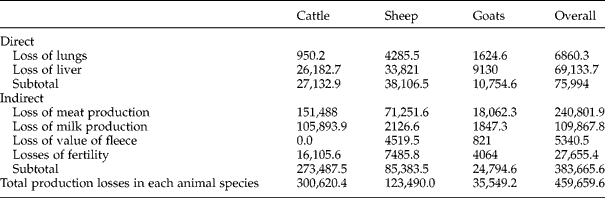
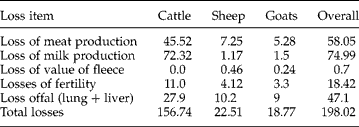
The estimated annual losses from CE for each livestock species slaughtered at Ahwaz abattoir, based on market prices in 2008, are shown in table 4. Direct, indirect and total financial losses in all ruminants slaughtered due to CE were estimated at US$75,994, US$383,665.6 and US$459,659.6 per annum, respectively. Production losses per infected animal due to CE in the region are presented in table 5.
Annual losses in US$ due to cystic echinococcosis in farm animals slaughtered at Ahwaz abattoir, south-western Iran.
Production losses in US$ per infected farm animal due to cystic echinococcosis in Ahwaz, south-western Iran.
Discussion
Cystic echinococcosis is a type of disease which is not apparent to farmers but is of considerable economic and public health importance. Diagnosis of CE in intermediate hosts is hindered by the absence of reliable tests for use in live animals. Although various imaging techniques have been used for the diagnosis of CE in humans, there still are problems associated with their application to ruminants. Most prevalence studies have relied on slaughter data (Blamier et al., Reference Blamier, Goodhand and Taylor1980; Al-Yaman et al., Reference Al-Yaman, Assaf, Hailat and Abdel-Hafez1985; Kamhawi et al., Reference Kamhawi, Hijjawi, Abu-Gazaleh and Abbass1995; Saeed et al., Reference Saeed, Kapel, Saida, Willingham and Nansen2000; Ahmadi, Reference Ahmadi2005; Ansari-Lari, Reference Ansari-Lari2005; Daryani et al., Reference Daryani, Alaei, Arab, Sharif, Dehghan and Ziaei2007; Fakhar & Sadjjadi, Reference Fakhar and Sadjjadi2007), as this is an economical way of collecting and analysing information on livestock disease, particularly subclinical conditions. It is suggested that an efficient meat inspection service should function as an important monitor of animal disease, being particularly valuable in the field of chronic and ill-defined conditions which are not apparent to either the stock owner or his veterinary surgeon but must be of considerable economic and animal health significance (Blamier et al., Reference Blamier, Goodhand and Taylor1980; Ansari-Lari, Reference Ansari-Lari2005). Also, feedback from the slaughterhouse to the individual farm is of great value in the field of preventive medicine. Hydatid disease is an important medical and veterinary problem in Iran, and domestic food animals, including cattle, sheep and goats, are major reservoirs for the disease in humans.
In the present study, the prevalence of hydatid disease in the region (table 1) was relatively lower than the reports from neighbouring countries in the Middle East, such as Iraq (Saeed et al., Reference Saeed, Kapel, Saida, Willingham and Nansen2000), Kuwait (Hassounah & Behbehani, Reference Hassounah and Behbehani1976) and Jordan (Abo-Shehada, Reference Abo-Shehada1993; Kamhawi et al., Reference Kamhawi, Hijjawi, Abu-Gazaleh and Abbass1995). From Iran, based on abattoir surveys, the prevalence of hydatidosis of sheep in different regions of the country had been reported to be 8.1% and corresponding figures for cattle, goats and camels were 12, 6.5 and 35.2%, respectively (Dalimi et al., Reference Dalimi, Motamedi, Hosseini, Mohammadian, Malaki, Ghamari and Ghaffari-Far2002; Ahmadi, Reference Ahmadi2005). The present study shows that the infection rate of livestock was generally lower in Khuzestan province than the mean of the country, whereas in Fars province, Mehrabani et al. (Reference Mehrabani, Oryan and Sadjjadi1999) gave data for 1996–1997, and Ansari-Lari (Reference Ansari-Lari2005) for 1999–2004, close to the present results. In the present study, the prevalence rate of hydatid cyst in sheep was significantly lower than in other intermediate hosts (P < 0.001). However, this finding contrasts with reports in many parts of Iran, such as Ansari-Lari (Reference Ansari-Lari2005) in Shiraz province, Daryani et al. (Reference Daryani, Alaei, Arab, Sharif, Dehghan and Ziaei2007) in Ardabil province, Akhlaghi et al. (Reference Akhlaghi, Massoud and Housaini2005) in Kurdestan province, Fakhar & Sadjjadi (Reference Fakhar and Sadjjadi2007) in Qom province and Dalimi et al. (Reference Dalimi, Motamedi, Hosseini, Mohammadian, Malaki, Ghamari and Ghaffari-Far2002) in the western part of Iran, and of other countries, such as Iraq (Saeed et al., Reference Saeed, Kapel, Saida, Willingham and Nansen2000), the eastern part of Kuwait (Hassounah & Behbehani, Reference Hassounah and Behbehani1976) and Jordan (Abo-Shehada, Reference Abo-Shehada1993; Kamhawi et al., Reference Kamhawi, Hijjawi, Abu-Gazaleh and Abbass1995), where the prevalence of CE in sheep was higher than that in cattle or goats. The overall trend was a significant decline in the prevalence of CE over a 10-year period (P < 0.01), which was more remarkable in the first several years. The prevalence of liver condemnations due to CE decreased from 3.86 and 1.51% in 1998–2000 to 2.56 and 1.40% in 2006–2008 for cattle and sheep, respectively. Lung hydatidosis was more prevalent than liver, but similarly declined from 7.89, 3.02 and 7.70% in 1998–2000 to 5.91, 1.74 and 4.40% in 2006–2008 in cattle, sheep and goats, respectively. The obtained results were confirmed by Ansari-Lari (Reference Ansari-Lari2005) in Shiraz province (southern part of Iran) where the prevalence of liver condemnations due to CE decreased from 2.10, 1.80 and 1.00% in 1999–2000 to 0.62, 0.33 and 0.20% in 2003–2004 for cattle, sheep and goats, respectively; and also lung hydatidosis declined from 3.00, 4.57 and 4.40% in 1999–2000 to 1.31, 1.53 and 0.57% in 2003–2004 in those animals, respectively. These results might suggest that the decline in cases was considerable. This may partly be attributed to greater awareness among farmers, anti-helminthic treatment of dogs (sheepdogs and farm dogs), destruction of organs containing hydatid cysts and prevention of access of dogs to raw offal. Another explanation is the implementation of a national programme undertaken in recent years in order to control rabies; during this programme many stray dogs were eliminated in the region (Azizi et al., Reference Azizi, Janghorbani and Hatami2000).
In the Middle East, the most common location of hydatid cysts in sheep and goats was reported to be in the liver, followed by the lungs (Al-Yaman et al., Reference Al-Yaman, Assaf, Hailat and Abdel-Hafez1985; Abo-Shehada, Reference Abo-Shehada1993; Kamhawi et al., Reference Kamhawi, Hijjawi, Abu-Gazaleh and Abbass1995; Saeed et al., Reference Saeed, Kapel, Saida, Willingham and Nansen2000), but for cattle and camels it was the reverse (Al-Yaman et al., Reference Al-Yaman, Assaf, Hailat and Abdel-Hafez1985; Kamhawi et al., Reference Kamhawi, Hijjawi, Abu-Gazaleh and Abbass1995; Ahmadi, Reference Ahmadi2005). The present study indicated that in all livestock the lungs were affected by CE much more than livers. These results are similar to those obtained earlier, on the location of cysts in sheep (Dalimi et al., Reference Dalimi, Motamedi, Hosseini, Mohammadian, Malaki, Ghamari and Ghaffari-Far2002; Akhlaghi et al., Reference Akhlaghi, Massoud and Housaini2005; Ansari-Lari, Reference Ansari-Lari2005; Daryani et al., Reference Daryani, Alaei, Arab, Sharif, Dehghan and Ziaei2007), goats (Dalimi et al., Reference Dalimi, Motamedi, Hosseini, Mohammadian, Malaki, Ghamari and Ghaffari-Far2002; Ansari-Lari, Reference Ansari-Lari2005; Fakhar & Sadjjadi, Reference Fakhar and Sadjjadi2007) and cattle (Kamhawi et al., Reference Kamhawi, Hijjawi, Abu-Gazaleh and Abbass1995; Dalimi et al., Reference Dalimi, Motamedi, Hosseini, Mohammadian, Malaki, Ghamari and Ghaffari-Far2002; Akhlaghi et al., Reference Akhlaghi, Massoud and Housaini2005; Ansari-Lari, Reference Ansari-Lari2005; Daryani et al., Reference Daryani, Alaei, Arab, Sharif, Dehghan and Ziaei2007). In the 10-year period, overall 155,555 (4.24%) livers and 228,172 (6.37%) lungs of all livestock slaughtered were condemned, and CE was responsible for 36.08% and 48.04% of total liver and lung condemnations, respectively. In a study performed in the slaughterhouse of Shiraz (Fars province), hydatid disease was responsible for 28.7 and 15.4% of total liver and lung condemnations, respectively, in a 5-year period (Ansari-Lari, Reference Ansari-Lari2005).
The present data showed seasonal fluctuations for prevalence of liver and lung condemnation due to CE in sheep, cattle and goats, but there was no statistical difference between various seasons for each intermediate host (table 2). The epidemiological implication of this finding might be attributed to chronicity of the disease. Once the animal is infected, the lesions of CE usually remain for the life of the animal. This may be the reason for non-seasonal patterns of the disease. However, Daryani et al. (Reference Daryani, Alaei, Arab, Sharif, Dehghan and Ziaei2007), in Ardabil province, described that only sheep showed a significant variation, with hydatidosis being prevalent in the autumn and winter. Ansari-Lari (Reference Ansari-Lari2005), in Shiraz province, also showed significant seasonal variation for prevalence of liver and lung condemnation due to CE, reporting higher prevalence of liver hydatidosis in spring and summer and lung hydatidosis in summer.
Odds ratios (odds of condemnation of liver and lungs due to hydatid disease in successive years) were calculated biennially (table 3). The odds ratio showed a slightly different pattern in some years; however, the overall declining trend was still observed (P < 0.01), which was more remarkable in the first several years. The odds ratio of lung condemnations due to CE decreased from 1 for each host species in 1998–2000 to 0.57, 0.55 and 0.73 in 2006–2008 for sheep, goats and cattle, respectively; and liver hydatidosis similarly declined for sheep and cattle, particularly in the first few years (P < 0.01). The results presented here indicate that the odds ratio of liver hydatidosis in sheep increased in 2006–2008 (OR = 0.92) in comparison to 2004–2006 (OR = 0.76). This is also the case for liver hydatidosis in cattle and goats (table 3). However, odds ratios showed that the trend of liver and lung hydatidosis was downward in the study period, and decreasing tendency of infection was found in livestock from beginning towards the end of the study period.
This is the first study to produce a parametric estimate of the annual economic burden of CE in animals in Iran. Studies that estimate the burden of disease at a regional level provide data that enable decision-makers to prioritize allocation of limited resources. The preferred way to capture the agricultural effect of a zoonosis is to estimate its economic impact (Carabin et al., Reference Carabin, Budke, Cowan, Willingham and Torgerson2005). In this study, high economic loss was registered due to CE, with an estimated annual loss of US$459,659.6, including direct losses of US$75,994 and indirect losses of US$383,665.6, based on the market prices in the year 2008. Different economical losses due to CE have also been reported from different parts of the world. For instance, the total estimated annual loss from bovine hydatidosis due to offal condemnation (lung and liver) and carcass weight loss at Debre Markos Municipality abattoir (Ethiopia) was US$51,883; this number corresponds to direct and indirect financial losses of US$2323.00 and 49,560.00 per annum, respectively (Kebede et al., Reference Kebede, Abuhay, Tilahun and Wossene2009). Torgerson et al. (Reference Torgerson, Dowling and Abo-Shehada2001) reported annual losses of US$266,286 for sheep and US$92,294 for goats in Jordan, while Sariözkan & Yalçin (Reference Sariözkan and Yalçin2009) reported US$32.4 million (US$26.2–39.1 million) for cattle, US$54.1 million (US$43.8–65.5 million) for sheep and US$2.7 million (US$2.2–3.3 million) for goats at national level in Turkey. In the present study, corresponding feature for cattle, sheep and goats slaughtered in Ahwaz abattoir were US$300,620.4, US$123,490.0 and US$35,549.2, respectively (table 4).
In the region, the annual financial losses per infected head of cattle (US$156.7), sheep (US$22.5) and goats (US$18.8) are higher than those reported in Turkey (US$139.2, US$13.7 and US$13.9, respectively; Sariözkan & Yalçin, Reference Sariözkan and Yalçin2009). However, direct comparison of data is difficult due to the variation in the prevalence of the disease, mean annual slaughter rate in different abattoirs and variation in market price of products (organs, milk, fleece and so on).
In conclusion, we found that hydatid disease is endemic and relatively prevalent in sheep, cattle and goats in Khuzestan province (south-western Iran). This survey can help to illustrate the usefulness of meat inspection records in monitoring disease situations and demonstrating possible long-term trends. However, a significant reduction of liver and lung condemnations due to CE was observed in slaughtered herbivores during a 10-year period. It would appear that the mentioned livestock could act as reservoirs of human infection, as intermediate hosts, and could play a major role in the transmission of E. granulosus in the region. The present survey provides preliminary baseline data for the future monitoring of this potentially important parasitic disease in the region, and more research should be conducted to produce a comprehensive estimate of the annual economic losses as a result of CE in Iran.
Acknowledgements
The authors thank the veterinary office of Khuzestan province for their cooperation and also the veterinary technicians for useful collaboration. Grateful thanks are extended to Gh Asadzadian for his useful advice during the writing of the manuscript.