


Introduction
Carbonatites have been defined by the IUGS Subcommission on the Systematics of Igneous Rocks as igneous rocks containing more than 50 vol.% modal primary carbonates and less than 20 wt.% SiO2 (Le Maitre, Reference Le Maitre, Streckeisen, Zanettin, Le Bas, Bonin, Bateman, Bellieni, Dudek, Efremova, Keller and Lamere2002). One other definition has been proposed by Mitchell (Reference Mitchell2005), defining carbonatites as rocks containing more than 30 vol.% primary igneous carbonates, regardless of silica content. Carbonatites are very diverse and enigmatic rocks, typically hosting large amounts of economically important REE and Nb (Loubet et al., Reference Loubet, Bernat, Javoy and Allegre1972; Simandl and Paradis, Reference Simandl and Paradis2018). The mineralogical nomenclature for carbonatites, recommended by Kamenetsky et al. (Reference Kamenetsky, Doroshkevich, Elliott and Zaitsev2021) and Mitchell and Gittins (Reference Mitchell and Gittins2022) is most widely used.
Carbonatite magmas are considered to be highly mobile (see the review of Jones et al., Reference Jones, Genge and Carmody2013) and are compositionally very different from most crustal rocks making them susceptible to metasomatic reactions with silica-rich country rocks. This has been investigated in the past and descriptions of metasomatic wall-rock interaction products have been recorded in early carbonatite research (Daly, Reference Daly1910; Holmes, Reference Holmes1950; von Eckermann, Reference von Eckermann1950; Russell et al., Reference Russell1954). Carbonatite metasomatism has been revisited in the recent literature e.g. Anenburg and Mavrogenes (Reference Anenburg and Mavrogenes2018, who proposed the term ‘antiskarn’ for metasomatism between the magma and the silica-rich wall rocks), Giebel et al. (Reference Giebel, Parsapoor, Walter, Braunger, Marks, Wenzel and Markl2019), Bouabdellah et al. (Reference Bouabdellah, Boukirou, Jébrak, Bigot, Yans, Mouttaqi, El Gadarri, Errami and Levresse2022), Walter et al. (Reference Walter, Giebel, Marlow, Siegfried, Marks, Markl, Palmer and Kolb2022, Reference Walter, Giebel, Siegfried, Gudelius and Kolb2023), Vasyukova and Williams-Jones (Reference Vasyukova and Williams-Jones2022), Li et al. (Reference Li, Anenburg, Wei, Yuan and Xu2024) and Voropaeva et al. (Reference Voropaeva, Arzamastsev, Botcharnikov, Buhre, Gilbricht, Götze, Klemd, Schulz and Tichomirowa2024).
Processes occurring during the magmatic-hydrothermal transition of carbonatites are complex and include carbonatite magma evolution and fractionation, through which the amounts of alkalis, H2O, CO2, sulfate and other volatiles (F, Cl) increase, leading to the formation of lower-temperature carbohydrothermal carbonatites and fluids (Zaitsev, Reference Zaitsev1996; Zaitsev et al., Reference Zaitsev, Wall and Le Bas1998). For more CO2-dominated fluids, Mitchell (Reference Mitchell2005) proposed the term ‘carbothermal fluid’ and for the resulting rocks ‘carbothermal residua’, subsequently revised to ‘carbothermalites’ by Mitchell and Gittins (Reference Mitchell and Gittins2022). Another term addressing magmatic-hydrothermal transition proposed by Prokopyev et al. (Reference Prokopyev, Borisenko, Borovikov and Pavlova2016) is a ‘brine-melt’, describing an evolved H2O- and alkali-rich carbonatite melt commonly dominated by Fe-rich carbonates, although this can be considered an equivalent to carbothermal fluids. Carbothermalites are typically fine- to very fine-grained rocks, although coarse-grained varieties have also been reported, with complex textures and mineralogy (Mitchell and Gittins, Reference Mitchell and Gittins2022).
Upon cooling and crystallization, carbonatite magmas typically expel CO2- and alkali-rich fluids into the surrounding country rock, causing metasomatism known as ‘fenitization’ (Le Bas, Reference Le Bas2008). Fenites typically contain alkali-rich minerals such as K-feldspar, albite, phlogopite, alkali pyroxene (aegirine-augite, aegirine) and amphibole (arfvedsonite, riebeckite), although the mineralogy can be extremely diverse (see the reviews of Le Bas, Reference Le Bas2008; Elliot et al., Reference Elliott, Wall, Chakhmouradian, Siegfried, Dahlgren, Weatherley, Finch, Marks, Dowman and Deady2018). These previous studies demonstrate that carbonatites and carbonatitic systems are extremely diverse, can be polygenetic, can metasomatize wall-rocks and be metasomatized by various fluids expelled and mixed in during, and after the intrusion (for details see Zaitsev and Spratt, Reference Zaitsev and Spratt2024).
The Osongombo Carbonatite Complex in NW Namibia is a unique location consisting of carbonatite dykes and veins of diverse composition (calcite carbonatite, Fe-bearing and ferroan dolomite calcite carbonatite and ankerite carbonatite) intruding Damara calcite marble and forming distinct metasomatic reaction zones [note: following International Mineralogical Association guidelines (IMA; Nickel and Grice, Reference Nickel and Grice1998), ‘Fe-bearing’ is used here for dolomite with Fe2+/(Mg+Fe2+) ≤ 0.1, ‘ferroan’ with 0.1 < Fe2+/(Mg+Fe2+) < 0.5, and ‘ankerite’ when Fe2+/(Mg + Fe2+) ≥ 0.5]. Several ‘carbonatite-like’ marbles and ‘marble-like’ carbonatites have been documented, mostly discussing the distinction between carbonatites and other carbonate rocks undergoing high-grade metamorphism or anatexis (Bohemian Massif, Czech Republic, Houzar and Novak, Reference Houzar and Novak2002; Borra, India, Le Bas et al., Reference Le Bas, Subbarao and Walsh2002; Abyan Province, Yemen Republic, Le Bas et al., Reference Le Bas, Ba-Bttat, Taylor, Milton, Windley and Evins2004; Bližná, Czech Republic, Radkova et al., Reference Radkova, Novak, Cempirek, Houzar and Skoda2021). This has proved to be a non-trivial task. In contrast, carbonatite dykes and veins at Osongombo were not metamorphosed, thus providing a unique opportunity to characterize metasomatic reaction zones at the carbonatite–marble interface in detail. This is essential, as metasomatism and fluid–rock interaction might control the redistribution and concentration of REE and Nb mineralization and provide key criteria for distinguishing mineralized from non-mineralized carbonatite occurrences.
Geological background
The Osongombo Carbonatite Complex is situated in the Damaraland Igneous Province and is a part of the Kalkfeld Group together with Kalkfeld, Ondurakorume and Etaneno. The complex intrudes Damara calcite marble and bodies of Salem suite granites. The ages of Kalkfeld and Ondurakorume are Permo-Triassic (Kramm et al., Reference Kramm, Körner, Kittel, Baier and Sindern2017; Sun et al., Reference Sun, Galli, Szymanowski, Guillong, Rosskopf, Simon, Shipandeni and Bachmann2024; Ladisic et al., Reference Ladisic, Marks, Walter, Giebel, Beranoaguirre and Markl2025), Etaneno belongs to the Lower Cretaceous magmatic event associated with the opening of the South Atlantic Ocean (Milner et al., Reference Milner, Le Roex and O’Connor1995; Trumbull et al., Reference Trumbull, Emmermann, Bühn, Gerstenberger, Mingram, Schmitt and Volker2000; Marsh et al., Reference Marsh, Ewart, Milner, Duncan and Miller2001; Miller, Reference Miller2013), whereas the age of Osongombo Carbonatite Complex remains undetermined.
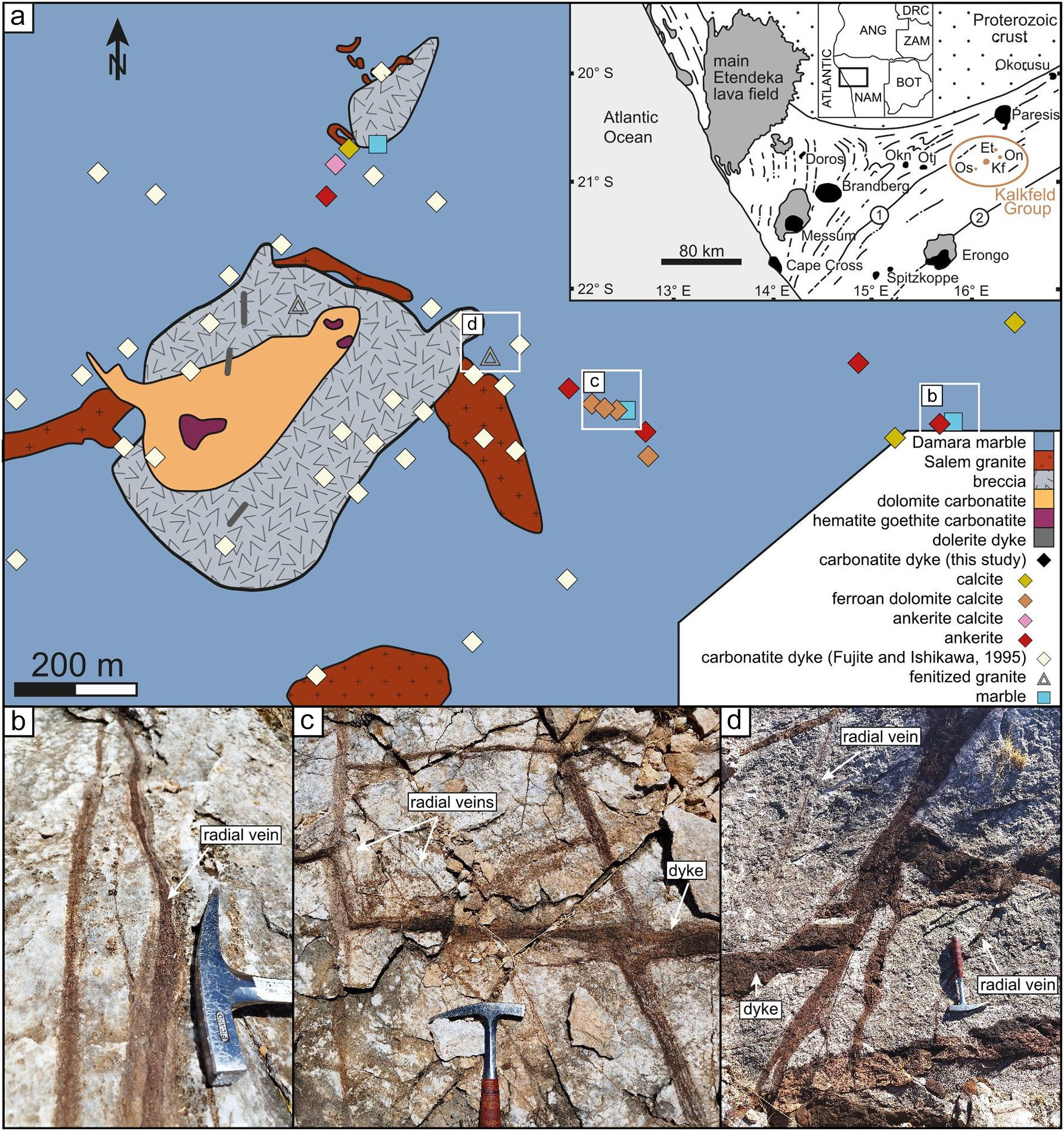
The Osongombo carbonatite complex (Fig. 1a) is a 500–600 m wide diatreme with a central plug of ferroan dolomite carbonatite surrounded by volcanic breccias (Verwoerd, Reference Verwoerd1967). The breccias consist mainly of fragments of reddish fine-grained and fenitized granite, with aegirine-filled veins and alkali feldspar, with subordinate quartzite, micaceous carbonate rock and highly altered volcanic rock with carbonatized phenocrysts (Verwoerd, Reference Verwoerd1967). The main ferroan dolomite carbonatitic body consists of ankerite, baryte, alkali feldspar, quartz, iron oxides and sulfides, including sphalerite, galena and pyrrhotite, which typically weather to a dark brown colour. Small outcrops of very fine-grained hematite and goethite-rich carbonatite (in the literature referred to as iron ore) can be found in and around the ferroan dolomite carbonatite. Two sets of carbonatite dykes and veins i.e. radial dykes and a second perpendicular set, cut the diatreme and the country rocks (Fig. 1b–d), extending for >1 km away from the magmatic centre. A few dolerite dykes can be observed to cut the complex, with phenocrysts replaced by calcite and zeolites. The complex has no associated silicate rocks (Verwoerd, Reference Verwoerd1967; Prins, Reference Prins1978; Miller, Reference Miller and Miller2008).
(a) Simplified geological map of the Osongombo carbonatite complex with dyke and vein samples from this study (coloured diamond) and from the report of Fujita and Ishikawa, Reference Fujita and Ishikawa1995 (white diamond). The inset is a simplified geological sketch of Damara Belt in northwestern Namibia with the Kalkfeld Group marked, which includes Kalkfeld, Ondurakorume, Etaneno and Osongombo (taken from Kramm et al., Reference Kramm, Körner, Kittel, Baier and Sindern2017 and slightly modified). (b–d) Field images of carbonatite dykes and veins perpendicular to each other showing metasomatic reaction zones in the Damara calcite marble.

Figure 1 Long description
A) Simplified geological map of the Osongombo carbonatite complex, showing dyke and vein samples from this study (colored diamond) and from Fujita and Ishikawa, 1995 (white diamond). The map includes a legend indicating various geological features: Damara marble, Salem granite, breccia, dolomite carbonatite, carbonatite dyke (this study), ferroan dolomite carbonatite, ankerite calcite, carbonatite dyke (Fujita and Ishikawa, 1995), fenitized granite, hematite goethite carbonatite and dolerite dyke. The inset shows a simplified geological sketch of the Damara Belt in northwestern Namibia, marking the Kalkfeld Group, which includes Kalkfeld, Ondurakorume, Etaneno and Osongombo (slightly modified from Kramm et al., 2017). B) Field image showing carbonatite radial veins in the Damara calcite marble. C) Field image showing a carbonatite dyke and radial veins in Damara calcite marble. D) Field image showing a carbonatite dyke and radial veins perpendicular to each other, illustrating metasomatic reaction zones. The images highlight the geological features and formations within the Osongombo carbonatite complex.
Methods
Sample material
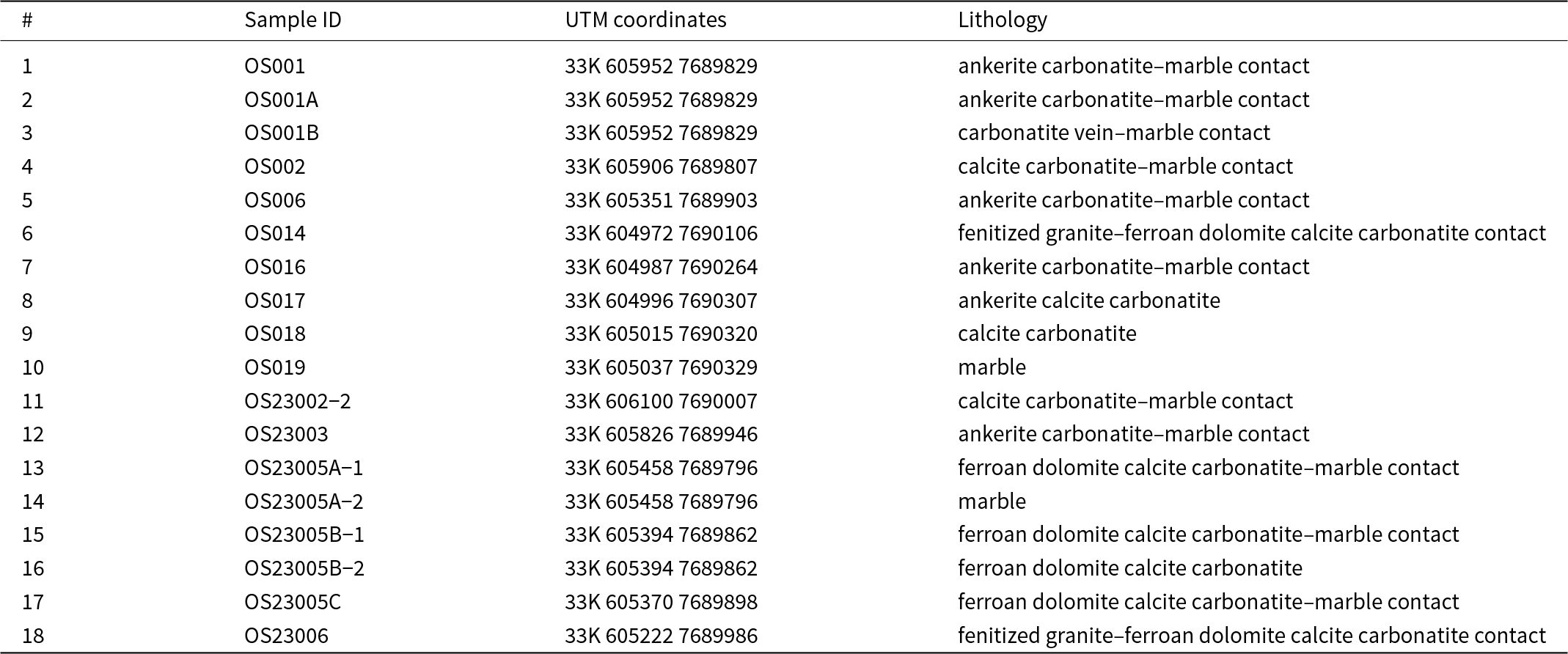
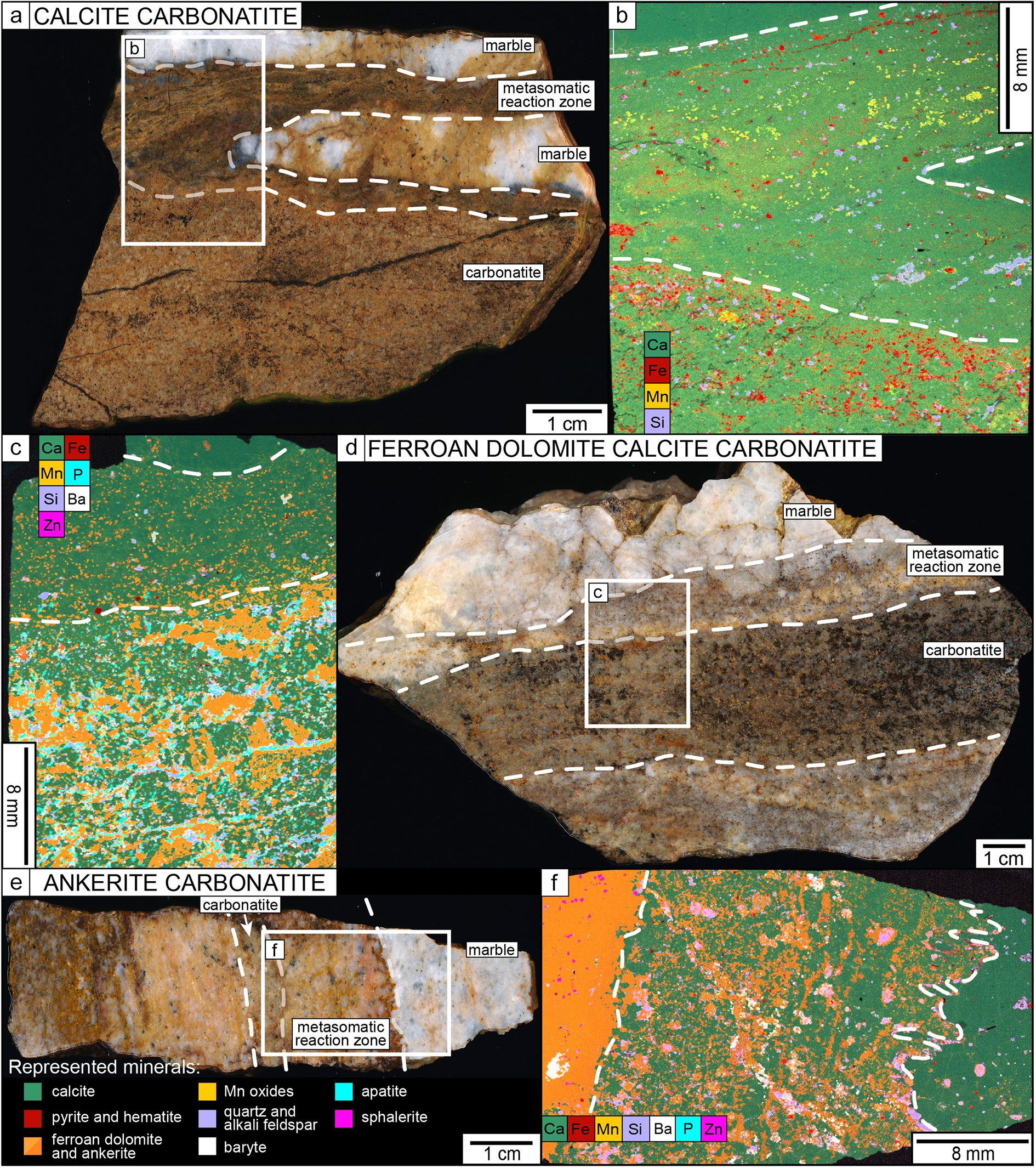
The samples were collected during fieldwork in 2021 and 2023, with a focus on carbonatite dykes and veins and the Damara marble on the eastern and northern sides of the complex. The samples were collected along a profile starting from ∼1.2 km away from the magmatic centre (Fig. 1). Twelve of 29 collected samples were chosen for further analytical work resulting in the preparation of 16 thin sections. These cover compositional varieties of carbonatite dykes and veins and corresponding metasomatic reaction zones as well as Damara calcite marble (Fig. 1b–d; Table 1). A selection of representative samples and corresponding thin section µXRF maps is shown in Fig. 2.
Osongombo carbonatites and marbles with their coordinates and determined lithology

Table 1 Long description
Thin sections from Osongombo carbonatites and marbles with their coordinates and determined lithology. Most of the thin sections represent contact between these two lithologies, including a reaction zone between the two.
Note: most of the samples mark contacts, which include reaction zones between the dyke (or vein) and the marble.
Hand specimens and corresponding thin section µXRF maps of: (a, b) calcite carbonatite, (c, d) ferroan dolomite calcite carbonatite, (e, f) ankerite carbonatite. The lines divide marble from metasomatic reaction zones and carbonatites.

Figure 2 Long description
Hand specimens and corresponding thin section µXRF mappings of: (a, b) calcite carbonatite, (c, d) ferroan dolomite calcite carbonatite, (e, f) ankerite carbonatite. The lines divide marble from metasomatic reaction zones and carbonatites. µXRF mappings in calcite carbonatite include Ca, Fe, Mn and Si, in ferroan dolomite calcite carbonatite and in ankerite carbonatite Ca, Fe, Mn, P, Si, Ba and Zn. These elements represent minerals present in the rock, Ca as calcite, Fe and Mn as ferric dolomite, P as apatite, Si as quartz, Ba as baryte and Zn as sphalerite. In addition, these elements mark a metasomatic reaction zone between carbonatites and Damara calcite marble, with a strong diffusion of Fe and Mn towards the marble, and Ca towards the carbonatite dyke, while P, Si and Ba mark carbothermal overprint.
Microscopy
Transmitted and reflected light microscopy including textural documentation was undertaken on polished thin sections using Leica Laborlux 12POLS and LEICA DM750P microscopes equipped with Nikon E950 and Olympus E-M5II digital cameras. Microscale textures were studied on carbon-coated samples using a Tabletop Phenom XL scanning electron microscope (SEM) applying back-scattered electron (BSE) imaging with a focused beam and acceleration voltage of 15 kV at a low vacuum (10 Pa). A lumic HC6-LM SG cathodoluminescence (CL) electron and light microscope with an Olympus XC10 camera operated with an acceleration voltage of 14 kV and a beam current of 0.4 mA was used to study the structures not visible in normal light conditions. All microscopy was carried out at the University of Tübingen, Germany.
Electron probe microanalysis (EPMA)
A wavelength-dispersive (WDS) JEOL JXA-8230 electron microprobe microanalyser at the University of Tübingen, Germany, was used for quantitativeanalysis of carbonates and apatite. Calibration was done using natural and synthetic certified reference materials (Astimex standard collection) including albite (Na), diopside (Mg, Si, Ca), sanidine (K), SrTiO3 (Sr), baryte (Ba, S), LREE glasses (La, Ce, Pr, Nd), bustamite (Mn), hematite (Fe), calcite (C; measured for matrix correction), tugtupite (Cl), UO2 (U), Durango apatite (Ca, P, F) and corundum (Al). Minerals were measured with an acceleration voltage of 15 kV, while the beam current was 20 nA for carbonate analysis and 10 nA for apatite. A defocused beam was used for both minerals: 5 µm for carbonate and 10 µm for apatite. Corrections of Pr-La and F-Ce overlaps were applied for apatite. Peak counting times were 16 s for major elements, 30 s for trace elements and 10 s for Na and F to avoid diffusion effects, while background counting times were always half of the peak-counting times. Mineral formulae for carbonates were calculated on the basis of a total of 2 cations and for apatite on the basis of 13 total anions, with OH calculated assuming charge balance and fully occupied Z position (Σ (F, OH, CL) = 1). Analysis points with mineral formulae can be found in Supplementary File 1, as well as the standards used with counting times, diffraction crystals, analysis conditions and detection limits for both minerals.
Microbeam X-ray fluorescence element mapping
Compositional maps were produced for all 16 thin sections, which cover carbonatite dykes and veins, metasomatic reaction zones and marble, using a Bruker M4 Tornado µXRF device at the University of Tübingen. Two additional hand specimens were analysed at the Technical University of Berlin. The instrument is equipped with a rhodium target X-ray tube. The analysis conditions were set at 50 kV using a beam current of 600 µA, with no filters and using two silicon drift detectors, for both thin sections and hand specimens. The beam spot size was 20 µm with a pixel size of 20 µm and a dwell time per pixel of 15 ms/pixel for thin sections and 30 µm with a dwell time per pixel of 30 ms/pixel for hand specimens. The results are presented as unquantified false-colour images for the Kα peaks of the measured elements. The maps depict relative differences in element concentrations, not absolute values.
Results
Petrography
The carbonatite dykes and veins investigated range from calcite carbonatite, ferroan dolomite calcite carbonatite to ankerite carbonatites, exhibiting mm- to 5 cm-wide metasomatic reaction zones with the host calcite marble. The contact with the basement granite is sharp, although it has aegirine-filled fissures and veinlets. The dykes and veins cross-cut and displace each other and their width and abundance generally decrease with increasing distance from the centre. Radial dykes and veins are relatively thin and reach only ∼10 cm in width, whereas the perpendicular set is up to 0.5 m wide close to the centre.
Damara marble (host rock)
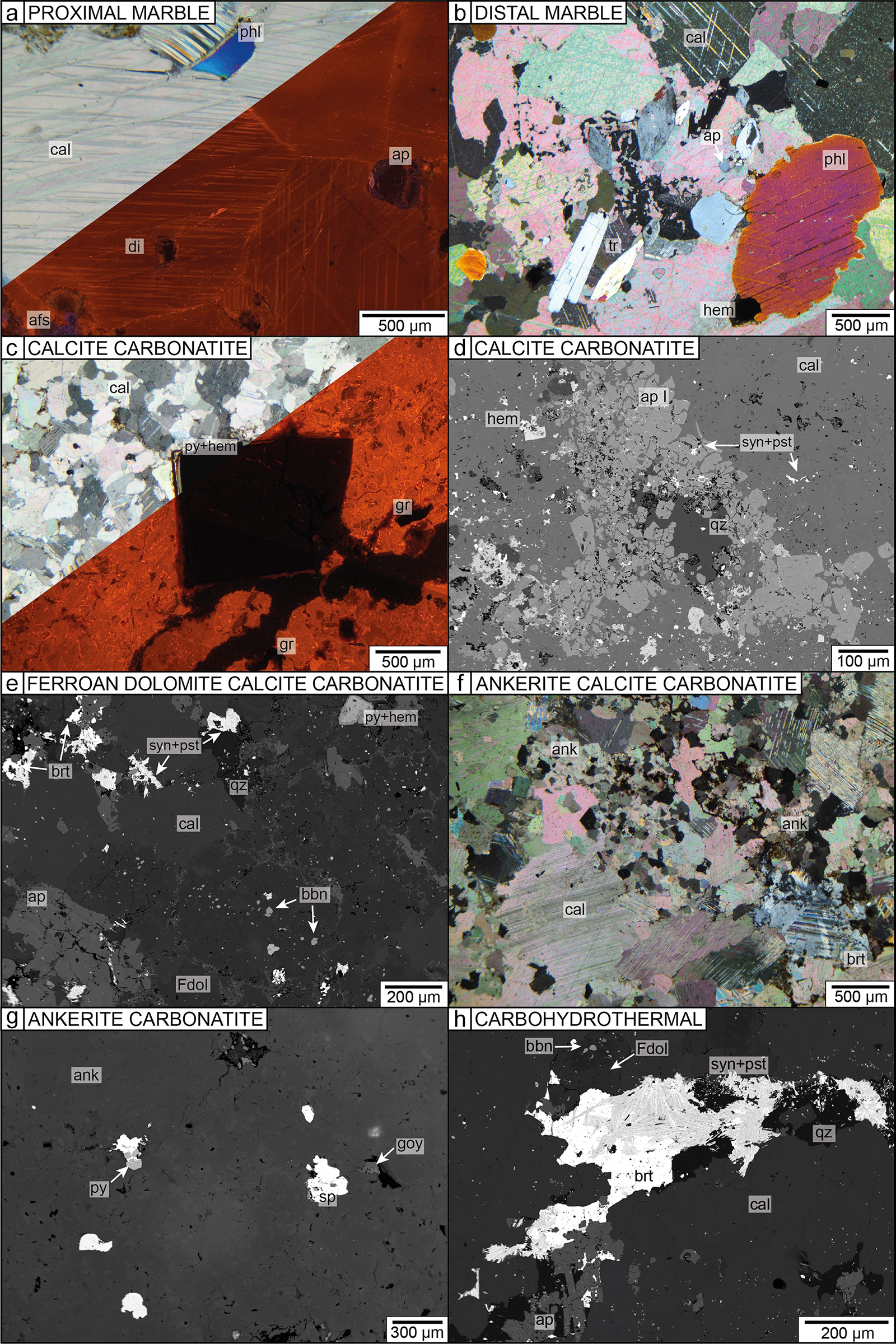
Damara marble (OS001B, OS019, OS23005A-2; proximal marbles) is predominantly composed of calcite (up to 5 mm), with up to 5 modal% of phlogopite (up to 1 mm), fine-grained alkali feldspar altering to dolomite and rounded diopside (up to 300 µm) (Fig. 3a). Accessory phases are rounded apatite (up to 500 µm) and euhedral pyrite (up to 0.3 mm). Occasionally, medium-sized dolomite (up to 2 mm) is present, occurring in association with elongated graphite, with lesser amounts appearing as exsolution in calcite. The cathodoluminescence colours of calcite and dolomite are very dark orange, whereas dolomite has a more reddish shade. Apatite is completely dark with only a thin bluish rim (Fig. 3a). The mineralogy of one distal marble from the area of Kalkfeld was investigated for comparative purposes. It has a similar mineralogy of calcite, phlogopite, rounded apatite, pyrite, but instead of diopside, it contains elongated, sometimes euhedral, tremolite (up to 0.6 mm; Fig. 3b).
Representative photomicrographs of: (a) proximal Damara marble (from Osongombo) showing polygonal calcite grain boundaries exhibiting a dark orange cathodoluminescence colour, with phlogopite, apatite, diopside and alkali feldspar as accessory phases; (b) distal Damara marble (from the vicinity of Kalkfeld) with calcite, large phlogopite, tremolite and apatite; (c) large pyrite with hematite rims in calcite carbonatite; (d) magmatic apatite with accessory hematite, parisite, synchysite and interstitial quartz in calcite carbonatite; (e) ferroan dolomite containing burbankite inclusions next to a carbothermal apatite II-baryte-parisite-synchysite-quartz assemblage; (f) ankerite clusters and large calcite in ankerite calcite carbonatite; (g) ankerite carbonatite consisting of ankerite, sphalerite, pyrite and accessory goyazite; (h) carbothermal assemblage of apatite II-baryte-parisite-synchysite-quartz. Mineral abbreviations after Warr (Reference Warr2021): cal-calcite, phl-phlogopite, ap-apatite, di-diopside, afs-alkali feldspar, tr-tremolite, hem-hematite, syn-synchysite-(Ce), par-parisite-(Ce), qz-quartz, gr-graphite, brt-baryte, Fdol-ferroan dolomite, bbn-burbankite, py-pyrite, ank-ankerite, sp-sphalerite, goy-goyazite.

Carbonatite dykes and veins
Carbonatite dykes and veins are divided into: (1) calcite carbonatites (OS002, OS018, OS23002-2); (2) ferroan dolomite calcite carbonatites (OS23005A-1, OS23005B-1, OS23005B-2, OS23005C); (3) one ankerite calcite carbonatite (OS017) and ankerite carbonatites (OS001A, OS006, OS016, OS23003).
Calcite carbonatites (CC) have variable grain sizes (∼0.4 mm on average, but up to 2 mm), typically decreasing towards the contact with the marble. Calcite is mostly anhedral, has a bright orange cathodoluminescence colour (Fig. 3c) and contains small inclusions of euhedral pyrochlore. One of the samples (OS002) also contains large clusters, up to 1.2 mm in size, of fine-grained euhedral to subhedral apatite I (0.02–0.3 mm; Fig. 3d). Pyrite is euhedral and up to 1.3 mm in size (Fig. 3c; on average <0.5 mm), whereas sphalerite occurs sporadically in association with pyrite. Smaller grains of Fe-bearing and ferroan dolomite can be found in the calcite, commonly with rims altered to hematite, which is also found to form secondary, fine-grained crusts on the calcite. Pyrite is typically oxidized to hematite, with alteration starting from the rim (Fig. 3c). Baryte is a common late-stage accessory phase in calcite carbonatite, occurring interstitially between calcite grains. Small subhedral apatite II can occur in late-stage veins. In addition, small amounts of Nb-bearing rutile can be found (Raman spectra in Supplementary File 2), as well as REE fluorocarbonates, including synchysite and parisite, and interstitial quartz (Fig. 3d). A Si-Ca-Th phase, possibly ekanite or perhaps ‘calciothorite’, can be found sporadically, mostly filling small cavities as well as minor amounts of fibrous opaque Mn oxides associated with goethite. Occasional grains of alkali feldspar (up to 0.04 mm) show corroded rims and are probably marble xenocrysts.
Ferroan dolomite calcite carbonatite dykes (FdolCC) exhibit fine- to medium-grained (0.1–1.5 mm), anhedral calcite, and contain small inclusions of pyrochlore. Common ferroan dolomite (∼30–40 modal% of each sample) is considerably smaller (up to 0.4 mm), subhedral, and forms clusters within the calcite matrix (Fig. 3e,f). The grains display a zoning with greater Fe contents towards the rims and occasionally contain residual dolomite cores and large (up to 30 µm) burbankite inclusions (Fig. 3e; burbankite EDS measurements in Supplementary File 2). In addition, these samples contain more sulfides compared to calcite carbonatites, including euhedral pyrite (up to 0.4 mm), anhedral sphalerite and very sporadic galena (both <0.15 mm). Furthermore, a characteristic carbothermal assemblage containing apatite II, baryte, REE fluorocarbonates (synchysite and parisite) and interstitial quartz formed in veins between calcite and ferroan dolomite crystals (Fig. 3e; see blue phosphorus on the µXRF map on Fig. 2c). The clusters containing ferroan dolomite commonly exhibit reddish-brown rims, which are composed of fine-grained hematite, to which pyrite is also commonly altered. Willemite forms as a reaction rim around sporadic sphalerite (willemite EDS measurements in the Supplementary File 2). Small grains of monazite and probably goyazite (SrAl3(PO4)(PO3OH)(OH)6) can be found in cavities, crusts of goethite form around iron phases, and secondary quartz veins may be present.
Ankerite carbonatite (AnkC) dykes display a relatively simple assemblage consisting of ankerite and sulfides, including sphalerite, pyrite and galena (Fig. 3g). The subhedral to anhedral ankerite displays two grain sizes. Smaller grains are between 0.1 and 0.3 mm in width, and the larger grains reach 0.8 mm in size. Inclusions of burbankite (<0.01 mm) can occasionally be recognized in ankerite of one single sample. Subhedral sphalerite is 0.1–0.3 mm in size, as is galena, which occurs in considerably lesser amounts. Pyrite is smaller, up to 0.2 mm, and forms euhedral to subhedral crystals. Minor amounts of ferroan dolomite occur with ankerite similar in size. Both display compositional zoning always with an increase in Fe towards the rims. One sample (OS23003) has a calcite-rich lens in the ankerite. The same carbothermal assemblage of apatite II, baryte, REE fluorocarbonates (synchysite and parisite) and quartz can be observed, occurring as veins and cutting through the ankerite (Fig. 3h), containing rare Nb-bearing rutile. During hydrothermal stages, hematite forms on the rims of pyrite and Fe-rich carbonates, whereas monazite and thorite occur as very small accessory phases in cavities. Sphalerite shows alteration rims of willemite, although in one sample it alters to either smithsonite or water-bearing Zn carbonate. Secondary calcite and quartz veins can be found, but are not common. Goyazite can be found sporadically in cavities, and goethite occurs alongside hematite as crusts.
Metasomatic reaction zones
Infiltration of increasingly Fe-rich carbonatite dykes and veins produce texturally and compositionally different metasomatic reaction zones. Calcite carbonatite dykes show no obvious signs of interaction or reaction on the contact with the marble in the thin sections investigated. Calcite from the carbonatite tends to become more fine-grained closer to the contact. Apatite and baryte can be observed to form on the sharp boundary with small amounts of quartz and pyrite altering to hematite.
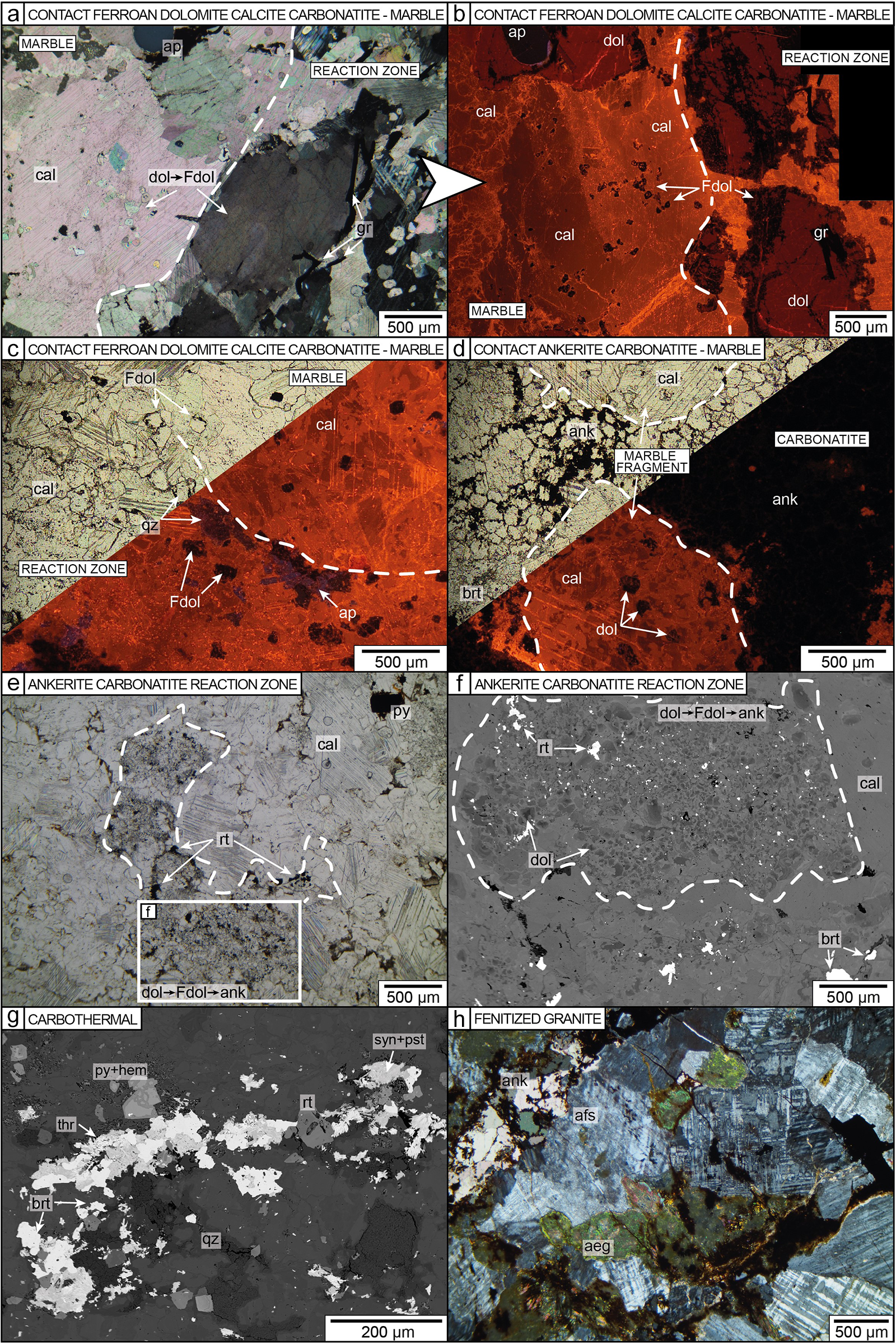
With an increase in Fe in ferroan dolomite calcite carbonatites and ankerite calcite carbonatites, the width of the reaction zone increases (Fig. 2). They are typically 0.2–1 cm in width and contain small, euhedral, up to 0.02 mm ferroan dolomite crystals scattered in medium-grained calcite (average of 1 mm wide). These crystals commonly exhibit ankerite rims and occasionally have preserved dolomite cores. Moreover, the calcite from the marble displays evidence of deformation and dynamic recrystallization (Fig. 4a), such as interstitial small-grain formation via grain-boundary bulging and subgrain rotation. The cathodoluminescence colour of the calcite changes, generally having brighter patches and rims on the contact with the carbonatite due to the reaction between the two (Fig. 4b–d). Larger dolomite crystals (0.5–2 mm) obtain a ferroan dolomite to ankerite rim at the contact with Fe-rich carbonatites (Fig. 4a,b). The carbothermal assemblage (apatite II-baryte-synchysite-parisite-quartz) from the dykes is also observed in the reaction zones.
Representative photomicrographs of: (a, b) the contact between the marble and the metasomatic reaction zone of ferroan dolomite calcite carbonatite. Marble dolomite has ferroan dolomite rims (dol→Fdol) and the dark orange CL colour of marble calcite is overprinted by a brighter carbonatitic CL. (c) Contact of reaction zone from ferroan dolomite calcite carbonatite and marble with newly-formed ferroan dolomite and calcite overprint visible on the CL part. (d) Contact between ankerite carbonatite and marble. (e and f) A cluster of dolomites progressively more Fe-enriched towards the rims (dol→Fdol→ank). (g) Carbothermal mineral assemblage found in a reaction zone of ankerite carbonatite. (h) Fenitized granite with aegirine-filled veins. Mineral abbreviations after Warr (Reference Warr2021): ap-apatite, cal-calcite, dol-dolomite, Fdol-ferroan dolomite, gr-graphite, qz-quartz, ank-ankerite, brt-baryte, py-pyrite, rt-rutile, thr-thorite, hem-hematite, syn-synchysite-(Ce), pst-parisite-(Ce), afs-alkali feldspar, aeg-aegirine.

The reaction zones produced by ankerite carbonatite dykes are generally the widest (up to 5 cm) and have clusters of fine-grained Fe-rich carbonates (0.03–0.2 mm) in the calcite (Fig. 4e,f). These crystals typically show compositional zoning from dolomite (core) to ferroan dolomite to ankerite (rim). Rarely, fine-grained remnants of alkali feldspar are either altered to clay minerals or disintegrated into very fine-grained aggregates of ferroan carbonates. Lesser amounts of pyrite, graphite and rarely apatite can be found at the contact with the marble. Furthermore, the reaction zone is, like the dyke itself, permeated by a carbothermal assemblage with baryte (either interstitial or along the contact with the marble), quartz, REE fluorocarbonates (synchysite and parisite), apatite II, and sometimes Nb-bearing rutile and thorite (Fig. 4g).
Salem-type granite and fenite
The granite (OS014, OS23006) forms several irregularly shaped bodies intruding the Damara marble and occurs as fragments in the breccia. It is mainly composed of quartz, albite, K-feldspar and biotite with accessory titanite and zircon. Although the contact with the dykes is well-defined, the granite is fenitized extensively along fissures and veinlets, where aegirine crystallized (Fig. 4h). Ferroan dolomite is also present and associated with the aegirine, and it forms veins with hematite aggregates along the crystal and vein rims. A small-grained apatite cluster can rarely be found. Late-stage baryte and quartz veinlets cut the fenite.
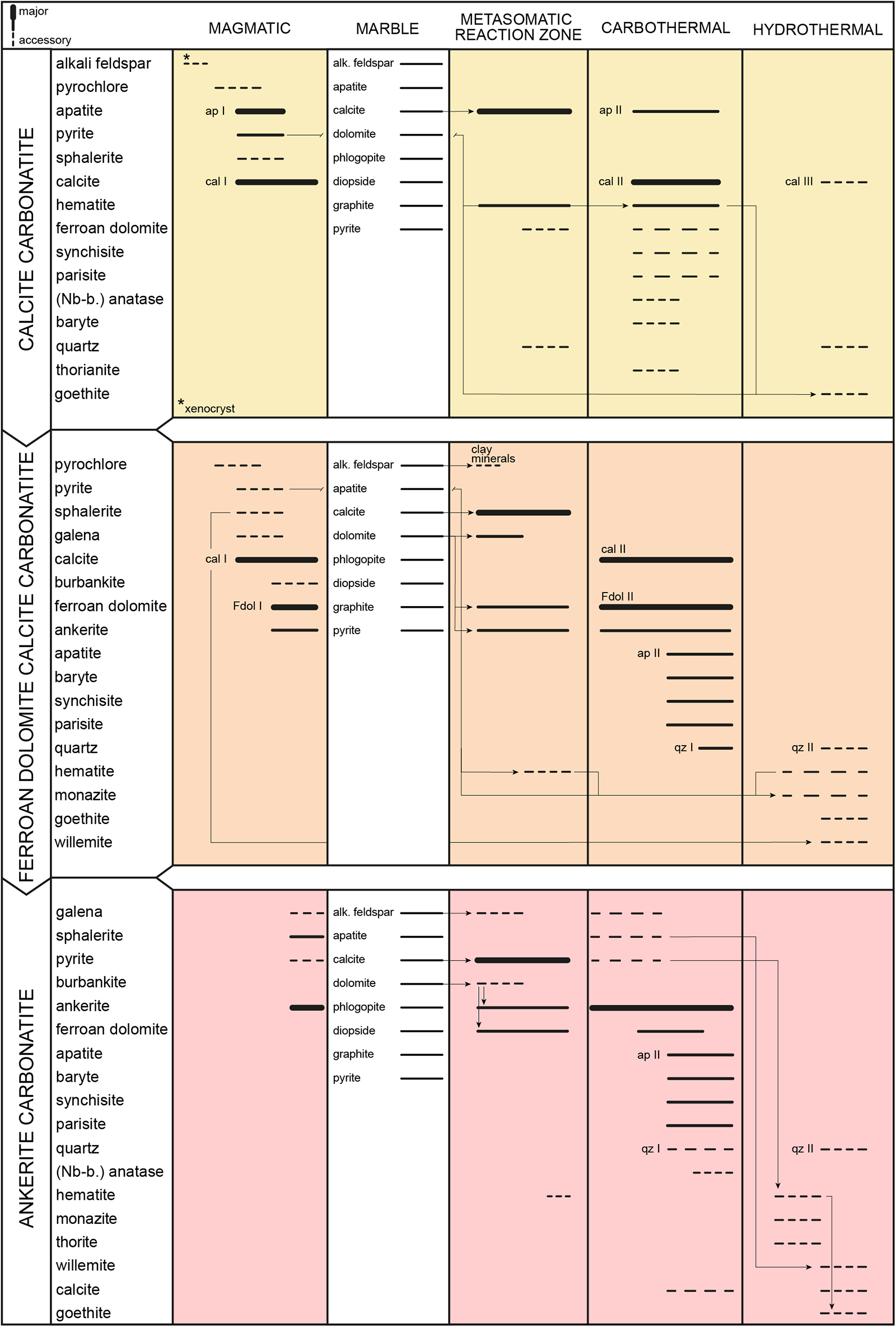
Paragenetic schemes for the carbonatite dykes intruding the marble and the metasomatic reaction zones are compiled in Fig. 5.
Paragenetic schemes of calcite carbonatite, ferroan dolomite calcite carbonatite and ankerite carbonatite. The arrows indicate reactions, alteration and replacements. Mineral abbreviations after Warr (Reference Warr2021): ap-apatite, cal-calcite, Fdol-ferroan dolomite, qz-quartz.

Figure 5 Long description
Paragenetic sequences of calcite carbonatite, ferroan dolomite calcite carbonatite and ankerite carbonatite across magmatic, metasomatic, carbothermal and hydrothermal stages. Horizontal lines for each mineral represent crystallization stages and mineral abundance, with thicker lines representing major minerals, and dashed accessories. Arrows represent reactions and alterations of minerals. The table highlights mineral progression and differences between carbonatite types, showing how mineral presence changes across stages.
Mineral compositions
Carbonates
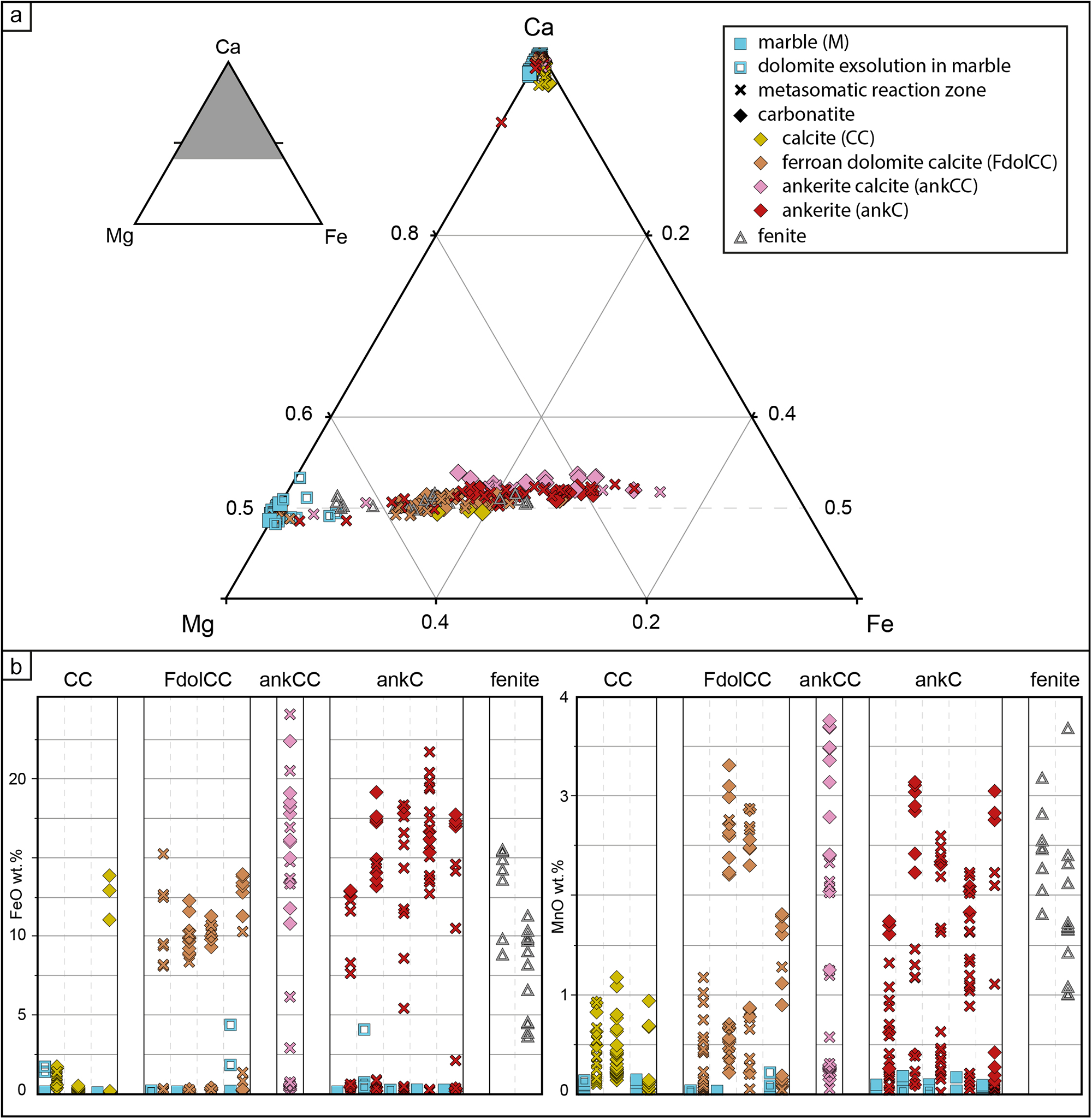
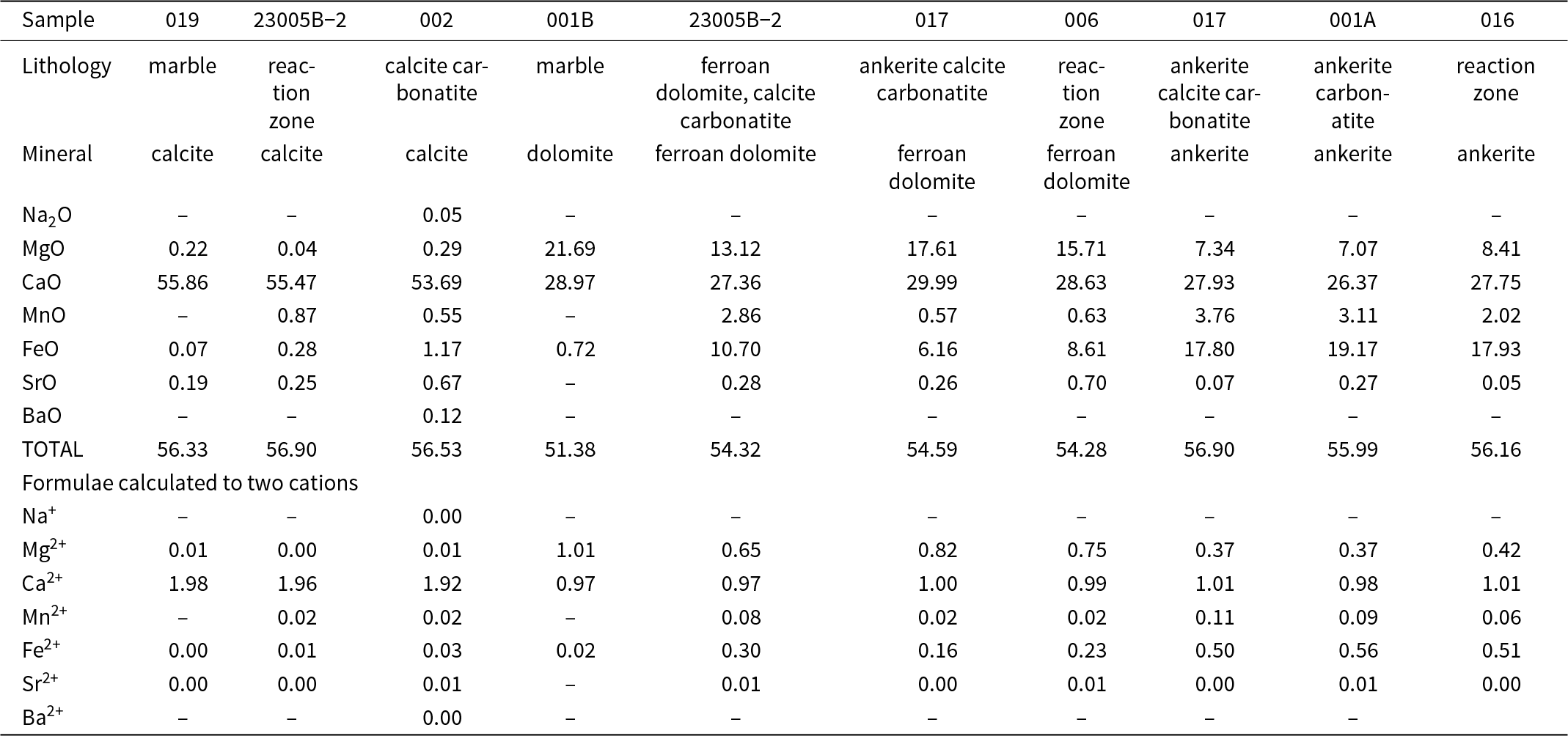
Carbonate minerals from Osongombo include calcite, dolomite, Fe-bearing and ferroan dolomite as well as ankerite (Fig. 6a). Marble-hosted calcite is relatively pure, with an average formula of (Ca0.99Mg0.01)(CO3). Trace elements, such as Fe, Mn and Sr, are mainly below the detection limit, with maximum values being: FeO = 0.16 wt.%; MnO = 0.17 wt.%; and SrO = 0.76 wt.%. Single crystals of dolomite in the marble are almost pure end-members (Ca0.99Mg1.00(CO3)2), whereas exsolved dolomite has slightly higher Fe contents (max. FeO = 0.80 wt.%).
Calcite from carbonatite dykes and veins has greater trace-element contents in comparison to the marble calcite, with: FeO = 0.02–1.73 wt.%; MnO = 0–0.92 wt.; MgO = 0.01–0.65 wt.%, but with similarly low SrO = 0–0.73 wt.% (all four elements are mainly >0.5 wt.%). The average formula of carbonatitic calcite is (Ca0.98Fe0.01Mn0.01)(CO3).
Iron-rich carbonates from ferroan dolomite calcite carbonatite and ankerite calcite carbonatites show that ankerites generally have slightly greater Mn contents, with a maximum MnO = 3.76 wt.% (in comparison to a max. MnO = 2.99 wt.% in ferroan dolomite; Fig. 6b), whereas Sr is, in both cases, very low (max. SrO = 0.48 wt.%).
Metasomatic reaction zones contain carbonates the compositions of which generally overlap with those from the carbonatites (Fig. 6b). One observable difference is evident in ankerite from samples in which all three zones (i.e. marble, reaction zone, carbonatite) were possible to analyse. The results demonstrate a transition from high Fe and Mn in the carbonatite to lower Fe and Mn accompanied by higher Mg contents within the reaction zone (Fig. 6b). Representative compositions of carbonates from all investigated lithologies are shown in Table 2.
Compositional data for carbonates from Osongombo: (a) ternary diagram representing calcite-siderite-magnesite end-members (note: only the upper part of the ternary is shown as there are no points in the lower part of the diagram; (b) binary diagrams showing FeO and MnO (wt.%) in each investigated lithology from Osongombo by sample.

Figure 6 Long description
A ternary calcite-siderite-magnesite end member diagram. The three corner labels are Ca at the top, Mg at the lower left and Fe at the lower right. A legend lists marble (M), dolomite exsolution in marble, metasomatic reaction zone, calcite carbonatite (CC), ferroan dolomite calcite carbonatite (FdolCC), ankerite calcite carbonatite (ankCC), ankerite carbonatite (ankC) and fenite. Points form a dense cluster near the Ca apex marking calcite. Another band of points lies across the lower half of the triangle, around the horizontal level marked near 0.5 on the left side, extending from left of center toward the right of center marking dolomites and ferric dolomites. Left and right binary diagrams show FeO and MnO contents in carbonates from all lithologies including metasomatic reaction zones. Within CC regarding Fe, points lie mostly between 0 and about 2, with a few higher points around the mid teens. Within FdolCC, points lie mainly between about 8 and about 15, with some near 0. Within ankCC, points form a vertical column from about 0 up to above 20. Within ankC, points span from about 0 up to the high teens. Within fenite, points lie mostly between about 6 and about 12, with some near 0. The right MnO plot within CC show points mostly between 0 and about 1, with sseveral points between 2 and 3.Within ankCC, points lie mostly between 0 and about 1, with a vertical column extending up to about 4. Within ankC, points lie mostly between 0 and about 1, with several points between about 1 and about 3. Within fenite, points lie mostly between about 2 and about 4.
Representative EPMA compositions of carbonates from marble, various carbonatite dykes and veins and reaction zones from Osongombo
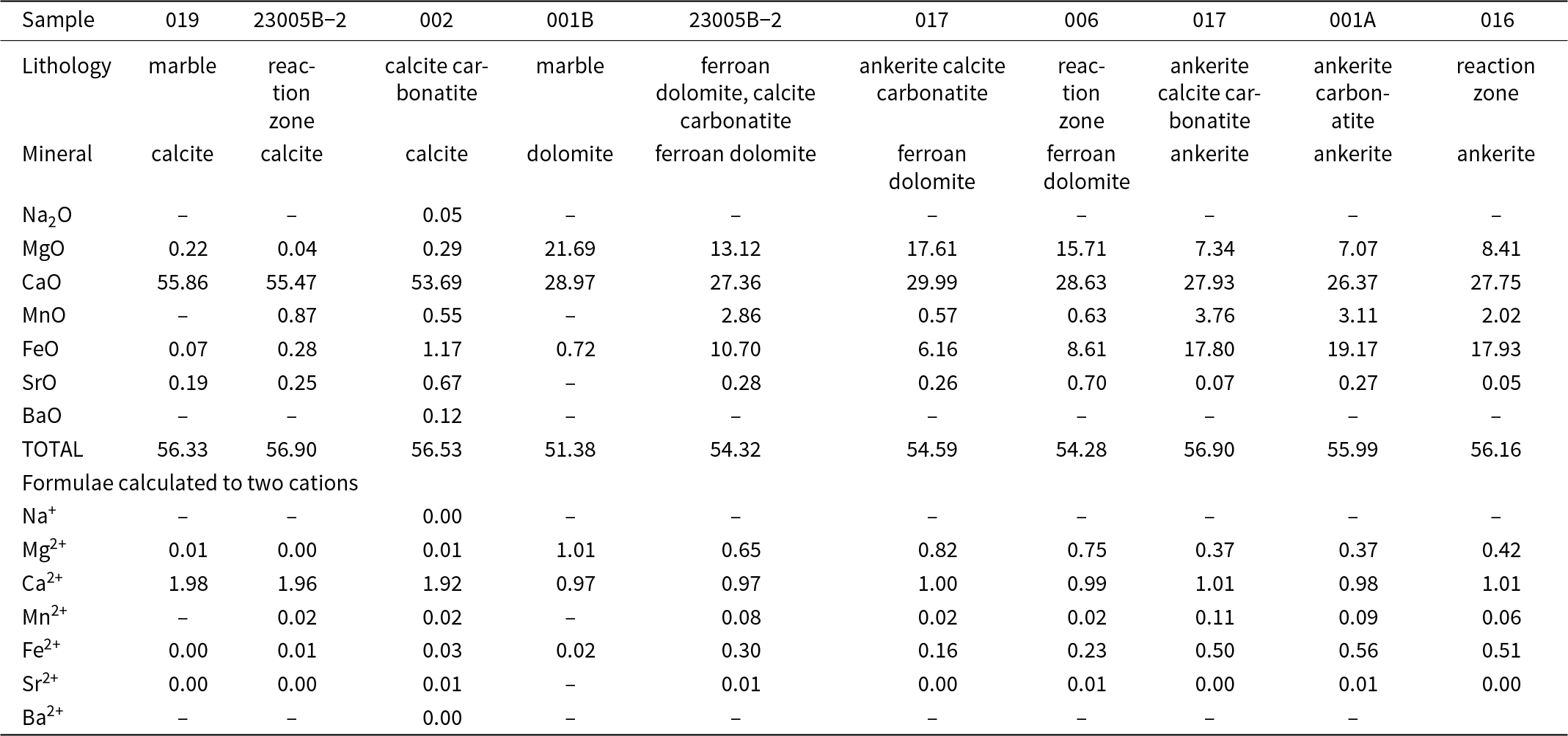
Table 2 Long description
Representative EPMA compositions of carbonates from marble, various carbonatite dykes and veins and reaction zones from Osongombo. Ten representative measurements show compositional variation between carbonatite dykes and Damara calcite marble.
Notes: Additional elements including K, La and Si were measured, but fall below the detection limit in all cases and are, therefore, omitted from the table. Hyphens represent measured values which were below the detection limit. Carbonate mineral formulae were calculated to two cations to allow direct comparison of cation proportions.
Apatite
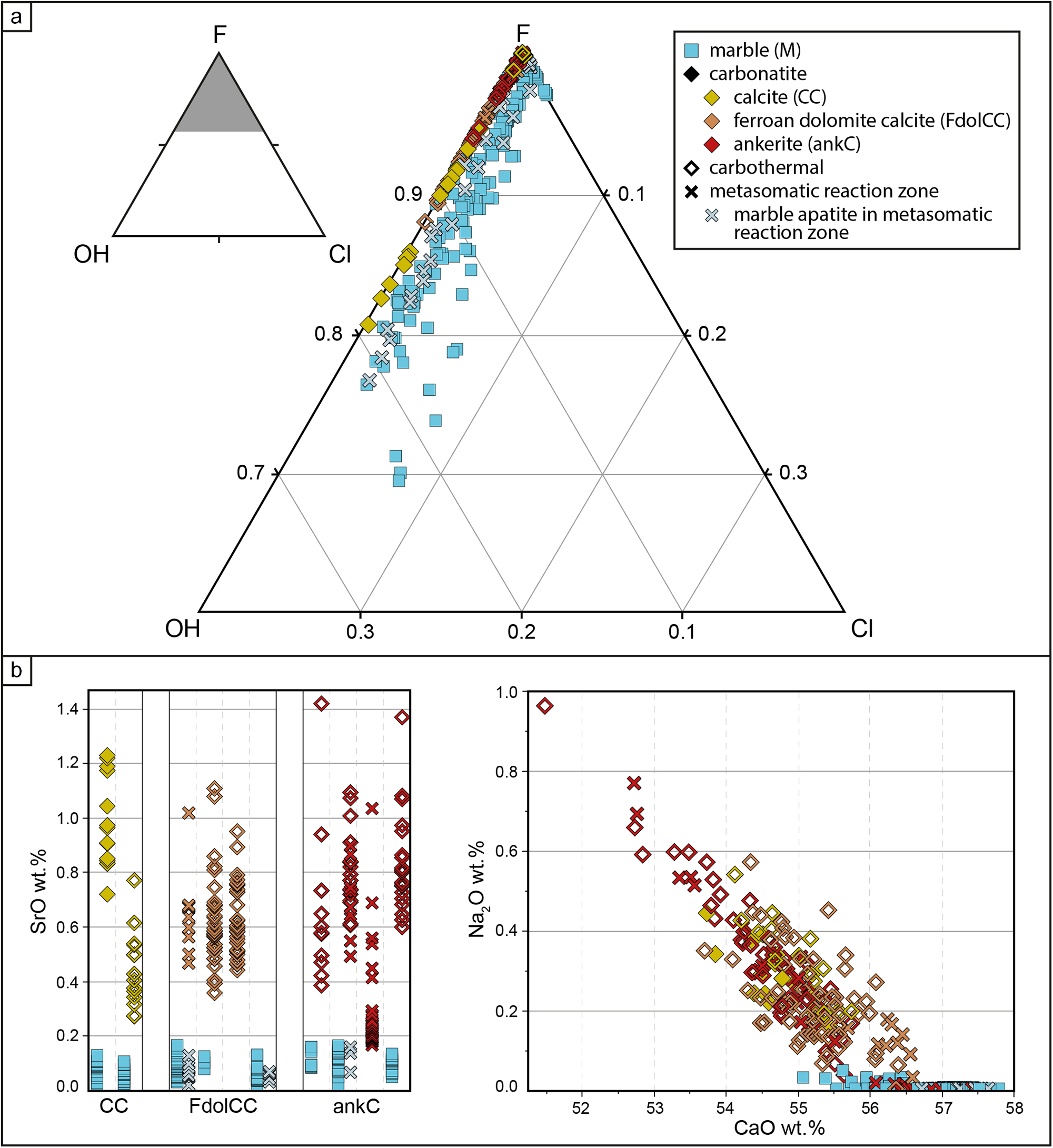
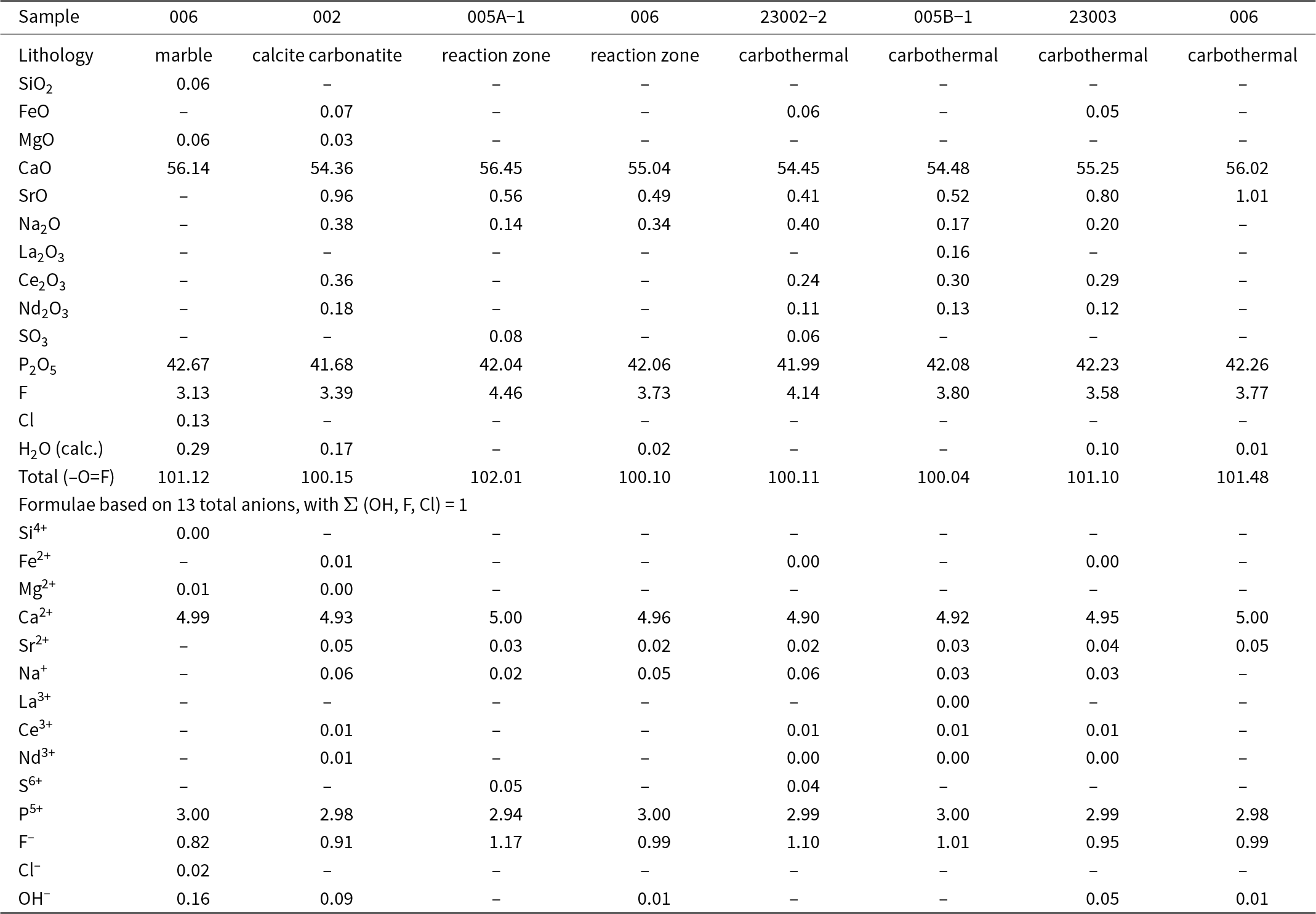
All analysed apatite are fluorapatite. Apatite from the marble is compositionally distinct, with a greater Cl content compared to carbonatite apatite I and carbothermal apatite II (Fig. 7a). Marble-derived apatite has, on average, 0.13 wt.% Cl, reaching up to 0.56 wt.%, and has low concentrations of trace elements, which are typically below or near the detection limits. Exceptions are Mg (up to 0.11 wt.%), and a few data points have noticeable Na (up to 0.31 wt.%) and Sr (up to 1.04 wt.%) (Fig. 7b). The average formula is (Ca4.99Mg0.01Sr0.02)P2.98O12(F0.90OH0.09Cl0.02).
Composition of apatite from Osongombo. (a) Ternary diagram representing F-OH-Cl end-members (note: only the upper part of the ternary diagram is shown because there are no data points in the lower part of the diagram); (b) binary diagrams showing SrO (wt.%) and Na2O vs CaO (wt.%) in each investigated lithology.

Figure 7 Long description
The F-OH-Cl end member ternary diagram labeled F at the top, OH at the lower left and Cl at the lower right. A legend lists marble (M), calcite carbonatite (CC), ferroan dolomite calcite carbonatite (FdolCC), ankerite carbonatite (ankC), carbothermal and marble apatite in metasomatic reaction zone. Most plotted points form a narrow band close to the right sloping edge near the F corner, with many points between the 0.9 and 1 tick region on the left edge and between the 0.1 and 0.2 tick region on the right edge. Marble points extend downward along the same band to around the 0.7 tick on the left edge, showing slightly larger Cl contents. Two scatter plots are shown. The left scatter plot shows SrO wt.% contents across all lithologies. Points for CC include many values near 0.0 to 0.2 and a vertical set around 1.1 to 1.3. Points for FdolCC cluster mainly around about 0.4 to 0.9, with several around about 1.0 to 1.1. Points for ankC span roughly from about 0.1 up to about 1.4, with many points between about 0.4 and 1.0. The right scatter plot shows CaO vs Na2O contents in the samples. Points form a downward pattern from higher NaO wt.% at lower CaO wt.% toward lower NaO wt.% at higher CaO wt.%.
In contrast, magmatic apatite I from calcite carbonatite has greater Sr and Na (∼1.0 and ∼0.3 wt.% on average, up to 1.42 and 0.44 wt.%, respectively; Fig. 7b). Iron and Ce are typically below or near the detection limit, but can reach 0.40 and 0.51 wt.%, respectively. Carbothermal apatite II in calcite carbonatites shows overlapping Na content (∼0.35 wt.%), but lower Sr (∼0.5 wt.%), with other elements mostly below detection limits.
Carbothermal apatite II in ferroan dolomite calcite carbonatite and ankerite carbonatite occurs only within reaction zones and is formed during the infiltration of the carbothermal fluid. This apatite has broadly similar compositions, differing mainly in Sr content, which is slightly higher in the ankerite carbonatite reaction zone (up to 1.42 wt.%; Fig. 7b). In one sample (016) apatite comes from the direct contact of the reaction zone and the marble, where intermediate Sr contents (SrO ∼ 0.2 wt.%) are observed (Fig. 7b), reflecting a transitional composition between marble- and carbonatite-derived apatite. Representative apatite compositions are listed in Table 3.
Representative EPMA compositions of apatite from marble and calcite carbonatite, as well as carbothermal apatite II

Table 3 Long description
Eight representative apatite analyses are listed by sample and lithology, with oxide weight percent values, totals, and calculated cation and anion proportions based on 13 total anions and with H2O calculated based on stoichiometry. Samples are labeled 006 marble, 002 calcite carbonatite, 005A-1 reaction zone, 006 reaction zone, 23002-2 carbothermal, 005B-1 carbothermal, 23003 carbothermal, and 006 carbothermal. Major oxides are CaO from 54.36 to 56.45 and P2O5 from 41.68 to 42.67; totals range from 100.04 to 102.01. SrO is absent in the marble sample and present in the others from 0.41 to 1.01 wt.%, with the highest SrO in the carbothermal sample 006 at 1.01 wt.%. Na2O is absent in the marble and carbothermal 006 samples and otherwise ranges from 0.14 to 0.40 wt.%. Rare earth oxides appear at low levels: Ce2O3 is 0.24 to 0.36 wt.% where present, Nd2O3 is 0.11 to 0.18 wt.% where present, and La2O3 appears only in carbothermal sample 005B-1 at 0.16 wt.%.
Notes: Mn, K, Al, Pr and U were also measured, but the amounts were below the detection limits and are not, therefore, included in the table. Hyphens represent those measured values which are below the detection limit. H2O contents were calculated on the basis of the stoichiometry.
Discussion
Carbonatite dyke and vein evolution
Osongombo carbonatites record differentiation from early calcite carbonatites to ferroan dolomite calcite carbonatites and ankerite carbonatites. This evolution is marked by a progressive Fe and Mg enrichment, increasing sulfide content and the appearance of REE-bearing phases (burbankite). This, paired with cross-cutting relationships observed in the field and roughly contemporaneous emplacement of the dykes suggest a magmatic evolution with overlapping intrusive phases. Calcite carbonatites represent an early magma pulse from which calcite with pyrochlore inclusions, pyrite, small magmatic apatite I, and very small amounts of sphalerite formed. With differentiation and at lower temperatures, the amounts of major elements such as Mg and Fe increased, allowing for the formation of ferroan dolomite calcite carbonatites and ankerite calcite carbonatites with pyrochlore inclusions. These mark a sufficient enrichment and crystallization of the first REE-bearing minerals, namely burbankite, as inclusions in ferroan dolomite (Fig. 3e). In addition, the abundance of sulfides increases, most noticeably sphalerite and to a lesser extent galena. Pure ankerite carbonatite follows, with a simple mineralogy of ankerite, sphalerite, pyrite and galena (Fig. 3g). This evolution from calcite to ferroan dolomite calcite carbonatite and ankerite carbonatite is not uncommon and is reported from many other localities (Amba Dongar, Gujarat, India, Viladkar, Reference Viladkar2000; Kandaguba, Kola Peninsula, Russia, Pilipiuk et al., Reference Pilipiuk, Ivanikov and Bulakh2001; Wicheeda Carbonatite, British Columbia, Canada, Trofanenko et al., Reference Trofanenko, Williams-Jones, Simandl and Migdisov2016). An increase in sulfides towards more evolved and late-stage carbonatites is also reported in the literature (e.g. see the compilation of Brazilian alkaline carbonatite complexes of Gomide et al., Reference Gomide, Brod, Junqueira-Brod, Buhn, Santos, Barbosa, Cordeiro, Palmieri, Grasso and Torres2013). Sulfides and sulfates are common in carbonatitic systems and when occurring together, they can reveal information about the redox state of the evolving magma. In case of the Osongombo system, the reduced S2– needed for the crystallization of sulfides must have been the dominant ion through most of the carbonatite differentiation. Thus, the system must have stayed relatively reduced, without major changes in pH, until the temperature was sufficiently low, and fO2 sufficiently increased to form SO42– ions during the carbothermal stage which allowed baryte to crystallize.
Carbothermal fluids and carbothermalites
The final stage of evolution at the Osongombo Carbonatite Complex is marked by the activity of carbothermal fluids and the formation of a distinct carbothermal mineral association. Following Mitchell (Reference Mitchell2005) and Mitchell and Gittins (Reference Mitchell and Gittins2022), the term carbothermal [or carbohydrothermal in the terminology of Zaitsev (Reference Zaitsev1996) and Zaitsev et al. (Reference Zaitsev, Wall and Le Bas1998)] is used to describe carbonate-dominated, volatile-rich fluids expelled from the evolved carbonatite, which produce carbothermalites. These fluids are rich in CO2, F–, SO42– and PO43– and elements such as REE, Ba and Sr. At Osongombo, the carbothermal stage is recorded as an assemblage of apatite II, baryte, synchysite, parisite and quartz (Fig. 3h, 4g), found interstitially in veined networks and smaller patches cutting both the carbonatites themselves and surrounding metasomatic reaction zones, but are not found in the marble (Fig. 2). Similar mineral assemblages have been reported from Kangankunde in Malawi (Wall and Mariano, Reference Wall, Mariano, Jones, Wall and Williams1996) and at Khibina and Vuoriyarvi complexes on Kola Peninsula (Zaitsev et al., Reference Zaitsev, Wall and Le Bas1998, Reference Zaitsev, Demény, Sindern and Wall2002) as pseudomorphs after burbankite. Additional similarities are found at Kamthai and Sevattur in India (Dey et al., Reference Dey, Chakrabarty, Mitchell, Bhattacharjee, Pal, Kynicky and Drüppel2024; Mitchell, Reference Mitchell2024) and Wigu Hill carbonatite in Tanzania (Moshi et al., Reference Moshi, Watanabe, Boniface, Tsujimori, Tupaz, Araoka, Aoki and Mshiu2024), although these lack typical (Na)-Sr-REE minerals such as burbankite, carbocernaite and ancylite.
The association of baryte with REE-fluorocarbonates further indicates an increase in fO2 during the late-magmatic to carbothermal transition, enabling the stabilization of SO42⁻ over S2⁻, in contrast to the reduced conditions prevailing during the earlier calcite carbonatite, ferroan dolomite calcite carbonatite and ankerite carbonatites. Similarly, the introduction of quartz, which is a common mineral in carbothermalites (Mitchell and Gittins, Reference Mitchell and Gittins2022), points to a significant increase in aSiO2, which may have been partly supplied by breakdown of marble silicates (phlogopite, diopside or alkali feldspar). However, this alone cannot explain the large amounts of quartz found in carbothermalite veins. Another silica source could have been an external hydrothermal fluid, which might have interacted with the granite at depth and carried it to the system.
The ambiguous transition from the carbothermal to the hydrothermal stage is recorded by alteration textures of pyrite, thorianite and sphalerite to hematite, thorite and willemite, respectively (e.g. Fig. 4g; Supplementary File 2). These textures are typical of decreasing temperatures and suggest that the system remained relatively oxidized with higher aSiO2, whereas fCO2 probably decreased, otherwise smithsonite (requiring greater fCO2) would have been formed around sphalerite (Brugger et al., Reference Brugger, McPhail, Wallace and Waters2003). Whether the carbothermal fluid cooled and evolved into a hydrothermal one, or mixed with an external fluid, remains unconstrained without additional data.
Metasomatic reaction zones
The late carbonatite-derived fluids reacted with the surrounding Damara marble producing Fe-rich metasomatic reaction zones. The thickness of the zones depends on a variety of factors and is proportional to: (1) proximity to the carbonatite body, probably due to the higher temperature gradient; (2) the thickness of the intruding carbonatite dykes and veins; (3) the compositional contrast, i.e. iron-richer carbonatites produce thicker reaction zones; and (4) the availability of the fluid. All of these factors play a role, but it generally seems that the proximity of the carbonatite body has the largest influence as the ankerite carbonatites closest to it form the thickest reaction zones, whereas those ∼1 km away from the centre have much more inconspicuous (making them more difficult to observe) reaction zones, although the chemical contrast is similar.
Observed textural and chemical changes at the contacts of the marble and carbonatites, i.e. recrystallization (Fig. 4a), Fe-rich rims around marble dolomite (Fig. 4b,f), newly formed Fe-rich carbonates (Fig. 4c,d,e), change in CL colour (Fig. 4b–d), changes in carbonate mineral chemistry (Fig. 6) and diffusion of Mn as seen in µXRF mappings (Fig. 2b,c,f), all prove that these rocks do interact and react to produce metasomatic reaction zones. One could then ask if these metasomatic zones could be referred to as fenite. A typical fenite forms by expulsion of carbonatite-derived alkali-rich fluids into silicate wall-rocks, where the two react to produce sodic chain silicates, phlogopite and alkali feldspar. Indeed, at Osongombo, this typical fenite forms at the contact with the granite, with aegirine forming in the veins (Fig. 4h). Similarly, the metasomatic reaction zones formed at the contact of the carbonatite and, in this case, marble, by a carbonatite-derived fluid where Fe-rich carbonates formed anew. However, contacts with the marble lack any Na- or K-containing minerals, and silicates from the marble which have the potential to record fenitization, e.g. diopside, forming more Na-rich rims, are absent from the metasomatic reaction zones. Therefore, these zones could at most represent an ‘atypical’ fenite due to formation from a carbonatite fluid at the contact with a host-rock, but from a mineralogical perspective, an Fe-rich metasomatic reaction zone or a metasomatite would be a more appropriate term, given the chemically distinct host rock and the absence of alkalis.
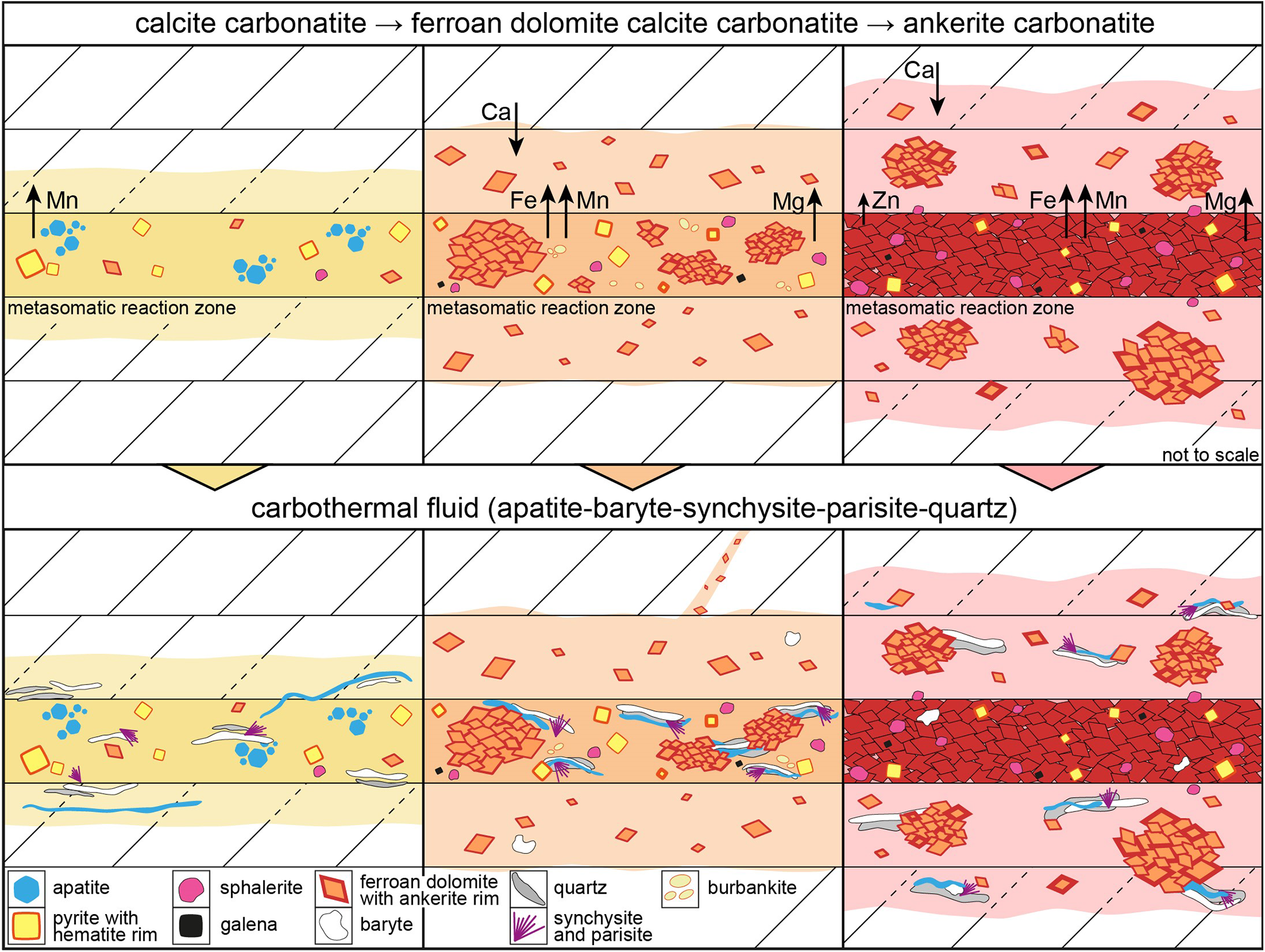
The changes in the metasomatic reaction zone imply elemental exchange of the two lithologies, which summarise the observations. Based on mineralogy, there is an Fe and Mg flux from the carbonatite to the marble, and a Ca flux in the opposite direction. The µXRF mappings revealed a Mn flux from the carbonatites to the marble. A small-reaching Zn flux from the carbonatite can be observed, whereas for Si a marble-derived and hydrothermal origin can be postulated. These elemental exchanges alongside carbonatite differentiation and carbothermal stage overprint are summarized and visualized in the scheme in Fig. 8.
Schematic representation of the evolution of carbonatite dykes/veins with metasomatic reaction zones forming along the contact with the Damara calcite marble, followed by a carbothermal stage forming the apatite II-baryte-synchysite-parisite-quartz assemblage. Note that background colours in all three carbonatites represent calcite. The arrows represent element exchange, where Fe, Mn, Mg and Zn migrate from the carbonatite, while marble provides Ca.

Figure 8 Long description
The schematic consists of two rows, each with three sections, illustrating the evolution of carbonatite dykes and veins. The top row shows three stages: calcite carbonatite, ferroan dolomite calcite carbonatite and ankerite carbonatite. Each stage includes a metasomatic reaction zone, where arrows indicate element exchange. In the first section, arrows show calcium moving from marble to carbonatite, while manganese moves in the opposite direction. The second section shows calcium and manganese moving from marble to carbonatite, with iron and magnesium moving in the opposite direction. The third section illustrates calcium moving from marble to carbonatite, with iron, magnesium and zinc moving in the opposite direction. The bottom row represents the carbothermal fluid stage, forming an assemblage of apatite, baryte, synchysite, parisite and quartz. Each section includes various minerals, such as apatite, sphalerite, galena and others, depicted with different symbols. The background colors represent calcite and the arrows indicate element exchange between the carbonatite and marble. The schematic is not to scale and visually summarizes the elemental exchanges and mineralogical changes during the evolution of carbonatite dykes and veins.
Conclusion
The Osongombo Carbonatite Complex reveals a three-stage evolutionary history:
(1) Magmatic stage. Early calcite carbonatite with accessory pyrochlore, apatite I, pyrite and sphalerite;
(2) Late-magmatic stage. Progressive enrichment of Fe and Mg produced ferroan dolomite calcite carbonatite and ankerite calcite carbonatites, accompanied by an increased amount of sulfide minerals and the first crystallization of burbankite as inclusions in Fe-rich carbonates;
(3) Carbothermal stage. Volatile-rich carbonate fluids percolated through the carbonatite precipitating apatite II, baryte, synchysite, parisite and quartz in veined networks and small patches. In addition, carbonatite dykes and veins produce metasomatic reaction zones with the marble, which records elemental exchange between the two. Iron, Mg and Mn migrate towards the marble, while the marble provides Ca. The thickness of these zones depends on the proximity of the main carbonatite body, the thickness of the intruding carbonatite dyke or vein, on the chemical contrast and the availability of the fluid.
Supplementary material
The supplementary material for this article can be found at https://doi.org/10.1180/mgm.2026.10201.
Acknowledgements
The German Science Foundation (DFG) funded this contribution [grants WA 3116/3-1 and MA 2135/26]. The authors thank Aniket Chakrabarty and Roger Mitchell for handling the contribution, as well as Anatoly Zaitsev and three anonymous reviewers whose comments greatly improved the manuscript. Thanks to the Ministry of Mines and Energy, Namibia, for their continued support. The authors also thank Inka van der Bijl from the Geological Society of Namibia for the opportunity to present ongoing research. The authors thank Pete Siegfried for providing help with the organization during fieldwork in 2021 and 2023. Special thanks to Ralf and Elke Kretschmar for their hospitality and access to their farmland, as well as to Dominic Raisch for the help with µXRF.
Competing interests
The authors declare none.


 Open access

