





Impact statement
We present a case study describing preliminary insights from early deployment of a mobile app created for traditional faith healers to support the care of people living with serious mental illness (SMI). Faith healing camps in Ghana and West Africa remain central to community mental health care. Developing digital technologies for this context presents a paradox: it offers pathways to collaboration, accountability and improved outcomes, while also introducing risks of undermining the traditional authority of faith healers. This case study highlights practical considerations for co-designing a digital mental health tool for deployment in a spiritually driven, low-resource setting. The discussion of opportunities and tensions at the intersections of technology, mental health and spiritual practices raises important factors for clinical researchers working in similar contexts. This case study discusses the integration of spirituality and digital health innovations leading to effective and meaningfully embedded training and facilitation. By approaching integration through cultural sensitivity, trust-building and infrastructure development, it is possible to design hybrid models of care that respect spirituality while embracing digital innovation. Such models may represent a future in which technology and spirituality converge not in conflict, but in partnership.
Introduction
Due to constraints in access to mental health resources (Weobong et al., Reference Weobong, Ae-Ngibise, Sakyi and Lund2023), persons living with mental illness in Ghana often resort to traditional and faith healing as a means of receiving care (Arias et al., Reference Arias, Taylor, Ofori-Atta and Bradley2016; Ofori-Atta et al., Reference Ofori-Atta, Attafuah, Jack, Baning and Rosenheck2018; Peprah et al., Reference Peprah, Gyasi, Adjei, Agyemang-Duah, Abalo and Kotei2018; Albright et al., Reference Albright, Le, Meller, Ofori Atta, Attah, Asafo, Collins, Ben Zeev, Snyder, Stephanidis, Antona and Ntoa2021). In West African cultures, traditional and faith healing practices have been used for centuries to address medical conditions (Sharma et al., Reference Sharma, Gupta, Saxena, Shah and Singh2020; Kpobi et al., Reference Kpobi, Read, Selormey and Colucci2024; Shrestha et al., Reference Shrestha, Shrestha, McArthur, Rowe, Maar and Walker2024). These practices aim to restore harmony among the body, mind and spirit, often employing prayer, rituals and herbal remedies, grounded in a belief in divine or ancestral influence over illness (Mbiti, Reference Mbiti2015; Asafo, Reference Asafo2021). Faith-healing sites, known as prayer camps, are common in Ghana. Many seek care at prayer camps, hoping for healing through faith, prayer, fasting, teaching and prophecy (Read, Reference Read2012; Lambert et al., Reference Lambert, Nantogmah, Dokurugu, Alhassan, Azuure, Yaro and Kørner2020). Camps provide spiritual treatments, residential care and prayer for those with illnesses attributed to spiritual causes. It is challenging to quantify these sites due to a lack of registration, but estimates suggest several hundred across Ghana (Human Rights Watch, 2024).
While traditional and faith healing can provide a sense of community and support during illness, harmful activities such as chaining, seclusion and forced fasting have also been reported (Sharma, Reference Sharma2020; Benyah, Reference Benyah2022). Despite concerns about these practices, faith healers remain a key part of mental health care in many low- and middle-income countries (LMIC), prompting calls for collaboration with formal health systems to improve culturally sensitive care (Osafo, Reference Osafo2016; Krah et al., Reference Krah, de Kruijf and Ragno2018; Badu et al., Reference Badu, Mitchell and O’Brien2019; Weobong et al., Reference Weobong, Ae-Ngibise, Sakyi and Lund2023). This case study examines the intersection of faith healing practices and the emerging use of digital platforms (Labrique et al., Reference Labrique, Wadhwani, Williams, Lamptey, Hesp, Luk and Aerts2018) to (1) expand mental health treatment based on evidence-based practices, (2) address concerns regarding humane care, and (3) provide ongoing culturally sensitive support to caregivers. Specifically, this case study focuses on insights gathered during initial design, development and preparations for larger-scale deployment. This important articulation work created opportunities for the research team to understand and respond to direct observations and interactions with faith healers. While the efficacy of the full intervention is being assessed through an ongoing clinical field trial, this case study provides a view into the process of designing and developing the culturally grounded digital mental health component of that trial.
This project requires a highly multidisciplinary team. The research team, composed of members from the US and Ghana, has expertise in digital mental health interventions in low-resource settings and in community mental health initiatives in West Africa, including regional prayer camps. Training and expertise of the group span psychology, psychiatry, global mental health, user-centered design and community-engaged psychosocial intervention programs.
Method
Study design and participants
Qualitative data were collected throughout the design and development of a global mental health intervention in West Africa (Ben-Zeev et al., Reference Ben-Zeev, Larsen, Attah, Obeng, Beaulieu, Asafo, Gavi, Kadakia, Sottie, Ohene, Kola, Hallgren, Snyder, Collins, Ofori-Atta and Team2024) that is currently in a clinical trial. The intervention includes (1) M-Healer, a mobile app providing psychosocial education to faith healers, and (2) a visiting nurse program pairing prayer camp staff with health professionals who supervise the dispensing of psychiatric medication. The M-Healer app was created for faith healers caring for individuals with SMI in collaboration with local clinical stakeholders and in consultation with faith healers. Visiting nurses work with healers at prayer camps to incorporate techniques from the app into camp routines. Individuals receiving medication are patients at prayer camps who have SMI, are over 18 years and have consented to participate in this study. Here, we focus on the acceptance and usability of the M-Healer mobile application in the context of spiritual practice, as assessed during the design process and through an optimization pilot study.
The M-Healer application was initially proposed as an extension of digital mental health interventions used in other parts of the world (Ben-Zeev et al., Reference Ben-Zeev, Larsen, Attah, Obeng, Beaulieu, Asafo, Gavi, Kadakia, Sottie, Ohene, Kola, Hallgren, Snyder, Collins, Ofori-Atta and Team2024) seen as promising by Ghanaian collaborators deeply familiar with the context of prayer camps in West Africa. The app and its content were designed and developed in collaboration with healers through a series of co-design sessions and periodic user feedback sessions (Albright et al., Reference Albright, Le, Meller, Ofori Atta, Attah, Asafo, Collins, Ben Zeev, Snyder, Stephanidis, Antona and Ntoa2021; Snyder et al., Reference Snyder, Asafo, Attah, Collins, Ofori-Atta and Ben-Zeev2026). The app delivers psychosocial training on de-escalation techniques, relaxation strategies, tutorials on alternatives to practices that constitute human rights abuses such as physical restraints and forced fasting, and education on human rights in the care of people with SMI. Content is delivered via animated videos and audio recordings and is available in English or Twi, both languages widely spoken in the region. M-Healer features basic tracking capabilities for logging patient progress over time, using a visual icon system to accommodate varying literacy levels among healers. Use of the app requires no ongoing data network access after installation.
This case study comprises data collected from faith healers through (1) preliminary context interviews and an on-site design workshop (Albright et al., Reference Albright, Le, Meller, Ofori Atta, Attah, Asafo, Collins, Ben Zeev, Snyder, Stephanidis, Antona and Ntoa2021), (2) work-in-progress feedback collected during app development, and (3) usability interviews with faith healers collected after an 8-week optimization trial of the full intervention conducted at a large prayer camp in rural southern Ghana (see Table 1). All research activities were approved by the Institutional Review Boards of the University of Washington (Study #00015549) and the University of Ghana (IRB 00001276).
Timeline of data collection and research activities in southern Ghana outside of the capital city of Accra

Table 1. Long description
The table is organized into four columns: Data collection activity, Dates and site(s), Participants, and Data collected.
* Row 1: Design field study involving semi-structured interviews and focus groups over 10 days. Conducted in November 2019 at 3 prayer camps with 18 faith healers. Data includes interview transcripts and field notes.
* Row 2: Co-design focus group involving a 3 hour interactive discussion. Conducted in November 2019 at a regional hotel or conference center with 12 faith healers. Data includes focus group transcripts and field notes.
* Row 3: User feedback session using a medium-fidelity app prototype. Conducted in October 2022 at a prayer camp optimization site with 3 faith healers. Data includes interview transcripts and field notes.
* Row 4: Optimization study for fidelity evaluation and user feedback. Conducted in June 2023 at the optimization site with 4 faith healers. Data includes interview transcripts.
Study procedures and data collection
A 10-day design field study with local stakeholders took place in November 2019 and included visits to three rural prayer camps. Semi-structured interviews were conducted with 18 faith healers who each received 50 Ghana cedi (about USD 8.50), and protocol questions focused on the prayer camp environment, assessment and treatment of mental health issues, roles and responsibilities of prayer camp community members and experiences with technology. Interviews were audio-recorded with permission and later transcribed. One healer declined to be recorded, resulting in 17 transcripts for analysis. During the field study, iterative ideas and possible approaches were presented through brief, informal focus groups at each camp, yielding three one-page transcripts. A single 3-h design workshop was conducted at the end of the field study with 12 previously interviewed faith healers from different camps. During this semi-structured interactive discussion, the US project lead and a Ghanaian team member fluent in Twi (1) introduced some of the ways that mobile technologies support mental health and (2) shared preliminary design concepts for a mobile app that could deliver psychosocial training and educational materials in a highly visual format, using Ghanaian language dialects and contextualized for prayer camps. Researchers led participants through an assessment of design concepts, including open-ended discussions and rating activities focused on cultural and spiritual fit. Design session participants received a meal and a compensation of 100 cedi (around USD 17) per person.
In October 2022, a medium-fidelity prototype of the M-Healer App was demonstrated on a smartphone to three healers working at the optimization trial site. In June 2023, as part of an 8-week optimization trial of the intervention in one large Christian prayer camp (Ben-Zeev et al., Reference Ben-Zeev, Larsen, Attah, Obeng, Beaulieu, Asafo, Gavi, Kadakia, Sottie, Ohene, Kola, Hallgren, Snyder, Collins, Ofori-Atta and Team2024), a final version of the M-Healer app was introduced to a prayer camp leader and four experienced healers caring for individuals with SMI. The four healers participated in a 2-day training session on the use of the M-Healer app, attended weekly discussions on their usage of M-Healer and received technical support throughout the trial. Fidelity and endline interviews were conducted with the four healers using a semi-structured interview protocol that focused on their experiences and perspectives on integrating the app into traditional healing practices.
All initial field study interactions occurred in a combination of English and Twi. All faith healers spoke Twi; some had proficiency in English. Real-time translations provided by Ghanaian research team members were captured in audio recordings. Additional translations were added during verification of transcripts. Optimization trial interviews were conducted in a combination of English and Twi by individuals fluent in both languages. Interviews were transcribed in the original language used by participants, then translated into English by Twi-speaking team members. Transcripts were then translated back into Twi and compared to the original statements to confirm accuracy. As a final check, translations were vetted for accuracy and clarity by the research team members who administered the interviews.
Data analysis
Inductive thematic analysis (Clarke and Braun, Reference Clarke and Braun2017) was conducted on transcripts and field notes using the Dedoose software version 9.2.22. Based on interviews and interactive discussions held throughout the design and development of the intervention, we identified that factors related to the intersection of digital technology and spiritual practice were influencing the direction and nature of our consultations and collaborations with faith healers. Therefore, three members of the research team, trained in qualitative analysis methods, individually performed exploratory thematic analysis on the qualitative data described above. Initial codes identified factors and attitudes at the intersection of technology use, spirituality and mental health care. Through an iterative cycle of independent coding, discussion, refining of emergent codes and eventual consensus, we arrived at a set of themes that captured the range and nature of these factors. Throughout the process, disagreements were discussed among coders until a consensus was reached.
Results
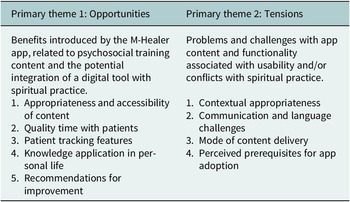
Two broad themes related to technology adoption in the context of spiritual practice and caregiving were identified: potential opportunities (5 subthemes) and tensions (4 subthemes) (Table 2). While data from initial interviews with healers provided important context, many of the most vivid excerpts illustrating these themes came from the design workshop and feedback gathered during optimization, after healers had used the M-Healer app.
Themes related to technology adoption and spiritual practices

Table 2. Long description
The table is divided into two primary themes.
Primary theme 1, titled Opportunities, is located in the left column. It describes benefits introduced by the M-Healer app regarding psychosocial training and digital integration with spiritual practice. It contains five numbered sub-themes:
1. Appropriateness and accessibility of content.
2. Quality time with patients.
3. Patient tracking features.
4. Knowledge application in personal life.
5. Recommendations for improvement.
Primary theme 2, titled Tensions, is located in the right column. It describes problems and challenges with app content and functionality related to usability or conflicts with spiritual practice. It contains four numbered sub-themes:
1. Contextual appropriateness.
2. Communication and language challenges.
3. Mode of content delivery.
4. Perceived prerequisites for app adoption.
Primary theme 1: Opportunities
Subtheme 1.1: Appropriateness and accessibility of content
Overall, healers valued the purpose, content and ease of use of M-Healer. During the design workshop, a healer envisioned how having materials accessible in an app could offer instant support during difficult situations:
So, when they’re dealing with something they’re not able to do very well, they could come back to the app to reference or get more information. (Design Workshop, Healer 7)
This corresponds with feedback given during the optimization trial, illustrating how the technology served as an on-demand mentor, supporting healer needs in real time:
It was a second level of help. It was a resource to go to when you needed to know how to handle a patient. It was like a mentor you could go to for guidance as you worked. (Optimization, Healer 2)
Subtheme 1.2: Quality time with patients
Healers explained how app content positively affected the time they spent focused on their patients, by applying skills learned in the educational modules and using the app to reflect on patient interactions:
In the past we would ignore them if we thought what they were saying didn’t make sense, but the app has helped us to understand that being calm, giving them attention and listening to them is key for their healing. (Optimization, Healer 2)
So now we are more conscious about some of the things that we used to ignore in the past. For example, if you come in the morning, your patients who are on medication should be your priority. You should be conscious of their welfare, and also see whether the medication being given to them is having a positive or negative effect on them. … (Optimization, Healer 4)
Subtheme 1.3: Patient tracking features
The app’s visual patient-tracking feature helps healers document progress, regardless of literacy. Healers can add patients and log daily assessments (positive/neutral/negative), with trends visualized over time. They found this simple tool influenced their choices about practices like chaining, enabling evidence-based decisions and more grounded interactions. One healer noted it fostered more intentional patient check-ins:
Every day I come and I go check the patient to see how they are doing. Although previously I used to check, now I do it more consciously. (Optimization, Healer 4)
Subtheme 1.4: Knowledge application in personal life
During the initial field study, when preliminary ideas for the digital intervention were presented to healers, some saw potential for the app to be beneficial outside the camp. A healer equated the potential for app content to soothe and calm in the moment with other patient-facing media sources in clinics:
If you go to some hospitals, you see screens and televisions showing movies and the rest. Sometimes patients are sitting there worried and they are watching the TV. Sometimes they see something funny that will help them laugh and then they forget about their problems. So, if it’s similar, it’s very beneficial. (Design Workshop, Healer 5)
Healers imagined using it in other aspects of their lives, highlighting pathways for integrating mobile delivery of educational materials outside the camps:
…so, I think that this is a special app and would be very helpful to the public too because someone might have a similar problem in the family. And if the person uses this app, he or she would know how to handle the other person … (Optimization, Healer 3)
Subtheme 1.5: Recommendations for improvement
Involving healers early in the mobile app design process provided opportunities to learn about preferences and expectations:
[My] suggestion is to be careful with culture and religion in terms of … the visuals. You have to take these things into consideration. (Design Workshop, Healer 2)
Seeking feedback from healers during the optimization trial yielded insights regarding how to enhance its functionality and content. Healers gave suggestions such as:
…One can get bored of watching it. If it could be updated and other videos could be added to it [it would be better]… (Optimization, Healer 1)
The app covers important topics, and I was hoping it could include a guide as to how to help individuals who had visual hallucinations. (Optimization, Healer 2)
Healer recommendations regarding the app’s usability and integration into spiritual practice during the optimization trial contributed to iterative refinement of the app and design and refinement of facilitation support provided by the nurses.
Main theme: Tensions
Subtheme 2.1: Contextual appropriateness
Among healers, there was consensus that the app should include an understanding of their beliefs and the context of their work. Specifically, they held adherence to spiritual treatment plans in the same light as medical interventions, something not directly addressed in the app:
It’s just like coming to the hospital. You need to do what you’ve been told to do because that’s how we believe we can help you. This is our belief here. If they do not fast, they do not think they will be helped. That is what we believe here. (Optimization, Healer 1)
They contextualized practices like chaining in terms of safety:
The issue of chaining, frankly, it is not deliberate, or due to a desire to harm them. But then we needed a way to protect ourselves. It was not a desire to humiliate the patients or push them to the wall. In caring for them, your life was also in danger and as a result, we had to do that. There is no other way to protect ourselves. (Optimization, Healer 2)
We cannot also allow a patient to fight with another and hurt him or her, which we would regret. So, as the chain is there [so far as the chains are available], we put the patient in chains. (Optimization, Healer 3)
The persistence of practices like chaining reflects concern about safety and a lack of training in alternatives, rather than defiance of the law or of ethics. These excerpts reflect a complex negotiation between biomedical ethics and practice of safety procedures for both patients and healers in the context of infrastructure challenges. Digital content delivered on a mobile device provides a particularly compelling opportunity to address these tensions close to their sources.
Subtheme 2.2: Communication and language challenges
Healers expressed frustration at what they perceived as criticism of their methods in some of the animated videos. They emphasized that it was not about what was said about human rights violations but how it was said. For example, one healer explained quite strongly:
After listening to the app, we realized certain words on the app destroy our work and discourage our morale for the work. The app was good but certain words with regards to the content didn’t go on well with us. (Optimization, Healer 3)
This feedback and initial resistance from healers regarding how practices like chaining were presented led to the addition of supplementary audio content to contextualize and align messaging within spiritual practices. It also influenced how practice facilitation was designed and integrated into study deployment, heightening awareness of the importance of situating app use in spiritual and practical activities performed by healers. While we see a potential connection to research showing the importance of communication tone in the reception of culturally diverse health interventions (Minnican & O’Toole et al., Reference Minnican and O'Toole2020), these types of statements from healers also prompted reflection among the research team on the possibility that some tensions might be necessary as familiar habits were replaced with new routines and practices.
Subtheme 2.3: Mode of content delivery
As described above, psychosocial training materials were delivered in two modes: animated videos with audio voiceover, available in both English and Twi, and audio-only recordings that covered slightly expanded treatments of topics and tutorials. Healers tended to prefer the audio versions of the content, reporting that this material, which was slightly more in-depth, seemed more relevant to their work. This preference suggests that audio-based formats align better with healers’ learning styles and literacy levels, reinforcing the need for adaptable media design.
Subtheme 2.4: Holistic approaches to adoption
Healers identified additional non-technology-focused factors they felt were essential for successful adoption of the intervention including (1) a stable supply of medication, (2) clear policies regarding expected use, (3) integration of M-Healer with camp rules and practices (negotiated with each camp at the beginning of their participation in the trial), and (4) content that acknowledges and supports spiritual practices, especially with respect to human rights education (achieved through targeted supplemental audio recordings added prior to launch).
Discussion
This case study shows that (1) technology has a place in mental health in West Africa, even in practices steeped in spirituality, and (2) involvement of spiritual practitioners in the design and development of digital health interventions is beneficial. Healer involvement is not solely about affirming the efficacy of those components; it is an opportunity to learn more about what is necessary for such interventions to work over the long term. Because many camp staff own mobile devices, the use of a digital mental health intervention did not require additional training in mobile device use. While ensuring the usability of the M-Healer app was important, it was not the only factor in its adoption. Integration with spiritual practice was necessary for healers to fully engage with the training materials and use them in their daily work.
We recognized the importance of healer input during the intervention’s evaluation, as diminished trust between biomedical professionals and TFHs can hinder collaboration (Read et al., Reference Read, Jilka and Singh2023). Interventions often seem unidirectional, from “experts” to healers, rather than encouraging reciprocal learning. We involved healers in designing and deploying the app and suggest that a digital device providing knowledge on delicate topics like human rights may ease sensitivities, as it allows healers to initiate learning. Technology may be a more neutral source of knowledge than health care professionals, especially when designed with input from community-affiliated individuals such as healers (Noorbergen et al., Reference Noorbergen, Adam, Teubner and Collins2021).
Nevertheless, necessary tensions remain that may not require resolution, but inform collaboration (Snyder et al., Reference Snyder, Asafo, Attah, Collins, Ofori-Atta and Ben-Zeev2026 ). As optimization study deployment began, the research team came to recognize that integration with spiritual practice required confronting the range of multifaceted approaches used by healers to manage care for people with SMI, including chaining. The research team carried the responsibility of minimizing and reporting observed harms in alignment with ethical requirements while acknowledging the complex cultural norms into which the intervention was being introduced. This positioning introduced what could be seen as conflicting aims: respecting the spiritual practices of healers while surveying camp activities for human rights violations. Managing the tension required forthright communication between healers and researchers, acknowledgment of healers’ anxieties when faced with people with SMI displaying agitation and reframing these tensions as prompts for healers to turn to the app when seeking alternatives to harmful behaviors. As a case study, the work reported here focuses on insights generated as the research team navigated these tensions during design, development and optimization. Our ongoing work will address broader questions of the efficacy of the integration of technology and spiritual practices to bridge mental health care gaps that result from limited resources.
Last, Patel (Reference Patel2011) notes that many collaborations between biomedical professionals and healers are short-lived due to challenges with human resources, equipment, medication and reaching remote areas. Digital health innovations like M-Healer could offer sustained access to knowledge and skills. This is only possible when technology is designed and deployed in ways that are aligned with fundamental spiritual practices and integrated with practical supports, such as community nurses, medications and attention to technology accessibility. In our case, this included keeping the app’s interaction design as streamlined as possible to accommodate constraints of data bandwidth and device energy consumption. Further, this meant ensuring content was aligned with materials that healers perceive as critical of their faith-based practices.
Iterative changes reflected a responsive attitude toward healers and reinforced that the prayer camp staff held agency in the process of changing practices. In this sense, the app was positioned as an extension of spiritual practice rather than in tension with it. Our case study suggests that the intersection of spirituality and digital health innovations is best realized when digital integration of training and facilitation is meaningfully embedded in spiritual practices and routines. Continued use and realization of the app’s utility, in particular, the integration of educational content and basic tracking with spiritual practices, have the potential to move it from a purely pedagogical resource to an integrated tool for delivering care to people with SMI.
Limitations
This study has limitations: (1) as an exploratory qualitative case study, its findings are specific to a particular context and cannot be presumed to represent all faith healing camps in Ghana, (2) data reported here were collected over a 4-year period, covering different phases of the intervention development and initial deployment, which may have implications for the faith healers’ attitude towards digital technology and care, and (3) while rigorous translational and back translation was employed, in conducting some interviews in Twi and translating into English some contextual meaning may have been lost. Finally, this study focused exclusively on healer’s perspectives, excluding those of patients and caregivers. Future research should focus on examining implementation across a broader range of faith healing camps, incorporating multiple stakeholders’ perspectives and evaluating the effectiveness of the interventions on patient outcomes and human rights practices.
Conclusion
Faith healing camps in West Africa remain vital to community mental health care. The rise of digital technology presents a paradox: it risks weakening traditional authority while providing opportunities for collaboration, accountability and better outcomes. By approaching integration with cultural sensitivity, trust-building and infrastructure development, it is possible to create hybrid care models that honor spirituality while adopting digital innovation. The findings from this case study highlight several critical considerations necessary for the successful implementation and adoption of a hybrid care model of this nature. These include: (i) the importance of co-designing intervention content collaboratively with end users while incorporating relevant cultural nuances to enhance contextual relevance and acceptability; (ii) the integration of trained facilitators, such as psychologists and nurses, to translate theoretical content into practical applications and provide consistent support through regular engagement; and (iii) the establishment of structured mechanisms for obtaining user feedback to inform iterative refinement, responsiveness and sustainability of the intervention. These considerations provide valuable insights to inform the design, implementation and scalability of similar digital mental health interventions in hybrid care models. These models may represent a future where technology and spirituality work together, not in opposition, but in partnership.
Open peer review
The supplementary material for this article can be found at http://doi.org/10.1017/gmh.2026.10289.
Data availability statement
Data, including from the optimization field trial, have not been made publicly available at the time of submission of this manuscript.
Acknowledgements
The authors thank all the faith healers who participated in the interviews.
Author contribution
The first, second and last authors shared editorial responsibility and contributed equally to data analysis, synthesis and manuscript writing. All authors were involved in the design and deployment of the optimization field trial, as well as in reviewing and ensuring the accuracy and fidelity of the manuscript.
Ethics and approvals
This study was approved by the institutional review boards of the University of Washington (IRB 00015549) and the University of Ghana (IRB 00001276). All study participants provided informed consent.
Competing interest
There are no known conflicts of interest to be declared.
Funding statement
This study was funded by the United States National Institute of Mental Health (Grant number: R01MH127531).
AI statement
Grammarly version 1.161.1 was used for grammar, spelling and minor improvements in phrasing.


 Open access


Comments
Dear Editor,
We are pleased to submit our manuscript titled “A Qualitative Evaluation of Digital Mental Health Integration within Spiritual Healing Practices in Ghana” for consideration as a case study for publication in Cambridge Prisms: Global Mental Health.
This manuscript presents a qualitative case study examining the integration of a culturally adapted digital mental health tool (M-Healer) within traditional faith healing settings in Ghana. Drawing on longitudinal engagement with faith healers across multiple prayer camps, we provide novel insights into the opportunities and tensions that arise at the intersection of digital innovation, spirituality, and mental health care in low-resource settings.
This work makes three key contributions. First, it advances the global mental health literature by offering empirically grounded evidence on how digital interventions can be co-designed and embedded within non-biomedical systems of care. Second, it highlights the importance of culturally sensitive adaptation, trust-building, and iterative collaboration when introducing technology into spiritually grounded contexts. Third, it contributes to ongoing debates on ethical care and human rights by demonstrating how digital tools may support improvements in caregiving practices without undermining local belief systems.
We believe this manuscript will be of strong interest to readers in global mental health, digital health, medical anthropology, and implementation science, particularly those concerned with culturally responsive and scalable interventions in low- and middle-income countries.
This work is original, has not been published elsewhere, and is not under consideration by any other journal. All authors have approved the manuscript and agree with its submission. There are no conflicts of interest to declare. The study was conducted in accordance with ethical standards and received approval from relevant Institutional Review Boards.
We would be grateful for the opportunity to have this work considered for publication and are happy to provide any additional information required.
Thank you for your time and consideration.
Yours sincerely,
Dr. Dzifa Abra Attah
(On behalf of all authors)