INTRODUCTION
The spiny dogfish, Squalus acanthias Linnaeus, 1758 presents a worldwide distribution and it is known from the north-eastern Atlantic, British Isles, Bay of Biscay (Quéro et al., Reference Quéro, Porché and Vayne2003), and south Strait of Gibraltar to Morocco (McEachran & Branstetter, Reference McEachran, Branstetter, Whitehead, Bauchot, Hureau, Nielsen and Tortonese1984). Squalus acanthias is known throughout the Mediterranean Sea, including its eastern areas (Chatzispyrou & Megalofonou, Reference Chatzispyrou and Megalofonou2005; Golani, Reference Golani2005) and the Black Sea (Avsar, Reference Avsar2001; Demirhan & Seyhan, Reference Demirhan and Seyhan2006). The species is known along the western side of the Atlantic (Bigelow & Schroeder, Reference Bigelow, Schroeder, Tee-Van, Breder, Hildebrand, Parr and Schroeder1948; Seco Pon & Gandini, Reference Seco Pon and Gandini2007) and elsewhere in the Pacific (Hanchet, Reference Hanchet1988; McFarlane & King, Reference McFarlane and King2003).
Squalus acanthias was the focus of several studies concerning distribution, population, size-structure and reproductive biology for specimens from the Atlantic (Ketchen, Reference Ketchen1972; Nammack et al., Reference Nammack, Musick and Colvocoresses1985; Saunders & McFarlane, Reference Saunders and McFarlane1993; Jones & Ugland, Reference Jones and Ugland2001; Cortès, Reference Cortès2002; Henderson et al., Reference Henderson, Flannery and Dunne2002) and the Pacific (Hanchet, Reference Hanchet1988; McFarlane & King, Reference McFarlane and King2003). Off the Mediterranean coast, Chatzispyrou & Megalofonou (Reference Chatzispyrou and Megalofonou2005) presented data on specimens collected in the eastern region, while Avsar (Reference Avsar2001) and Demirhan & Seyhan (Reference Demirhan and Seyhan2006), on specimens from the Black Sea.
Off the Languedocian coast, S. acanthias is generally targeted for local consumption, having a relative high economic value, and, only preliminary biological observations were reported by Capapé et al. (Reference Capapé, Tomasini and Quignard2000b). Recent records made in the area provide additional data that allow us to enlarge and improve the knowledge of the local spiny dogfish, about main traits of its reproductive biology such as size at sexual maturity, reproductive cycle and fecundity. Such information could be useful to assess the real status of the species off the Languedocian coast. Aldebert (Reference Aldebert1997) previously reported a decline in observations of S. acanthias landings beginning in the 1980s, in the region. Additionally, the spiny dogfish is listed as vulnerable on the IUCN list (Fordham et al., Reference Fordham, Fowler, Coelho, Goldham and Francis2006; Gibson et al., Reference Gibson, Valenti, Fordham and Fowler2008), which considered that the real decrease in the population biomass could be higher than presented in the literature, taking into account that official fisheries statistics only consider landed biomass and not actual captures.
MATERIALS AND METHODS
The specimens of Squalus acanthias were collected off the Languedocian coast, between 43°30′ and 43°05′N, and between 3°40′ and 4°15′E, from 1997 to 2005; sampling was carried out from three to five times per month. Most of the examined specimens were landed at the fishing harbour of Sète and the fishing sites of Palavas-Les-Flots and Carnon. They were caught by trawling at depths between 80 and 100 m, on sandy–muddy and detritic bottoms. The sample included 209 specimens, 110 males and 99 females. In addition, 76 embryos, 45 males and 31 females were also examined.
Specimens were measured for total length (TL) to the nearest mm following Compagno (Reference Compagno1984) and weighed to the nearest gram. Clasper length (CL, mm) was measured according to Collenot (Reference Collenot1969), from the forward rim of pelvic girdle to tip of clasper as were the diameter of yolky oocytes and embryos TL. Oocytes and embryos were removed from the ovaries and then measured and weighed to the nearest decigram.
The onset of sexual maturity was determined in males from the condition and the length of claspers following Stevens & McLoughlin (Reference Stevens and McLoughlin1991) and Watson & Smale (Reference Watson and Smale1998). The claspers of juveniles are shorter than pelvic fin, flexible and not calcified; those of sub-adults are longer than pelvic fin, flexible but slightly calcified. In adults, claspers are elongated, longer than pelvic fins length, rigid and calcified. Some aspects of the testes and other reproductive organs are given following Henderson et al. (Reference Henderson, McIlwain, Al-Oufi and Ambu-Ali2006). Size at sexual maturity was determined in females from the condition of ovaries and the morphology of the reproductive tract (Henderson et al., Reference Henderson, McIlwain, Al-Oufi and Ambu-Ali2006). In both males and females, specimens were divided into three categories: juveniles, sub-adults and adults.
Hepatosomatic index (HSI) and gonadosomatic index (GSI) were calculated for both males and females, as HSI = (LM/TM) * 100, GSI = (GM/TM) * 100. Variations in HSI and GSI related to size were considered in all categories of specimens in both sexes, and among adult females.
To investigate the embryonic development and the role of the mother during gestation, a chemical balance of development (CBD) was determined. It is based on the mean dry mass of fertilized eggs and fully developed embryos and can be computed as the mean dry mass of fully developed embryos divided by the mean dry mass of yolky oocytes or eggs. Water content of 50% in ripe oocytes and 75% in fully developed embryos were standard values, based on chemical analyses of the small spotted catshark, Scyliorhinus canicula, by Mellinger & Wrisez (Reference Mellinger and Wrisez1989). The chemical balance of development is a tentative estimate of the degree of nutritional support provided by the mother aside from yolk reserves.
Normality and homogeneity of variance of the variables were tested by the Shapiro–Wilk test and Levene's test, respectively. Tests for significance (P < 0.05) were performed by using analysis of variance, Student's t-test and the Chi-square test. The linear regression was expressed in decimal logarithmic coordinates. Correlations were assessed by least-squares regression. In the relationship mass versus total length and liver mass versus total length, comparisons of curves were carried out by analysis of covariance.
RESULTS
Sample description
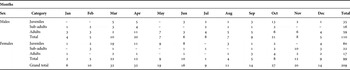
The monthly collection of observed specimens is presented in Table 1 with W = 0.94 and P < 0.0001, using the Shapiro–Wilk test. The three categories of free-swimming specimens, male and female juveniles were not equally distributed in the sample: among juveniles, females significantly outnumbered males (χ2 = 7.2, df = 1, P > 0.05) whilst in adults, males significantly outnumbered females (χ2 = 23.2, df = 1, P > 0.05). Additionally, among embryos males significantly outnumbered females (χ2 = 8.9, df = 1, P > 0.05).
Monthly collection of the observed Squalus acanthias captured off the Languedocian coast.

MALES (FIGURES 1 & 2)
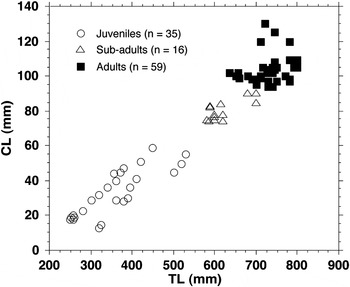
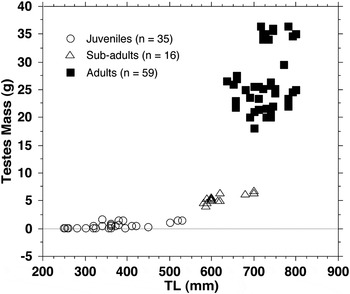
The observed juveniles ranged from 250 to 530 mm TL and weighed from 52 to 176 g; however, the lightest juvenile weighed 48 g and was 260 mm TL. Specimens had short and flexible claspers. Testes and genital ducts were inconspicuously developed and thread-like. Juveniles were not recorded in January, February and May; in contrast, a peak of 13 specimens was observed in October (Table 1).
Clasper length (CL) versus total length (TL) in male Squalus acanthias.

Testes mass (TM) versus total length (TL) in male Squalus acanthias.

The observed sub-adults ranged between 580 and 700 mm TL, and the mass was between 900 and 1100 g. During the sub-adult stage, the claspers developed, they were slightly longer than pelvic fins. The testes increased in mass, but had no spermatocysts externally visible; no sperm was observed in the seminal vesicles. The genital duct was slightly convoluted anteriorly. Some sub-adults were recorded, none in May, June, November and December (Table 1).
During the adult stage, the claspers were elongated, calcified, and rigid, and are slightly longer than the pelvic fins. Testes were well-developed and exhibited spermatocysts externally visible. The genital duct was twisted and sperm occurred in seminal vesicles. In all, 59 adult males were examined. The smallest sexually mature male observed was 635 mm TL and weighed 1400 g; all the males above 700 mm TL were adult. The largest male was 800 mm TL and weighed 2220 g. Adult males were collected throughout year, with a peak in May (Table 1).
FEMALES
The observed juveniles ranged from 250 to 550 mm TL and weighed between 54 and 650 g, had whitish and undeveloped ovaries, thread-like oviducts and inconspicuous oviducal glands. Captures occurred especially from March to June, no specimens were recorded in July and November (Table 1).
The observed sub-adults ranged from 600 to 800 mm TL and weighed from 985 to 2225 g, exhibiting primarily white translucent follicles and a well-differentiated genital duct. The oviducal glands were visible and slightly rounded. Rare specimens were caught year round; in contrast a peak of captures was recorded in November (Table 1).
The adult females exhibited a single functional ovary containing batches of yolky oocytes and exhibited fully developed genital ducts. The oviducal glands were conspicuously rounded and the mass considerably increased in adults. The smallest sexually mature female had 800 mm TL and weighed 2750 g, it carried developing yolky oocytes. Additionally, the two smallest pregnant females were 860 mm and 870 mm, respectively and weighed 4000 g and 4125 g, respectively. The first female carried encapsulated eggs in its uteri, and the second developing embryos. All the sampled females above 880 mm TL were adult. In all, only 17 adult females were collected, mostly in September and October (Table 1); the largest female had 1100 mm TL and weighed 8900 g.
Total length–mass relationships
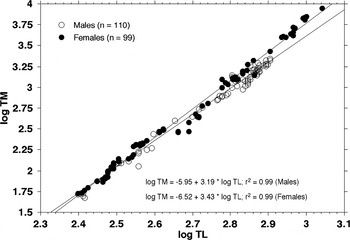
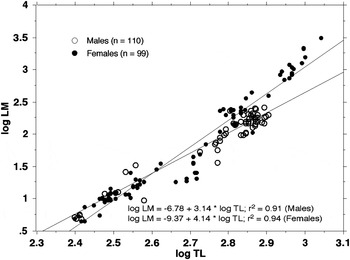
The relationship between TL and total mass (TM), plotted in Figure 3, showed significant differences between males and females (F = 29.1, P < 0.0001, df = 1). The relationship between TL and liver mass (LM), plotted in Figure 4, differed significantly between males and females (F = 40.1, P < 0.0001, df = 1).
Relationships for total mass (TM) versus total Length (TL) expressed in logarithmic co-ordinates for male and for female Squalus acanthias.

Relationships for liver mass (LM) versus total length (TL) expressed in logarithmic co-ordinates for male and for female Squalus acanthias.

Hepatosomatic and gonadosomatic indices
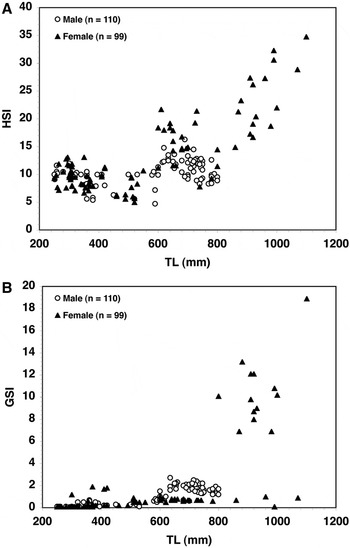
Considering the whole sample, the values of female HSI (Figure 5A), were significantly higher than those of male HSI (F = 74.20, df = 1, P < 0.0001). Similar patterns were recorded in GSI values (Figure 5B) between females and males (F = 36.58, df = 1, P < 0.0001).
(A) Relationships for hepatosomatic index (HSI) versus total length (TL, mm); (B) relationships for gonadosomatic index (GSI) versus total length (TL, mm), for male and for female Squalus acanthias.

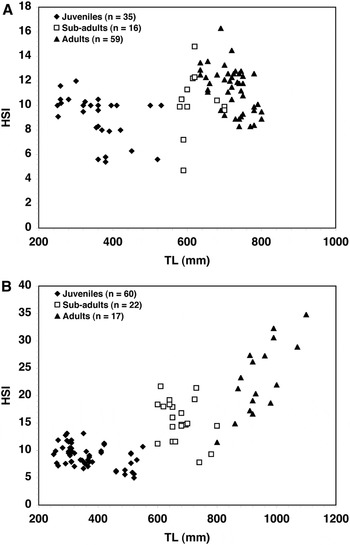
The HSI of males exhibited high values in the smallest free-swimming specimens, and decreased from TL of about 300 onward (Figure 6A). Then, HSI globally increased when males entered maturation stage and became sub-adults; HSI reached the highest values in adult specimens. However, significant differences in HSI values between juveniles and sub-adults (df = 2, P = 0.213) and between sub-adults and adults (df = 2, P = 0.116) did not appear among males. Female HSI showed significant differences between juveniles and sub-adults and between sub-adults and adults (Figure 6B).
Variations in hepatosomatic index (HSI) versus total length (TL, mm). (A) In male Squalus acanthias; (B) in female Squalus acanthias.

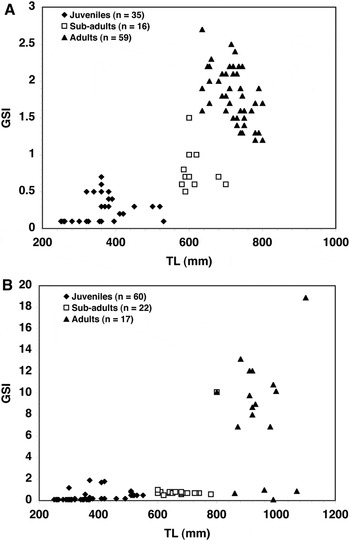
The male GSI values significantly increased with TL of specimens (Figure 7A); additionally, they showed significant differences between juveniles and sub-adults and between sub-adults and adults (df = 2, P < 0.0001). The female GSI values considerably increased in adult specimens where they reached a significant high level, up to 10 in some specimens (Figure 7B); however, significant differences in GSI values between juvenile and sub-adult specimens did not appear (df = 2, P = 0.39).
Variations in gonadosomatic index (GSI) versus total length (TL, mm). (A) In male Squalus acanthias; (B) in female Squalus acanthias.

Reproductive cycle
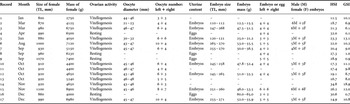
Throughout the year, all adult males were found with running ripe spermatozoa and sperm was present in the seminal vesicles. Of the 17 adult females examined (Table 2), 3 were non-pregnant and 14 were pregnant. Among the latter, 4 carried encapsulated eggs and their ovaries were in a resting phase, 2 carried developing embryos and developing oocytes, and 8 near-term embryos and yolky oocytes ready to be ovulated, showing that oocytes were progressively charged with yolk and both their mass and diameter increased concomitantly with embryonic development. In adult females, both ovaries and both uteri were functional. Large yolky oocytes were more abundant in the left ovary (79) than in the right one (55), however the differences were not significant (χ2 = 3.7, df = 1, P < 0.05); additionally, encapsulated eggs, developing embryos and near-term embryos were practically distributed in equal number in left uterus (54) and in right uterus (52). Nine male and 5 female developing embryos, 36 male and 26 female near-term embryos were sexed. In uterine content, males significantly outnumbered females. In all, 134 yolky oocytes were measured, the diameter ranged between 43 and 47 mm (mean 45.08 ± 0.98), while the mass ranged between 29.5 and 37.4 g (mean 31.79 ± 2.20). Sixty-six near-term embryos were examined, with yolk sac completely resorbed into an internal yolk; they exhibited an unhealed umbilical scar on ventral surface between pectoral fins. They ranged from 245 to 271 mm TL (mean: 258.85 ± 7.28) and weighed from 47.5 to 55.9 g (mean 53.35 ± 2.26). These latter features could be considered as both size and mass at birth for S. acanthias off the Languedocian coast. The smallest free-swimming specimens recorded were two females having 280 mm and 290 mm TL, respectively, and weighing 75 g and 74 g, respectively; they probably were, born of the year. Additionally, CBD based on mean dry masses of yolky oocytes and near-term embryos for S. acanthias was 0.84.
Reproductive cycle of female Squalus acanthias. Condition of ovary and uteri during gestation with hepatosomatic index (HSI) and gonadosomatic index (GSI).

TL, total length.
Near-term females were captured practically throughout the year but especially from March to September, some specimens were caught in October, November and December. Parturition probably occurred at different periods of the year. Some females exhibited yolky oocytes ready to be ovulated and enlarged uteri, they were postpartum specimens and it cannot be excluded that a resting phase occurred between two pregnancies in one or two months at least. HSI reached the highest values in females carrying encapsulated eggs that are significantly different from those recorded in females carrying developing and near-term embryos (t = –5.391, df = 10, P = 0.0003). GSI showed the lowest values in females carrying encapsulated eggs. GSI did not present significant differences between pregnant and non-pregnant females (t = –1.052, df = 10, P = 0.34), by contrast, GSI values were significantly different between pregnant females and females carrying encapsulated eggs, at the beginning of gestation (t = 7.158, df = 10, P < 0.001).
Fecundity
Ovarian fecundity was based on number of developing or yolky oocytes counted in both ovaries of adult females, it ranged from 6 to 15 (mean = 10.38 ± 2.66). Ovarian fecundity showed a positive relationship with TL of females, the regression equation is: ovarian fecundity = 0.031 TL –18.167, r = 0.84, N = 13. Uterine fecundity or litter size was based on number of encapsulated eggs, or developing embryos or near-term embryos counted in both uteri, it ranged from 4 to 12 (mean = 8.15 ± 2.07). Litter size showed a positive relationship with TL of females, the regression equation is: litter size = 0.023 TL –14.141, r = 0.85, N = 13. A paired t-test showed that ovarian fecundity was significantly higher than litter size (t = 4.075, df = 7, P = 0.0047).
DISCUSSION
Capture-depth of Squalus acanthias differed from regions. Off New Zealand, Hanchet (Reference Hanchet1988) noted that it is related to reproductive cycle of females that moved between 50 and 300 m depth, because parturition and mating occurred in deep waters, in agreement with the observations carried out for the specimens caught off the Languedocian coast. Chatzispirou & Megalofonou (2005) noted the occurrence of captures in depths from 350 to 418 m, in the eastern Mediterranean (off Cyclades Islands and Crete), while Demirhan & Seyman (2006) reported all reproductive stages in shallow waters, 25–60 m depth in the Black Sea, probably due to specific environmental characteristics of the area.
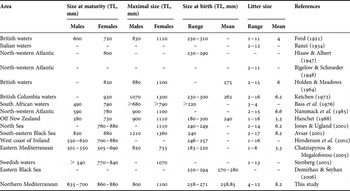
The sample of spiny dogfish collected off the Languedocian coast came from a normally distributed population. In this area, males matured at a smaller size than females did, and consequently reached a smaller maximal size. Similar patterns were observed by different authors for populations of S. acanthias (see Table 3), except in specimens from the eastern Mediterranean, where females reached a larger size than males (Chatzispirou & Megalofonou, 2005). Sexual dimorphism size favourable to females was frequently observed in viviparous sharks (Mellinger, Reference Mellinger1989), by contrast in oviparous sharks such as the smallspotted catshark Scyliorhinus canicula (Linnaeus, 1758), males matured at a larger size and were larger than females (Mellinger, Reference Mellinger1989, Reference Mellinger2002). Size at maturity and size at birth recorded in specimens, especially males, caught off the Languedocian coast were smaller than those recorded from specimens outside the Mediterranean (Table 3). The Languedocian specimens were larger than those from the eastern Mediterranean area (Chatzispirou & Megalofonou, 2005), but smaller than those from the adjacent Black Sea. The general pattern of latudinal variation in maturity and maximum size was reported in several other chondrichthyan species (Leloup & Olivereau, Reference Leloup and Olivereau1951; Mellinger, Reference Mellinger1989). Lombardi-Carlson et al. (Reference Lombardi-Carlson, Cortès, Parsons and Manire2003) noted that latitudinal differences are thought to be the results of environmental factors, but may be also due to physiological constraints or genetic factors.
Size at sexual maturity, maximal size, size at birth and litter size in Squalus acanthias from different marine areas.

TL, total length.
Size at birth (Table 3) presented a wide range in specimens from New Zealand, between 180 and 300 mm TL (Hanchet, Reference Hanchet1988), and the smallest neonates were recorded off South Africa (Bass et al., Reference Bass, D'Aubrey and Kistnasamy1976) and in the eastern Mediterranean (Chatzispirou & Megalofonou, 2005). Hanchet (Reference Hanchet1988) stated that it is due to the fact that specimens matured at a smaller size. However, sampling method cannot be excluded; in the eastern Black Sea, for instance, Avsar (Reference Avsar2001) reported that size at birth occurred at 240 mm TL, while Demirhan & Seyhan (Reference Demirhan and Seyhan2006) recorded neonates ranging in size from 250 to 294 mm TL, with ‘a mean size included between 270 and 280 mm TL’.
Squalus acanthias produces large yolky oocytes, for instance, Ford (Reference Ford1921) recorded from 40 to 49 mm in fully yolked oocytes of spiny dogfish caught off Plymouth; they measured between 34 and 42 mm and weighed between 36 and 43 g in females from Newfoundland waters (Templeman, 1944 in Mellinger, Reference Mellinger2002). Ketchen (Reference Ketchen1972) reported 30–40 mm in specimens from British Columbia waters, Hanchet (Reference Hanchet1988) noted that at time of parturition they reached a mean diameter of 42 mm, in females off New Zealand, while in Swedish waters, Stenberg (Reference Stenberg2006) measured oocytes having 40–45 mm in diameter. The largest yolky oocyte recorded in the eastern Mediterranean had 51 mm in diameter and weighed 29.32 g (Chatzispirou & Megalofonou, 2005), while female spiny dogfish from the Languedocian coast carried yolky oocytes having between 43 and 47 mm (mean 45.08 ± 0.98) in diameter, and weighing between 29.5 and 37.4 g (mean 31.79 ± 2.20). Intraspecific changes did not appear in diameter and mass of yolky oocytes of female S. acanthias according to area. In a female longnose spurdog, S. blainvillei (Risso, 1826) caught in the same area, Capapé et al. (Reference Capapé, Tomasini and Quignard2000b) found yolky oocytes having between 40 and 43 mm in diameter and weighing from 27.5 to 32.0 g. Large oocytes explained why GSI reached significant high values in both postpartum and near-term female spurdogs in the sample.
A literature review carried out by Stenberg (Reference Stenberg2006) showed that number of yolky oocytes concomitantly increased with TL of females, in agreement with our findings. By contrast, there did not appear to be a relationship between female TL and size and mass of yolky oocytes as reported by Quignard (Reference Quignard1971) in S. blainvillei, who noted that yolky oocytes weighed between 12 and 21.3 g, in females from 580 to 660 mm TL, and weighed between 21.4 and 34.6 g in those from 680 to 760 mm. Similar patterns were observed by Capapé et al. (Reference Capapé, Seck and Diatta2000a) in the common torpedo Torpedo torpedo (Linnaeus, 1758) and by Seck et al. (Reference Seck, Diatta, Diop, Guélorget, Reynaud and Capapé2004) in the blackchin guitarfish Rhinobatos cemiculus E. Geoffroy Saint-Hilaire, 1817 from the coast of Senegal.
Additionally, Stenberg (Reference Stenberg2006) summarizing previous observations made on S. acanthias from different areas noted that ovarian fecundity is generally higher than litter size in agreement with the data included herein. Stenberg (Reference Stenberg2006) stated that it is due to the fact that yolky oocytes were not ovulated and became atretic, some eggs were not fertilized and did not develop; additionally, abortion cannot be excluded, naturally, during embryonic development, or under human pressure during fishing, handling and landing. Furthermore, litter size-range observed in Languedocian S. acanthias was in agreement with other studies carried out elsewhere; globally litter size-ranges were not very large and showed that the species is not very prolific whatever the marine area. However, mean litter size calculated in our study was slightly higher and could be due to sampling.
The CBD was 0.84, close to that observed in squatinid species which was about 1. These low values showed that the role of the mother in S. acanthias is minimal and the uterine fluid provides a full complement of nutriments and inorganic matter and protects the embryos throughout embryonic development. The CBD value calculated for S. acanthias was close to sharks, skates and rays that are considered as lecithotrophic species (Hamlett et al., Reference Hamlett, Kormanik, Storrie, Stevens, Stevens and Hamlett2005), different from matrotrophic species such as carcharhinid species (Capapé et al., Reference Capapé, Hemida, Seck, Diatta, Guélorget and Zaouali2003) with CBD > 30.
In S. acanthias, it clearly appeared that vitellogenesis proceeded in parallel with embryonic development and could explain why the relationship of liver mass versus total mass also showed significant differences between males and females, and also the significant high HSI values reached by adult females. Consequently, it suggests that liver plays an important role in life cycle of the latter. Liver size is sexually dimorphic in chondrichthyan species.
The liver accumulates hepatic lipids for metabolic functions such as gonadic products; this phenomenon is more evident in females during vitellogenesis and egg cases production (Lucifora et al., Reference Lucifora, Menni and Escalante2002). A larger liver observed in females may be related to the increased energy expenditure during vitellogenesis, oocyte maturation and gestation; females store large quantities of lipids in the liver during the reproductive cycle (Lucifora et al., Reference Lucifora, Menni and Escalante2005). However, Bone & Roberts (Reference Bone and Roberts1969) and Baldridge (Reference Baldridge1970, Reference Baldridge1972) showed the role of liver in buoyancy for some elasmobranch species, especially for both deep-sea and pelagic sharks, as shown by the relative high values reached by both male and female adults in the sample.
Shark species displaying an annual reproductive cycle assume concomitantly vitellogenesis and embryonic development (Capapé et al., Reference Capapé, Diatta, Diop, Guélorget, Vergne and Quignard2006), so as embryos developed in uteri, a crop of fully yolked oocytes was enlarging and receiving yolk in the ovary, and soon after parturition, the female ovulated and conceived again. However, the fact that near-term females were observed practically throughout the year suggests that the length of the breeding cycle was not clearly delineated in S. acanthias from the Languedocian coast. Ford (Reference Ford1921) noted that embryos ready for birth remained in the uterus for an extended period of time; it could explain that near-term females occurred in different months of the year. A 22 month gestation period assessed by Compagno (Reference Compagno1984) is considered as accurate by Henderson et al. (Reference Henderson, Flannery and Dunne2002), nevertheless a wider range of gestation from 18 to 24 months and more, could be considered also as a suitable hypothesis.
The rather rare captures recorded off the Languedocian coast concerned all categories of specimens including also pregnant females; they were probably due to a strong fishing pressure. Additionally, maturity was reached at a large size in both males and females, while length of reproductive cycle extended during a rather long period showed that S. acanthias from off the Languedocian coast developed K-selected biological characteristics (sensu McAuley et al., Reference McAuley, Simpfendorfer, Hyndes and Lenanton2007), and consequently this study demonstrated that sustainable efforts need to be improved in order to preserve the species in the region, following both IUCN and Aldebert's recommendations (1997), as well as in other Mediterranean regions (Fordham et al., Reference Fordham, Fowler, Coelho, Goldham and Francis2006; Gibson et al., Reference Gibson, Valenti, Fordham and Fowler2008).