Introduction
Anaplastic thyroid cancer (ATC) is an aggressive form of thyroid cancer with poor prognostic outcomes. Despite its rarity, accounting for only 2 per cent of all thyroid cancers, it is responsible for approximately 50 per cent of thyroid cancer-associated deaths.Reference Molinaro, Romei, Biagini, Sabini, Agate and Mazzeo1–Reference Lowe, Loughran, Slevin and Yap3 This is due to rapid progression of the disease with metastatic status at the onset of diagnosis.Reference Molinaro, Romei, Biagini, Sabini, Agate and Mazzeo1,Reference Jannin, Escande, Al Ghuzlan, Blanchard, Hartl and Chevalier4 Historically, ATC was associated with a mere four-month median overall survival.Reference Agosto Salgado5
Treatment options for ATC encompass surgical intervention, radiotherapy, chemotherapy, and novel adjuvant therapies such as the serine/threonine-protein kinase B-Raf (BRAF) and mitogen-activated protein kinase kinase (MEK) inhibitors.Reference Bible, Kebebew, Brierley, Brito, Cabanillas and Clark6 While surgical intervention can be effective for localised disease,Reference Lowe, Loughran, Slevin and Yap3 the majority of patients present with metastatic disease at diagnosis, limiting the impact of surgery alone.Reference Molinaro, Romei, Biagini, Sabini, Agate and Mazzeo1,Reference Jannin, Escande, Al Ghuzlan, Blanchard, Hartl and Chevalier4 Combined modalities, often integrating surgery with other treatments, prove to be significantly more effective than surgery in isolation.Reference Bible, Kebebew, Brierley, Brito, Cabanillas and Clark6,Reference Yau, Lo, Epstein, Lam, Wan and Lang7 This is demonstrated by a median OS figure of 6.6 months with surgery alone compared to 9.6 months with additional adjuvant therapy.Reference Bible, Kebebew, Brierley, Brito, Cabanillas and Clark6 Radiotherapy has an important role in treating ATC, but treatment strategies involving this are usually combined with surgery or further chemotherapy.Reference Yau, Lo, Epstein, Lam, Wan and Lang7,Reference Kebebew, Greenspan, Clark, Woeber and McMillan8 Radiotherapy alone is commonly unable to control disease progression.Reference Yau, Lo, Epstein, Lam, Wan and Lang7 This is reflected in overall survival figures, where patients receiving surgical intervention and radiotherapy demonstrate a median overall survival of 10.7 months, compared to 3.9 months with radiotherapy alone.Reference Park, Choi, Yoon, Lee, Kim and Kim9 Notably, BRAF/MEK inhibitors have revolutionised the prognostic landscape of ATC, attaining the status of standard care in current US guidelines.
The role of traditional chemotherapy in treating ATC has been limited owing to primary chemoresistance and rapid disease progression.Reference Jannin, Escande, Al Ghuzlan, Blanchard, Hartl and Chevalier4 This had led to the subsequent utilisation of BRAF/MEK inhibitors.Reference Jannin, Escande, Al Ghuzlan, Blanchard, Hartl and Chevalier4 These inhibitors target protein kinase pathways specific to cancerous cells.Reference Natoli, Perrucci, Perrotti, Falchi and Iacobelli10 The combination of the kinase inhibitors dabrafenib and trametinib has been explored further in patients with ATC. Dabrafenib acts as a BRAF inhibitor, whereas trametinib is a MEK inhibitor.Reference Jannin, Escande, Al Ghuzlan, Blanchard, Hartl and Chevalier4,Reference Pisapia, Pepe, Iaccarino, Sgariglia, Nacchio and Russo11,Reference Cheng and Tian12 Dabrafenib and trametinib, proven effective in increasing overall survival in metastatic melanoma and non-small cell lung cancer,Reference Cheng and Tian12 were subsequently applied to patients with BRAF-mutated ATC. Following successful phase II clinical trials, this combination has gained recognition and approval from the US Food and Drug Administration (FDA) as a recommended treatment regimen.Reference Research13
Methods
Search and screening
This systematic review adhered to Preferred Reporting Items for Systematic reviews and Meta-Analyses (PRISMA) guidance, according to a prospectively registered protocol on PROSPERO. On 2 July 2023, MEDLINE, PubMed, Scopus, Embase (via OVID), Web of Science and Google Scholar were searched for the following: (“anaplastic thyroid cancer”) AND (“dabrafenib”) AND (“trametinib”). Abstract and full text screening were undertaken by three researchers independently and duplicates were removed. The following inclusion and exclusion criteria were employed: (1) publication of full text in English language; (2) primary research study; (3) primary pathology of anaplastic thyroid cancer; (4) dabrafenib and trametinib treatment; (5) reported outcomes; (6) more than three participants. There were no restrictions on participant characteristics, cancer grade or other neo-adjuvant and adjuvant treatments. The exclusion criteria consisted of non--evidence-based studies, reviews, evaluations, or case reports with n less than or equal to 3.
Data extraction and analysis
Data were extracted into Microsoft Excel TM for processing and analysis. All three researchers undertook blinded data extraction for the included studies. A second round of blinded extraction was conducted, reviewing any discrepancies between the first and second round. The primary endpoint was overall response rate (ORR), defined as a complete or partial response in radiological tumour size in accordance with the Response Evaluation Criteria in Solid Tumours (RECIST) v1.1 guidelines.Reference Eisenhauer, Therasse, Bogaerts, Schwartz, Sargent and Ford14 Secondary endpoints were 12-month overall survival (OS), median OS and median progression-free survival (PFS). Additional data gathered included country of origin, patient recruitment period, total number of patients in the trial, treatment details, median follow-up duration, patient demographics and adverse side effects.
Risk of bias were appraised with the QUADAS-2 framework by one researcher, with a second researcher validating each appraisal.Reference Whiting, Rutjes, Westwood, Mallett, Deeks and Reitsma15 For studies exhibiting Kaplan-Meier plots without reporting figures for median OS or 12-month OS, interpolation was conducted with WebPlotDigitizer (version 4.6.0; Ankit Rohatgi, Pacifica, California, USA). Quantitative data between comparable studies were selected for inclusion in meta-analysis.
Meta-analysis was carried out using R (version 4.3.0; R Foundation for Statistical Computing, Vienna, Austria) via the “metfor” package and “metaprop” function. Due to the heterogeneity in included studies, a random effects model was employed, with the inverse variance weighting method used to pool effect sizes. The effect size measure used was proportions, with the percentages for both outcomes expressed as a proportion. Knapp-Hartung adjustments were made to calculate the confidence interval of pooled effect sizes, reducing the chance of false positives. Higgins and Thompson's I2 statistic was used to measure heterogeneity. Prediction intervals were also included.
Results
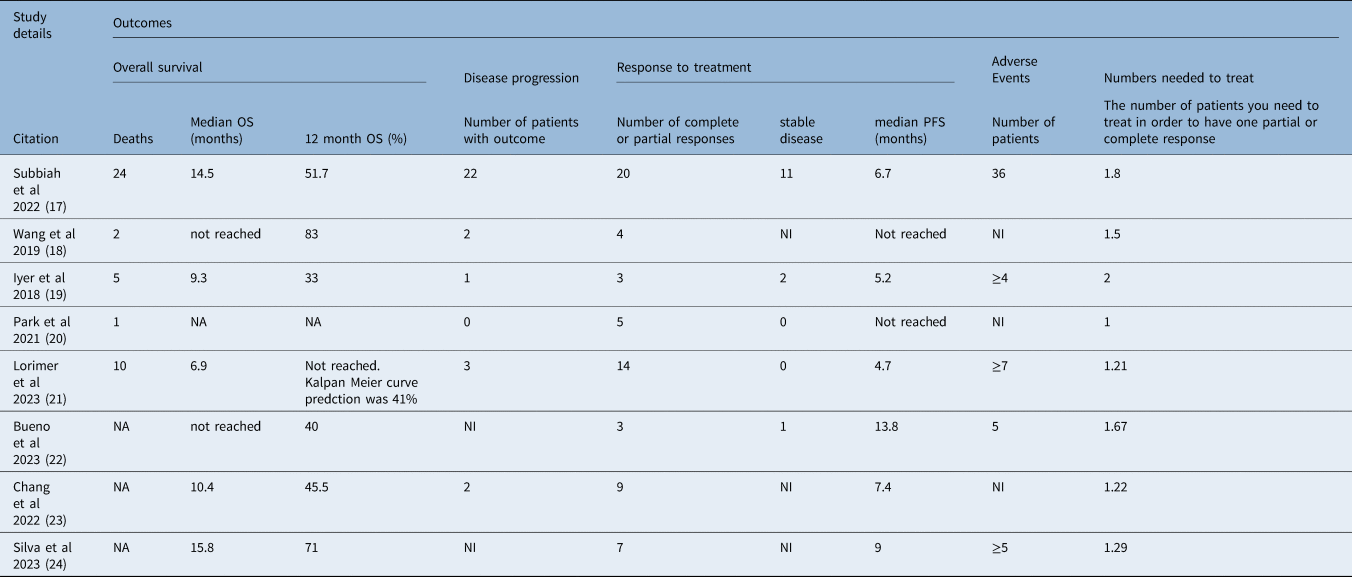
The undertaken literature search and screening processes are summarised in Figure 1. Out of the 656 initially identified reports, 8 studies were included, featuring 95 patients (median age 68.5 years, 46 per cent male). Patient characteristics and data outcomes are shown in Table 1 and 2, respectively. Median follow-up duration was 11.8 months with a 12-month OS of 51 per cent. Median OS was 10.4 months. Progression-free survival (PFS) was 6.5 months. The ORR was 71 per cent, calculated using the random effects model. A total of 65 patients exhibited a partial or complete response in radiological tumour size with a number needed to treat (NNT) of 1.52. Side effects, reported in five studies with 73 total patients, compared favourably to other kinase inhibitors. Frequencies of side effects are shown in Table 3 and 4. Side effects that were very common included: pyrexia, fatigue, nausea, decreased appetite, anaemia, diarrhoea, constipation, rash, dyspnoea, pneumonia, chills, dizziness and hyponatremia. Common side effects included: headache, hypertension, hypoalbuminemia, hypotension, anorexia, dysphagia, vomiting and weight loss. Pyrexia was the most common side effect reported (38 per cent), followed by fatigue (34 per cent) and nausea (32 per cent). Side effects tabulated with an incidence of 0 indicates the side effect was not reported.
PRISMA flowchart illustrating the literature search, screening process and articles included in this review. PRISMA = Preferred Reporting Items for Systematic Reviews and Meta Analyses. MEDLINE = Medical Literature Analysis and Retrieval System Online

Patient characteristics

Data outcomes

Table 2: Data outcomes of the included studies.
OS: overall survival
PFS: progression-free survival
Side effect heat map

Pooled side effect incidence

Forest plots for 12-month OS and ORR are shown in Figure 2 and 3, respectively. Heterogeneity I2 was calculated to be 0 per cent for both ORR and 12-month OS. Despite strong heterogeneity in the data, the likely explanation is the small number of included studies causing an underestimate of I2. In a meta-analysis with seven studies and 80 per cent true heterogeneity, I2 is underestimated by approximately 28 per cent. With a median I2 estimate in most meta-analyses of 21 per cent, this can easily generate a 0 value for I2.Reference von Hippel16
The 12-month overall survival forest plot

The overall response rate forest plot

Risk of bias judged with QUADAS-2 was moderate, as illustrated by Figure 4. Although concerns were highlighted regarding the applicability of studyReference Subbiah, Kreitman, Wainberg, Cho, Schellens and Soria17, it is a pivotal paper in the literature, so it was ultimately included.
Risk of bias appraisals. Appraised with the QUADAS-2 framework. QUADAS-2 = Quality Assessment of Diagnostic Accuracy Studies 2; RoB = risk of bias.

Median OS was calculated from the median of reported median OS from available studies. PFS was calculated from the weighted mean of median PFS from available studies. NNT, defined as the number of patients that were treated to obtain one partial or complete response, was calculated through weighted means.
Discussion
According to the Surveillance, Epidemiology, and End Results (SEER) national cancer database, there has been no significant improvement in overall survival for ATC patients from 1986 to 2015.Reference Lin, Ma, Ma, Zhang, Sun and Hsieh25 The introduction of molecular classification for ATC as the standard in 2014 has played a pivotal role, leading to an increased utilisation of targeted therapies over time.Reference Maniakas, Dadu, Busaidy, Wang, Ferrarotto and Lu26,Reference Gao, Hong, Xie and Zeng27 The subsequent adoption of BRAF/MEK inhibitors has notably improved survival outcomes, establishing it as the current standard of care in the USA.
Although several studies have published their results concerning the efficacy of BRAF/MEK inhibitors on patients with ATC, to our knowledge, this is the first systematic review and meta-analysis of dabrafenib and trametinib in the treatment of ATC. By collating the highest power studies from the literature at present, these data provide a snapshot of where we presently stand with this selective targeted therapy. Both clinicians and policy-makers may refer to these data when making decisions that necessitate statistical comparison of current or emerging therapies to the current ‘standard’ of care.
By conducting this review, we aim to inform policy-makers on the efficacy of this treatment. This effort holds the potential to expand approval of dabrafenib and trametinib in regions where they are not currently licensed for ATC. With the amalgamated data we present, policy-makers can conduct reliable and comprehensive cost-benefit analysis for this expensive therapy, weighing its potential advantages against alternative treatment modalities. Policy-makers must carefully deliberate whether reallocating funds to this therapy represents the most efficient use of resources, or if these funds could yield greater benefits when directed to other stages or aspects of care for this condition. These decisions may pave the way for expanding the approval of dabrafenib and trametinib to include ATC in the UK, as current licensure restricts their usage to BRAF V600 mutated melanoma and non-small cell lung cancer.
Tumour response
Utilising the random-effects model, the pooled ORR in the primary tumour was 71 per cent, indicating dabrafenib and trametinib are effective at halting or reducing the primary tumour burden. In certain cases, this was enough to enable surgical intervention on previously inoperable cancer, contributing to improved outcomes. Studies investigating various targeted therapies, including tyrosine kinase inhibitors and other BRAF inhibitors, reported an ORR of approximately 30 per cent, with some novel therapies showing no significant response at all.Reference Hescheler, Hartmann, Riemann, Michel, Bruns and Alakus28
Survival rates
The pooled 12-month OS was 51 per cent, and the median OS was 10.4 months. In a single-institution cohort study of 152 patients, the 12-month OS on multi-modal therapy for ATC was reported as 59 per cent.Reference Maniakas, Dadu, Busaidy, Wang, Ferrarotto and Lu26 Although multi-modal treatment with dabrafenib and trametinib shows promise in its efficacy on tumour response, it does not offer a significantly greater survival outcome compared to the use of other BRAF/MEK inhibitors in its place. The heterogeneity in the data obfuscates our outcomes, mainly due to the absence randomised controlled trials and a low number of eligible studies.
Side effects
Medication safety is a focal point in novel drug development and integration into clinical practice. Effective side effect management is crucial for therapy continuation. This meta-analysis revealed that almost all patients with reported side effects (n = 73) experienced adverse events, experiencing mostly grade 1 or 2. Adverse events were graded according to the Common Terminology Criteria for Adverse Events (CTCAE). The most common side effects were pyrexia (38 per cent) followed by fatigue (34 per cent), nausea (32 per cent), decreased appetite (23 per cent), anaemia (22 per cent), dyspnoea (22 per cent), diarrhoea (18 per cent), constipation (14 per cent) and rash (14 per cent). Grade 1 and 2 adverse events are generally manageable, with medical treatment available for common adverse effects such as pyrexia, fatigue, nausea, diarrhoea and constipation. Grade 3 and 4 adverse events often require monitoring measures. In the included studies, patients sustaining grade 3 or 4 adverse events often needed a dose reduction or cessation of BRAF/MEK treatment.
Table 5 summarises adverse events from comparable studies in the literature. Temporary dose interruptions of dabrafenib and trametinib were reported as effective management strategies for medication-induced pyrexia, and similar control measures were observed for medication-induced hypertension and proteinuria.Reference Schadendorf, Robert, Dummer, Flaherty, Tawbi and Menzies29,Reference Huang, Zhang, Zheng and Gao30 In a phase III trial of dabrafenib and trametinib for unresectable metastatic melanoma, 98 per cent of the cohort experienced adverse events but few were reported as grade equal to or greater than 3. Despite this, 18 per cent of adverse events led to treatment discontinuation.Reference Robert, Grob, Stroyakovskiy, Karaszewska, Hauschild and Levchenko34
Side effect incidence from various studies

NSCLC: Non-small cell lung carcinoma
ATC: Anaplastic thyroid cancer
The side effect profile for dabrafenib and trametinib seems promising when compared to other kinase inhibitors trialed for ATC. However, it is important to consider other therapies’ contributions to adverse effects, as patients receiving chemotherapy and radiotherapy may experience overlapping side effects. Since it was at the investigators discretion to decide if an adverse event was due to dabrafenib and trametinib, there may have been unidentified reporting bias. Notably, in the phase II ROAR basket trial, 36 patients experienced adverse events but only 27 were said to be attributed to dabrafenib and trametinib. The adverse events were reported for all 36 patients without isolating those that were due to dabrafenib and trametinib.Reference Subbiah, Kreitman, Wainberg, Cho, Schellens and Soria17
Costs
The treatment regime of dabrafenib 150 mg twice daily and trametinib 2 mg once daily costs £2520 per week at list price.35 Considering these costs at The National Institute for Health and Care Excellence (NICE) reported market value, the range of dabrafenib and trametinib treatment for the phase II ROAR basket trial would be £10 950–£689 850. Whilst specific discounts are commercial in confidence, the high costs of dabrafenib and trametinib should be considered when comparing healthcare economics with other therapies on the market.
Limitations
This review and analysis faced several limitations. Firstly, there were a limited number of published studies. Secondly, Small sample sizes in included studies make data outcomes prone to variability.Reference Maniakas, Dadu, Busaidy, Wang, Ferrarotto and Lu26 Thirdly, there was a predominance of case series over randomised control trials in included studies.Reference Lowe, Loughran, Slevin and Yap3 Fourthly, many patients experienced treatment interruptions and dose reductions within each study, affecting the reliability of drawn conclusions. Fifthly, high variability in treatment duration ranged from weeks to many months. Undertreatment could obfuscate any true effect dabrafenib and trametinib may have had. It could also under-report potential side effects. Sixthly, there was high variability in the multi-modal therapies each patient received. Many permutations of treatment were seen which likely skewed outcomes. For example, Chang and colleagues found that, in ATC patients, surgery before dabrafenib and trametinib had a significantly better overall survival when compared to no prior surgery.Reference Chang, Yang, Lee, Shih, Lin and Chen23 Seventhly, reporting bias was found in several studies due to missing outcome data (Table 2). Eighthly, the largest BRAF-mutated ATC paper in the literature was excluded (Zhao et al., 2023) because BRAFi/MEKi treatment was grouped, and isolated combination therapy of dabrafenib and trametinib was not reported.
While we recognised the limitations inherent in our study from the outset, the rationale for conducting this review remained strong. To date, there has been a lack of consolidation of the diverse data surrounding this emerging therapy. While future meta-analyses will undoubtedly be necessary as additional trials are conducted, synthesising the existing data provides a less biased yet valuable foundation for understanding the treatment landscape. Despite its limitations, this approach offers more informed insights than having no data aggregation at all.
Conclusion
The conducted meta-analysis reports that dabrafenib and trametinib exhibit a promising tumour response with a well-tolerated side-effect profile. Given the poor prognosis and rarity of ATC, improvements in OS, ORR and PFS are significant in the context of this disease. Given the often palliative nature of ATC diagnoses, monitoring side effects from targeted therapies is crucial, as it directly impacts patient comfort and medication compliance. In this meta-analysis, multiple factors limit the confidence in conclusions. These include the inherent heterogeneity amongst studies, selection bias and reliance on data derived from case studies rather than controlled clinical trials. The rarity of BRAF-mutated ATC poses a challenge in designing robust clinical trials, as clinicians would ethically hesitate to randomise these patients to anything other than BRAF/MEK inhibitors. To determine the true effect of dabrafenib and trametinib on morbidity and mortality, a global effort is necessary to include and report studies with substantial statistical power. Continued reporting of outcomes from clinical trials and cohort studies remains paramount to further build upon the already promising results. In the interim, it would be beneficial to delve into additional research and experimentation concerning the side effects of these selective inhibitors. Are there strategies available to mitigate these side effects, consequently enhancing long-term adherence to treatment and maximising efficacy? Despite the historically dire prognosis associated with ATC, the advent of BRAF/MEK inhibitors marks a significant stride in the development of therapeutics for this relentless disease, offering an optimistic outlook for the treatment landscape to come.