Introduction
In recent papers in Ageing & Society, Adams, Leibbrandt and Moon (Reference Adams, Leibbrandt and Moon2011) proposed that an engaged lifestyle is integral to successful ageing and positive wellbeing, and Dwyer and Hardill (Reference Dwyer and Hardill2011: 1) suggested that, in Britain, community-based services and activities ‘promote social inclusion by enhancing older rural residents' [and especially women's] access to the resources, rights, goods and services that encourage social interaction and meaningful participation in community life’. In earlier work published in Ageing & Society, and drawing upon British Household Panel Survey (BHPS) data, Gray (Reference Gray2009) examined the extent to which older people felt they can count on emotional and practical support from friends and relatives, and found diverse forms and levels of social capital needed to maintain crucial social engagement.
This paper explores the mechanisms behind age-related changes in social networks and examines their impact on patterns of engagement by drawing on the perspectives of older rural Australians and community-based health professionals who provide services supporting them. The term social engagement (or engagement) is used to encompass those contacts or connections between individuals that include some element of socio-emotional exchange, that is, flows of interactive, utilitarian and affective elements. Although such exchange can be symmetrical or asymmetrical, and include positive and negative elements, the emphasis was on maintaining social engagement that is, on balance, volitional, positive and protective of health and wellbeing. Australians, like many in the developed world, are grappling with the various implications of population ageing. Over the next half century the proportion of the population that is old will increase such that approximately 7.2 million Australians will be 65 years or more by 2050 (Australian Government Department of Treasury and Finance 2007; Australian Government Productivity Commission 2005; Jackson Reference Jackson2004). This trend will be keenly felt in rural areas where the outward migration of younger people and sometime inward migration of later life ‘sea/tree changers’ (Burnley and Murphy Reference Burnley and Murphy2004) is exacerbating an already older population profile.
Based on pilot studies completed between 2004 and 2007, the investigation reported here was conducted from 2008 to early 2011 and was funded by the Australian Research Council. The project's impetus stemmed from recognition that a more robust evidence base is needed to generate sound responses to complex social and demographic changes in rural areas (Boyer, Orpin and Walker Reference Boyer, Orpin and Walker2010; Orpin et al. Reference Orpin, Walker, Stratford, Robinson, Vickers, Bull, Felmingham, Behrens and Boyer2005). In particular, the research team sought to make two contributions: to inform aged care policy development and service planning; and to facilitate the design of service models to assist older rural people to stay socially engaged as they face the changes and challenges posed by increasing age. Both contributions are addressed in this paper.
What is known of social engagement and ageing?
In global terms, ageing will accelerate over the century; in Australia, as elsewhere in the developed world, population ageing presents major social and economic challenges on two fronts (Australian Government Productivity Commission 2005; Lutz, Sanderson and Scherbov Reference Lutz, Sanderson and Scherbov2008). First, an older population will increase the national health bill especially if, as projected, the proportion of old-old (85+ years), the largest users of medical services, rises from 1.6 per cent (344,100) of the population in 2006 to 4.9 per cent (1,738,030) by 2056 (mid-range projection). Second, population ageing will mean an increase in the number and proportion of net dependants on socio-economic systems.
These challenges have prompted successive Australian governments to foster policy settings and service models to extend the independent, healthy and economically productive lives of older citizens; they have also informed significant research exploring the relationships between age, health, productivity and dependence (Australian Government Department of Health and Ageing 2008; Australian Institute of Health and Welfare and Office for an Ageing Australia 2003; Banks Reference Banks2004; Warburton and Bartlett Reference Warburton and Bartlett2004). As means to delay age-related dependency, loss in productivity, and escalations in national medical costs, Australian Government policy and service structures are largely focused on twin strategies to delay retirement from the paid workforce and prevent and manage a growing chronic disease burden (Australian Government Department of Health and Ageing and Australian Health Priority Action Council 2005). Important though these initiatives are, they are limited by their generational time-frames and inability to do more than time-shift the inevitable onset of disability.
There is room for a third approach with shorter time-frames and which seeks to prolong independent productive engagement in older people and in the face of inevitable age-related declines in health and physical and cognitive capacity. Indeed, there is strong and growing evidence of a link between low levels of connectedness and engagement in older age and poorer wellbeing, morbidity and mortality outcomes (Hawkley and Cacioppo Reference Hawkley and Cacioppo2010; House, Landis and Umberson Reference House, Landis and Umberson1988; Mendes de Leon Reference Mendes de Leon2005; Valliant et al. Reference Valliant, Meyer, Mukamal and Soldz1998). This link raises the possibility that support and services oriented to engagement may improve older people's health, social productivity and overall wellbeing.
The potential here is great: during the 2000s, less than 8 per cent of Australians 65 years and over were in dependent care (Australian Institute of Health & Welfare 2002) and required approximately 77 per cent of the Australian Government aged-care budget (Australian Government Productivity Commission 2005). However, the vast majority of older Australians are neither particularly frail nor dependent. Properly supported until quite late in life these individuals make substantive and varied contributions to families and communities. In this light, there is reason to shift attention and resources towards models of service delivery that protect the community resource represented by the healthy non-frail older people, particularly within rural settings where service capacity and options are limited.
However, any propensity to disengagement must not be ignored. There is mounting evidence about the correlates of disconnection or disengagement – for example, rurality, living alone and/or disability (Savikko et al. Reference Savikko, Routasalo, Tilvis, Strandberg and Pitkala2005); driving cessation (Marottoli et al. Reference Marottoli, Mendes de Leon, Glass, Williams, Cooney and Berkman2000); loss of a partner though death (McInnis and White Reference McInnis and White2001); and the burdens of being a care-giver and ageing oneself (Levine Reference Levine1999). While many of these correlates are inevitable consequences of growing old, nevertheless there is limited understanding of the disengagement process and a dearth of service models to circumvent or slow that process. Support and services are required that address the avoidable sequela or consequences that follow events or processes that trigger disengagement. Such consequences are generally well-recognised and understood among aged services professionals and most jurisdictions have service models to deal with them, albeit that many have a short-term crisis-coping focus, intended to support continued independent living. Alternatively, the disengagement process is drawn out, progressive and largely invisible to service providers until individuals have become frail and require more focused interventions.
The rural context
Despite issues with research definitions (Keating, Swindle and Fletcher Reference Keating, Swindle and Fletcher2011; Scharf Reference Scharf2001) and gaps in our current understanding of rural life (Heenan Reference Heenan2011), the evidence suggests that rural context does present particular challenges in ageing in general, and to social engagement in particular (Heenan Reference Heenan2011; Keating, Swindle and Fletcher Reference Keating, Swindle and Fletcher2011; Phillipson and Scharf Reference Phillipson and Scharf2005), although we found no convincing evidence in the literature of higher levels of social isolation, exclusion or loneliness among rural, as compared to urban, older people. Rural challenges include the centralisation and rationalisation of already scarce services (Heenan Reference Heenan2011), poorer baseline health (Peters and Jackson Reference Jackson2005), low income, inadequate transport and demographic change (Chapman and Peace Reference Chapman, Peace and Keating2008).
In the present study, although older rural participants faced considerable age-related challenges to their health and capacity, almost universally they remained actively engaged in their communities and generally upbeat about their lives. It is also apparent that such engagement can be a fragile accomplishment, under constant threat from deteriorating health, waning physical and cognitive capacities, and rapidly changing social environments which can be superimposed on underlying lifecourse risk factors for social exclusion (Lang et al. Reference Lang, Llewellyn, Langa, Wallace, Huppert and Melzer2008). Under such circumstances, what might be the optimal roles for service providers, and what sorts of principles might best foster engagement that older rural people see as neither diminishing their independence nor based in ‘charity’ and ‘misdirected’ interventions? Ultimately, it is the aim of this paper to address such questions of wide salience among those concerned with rural health and ageing in developed nations. The study aimed to address these questions primarily from the perspective of older people themselves. There is a considerable literature on policy and interventions to address social isolation among older people (Cattan et al. Reference Cattan, White, Bond and Learmouth2005; Dickens et al. Reference Dickens, Richards, Greaves and Campbell2011; Findlay Reference Findlay2003; Phillipson and Scharf Reference Phillipson and Scharf2005; van Haastregt et al. Reference van Haastregt, Diederiks, Van Rossum, De Witte and Crebolder2000) but the first-hand ‘voice’ of individual older people is notable for its absence in much of this, a major gap considering the ‘varied and complex’ origins of social inclusion (Scharf Reference Scharf2001) and ‘diverse pathways’ to ageing well (Keating, Swindle and Fletcher Reference Keating, Swindle and Fletcher2011). The paper is, therefore, primarily focused on giving expression to that voice with greater emphasis on the description and discussion of older rural people's responses versus service providers' responses.
Social engagement for productive ageing – sites and methods of approach to the study
Approved by the Tasmanian Social Science Human Research Ethics Committee, this research involved various stages and informants. In this paper, the focus is on interviews or focus groups with community dwelling older people (65+) in three rural local government areas (LGAs) in the State of Tasmania and health and human service providers mostly working within those LGAs. Hereafter, in the main we shall refer to the first as older rural participants or participants, and the second as service providers or providers. The LGAs were selected to reflect a range of demographic, social and economic characteristics, as well as migration, mobility and occupational patterns. Acknowledging their different internal dynamics of transformation, apparent stasis and decline, all communities are classified either ‘Outer Regional’ or ‘Remote’ within the Australian Standard Geographical Classification – Remoteness Areas (ASGC-RA), a system which utilises a five-step categorisation (Major City, Inner or Outer Regional, Remote or Very Remote) based on measures of distance and access.Footnote 1 Together the study sites constitute a broad sample from which to generalise to other rural locales in Australia and overseas; individually they allow examination of particularities from which novel insights may also be drawn.
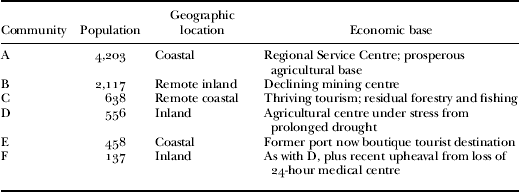
Older rural participants and service providers were recruited from six communities within the LGAs (Table 1). Community A is a reasonably large township based on primary industry, administration and services, with a population of 4,203 at the 2006 Census of Population and Housing. Community B is a remote resource town experiencing downgrading of the mining workforce; its population was 2,117 in the same year. Community C is an isolated coastal town of 638 people based on fishing and forestry and, increasingly, on tourism. Community D is an inland agricultural town of 556 residents experiencing social, economic and environmental stress as a result of extended drought. Community E is a once-busy port being transformed into a tourism centre, its 458 residents experiencing an influx of well-educated ‘sea-change’ in-migrants of socio-economic status higher than the locale's norm. Community F, another inland agricultural settlement of 137, recently experienced a period of unrest following the conversion of the hospital/residential aged care facility to a community health centre which operates in normal weekday business hours only. Such experiences and changes map on to those documented elsewhere in similar jurisdictions, and will become no less significant in the future because of accelerated population ageing and increasing demands on welfare or other support regimes (Tepe and Vanhuysse 2010). In the three LGAs, then, are shared – but not homogeneous – experiences of social, economic and demographic change.
Study communities
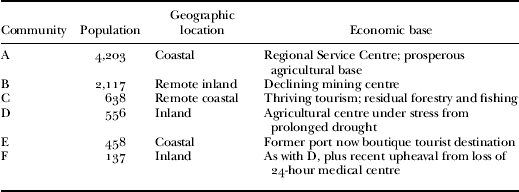
Source of population data: Australian Bureau of Statistics 2006 Population Census.
To learn about such experiences, the study used a convenience ‘snowball’ sample of older rural participants. That is, researchers utilised key community contacts and early participants to identify further potential participants within the study communities. The likelihood that this approach biased the sample towards the more connected is acknowledged, however, we are not aware of an ethically and methodologically sound alternative. To counter such bias, the researchers took considerable time and trouble to immerse themselves within the community prior to, and during, the recruitment process to maximise chances of identifying and recruiting those with weaker community connections. The resulting sample of 69 is balanced across sites, age (modal value 70–74 years), gender, partner status and, anecdotally, by position within local social gradients. Face-to-face semi-structured interviews of 60–90 minutes were designed to explore older rural participants' experience of ageing. Attention was paid to changes in levels and patterns of engagement as participants have aged, and to the reasons behind those changes. Service providers were recruited purposively through health and human service agencies and mainly comprised individuals directly delivering on-ground community health and human services to older rural people within the study LGAs (community nurses, general practitioners, and a range of other community care and development workers). Thirty-two service providers participated in the research in one of five focus groups ranging in size from four to ten participants held across the study areas, or via individual telephone interviews – and this latter method was used with all of the general practitioners in this study group. Focus groups and telephone interviews explored service providers' observations and experiences of age-related challenges to maintaining engagement, and examined service responses to those challenges.
All interviews and focus groups were audio-recorded and transcribed. These rich narratives were then subjected to an exhaustive and systematic process of multi-level iterative thematic analysis using NVivo© software (QSR International 2010). An initial coding tree was constructed from the major themes identified in the literature and these were progressively modified and expanded through multiple iterative rounds of close interrogation of the text in relation to the research questions. The analysis was undertaken simultaneously by two members of the research team working independently on the same material but meeting frequently to collate and integrate themes and findings until consensus was reached on the main themes emerging from the data. The themes reported here do not exhaust the possible thematic content of the data, however, the system and rigour of the analytical process does support claims to their validity. Alongside the literature, these findings informed significant discussions among the 11-member research team and its reference group – the latter comprising three key stakeholders drawn from government and non-government sectors. The following relates mainly to an analysis of transcripts of interviews with older rural participants, and to an examination of findings from considerations with service providers. In the discussion, attention turns to fleshing out certain principles that may more effectively foster engagement among older rural people.
Perspectives on social engagement among older rural participants
Ageing almost inevitably unsettles the ability to maintain established life patterns of social connection and engagement (Noone Reference Noone2009; Scharf and Bartlam Reference Scharf, Bartlam and Keating2008). Older rural participants reported dealing with such trials, many of which involved loss: of physical or cognitive capacity; of significant others and social networks through death and out-migration; of important social roles and functions; and of familiar social and cultural norms, forms and activities. All such forms of change – alone and in concert – worked against participants attempting to maintain preferred levels of engagement.
Focusing on physical capacity, and in common with experiences elsewhere (see e.g. Smith et al. Reference Smith, Borchelt, Maier and Jopp2002), virtually all participants reported some loss of mobility generally related to advancing chronic diseases such as musculo-skeletal, respiratory and cardio-vascular conditions. Mobility issues are well-recognised in the literature (Burnett and Lucas Reference Burnett and Lucas2010; Collins, Goldman and Rodríguez Reference Collins, Goldman and Rodríguez2008). In this vein, the effects of increasing restriction on movement were an issue for participants in settlements where public transport is virtually non-existent, or where services and facilities are spatially dispersed. These effects were pronounced where footpaths or sidewalks are poorly developed and maintained, or where close family members – who might otherwise provide mobility assistance – are also geographically dispersed. In addition, as one participant observed:
You'd be in a real predicament if you couldn't drive … with doctor's appointments and shopping. I know there's a bus on a Friday for the elderly and widows … but it's only for two hours and if that didn't work in with your appointments…
Where spouses no longer drove or were deceased, this inability to drive had impact upon women's ability to maintain former engagements or take on new involvements (Burnett and Lucas Reference Burnett and Lucas2010; Marottoli et al. Reference Marottoli, Mendes de Leon, Glass, Williams, Cooney and Berkman2000; Mezuk and Rebok Reference Mezuk and Rebok2008), although the literature is equivocal on this matter (see e.g. Buys and Carpenter Reference Buys and Carpenter2002).
Participants also referred to diminished levels of energy and endurance that lessened the desire and capacity to engage with others. Such states of being were expressed in various ways; for example, ‘I don't want to go anywhere. I'd rather just be home’ or ‘At our age we don't miss out on much, because you have to get up and go which is a bit of an effort’. Even so, numerous activities and organisations – including those providing primary sources of engagement – are cherished by participants. Yet despite the value placed upon them, many such activities and organisations have declined in viability or have ceased because of lack of membership, leadership and organisational succession, as the following suggests:
I don't know how to explain it because for years I've belonged to the CWA [Country Women's Association] and that was another group that's folded so that's altered another dimension of it [social relationships] … We ran out of members and inclination mainly, but the members we had just got old.
Not surprisingly then, the desire among participants to remain involved in organisations and activities often endures well beyond the capacity to lead, champion or otherwise support them.
Many traditional avenues of engagement are at risk without younger community members to succeed their elders, especially in light of limited government funds, intervention and support. Such factors are symptomatic of larger demographic and cultural changes widely relevant in rural regions in the West (Dykstra Reference Dykstra2009; Goobermanhill Reference Goobermanhill2008; van Tilburg, Havens and Gierveld Reference van Tilburg, Havens and Gierveld2004). One participant confided that, of the ‘people I used to go around with over the years I've been here, there's only about two or three of us left. If they haven't moved out, they've passed on’. Older rural participants talked of the way in which the increasing involvement of women in the paid workforce contributed to reducing opportunities for older rural people to maintain their engagement and increased the likelihood that progressive disengagement would go unnoticed and unaddressed. In the past, up-coming generations of women provided older rural people of both sexes with one-on-one support and were often seen as upcoming leaders in community organisations. While a general and uniform decline in community organisations in the study townships was not evident there was a shift in their characteristics and mix, one driven by the changing cultures and lifestyles of both younger long-term locals and incomers.
At the same time, townships in which older rural participants live are changing; all were experiencing substantial demographic shifts as fluctuating economic fortunes and industrial bases led to the out-migration of former – and especially younger – long-term residents. These residents left chiefly in search of employment opportunities, and may have been partly replaced (if only in numerical terms) by in-migrants. Some were in search of housing less expensive than stock available in urban areas, and were perceived as disruptive influences in the towns in which they settled. For instance, we were advised of one study area that:
It used to be a quiet neighbourhood. It was a good neighbourhood, and then we got some neighbours that moved in and it's not a good neighbourhood now … They're into drugs and they drink a lot. They have lots of parties. She is very abusive and things like that.
Other in-migrants were in pursuit of the apparent benefits of rural lifestyles; sea- or tree-changers, these are people seeking residential amenity in beachside or woodland environments (Jackson Reference Jackson2005; Jobes Reference Jobes2000; Joseph and Cloutier Reference Joseph and Cloutier1991; Longino et al. Reference Longino, Bradley, Stoller and Haas2008). They were present in the research, and are generally distinguishable from longer-term residents by virtue of having greater social resources – principally higher education and income levels, and by engaging in cultural interests unlike those considered the norm in situ in these townships. Either way, such population dynamics, and the diverse social and cultural changes they have engendered, mean that some longer-term resident older rural participants felt themselves strangers in their own communities and struggled to preserve what they could of familiar community structures and activities.
Irrespective of their different residential histories, virtually all participants faced broadly similar challenges, yet insights from the data highlight the singularity of each ageing experience. This distinctiveness partly arises from the kinds of challenges faced. For example, there were wide variations in morbidity even among those of similar age, and such variations may be attributed in part to the personal capacities and social resources individuals were able to bring to coping with change. Furthermore, there appears to be a clear divide between those who might be described as enacting positive, active psycho-social styles of approach to those who presented as more passive and sometimes as defeatist. It is beyond our remit to expand on the fine-grained details of the psychology of ageing, other than to observe that older rural participants' experience of ageing was affected by the nature of the challenges faced and styles of coping (see e.g. Anna, Dana and Jacqui Reference Anna, Dana and Jacqui2008; Kunzmann Reference Kunzmann2008).
Despite almost all participants reporting that their social worlds were shrinking and their engagements declining, few saw these changes as significant, or as warranting particular assistance, especially from service providers. Rather, we were told that ‘We don't see a lot of people across here, but we know they're there and we only have to say the word’. This apparent acceptance of a shrinking social world appeared to stem from a degree of adaptive compensation, the normalisation of ageing, and a culture of stoic self-reliance.
This point is worth elaboration. While noting the well-established correlation between the maintenance of engagement in ageing and lower morbidity and mortality (Bath and Deeg Reference Bath and Deeg2005; Hawkley et al. Reference Hawkley, Hughes, Waite, Masi, Thisted and Cacioppo2008; Lyyra et al. Reference Lyyra, Törmäkangas, Read, Rantanen and Berg2006; Menec Reference Menec2003), the data provide a warning against assuming that decreasing engagement in ageing is necessarily pathological and/or detrimental to wellbeing. For many participants, some degree of reduced engagement would appear volitional, welcome and functional. As they age, most participants simply found that they have less capacity and energy to expend on social activities. They become more discerning about how they expend energy, particularly in terms of the emotional, social and support returns they secure from interactions. They also gain heightened (and possibly compensatory) pleasures from a select range of activities and involvements. Exemplifying the manner in which this discernment may gain hold, one participant made the observation that ‘I used to go to Rotary, for 10 or 15 years. They were on my back the whole time … [to] do jobs all the time, and you have to give time to them’. No longer being engaged in such activities has been a relief and net benefits to wellbeing may emerge from shedding engagements marked by a negative, asymmetric or non-reciprocal socio-emotional balance.
At the same time, having some regular engagement to look forward to remained important for some participants. We were advised, for example, that a monthly community bus outing may – in anticipation, enjoyment and recall – provide adequate external engagement for someone approaching frailty:
We're going to Tarraleah [a remote village in Tasmania's central highlands] this time and we had a trip to the casino in Hobart [the State's capital city] last time. We've been to St Marys [on the northeast coast] and up the coast and all over. I had a wonderful trip down to the casino and had a beautiful luncheon.
For some participants sufficient company may be found in the companionship of a confidant or partner: ‘What do [we] most enjoy doing? Sitting in the chairs looking at one another!’
Notwithstanding the relative transparency of much of the data, there is some difficulty distinguishing between certain patterns of diminished engagement largely imposed – but welcomed or accepted as necessary adaptive responses to the challenge of maximising quality of life in the face of diminishing capacity – and other patterns of engagement imposed, unwelcome and detrimental to quality of life but that are accepted largely without complaint. In wrestling with the task of distinguishing between different patterns of disengagement, interpretation of the data does suggest that older rural participants proved, in the main, reactive rather than reflective and strategic in the face of the challenges of ageing. The prevailing practice seemed to be ‘accept, adapt and carry on’. One stark example of this approach was shared by someone with heart problems: ‘I've got a silly ticker … It goes all erratic but I live with that. I can't be bothered worrying about it.’
Notable exceptions to this approach emerged, often in conversations with sea- or tree-change in-migrants. In terms of ageing, these individuals presented as being more reflective and strategic than longer-term locals, which may be attributable to their generally higher levels of education, greater financial resources and approach to maximising quality of life by moving into the community. One such participant described the process of strategic thinking thus:
We were looking for somewhere that we could escape to … We wanted to stay within an hour and a half of Hobart. We were just looking for a nice little place with a bit of history in a nice sort of neighbourhood. We felt that being closer to Hobart is good for theatres, doctors, hospitals, TAFE [Technical and Further Education/adult education] courses and things like that.
Another observed:
If there are problems you have to be able to do something about it so you can function. I mean having a bad knee; that is not necessarily going to impede you if you make alterations in the house. If we are able to stay here, we might have to make some adaptations, if there's need, for wheelchair access and things like that.
Almost all participants, long-term locals or incomers, thought of ageing not as a unique and separate life-stage, nor even as uniquely problematic, but as part of the continuum of life. Any changes and challenges ageing brought with it were to be accepted and coped with in the manner corresponding to past methods of adaptation, among which stoicism was prevalent. Such behavioural patterning and stoicism are encapsulated in observations shared with us. For example:
I just don't think about getting older and having to go into [residential aged care facility] or dying beforehand. I enjoy every day.
Age is the reason I've stopped doing things. All involvements change over the years. Well I'm running downhill so things have got to change. That is evolvement.
Oh well, you discount the things that don't matter.
The normalisation of age-related change is undergirded by its subtly incremental characteristics, and especially by social disengagement. It is possible to identify within the data a series of ‘triggers’ to disengagement: single traumatic events with precipitate impact on abilities to maintain engagement. The most notable of these events are the death or onset of severe incapacity of a spouse, especially where that spouse is the driving licence holder; loss of one's own licence; a major incapacitating illness; the demise of a valued community activity or institution; or the loss of a crucial support provider through death, incapacity or out-migration. The impacts of these factors on engagement are likely to be evident only over time and to be masked by other and more immediate concerns. In this regard, one participant shared her experiences thus:
I've been so many years [caring for my husband] that I've had nothing. I couldn't do anything. I had an empty life, didn't know anybody, didn't know what to do. I still feel that way at times [eight years after his death].
More typically, decrease in engagement was gradual and multifactorial. In either case it would appear that, subtle in onset, disengagement comes to affect individuals in ways that are largely unremarked and unaddressed.
In general, participants, even the limited number who expressed concern or sadness about disengagement, are characterised by a culture of stoic acceptance; they present as fiercely private, independent and self-reliant – traits widely recognised in the international literature on rural health and ageing (Birnholtz and Jones-Rounds Reference Birnholtz and Jones-Rounds2010; Broese van Groenou and Thomese Reference Broese van Groenou and Thomese1996). As a group, participants were dismissive of any suggestion of a role for government in that aspect of their lives; indeed, several asserted very strongly that people's social engagement was ‘their business’. Even when participants were able to identify individuals within their communities whose quality of life they judged as compromised by disengagement or isolation, they were quite clear that it was ‘up to them’ to do something about it. In short, participants were unequivocal in expecting government involvement in providing (improved) health services and supports, but saw their social lives as their responsibility alone to manage. Yet, this view is at odds with participants' identification of government programmes such as the state Department of Health and Human Services Home and Community Care bus outings and day care centres as the mainstay, and often highlight, of their social lives.
An uncritical reading of the data would suggest that disengagement is a feature of the ageing experience for participants but remains an inevitable part of ‘normal’ ageing: largely functional, well-accepted and dealt with as such. Participants expected no government support in this area, and actively dismissed and resisted suggestions of intervention. However, a deeper reading of the data suggests that normalisation, stoic acceptance and self-reliance mask potentially avoidable and negative impacts of disengagement. This sustained interrogation of the data suggests there are opportunities to enhance the experience of ageing via sensitive and appropriate interventions to address the risk of premature social disengagement.
Most obviously, there were a small number of cases within the sample, and others by report, where age-related challenges had led to participants becoming isolated, unhappy and at risk. While the aetiology of disengagement appeared unique to each individual, for most the process – for example, long years in a high-demand spousal-carer role – had left them isolated and lacking social skills and resources needed to re-establish lost connections or forge new ones. The number of such individuals in the sample was small but this may not accurately reflect their occurrence in the communities under study or, by extension, other rural settlements in Australia and elsewhere. Despite every effort to connect with the disconnected, anecdotal evidence gathered in the course of the study suggests such individuals can become almost invisible or inaccessible to researchers, to communities and to service providers. Where it is visible, social detachment has impact upon the richness and quality of life experienced by individuals even if portrayed as volitional or simply dismissed as a ‘fact of life’. Certainly, participants revealed the degree to which engagement in communities and with families is central to a sense of belonging and identity, and to views of themselves as full, relevant, valued and valuable social beings.
These social factors and other challenges posed by the ageing process add up to a substantially increased risk of participants becoming excluded, marginalised or disconnected. Even those who present as currently comfortable and in control of engagement decisions and practices are generally dealing with some reduction in the quality and richness of their lives. A significant number of those individuals are also highly vulnerable and at risk of isolation if loss is experienced in relation to dependence on one intimate social connection (usually a spouse) or access to a private car. In such events, it is often community-based service providers who are best placed and most likely to recognise both incremental losses of quality of life and major vulnerabilities. It is to an examination of their perspectives on social engagement and ageing that this paper now turns.
Perspectives on social engagement and ageing among service providers
Focus groups conducted with service providers based in the six communities under study were designed to tap into their professional insights about social engagement among older rural people. In the main, service providers thought of ageing largely in terms of problems and pathology; this is in contrast to the normalised view of ageing revealed by in-depth conversations with older rural participants. Like older rural participants, providers were aware of the challenges that ageing presented to social engagement and were deeply cognisant of the ways in which these challenges are compounded in rural settings (Wakerman et al. Reference Wakerman, Humphreys, Wells, Kuipers, Entwistle and Jones2006, Reference Wakerman, Humphreys, Wells, Kuipers, Entwistle and Judith2008).
Service providers were especially concerned that formal professional services were not sufficiently resourced to meet current need, let alone increase. We were told, for example, ‘We have waiting lists’ or ‘There's no money for overnight care’ or ‘I visit for half an hour once a week – for a shower and a bit of housework and that's about it’. Providers were also perturbed that rural communities were increasingly unable to maintain traditional networks and levels of informal support for older people. Such concerns were evinced by observations such as the following:
If their families are away working they've got no transport.
[In the event of family] moving away from rural areas the support's not there.
Volunteers are thin on the ground now. They have a periodic call for volunteers [to drive a community car]. They get a few, but only a few because it's a long drive to [urban centre] and mostly they [clients] want to do it in a day [to avoid overnight accommodation costs].
While providers were intensely aware of the correlation between engagement and older rural people's wellbeing, in a climate of stretched resources the provision of such support was generally not prioritised above meeting immediate medical needs. Given such circumstances, service providers emphasised their interest in, wherever possible, working from a broad understanding of health and wellbeing that included meeting the full range of client needs, including social needs. This commitment often meant adopting a liberal interpretation of prescribed duties, an internal negotiation through which service providers face two major difficulties.
First, service providers confirmed and extended findings derived from speaking with older rural participants that suggest they are very reluctant to seek and accept support. Among older rural participants this reticence even extended to asking close friends and families for help, and it applied especially to formal professional support beyond the most basic essential health and medical services. Service providers' experiences also confirmed other findings from discussions with older rural participants insofar as their reluctance to seek and accept help had its origins in a culture of self-reliance and the desire to protect both independence and privacy.
There was a concern among service providers that this cultural stance could mean that older rural people were rejecting much-needed services and support, and living impoverished and vulnerable lives out of fear that any help-seeking would put them on the ‘slippery slope’ to loss of control, increased dependence and premature death. Providers were aware of the need to be circumspect, flexible and patient in dealing with such clients. They were also cognisant of the value clients placed on personal face-to-face relationships, and were alert to the point that time and patience are required to build the trust that underlies helping relationships that avoid confirming such fears.
In addition, service providers recognised the need to acquire sound understandings of individuals – of their place among, and of their relationships with, wider family and community members. As part of this recognition, providers knew the value of being prepared to shape service responses; in this vein, they saw substantial advantages in being a service provider and a member of a given community.
That's just one of the extra things that you do [action that benefited a client but was outside the work role] … I'm not doing that as part of my work time. I live in the community so I'm a community person as well. We all do it [general agreement] when we live in the community, as part and parcel of that.
Second, service providers identified major tensions between what they saw as a necessarily flexible and responsive model of practice and the bureaucratic and professional frameworks in which they were required to work. These tensions centre principally around scope of duties and accountability requirements.
In terms of scope of duties, complex regulatory and funding frameworks mean that the majority of service providers and their employers work with narrowly defined client eligibility parameters, rigid codes of practice, and a carefully specified range of duties and services. This situation frequently led, at least in rural settings, to clients' needs getting lost in the gaps between services, or not being met in a timely manner or, more importantly, being met in fragmented and decontextualised ways by a procession of different visiting professionals moving briefly in and out of older rural people's lives. Service providers were acutely aware that these shortfalls exacerbated underlying client resistance to needed services and potentially led to a failure be able to recognise and address client need in a more coherent manner. By virtue of understanding their clients and in order to meet clients' complex needs, providers knew they had little alternative but to practise at, or beyond the margins of the ‘letter’ of their defined competencies, specified duties or organisational funding models, although all were careful to emphasise the need to strictly maintain professional and ethical standards. A portion, at least, of service providers interviewed had, often at personal cost, been able to adopt a holistic flexibly responsive approach to supporting their older clients:
You can't just walk out. Our jobs don't fit into a set mould. You certainly don't fit into that half-past four finish time. You stay until the client has finished what they want to talk about or you've finished what you want to do for them … I have 44 hours of flex time [time off in lieu] and there's no way I'm ever going to be able to take that.
We follow through, beyond what we are supposed to. They usually say one or two grief sessions after someone's died, but it depends on the person. We normally follow them through for 12 months.
In terms of accountability requirements, the need to operate in a context-sensitive, flexible, integrated and responsive manner raises issues of responsibility and culpability within tightly prescribed and regulated systems that dominate much funding for health service delivery in Australia. Within such systems reporting is largely based on outputs measured as ‘defined occasions’ or ‘items of service’. Service providers noted that substantial elements of their practices do not lend themselves to such categorisations, falling outside defined scopes of duty or being too complex or diffuse to be encapsulated by the tightly defined measures. For example, a rural community nurse may regularly ‘pop in’ to a client at risk without delivering any defined service; or a Department of Health and Human Services Home and Community Care cleaner may occasionally take a client shopping. Unaccounted services become unpaid and unrecorded workload, and for many of the service providers understated and under-remunerated workloads and professional vulnerability have become an inevitable part of meeting the complex needs of older clients in rural settings. Service providers were aware that any increase in reliance on visiting or outreach services from regional centres would likely lead to greater neglect of the broader socio-cultural needs of older rural people.
Discussion
This research explored the processes underlying age-related disruption of patterns of social engagement among older rural people in order to inform service interventions to protect that engagement. The role of adequate social engagement in promoting ageing ‘well’ (Bowling Reference Bowling2005) is long and well established in the literature (Adams, Leibbrandt and Moon Reference Adams, Leibbrandt and Moon2011; Giles Reference Giles2005; Gray Reference Gray2009; House, Landis and Umberson Reference House, Landis and Umberson1988; Valliant et al. Reference Valliant, Meyer, Mukamal and Soldz1998), suggesting that interventions to protect against network disruption could constitute an important element in public health strategies to address the issues of an ageing population. However, there are major gaps in our theoretical understanding of how age-related challenges to social engagement play out at the level of the individual (Cattan et al. Reference Cattan, Newell, Bond and White2003; Dickens et al. Reference Dickens, Richards, Greaves and Campbell2011), particularly for those located within particular ‘strands of disadvantage’ (Scharf Reference Scharf2001). Analyses of the effectiveness of interventions to address social isolation (Adams, Leibbrandt and Moon Reference Adams, Leibbrandt and Moon2011; Findlay Reference Findlay2003; Noone Reference Noone2009; Scharf Reference Scharf2001; van Haastregt et al. Reference van Haastregt, Diederiks, Van Rossum, De Witte and Crebolder2000) have yielded mixed or inconclusive results, largely due to methodological shortcomings in the studies reviewed (Dickens et al. Reference Dickens, Richards, Greaves and Campbell2011; Findlay Reference Findlay2003; Noone Reference Noone2009). Published studies also tend to be more focused on elucidating models and mechanics of practice than exploring either the theoretical underpinnings of process or the lived experience of clients (see e.g. Feldman et al. Reference Feldman, Oberlink, Rudin, Clay, Edwards, Stafford and Rigoglioso2003). By exploring how challenges to disengagement are experienced, and dealt with, at the level of the individual and their community, this study provides insight into some essential theoretical principles underpinning effective interventions to address disengagement and social isolation among older rural residents.
Most clearly, while older rural participants, to some degree, share characteristics related to cohort, place and lifecourse, ultimately every ageing experience is highly individual and contextual. Therefore, while practice approaches need to be informed by general and categorical understandings they also need to retain the intimacy and flexibility to respond to the individual and the contextual. These findings are in accord with those of Wenger and Burholt (Reference Wenger and Burholt2004) who, in their study on loneliness and isolation among older rural people, stress both the ‘highly idiosyncratic’ nature of patterns of isolation and the difficulties such personal and private issues pose for intervention design and delivery, especially for a cultural group with such strong norms about privacy, self-reliance and stoic acceptance (Chapman and Peace Reference Chapman, Peace and Keating2008; Cloke and Little Reference Cloke and Little1997; Dempsey Reference Dempsey1990; Goins and Krout Reference Goins and Krout2006; Keating Reference Keating2008; Keating, Swindle and Fletcher Reference Keating, Swindle and Fletcher2011; Wenger and Keating Reference Keating2008). The analysis suggests that in order to circumvent client wariness and reluctant help-seeking there is a requirement that interventions are, as far as possible, integrated into, facilitate, and function according to, the processes of community with which the older rural participants are already familiar and comfortable (Heenan Reference Heenan2011). That is, interventions should present as minimal and as facilitative, and take place within the sorts of relationship of trust and authentic connection that mark much in rural community life (rather than as being seen as paternalistic professional ‘care’). This ‘prescription’ presumes that such interventions are flexibly responsive to individual need based on a nuanced understanding of the individual and their context and that they build upon existing community resources.
The age-related (as opposed to lifecourse) risks to social disengagement identified in this study are all well recognised in the literature: the loss of valued social connections through ill-health, role change (especially retirement from paid employment), residential shifts (their own and others) and death, and difficulties in maintaining existing, and forging new, patterns of engagement and social connection due to decreasing mobility and capacity (Findlay and Cartwright Reference Findlay and Cartwright2002; Lang et al. Reference Lang, Llewellyn, Langa, Wallace, Huppert and Melzer2008; Owen Reference Owen2007; Wenger and Burholt Reference Wenger and Burholt2004). There is less empirical evidence concerning how older rural cohorts respond to these challenges (Cattan et al. Reference Cattan, White, Bond and Learmouth2005). The current research confirms earlier findings that older rural cohorts are, in general, highly resilient in the face of the age-related challenges, that they accept the ageing process as ‘natural’ and normative, focus on ‘making the best of it’ (Chapman and Peace Reference Chapman, Peace and Keating2008; Howse, Ebrahim and Gooberman-Hill Reference Howse, Ebrahim and Gooberman-Hill2004; Keating, Swindle and Fletcher Reference Keating, Swindle and Fletcher2011; Walker et al. Reference Walker, Orpin, Stratford, Robinson, Vickers, Bull, Felmingham, Behrens and Boyer2005, Reference Walker, Orpin, Boyer and Behrens2007) and, in the interests of maintaining privacy and independence and avoiding the stigma of being seen as ‘not coping’, are reluctant users of formal services (Scharf and Bartlam Reference Scharf, Bartlam and Keating2008; Wagner and Niles-Yokum Reference Wagner, Niles-Yokum, Goins and Krout2006). While in many cases such responses appear to be adaptive, both this study and earlier research (Scharf and Bartlam Reference Scharf, Bartlam and Keating2008) highlight the risk that it poses for unaddressed progressive disengagement and social isolation, especially where social isolation is unrecognised, unacknowledged or becomes a self-reinforcing maladaptive cognitive loop (Hawkley and Cacioppo Reference Hawkley and Cacioppo2010). Rural health providers ‘wise to the ways’ of local community emphasised the point that support, if it is to be effective, should be offered subtly, circumspectly and in a manner that utilised, stressed, and built upon, the older person's perceptions of self-efficacy and independence. Such an approach would thereby avoid triggering resistance based on perceived threats to the person's self-sufficiency and from intrusion into their lives, especially by government. This point bears out observation (Owen Reference Owen2007) that one of the failures of current practice to address social isolation among older people is their lack of flexibility and patience and a focus on high care rather than low or minimal care. While the social inclusion literature does acknowledge active client involvement as a marker of effective social inclusion strategies (Austin et al. Reference Austin, DesCamp, Flux, McClelland and Sieppert2005; Dickens et al. Reference Dickens, Richards, Greaves and Campbell2011; Findlay Reference Findlay2003) there is little discussion around ways to deliver support by working around client denial, resistance and wariness.
Another reason exists for the inconclusive outcomes from reviews of strategies to address social isolation among rural older people, particularly in terms of reaching the most isolated. This explanation is that many interventions are not grounded in a detailed understanding of both individual and collective needs, and lack the capacity to respond to that need in a flexible and timely manner (Cattan et al. Reference Cattan, Newell, Bond and White2003; Winterton and Warburton Reference Winterton and Warburton2011). ‘One size fits all’ approaches are highly unlikely to be effective with older rural participants. As with the experience of ageing, support needs in ageing, as revealed in the interviews, are similarly highly personal and individual, reflecting personalities, personal resources and biographies, and can only be understood in context (see the discussion of ‘critical human ecology’ and lifecourse perspective in Keating Reference Keating2008). Juxtaposing the data from older rural participants and services providers highlights inherent tensions between what the data, and providers' own experience, identify as appropriate service responses and those they are able to provide. There is a recognised requirement for nuanced, flexible patient support of the sort that can only be developed, and delivered, within the context of sound local knowledge and an ongoing relationship of trust and authentic connection with the individual and the community. Yet, the various requirements of bureaucratic practice shape services and supports in ways that are peripatetic and episodic, narrowly specialised, and tightly prescribed and accounted for through discrete occasions of service measures; and that are frequently delivered by visiting providers outreaching from centres far removed from the local community. Health provider participants report a struggle to reconcile these competing demands without, on one hand, compromising patient, flexible, relationship-based support or, on the other, financial and professional accountability. There is an urgent need to develop innovative approaches to professional and bureaucratic accountability that do not compromise providers' ability to tailor service delivery flexibly to individual need (Findlay Reference Findlay2003).
Older rural participants, even those who were later incomers to their communities, revealed a strong attachment to place and community as the centre, and the driver, for their historical and ongoing social engagements. For longer-term participants in particular, community, and their own roles in building and sustaining ‘their’ community over a life-time (or parts of a life-time) were clearly central to their attempts to maintain a coherent and continuing sense of identity and meaning in the face of age-related challenges to engagement. Community contribution was also a strong focus among more recent incomers who, while they lacked sustained historical connection, had made a conscious choice to commit to the ideals of rural community life. While not focused specifically on the rural context, Austin et al. (2005) identified community development as both ‘goal and method’ in promoting age-friendly environment and engaging older people in ‘direct involvement in concrete initiative that matter to them’ as the most effective approach. Their findings echo earlier work by Findlay (Reference Findlay2003) who identified three themes for effective interventions to address social isolation: quality of facilitators; involving the older people themselves and utilising and building existing community resources. Many older participants did value governmentally provided socialisation opportunities such as monthly bus outings and day centres; however, there were significant numbers, especially males, who were disinclined to engage with these activities. For them, and indeed for most older rural participants, the most keenly felt losses were those traditional community organisations and activities that had constituted both the source and the product of their lifecourse social engagement. This sense of loss was particularly the case for the small number of truly socially isolated participants in the study and likely for those whose social isolation rendered them inaccessible to the study. In reviews, one of the most consistently effective models for addressing social exclusion among older people is the ‘gate-keeper’ model in which the task of identifying and referring older members at risk of disengagement is devolved to the community. Locally embedded community aged care providers are ideally placed to facilitate such approaches but constrained from doing so by their highly prescribed and regulated scopes of practice and frameworks of accountability.
Conclusion
The current research confirms earlier findings concerning the considerable potential for community engagement and contribution that older rural people retain well into older age. It also reveals the personal and environmental age-related changes that put at risk and/or disrupt their capacity to pursue that engagement and to make those contributions. The highly personal and individual nature of both patterns of social engagement and the ageing experience, and the stoic independence and self-reliance of rural older people, mean that to be effective, interventions to protect and build social connection among older rural people cannot be ‘top down’ or ‘one size fits all’ but need be highly flexible, individually tailored, subtle and embedded within, and oriented to building, community. Many of the local community service providers in this study were endeavouring to incorporate ‘making and building connections’ elements into their prescribed practice but difficulties in reconciling such approaches with existing regulatory and accountability structures meant that they were doing so largely unacknowledged, unsupported and unresourced. Given the centrality of regulation and accountability in modern service delivery, now and in the foreseeable future, there is an urgent need for research into innovative solutions to this tension if we are to support ageing well.
Study limitations
The sample bias risks of a snowball sampling approach are discussed above and the limits this places on generalizability are acknowledged. The majority of the older rural participants in this study, however, articulate experiences and attitudes that resonate with other studies looking at similar long-term rural cohorts in Australia and internationally (Cloke and Little Reference Cloke and Little1997; Dempsey Reference Dempsey1990; Goins and Krout Reference Goins and Krout2006; Keating Reference Keating2008). However, there are sufficient participants in this study who are more recently incomers to the study areas, and a growing literature on counter-urbanisation, to suggest that economic, demographic and social change is disrupting traditional rural cultures. While the principles elucidated in this research relating to the need for flexible responsiveness to the individuality of the ageing experience and the importance of context are likely to remain relevant, some of those relating specifically to the present rural context and cohort may well change with future rural cohorts.
Acknowledgements
The research team wishes to acknowledge all participants in the study, and is grateful for support from the Tasmanian Government Department of Health and Human Services, the University of Tasmania, and the Australian Research Council, which funded the Linkage Project (LP0882497) ‘Community Engagement for Productive Ageing: Models to Support Rural Healthy Ageing Through the Maintenance of Community Involvement and Contribution’.