1. Introduction
A growing body of political science research looks at how the design of the electoral system shapes the voting behavior of politicians in parliaments. A common view is that in ‘closed’ list proportional representation (PR) systems, where citizens can only vote for slates of candidates presented by parties, politicians are dependent upon the performance of their party as a whole, and so are beholden to their party leaders to place them in high enough positions on the list to gain election. In contrast, in ‘open-list’ PR or SMDs, where voters can reward or punish politicians independently from their parties, politicians have an incentive to cater to the particular interests of their constituents and so may sometimes dissent from their parties' positions in parliamentary votes.
South Korea is a good case for investigating these propositions. The Korean National Assembly (KNA) has a mixed-member electoral system, with some members elected in SMDs and others elected on closed national party lists. Existing research on legislative behavior in mixed-member systems tends to confirm the general expectations: that the politicians elected in the SMDs are more likely to vote against their parliamentary parties than the politicians elected on the party lists. Nevertheless, looking at voting behavior in the KNA, we find the opposite pattern: KNA members in SMDs are more loyal than members from party lists. This behavior stems from the particular structure of candidate selection and politicians' career paths in South Korea. Specifically, after the introduction of a two-ballot system in 2004, Korean parties had an incentive to use the national party lists to show-case high profile figures who only expect to be in the KNA for a single term. In contrast, the members elected in the SMDs in the parties' regional heartlands tended to be senior party barons who set the policy positions of the parties.
These findings consequently suggest that any theory of how electoral systems shape individual parliamentary behavior needs to look beyond the opportunities provided by the electoral rules for voters to reward or punish individual politicians (as opposed to parties), to the structure of candidate selection inside parties and the related career paths of politicians.
The rest of the paper is organized as follows. In Section 2, we review the literature on electoral systems and legislative behavior, focusing on the research on multi-member systems. In Section 3, we discuss the specific characteristics of elections, candidate selection, and career paths in South Korea and propose several hypotheses about how we expect these processes to affect legislative behavior in the KNA. In Section 4, we introduce the data and variables, and Section 5 presents the results. Finally, Section 6 contains the conclusion.
2. Electoral systems, career paths, and legislative behavior
With the availability of new parliamentary voting data and armed with new theoretical propositions there has been an explosion of new research in political science in the last decade on the impact of electoral institutions on legislative behavior. A variety of theoretical ideas have been put forward. In particular, John Carey, Matthew Shugart, and others argue that politicians elected under ‘candidate-centric’ electoral rules, such as an open-list PR system, are more likely to be independent from their parties than politicians who are elected under ‘party-centric’ rules, such as closed-list PR system (Carey and Shugart, Reference Carey and Shugart1995; Samuels, Reference Samuels1999; Shugart, Reference Shugart, Gallagher and Mitchell2005; Mitchell, Reference Mitchell2000; Shugart et al., Reference Shugart, Valdini and Suominen2005; Carey, Reference Carey2007, Reference Carey2008). When testing these propositions in cross-country research, a common problem is that it is difficult to identify the causal effect of electoral rules on legislative behavior independently from several other cross-country factors, such as how parties are organized. For example, are electoral rules the cause or the consequence of cohesive parties, in that highly institutionalized parties might choose closed-list PR systems, while divided or weak parties choose open-list PR systems?
So, one potential way of identifying the effects of electoral rules on legislative behavior is to look at countries with mixed-member systems; where legislators in the same country and in the same party are elected under two different sets of rules – usually SMDs and multi-member list PR. For example, Haspel et al. (Reference Haspel, Remington and Smith1998) find that parties in the Russian Duma are less cohesive if a high proportion of a their politicians are elected in SMDs compared to party lists. Stratmann and Baur (Reference Stratmann and Baur2002) find that German Bundestag members elected in SMDs tend to join committees that mainly serve geographic interests, whereas members elected on party lists tend to join committees that mainly serve general public interests. Herron (Reference Herron2002) finds that members of the Ukrainian Rada elected either on PR lists or in safe SMDs are more likely to vote against their party than members elected in marginal SMDs, while Ferrara (Reference Ferrara2004) finds similar results for the Italian Chamber of Deputies (cf. Ferrara et al., Reference Ferrara, Herron and Nishikawa2005). And, Pekkanen et al. (Reference Pekkanen, Nyblade and Krauss2006) find that Japanese Diet members in vulnerable positions either on the party lists or in marginal SMDs are given high profile legislative posts to increase their chances of re-election.
However, even in mixed-member systems the effect of electoral rules on legislative behavior is not uniform. This is because several other factors shape the relationship between parliamentarians and their parties. For example, political career paths influence the availability and power of the ‘carrots’ party leaders have at their disposal to enforce party discipline. A standard assumption in theories of parliamentary government is that politicians not only seek re-election but also seek promotion to ministerial office (e.g. Kam, Reference Kam2008). If party leaders are free to decide who gets promotion, they can use the carrot of promotion to encourage potential rebels to toe the party line. As a result, once a politician has finished his or her ministerial career, the promise of promotion is less forceful (e.g. Benedetto and Hix, Reference Benedetto and Hix2007).
A similar effect exists if a politician is not standing for re-election, in which case they cannot be considered to be re-election seekers. However, final-term politicians might be interested in a political career outside parliament. Hence, even if a politician is not seeking re-election or promotion to ministerial office she might be dependent on her party leadership for a post-parliamentary career, such as election to local or regional office or to an upper chamber – as tends to be the case in the fixed single-term congresses in Costa Rica and Mexico (Carey, Reference Carey1996), for some parties in the Brazilian congress (Samuels, Reference Samuels2003), and for Members of the European Parliament who seek to return to national parliaments (Hix, Reference Hix2004).
A second factor is how candidates are selected in elections. If a party has a centralized system of selecting candidates – for example, if the party leadership is responsible for determining the order of candidates on the PR lists or which members can stand in which SMDs – then the party leaders have a powerful mechanism for enforcing legislative discipline. In contrast, if a party has a decentralized system of selecting candidates – for example, if a primary is used to determine the order of candidates on a party list or if local party members are responsible for selecting candidates in districts – then politicians will be less dependent upon their parliamentary party leaders for their re-selection prospects. For example, Samuels (Reference Samuels1999) finds that the way candidates are selected and how campaign finances are controlled by parties in Brazil have a significant effect on politicians' behavior. Noury and Mielcova (Reference Noury and Mielcova2005) find that the centralization of candidate selection on the party lists between two electoral periods led to more cohesive parties in the Czech Chamber of Deputies. Also, Thomas (Reference Thomas2005) finds that across comparable mixed-member systems the centralization of parties in Hungary and Ukraine enables these parties to be more cohesive in legislative votes than more weakly institutionalized parties in Russia.
A third issue is the heterogeneity of politicians' preferences within parties. The distance between a politician's policy preferences and the preferences of the party is likely to be correlated with the number of times a politician will want to vote against the party's position in a legislative vote (esp. Krehbiel, Reference Krehbiel1993). If a politician agrees his or her party leader on every issue on the plenary floor, s/he will never have a desire to vote against the party. Hence, if a party is ideologically homogeneous, a party leader will not need to use the threat of de-selection or the promise of promotion to ministerial office to enforce party discipline, as the members of the party will naturally vote together. Following from the former point, parties with more centralized candidate selection rules are likely to be more ideologically homogeneous – and hence more cohesive in legislative votes – than parliamentary parties with a decentralized system of selecting candidates. But, even in parties with decentralized candidate selection, there could be significant variance in the preference heterogeneity of their members, as a result of the preferences of local selectorates or the socio-economic profile of the members.
One way these factors play out in mixed-member systems is through what the literature refers to as ‘contamination’ between the two electoral tiers (esp. Ferrara et al., Reference Ferrara, Herron and Nishikawa2005). This notion of contamination initially referred to the complex strategic incentives faced by citizens when voting for two different sets of candidates (e.g. Herron and Nishikawa, Reference Herron and Nishikawa2001; Ferrara, Reference Ferrara2004). However, the existence of two electoral tiers also contaminates the strategic behavior of parties and politicians (Crisp, Reference Crisp2007). First, many mixed-member systems allow candidates to stand in both the lower and the upper levels – for example in SMDs and on PR lists. So, if a ‘dual candidate’ politician is in a safe position on the PR list, the marginality of his/her position in the SMD is unlikely to influence any relationship with the party leader. Conversely, if a ‘dual candidate’ politician is low down on the PR list, s/he will be heavily dependent on the party to maintain him/her as a candidate in the SMD and to try to help him/her win the election in the SMD.
Moreover, even where dual-candidacy does not exist, politicians in mixed-member systems can seek to be promoted from marginal positions on one level to safe positions on the other level – for example from a marginal SMD to a safe position on a PR list, or from a low position on a PR list to a safe SMD. Also, a party may decide to nominate a high-profile candidate in a SMD where the party has no chance of winning the seat to encourage its supporters to participate in the election and vote for the party's slate of PR candidates (Cox and Schoppa, Reference Cox and Schoppa2002; Herron and Nishikawa, Reference Herron and Nishikawa2001). As a result, the strategies parties use when selecting candidates for the two tiers, and the resulting career trajectory of candidates between the two tiers, will shape how politicians relate to their party leaders in both the electoral and the legislative arena.
In sum, the effect of electoral rules on legislative behavior is clearer to identify in a study of a single country with a mixed-member system, where politicians from the same party are elected under different electoral rules, than in cross-country research, where lots of country-specific factors are likely to be correlated with the electoral rules and/or legislative behavior in a particular country. Most research on legislative behavior in mixed-member systems finds that members elected in SMD seats are less likely to vote against their parties than members elected on PR lists. However, the effect of electoral rules in a particular mixed-member system is also shaped by how parties select candidates and the career paths and ideological positions of individual politicians.
3. Elections, parties and political careers in South Korea
Our research on South Korea is hence similar to existing research on parliamentary voting in Italy, Ukraine, Russia, Germany, Hungary, and other countries with mixed-member systems. In several ways, though, South Korea is a better case than some of these other cases for isolating the effect of electoral rules and candidate incentives independently of parliamentarians' ideological preferences. First, there is no dual candidacy in Korea – in other words, candidates must choose whether they stand in SMDs or on party lists, which removes one element of cross-tier contamination. Second, and more significantly, from a survey of KNA members, in South Korea there are good quality exogenous measures of legislators' preferences. These measures allow us to identify the ideological heterogeneity within parties and the likely policy incentives for legislators to vote against their parties. Without exogenous measures of legislators' preferences, most research on legislative voting needs to assume that policy conflicts between members and parties are either constant or are correlated with other institutional characteristics, such as the safety of a SMD or the seniority of a member in the party.
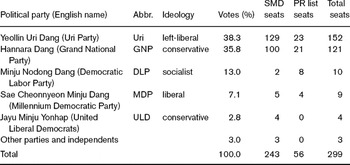
We focus on the seventeenth session of the KNA, which was elected in April 2004, because this is the first session in which a significant number of votes were taken by roll-call. It also happens to be the first KNA session elected under a mixed-member system with two ballots: one for an SMD and the other for a party list. In the 2004 election, 243 seats (81%) were elected in SMDs and 56 seats (19%) were elected in a nationwide multi-member constituency by a system of ‘closed-list’ PR, where voters can only choose between pre-ordered lists of candidates and cannot influence the order of the candidates of the party for which they vote. The make-up of the seventeenth KNA is shown in Table 1.
Make-up of the Seventeenth Korean National Assembly

Source: National Assembly of the Republic of Korea (http://korea.assembly.go.kr), Korean National Electoral Commission (http://www.nec.go.kr).
Regarding the party system, South Korean politics is dominated by a regional cleavage (cf. Moon, Reference Moon2005; Hix and Jun, Reference Hix and Jun2009). For example, in the 2004 KNA elections, the two progressive parties, President Roh's Uri Party and the Millennium Democratic Party (MDP), together won 86% of the votes and 30 of the 31 SMD seats in the south-western region (Honam), while the main conservative party, the Grand National Party (GNP), won 65 of the 73 SMD seats in the south-eastern region (Youngnam).
As in other mixed-member systems with two separate votes, politicians elected from the PR lists have different incentives from those elected in the SMDs. However, some features of candidate selection and career trajectory of politicians are specific to Korea. In general, because of the geographic concentration of the votes of the two main parties, a position in an SMD is generally more desirable than a position on a party list. Morevoer, candidates on the PR lists in Korea can be classified into two groups. One group is the newcomers to politics, who secure a place on a PR list with the hope of using this to secure nomination to an SMD in a future election. These members are recruited by the parties either because of their policy expertise, or because their candidacy will lead to support from their professional groups. It is unusual for a party to give these newcomers a second chance to be in the list again, because a position on the list is a form of currency for a party to use to broaden its appeal to new voters. So, if these new members want to be re-elected, they need to build a national profile to make themselves attractive for a competitive SMD seat. However, because of a strong incumbency bias in the SMDs, as a result of the regional concentration of votes and the related safety of many SMD seats, it is difficult for new candidates to find winnable SMDs.
A second group of candidates on the PR lists are high-profile figures who do not intend to have a career in the KNA beyond a single term. These can be former ministers or close advisors to the party leaders who are recruited from academia, business, or the bureaucracy. Parties primarily place these politicians on the PR lists because it raises the profile of the party in a national campaign. Also, many of these policy-makers do not have the time, the desire, or the local party connections to cultivate the necessary local support to be able to be nominated as a candidate in a SMD. Many of these high-profile politicians are also too old to expect more than one term in the KNA.
In the seventeenth KNA, for example, in the two main parties (GNP and Uri), all of those elected from the PR list (44 in total) were elected to the KNA for the first time. Of all the parties, only five members from the list (out of 190) in the sixteenth KNA ran for election for the seventeenth KNA, and none of these incumbents was from the two major parties. Three of these incumbents were party leaders of the minor parties and one was the son of former president Kim Dae Jung. This was a big change from the sixteenth KNA, when 29 members elected from the PR list were elected to the Assembly for more than a second time.
This change in the incumbency profile of the sixteenth and seventeenth KNAs was partly due to the emergence of a new party: Uri. However, this change was also due to the replacement of a single-ballot with a new two-ballot system. In the previous single-ballot system, the focus of parties and politicians was to place high-profile politicians in the single-member seats, which meant that the PR list members were largely elected ‘on the coat tails’ of the SMD members. However, the introduction of the two-ballot system in 2004 introduced a new incentive for parties: to place high-profile figures on the PR lists to attract voters to support their national lists even if they were not voting for the party in the SMD.
Turning to the career trajectory of members elected in the SMDs, there are two types of constituencies in terms of electoral success. First, there are the safe seats, in which a particular party has stable popularity. These seats are mostly in the regional heartlands of the parties: in Honam for Uri and Yongnam for GNP. In these districts, nomination by the ‘hometown party’ virtually guarantees electoral victory. As a result, competition to be selected as a candidate in these seats is severe, and more intensive than the actual election. In such districts, the main opponent for the popular party's candidate is usually an independent candidate, who often fails to get nominated by that party. The other type of district is one in which no party has a safe seat and regional voting is not expected. Here, party nomination does not guarantee electoral success. Normally, the parties re-nominate the incumbents. In the case of the seventeenth KNA, though, there was an unusually high turnover even in the safe seats because the parties recruited new faces in an attempt to refresh their public image.
Both the GNP and Uri Party used a combination of centralized and localized candidate selection systems. In 2004, each party set up a special central committee to assess potential candidates. In both parties, these committees were composed of equal numbers of internal and external ‘examiners’. The committee could recommend more than one candidate for an SMD. When the committee recommended one candidate for a SMD, the party leadership could veto him or her. When the committee recommended more than one candidate, the parties usually conducted a local primary. The primaries were open to non-party members. Still the party leadership could choose not to have a primary, and the party leaderships could even veto the candidates who won the primaries and impose their preferred ones. In fact, the Uri Party held primaries in 83 out of the 243 districts it contested (34.2%) and the GNP in 15 out of the 228 districts it contested (6.6%). Hence, although both parties introduced some localized elements into their candidate selection system, the centralized systems of selection prevailed.Footnote 2
Turning to the PR list candidates, only ten KNA members who had been elected on the PR list in the seventeenth KNA were re-elected in the eighteenth KNA election in 2008. Nine of these members gained re-election in an SMD seat. Interestingly, among these, all four of the female members (three from the GNP and one from the IDP) were re-elected in districts in Seoul, and won with margins of between 1.3% and 18.5%. The three male GNP members were re-elected in the party's ‘home’ region (Youngnam), winning with margins of between 18.1% and 72.6%.
So, given what we know about electoral institutions, candidate selection, and political careers in South Korea, what should we expect to observe in terms of voting in the KNA?
First, as far as the difference between PR and SMD members is concerned, the general literature on electoral systems and legislative behavior predicts that politicians elected in SMDs are more likely to vote against their parties than politicians elected on PR lists, although the research on contamination effects in mixed-member systems suggests that there should be no significant difference between these two sets of politicians.
However, the candidate selection process and the resulting career trajectory of politicians in the two main parties in South Korea go against these expectations. Because PR list members are mainly high-profile figures who only expect a single term, and hence do not seek party leadership approval for re-selection and re-election, we can expect these members to be relatively independently minded. In contrast, the members elected in SMDs are likely to be party ‘insiders’, who are chosen by party leaderships for their loyalty and need to stay loyal to secure re-selection and re-election. As a result, we expect an effect that is counter to the existing literature: that politicians elected on the PR lists are more likely to vote against their party leaders than politicians elected in SMDs.
Second, the general literature suggests that politicians elected in ‘safe’ SMDs or who are placed in ‘safe’ positions on PR lists are more likely to vote against their parties in the legislature than politicians in less safe positions. Politicians in low positions on PR lists will seek the approval of party leaders in an effort to be placed in a higher position at the next election. Similarly, politicians in marginal SMDs either seek to be nominated in safer seats or fear being punished by their voters for rebelling against party positions – although this effect could work the other way in that a politician in a marginal seat may have an incentive to rebel to appeal to a median voter who disagrees with the position of the incumbent's party on a particular issue (cf. Benedetto and Hix, Reference Benedetto and Hix2007).
Once again, given the particularities of career paths and regionalized electoral politics in Korea, we expect the relative ‘safety’ of politicians to affect PR list members and SMD members in different ways. Specifically, the higher the place a member is on the PR list, the more likely the candidate will have a high national profile independent from his/her party, and the more likely s/he will then be relatively independent in his/her voting in the chamber. This is consistent with the standard notion in the literature about the relationship between seat safety and legislative voting. However, in South Korea, the leaderships of the parties tend to be those members who are elected in the safe SMDs in the parties' regional heartlands, while the new entrants tend to be elected in the competitive districts, which the parties sometimes win and sometimes lose. Since the party leaders determine the legislative positions of the parties, these politicians are unlikely to dissent from the majority position of their party in legislative votes. As a result, we expect that seat safety works in different ways for the two sets of KNA members: where politicians on PR lists will dissent more if they are in safe positions, while politicians in SMDs will dissent less if they are in safe positions.
4. Data, models, and variables
We test these ideas by looking at the voting behavior of the members of the seventeenth KNA. There were 574 roll-call votes in the first year of that Assembly. Although many of these votes were highly lopsided, there were defections from the voting positions of the main parties. We focus on the two main parties: the Uri Party and GNP. We exclude the smaller parties as these parties rarely influence policy outcomes in the KNA, and treating the votes of the members of these smaller parties against the party majority as ‘party defection’ is rather dubious since the majority position of these parties is difficult to observe in legislative votes.
To look at the voting behavior of KNA members vis-à-vis their parties in the seventeenth KNA we estimate the following fixed-effects logistic regression model

where, Ymv is a vote by KNA member m against the majority of his/her party in vote v, each KNA member is indexed by m and each roll-call vote is indexed by v, and

The dependent variable is whether a KNA member voted against the majority position of his/her party, which is coded 1 for a vote against the party majority and 0 otherwise. On average, a member of the two largest parties in the KNA voted against his/her party 4.4% of the time, in other words 25 times out of 574 roll-call votes. Uri members voted on average 1.9% of the times against their party, whereas GNP members voted on average 7.4% of the time against their party.
PR_LIST is a dummy variable, which is coded 1 if a member was elected on a PR list, and 0 if a member was elected in a SMD.
SAFETY measures the safety of the electoral position of a KNA member. In the models of the behavior of the SMD members, the SAFETY term is the winning margin of a member, measured as the vote share of the winning candidate minus the vote share of the second placed candidate. In the models of the behavior of the PR list members, the SAFETY term is the position of the member on the party list, where the top person on the list is coded as 23 for the Uri members and 21 for the GNP members (since Uri had 23 PR list members, whereas GNP had 21 PR list members elected), the second person on the list is coded as 22 and 20 respectively, the third person is 21 and 19, and so on down to the last person to be elected on the list, who is coded 1 for each party.
IDEOLOGY is a vector of two variables that capture the policy positions of the KNA members and the likely policy divergence between the KNA members and their parties. First, an ideological self-placement variable is the self-placement of a KNA member on a ten-point ‘progressive-conservative’ scale, where 0 is the most progressive position and 10 is the most conservative position. These data are taken from a survey of the seventeenth KNA members, conducted by the Joong Ang Daily and the Korean Party Studies Association (2005). Second, an ideological distance from party variable is calculated as the absolute difference between the location of the member on the ten-point scale and the location of the median member of the party on the same scale.
These measures are based on the progressive–conservative dimension in South Korea. This is not exactly the same as the classic ‘left–right’ dimension in western party systems, since the progressive–conservative division in Korea combines economic policy positions, security preferences (relating to policies towards North Korea and the United States), and social policy questions (such as rights of women and minorities in Korean society). Progressives are usually associated with protecting workers' rights, a dovish (‘sunshine’) policy towards North Korea, and liberal social policies, while conservatives are usually associated with protection of the Chaebol (the industrial conglomerates), hawkish policies towards North Korea, and traditional social values. We use several survey questions to construct a single progressive–conservative scale, which previous research suggests is a reasonable proxy of the policy preferences of KNA members (Hix and Jun, Reference Hix and Jun2009). The 233 out of 299 members responded to the survey (a 78% response rate), and after pairwise deletion of missing responses we can derive a basic ideological location of 209 KNA members.
CONSTITUENCY is a vector of three variables, which control for the constituency characteristics of KNA members elected in SMDs: (1) district population density, which is the average number of people per km2 in a district; (2) district agricultural ratio, which is the ratio of people working in agriculture among the working population in a district; and (3) district budgetary independence, which is the proportion of a district's total expenditure not covered by central public finances. If the local government cannot afford to cover its own expenditure, the central government supports the rest. So, rich districts tend to have higher district budgetary independence.
CONTROLS is a vector of four variables which control for potential individual-level characteristics that might influence how KNA members behave vis-à-vis their party leaders: (1) times elected, which is the number of times a member has been elected to the KNA; (2) age, which is the age in years of each KNA member at the start of the seventeenth session; and (3) leadership position, which is a dummy variable indicating whether a KNA member has a key position either in the party or the assembly, such as a committee chair, a party whip in the Assembly, and the assembly president or vice-president; and (4) female, which is a dummy variable for the gender of a member.
URI is a dummy variable for the Uri Party, which allows us to see whether the effects are different within the two main parties.
Finally, VOTE is vector of 574 dummy variables indicating each vote. These vote-level fixed-effects are included to control for any vote-specific effects that might influence the defection rate in a vote, such as the policy issue in a vote or the political salience of a particular vote.
We first estimate a model of the behavior of all KNA members with and without the ideological variables. We then estimate separate models for members elected on the PR lists and members elected in the SMDs as well as separate models for Uri and GNP members. Descriptive statistics for the variables are contained in the Appendix.
5. Results and analysis
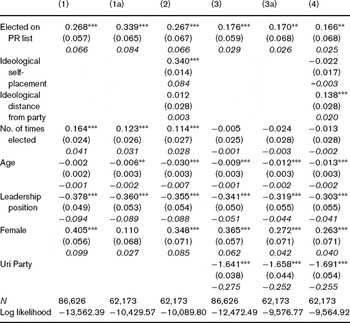
The results from the basic models are reported in Table 2. Here, models 1a and 3a replicate models 1 and 3, respectively, but only for those KNA members for whom we have ideological self-placement data, so that the results from the models with and without the ideological variables can be directly compared.
Basic models

Notes: Dependent variable: Vote by a KNA member against his or her party majority in a vote. Models 1a and 3a replicate models 1 and 3, respectively, for those KNA members for which we have ideological placement data. The GNP is the baseline category in models 3, 3a and 4. All models include a fixed-effect for each vote. Method: Logit. *p ≤ 0.1, **p ≤ 0.05, ***p ≤ 0.01. Standard errors in parentheses. The marginal effects of a one unit change in an independent variable on the dependent variable are in italics (holding all other independent variables at their mean value).
The first key result is that members elected on PR lists are more likely to vote against their legislative party majority than members elected in SMDs. Averaged across the two main parties, and without controlling for ideological heterogeneity, KNA members elected on the PR lists are approximately 7% more likely to vote against their party than SMD members (6.6% in model 1 and 8.4% in model 1a).Footnote 3 This result is robust to the inclusion of the level of ideological conflict in a party (in model 2), and to the inclusion of a dummy variable for the Uri party (in models 3, 3a, and 4).
The other main finding in Table 2 is that Uri party members are much less likely to dissent from their party majority than GNP members. This may be because Uri was the governing party in this period, and hence had dominant agenda-setting powers. Nevertheless, several other factors correlate with this potential government–opposition effect, such as the fact that Uri was a new party while GNP is an older party, and the fact that the two parties had different methods of candidate selection, as we discussed above. Without variance across time in the make-up of government we cannot distinguish between these effects. All we can say, at this stage, is that Uri and GNP members behave differently towards their parties.
Regarding the control variables, older KNA members and members in party leadership positions are less likely to vote against their party than ‘backbench’ members. This is as expected, as these ‘senior’ members of the KNA are likely to be able to shape the policy agenda and decide party positions on key legislative issues. However, we find that younger KNA members are more likely to defect from their parties than older members, controlling for leadership position in the party. With longer careers ahead of them, we may expect the younger KNA members to defect less than the older ones, who are more established politicians. Also, the younger KNA members are more vulnerable to the withdrawal of support by the party leadership. However, the results show the opposite. This may be because younger KNA members have less say in shaping the party positions, and so are more likely to disagree with positions the party takes in roll-call votes. Interestingly, women KNA members tend to vote against their party more often than men.
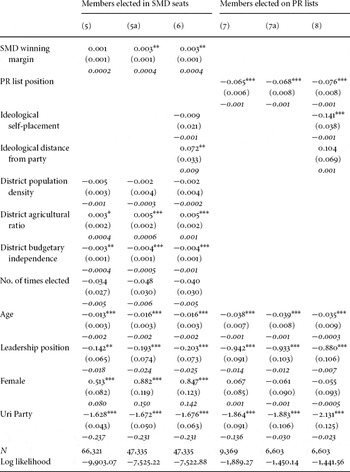
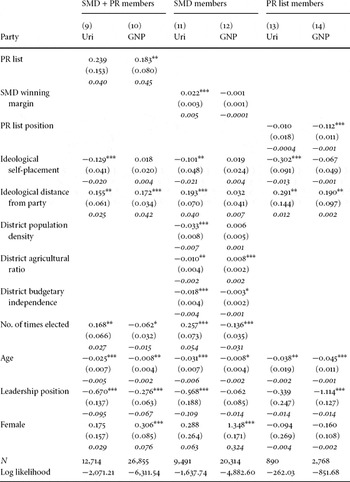
Table 3 shows the results from separate models of the behavior of PR list and SMD members, controlling for the difference between the two parties (with the inclusion of the Uri variable). As before, models 5a and 7a replicate models 5 and 7, respectively, but only for those KNA members for whom we have ideological placement data.
Comparison of single member districts and PR districts

Notes: Dependent variable: Vote by a KNA member against his or her party majority in a vote. Models 5a and 7a replicate models 5 and 7, respectively, for those KNA members for which we have ideological placement data. The GNP is the baseline category in all models in this table. All models include a fixed-effect for each vote. Method: Logit. *p ≤ 0.1, **p ≤ 0.05, ***p ≤ 0.01. Standard errors in parentheses. The marginal effects of a one unit change in an independent variable on the dependent variable are in italics (holding all other independent variables at their mean value).
The key result here is that the safer the SMD, the more likely the member will vote against his/her party, while the safer the position on the PR list, the less likely the member will vote against his/her party. Also, this result is robust to the addition of the ideological variables. Interestingly, though, the ideological distance between a member and his/her party affects PR list and SMD members differently. For SMD members, but not for the PR list members, ideological divergence between a member and his/her party increases the propensity to dissent.
Interestingly, the constituency characteristics of the members elected in the SMDs also make a difference. Members from agricultural districts are more likely to vote against their parties than other members, while members in richer districts (as measured by the district budgetary independence variable) are less likely to vote against their parties than other members. As agricultural districts tend to have electorates with concentrated and specific policy interests (e.g. subsidies to farmers and protectionism in agricultural trade), the KNA members elected from these districts tend to have a bigger electoral incentive to be responsive to the demands from their electorates. Also the electorates in poor districts are more interested in their representatives' ability to bring pork-barrel from the central government to financially support local projects as their local governments are less capable of pursuing these projects alone. With distinctive constituency interests, the members elected from poor and rural districts have more to gain to pursue their voters' interests distinctive from their party's policy positions.
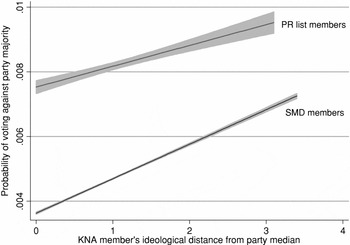
Figure 1 illustrates the effect of ideological divergence on the propensity of PR list and SMD members based on the results in models 6 and 8 in Table 2. As the figure shows, PR list members vote more against their parties than SMD members. Also, greater policy divergence between a member and her party increases the propensity of the member to vote against her party, but the magnitude of the effect of increasing policy divergence is greater for SMD members than PR list members.
Voting defection of KNA members by election tier

Table 4 looks at the difference between Uri and GNP members across the two different electoral tiers. The results show some clear differences between the two parties. For GNP, PR list members dissent more than SMD members, while this is not the case for Uri. Also, for Uri, the size of the winning margin for the SMD members increases the propensity of a member to vote against the party, while this has no effect for GNP. On the other hand, for GNP, the lower (higher) the position on the PR list, the less (more) likely the member will vote against the party, while this effect is not significant for Uri members.
Comparison of Uri party and GNP members

Notes: Dependent variable: Vote by a KNA member against his or her party majority in a vote. All models include a fixed-effect for each vote. Method: Logit. *p ≤ 0.1, **p ≤ 0.05, ***p ≤ 0.01. Standard errors in parentheses. The marginal effects of a one unit change in an independent variable on the dependent variable are in italics (holding all other independent variables at their mean value).
Regarding the effect of ideology, for both parties, increasing ideological divergence between a member and his/her party has a positive effect on the propensity of a member to vote against her party. However, absolute ideological placement on the progressive-conservative scale only makes a difference for Uri. Specifically, the left-wingers in the Uri party are more likely to dissent than the centrists.
Regarding the other control variables, age has a consistent effect for both parties and both electoral ties, and so does leadership position. However, GNP women elected in SMDs are more likely to defect from their party than men, while gender has no effect for Uri members or for GNP members elected on the PR lists.
6. Conclusion: the interaction of electoral institutions and career paths
Electoral systems clearly shape how elected politicians behave inside parliaments vis-à-vis their voters and their party leaders. However, the relationship between electoral system design and legislative behavior is probably not as straightforward as some of the existing theoretical ideas suggest. Contrary to the behavior that has been observed in some other countries with mixed-member systems, we find in South Korea that the members of the KNA who were elected on PR lists are more likely to vote against their party leadership than the members elected in SMDs.
To understand why this is the case we need to know about how candidate selection and career paths work in South Korea. Specifically, the selection of candidates in Korea for both party lists and SMDs is highly centralized. However, the main parties use the party lists to attract high profile personalities into politics who are willing to stand under the brand label of a party and sit in the KNA for a single term, but do not want to get involved in competing to stand as a candidate in a SMD and then running a district-level electoral campaign, often in a competitive district, or expect a long career in the KNA. In contrast, the members of the two main parties who are elected in SMDs tend to be the senior party barons who run the party and so have a role in selecting candidates in the marginal districts and on the party lists.
The career incentives also mean that the safeness of a member's position affects PR list and SMDs members differently. Members who are elected in safe SMDs are more likely to vote against the party than members elected in marginal seats, controlling for seniority, which is consistent with standard work on electoral safety and legislative behavior. However, members elected in safe positions on the PR lists are more likely to vote against their party than members in less safe positions. This is against a standard view, but nevertheless is consistent with the fact that top positions on party lists tend to be reserved for high-profile independent candidates whom the parties try to attract into politics to raise the parties' profiles in the elections but then are relatively independently minded once elected.
In short, political science is starting to build up a body of knowledge about how electoral systems shape individual political behavior. In this endeavor, theory and empirical research has progressed rapidly in the past decade. However, to understand how electoral institutions affect legislative behavior we need to look beyond district magnitude (such as the PR list or SMD) or the type of ballot structure (such as open or closed) to how parties select candidates in different seats and how political career trajectories shape the relationship between voters, politicians, and party leaders.
About the author
Hae-Won Jun is an Assistant Professor at the Institute of Foreign Affairs and National Security in Seoul. Her articles have appeared in journals such as European Union Politics, Party Politics and Korean Journal of International Studies. Simon Hix is a Professor of European and Comparative Politics at the London School of Economics. His books include ‘What's Wrong with the European Union and How to Fix It’ (Polity, 2008) and ‘Democratic Politics in the European Parliament'’ (Cambridge, 2007, with Abdul Noury and Gerard Roland), which won the 2008 Fenno Prize of APSA for the best book on legislative politics. His articles have appeared in inter alia the American Journal of Political Science, British Journal of Political Science, Journal of Politics, World Politics, and Comparative Politics.
Appendix: Descriptive statistics