

1. Introduction
In a stylized textbook gold standard regime, reserves at the central bank serve to guarantee the convertibility of the notes issued by the central bank into gold coin on demand.Footnote 1 The convertibility of the banknotes in turn stabilizes the value of domestic money in terms of other gold currencies, as a rise or fall of the exchange rate beyond the gold points triggers equilibrating international shipments of gold. In this framework, central banks transact in gold (or foreign exchange in a gold-exchange standard regime) in principle on the initiative of the public only: the central bank is essentially a currency board passively exchanging gold against banknotes and vice versa.
Under the catchphrase of the rules of the game, the literature on the gold standard has extensively discussed another aspect of central bank policy, the setting of the discount rate.Footnote 2 Concerning transactions in reserve assets, on the other hand, very little is known beyond the fact that most central banks manipulated gold export and import prices and that some operated not only in gold but also foreign exchange.Footnote 3 The size, nature, frequency and rationale of reserve operations and foreign exchange transactions in particular remain largely uncharted territory.
This article brings to bear new archival evidence on the foreign exchange interventions of the central bank of the Austro-Hungarian Empire, the Oesterreichisch-Ungarische Bank (OeUB). While the foreign exchange policy of the OeUB had early on attracted the interest of economists, we remain ignorant on key aspects of the Bank's policy. Contemporary authors like Ludwig von Mises mainly relied on official accounts coupled with anecdotal evidence from financial market participants. More recent work has built on the econometric analysis of exchange and interest rate data. On the other hand, hardly anything is known about the OeUB operations themselves, in particular about the instruments used, the frequency and size of interventions, and the motives of the decision makers. This article proposes to fill the gap by presenting a broad set of quantitative and qualitative evidence on the operations of the OeUB and the market setting within which they took place.
The article proceeds as follows. Section 2 reviews the existing literature on the foreign exchange policy of the OeUB and gives an outline of the open questions. Section 3 portrays the foreign exchange operations of the OeUB based on new material from the archives of the Bank. In addition to spot sales and purchases, the section documents the use of forward contracts as well as of foreign exchange repurchase operations. Section 4 explores the evolution of the Vienna foreign exchange market. After 1901, the OeUB commanded by far the largest foreign exchange holdings in the monarchy and, more surprisingly, became the key market maker and a high-frequency trader, in sum the market leader. Section 5 links the changes in market structure to the increase in foreign exchange market efficiency that occurred at the same time. Section 6 then looks at the practice of modern central banks to understand why the OeUB developed new instruments and why the Bank was so keen on dominating the market. The conclusion wraps up and sketches some avenues for future research.
2. A successful exchange rate stabilization programme and some open questions
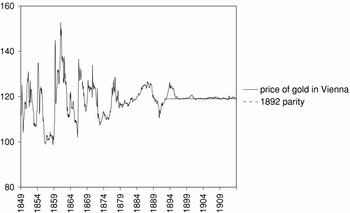
After decades of floating and several aborted attempts at stabilization, a series of monetary reforms in the 1890s tied the Austro-Hungarian florin to gold. The legal adoption of a gold standard had no immediate effect on the exchange rate, however, as the convertibility of banknotes into specie remained suspended.Footnote 4 The new regime proved nevertheless very successful in stabilizing the value of the Austro-Hungarian currency on the foreign exchange markets. After wide gyrations in the 1850s and 1860s and fluctuations in the order of +/−7 per cent up until the mid 1890s, exchange rates became steady after 1896, when the OeUB started to intervene in the foreign exchange markets. After 1901 volatility declined even further, and exchange rates behaved similarly to those between the core gold standard countries France, Germany or the UK. Figure 1 tracks the price of gold, representative of the trends in the value of the Austro-Hungarian currency vis-à-vis the main international currencies.
Price of gold in Vienna

2.1. Early debates on rules vs discretion
Almost from its inception, Austria–Hungary's new exchange rate regime aroused the curiosity of economists. One aspect that intrigued contemporaries was the absence of gold convertibility. Georg Friedrich Knapp closes his presentation of the state theory of money (Reference Knapp1905) with the Austro-Hungarian example of exchange rate stability without specie payments. In a drawn-out debate, Ludwig von Mises confronted the Viennese economic journalist Walther Federn on the true nature of the Austro-Hungarian exchange rate regime. Von Mises (Reference Mises1909a, Reference Mises1909b, Reference Mises1912) claimed that the absence of a legal obligation for the OeUB to redeem banknotes in gold on demand had no practical relevance for exchange rate dynamics and that the regime was just a gold standard in disguise: While in a stylized gold standard, exchange rate movements are limited by gold convertibility, in Austria-Hungary, Mises argued, foreign exchange intervention by the OeUB had been substituted for this mechanism. The result was the same, as the OeUB stood ‘always [ready to sell] foreign bills at such a price that it [was] cheaper to purchase and forward cheques or bills than gold’, i.e. at a ‘price which would be lower than the above gold point after the introduction of the gold currency’ (Mises Reference Mises1909b, pp. 204 and 203). In the end, Mises claimed, the foreign exchange policy of the OeUB was just a slightly more sophisticated version of gold convertibility.Footnote 5
Federn (Reference Federn1910, Reference Federn1911), on the other hand, argued that the OeUB was not intervening according to such a simple rule.Footnote 6 Instead the bank exercised discretion by letting the exchange rate occasionally depreciate beyond the notional gold points as well as by discriminating between the demand for forward versus spot exchange. Seemingly technical, the debate on policy implementation drew its significance from the supposed implications for the autonomy of domestic monetary policy. According to Federn, the use of forward contracts and the discretion afforded by the suspension of specie payments allowed the OeUB to discourage speculative capital flows and (partially) insulate the domestic money market from shocks in foreign money markets. With an exchange rate slightly below the gold export point, capital exports faced the risk of a return of the exchange rate back within the band. Speculative flows were consequently discouraged.Footnote 7 Furthermore, from time to time the Bank discriminated between the spot and forward exchange markets. In Federn's argument, short-term capital exporters needed spot exchange, while importers could do with forward exchange as well. Consequently, the OeUB let the spot exchange depreciate while keeping the price of forward exchange steady, thereby putting short-term investment abroad at a disadvantage without hurting the ‘legitimate interests’ of commerce.
Einzig (Reference Einzig1937), witness to the hot capital flows of the interwar years, refined Federn's argument in the modern terms of covered interest rate arbitrage. In his story, short-term capital exporters covered their investments abroad by selling forward in order to lock in their gains. By driving a wedge between spot (the price at which foreign exchange could be acquired for investment today) and forward rates (the price at which funds could be repatriated), through the technique described by Federn, the Bank rendered covered interest rate arbitrage unattractive. In the words of Einzig: ‘The Austro-Hungarian Bank evidently went out of its way to cause [the forward] premium to widen, so as to make the cost of covering the exchange risk on interest arbitrage prohibitive’ (1937, p. 333).Footnote 8 By inventing this creative tool, the OeUB pioneered modern, i.e. interwar, foreign exchange policy, Einzig concluded.
2.2. Modern views on monetary policy autonomy
Leaving aside the question of how the exchange rate band was implemented – a central topic in the Federn–Mises debate – Flandreau and Komlos (Reference Flandreau and Komlos2002, Reference Flandreau and Komlos2006) have revisited the question of monetary policy autonomy from the viewpoint of the behaviour of market prices, interest rates and exchange rates.Footnote 9
Recent interpretations of the gold standard have insisted on the flexibility afforded by the possibility of exchange rate fluctuations within the gold points.Footnote 10 As long as the exchange rate parity is perceived to be credible, speculation will be stabilizing as economic agents bid up (down) the exchange rate whenever it is weak (strong) in anticipation of an eventual return of the exchange rate towards parity. While their argument is related to the literature on target zones, Flandreau and Komlos derive the properties of stabilizing speculation and monetary policy autonomy in the Austro-Hungarian case despite the fact that a well-determined band had not been in place historically. They conclude that instead of the band, the two important ingredients for policy autonomy were (1) the credibility of the parity, which they find established from 1896 onwards, and (2) the efficiency of the foreign exchange market, which guarantees that expected appreciation or depreciation is actually translated in a forward premium or discount.Footnote 11 While most studies of modern forward markets have found markets little or inefficient (MacDonald Reference MacDonald1988) – forward rates predict future changes in the exchange rate very badly – Flandreau and Komlos (Reference Flandreau and Komlos2006) find the market for the German mark in Vienna to be efficient from 1901 onwards: the forward premium became an unbiased predictor of changes in the exchange rate.
The resulting limited flexibility allowed significant discretion in setting the monetary stance over the short run, as Flandreau and Komlos (Reference Flandreau and Komlos2006) show for the crisis of 1907, when the OeUB succeeded in keeping its discount rate relatively steady, despite large increases in the official rates in Berlin and London. In a final step they show that the interest rate differential (the policy variable of the OeUB) drove the expected rate of currency depreciation: the exchange rate band effectively isolated domestic monetary policy.
While the debate on monetary policy independence thereby appears settled, the literature leaves us with the puzzle of how credibility was established and maintained and why forward markets were efficient after 1901 while they had been inefficient before. Interestingly, forward exchange and the structure of the foreign exchange market feature prominently in both the earlier and the modern literature. Federn and Einzig argue that the OeUB could manipulate the market through forward market interventions. Flandreau and Komlos point to the sudden improvement in forward market efficiency. The presence of this common element in the two different arguments is intriguing and suggests that the working of the foreign exchange market and the seemingly technical aspects of exchange rate intervention might in fact be just the two sides of the foundation on which the stability and success of the Austro-Hungarian peg rested. Policy and market performance will be analysed in turn.
3. Innovation in policy instruments: forward contracts and foreign exchange repos
3.1. The Vienna foreign exchange market before 1898
Before looking in detail at the foreign exchange operations of the OeUB, it is useful to sketch briefly the set-up of the Vienna foreign exchange market. In the second half of the nineteenth century, the market was dominated by the large internationally connected banks of the monarchy – Creditanstalt, Länderbank, Anglo-Österreichische Bank and the like – and private banking houses like the Vienna branch of the Rothschild family (März and Sochor Reference März, Sochor and Brusatti1973). An important line of business was international securities arbitrage. Austrian and Hungarian shares and bonds were cross-listed on numerous exchanges in Western Europe and markets closely integrated (Baltzer Reference Baltzer2006). Arbitrage, however, involved an element of exchange rate risk as the Austrian florin floated throughout the entire second half of the nineteenth century. The need for hedging was probably the most important driving factor behind the early emergence of forward markets in foreign exchange in Vienna, much earlier than in the leading financial centres, London or Paris (Einzig Reference Einzig1961 pp. 7–9; Flandreau and Komlos Reference Flandreau and Komlos2002). In many European markets, securities themselves were traded forward, with transactions being settled mostly at the end of the month (in Vienna called Ultimo). To match settlement dates in security transactions, the Viennese forward market in foreign exchange became equally tied to Ultimo. In the bulletin of the Vienna stock exchange forward (or Ultimo), quotes for German marks can thus be found alongside spot (or Cassa) rates. Lotz (Reference Lotz1889) gives a vivid description of the hedging involved in international arbitrage operations.
Until the mid 1890s, i.e. for almost the first 80 years of its existence, the OeUB had been completely absent from the Vienna foreign exchange market. While the Bank had invested in foreign bills as early as 1848, operations remained limited to adjustments within the portfolio of reserve assets. Reserve management was firmly circumscribed by the legal rules on the metallic cover of the note issue. In its earlier years, foreign bills did not count towards the legal cover, after 1888 up to 30 million florins (60 million crowns).Footnote 12 On the other hand, under pressure to increase profitability, the Bank had an incentive to invest at least part of its silver and gold holdings in foreign bills, e.g. sterling bills, which earned interest but could, if necessary, be easily converted back into gold (Mecenseffý Reference Mecenseffý1897; [Anonymous] 1898). As a result, the Bank used part of those reserves, which it held in excess of the amount legally required, to buy foreign bills. These transactions did not involve domestic bank notes. When excess reserves were high, the Bank shipped silver or gold abroad to acquire bills. When excess reserve holdings fell low, some bills were cashed and the proceeds added to the metallic reserves in form of silver or gold.Footnote 13 As a result, foreign exchange operations had no impact on the availability of foreign bills in the Vienna market or on domestic money supply.
The situation changed only in the wake of the adoption of a new gold parity in 1892. Before, the Bank had declined any responsibility for the management of the exchange rate. Now, even though legal convertibility of banknotes into the new gold crowns remained suspended, the governments pressured the Bank to start supporting the exchange rate. Anxious about its newly acquired gold stock, the OeUB hesitated to lose gold in possibly futile interventions. Instead of selling, the Bank started to lend gold and some limited amounts of foreign bills to the market in 1893 (Mecenseffý Reference Mecenseffý1896, p. 50). Soon however, the Bank had to recognize that limited lending was not the appropriate tool to permanently affect the level of the exchange rate and decided in 1898 to start selling foreign exchange outright (BHA 1064/1898, Spitzmüller Reference Spitzmüller1900). By extending significantly the range of businesses the Bank was allowed to engage in, the new statutes from 1899 made this shift in policy official.Footnote 14 Furthermore, foreign exchange operations were reorganized within the Bank and entrusted with a small unit directly subordinated to the secretary-general (see appendix to GR 427 and GR 449). The concentration of foreign exchange operations is an interesting contrast to the otherwise high degree of decentralization in Bank operations and underlines the key role of foreign exchange interventions, which required speed and confidentiality to be effective.Footnote 15 The organizational transformations mark the beginning of the Bank's active involvement in the Vienna foreign exchange market and of a foreign exchange policy properly speaking.
3.2. Plain vanilla interventions
The standard way to explore central bank operations in the foreign exchange market is to look at patterns in intervention behaviour. The modern empirical literature usually takes central bank interventions either directly from central bank published or unpublished records or uses changes in net foreign reserves as a proxy, both series either in total or broken down by currency (Sarno and Taylor Reference Sarno and Taylor2001). Then as today, however, most central banks preferred to keep techniques and policy behind a veil of secrecy and empirical studies depend very much on data availability.
The same is true for the OeUB. The weekly published balance sheet does not give a full picture of the reserve position. Of course, those items serving as legal cover of the note issue, gold and foreign bills up to the limit of 60 million crowns, had to be published. At the same time, information on foreign bills held in excess of the 60 million crown limit, foreign bills maturing in more than three months and foreign deposits cannot be deduced from the published reports.Footnote 16 Fortunately, these series can be completed using internal files of the Bank. Foreign reserves thus defined include gold, foreign bills and foreign currency denominated deposits the OeUB kept at commercial banks abroad.Footnote 17 The result is a high-frequency series for changes in foreign reserves.Footnote 18
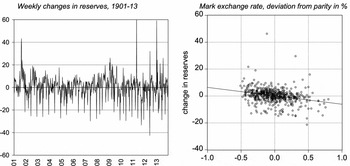
Figure 2 plots weekly changes in foreign reserves between 1901 and 1914 both over time and against the level of the exchange rate, which here is the mark as this was the most important exchange rate for Austria–Hungary. Two observations emerge. First, the level of reserves exhibits significant short-term fluctuations. Secondly, we note that contrary to the idea implicit in the standard textbook view, there is no significant increase in reserve gains or losses when the exchange rate gets closer or crosses the gold export and import points. Instead, there appears to be a broadly linear relationship between the exchange rate and changes in reserves. The OeUB tended to sell foreign exchange when the crown was trading below par and tended to buy when the crown appreciated relative to the mark. However, there are large deviations around the linear relationship, the Bank acquiring reserve assets when the crown was weak, and selling assets when the crown was strong.Footnote 19 This is in line with the suggestions by both Federn and Flandreau and Komlos that the OeUB did not commit to intervene at well-specified exchange rate levels but exercised discretion in its defence of the exchange rate parity.
Weekly reserve changes in million K vs exchange rate, 1901–13

3.3. More sophisticated instruments: transactions on the forward market
While informative, changes in reserves per construction capture spot sales and purchases and have only limited value to track forward transactions, the peculiar instrument that has so interested Federn and Einzig. The reason is technical and related to the way the balance sheet is drawn up. A forward sale or purchase does not entail any transfer of cash at the moment of contracting but only after settlement, e.g. at Ultimo of next month, depending on the stipulations of the deal. As long as the deal was not settled, reserve holdings appeared unchanged.Footnote 20 Furthermore, if the Bank decided to sell forward for the same settlement day the forward exchange it had just bought, the sale compensated the purchase and no trace of the two transactions ever showed up in the books.
Even today with access to the Bank's internal files, it is difficult to reconstruct the practice of forward interventions. A complicating factor is the highly concentrated organization of foreign exchange trading within the OeUB, sketched above. Information on reserve positions was kept within a small unit and wasn't fully passed on even to the board of directors (called the Generalrath or general council) that met on a monthly basis to set the discount rate and whose minutes are the main source on Bank policy during the period. While much more detailed than the published weekly reports, the balance sheets communicated to the Council included only current holdings but no future commitments. In a telling episode in June 1900 the secretary-general had to explain to the members of the Council why the reported foreign exchange holdings had increased although it was ‘generally known’ that the Bank had sold significant amounts in the market. He explained that the sales had been done forward and had not yet been settled (GR 423).
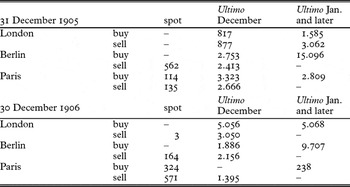
As a consequence of reporting practice, no continuous series on forward commitments can be reconstructed. However, data for some particular days have survived. All attest to the volume and variety of forward transactions undertaken by the OeUB. The most telling evidence is provided by two internal reports dated from 31 December 1905 and 30 December 1906.Footnote 21 The printed forms, entitled Devisen-Engagement Stand (foreign exchange commitment), detail the amount of cheques, banknotes and foreign coins the Bank expected to receive or was committed to pay on specific days over the coming months. Commitments resulted from both forward and spot transactions. Spot transactions were settled on the next working day after conclusion of the contract and thus also figured among commitments.Footnote 22 As the reports are from the last day of December, they allow us to compare the volume of spot transactions for one day in December with the total of the forward deals done for Ultimo December as well as outstanding forward transactions for later dates in January and February.
From Table 1 we can derive three observations: (1) The OeUB dealt in both forward and spot exchange. As far as any inferences can be drawn from two observations, it appears that volumes were sizeable in both spot and forward markets; (2) the Bank appears on both sides of the market with net sales/purchases being small relative to total volume, in particular for forward contracts, but also in the spot market. This shows that the Bank operated as a market maker; and (3) there are sizeable volumes in forward sterling and francs. This is interesting, as in the stock exchange bulletin only forward marks were quoted. Apparently, there was a complementary OTC market in sterling and francs.Footnote 23 Together these elements provide the first proof based on internal files of the OeUB for Federn's claim that forward transactions were important.
Foreign exchange commitments end of year, 1000 K

Source: Author's calculations based on BHA 263/1906 and 344/1907.
3.4. Linking the spot and forward markets: the invention of the foreign exchange repo
Outright purchases and sales of forward exchange were however not the only means of dealing in the forward market. A related tool was the already mentioned lending operations. To understand the significance of lending operations for the forward market, we have to look closer at the underlying contract. In fact, what the OeUB called Leihoperation was equivalent to a modern-day foreign exchange swap or repurchase agreement (repo): foreign exchange was sold spot under the condition of a future repurchase at a price fixed today.Footnote 24 Occasionally, the Bank also bought foreign exchange, spot selling at the same time forward. These reverse repos were carried out on a much smaller scale, however, and outstanding volumes were zero most of the time.Footnote 25
The existence of foreign exchange repos is highly interesting in itself. The operation is much more complex than redeeming notes in gold or selling foreign bills in the market and attests to the sophistication of central banks in the late nineteenth century and of the OeUB in particular. The only other central bank, for which combined spot sales and forward repurchases of securities are documented is the Bank of England, which used these repos in government debt to steer market liquidity (Sayers Reference Sayers1976, p. 38).Footnote 26 The evidence provided here on the OeUB is, however, the first to document the use of repurchase agreements in foreign exchange.
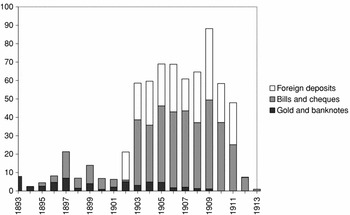
How were repos employed? The appendices to the annual balance sheet give the annual volume of business as well as the amounts outstanding on 31 December. Both behave very similarly. Figure 3 tracks the end-of-year volumes from 1893 to 1913. Clearly visible is an early experimentation period during which business remained limited in size and, until 1897, mainly in effective gold coin, i.e. the Bank sold 20 francs or 20 mark gold pieces and repurchased them forward. As already pointed out, the Bank had initiated lending in order to support the exchange rate without parting permanently with its gold and foreign exchange reserves. In this respect lending proved ineffective and so the Bank started to sell foreign exchange and gold outright from 1898 onwards. However, instead of discontinuing the repo operations as repeatedly announced in public, the Bank actually increased the amount of funds employed in lending substantially.Footnote 27 At the same time, within operations, the importance of effective gold declined, while bills, cheques and transfers became dominant.Footnote 28
Repurchase agreements outstanding end of year, million K

Clearly, repos must have come to serve a new purpose. Very likely, part of the increase in repos was related to the transfer of the foreign exchange holdings of the governments to the Bank, which will be discussed in Section 4 below. Repurchase operations were one of several possibilities for the OeUB to earn interest on the government deposits while keeping the investment short-term and liquid. Repurchase contracts, however, had an additional interest both for the OeUB and the commercial banks. By combining a spot with a forward transaction, repos were in fact the perfect tool for the OeUB to influence the forward premium, just as suggested by Federn and Einzig, as an increase in outstanding repos would drive down spot prices relative to forward rates. From the viewpoint of the commercial banks on the other hand, repos provided a well-suited instrument for international arbitrage operations. Banks lending abroad needed spot foreign exchange but also typically sought to hedge the eventual repatriation of funds by selling forward. The repos offered by the OeUB combined both operations in one. Therefore it was the central bank that provided the most convenient, and probably most cost-efficient, instrument for commercial banks undertaking interest arbitrage, as was recognized by the OeUB itself (BHA 1064/1898).Footnote 29 Surprising at first sight, the practice will appear much more natural, when the Bank's role as market maker is discussed in the next section.
After years of stable and high lending, volumes fell sharply in 1912. At the end of 1913, almost no repo contracts were outstanding. Several factors might have contributed to the decrease in repo volumes. The first were legal constraints in the form of cover requirements, which became binding after 1910. According to the Bank's statutes, notes in circulation had to be backed fully in gold, with a maximum of 60 million crowns of the metallic reserves held in foreign bills. Unbacked notes in excess of 400 million crowns, after 1910 600 million crowns, paid a tax to discourage excess issue. As long as the unbacked note issue fell short of 400 million, excess gold reserves could be invested in foreign exchange. The scope for repo operations thus depended crucially on the availability of excess reserves. While high in the early years of the 1900s, excess reserves declined when the increase in circulation forced the bank to call in gold. Excess reserves became almost permanently negative from summer 1910 onwards, forcing the Bank into increased tax payments on account of unbacked issues. While not impossible, holding a large foreign bill portfolio became increasingly costly.
Aggravating factors that may have further hampered the Bank's ability to undertake repo operations include international political tensions during the years preceding 1914. These confronted the OeUB with a double shock of high cash demand and government deficits, increasing the need for gold and reducing the foreign exchange deposits of the governments at the Bank. To summarize, at the very moment when the Bank would have needed more resources, the funds it could actually employ in foreign exchange lending and outright transactions declined. Its position as market leader was weakened and this became manifest precisely when the exchange rate of the crown declined in 1911.Footnote 30
4. The OeUB as market leader
The previous section has documented the important transformation in the way the OeUB operated on the foreign exchange markets. From occasionally exchanging foreign bills against precious metals before the 1890s, the Bank gradually extended the range of financial instruments and currencies it was dealing in. By late 1901, the Bank transacted regularly in forward markets and had introduced foreign exchange repos as a new instrument. Around the same time, the Vienna foreign exchange market itself underwent a dramatic structural transformation, as the OeUB sought and actually acquired a leading position. Contemporaries like Federn repeatedly emphasized the importance of market dominance for the capacity of the Bank to influence exchange rates.Footnote 31
From the inception of foreign exchange sales in 1898, the OeUB insisted that its position in the market had to be strengthened. Its principal concern was the significant mark and franc holdings of the governments.Footnote 32 Deposited with commercial banks, they were large enough to neutralize any intervention by the Bank, the OeUB argued (Spitzmüller Reference Spitzmüller1900, BHA 283/1906). At the end of 1897, the Austrian government kept foreign currency deposits worth about 25 million K at six Vienna banks, of which 10 million K were deposited at the Creditanstalt alone.Footnote 33 On 1 October 1901 all these accounts and transactions were transferred to the OeUB, which reduced significantly the amount of foreign deposits available to the commercial banks.Footnote 34 Further measures to concentrate gold and foreign exchange holdings at the Bank included the introduction of gold coupons (Zollgoldanweisungen) to be used in customs payments.Footnote 35 The private market for gold coin was consequently squeezed. In March 1910 the Bank entered the retail exchange business on a large scale when it extended the service of purchasing and selling foreign gold coins and banknotes from its headquarters to all of its well over hundred branch offices.
While contemporary observers generally agreed on the OeUB's ‘mastery of the market’, they offer no, or limited, quantitative evidence.Footnote 36 As earlier studies on pre-1914 foreign exchange holdings and short-term capital flows have already noted, it is tremendously difficult to obtain data on the private sector. The current and capital accounts were open and relevant transactions did not have to be reported to a government statistical office. In the published balance sheets of the commercial banks relevant items were typically pooled, so that domestic and foreign bills of exchange showed up under a common heading.Footnote 37 No series on private holdings of foreign exchange can thus be constructed.
The remainder of the section presents the best indicators we can find on the activity of commercial banks in the Vienna foreign exchange market. The indicators can be grouped under two headings, reflecting two ways we can think about market dominance, often mixed up in contemporary discussions of the topic.
First, the level of foreign exchange holdings. Foreign exchange reserves are the logical measure for a central bank's room for manoeuvre in the face of capital outflows or a speculative attack. To put the reserves of the OeUB, for which reliable data are available, into perspective, a number of indicators will be derived to get an idea on the order of magnitude of foreign assets held by the private sector. The second set of indicators concerns the share of the central bank in market turnover, a more subtle concept. Contemporary observers often noted that the OeUB appeared on either the buyer or the seller side in many deals done on the foreign exchange market (Mises Reference Mises1909a, p. 142). In principle, the turnover of the Bank in its role as market maker is independent of the stock of foreign exchange held. The advantage of frequent interaction with the foreign exchange market, however, is less evident than the advantage of large reserves. Potentially, in its role as market maker, the Bank can smooth exchange rate fluctuations, and in this case having a larger buffer stock would certainly help. Another advantage of being a market maker could be access to information. By taking part in a large number of transactions, the Bank can observe activity, the relative predominance of buyer- or seller-initiated orders, the identity of buyers and sellers and finally whether underlying transactions relate to trade or capital flows.Footnote 38 The information thus assembled was certainly of high value when assessing the economic situation and formulating policy. The two dimensions, holdings and turnover, are analysed in turn.
4.1. Concentrating foreign exchange at the central bank
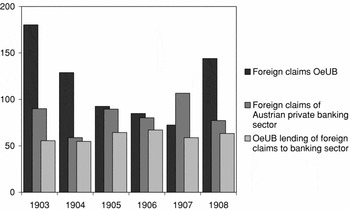
In a fortunate exception to the rule that international financial transactions in the nineteenth century are a statistical no man's land, the Austrian statistical office collected some numbers on the foreign bill holdings of commercial banks for the years 1903 to 1908.Footnote 39 The statistics were gathered from all banks in the Austrian half of the Empire; however, only bills are included, not foreign deposits. The series was discontinued in 1909. As can be seen in Figure 4, holdings fluctuated between 50 and 100 million crowns. Figure 4 also gives two measures for the relative size of the OeUB. As for the commercial banks, the OeUB series includes only foreign bills, not deposits. With the exception of 1907, the foreign portfolio of the OeUB exceeded the combined holdings of all Austrian banks throughout the years, sometimes by a large margin. The second measure for the relative size of the OeUB is the amounts of outstanding lending operations (repos). If we make the reasonable assumption that it was only or mainly banks that borrowed foreign exchange at the OeUB, a surprising dependence of the banks on OeUB resources becomes visible. Throughout the period, the total amount of foreign bills held by the commercial banks barely exceeded the amounts they borrowed at the OeUB.Footnote 40 It is evident that by reducing or increasing the level of outstanding repos the Bank could heavily influence the amount of foreign assets available for the commercial banking sector and thereby influence market conditions at least over the short run.
Foreign bills held by the OeUB and the Austrian banking sector, lending operations of the OeUB, all end of year in million K

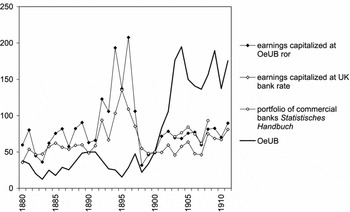
To get a longer-term perspective and to appreciate the shift that occurred in 1901, we have to use alternative proxy series. A possible indicator is earnings on foreign exchange, which is available for a sufficiently large sample of banks over a longer time span. Using an appropriate interest rate, earnings can be used to derive the average foreign exchange portfolio held during the year. Figure 5 shows the results using two different interest rates. The first capitalizes earnings using the (known) rate of return on the foreign portfolio of the Austro-Hungarian Bank, the second the average annual UK bank rate.Footnote 41 It is not clear whether earning numbers include only interest earned or also trading profits. By ignoring trading profits, the estimated holdings give an upper bound of the portfolio size. Both estimates show a significant increase in the early 1890s and a sharp decline after exchange rates stabilized in 1895.Footnote 42 If we put the numbers against the average foreign bills portfolio of the OeUB, a dramatic shift in relative size again becomes evident. Before 1901, the OeUB was one among several holders of foreign bills and deposits. The OeUB overtook the commercial banks in 1901 and soon became about twice as large as the main banks taken together. The gap only started to close somewhat towards the end of the period.Footnote 43
Estimated portfolio of a sample of commercial banks, average portfolio OeUB, in million K

4.2. The market leader as market maker
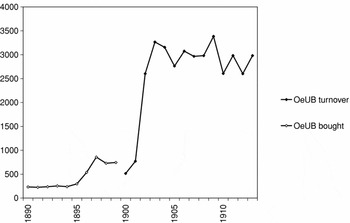
Getting numbers on the volume of foreign exchange transactions is even more hazardous than on assets. Between 1890 and 1898, the OeUB published figures on the total sum of foreign exchange acquired during the calendar year. From 1902 onwards, a series for turnover (‘Umsatz in Devisen und Valuten’) is available.Footnote 44 Similarly named series were also published for several private banks, although the series don't necessarily overlap in definition.
Before comparing the commercial banks with the OeUB, the new policy of the OeUB already becomes clear by looking at OeUB turnover alone (Figure 6). A visible increase in 1896 was followed by an explosion in transactions again after 1901. The transfer of the government accounts – equivalent to an annual turnover of about 250 to 300 million crowns – played a role but can account for only about 10 per cent of the increase in market activity of the OeUB. Clearly, the OeUB actively strived to increase its involvement in the foreign exchange market.
Turnover in foreign exchange, million K

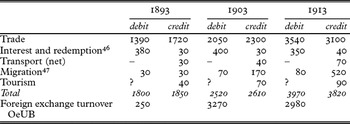
One way to put turnover at the OeUB into perspective is by looking at the overall volume of transactions with foreign countries derived from the current account. Table 2 gives an overview of the payments Austro-Hungarian residents made and received over three benchmark years.Footnote 45
Austro-Hungarian current account in million K

Sources: K.k. Finanz-Ministerium (Reference Finanz-Ministerium1903–6), Bartsch (Reference Bartsch1916).
As can be seen in Table 2, by 1903 foreign exchange transactions at the Bank exceeded the sum of all payments on current account. Of course, short-term capital movements are not included in these numbers, but the size of the OeUB appears impressive in any case. The share of the Bank declined in the following decade, as turnover fluctuated around three billion crowns while foreign trade rose by 75 per cent and remittances from migrants became an important item on the credit side. Nevertheless, the Bank remained an important player up to 1914.
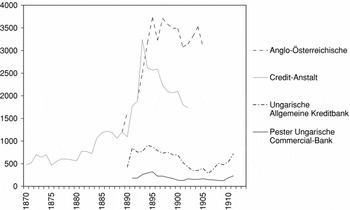
What about the commercial banks? Figure 7 shows turnover for a number of Viennese and Budapest banks that have published data for selected years. As has been noted, it has to be kept in mind that there is no common definition of turnover, so that the comparison of the levels of the series should not be taken too far. Looking at trends, we see a steady increase in turnover until the early 1890s, broadly in line with the increase in foreign trade, an explosion in activity around the stabilization and the passage of the gold standard laws in 1892, followed by a period of stagnation or decline. Only at the end of the period, after 1910, do turnover volumes seem to have increased again. The weak performance of the banks after 1895 is all the more significant as one of the underlying drivers of foreign exchange transactions, trade, continued to increase. At the same time, the OeUB entered the scene, taking market share from the commercial banks.
Turnover in foreign exchange, selected Austro-Hungarian banks, million K

To sum up, on both dimensions of market dominance, the OeUB scored high from 1901 onwards. Foreign exchange assets of the commercial banks pale in comparison to the reserves of the OeUB. At the same time, the OeUB lent the banks significant amounts of foreign assets that could be extended or withdrawn in order to influence market prices. In addition, the OeUB became the central market maker and counterpart in a large share of deals in the Vienna foreign exchange market.
5. Did it matter? Repo operations and the rise and fall in market efficiency
Sections 3 and 4 have provided critical empirical evidence documenting the introduction of new instruments by the Bank and its drive to dominate the Vienna foreign exchange market. Having answered the question of the ‘how’ leads directly to two related questions, first, ‘did it matter’, and secondly, ‘why’, i.e. what were the reasons that motivated the OeUB to opt for such a complex strategy and sophisticated operational procedures.
Given the focus of the OeUB on changing the structure of the foreign exchange market, a natural way to assess the impact of its operations is to look at the functioning of the market itself. One possible indicator is market efficiency. In fact, Flandreau and Komlos (Reference Flandreau and Komlos2006) document marked changes over time in the efficiency of the market for forward German marks in Vienna. The evidence has to be seen against the background of studies on contemporary forward markets, which typically find markets to be inefficient: forward rates predict future exchange rates badly and in some cases even point systematically in the wrong direction (see e.g. de Grauwe Reference De Grauwe1996, pp. 156–8; Flood and Rose Reference Flood and Rose1996). As nowadays, Flandreau and Komlos don't find market efficiency for most of the years between 1876, when forward quotes for the mark appear for the first time in the Viennese financial press, and 1914. During the last subperiod, August 1901 to July 1914, however, markets appear clearly efficient.
The evidence of Flandreau and Komlos is derived from testing Fama's (Reference Fama1984) simple test of the predictive power of forward market rates:

where st is the log spot rate at month t, ft the log forward rate quoted at month t for delivery at t + 1 and νt is a random shock. Efficiency in the forward market implies that there is no systematic bias in the prediction of future exchange rate changes: β = 1 and α = 0, if investors are risk neutral. The authors then estimate equation (1) for several subperiods – motivated by political and institutional changes. As already mentioned, the hypothesis of β = 1 and α = 0 can not be rejected for the last 13 years before World War 1.
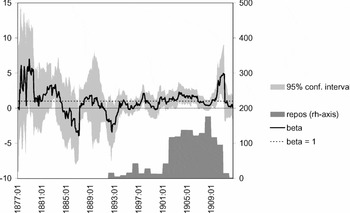
Can this change in market behaviour be linked to changes in OeUB operations? To better track the predictive power of forward rates over time, I reran their equation (1) but looked at moving two-year windows instead of using exogenously set cut-off dates.Footnote 48 The results for β are plotted in Figure 8 along the 95 per cent confidence interval.Footnote 49 As can be seen, efficiency increased in fact markedly in 1901, right around the cut-off point chosen by Flandreau and Komlos. The confidence interval around β becomes relatively tight and centred around 1. Afterwards the estimated β was not always equal to one, but always positive, meaning that on average the forward rates predicted at least the direction of future changes in the exchange rate correctly. After 1910–11, however, efficiency deteriorated markedly. β started to behave increasingly randomly and was essentially zero for the final years 1912–14. The moving-window regression clearly suggests that the period 1901–14 in fact should be considered as two periods, one from 1901 to 1910 of high efficiency, followed by a breakdown in efficiency between 1910 and 1914.
Moving window regressions of Fama efficiency test, β with 95 per cent confidence intervals

Interestingly, the chronology of market efficiency conforms very well with the position of the OeUB as market leader. Alongside the estimates for β, Figure 8 also shows the level of outstanding repo contracts, taken from Figure 3 above and lagged by a year to match the two-year regression window. Repo volumes, an indicator for the involvement of the Bank in foreign exchange markets, increased strongly in 1901/2 and dried up from 1911/12 onwards. Efficiency rose and declined in line, suggesting that the high level of market efficiency between 1901 and 1911 owed something to the active role of the Bank at the intersection of spot and forward markets.
As we have seen in Section 3, while the Bank had actively sought to achieve market dominance in the early 1900s, a series of exogenous shocks after 1911 reduced the resources available to the Bank, legal restrictions on reserve composition became binding and as a result the OeUB was forced to scale back its repo operations. The position of the market leader was lost, and the market reverted to the kind of behaviour exhibited before 1901.
6. Why? Some hints from modern central bank practice
While the coincidence of a change in structure of the foreign exchange market with a change in its performance is interesting in itself, it does not answer the question of the ‘why’ from the point of view of the OeUB. In fact, observations by contemporaries, the practices of other central banks as well as economic theory suggest various interpretations that are consistent with the observed actions of the Bank. Instead of attempting to provide an exhaustive portrait, which would anyway go far beyond the scope of an article, the following section will focus on two specific aspects of OeUB policy: (lack of) transparency in foreign exchange operations and repurchase operations, both of which will be put into the perspective of current central bank practice.
6.1. Constructive ambiguity
We have seen that the OeUB kept a veil of secrecy around some key elements of its foreign exchange policy. While the defence of the gold parity was clearly the ultimate objective, the Bank never committed to any specific prices at which it would unconditionally sell or buy foreign exchange. Ex-post disclosure of foreign exchange intervention was also limited. As described in Section 3, the weekly published financial statements contained only certain parts of the reserve assets, making it very easy to hide operations among other items in the balance sheet. While OeUB transactions in the Vienna foreign exchange market could in principle be observed by counterparties, the Bank disposed of additional means to reduce the visibility of operations, if it wanted to. After 1901 the Bank considerably expanded its network of correspondent banks in foreign financial centres, which in 1913 encompassed eleven partner banks in London and Berlin and nine in Paris.Footnote 50 Using this network, the Bank could conceal transactions by passing through third markets, by using foreign accounts or shipping gold itself instead of selling it in Vienna, without any of this information coming directly to the attention of the Viennese banks.
What are the reasons for opacity when policy was ultimately founded on the credibility of the peg? Today a lack of transparency in central bank operations is often rationalized under the term of ‘constructive ambiguity’, i.e. ambiguity that is intentionally created. The mix of transparency about the objectives (the exchange rate target) and opacity about intervention tactics (what triggers intervention, like maximum/minimum tolerated exchange rates) as well as limited visibility and disclosure of interventions (both real-time and ex-post) that can be observed for the OeUB is not too much unlike what central banks do today (Chiu Reference Chiu2003). Although practices vary and there are theoretical arguments both against and in favour of transparency (Geraats Reference Geraats2002), central bankers nowadays seem to concur that a degree of ambiguity, not on intervention objectives, but on intervention tactics, is useful. One reason is that central banks are big players, or at least players that influence market prices and want to avoid being perceived as distress buyers or sellers. In regimes with predetermined bands there is the additional risk of one-sided bets, which can lead to the quick build-up of speculative positions at the edges of the band.Footnote 51 It seems reasonable that policy then responded to similar concerns.
6.2. The management of the domestic money market
This brings us to the second point, repurchase operations. So far, repos have been discussed only within the context of the foreign exchange market. By definition, however, repos (as well as outright foreign exchange sales/purchases more generally) have a counterpart in domestic currency and thus influence conditions on the domestic money market and domestic interest rates. The preceding discussion has focused on the foreign exchange market; yet both foreign exchange and domestic monetary operations act in the end on the same lever and have to serve the same ultimate objective, which is the defence of parity.
The link to domestic liquidity conditions might provide a complementary interpretation of repurchase operations.Footnote 52 The key challenge for central banks in monetary policy implementation is to influence the interest rate(s) that are relevant for the agents in the economy (Bindseil Reference Bindseil2004). Lowering and increasing the official policy rate alone is not enough, if market rates do not move accordingly. Occasional complaints about ‘too easy conditions in the money market’ suggest that the OeUB at times had difficulties in influencing market interest rates and thereby capital flows and foreign reserves and ultimately in achieving its exchange rate objective.
In modern terms the issue can be stated as follows. The banking sector has to be short in liquidity so that banks are obliged to borrow at the central bank and thus at the policy rate, which through arbitrage is transmitted to the money market as a whole. Nowadays central banks dispose of a variety of techniques to create a structural liquidity deficit, mainly through imposing minimum reserves or selling or issuing securities to the market (Borio Reference Borio1997). The techniques of nineteenth-century note-issuing banks evolved slowly in the direction of modern central banking. Throughout the nineteenth century, the Bank of England experimented with various ways of ‘making bank rate effective.’ As early as the 1870s, it employed open market sales and repurchase operations in government securities to drain liquidity from the market, pushing up the market interest rates towards bank rate and thereby forcing the banking sector to borrow at the BoE (Sayers Reference Sayers1976).
In the interest of smooth implementation, the central bank will choose an instrument with a liquid market that can be easily sold without distorting relative prices. In England, treasuries were an obvious choice. In Austria–Hungary, foreign exchange repos maybe constituted a superior alternative, as international arbitrage linked the big banks closely to money markets in London, Paris and Berlin. Management of domestic monetary conditions, domestic interest rates and thereby short-term capital flows and the exchange rate, potentially provided an additional rationale for the OeUB's foray into foreign exchange repurchase operations.
To sum up, in both disclosure policy and the set-up of foreign exchange repurchase operations, the practices of modern central banks can be used to make sense of the motivations of its historic predecessors. In interesting respects, central banking back then appears not too unlike central banking today. Lessons may go both ways.
7. Conclusion
The article has presented fresh archival material to understand how central banks managed exchange rates under the gold standard. While the literature on the gold standard extensively discussed discount rate policy, the objectives and techniques in operations in reserve assets, be they gold or foreign exchange, have remained underexplored. The article looked at the example of the central bank of Austria–Hungary. The picture that emerges is resolutely modern.
The OeUB disposed of a highly sophisticated tool box, including not only operations on the spot market but equally forward interventions and foreign exchange repurchase contracts, whose use is for the first time documented for a nineteenth-century central bank. The article also points to the attention given by the Bank to the structure of the foreign exchange market and its own position within. The OeUB sought to dominate both with respect to resources held and its share in daily market turnover. The shift in policy coincides with and mostly likely caused the change in the way the Vienna foreign exchange market operated that occurred roughly around 1901/2. In particular, the increase in market efficiency combined with high credibility of the peg led to stabilizing speculation, in turn supporting the conduct of monetary policy.
Several elements appear crucial to the policy of the OeUB: the role of market maker, reducing exchange rate volatility and enhancing forward market efficiency, the strong commitment to parity combined with a degree of ambiguity about the exact moment of intervention to discourage one-sided bets, the use of innovative instruments linked to the specific characteristics of the Vienna foreign exchange market, like the presence of developed forward markets and high degree of international integration, and finally the dominating position relative to the commercial banks. All these elements underscore the importance of the structure of financial markets for the conduct of monetary policy.
The results give a clear direction for future research, which should try to bring together more case studies on foreign exchange operations in order to develop a more systematic and comprehensive perspective. There are some obvious candidate countries like Spain or Italy, which were also shadowing the gold standard in the same period. Reis (Reference Reis2007) and Esteves et al. (Reference Esteves, Reis and Ferramosca2009) present intriguing evidence on the Banco de Portugal. But even the central banks of major countries like the Reichsbank invested in foreign exchange and the Banque de France on occasion managed the liquidity needs of the big French banks by buying sterling bills in the market (Bopp Reference Bopp1954; Flandreau and Gallice Reference Flandreau, Gallice, Cassis and Bussière2005). A fascinating field is open there.
Acknowledgements
The views expressed in this article are those of the author and do not commit the Oesterreichische Nationalbank. I would like to thank the participants in the Third Past, Present, Policy conference in Genoa and in particular the editors Barry Eichengreen and Marc Flandreau, as well as Claudio Borio, Isabel Schnabel, Nathan Sussman, Stefano Ugolini and an anonymous referee for crucial comments. For valuable suggestions on earlier versions I am grateful to Vincent Bignon, Larry Neal, Jaime Reis and Lucio Sarno. Walter Antonowicz and Bernhard Mussak facilitated access to the historical archives of the Austrian National Bank. The responsibility for errors and misinterpretations remains mine.
Archives, regular statistical publications and periodicals
ÖStA: Österreichisches Staatsarchiv, Austrian National Archives, Vienna.
BHA: Bankhistorisches Archiv, Bank history archives, Oesterreichische Nationalbank, Vienna.
Documents are organized in files, identified by the year of creation and a consecutive number within each year.
GR: minutes of the General Council (Generalrat) with number of session.
Annual reports
Balance sheet files
Amtliches Coursblatt der Wiener Börse
Compass
Oesterreichische Volkswirt
Österreichisches statistisches Handbuch für die im Reichsrathe vertretenen Königreiche und Länder.
RGBl.: Reichsgesetzblatt