Introduction
This article discusses the role that statistical classifications play in creating gendered boundaries in the world of work. The question that is posed is to what extent women’s work in the family business was accounted for within the International Labour Organization (ILO) occupational statistics during the twentieth century, and how this categorization has changed in a broader global context. Conceptual and social boundaries flag ‘the social territories’ of belonging, in which the distinctions between market-related and home-related work are among the most salient.Footnote 1 We argue that statistics have a particular hand in these social processes. Statistical divisions generate patterns of difference and similarity as their objectifying procedures sort disparate things into classes under particular headings – things that only acquire a common or different meaning through this very process of categorizing and aggregating operations.Footnote 2 What can be known about work-related gendered boundaries is constantly objectified and visualized in statistical figures, which produce and reproduce the arrangement of the sexes.Footnote 3 The establishment of the occupational statistics itself poses a structural turning point for the gendered coding of home and work around 1900. An observational grid was institutionalized that restricted the modern economic understanding of work – closely interwoven with gender classification – to market-mediated, gainful employment.Footnote 4
Over the last decades, research in official statistics and gender history has elaborated on these transformations. When, around 1900, a country’s population was divided into occupied and non-occupied people, according to Christian Topalov a revolution in the representations of work took place. A strictly individualistic and market-oriented formalization of occupational activity emerged, while domestic work became classified as unproductive.Footnote 5 According to Silvana Patriarca, as a part of these processes, ‘the rising numbers of “housewives” and the masculinization of the “active” population’ converged.Footnote 6 Regarding the United States’ census, Nancy Folbre and Marjorie Abel demonstrate how labour was designated ‘as “market work” that literally devaluated women’s unpaid work within the home’.Footnote 7 Likewise in the British, German, Italian, and French censuses, wives, daughters, sisters, and mothers, together with children and young people living and working at home without pay, were excluded from gainful work.Footnote 8 Closely connected to those new representations was the advent of the notion of the ‘breadwinner’.Footnote 9 Before the late nineteenth century, the idea of ‘an individual male breadwinner supporting his family was unfamiliar’.Footnote 10 In 1910, however, for Alba M. Edwards, the head of the US Statistical Bureau, ‘occupation became the all-purpose indicator that could describe the total life experience of a worker and his family’.Footnote 11 Hence, cultural assumptions about the status of male and female individuals, as well as beliefs in appropriate gender roles, infused the statistical reasoning in Europe and North America. At the beginning of the twentieth century, the terminology of the ‘unproductive housewife’ represented this division of productive and non-productive work, while defining married women as dependants of their gainfully working husbands. Women’s housework became invisible, and their participation in market-related work was also underestimated.Footnote 12
Against this backdrop, one thread in gender research is concerned with the underestimation of women’s paid and unpaid labour in official statistics by illuminating its impact on the rendering invisible of women’s work. Since Marilyn Waring’s ground-breaking research on the counting of women in the United Nations’ System of National Accounting, the ways of making women’s work invisible have become a subject of attention for feminist economists.Footnote 13 Another strand in gender and global labour scholarship focuses on the various types of work that women have carried out within the home as a workplace. Home-based work located in the space of family, in the dwelling, ‘brings the wage into the place where “love”, “duty”, and “need” … compel labour’.Footnote 14 When the revolution in the representations of work took place, the homeworker was seen as an ‘inefficient producer’ and work in the home as itself ‘an out-dated mode of production’.Footnote 15 Nevertheless, work in the home constitutes a significant part of today’s global economy, spanning the garment industry from Rio de Janeiro to Zapotlanejo and from Iran to Java,Footnote 16 as well as homeworkers who ‘roll cigarettes, weave carpets, peel shrimps, prepare food, polish plastic, process insurance claims, edit manuscripts, and assemble artificial flowers, umbrellas, and jewelry’.Footnote 17
Surprisingly, neither gender and global labour research nor scholarship on official statistics has addressed ‘family work’ to date. The work of spouses and children in family enterprises, including small firms in urban and rural contexts,Footnote 18 has received hardly any attention in those research fields.Footnote 19 This article proposes to fill that gap by exploring ‘family work’ through the lens of occupational statistics.
The term ‘family worker’ initially became a statistical category in various Western national statistics around 1900. From the 1930s onwards, it was introduced in ILO employment statistics. By 1938, the League of Nations had adopted ‘family worker’ as an international category of the ‘gainfully occupied population’ to facilitate international comparability. After the Second World War, the term ‘family worker’ was established as a category of the ‘labour force’ in ILO statistics; since then, it has been extended to the wider world by way of the UN System of National Accounts (UNSNA).
Unlike terms indicating the home, the household, and the domestic, ‘family work’ explicitly relates to the family, insofar as it is work for the economic gain of the family. The respective work is enacted by daughters, sons, sisters, brothers, and wives, and by both young and old, although in Europe, since the late nineteenth century, women have made up the majority of family workers.Footnote 20 Today, women are globally expected more than men to be ‘contributing family workers’.Footnote 21 Both in the past and today, the very intermingling of ‘family work’ with labour activities within and without the household transgresses the division between ‘active’ and ‘passive’ populations.Footnote 22 The following sections will systematically explore the statistical term ‘family work’, so as to examine gendered classifications of work.
By studying ‘family work’ as an international statistical standard, this article aims to accomplish a second objective. To date, the formation of national occupational statistics from the nineteenth century to the First World War, together with the ascent of ‘gainful work’, has been extensively explored.Footnote 23 In contrast, international statistical classifications have been underestimated to this day. Nevertheless, these classifications provide conceptual elements for observing the world from a global perspective by making categories comparable on a worldwide scale. In the field of work, the ILO claims to be the major actor in providing data on the global labour force and defining legitimate definitions of world labour problems. From its inception in 1919, the ILO has focused on the international comparability of statistical classifications, including that of the ‘family worker’.
During the last few years, there has been a drive to recover and reposition the local perspective both within and between the level of the transnational or the global – whether from the perspective of relativizing reference systems and of entangled global history, or through the lens of a so-called world culture, to name just a few.Footnote 24 Within this still growing scholarly field, international statistical classification forms an intriguing research object to explore, investigating the extent to which shifting meanings of work and gender occur at a transnational level. These questions form an analytical challenge for historians and sociologists alike. By exploring statistical classifications, one obtains an empirical insight into how and by which particular means various phenomena become ‘globalized’.
This article proceeds in three parts. The first section is dedicated to the conceptual framework. The emergence of ‘gainful employment’ as a standard in national statistics around 1900 illustrates the distinct capacity of statistics to make things comparable by transcending spatial and cultural differences, thereby creating new lines of division between ‘active’ and ‘passive’, between business and household. Next, the article argues that the ILO as an international organization established the global world of work as an object of knowledge, and thereby created its object in a specific way. Both the statistics’ particular capacity and the nature of the ILO contribute to the argument that comparability works as a mechanism of globalization, since it encourages ‘cultural links’ between previously unconnected entities worldwide.
Against this background, the second empirical section is concerned with the ILO labour statistics from the interwar period to the 1980s. First, the evolution of the ILO into a centre of production of labour standards and comparable labour statistics is examined. In this context, the ILO strived to establish ‘family work’ as an international category within the colonial framework of European empires. Based on these findings, attention is directed to the international reconstruction after 1945, during which ‘family work’ became a category in the ILO labour force concept, which, in turn, was embedded within the UNSNA. This contribution is based on original empirical research on ILO labour statistics from the interwar period to the early 1980s.
The empirical sections indicate that the boundaries between productive and unproductive work, between household and (family) business, are under constant negotiation. Through the sharing of rules for classification, this communication also crosses oceans and continents. The final section discusses these empirical results with respect to long-term historical changes in the classification of family work. Here it is argued that the notion of gainful occupation was opened to unpaid family workers during the twentieth century, whereas the distinction between family work and housework was increasingly fixed as a fundamental boundary. The negotiation and reinterpretation of family work at the international level is an indication of the worldwide relevance of ILO categories, which contribute to a global discourse on the boundaries of market and home, and, as such, on the social status of women and their income.
Conceptual framework: how statistical classification fosters globalization
In order to explore global processes of communication and connectivity, one must demonstrate how ‘something’ is globalized, namely how far the meaning and social organization of something is altered by being globalized, and which kind of social mechanism enables this process.Footnote 25 According to John W. Meyer and David Strang, cultural linkages, such as abstract categories and generalized models, have the capacity to connect social unities. This implies that ‘the cultural understanding that social entities belong to a common social category constructs a tie between them’.Footnote 26 As the transnational campaign ‘Women against violence’ demonstrates, the concept of gender-based violence ‘had to be constructed and popularized before people could think of these practices as the “same” in some basic way’.Footnote 27 Once categories such as ‘gainful work’ become institutionalized and taken for granted, they can provide a basis for perceived ‘similarity’ and, thus, for global linkages.Footnote 28
The sciences and professions are crucial in this because they reverse local or scattered rules into generalized and more universal models. By defining and constructing ‘social entities as comparable’, they anchor general categories such as gender and work into organizational structures like those of the ILO.Footnote 29 Statistical classification plays a crucial role in these processes. As a mode of making things objective (objectivation), statistical categorization triggers formal and scientific patterns for ordering and managing social relations (scientization) in the modern world.Footnote 30 As with legal categorizations, statistical ones produce new relations of equivalence and terminologies ‘that transcend the singularities of individual situations’ through norms and standards.Footnote 31 As Bettina Heintz suggests, statistics have the distinct capacity to make things comparable by classifying them under the same category and comparing them according to particular criteria of difference. By doing so, they also connect categories that have not previously been related to one other.Footnote 32 According to Wendy N. Espeland and Mitchell L. Stevens, before objects can be made commensurate, they must be classified in ways that make them comparable.Footnote 33
Statistical numbers appear impersonal – that is, fair and objective – because ‘quantification is a way of making decisions without seeming to decide’.Footnote 34 Such decisions can in turn be referred to in an unnoticed manner. By producing and communicating numbers that transcend individuality and local context, statistics can span spatial and cultural distances and be ‘used to coordinate activities and settle disputes’.Footnote 35 If the categories of classification are broadly agreed, commensuration may appear to be a simple matter of specifying incremental differences between otherwise similar units.
As a scientific object, family work allows one to observe the troublesome practice of making things comparable, namely its ‘active construction of both similarity (through lumping) and difference (through splitting)’.Footnote 36 Research on the classification of women’s work in national occupational statistics around 1900 emphasizes the splitting of the statistical category ‘gainful employment’ from domestic work. The imposition of gainful employment as the standard and legitimate way of working – as opposed to former or alternative practices – was reinforced by patterns of gender difference and new representations of familial community, among them ‘the separation of home and workplace’.Footnote 37 In fact, this new definition represented a tremendous shift, as labour activities were now to be attributed to the private, reproductive, and/or familial sphere, thus making them statistically invisible.
Around 1900, national statisticians faced the challenge of documenting the emerging industrial world with the help of general classification schemes. The attempt to identify a ‘personal occupation’ generated ‘a representation of occupational activity’ by which every single individual was to be measured and ‘attributed with one and only one occupation’.Footnote 38 According to Christian Topalov, in the case of French, US, and British censuses, ‘the criterion for categorization was thus no longer the nature of the work done, its utility or dignity, but whether or not it was marketable. The statisticians’ choice ran up first of all against the way in which domestic economies were organized and dominant representations of gender relations within the family.’Footnote 39
For the first occupational census of the German empire, in 1882, the people of the diverse federal states were sorted according to the criterion of their participation in gainful work. Wages became a core attribute of the ‘modern’ (as it was then called) definition of earning, now conceived as ‘gainful’ employment. Family members (including wives) not engaged in any occupational activities were considered ‘passive’ and classified as ‘dependent’ upon the ‘gainful employed person’, namely the head of the household.Footnote 40 With respect to their occupational status, wives and children working in the business of the head of the household (mostly in agriculture and handcrafts) were categorized as ‘family workers’ (from 1895 on), and therefore recognized as part of the ‘gainful’ population – despite being unpaid. Between 1882 and 1925, German family workers were classified under the umbrella category of ‘workers’. The 1925 occupation census removed them from this category and created a separate one in order to take their ‘specific’ position between dependent and independent workers into account.Footnote 41 Silvana Patriarca shows how the Italian census of 1901 similarly introduced new categories in order to differentiate more rigorously between ‘factory workers’, ‘independent artisans’ (including workers in the textile industry in southern regions), and ‘workers in domestic industry’.Footnote 42 Thus, in Italy as well as in Germany, the ‘working class’, involved in gainful employment, was created as a statistical scale by means of which other classes had to be ordered.
By 1861, the British census categorized both paid domestic servants and wives and children performing household work in the same class (‘Domestic class’) but, at the same time, separated them into two distinct ‘Orders’.Footnote 43 Just as in the German census, wage-earning thus appears to have been a legitimate criterion of distinction, though a secondary one. By the 1881 census, structures had changed drastically: unpaid household work was no longer classified as an occupation, whereas paid domestic workers, external to the family, continued to be registered in the domestic class, as were family workers.Footnote 44 The 1911 census instructions indicated: ‘The occupations of women engaged in any business or profession, including women regularly engaged in assisting relatives in trade or business, must be fully stated. No entry should be made in the case of wives, daughters, or other female relatives wholly engaged in domestic duties at home’.Footnote 45
In the US context, congressmen and statisticians emphasized the political usage of categories: ‘individuals who were not part of the political universe were also not part of the occupational universe in census terms. Free colored men, women, children, and slaves might do a great deal of the work of the society, but they had no political rights which Congress had to attend to or represent.’Footnote 46 Thus, ‘“unwaged housework”, women’s and children’s contribution to a family business, or “volunteer work” were not included in occupational statistics or classifications’;Footnote 47 they were categorized, but they were not recorded sufficiently in practice in the 1870 US census.Footnote 48
These emerging standards were lumped with a broad spectrum of livelihood activities, the ‘domestic’ and familial sphere. Consequently, the generalized model of employment was based upon the incommensurability of people working for domestic and familial purposes and those working to earn their living in an enterprise. This dynamic of making work categories comparable resulted in the institutionalization of a strict differentiation between housework and gainful employment in occupational statistics. Against this background, the specific position of unpaid family workers constituted a challenge for the statistical classification scheme, as they were positioned at the juncture between family and business, between household and enterprise. For the social ordering, this category served as a kind of playing field to differentiate between home and market-related labour.
The new representation of work spread to different national contexts, constituting different paths, but ‘to the same convention’.Footnote 49 The boundary object of housework formed the basic line of distinction across national differences. The category of family work figured in these processes as a kind of Janus face, highlighting market-related work while concealing housework.
Converting family workers to an international standard classification during the interwar period
After the First World War, the ILO was established as a unique international organization to address social problems, in particular labour relations and standards at international scale. To this day, the ILO’s standard-setting system provides conventions, recommendations, and declarations. As opposed to other international organizations’ measures, the ILO’s standards are negotiated in the distinctive model of tripartism, namely the participation of the representatives of both workers’ and employers’ organizations in its decision-making structure.Footnote 50 The ILO was established and dominated by the European powers, particularly the British empire, and thus was deeply entrenched in the colonial system of the twentieth century.Footnote 51 Equally, however, it belonged to those international organizations that formed a laboratory for ‘technical internationalism during the interwar period’.Footnote 52
During the second half of the nineteenth century, this ‘statistical internationalism’ attempted to elaborate methods and uniform measures.Footnote 53 It was the International Statistical Congress (1853–78) that aimed to standardize remuneration methods, time references, and key categories.Footnote 54 During its Congress in 1878, a classification of occupations was circulated but not adopted. Some ten years later, the French statistician Jacques Bertillon proposed ten major categories covering all occupations and their ranking at the session of the International Statistical Institute.Footnote 55 Meanwhile, the International Association for the Legal Protection of Workers was aware that statistics would confer authority on their activities, since they represented scientific legitimacy. Hence, at the turn of the century, an awareness of the need for comparable labour statistics and their scientific authority existed among statisticians and social reformers. However, the lack of an international organizational structure armed with international expertise narrowed those efforts.Footnote 56
Founded in 1919, under the umbrella of the League of Nations,Footnote 57 the ILO was created as a permanent international organization, on the principle that ‘lasting peace can only be established if it is based on social justice’.Footnote 58 This constitution included ‘the collection and distribution of information on all subjects relating to the international adjustment of conditions of industrial life and labour’, in particular ‘with a view to the conclusion of international conventions, and the conduct of such special investigations’.Footnote 59 The ILO was also authorized to standardize labour-related questions on an international scale, and to create internationally comparable labour statistics, thus becoming the ‘producer of knowledge and international social standards’.Footnote 60 The Statistical Section of the International Labour Office formed the ILO’s central measurement agency. In 1923, the International Conference of Labour Statisticians (ICLS) began convening to provide national statistical administrations with guidelines for the definition of concepts and the methods of data collection. In the second part of the twentieth century, both the ILO and the ICLS became powerful global actors in the fields of labour law and labour statistics.
During the interwar period, the ILO legal instruments did not overcome gendered distinctions regarding work and the idea of individual, gainful employment, including the category of the (male) breadwinner.Footnote 61 In the field of statistics, the organization was predominantly concerned with (male) industrial wage earners in Europe, particularly with respect to the social risks of unemployment, the cost of living, and family budgets. This focus was indicated by a restrictive understanding of employment that excluded domestic work as such.
ILO statisticians were challenged to make comparable national statistical terminologies that were extremely diverse with regard to language, instructions, criteria, definitions, categories, and methods. How did they cope with that? The Year-books of labour statistics (published from 1935–36 onwards) document this practical task of generating the ‘gainfully occupied’ population as an object within an international context. Every single preface of the Year-book is dedicated to this endeavour. With each country’s ‘original terminology having been respected as far as possible’, the tables are based on various national definitions and display many ‘inevitable differences’.Footnote 62 In addition, it is emphasized that discrepancies exist in the categories ‘of females gainfully occupied, even more influenced by differences of definitions’, as well as in the treatment of unpaid family workers compared to the categories of male workers.Footnote 63 The gainfully occupied comprised those engaged in remunerative work, including employers, persons working on their own account, and the ‘employed’.Footnote 64 The ILO simultaneously incorporated unpaid family workers as far as national data was available, but did not provide an internationally comparable definition for bridging the different usages and notions.
This is clearly evident in the comments that were provided on the tables in the Year-books from 1937.Footnote 65 The notes indicate which tasks are lumped into which categories. For Germany, the category of employer covered ‘manager und higher officials’, and for the United Kingdom ‘directors and managers’, whereas the equivalent French category also included ‘wives of heads of establishments who assist their husbands’.Footnote 66 Thus the work of spouses was incorporated into the status of the head of the household or rather of the husband, whereas the column for unpaid family workers was left empty.Footnote 67 The comment concerning Italy makes the unevenness within the national nomenclature itself visible: ‘No distinction of unpaid family workers by industrial status is given, but for fishing, industry, transport and communication and commerce the figures for each industrial status include the unpaid family workers belonging to it.’Footnote 68 The category of unpaid family workers (where they were counted at all) embraced different branches, sectors, and trades.
Unlike the ILO, the League of Nations Economic and Financial Organization took a crucial step toward international comparability. The International Convention relating to Economic Statistics (1928) provided an initial framework for compiling statistics of external trade, occupation, and various branches at regular intervals (Articles 1 and 2).Footnote 69 Later on, the report on the ‘Statistics of the Gainfully Occupied Population’ (1938), by the Committee of Statistical Experts established the definition of family workers as part of the gainfully occupied population.
The League did not expect member states to change the overall system of their censuses in order to comply with an international standard.Footnote 70 Instead of encompassing the entirety of all the categories, the Committee of Statistical Experts commenced from the premise of an ‘international minimum programme’.Footnote 71 The committee proposed facilitating international comparability by introducing a selective set of distinct classifications to overarch the national nomenclature.Footnote 72 Accordingly, member states would deliver a supplementary table to their census figures to the League without the requirement to adjust their categories to the international nomenclature. This endeavour implied a decisive step toward international standards.
Since the International Convention relating to Economic Statistics included statistics of occupation, a definition of gainful occupation was required. This international definition embraced a broader scope: ‘any’ principal or secondary occupation that was remunerated, ‘directly or indirectly, in cash or in kind’ was to be considered ‘as a gainful occupation’.Footnote 73 Thus, gainful occupation would no longer be restricted to direct remuneration in cash or kind. Housework ‘done by members of the family’ was not incorporated, ‘but work done by members of a family in helping the head of the family in his occupation is so included, even though only indirectly remunerated’.Footnote 74 The total population was perceived as gainfully or non-gainfully occupied. Among the first group, members of families were discussed separately, namely, the wives of farmers, wives of persons other than farmers, other members of the families, other members of families of persons other than farmers.Footnote 75
For the first time, an international vocabulary for occupational status was introduced for family workers: ‘Members of families aiding the heads of their families in their occupations’.Footnote 76 This definition served a twofold aim. First, by relating family work to the occupation of the head of the family, it was distinguished from housework. Second, the definition served to specify the category of ‘employers’, covering among others: ‘Persons working on their own account, either alone or with the assistance of members of their families’.Footnote 77 Similarly, this distinction contributed to the classification of family work both as a personal status and as an individual occupation within the establishment as part of a branch.Footnote 78 Each chapter of the three classifications was to be subdivided by sex, age, and marital status.Footnote 79 Just as in the national census, in the international nomenclature housework was fixed and reaffirmed as the boundary to market-related work. The adaption of this scheme was, however, nullified through the war that was to come in 1939. Then, during the transition from a war economy to a peace economy, the League’s scope and concept entered the purview of ILO statisticians readdressing the issues raised before the war.Footnote 80
The place of ‘family workers’ within the ILO labour force concept and the UN System of National Accounts after 1945
After 1945, an ‘explosion in the demand for data’ took place.Footnote 81 The hunger for statistics resulted from the need for both economic and social reconstruction. New statistical instruments and economic models were able to perceive social inequality at a worldwide range and to realize the degree of economic disparity.Footnote 82 As the ‘Report on economic development’ to the thirty-third International Labour Conference read: ‘If the world is no poorer today than it has been in the past, it is more conscious of its poverty. … “any improvement in the economic conditions … postulates an increase in national wealth: a mere redistribution of existing wealth would make no essential difference to the people and would merely mean the redistribution of poverty”.’Footnote 83
Both economic policies and employment and unemployment policies were considered crucial for increasing wealth and for changing social inequality in the former colonies and the emerging new national states. By offering the respective numbers on the available labour forces, ILO statistics were considered to contribute to this aim, including the levelling of welfare standards beyond Europe.Footnote 84
At the first post-war ICLS meeting, this change was designated as ‘the shift of emphasis from unemployment’ during the interwar years ‘to employment as a major task for sound economic planning’.Footnote 85 Together with this shift, full employment and the raising of living standards were addressed to ‘the population as a whole’.Footnote 86 In turn, a more precise knowledge of the entire population and its labour force became essential; together with this, the notion of ‘work’ and the classification of family workers were shifting. The scope of employed people was broadened from the notion of the gainfully occupied population to that of the more abstract ‘total labour force’, covering the employed and the unemployed in both the civilian and the military sectors. Together, they represented the available labour force, namely the current and future potential of labour resources. The concept of the labour force was inspired by the 1940 United States census publications. While the notion of the gainful worker was based on occupational status ‘without regard to activity at any particular time’,Footnote 87 the labour force concept referred to the number of the population in work at that specific time. This measurement was expected to provide ‘a crucial indicator of changing economic and social conditions’.Footnote 88
Owing to shifting definitions, family workers were now counted as a part of the labour force. First, remuneration gained another definition and might be (depending on customary practices) either ‘in money or in kind’.Footnote 89 Second, ‘the “employed” should include all persons who work for their own account or in the employ of others – employers; persons working independently, i.e., who work for their own account; salaried employees; wage earners; and unpaid family workers’.Footnote 90 Once again, housework was not included. This time, however, the legitimation for this exclusion changed. Since ‘the remuneration for housewives is neither customary nor expected’, they were excluded.Footnote 91 Thus, the basic distinction between home and work had already become conventional and taken for granted as an institutional pattern.
ILO statisticians were interested in the numbers, features, and dispersion of family workers, insofar as they formed a reasonable part of the worldwide agricultural sector, for which these characteristics were rarely explicit and still had to be accounted for. Statistical figures were therefore necessary for these people ‘who are more or less actively concerned with production for the market, including those who as family members receive no pay for this work’. Furthermore, these details were essential for recording the labour force and for measuring agricultural productivity. Otherwise, ‘international comparisons of employment and productivity data are quite impossible’.Footnote 92 In particular, for the international enumeration of the labour force it was necessary to identify family workers as members of agriculture in order to calculate productivity.Footnote 93
In the 1950s, the South American ILO member states started to send their numbers to the ILO. Family workers formed a significant part of the Mexican economic and labour structure. Work was carried out in a kind of rotation, overlapping between family work, domestic work, and wage work, depending on the rationales of subsistence.Footnote 94 The Mexican statistical office introduced the category of Ayuda a la familia sin retribution (‘family help without remuneration’) for the occupational status in the 1950 population census. In contrast to the ‘international minimum programme’ of the League of Nations (1938), the term relates to family ‘help’ instead of ‘work’. The notes to the table focus on the terms familia (‘family’) and hijos (‘children’), without addressing wives at all.Footnote 95 The ILO Year book for 1951–52 incorporated the Mexican numbers under the heading of Trabajadores familiars no remunerados (‘family workers without remuneration’) by emphasizing the notion of work.Footnote 96
The adoption of the category of family work took time, depending on the particular local context. Phyllis Dean faced this fundamental conceptual problem when she investigated the southern territories of Africa in her 1948 study on national income. Using the theoretical model of national accounting developed by the United Nations statistics proved to be inappropriate for grasping the range of working activities in the societies under review. It became clear to Dean that market-oriented economic models were unable to accommodate both reproductive work at home and the subsistence-oriented work of agrarian production.Footnote 97 She concluded that feasible models of national income were by no means universal. Rather, they supported restricted notions of work concerning the manner in which women as well as men earned their living.Footnote 98
Other experts who prepared the national accounts estimates for Nigeria also pointed to the household system in Africa, which should be interpreted differently from that of the West. The project of the Western-oriented system of national accounts was, however, pursued, owing to the political problem of governing ‘development’, which economic experts had the means to respond to.Footnote 99 In other words, they approached statistics more as a political problem than as a knowledge issue, as Sally Merry argued with respect to indicators.Footnote 100 As Daniel Speich Chassé notes, the quest for ‘human betterment had to be translated into a series of practical measures in order to become useful in daily politics’. This promise of improving living conditions ‘deployed a new global political potential after World War II because it was conceptualized as a technical issue and linked to academic expertise’ in a North–South spatial arrangement.Footnote 101 The technical enterprise both reflected and continued the colonial legacy with respect to geographic, epistemological, and organizational dimensions.Footnote 102
During the eighth meeting of the ICLS in 1954, the inadequate details on family workers in census and labour force statistics appeared to be even worse. The differences in national definitions and instructions were now considered to constitute ‘one of the most important obstacles to international comparability of statistics of the economically active population’.Footnote 103 Since economic development was reflected in employment trends, detailed numbers for employment in agriculture or industry reflected the ‘development’ of each individual nation-state, which could be compared with other nation-states and regions. Now, housewives appeared together with students; ‘although outside the definition of the labour force’, they were considered ‘a manpower reserve’.Footnote 104
These debates were connected to a broader discourse in the field of emerging global institutions. Building on the League of Nations statistical knowledge, the United Nations Statistical Commission assumed ‘a defining and founding role for international statistical organization’.Footnote 105 The ILO was incorporated into that framework with respect to the UN population census, forming a source for recording economic activity as well as for the International Standard Classification of Occupations. This development also held true for the project of the UNSNA into which the ILO was incorporated in 1947.Footnote 106 It took the ILO until 1982 to integrate the SNA category of ‘economically active people’ as the core classification in its labour force measurement, adopting it through the ‘Resolution concerning statistics of the economically active population, employment, unemployment, and underemployment’.Footnote 107
The guiding concept of the economically active population offered a frame in which a multitude of modes of work could be integrated and made commensurate. Above all, its basic distinction of economic activity and non-activity shifted the perspective from production to productivity, from people producing products to their economic value or their productivity. From this perspective, housewives were now only counted inasmuch as they combined ‘their principal activity (as housewife, student, etc.) with a remunerated occupation’.Footnote 108 Their inclusion was based on their occupational productivity, not on their housework.
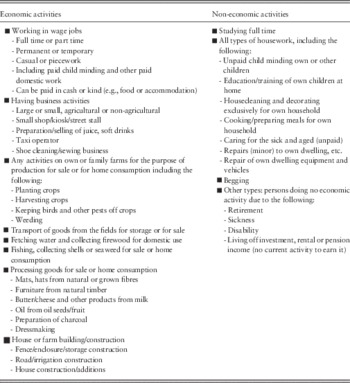
The thirteenth ICLS introduced various categories of economic activity for measurement together with this resolution. Accordingly, the ‘economically active population’ covered all persons above a specified age and was to be comprised of ‘all persons of either sex who furnish the supply of labour for the production of economic goods and services’, including family workers as employed individuals.Footnote 109 The UN processed the concept of the economically active population for the purpose of population census data,Footnote 110 while the ILO used it for labour force statistics. The labour force was divided, with the economically active and non-active population as the basic distinction (see Table 1).Footnote 111 Family workers were included as paid employment ‘at work’ (in wage, salary, cash, or kind) and self-employment at work ‘performing some work for profit or for family gain in cash or in kind’.Footnote 112
Illustrative set of economic and non-economic activities, according to the UN.

Source: Reproduced from Handbook on measuring the economically active population and related characteristics in population censuses, by United Nations, Statistics Division, Department of Economic and Social Affairs, ST/ESA/STAT/SER.F/102, New York: United Nations, 2009, p. 41, available at https://unstats.un.org/unsd/demographic/sources/census/Entire%20Handbook.pdf (consulted 12 July 2017). © 2009 United Nations. Reprinted with the permission of the United Nations.
Decades ago, Marilyn Waring explained the ‘boundary of conception’ in the following way: ‘If the “head of the household” classifies himself as a cattle farmer and kills a beast for the family, it is counted as if it went to the market. If all the rest of the food that accompanies the meat is grown in a garden plot by a wife of the “head of the household” no valuation is imputed.’Footnote 113 As Table 1 demonstrates, housework as waged domestic work and family work figure in the column of economic activities, while ‘all types of housework’ as unpaid are attributed to the column of non-economic activities.
The 1982 resolution represents a turning point in the categorization of family workers in four respects. First, because of the SNA, gainful work was explicitly categorized as economic activity. People were included if they ‘contribute or are available to contribute to the production of goods and services falling within the SNA production boundary’, including market production and certain types of non-market production. ‘Unpaid activities such as unpaid domestic activities and volunteer community services’ were excluded.Footnote 114 Second, the resolution adopted the labour force concept as a standard of measurement, as ‘each country should aim at developing a comprehensive system of statistics on the economic activity of the population’ in order to meet the needs of international comparability.Footnote 115 This included the category of ‘family worker’ that was introduced into the taxonomy of measurement with potential global reach.
Third, the labour force concept covered estimates not only of employment and unemployment but also of underemployment.Footnote 116 This category reflected the insufficient volume of employment relating to the new rationale of the underutilization of human resources and their unrealized opportunities, which needed to be changed.Footnote 117 Finally, for the purpose of underemployment, statisticians became increasingly interested in the characteristics of working women. Data for programmes for ‘women in development and the promotion of equality between the sexes’ were to be produced regarding women’s employment characteristics.Footnote 118 All categories of statistics were ‘to be compiled separately for males and females’.Footnote 119 Methods which may result in biased coverage, underestimation, failure to report women’s activities, and so forth were to be examined carefully.Footnote 120 In addition, the resolution stated that more accurate data should be produced explicitly regarding family members and family activities, ‘particularly in rural areas of developing countries’.Footnote 121
Looking at the visual representation of the 1982 measurement scheme, the division between work and non-work becomes even clearer. As Table 1 shows, housework – including everyday reproductive and caring tasks like cleaning, feeding, caring, preparing, and repairing – is visualized outside the SNA economic activities.Footnote 122 The constantly repeated presentation of the SNA boundary between housework and economic market-related family work, which still holds, reinforces the excluded non-economic classification of housework. The impersonal character of statistics and its appearance of objectivity legitimize decisions ‘without seeming to decide’.Footnote 123
At the same time, housewives attracted the statisticians’ interest insofar as they were partially considered a labour force reserve. For example, they are discussed in the preparatory report to the thirteenth ICLS under the heading of ‘emerging issues’:
One major change is that the conditions of labour market are much less rigid now and, owing to the development of the part-time employment market and flexible working time, several groups of persons who formerly did not take part in any or in more or less regular economic activity are now doing so by combining their principal activity (as housewife, student, etc.) with a remunerated occupation.Footnote 124
Since the 1947 ICLS conference, housework has increasingly been observed from an economic perspective. In 1947, the exclusion of housework figured as a convention, since the ‘remuneration for the housewife is neither customary nor expected’.Footnote 125 In 1954, various categories ‘such as housewives, students, etc.’ constituted ‘a manpower reserve’, even though they were not included in the definition of the labour force.Footnote 126 As a consequence, from the 1950s the classification of housewives as non-productive was fortified, while they simultaneously became considered as a potential labour force as regards part-time work.
Discussion of the findings: shifting boundary-making within a global world of work
From the perspective of internationally comparable statistics, this article has demonstrated how particular concepts of work became ‘globalized’. We have argued that the gainfully occupied population emerged around 1900 in national statistics, together with categories of the ‘unproductive housewife’ and ‘family workers’. In the early twentieth century, statisticians sought to identify social differentiations within a developing industrial society represented in a national frame, while dealing with the practical problem of classifying a variety of work activities.Footnote 127 As an international organization, the ILO attempted to transcend national restrictions so as to make labour statistics internationally comparable. The League of Nations, in contrast, pushed by the rationale of international economic statistics, introduced regularly performed family work into the category of the gainfully occupied population. After 1945, the world underwent a fundamental shift, and the frame of reference changed once again. From the 1950s, the gainfully occupied population was incorporated in the new UN classification scheme of the economically active population and within the ILO labour force concept. ILO statisticians became embedded in global institutions around the newly established UN organization, which emerged as the centre of calculation within a worldwide system of mutual observation.Footnote 128 ‘Work’ and ‘non-work’, as well as family work and housework, were standardized in this format at a broader overarching scale. This indicates a shift from locally standardized notions of market-oriented gainful work to its transnational scope of standardization integrated into the framework of the economically active population. Thus, the boundary between family work and housework was constantly rearticulated and reclassified.
Our findings suggest that the objectifying power of statistics triggered formal and scientific patterns for ordering the division between housework and market work. With regard to family work, statistics produced new relations of equivalence with gainful occupations, and, concerning housework, they fortified the equivalence with non-productive work. While, around 1900, housewives and employed women were lumped together with children and youth, after 1945 the first were assigned to the same class as students and volunteer workers, whereas the latter were lumped together with the labour force.
Shifting legitimations of the boundary between housework and market work reflect both the rise of technical expertise and the social transformation of labour organization and the labour market. In the United States, part-time work rose from 18% of the female labour force in 1940 to 28% in 1960.Footnote 129 In the early 1950s, the emerging pattern of married women’s part-time employment and ‘flexible working time’ became relevant for ILO statisticians as a function of the labour force reserve. Contrasting with the period around 1900, the new logics of economic growth and of labour force governance contributed to a statistical boundary-making with regard to married women, by classifying them as housewives, on the one hand, and part-time workers, on the other.
Even though family work has become an inclusive category, its history demonstrates how both the household and housework have been rearticulated and reclassified, revealing one of the fundamental patterns of statistics, namely the processing of inclusion, while legitimating and reinforcing different kinds of exclusion.
However, these changes do not reveal a linear and inevitable development from local classifications to global standardization. The ILO only partially transcended national limits, first and foremost within an imperial European order. During the 1930s, the ILO statistics on family workers were drawn almost exclusively from the Western countries (even though France and the United Kingdom did not deliver data). As the tables of the 1937 ILO Year-book discussed above indicate, a reasonable degree of incommensurability existed even between European states. The notes to the tables reveal a constant overlap between diverse categories of work, offering an insight into the problem of making things commensurate, even in Europe. At the same time, the interwar period became a formative time for transnational expert fields connected to the further spread of nongovernmental international organizations as embodied in the ILO and the League of Nations.Footnote 130 The ILO itself emerged as an actor of knowledge related to labour statistics. These organized types of knowledge-making and technical expertise arose during the middle of the twentieth century, coexisting with colonial structures until the 1970s.
When labour in the family enterprise became enumerated and counted as an economic activity (i.e. as a matter of recording the labour force in an inclusive way), the social and symbolic boundary-making between housework and family work resulted in increasing concern. Technical expertise, such as that provided by manuals and handbooks, abundantly affirms that fact. Discussing the different placings in tables and questionnaires, the ILO and the UN constantly specified and visualized gendered boundaries of work. In keeping with this technical discourse, statisticians offer a positivist legitimation for the elimination of housework from the tables, but without mentioning that the criterion of remuneration refers to economically active people, and thus to productivity. The decision and negotiation process underlying categorization is hidden from the readers’ view.
Closely connected to the impersonal character of statistics and the corresponding technical rationale for the boundary between home and work, these findings demonstrate the statistical power to objectify and to visualize extremely abstract phenomena. As a consequence, the gendered boundary included in SNA functions as a quasi-natural phenomenon, a gender belief that ‘can be given ritual expression’ in various tables.Footnote 131 The capacity of statistics to objectify and to visualize contributes, in turn, to the facticity and plausibility that gendered boundaries have gained and to the arrangement of the sexes in the modern world.
This characteristic of statistics is reinforced in an international field of expertise. The negotiations within the ILO and the UN indicate a change since 1900, during which statistical conversation has become a global field of self-reference, though it is still not universal. The discourse itself, including the rules of classification and shared practices, attests to an increasingly global form of knowledge and communication with regard to the status of gender and work. Quantification thus has to be considered as an eminent means by which statistical expertise on work ‘has been constructed as a global network rather than merely a collection of communities’.Footnote 132
Theresa Wobbe is Professor of Gender Sociology at the University of Potsdam. Her research interests include historical sociology, sociology of classification, globalization, and global history. She has extensively published in the field of shifting institutional gender patterns, global society, and the gender politics of the European Union.
Léa Renard is a PhD candidate working on a joint French–German dissertation project ‘The statistical construction of alterity: social history of migration statistics in France and Germany (1880–2010)’ with the universities of Grenoble and Potsdam. Her research interests include historical sociology, history of statistics, and French–German comparison.