Introduction
Preservation of cognitive functioning into later adult years represents a major public health concern. Several longitudinal studies (Laurin et al. Reference Laurin, Verreault, Lindsay, MacPherson and Rockwood2001; Yaffe et al. Reference Yaffe, Barnes, Nevitt, Lui and Covinsky2001; Richards et al. Reference Richards, Hardy and Wadsworth2003; Weuve et al. Reference Weuve, Kang, Manson, Breteler, Ware and Grodstein2004; Singh-Manoux et al. Reference Singh-Manoux, Hillsdon, Brunner and Marmot2005; Sabia et al. Reference Sabia, Nabi, Kivimaki, Shipley, Marmot and Singh-Manoux2009; Chang et al. Reference Chang, Jonsson, Snaedal, Bjornsson, Saczynski, Aspelund, Eiriksdottir, Jonsdottir, Lopez, Harris, Gudnason and Launer2010; Middleton et al. Reference Middleton, Barnes, Lui and Yaffe2010; Tierney et al. Reference Tierney, Moineddin, Morra, Manosn and Blake2010; Vercambre et al. Reference Vercambre, Grodstein, Manson, Stampfer and Kang2011) suggest that leisure-time physical activity (LTPA) may be associated with improved cognitive functioning at the population level. However, several important questions remain to be clarified. First, what is the optimal level of LTPA frequency or intensity for protecting cognitive function? Previous research has often focused on the achievement of the recommended levels of LTPA, that is at least 150 min/week of physical activity. Tierney et al. (Reference Tierney, Moineddin, Morra, Manosn and Blake2010), for instance, estimated the cognitive impact of retrospectively recalled strenuous and moderate LTPA, but not mild LTPA. Some studies have investigated the potential benefits of less frequent LTPA for cognitive functioning. Second, there are few data to disentangle how early-life and adult-life LTPA shape cognitive functioning. Existing studies tend to rely on older adults recalling their childhood LTPA levels (Dik et al. Reference Dik, Deeg, Visser and Jonker2010), increasing the risk of recall bias. Third, the generalizability of existing studies is questionable, with studies focusing on specific social groups, such as public servants (Sabia et al. Reference Sabia, Nabi, Kivimaki, Shipley, Marmot and Singh-Manoux2009) or women (Weuve et al. Reference Weuve, Kang, Manson, Breteler, Ware and Grodstein2004). Although women and men may differ with respect to the frequency or intensity of their LTPA (Loprinzi & Cardinal, Reference Loprinzi and Cardinal2012), lifelong comparative evidence for gender difference in the association between LTPA and cognitive functioning is relatively sparse.
Population-based studies investigating how exposure at different stages of life to LTPA of varying frequency and intensity might influence cognitive functioning within a prospectively defined cohort are scarce. Using a prospective birth cohort, the objective of the present study was to provide novel evidence about the influence of lifelong timing, intensity and frequency of LTPA on cognitive functioning in late mid-adult years separately for men and women.
Method
The present study used data from the National Child Development Study (NCDS), a nationally representative cohort study of all children born in Great Britain during 1 week in March 1958. The participants were recruited by the nurse at the time of birth. The analysis included data from all surveys of the cohort at which information on LTPA was collected, namely ages 11, 16, 33, 42, 46, and 50 years. The data have been described previously in more detail (Power & Elliott, Reference Power and Elliott2006).
Cognitive functioning
Data for cognitive measures were collected in the 2008–2009 survey using face-to-face interviewing by a trained researcher, when participants were 50 years of age. The measures have been described previously (Brown & Dodgeon, Reference Brown and Dodgeon2010; Dregan & Gulliford, Reference Dregan and Gulliford2012) and are summarized in the following sections.
Memory
Participants were asked to learn 10 unrelated words and perform two recall tasks, one immediate and one delayed. The delayed task was performed after the executive functioning tests were performed. Immediate and delayed recall tests have been used in previous studies (Baars et al. Reference Baars, van Boxtel, Dijkstra, Visser, van den Akker, Verhey and Jolles2009). Participants' performance on the two memory tests was standardized and scores were combined to provide an overall memory index.
Executive functioning
In the verbal fluency task, participants were asked to name as many different animals as possible within 1 min. A letter-cancellation test was used to measure individuals' attention span, mental speed and visual scanning abilities. The participants were given a page of random letters of the alphabet and asked to cross out as many Ps and Ws as possible within 1 min. Independent scores were calculated for speed and accuracy. The speed score was measured as the total number of letters scanned, and the accuracy score was measured as the number of Ps and Ws that were scanned but missed. Participants' performance on animal-naming, speed and accuracy tasks was standardized and scores were combined to provide an overall executive functioning index.
Cognitive index
A continuous measure of cognitive functioning was derived by summing participants' standardized scores on the overall memory and executive functioning indexes. There was a strong correlation between cognitive index with memory (0.82) and executive functioning (0.77) measures. The correlation between memory and executive functioning was smaller (0.33), indicating that the two indexes measure different cognitive domains. These tests were similar to those used in other population and community surveys (Herzog & Wallace, Reference Herzog and Wallace1997).
LTPA assessment
LTPA data were collected through face-to-face interview-administered questionnaires at ages 11, 16, 33, 42, 46 and 50 years. Data collected at age 23 were not included because they differed with respect to the reference period (previous 4 weeks versus past 12 months) and type of activities (sport only versus any LTPA). All measures were self-reported apart from the age 11 survey, which was based on parental reports.
Age 11
Children's activity level at age 11 was based on parents reporting the amount of any out-of-school sports in the past 12 months. The response options were: ‘hardly ever’, ‘sometimes’ and ‘most days’, which grouped participants into inactive, active and very active respectively.
Age 16
At age 16, participants reported the frequency of indoor and outdoor sport activities (‘hardly ever’, ‘sometimes’, ‘often’) over the past 12 months. Participants were grouped into inactive (never), somewhat inactive (hardly ever), active (sometimes) and very active (often).
Ages 33–50
At the 1991, 1999–2000, 2004–2005 and 2008–2009 surveys the questions on LTPA were asked in a similar fashion. In particular, participants' frequency of LTPA was derived from two related items: performance of any regular sport or exercise (yes/no) and the frequency of any sport or exercise for most of the year. Based on their responses, participants were classified as very active (everyday or on 4–5 days/week), active (2–3 days/week or once a week), somewhat inactive (⩽2–3 times a month) and inactive (no LTPA). A second measure assessed the intensity of LTPA and was based on how often participants reported being out of breath during LTPA. This measure grouped participants into four categories: most times, sometimes (sometimes or rarely), never (never run out of breath), and no LTPA. There was a strong correlation between frequency and intensity of LTPA in all surveys (r = 0.99).
Composite measures
A cumulative lifetime activity measure was generated by counting the number of surveys (age 11, 16, 33, 42, 46 and 50 years) at which participants were classified as very active, with scores ranging from 0 (no survey) to 5 (five or more surveys). A similar cumulative variable was created for adult LTPA intensity by counting the number of times at which intensive LTPA levels were reported ‘most times’, with scores ranging from 0 (no survey) to 4 (all adult surveys).
Covariates
Several variables found to be associated with LTPA and cognitive functioning in previous studies (Laurin et al. 2001; Richards et al. 2003; Singh-Manoux et al. 2005; Sabia et al. 2009) and in the present study were selected as covariates. The following variables were retained at each survey: social class (manual/non-manual), educational qualification [no qualifications, O-level (less than high school diploma), A-level (high school diploma), below degree, degree level or higher] or cognitive ability of participant at childhood surveys, long-standing disability/illness (yes/no, i.e. any physical, mental or psychiatric conditions under the supervision of a medical practitioner), body mass index (BMI, kg/m2), current smoker (yes/no), and alcohol units/week (1 unit = 10 ml or 8 g of pure alcohol). Childhood cognitive ability was measure using the General Ability Test (GAT; Douglas, Reference Douglas1964). Participants' depressive symptoms were assessed using the Malaise Inventory, a commonly used self-completion scale for assessing psychiatric morbidity (Rutter et al. Reference Rutter, Tizard and Whitmore1970). The Inventory was not included at childhood surveys and the Rutter Behaviour Scale (Rutter, Reference Rutter1967) was used instead as an indicator of participants' psychological distress. This scale is a strong predictor of adult Malaise scores (Dregan & Gulliford, Reference Dregan and Gulliford2011; Dregan et al. Reference Dregan, Brown and Armstrong2011).
Statistical analysis
Initially, multivariable regression analyses were used to identify study covariates associated with LTPA and cognitive functioning at each survey. All three cognitive outcome measures were normally distributed and were standardized as z scores (mean of 0 and a standard deviation of 1) so that direct comparison could be made between the cognitive tests. Multivariable regression was used to quantify the association between differences in frequency and intensity of LTPA at each survey and cognitive functioning at age 50. Separate models were run for LTPA frequency and intensity, adjusting for each LTPA attribute (i.e. LTPA intensity was included as a confounder in the models exploring the impact of LTPA frequency on cognitive functioning and vice versa). In the final set of analyses, the study explored the possibility of a dose–response relationship by estimating the association between the cumulative LTPA measures and cognitive functioning. Adjusted models in all analyses controlled for all study covariates apart from smoking and alcohol variables at age 11, where these data were not collected. Age 11 and 16 models also adjusted for childhood cognitive ability. Analyses were stratified by sex because of the suggested difference in LTPA and cognitive functioning between women and men (Loprinzi & Cardinal, 2012). Following the suggestion by Hawkes & Plewis (Reference Hawkes and Plewis2006) that non-response data in NCDS may be missing at random (MAR), multiple imputation was performed to address missing data by predicting missing values for any study variable from existing values from other study variables. Separate multiple imputations were performed at each survey and included the study outcomes, exposures and covariate measures. Ten imputed datasets were created at each survey to reduce sampling variability from the imputation process (Horton & Lipsitz, Reference Horton and Lipsitz2011). The direction and statistical significance results were the same between the complete and imputed data. All analyses were performed using SPSS version 19 (SPSS Inc., USA).
Results
Of the original sample of 17 638 children, 12 316 (70%) were eligible (alive and traceable) to take part in the age 50 survey and 9790 (80%) were interviewed. The main reason for sample attrition was inability to trace individuals (10%) (Power & Elliot, Reference Power and Elliott2006). In total, 1474 (9%) of the original cohort had died by age 50. Participants who were missing from adult surveys were more likely to be males and to have lower educational attainment; to adjust for these differences, both variables were used as covariates in the analyses.
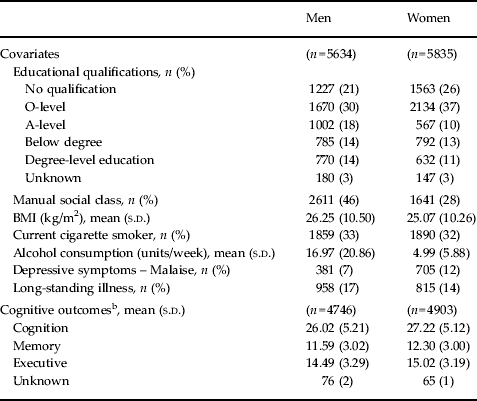
Table 1 provides descriptive data for the sample. A greater proportion of men were from a manual social background (46% v. 28%) and reported a long-standing disability (17% v. 14%) compared to women. However, a greater proportion of women (17%) reported depressive symptoms compared to men (12%). The mean cognitive scores at age 50 across all study outcome measures were similar for men and women.
Characteristics of participants at adult baselinea survey (age 33) and age 50 cognitive outcomes

BMI, Body mass index; s.d., standard deviation.
a Age 33 represents the first data where all study covariates were measured in a similar fashion.
b Raw scores.
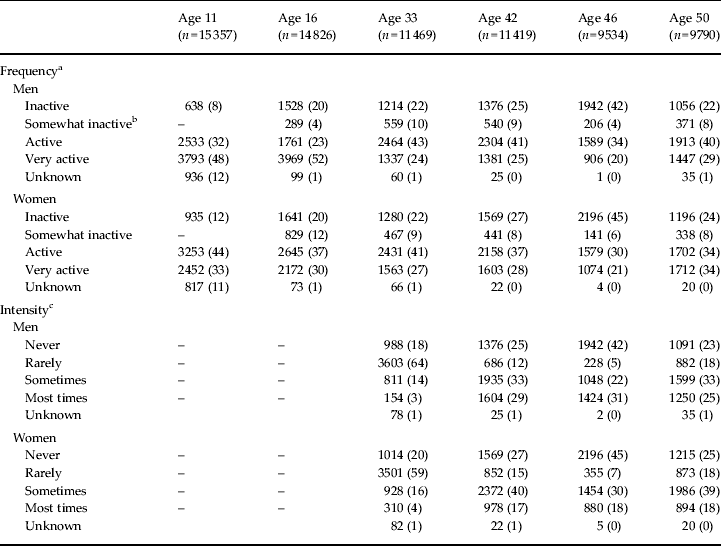
Table 2 shows the distribution of LTPA in the cohort at different ages. In general, there was a steady decline in the proportion of men and women who participated in LTPA for at least 4 days/week from childhood to age 46, but this was followed by an increase in LTPA to age 50. A higher proportion of women participated in LTPA for at least 4 days/week at each adult survey compared to men. The reverse trend was observed with respect to childhood years. Regarding the intensity of LTPA, there was a substantial increase in the proportion of men who reported intensive LTPA ‘most times’ from age 33 (3%) to age 46 (31%), followed by a 20% decline to age 50 (25%). At each adult survey, a greater proportion of men reported intensive LTPA ‘most times’ compared to women.
Participants' LTPA habits at each survey
LTPA, Leisure-time physical activity.
a Inactive = no LTPA reported; Somewhat inactive = once a month, 2–3 times a month (adult surveys) or less often (childhood only); Active = once or 2/3 days/week (adult surveys) or sometimes (childhood only); Very active = at least 4 days/week (adult surveys) or most times (childhood only).
b Option not available at age 11 survey.
c Intensity of LTPA refers to how often participants were out of breath during LTPA with data not available at ages 11 and 16.
Values are given as n (%).
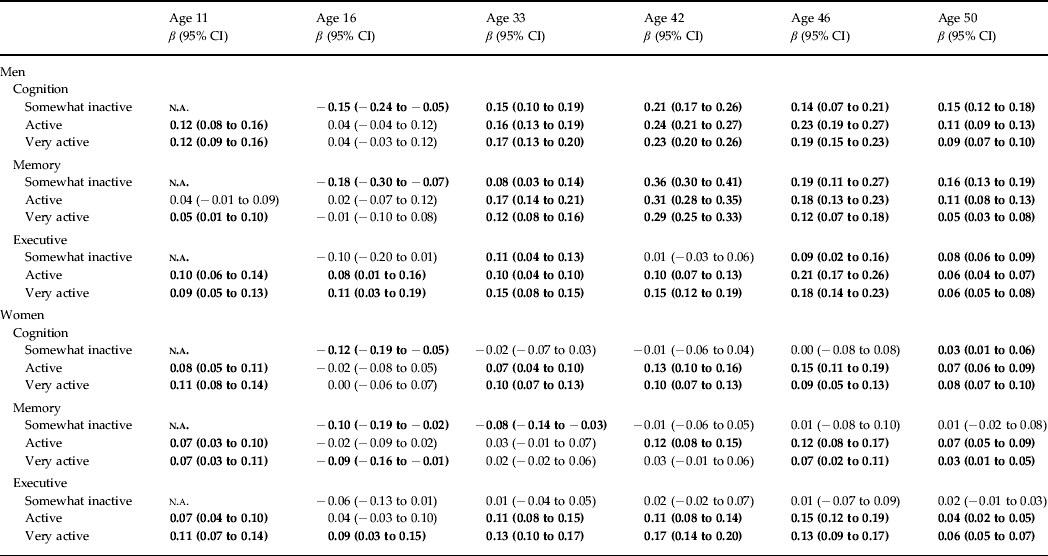
The results of multiple regression analyses are shown in Table 3. After adjusting for confounding variables, there was a positive association between LTPA frequency and cognitive index, and also memory and executive functioning, for both men and women. In adult surveys these associations were statistically significant after adjusting for LTPA intensity. Men who reported LTPA for most days of the week had higher cognitive index scores at age 50; these scores ranged from 0.09 [95% confidence interval (CI) 0.07–0.10] standard units for age 50 LTPA to 0.23 (95% CI 0.20–0.26) standard units for age 42 LTPA. Men who were either ‘active’ or ‘somewhat inactive’ nevertheless showed a higher cognitive index, along with higher specific memory and executive functioning scores, compared to those reporting no LTPA participation. The only exception emerged with respect to the age 16 survey. Whereas a positive association was observed between LTPA and executive functioning for the ‘very active’ and ‘active’ men, a negative association was observed between LTPA and memory outcome for men who were ‘somewhat inactive’. No clear dose–response relationship between the frequency of LTPA and cognitive outcomes among men was seen. Similar associations were observed among women.
The association of LTPA frequency with cognitive functioning at age 50, adjustinga for intensity
LTPA, Leisure-time physical activity; n.a., not applicable; β, regression coefficient; CI, confidence interval.
Bold figures indicate statistically significant estimates at the 0.05 level.
Somewhat inactive = once a month, 2–3 times a month (adult surveys) or less often (childhood only); Active = once or 2–3 days/week (adult surveys) or sometimes (childhood only); Very active = at least 4 days/week (adult surveys) or most times (childhood only). The analyses adjusted for educational qualification, social class, body mass index (BMI), long-standing illness, depressive symptoms, smoking, and drinking.
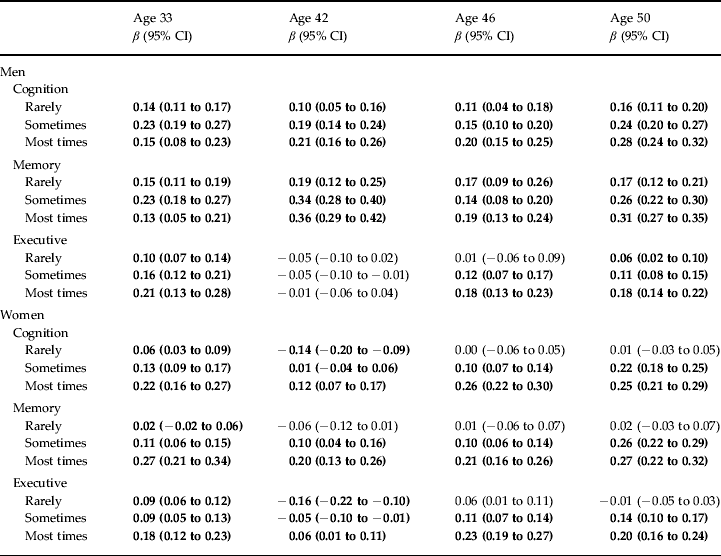
Table 4 shows the results for the intensity parameter of LTPA adjusting for frequency. There was strong evidence for an increase in cognitive scores with increased LTPA intensity at each time point for both men and women, more consistently so for women. The cognitive index score at age 50 for women with different LTPA intensity reports at age 33 ranged from 0.06 (95% CI 0.03–0.09) standard units for rarely intensive LTPA to 0.13 (95% CI 0.09–0.17) standard units for sometimes intensive LTPA, and 0.22 (95% CI 0.16–0.27) standard units for most times intensive LTPA. Similar associations were observed among men.
Association of cognitive functioning at age 50 with the intensity of LTPA recorded at different ages after adjustmenta for LTPA frequency
LTPA, Leisure-time physical activity; β, regression coefficient; CI, confidence interval.
Bold figures indicate statistically significant estimates at the 0.05 level.
a Adjusted for education, social class, long-standing illness, smoking, drinking, depression, and body mass index (BMI).
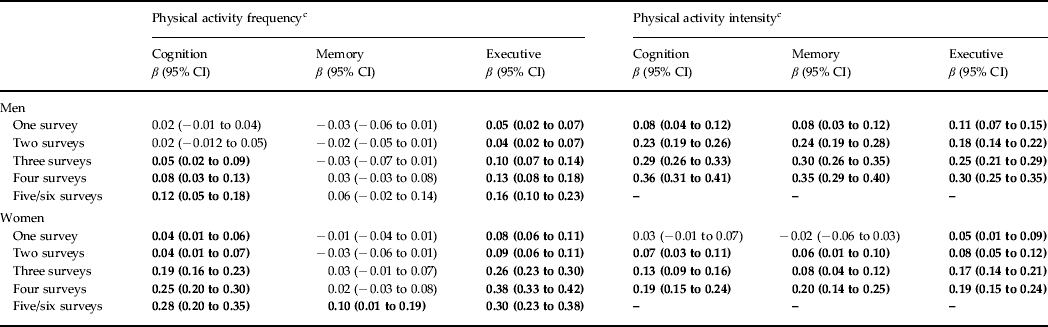
The final set of analyses revealed a strong and consistent dose–response relationship between cumulative LTPA and cognitive functioning outcomes at age 50 (Table 5). There was a graded association with a higher cognitive functioning score in both men and women. Women who reported LTPA for ⩾4 days/week at one survey had 0.04 (95% CI 0.01–0.06) standard units higher cognitive index score than women who never reported LTPA for ⩾4 days/week. The difference was 0.28 (95% CI 0.20–0.35) standard units when LTPA was reported for at least 4 days/week at five or six surveys. The largest effect sizes were observed for the executive functioning measure.
Adjusteda regression coefficients (95% confidence interval) for cognitive functioning at age 50 as a function of the number of adult surveys at which intensive LTPAb was reported
LTPA, Leisure-time physical activity; β, regression coefficient.
Bold figures indicate statistically significant estimates at the 0.05 level.
a Adjusted for education, social class, long-standing illness, smoking, drinking, depression, and body mass index (BMI).
b At least 4 days/week moderate activity or at least 2 days of ‘most times’ intensive activity.
c The reference group was ‘Never reported activity for 4 days or more a week’ and ‘Never reported “most times” intensive activity’ respectively. Data based on dichotomized exposures (i.e. 1 = reported intensive activity, 0 = did not report intensive activity).
The dose–response relationship was particularly robust with respect to the intensity attribute of LTPA. For men, there was a gradual increase in absolute differences in cognitive index scores ranging from 0.08 (95% CI 0.04–0.12) standard units with a single survey to 0.36 (95% CI 0.31–0.41) standard units when intensive LTPA was reported for ‘most times’ at all four adult surveys. The corresponding figures for women were 0.03 (95% CI − 0.01 to 0.07) standard units for one survey with LTPA and 0.19 (95% CI 0.15–0.24) standard units for five or more surveys with LTPA. Similar patterns emerged for memory and executive functioning tests.
Discussion
Drawing on a nationally representative sample, a positive association between lifelong LTPA and better cognitive functioning in late mid-adult years was observed. After accounting for LTPA intensity, a positive influence of LTPA participation on men's cognitive functioning scores at age 50 was observed at all LTPA frequency levels. There was evidence in women that higher cognitive functioning scores were associated with LTPA engagement for at least 1 day/week, but not less frequent LTPA. However, participating in intensive LTPA was associated with greater cognitive benefits even after adjusting for LTPA frequency. It would therefore seem that intensive LTPA may yield important cognitive benefits over and above those derived from regular but less intense participation in LTPA. There was strong evidence for a dose–response relationship with respect to the intensity of LTPA. In particular, there was a gradual increase in memory and executive functioning scores with greater intensity of LTPA. With regard to a possible differential impact of activity on various cognitive domains, the present findings suggest an all-encompassing cognitive functioning benefit from LTPA participation. However, the positive influence of cumulative LTPA on executive functioning and not memory implies a possible domain-specific effect for LTPA frequency. Concerning the lifelong timing of LTPA, cognitive functioning in late mid-adult years benefited from participation in both childhood and adult activities. The consistent dose–response relationship observed between cognitive functioning and the number of surveys at which LTPA was reported implies, however, greater cognitive benefits from participating in frequent or intensive lifelong LTPA.
This study extends the findings from previous studies (Yaffe et al. Reference Yaffe, Barnes, Nevitt, Lui and Covinsky2001; Singh-Manoux et al. Reference Singh-Manoux, Hillsdon, Brunner and Marmot2005; Sabia et al. Reference Sabia, Nabi, Kivimaki, Shipley, Marmot and Singh-Manoux2009) to lifelong LTPA and across different levels of LTPA frequency and intensity. Richards et al. (Reference Richards, Hardy and Wadsworth2003) found that LTPA over the previous month at age 36 was associated with improved memory at age 53. Our findings extend their study to childhood LTPA and to executive functioning. Our study also considered LTPA over the previous 12 months, offering a more reliable assessment of LTPA habits over time. Tierney et al. (Reference Tierney, Moineddin, Morra, Manosn and Blake2010) focused on the cognitive benefits of moderate to vigorous LTPA. The present findings suggest that participation in mild LTPA can also benefit cognitive functioning even after taking into account LTPA intensity. Dik et al. (Reference Dik, Deeg, Visser and Jonker2010) found that early-life LTPA was associated with better cognitive functioning in older men but not older women. Our prospective study indicated a positive association between adolescent LTPA and cognitive functioning in late mid-adult years for both men and women. Dik et al.'s (Reference Dik, Deeg, Visser and Jonker2010) study relied on older participants (mean age 74.9 years) recalling their activity attributes during teenage years, increasing the risk of information bias. The dose–response relationship between frequency and intensity of LTPA and cognitive functioning is not well established; however, the present findings corroborate with studies using different outcome measures such as mortality and cardiovascular disease (Bijnen et al. Reference Bijnen, Caspersen, Feskens, Saris, Mosterd and Kromhout1998; van Dam et al. Reference van Dam, Li, Spiegelman, Franco and Hu2008; Stamatakis et al. Reference Stamatakis, Hamer and Lawlor2009). Previous longitudinal evidence is constrained by the arbitrary definition of LTPA intensity, often being equated with duration (Angevaren et al. Reference Angevaren, Vanhees, Wendel-Wos, Veerhar, Aufdemkampe, Aleman and Vershcuren2007; Devore et al. Reference Devore, Kang, Okereke and Gordstein2009; Angevaren et al. Reference Angevaren, Vanhees, Nooyens, Wendel-Wos and Vershcuren2010) or frequency (Tierney et al. Reference Tierney, Moineddin, Morra, Manosn and Blake2010). In our current study participants reported how often they ‘got out of breath’ while engaging in LTPA, which represents a more explicit measure of LTPA intensity. Furthermore, several studies have focused on specific subpopulations, particularly public-sector employees (Sabia et al. Reference Sabia, Nabi, Kivimaki, Shipley, Marmot and Singh-Manoux2009) or women (Vercambre et al. Reference Vercambre, Grodstein, Manson, Stampfer and Kang2011), thus restricting the generalizability of their findings.
Current recommendations suggest that people in the general population should perform moderate physical activity for at least 5 days/week or vigorous physical activity for at least 3 days/week (Department of Health, 2004; Haskell et al. Reference Haskell, Lee, Pate, Powell, Blair, Franklin, Macera, Heath, Thompson and Bauman2007). The present findings suggest that engagement in lifelong LTPA even at low levels of frequency or intensity might benefit cognitive functioning. Taking into account the larger effects sizes associated with intensive LTPA, the interventions with the greatest benefit for the cognitive well-being of the largest number of people are likely to be those focusing on the promotion of at least weekly intensive LTPA over extended periods in individual's lives. The cumulative influence of lifetime LTPA on cognitive functioning also advocates that guidelines for LTPA participation should begin early in life and extend across the life course. The mean rate of 12-year decline in cognitive scores among adults is around 1.4 points on the Mini-Mental State scale (Lyketsos et al. Reference Lyketsos, Chen and Anthony1999). Based on our findings, lifelong intensive LTPA could reduce the rate of 12-year cognitive decline in the general population by around a third (0.52) in men and a quarter (0.35) in women.
The substantial drop in the proportion of men engaged in LTPA for at least 4 days/week from age 16 to age 33 suggests that men's cognitive functioning may benefit from efforts targeted to promoting LTPA during the transition period from adolescence to early adult years. The low proportion of women reporting intensive LTPA during adult years suggests that encouraging more intensive LTPA among adult women may translate into improved cognitive functioning in late mid-adult years. Future studies should explore whether the cognitive benefits of lifelong intensive LTPA extend to older age. Studies including biomarkers of healthy cognitive aging (e.g. Aβ42) as surrogate outcomes are also to be encouraged. Such evidence would reveal promising avenues for developing personalized LTPA guidelines to facilitate cognitive well-being across the lifespan.
The sharp decline in rates of sedentary/low-intensity activity from age 46 to age 50 could be due, among other factors, to an increased emphasis on the health benefits of LTPA across all ages around the time of the survey. This suggestion fits in with the American Heart Association (AHA) and National Institute for Health and Clinical Excellence (NICE) timing of the most recent adult physical activity guidelines (Department of Health, 2004; Haskell et al. Reference Haskell, Lee, Pate, Powell, Blair, Franklin, Macera, Heath, Thompson and Bauman2007). Methodological issues including measurement error response bias (i.e. social desirability bias) are plausible alternative explanations.
Several potential mechanisms have been proposed to account for a positive influence of LTPA on cognitive functioning including effects on the cardiovascular, endocrine and metabolic, and immune systems (Ostrowski et al. Reference Ostrowski, Ohde, Asp, Schjerling and Pedersen1999; Kramer et al. Reference Kramer, Bherer, Colcombe, Dong and Greenough2004; Lai et al. Reference Lai, Studenski, Richards, Perera, Reker, Rigler and Duncan2006; Pereira et al. Reference Pereira, Huddleston, Brickman, Sosunov, Hen, McKhann, Sloan, Gage, Brown and Small2007; Friedenreich & Cust, Reference Friedenreich and Cust2008). The beneficial influences of LTPA on cognition also include neurogenesis, angiogenesis and synaptogenesis (Redila & Christie, Reference Redila and Christie2006). Physically active people may also benefit from other healthy lifestyle behaviors including not smoking, better sleep patterns and healthy diet (Gomez-Pinilla, Reference Gomez-Pinilla2011), endorsing therefore a multifaceted perspective on cognitive functioning, with intensive LTPA having an influential contribution.
The present study has several strengths, including the prospective and repeated assessment of several attributes of LTPA within the same prospective study, the consideration of gender differences, and long-term follow-up of same-age participants. It is, however, important to note some of the study limitations. One limitation of the study is the lack of detailed cognitive testing; for example, episodic memory was not measured and, for executive functioning, there were no measures of planning or problem solving. Self-reported LTPA may lead to reporting bias as participants may over- or underestimate their LTPA levels. This issue is mitigated against in this study by the use of repeated measures of LTPA, and self-reported LTPA levels over the past year were found to show good reliability and validity (Bowles et al. Reference Bowles, Fitzgerald, Morrow, Jackson and Blair2004; Friedenreich et al. Reference Friedenreich, Courneya, Neilson, Matthews, Willis, Irwin, Trionao and Ballard-Barbash2006). In addition, objective measures of LTPA are impractical in longitudinal studies and can suffer from measurement bias (i.e. greater risk of reactivity). Another concern is that the childhood LTPA questions were not asked in a similar fashion to adult survey questions. However, both childhood and adulthood questions were broadly defined to include any LTPA and referred to the same time period. Moreover, the results of the analyses were largely in the same direction and of similar significance levels for both childhood and adult models, increasing our confidence in the comparability of the findings. The lack of a cognitive functioning measure at other adult surveys precluded our ability to investigate the association between LTPA and cognitive functioning over time, and future studies are needed to address this issue. We cannot exclude the possibility of reverse causality, although the inclusion of participants' cognitive ability measure in childhood and educational attainment in adult surveys, a frequently used marker of cognitive reserve (Stern, Reference Stern2006), may temper this limitation. Although we adjusted for the main factors involved in LTPA activity, this does not rule out the possibility that other unknown or unmeasured factors not considered here may confound the relationship between LTPA and cognitive outcomes. We initially considered a broader range of factors (i.e. housing, general health, hypertension, diabetes, diet) but these were not retained for further analyses as they were not significantly associated with the exposure and outcomes or did not significantly affect the estimates for LTPA when excluded from the analyses. The inclusion of terms for each covariate at each year may increase the risk of multicollinearity; however, the variance inflation factor (VIF) test indicated that multicollinearity was not present in our data (VIF < 3). In addition, the large sample size partially offsets the problem of multicollinearity, which may lead to high standard errors. The study data did not have information about the type of LTPA. We initially adjusted for the amount of physical demands in a job but it did not influence the association between LTPA and cognition. The categorization of LTPA was imposed to a certain degree by data constraints; however, it does approximate to the NICE and AHA (Haskell et al. Reference Haskell, Lee, Pate, Powell, Blair, Franklin, Macera, Heath, Thompson and Bauman2007) guidelines for adult weekly physical activity levels. Attrition problems are a major concern with longitudinal data and the present study used multiple imputations to deal with this issue.
Using different attributes of LTPA, the present study documented that, in late mid-adult years, cognitive functioning increased with each additional decade of life where participation in LTPA was reported. Overall, any LTPA participation is better than not being active at all, and more intensive LTPA is better than less intensive LTPA. As physical activity represents a key component of lifestyle interventions to prevent cognitive decline, cardiovascular disease, diabetes and cancer, public health interventions to promote lifelong LTPA have the potential to reduce the personal and social burdens associated with these conditions in late adult years.
Acknowledgments
This research was supported by the National Institute for Health Research (NIHR) Biomedical Research Centre at Guy's and St Thomas' National Health Service (NHS) Foundation Trust and King's College London. The views expressed are those of the author(s) and not necessarily those of the NHS, the NIHR or the Department of Health.
Declaration of Interest
None.