In pathological gambling (PG), anger and aggression have received limited attention in the literature. Marked impulse dysregulation has often been related to difficulties in expressing anger. Therefore, anger, a component of negative affect, may play a greater role in PG. In many cases, gambling is used for regulating negative emotional states associated with life events dissatisfaction, frustration and anger. Anger in PG may be due to many variables, being financial despair one of the most prominent factors. However, it can also be associated with underlying personality traits, such as impulsivity. The present study therefore explores the way in which various facets of anger are linked to PG, comorbid psychopathology and personality traits and how these constructs differ across gender.
Literature on the role of anger expression in PG is scarce. There is some evidence, which suggests that anger and gambling frequently co-occur (Cunningham-Williams, Gattis, Dore, Shi, & Spitznagel, Reference Cunningham-Williams, Gattis, Dore, Shi and Spitznagel2009; Goodyear-Smith et al., Reference Goodyear-Smith, Arroll, Kerse, Sullivan, Coupe, Tse and Perese2006; Korman, Collins, Dutton et al., Reference Korman, Collins, Dutton, Dhayananthan, Littman-Sharp and Skinner2008; Korman, Collins, Littman-Sharp et al, Reference Korman, Collins, Dutton, Dhayananthan, Littman-Sharp and Skinner2008; Sacco, Cunningham-Williams, Ostmann, & Spitznagel, Reference Sacco, Cunningham-Williams, Ostmann and Spitznagel2008). In fact, epidemiological studies identified high rates of anger problems in PG (Bland, Newman, Orn, & Stebelsky, Reference Bland, Newman, Orn and Stebelsky1993). One of the few studies made with a large sample of slot machine gamblers (Parke & Griffiths, Reference Parke and Griffiths2004), observed the occurrence of aggressive behaviors as a consequence of PG. More recently, Korman, Collins, Dutton et al. (Reference Korman, Collins, Dutton, Dhayananthan, Littman-Sharp and Skinner2008) explored the prevalence and severity of domestic abuse among a cohort of pathological gamblers (PGs) and found that 64.5% of the individuals had significant problems with inadequate anger expressions and that anger and lifetime substance use were associated with an increased risk to suffer from domestic violence. Formerly, the same group of researchers (Korman, Collins, Littman-Sharp, McMain, & Skinner, Reference Korman, Collins, Littman-Sharp, McMain and Skinner2005) uncovered that in a group of untreated PG patients, 74% presented verbal abuse and 25% displayed acts of physical violence towards other persons. Muelleman, DenOtter, Wadman, Tran, and Anderson (Reference Muelleman, DenOtter, Wadman, Tran and Anderson2002) also found a relationship between verbal or physical abuse and PG in a study carried out with female domestic abuse victims. Moreover, these authors observed, that the likelihood of suffering this type of violence increased when the couple suffered from alcohol problems, and that violence augmented even more when both disorders (PG and alcoholism) were present.
From a methodological point of view the investigation of gender and anger is complex, given the heterogeneity of the samples and the instruments used to evaluate this characteristic (Milovchevich, Howells, Drew, & Day, Reference Milovchevich, Howells, Drew and Day2001). Generally, studies agree on the finding that men and women display anger differently (Fox, Hong, Siedlarz, & Sinha, Reference Fox, Hong, Siedlarz and Sinha2008). Research results demonstrate that compared to men, women more frequently experience angry feelings, display them more intensely and with a longer duration (Archer, Reference Archer2000; Fernández & Scott, Reference Fernández and Scott2009). Women may express anger through the inhibitory control of anger. On the contrary, men tend to show more aggressive and violent behaviors (towards objects or people-Campbell & Muncer, Reference Campbell and Muncer2008).
Pathological gambling has also frequently been associated substance use, depression, anxiety disorders, other impulse control disorders and attention deficit disorders (Fernández-Aranda et al., Reference Fernández-Aranda, Jiménez-Murcia, Álvarez-Moya, Granero, Vallejo and Bulik2006; Kessler et al., Reference Kessler, Hwang, LaBrie, Petukhova, Sampson, Winters and Shaffer2008; Petry, Stinson, & Grant, Reference Petry, Stinson and Grant2005; Stewart, Zack, Collins, & Klein, Reference Stewart, Zack, Collins and Klein2008). Thus, PGs may exhibit psychopathological traits related to inadequate anger expressions and deficits in coping with anger and frustration. Maclaren, Fugelsang, Harrigan, and Dixon (Reference Maclaren, Fugelsang, Harrigan and Dixon2011) consider that PG could be included in a cluster of externalizing psychopathology.
An important dimension to consider when studying anger in PG is personality. PG has frequently been related to impulsivity, hostility, aggression, novelty seeking and emotional instability in several studies (Jollant et al., Reference Jollant, Bellivier, Leboyer, Astruc, Torres, Verdier and Courtet2005; Schwebel, Severson, Ball, & Rizzo, Reference Schwebel, Severson, Ball and Rizzo2006). Even though a specific personality profile unique to PG has not yet been described (Álvarez-Moya et al., 2007; Jiménez-Murcia et al., Reference Jiménez-Murcia, Álvarez-Moya, Granero, Aymamí, Gómez-Peña, Jaurrieta and Vallejo2007), probably because this disorder presents a high heterogeneity. Blaszczynski and Nower (Reference Blaszczynski and Nower2002) proposed three distinct subgroups of gamblers: (a) behaviorally conditioned, (b) emotionally vulnerable and (c) antisocial impulsive problem gamblers. The last two are associated with impulsivity and related traits. Later, Álvarez-Moya et al. (Reference Álvarez-Moya, Jiménez-Murcia, Aymamí, Gómez-Peña, Granero, Santamaría and Fernández-Aranda2010) identified at least four types of pathological gambling patients according to personality variables. But only Type I (disorganized and emotionally unstable) and Type III (reward sensitive) showed high impulsiveness and related traits (sensation seeking, substance abuse). Likewise, there are also differences in personality traits and clinical characteristics of the PGs, depending on the type of preferred game that is presented. Thus, strategic game players (poker, blackjack, sports betting, etc.) would show different profiles, when compared with non-strategic game players, such as slot machines or bingo. Generally, the former would be more motivated by the search for risk, excitement and action, while the latter would use the game as a form of mood regulation, presenting lower sensation seeking and arousal (Ledgerwood & Petry, Reference Ledgerwood and Petry2006; Potenza et al., Reference Potenza, Steinberg, McLaughlin, Wu, Rounsaville and O'Malley2001). Based on this evidence, it could be postulated that the traits anger may be more associated with some subtypes of PGs than others, depending on their clinical, psychopathological and personality traits as well as on the preferred game.
The present study extends previous research on the association between PG and anger by assessing whether psychopathology and personality is related to PG and how these differ across gender. Given the current gaps in the literature concerning anger expression the goals of the present study were four-fold: (a) to compare several facets of anger in individuals with PG and healthy controls; (b) to explore the role of gender on anger in PGs and HC; (c) to explore the relationship of anger with comorbid psychopathology and personality in PGs and (d) to assess the predictive capacity of anger on the intensity of the PG. Our first hypothesis was that PG patients will obtain higher scores than controls on levels of anger, both in state and trait. The second one was that men will exhibit higher scores in external expression of rage and lower external control than women in both PGs and HC, which implies higher propensity to express anger toward other people or objects in the surroundings and less control capacity to avoid these manifestations of anger or rage.
Method
Participants
The sample included 108 individuals: 71 pathological gambling patients (54 men and 17 women) who consecutively attended assessment and outpatient treatment at a Pathological Gambling Unit in the psychiatric department of one of the general hospitals of Barcelona, Hospital Universitari de Bellvitge and 37 healthy controls (20 men and 17 women). All participants were diagnosed, by experienced psychologists and psychiatrists in PG, using the Diagnostic Questionnaire for Pathological Gambling according to DSM-IV criteria (Stinchfield, Reference Stinchfield2003).
Individuals visiting the hospital for routine blood tests, were asked to volunteer in a study of pathological gambling and recruited as healthy controls. All controls were from the same catchment areas as index patients. The exclusion criteria for the control group were: (a) younger than 16 years old (since it is a hospital serving population from 16 years, not providing specialized services for child population) (b) a lifetime history of mental illnesses (including PG), as assessed by the GHQ-28; (c) total score of the SOGS equal or superior to three. No participant had to be excluded from the present study. Both groups were matched in terms of sex and age. The patients in the PG cohort had primary (64.3%) or secondary studies (28.6%). More than half of the patients (55.7%) were married or lived with a partner. With regard to occupation, 23.9% of the patients were unemployed. The socioeconomic level was middle or lower-middle class for most patients (53.4%). The mean age of the PGs was 40.3 (SD = 11.5) years (range 20–74). To guarantee the comparability of the control cohort, the participants of this group were recruited from the same geographical area of the cases attending to the hospital (cases and controls came from the same population) and their selection was independent of the exposures. The control cohort included 20 men (54.1%), and obtained a mean age of 42.3 years-old (SD = 8.7). Many participants in the control group were married or lived with a partner.
Instruments
South Oaks Gambling Screen
(SOGS; Lesieur & Blume, Reference Lesieur and Blume1987) It was used to assess the cognitive, emotional, and behavioral aspects related to PG. This scale includes 33 items that allow for a total score ranging from 0 to 20 (higher values are indicatives of a more severe psychopathology). The Spanish adaptation (Echeburúa, Báez, Fernández, & Páez, Reference Echeburúa, Báez, Fernández and Páez1994) shows a satisfactory test-retest reliability (r = .98), internal consistency (α = .94), and convergent validity (r = .92) with regards to DSM-III-R criteria for PG (American Psychiatric Association, 1987).
Diagnostic Questionnaire for Pathological Gambling
(Stinchfield, Reference Stinchfield2003) It is a brief questionnaire examining the concrete diagnostic criteria for PG according to DSM-IV (American Psychiatric Association, 1994). In this study the total score was used, which is derived from the total symptoms presented by the patient. The Spanish version we used has shown a satisfactory internal consistency (α = .95) in a combined sample and convergent validity (with moderate to high correlations with other measures of problem gambling). Using the standard DSM-IV cut-score of five, the 10 criteria were found to yield satisfactory classification accuracy results with a high hit rate (.95), high sensitivity (.92) and specificity (.99), and low false positive (.01) and false negative rates (.08) (Jiménez-Murcia et al., Reference Jiménez-Murcia, Stinchfield, Álvarez-Moya, Jaurrieta, Bueno, Granero and Vallejo2009).
State-trait anger expression inventory 2
The STAXI-2 is a self-report instrument that examines the experience and expression of anger (Spielberger, Reference Spielberger1996).. The Spanish version of the STAXI-2 comprises 49 items and entales six scales and seven subscales: State Anger; Trait Anger; Anger Control; Anger Expression-In; Anger Expression-Out and Anger Expression. The Spanish version has been found to be reliable (α’s from .63 to .95) (Fernández-Abascal & Martín, Reference Fernández-Abascal and Martín1994; Miguel-Tobal, Casado, Cano-Vindel, & Spielberger, Reference Miguel-Tobal, Casado, Cano-Vindel and Spielberger1997).
Temperament and Character Inventory-Revised
(TCI-R; Cloninger, Reference Cloninger1999). The TCI-R is a 240-item, scored on a five-point Likert-scale that measures seven dimensions of personality: four temperament (Harm Avoidance, Novelty Seeking, Reward Dependence, and Persistence) and three character dimensions (Self-Directedness, Cooperativeness, and Self-Transcendence). The Spanish revised version (Gutiérrez-Zotes et al., Reference Gutiérrez-Zotes, Bayón, Montserrat, Valero, Labad, Cloninger and Fernández-Aranda2004) has shown a satisfactory internal consistency (α = .87).
Symptom Check List-90 items-Revised
In order to evaluate a broad range of psychological problems and symptoms of psychopathology, the SCL-90-R was used. It contains 90 items and helps to measure nine primary symptom dimensions: Somatization, Obsession-Compulsion, Interpersonal Sensitivity, Depression, Anxiety, Hostility, Phobic Anxiety, Paranoid Ideation, and Psychoticism (Derogatis, Reference Derogatis2002).. In addition, it includes three global indices: a global severity index (GSI), designed to measure overall psychological distress; a positive symptom distress index (PSDI), designed to measure the intensity of symptoms; and a positive symptom total (PST), which are reports of self-reported symptoms. The GSI can be used as a summary of the test. The questionnaire has been validated in the Spanish population (Martínez-Azumendi, Fernández-Gómez, & Beitia-Fernández, Reference Martínez-Azumendi, Fernández-Gómez and Beitia-Fernández2001), obtaining an acceptable mean internal consistency (α = .75).
General Health Questionnaire-28
The GHQ-28 comprises four subscales: Somatic Symptoms, Anxiety and Insomnia, Social Dysfunction, and Severe Depression. In the current study a cut-off score of 6/7 (6 = no case; 7 = case) was employed to exclude individuals with an elevated likelihood of a present psychiatric disorder. In previous studies this cut-off score has yielded a sensitivity of 76.9% and a specificity of 90.2% (Lobo, Pérez-Echeverría, & Artal, Reference Lobo, Pérez-Echeverría and Artal1986). The GHQ-28 has been studied in various European countries and has been found to be a valid and reliable tool (Goldberg & Williams, Reference Goldberg and Williamns1996).
Procedure
In addition to the assessment battery, the PG group was assessed by a semi-structured face-to-face interview regarding their PG and psychopathological symptoms (Jiménez-Murcia et al., Reference Jiménez-Murcia, Aymamí-Sanromà, Gómez-Peña, Álvarez-Moya and Vallejo2006, Reference Jiménez-Murcia, Álvarez-Moya, Granero, Aymamí, Gómez-Peña, Jaurrieta and Vallejo2007). The same interview also assessed sociodemographic data (e.g., education, occupation, civil state) and additional clinical information. The control group completed the STAXI-2 so that the experience and expression of anger can be assessed, the South Oaks Gambling Screen (SOGS) and the PG diagnostic questionnaire according to the DSM-IV criteria (the last two instruments to exclude the possibility of having suffered any present or lifetime gambling problem). A general distress was measured by self-report (28-item version of the General Health Questionnaire (GHQ) (Goldberg Reference Goldberg1981). None of the controls had a history of mental illness.
This study was carried out in accordance with the latest version of the Declaration of Helsinki. The Ethics Committee of the Hospital Universitari de Bellvitge approved the study, and informed consent was obtained from all participants.
Statistical analysis
Firstly, we assessed the relationship between the presence of PG and the mean STAXI-2 scores with analyses of covariance (ANCOVA) procedures adjusted for age and sex. Next, we assessed whether sex is a predictive variable for the mean STAXI-2 scores within each group (clinical-control) with an ANCOVA (adjusted by age and duration of the disorder for the PG sample). Pearson’s correlation coefficients were calculated to examine the linear association between STAXI-2, SCL-90-R, and TCI-R direct scores, and absolute values above .30 were considered for practical significance (Rosnow & Rosenthal, Reference Rosnow and Rosenthal1996). Finally, the predictive capacity of the STAXI-2 scores (independent variables or predictors) on the intensity of the disorder (dependent variables or criteria) for the PG sample was evaluated thorough multiple linear regression models (for quantitative criteria, SOGS total score) and negative binomial models (for criteria that represent counting, such as number of the DSM-IV criteria and the total number of games briefed by the patient) adjusted by sex and duration of the disorder. The negative binomial regression is a mathematical model that has recently been used as an alternative to the Poisson regression model. It has been shown to be efficient in modeling discreet quantitative data characterized by overdispersion (Hilbe, Reference Hilbe2007). In order to control for Type I error due to the multiple statistical comparisons the Bonferroni-Holm (Holm, Reference Holm1979) correction was applied. This correction has shown to be less conservative than the classical Bonferroni procedure and is therefore especially useful for individual tests.
Results
Comparison of the clinical characteristics of the PG group across gender
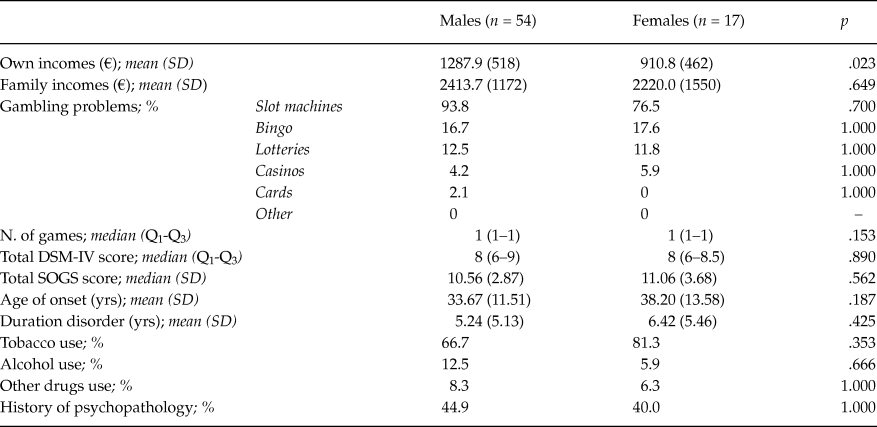
Table 1 contains the descriptive data of the clinical characteristics of the PG patients across gender. With the exception of the average own income, no statistically significant differences were observed between males and females for any of the clinical variables. Regarding the type of problem gambling, most were slot-machine players. It has to be clarified that this result is in concordance with previous reports in Spain (Becoña, Reference Becoña1999; Jiménez-Murcia et al., Reference Jiménez-Murcia, Álvarez-Moya, Granero, Aymamí, Gómez-Peña, Jaurrieta and Vallejo2007), where it has been shown that slot-machine gambling are the most prevalent gambling behaviors, especially in men. This result evidenced some cultural bounding differences, due to the fact that slot-machines are a widespread and very popular practice in Spain (Becoña, Reference Becoña, Meyer, Hayer and Griffiths2009), in comparison to other countries (Jiménez-Murcia et al., Reference Jiménez-Murcia, Álvarez-Moya, Stinchfield, Fernández-Aranda, Granero, Aymamí and Menchón2010).
Clinical description of the pathological gamblers

Note: SD: standard deviation. Q1-Q3: quartiles (percentiles 25 and 75).
Anger expression and PG
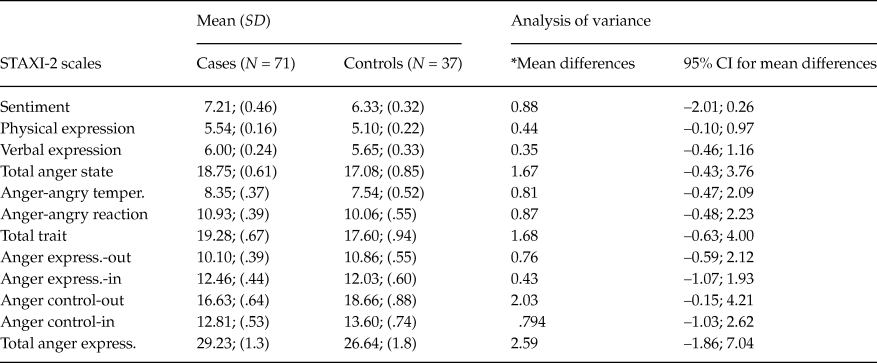
Table 2 outlines the results of the comparisons between PGs and controls on the STAXI-2 measures. No statistically significant differences were revealed between controls and patients in any of the mean STAXI-2 scores, even after adjusted for gender and age.
Differences between PGs and controls in STAXI-2 scores

Note: Analysis of variance adjusted for gender, age and TCI-R scores. *Significant comparison cases-controls with Bonferroni-Finner’s correction.
The effect of gender on anger in PGs and healthy controls
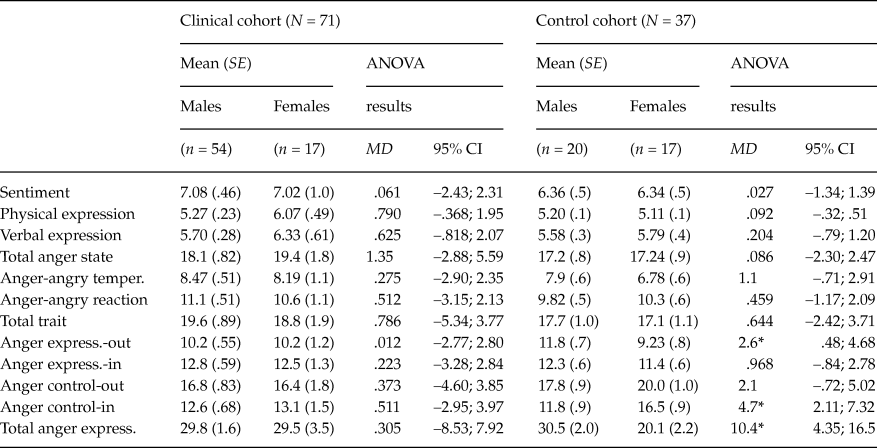
As can be observed in Table 3, ANCOVA analyses indicated that in the clinical sample, after adjusting for age and duration of the PG, there were no significant differences attributable to sex. However, in the control group, the ANCOVA revealed that males scored significantly higher in the Anger Expression Out subscale and the total Anger Expression Index. Contrarily, females obtained a higher score than males on the Anger Control In scale.
Differences between PGs and controls in STAXI-2 scales across gender

Note: 1Analysis of variance adjusted for age, duration of the disorder and TCI-R scores. 2Analysis of variance adjusted by age. SE: standard error. MD: mean differences. *Significant MD for gender with Bonferroni-Finner’s correction.
Anger, psychopathology and personality in PG
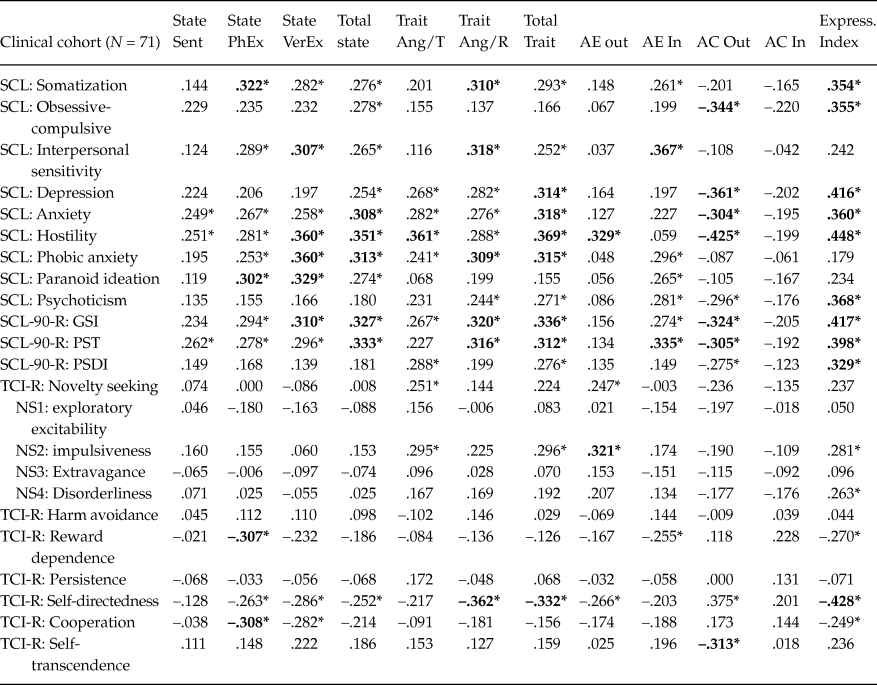
Table 4 shows the results of the Pearson correlations between the STAXI-2 scales and the clinical symptoms and personality variables. This analysis was conducted only for the case cohort (N = 71 PGs). As expected, considerable associations among several STAXI-2 subscales and all the symptomatological dimensions evaluated by the SCL-90-R (r > .30) were observed. With respect to the TCI-R subscales, a positive association between Novelty Seeking and the Anger Expression Out scale was obtained. On the other hand, a negative relationship was found between the TCI-R Reward Dependence and the STAXI-2 Physical Expression subscale. Various negative associations between Self-Directedness and several anger subscales (Total Trait, Reaction and Total Anger Expression Index) were also revealed. Finally, it is also necessary to highlight the negative correlation between Self Transcendence and Anger Control Out.
Correlations between STAXI-2, comorbid psychopathology and personality

Note: *Significant correlation (.05 level). Bold: | R | ≥ 0.30.NS1 to NS4: Novelty Seeking subscales. STAXI-2 scales: Sentiment, Physical expression, Verbal expression, total state, trait anger-angry temperament, trait anger-angry reaction, total trait, anger expression out, anger expression in, anger control out, anger control in, total anger expression index.
Predictive capacity of anger on the severity of PG
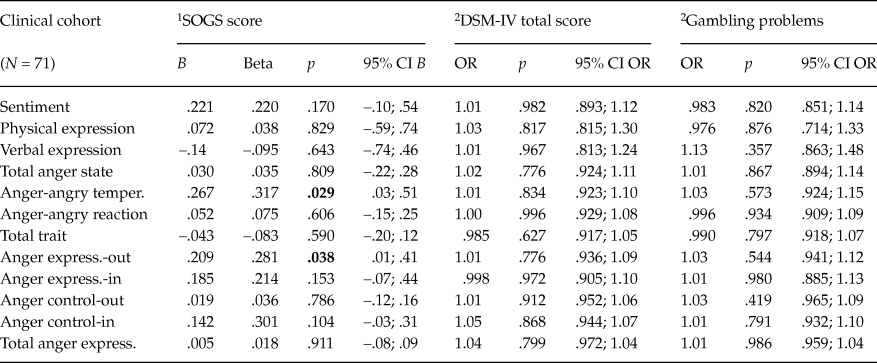
In Table 5 the results of the multiple linear regression models and the negative binomial regression models are displayed. These models assessed the predictive capacity of the STAXI-2 on the severity measures of the PG (SOGS, diagnostic DSM-IV questionnaire and number of gambling problems). After having adjusted the models for gender, age, and duration of the disorder, a positive relationship between the SOGS and the following STAXI-2 scales was made evident: Anger Temperament and Anger Expression Out. Concretely, it was found that for each point more in the Anger Temperament subscale, the SOGS increased 0.27 points (CI 95%: 0.03 to 0.51) and for each point more in the Anger Expression Out scale the SOGS augmented on average 0.21 points (CI 95 %: 0.01 to 0.41). However, the scores from the diagnostic DSM-IV questionnaire and the number of gambling problems were not associated with any of the STAXI-2 scales.
Predictive accuracy of anger on PG

Note: 1Multiple regression adjusted by sex, age, duration of the disorder and TCI-R scores. 2Negative binomial regression adjusted by sex, age, duration of the disorder and TCI-R scores.
Discussion
The present study compared several components of anger in individuals with PG and healthy controls, assessed whether there were gender differences in anger expressions in PGs and healthy controls and explored the relationship between anger, general psychopathology and personality in PG. Finally the predictive capacity of anger on the intensity of the PG was assessed.
Anger in pathological gambling and healthy controls
Our first hypothesis that the PG patients would score higher in anger expressions than healthy controls was not confirmed, since the STAXI-2 scales did not differ significantly between patients and controls. These results do not coincide with the ones of previous studies.
In this sense, although the literature on the role of anger expression in PG is scarce, there is some evidence, which suggests that anger expression is highly frequent in PG (Cunningham-Williams et al., Reference Cunningham-Williams, Gattis, Dore, Shi and Spitznagel2009; Goodyear-Smith et al., Reference Goodyear-Smith, Arroll, Kerse, Sullivan, Coupe, Tse and Perese2006; Korman, Collins, Dutton et al., Reference Korman, Collins, Dutton, Dhayananthan, Littman-Sharp and Skinner2008; Korman, Collins, Littman-Sharp et al., Reference Korman, Collins, Dutton, Dhayananthan, Littman-Sharp and Skinner2008; Sacco et al., Reference Sacco, Cunningham-Williams, Ostmann and Spitznagel2008). Moreover, the few studies assessing this topic have observed that the presence of aggressive behaviors (verbal and physical) could be related to the consequences of gambling problems, such as financial problems (Korman et al., Reference Korman, Collins, Littman-Sharp, McMain and Skinner2005; Korman, Collins, Dutton et al., Reference Korman, Collins, Dutton, Dhayananthan, Littman-Sharp and Skinner2008; Muelleman et al., Reference Muelleman, DenOtter, Wadman, Tran and Anderson2002). However, it can be postulated that domestic violence can be modulated by other problems such as comorbid disorders or personality traits such as impulsivity, among others. Yet, these studies assessed anger only tangentially, and therefore their findings are hardly conclusive.
Furthermore another problem might be related to the fact that PGs are very heterogeneous in terms of personality and associated impulsive traits such as anger (Álvarez-Moya et al., Reference Álvarez-Moya, Jiménez-Murcia, Granero, Vallejo, Krug, Bulik and Fernández-Aranda2007). Moreover, these homogeneous subgroups identified based on certain clinical characteristics of personality and psychopathology, also are associated with the type of gambling that patients choose as their addiction. Bonnaire, Lejoyeux, and Dardennes (Reference Bonnaire, Lejoyeux and Dardennes2004), suggested that gamblers who preferred skill gambling played mainly for the excitement itself, while those who prefer non-strategic games, did so to regulate negative emotional states. In that respect it could be hypothesized that the subjects of the sample are probably less impulsive tan other types of players. This might explain the lack of differences in anger found between pathological gamblers and healthy controls.
The role of gender in Anger expression
Our second hypothesis stated that men would score significantly higher on anger expression than women. The present results revealed that in the PGs, there were no significant differences across gender on any of the STAXI-2 scales. However, in the control group, men scored significantly higher on the Anger Expression Out subscale (anger expressed verbally or with physical aggressive behavior) and the general Anger Expression Index. In contrast, women revealed higher mean scores on the Anger Control In subscale (control of anger through relaxation and moderation in annoying situations) compared to males. These results go along with previous studies conducted in patients with drug dependence (Fernández & Scott, Reference Fernández and Scott2009) and general populations (Brody, Reference Brody1985). Thus, there is a link between the anger trait and behaviors like smoking, drinking and marijuana use (Nichols, Mahadeo, Bryant, & Botvin, Reference Nichols, Mahadeo, Bryant and Botvin2008). In fact, several authors suggest that anger may be a risk factor for substance use, especially in women, because through consumption they can regulate and escape from negative emotions, including anger (Gunn, & Botvin, 2006; Nichols, Graver, Brooks-Gunn, & Botvin, Reference Nichols, Graver, Brooks-Gunn and Botvin2006; Seguire & Chalmers, Reference Seguire and Chalmers2000). Colder and Stice (Reference Colder and Stice1998) even identified an association between anger and greater substance use in women, not observing this association among men. By extending these findings to non-substance abuse addictions, such as pathological gambling, it could be postulated that the differences in anger observed in the general population disappear in the presence of addictive behavior. However, if anger is the cause or consequence of pathological gambling, the cross-sectional design of our study does not allow for this setting.
Compared to the control group, some of our findings coincide with the ones obtained by Miguel-Tobal et al. (Reference Miguel-Tobal, Casado, Cano-Vindel and Spielberger1997), who found that females scored higher on the Anger Internal Control scale than males. Conversely, these authors did not find significant differences across gender in the Anger Expression Out subscale and the Anger Expression Index. Our results also agree with the ones obtained by another study (Campbell & Muncer, Reference Campbell and Muncer2008), in terms of greater inhibitory control in women than men. However, these studies assessed general psychiatric patients and did not focus exclusively on PG. The studies that have assessed anger in PG have generally not differentiated the sample in terms of gender and therefore comparisons with our results are rather difficult.
Anger and clinical, psychopathological and personality correlates
The third hypothesis of this study that the PGs with personality traits related to impulsivity, would score higher in anger expression was confirmed by our findings. We found that the individuals with gambling problems scored higher on the TCI-R Novelty Seeking Subscale (especially on the temperament NS2 subscale, which evaluates impulsivity, lack of emotional control and lack of planning) and the STAXI-2 Anger Expression Out subscale. These results are in agreement with the ones obtained by Schwebel et al. (Reference Schwebel, Severson, Ball and Rizzo2006), who found a positive relationship between the binomial concept anger/hostility and its interactions with Novelty Seeking. Furthermore, our results are in concordance with the findings of other studies which have found significant relationships between impulse control deficiencies, PG (Cunningham-Williams et al., Reference Cunningham-Williams, Grucza, Cottler, Womack, Books, Przybeck and Cloninger2005; Fernández-Aranda et al., Reference Fernández-Aranda, Jiménez-Murcia, Álvarez-Moya, Granero, Vallejo and Bulik2006) and lack of anger control (Truglia et al., Reference Truglia, Mannucci, Lassi, Rotella, Faravelli and Ricca2006). With respect to the associations between psychopathology and anger, our results indicate that individuals showing high scores in the Anger Expression Out subscale, also scored higher on the Hostility subscale of the SCL-90-R. This finding agrees with the ones of other authors, that have described aggressive behaviors (e.g., hostile or impulsive aggression, lack of modulating physiological arousals and loss of behavioral control) in PGs (Blaszczynski & Nower, Reference Blaszczynski and Nower2002; Ramírez & Andreu, Reference Ramírez and Andreu2006; Stewart et al., Reference Stewart, Zack, Collins and Klein2008).
Conversely, the PG patients who scored high on the Anger Expression In (feelings of anger are suppressed) STAXI-2 scale, also scored high on the SCL-90-R Interpersonal Sensitivity scale, which is in accordance with the results obtained by Gilbert and colleagues who assess a sample of depressive patients (Gilbert, Irons, Olsen, Gilbert, & McEwan, Reference Gilbert, Irons, Olsen, Gilbert and McEwan2006). However, high scores in the Anger Control Out Scale (control of the expression of feeling angry by avoiding its demonstration towards other persons or objects), were found to correlate negatively with the following SCL-90-R scales: Obsessive-Compulsive, Depression, Anxiety and Hostility, and the TCI-R Self-transcendence scale.
These results would justify from explanatory theories about the heterogeneity of gambling and the existence of homogeneous groups. This homogeneity would depend on the implication of certain neurobiological and psychosocial variables. Mostly, studies that have identified pathological gamblers subtypes can be classified in three subgroups, in adolescent populations and in young people up to five have been reported (Gupta et al., Reference Gupta, Nower, Derevensky, Blaszczynski, Faregh and Temcheff2013).However, they all agree that there is a subtype characterized by greater impulsivity, sensation seeking, antisocial behavior, early onset age, comorbid substance abuse, severity gambling problem and increased neurobiological vulnerability. Another subtype would be characterized by emotionally vulnerable individuals with late age of onset, poor coping skills, greater presence of life stressors, more lifetime and current comorbidity with anxiety and affective disorders and feelings of inferiority, low self-esteem and fear of rejection. Finally, there’s a third group with milder gambling problems, more emotional stability and adapted personality profiles, in which the involvement of environmental factors would be more relevant (Álvarez-Moya et al., Reference Álvarez-Moya, Jiménez-Murcia, Aymamí, Gómez-Peña, Granero, Santamaría and Fernández-Aranda2010; Blaszczynksi & Nower, Reference Blaszczynski and Nower2002; Iancu, Lowengrup, Dembinsky, Kotler, & Dannon, Reference Iancu, Lowengrup, Dembinsky, Kotler and Dannon2008; Nower, Martins, Lin, & Blanco, Reference Nower, Martins, Lin and Blanco2013).
From this perspective, it could be postulated that the obtained results in the anger scale could be explained by considering the three subgroups described in the literature. According to our results, an association between high verbal expression and impulsivity and sensation seeking has been observed. This would be consistent with the impulsive subtype, high suppressed feelings of anger with interpersonal sensitivity (low self-esteem and feelings of inferiority), an association that would coincide with the subtype of emotional vulnerability and finally, anger control out scores with less psychopathology (measured by SCL-90-R), which would be consistent with the subtype most suited and more capable of self-control.
Future studies about categorization of subgroups of pathological gamblers could include that variable to confirm these results.
Predictive capacity of anger on PG
The final goal of the present study was to evaluate the predictive capacity of various facets of anger on the intensity of the PG disorder. Higher scores in the Angry Temperament subscale (a trait that indicates the disposition to experience anger without a specific provocation) and the Anger Expression Out scale increased the severity of the disorder (measured by the SOGS). However, this positive association was not observed with the DSM-IV diagnostic criteria (measured by DSM-IV questionnaire). One explanation that would justify this finding can be found in the difference between the two instruments used. The predictive ability of the SOGS, rather than DSM-IV questionnaire, could be due to its range of variation. In SOGS, scores range from 0–16, while in the DSM-IV this variation is only between 0–10. Moreover, considering only the scores indicating the presence of gambling problems, the scale is also more restricted for the DSM-IV (positive cases range between 5–10), tan the SOGS (5–16). Moreover, it has been shown that the DSM-IV diagnostic questionnaire of Stinchfield presents a moderate correlation with other measures, including SOGS (Jiménez-Murcia et al., Reference Jiménez-Murcia, Stinchfield, Álvarez-Moya, Jaurrieta, Bueno, Granero and Vallejo2009).
Again, this relationship could be justified contextualizing in the theory of subgroups. Several authors have all pointed out that the impulsive subtype (that at the same time would be that which presents high levels of hostility, aggression and antisocial traits) is the most serious and complex to treat, recommending the need to tailor tested approaches to psychopathological characteristics and personality of these patients (Álvarez-Moya et al., Reference Álvarez-Moya, Jiménez-Murcia, Aymamí, Gómez-Peña, Granero, Santamaría and Fernández-Aranda2010; Blaszczynski & Nower, Reference Blaszczynski and Nower2002). It could be consider that the anger trait may be a measure of severity of pathological gambling, as demonstrated in alcohol and substance addictions (Evren, Cinar, Evren & Celik, Reference Evren, Cinar, Evren and Celik2012; Kachadourian, Taft, O’Farrell, Doron-Lamarca, & Murphy, Reference Kachadourian, Taft, O'Farrell, Doron-Lamarca and Murphy2012).
The present study also has several limitations. First, the retrospective and self-report data collection procedures may limit the validity and the reliability of our findings. Second, the cross-sectional design does not allow us to determine causality of the variables assessed. Third, the lack of specific tests in the control group (except for the SOGS and the DSM-IV diagnostic questionnaire, solely for the purpose of identifying positives cases of pathological gambling and exclude them from the study),does not allow us to establish more comparisons between the two groups on measures of personality. Also, the control group, were not interviewed face-to-face, to exclude psychopathological symptoms. Fourth, the lack of more specific assessment measures (e.g., structured interview for Axis I, II comorbid disorders), does not allow us to, validly and reliably, analyze comorbidity in the clinical group. Fifth, this study has been conducted with a sample of treatment-seeking pathological gamblers and, in addition, the majority were slot machine gamblers. So our results cannot be generalized to other gambling populations. Finally, it is also important to acknowledge that the sample size in the present study was very small and could therefore have influenced the results. However, it should be noted that PG is an illness which is more common in males than females and therefore men generally seek treatment more often than women.
Longitudinal studies could explore the role of anger in the etiological factors and clinical course of PG. In addition further studies could assess the influence of multiple psychological, neurobiological, genetic or social factors that might have an influence over anger and PG. In conclusion, the present findings contribute to an improved understanding of how the several facets of anger are associated with gender, psychopathology and personality traits, and that merits further exploration.
Partial financial support was received from the Spanish Ministerio de Economía y Competitividad (PSI2011–28349), Fondo de Investigación Sanitaria (CIBER; CB06/03/0034), Generalitat de Catalunya FI (2005 FI 00425) and FI (2008 FI_A 00370). The CIBER Fisiopatología de la Obesidad y Nutrición is an initiative of ISCIII. This work is part of the doctoral dissertation of Neus Aymamí at the Universitat Autònoma de Barcelona, within the program Doctorat en Psicopatologia de nens, adolescents i adults.