Introduction
Mexico is the second largest guava producer worldwide (around 27,000 ha being cultivated), just behind India. More than 50% of guavas are cultivated in the ‘Calvillo-Cañones’ region of México (González-Gaona et al., Reference González-Gaona, Padilla-Ramírez, Reyes-Muro, Perales-De la Cruz and Esquivel-Villagrana2002), which includes the states of Aguascalientes (Calvillo) and Zacatecas (Tabasco, Huanusco, Jalpa, Apozol and Juchipila). The guavas from this region exhibit the highest quality and longest shelf-life (Padilla-Ramírez et al., Reference Padilla-Ramírez, González-Gaona, Esquivel-Villagrana, Mercado-Silva, Hernández-Delgado and Mayek-Pérez2002). Fruit yields in the Calvillo-Cañones region range from 13 to 15 ton/ha and are generally limited by low water levels, soil salinity and fertility, amongst other abiotic (drought, frost) and biotic (nematodes, insect pests and diseases) factors (González-Gaona et al., Reference González-Gaona, Padilla-Ramírez, Reyes-Muro, Perales-De la Cruz and Esquivel-Villagrana2002). Guava breeding could help increase crop productivity and fruit quality, but the first step includes the characterization of the genetic variability in the germlines propagated, in order to detect those trees that can be employed as parents for crop improvement. Although broad phenotypic and productive variability has been found in most orchards in the Calvillo-Cañones region, due to the fact that guavas are propagated by seed (Martinez-De Lara et al., Reference Martínez-De Lara, Barrientos-Lara, Reyes-de Anda, Hernández-Delgado, Padilla-Ramírez and Mayek-Pérez2004), no intensive morphological and/or molecular characterization of guava germplasm has been carried out. Both low phenotypic and genetic variability have been found in guava germplasm of diverse origins (Du Preez and Welgemoed, Reference Du Preez and Welgemoed1990; Tong et al., Reference Tong, Medina and Esparza1991; Ribeiro et al., Reference Ribeiro, Picarelli, Antunes, Magali and Igue1998; Padilla-Ramírez et al., Reference Padilla-Ramírez, González-Gaona, Esquivel-Villagrana, Mercado-Silva, Hernández-Delgado and Mayek-Pérez2002). Amplified fragment length polymorphism (AFLP) analysis is a very useful molecular marker technique, of genome-wide coverage, that allows detection of a high number of polymorphisms. AFLPs have recently been used to analyse 62 Cuban guava accessions (Valdés-Infante et al., Reference Valdés-Infante, Decker, Rodríguez, Velázquez, González, Sourd, Rodríguez, Ritter and Rohde2003), where cluster analysis did not clearly separate the introduced germplasm from Florida and Seychelles Islands from Cuban germplasm, which was mainly selected from open pollination rather than controlled crosses. However, no molecular marker-based characterizations of Mexican guava germplasm have been carried out, and only one report using random amplified polymorphic DNA (RAPD) technology has been published, where 12 guava accessions were analysed, allowing the detection of high genetic similarities among them (Padilla-Ramírez et al., Reference Padilla-Ramírez, González-Gaona, Esquivel-Villagrana, Mercado-Silva, Hernández-Delgado and Mayek-Pérez2002). In order to contribute to the knowledge of this important fruit, we present here the results of morphological, productive and genetic analyses of 52 guava accessions.
Materials and methods
Plant materials
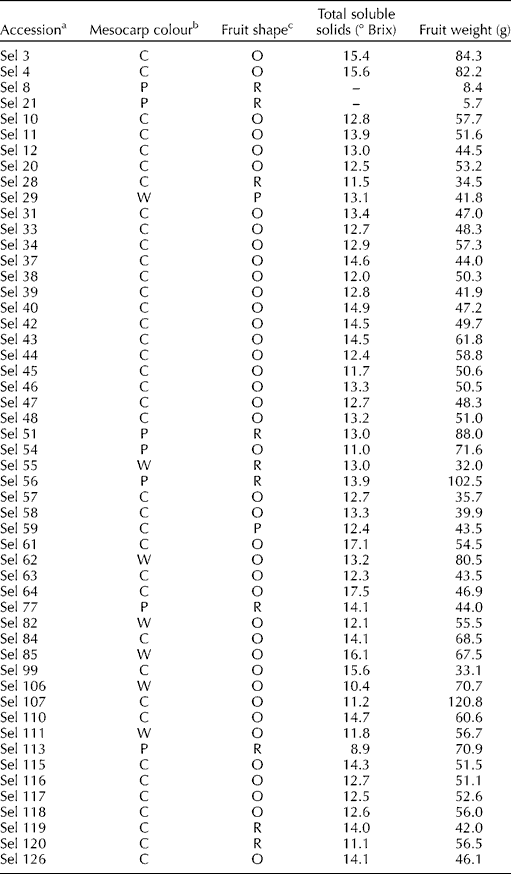
The work includes accessions from the Guava Germplasm Bank of INIFAP (National Institute for Forest, Agricultural and Livestock Research) located at Los Cañones Research Station (CEDEC) in Huanusco, Zacatecas, Mexico (21°45′N; 102°58′W; 1500 m above sea level). The Guava Germplasm Bank includes 48 Psidium guajava (L.) accessions (Table 1) collected in five counties from the state of Zacatecas (Huanusco, Apozol, Juchipila, Tabasco and Jalpa) and one county of Aguascalientes (Calvillo) in 1990, as well as two accessions of P. cattleianum (Sabine), and two of P. friedrichsthalianum (Berg-Niedenzu) introduced from Costa Rica (Perales and Silguero, Reference Perales and Silguero1995). Each guava accession was one tree planted at 3 × 3 m in 1990 (9 years old). The germplasm was subjected to the agronomical practices recommended by INIFAP. These practices include annual fertilization using 60–60–60 NPK; manual weed control; chemical control of insect pests such as Conotrachelus spp. (malathion) and Cyclocephala lunulata (parathion); chemical control of diseases such as Pestalotia psidii (cupravit); annual pruning to eliminate dead or diseased branches; and annual induction of water stress 4 months after fruiting (a practice called ‘calmeo’) to define the next harvest period (Padilla-Ramírez et al., Reference Padilla-Ramírez, González-Gaona, Valadez-Marín, Esquivel-Villagrana and Reyes-Muro1999; González-Gaona et al., Reference González-Gaona, Padilla-Ramírez, Reyes-Muro, Perales-De la Cruz and Esquivel-Villagrana2002).
Agronomic characteristics of the guava germplasm included in this work

a Sel 3 and 4 are P. friedrichsthalianum; Sel 8 and 21 are P. cattleianum; all others are P. guajava.
b Mesocarp colour: W, white; C, cream/beige; P, pink.
c Fruit shape: O, ovoid; R, round; P, pear.
Morphological and productive analyses
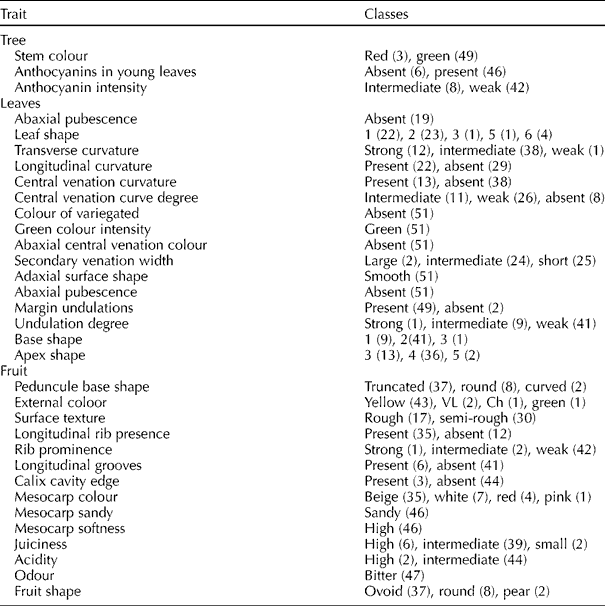
Fifty morphological characteristics described by UPOV (1987) were measured in each accession during 2002–2003. Descriptors included five characteristics of trees, 18 of leaves and 27 of fruits (Table 2). Data were registered from 20 leaves and/or fruits by accession. Total soluble solid contents were measured using a refractometer (ATAGO® model N-1EBX) (Mercado-Silva et al., Reference Mercado-Silva, Benito-Bautista and García-Velasco1998). The fruit production of each accession was registered through productive cycles 1999–2000, 2000–2001 and 2001–2002. The fruits were harvested at physiological maturity (Mercado-Silva et al., Reference Mercado-Silva, Benito-Bautista and García-Velasco1998). Number of fruits and fresh fruit yield per accession were registered and average fruit weight calculated. Fruit colour and shape were determined based on UPOV (1987) characteristics.
Summary of qualitative characteristics measured in 52 guava accessions

Numbers between parentheses indicate the number of accessions by class.
AFLP analysis
Total genomic DNAs were extracted from 0.5 g of young leaves of each plant by the cetyl trimethyl ammonium bromide (CTAB) method of Doyle and Doyle (Reference Doyle and Doyle1987) with slight modifications (Padilla-Ramírez et al., Reference Padilla-Ramírez, González-Gaona, Esquivel-Villagrana, Mercado-Silva, Hernández-Delgado and Mayek-Pérez2002). Polyvinyl-pyrrolidone (PVP, approximately 1 mg per sample) was included when leaf tissues were macerated with liquid nitrogen. DNA concentrations were digitally estimated on agarose gels by comparison with standard λ phage digested by HindIII and the AFLP protocol was performed following Vos et al. (Reference Vos, Hogers, Bleeker, Reijans, van der Lee, Hornes, Frijters, Pot, Peleman, Kuiper and Zabeau1995). Approximately 150 ng genomic DNA were subjected to double-digestion by EcoRI and Tru91 endonucleases at 37 °C for 4 h and incubated at 70°C for 15 min. The DNA fragments were linked to EcoRI and MseI adapters at 15°C overnight. After pre-selective amplification by polymerase chain reaction (PCR) using the nucleotide A, a second selective amplification by PCR was performed with four combinations of EcoRI and MseI primers. AFLP reaction products were denatured by boiling with formamide buffer (98% formamide, 10 mM EDTA, bromophenol blue, xylene cyanol). All samples were electrophoresed on 6% denaturing polyacrylamide gels (35 × 45 cm) for 3 h at 2000 V and then revealed using the manufacturer's instructions for the Silver Sequence Staining Reagents kit (PromegaR) manual.
Data analysis
Morphological analysis
Descriptive statistics (mean, variance, standard deviation and coefficient of variation) were calculated in all quantitative variables. Data were subjected to principal component (PC) analysis in order to identify the most explicative morphological variables (Hair et al., Reference Hair, Anderson, Tatum and Black1992). Data analysis was performed using the software Statistica version 5.0 (StatSoft, Tulsa, Oklahoma, USA).
Productive analysis
The fruit yield per accession data were subjected to analysis of variance (ANOVA) using a randomized complete block design, where treatments were the guava accessions and replicates the years of evaluation. Broad-sense heritability of fruit yield was calculated as described by Molina-Galán (Reference Molina-Galán1992). Finally, Pearson's correlation coefficients of some productive characteristics were calculated. Statistical analysis was performed using the software SAS version 6.12 (SAS Institute Inc., Cary, North Carolina, USA).
Genetic analysis
A binary matrix reflecting the presence (1) or absence (0) of each AFLP band was generated for each genotype. The genetic distance between accessions was estimated using a simple matching method. Cluster analysis using the similarity matrix was performed with Statistica 5.0 using the UPGMA algorithm (Hair et al., Reference Hair, Anderson, Tatum and Black1992), as well as a hierarchical analysis of molecular variance (AMOVA) (Excoffier et al., Reference Excoffier, Samuse and Quattro1992) using Arlequin 1.0 software (Schneider et al., Reference Schneider, Kueffer, Roessli and Excoffier1997). Diversity index (DI) values for each primer combination and averaged diversity were calculated as described by Powell et al. (Reference Powell, Morgante and Andre1996):

where p i is the frequency of a band in the population, and n, the number of individuals analysed. Diversity values for each primer combination and averaged diversity value were calculated as:

where r is the number of markers revealed by primer combination.
Molecular variance was partitioned in four hierarchies: P. cattleianum accessions, P. friedrichsthalianum accessions, the 12 most productive P. guajava accessions and the other 36 less productive P. guajava accessions. The number of permutations for significance testing was set at 1000 for all analyses.
Results
Morphology
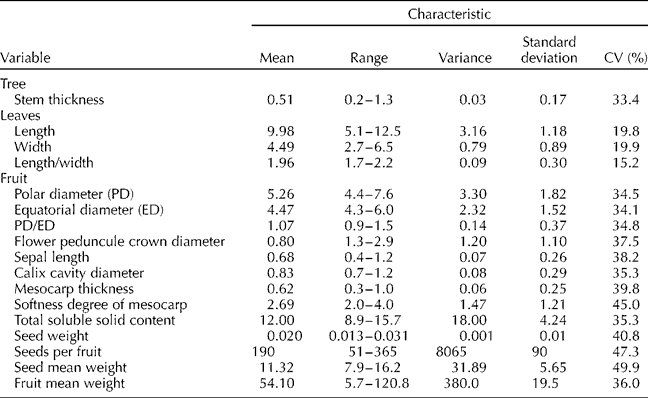
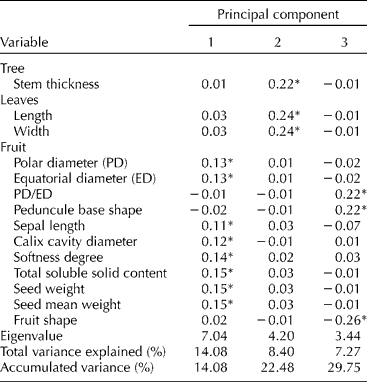
Morphological characteristics measured in guava germplasm were separated into qualitative (33) and quantitative (17) traits (Tables 2 and 3). Three qualitative characteristics showed more than three classes (leaf shape, fruit colour, fruit mesocarp colour), while eight characteristics exhibited one class (abaxial pubescence, variegated colour, leaf colour intensity, venation colour, abaxial surface shape, mesocarp sandy, mesocarp softness, fruit odour) (Table 2). Some quantitative characteristics were highly variable [mesocarp thickness, mesocarp softness, total soluble solid content (TSSC), seed weight, seed mean weight, seeds per fruit]. The less variable characteristics were length, width and length/width ratio of leaves (Table 3). The three principal components obtained from the principal component analysis (PCA) explained less than 30% of total variation found in guava germplasm. Fourteen characteristics were the most explicative of guava morphology: one from tree, two from leaves and 11 from fruit; two characteristics were qualitative and the other 12 quantitative. For principal components (PC) 1 and 3, the most explicative characteristics were fruit traits, while for PC 2 the most important were vegetative traits (tree and leaves) (Table 4). The accessions 3 (P. friedrichsthalianum), 8, 21 (P. cattleianum); 44 and 107 (P. guajava) were not included in the PCA, as not enough data were registered. Three major groups of accessions were shown by PCA. One group included four accessions that show high fruits size and weight, as well as high stem diameter and large leaves. The second group of accessions included 46 accessions with intermediate fruit weight, intermediate stem diameter and leaf size. Finally, the third group included accession 51 which exhibited the lowest averages in the characteristics mentioned above (data not shown).
Statistical summary of quantitative characteristics registered in 52 guava accessions

CV, Coefficient of variation.
Eigenvalues of the most descriptive characteristics on the basis of principal component analysis in guava accessions

*p ≤ 0.0001.
Productivity
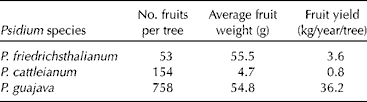
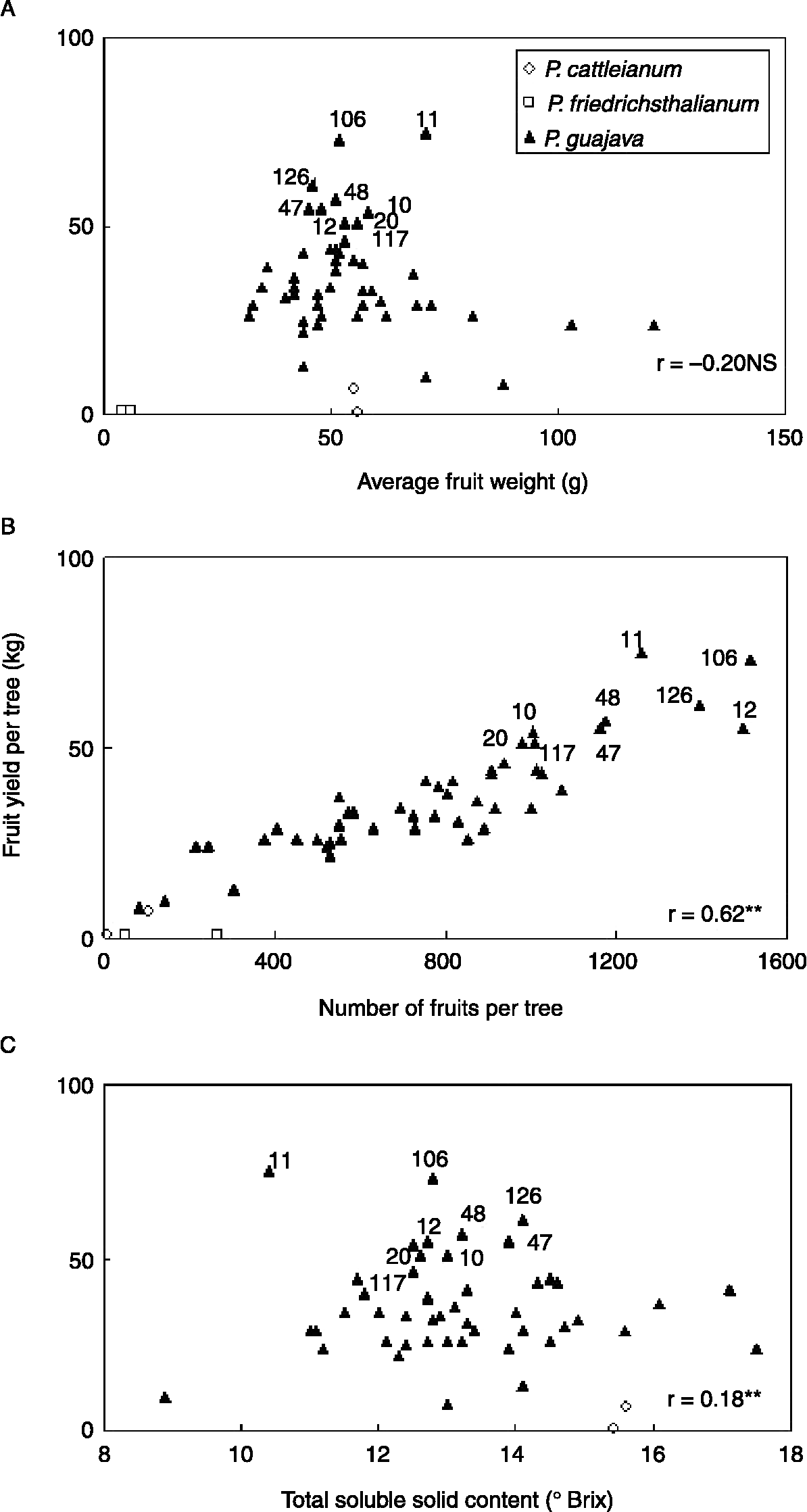
Significant differences in fruit yield were found among guava accessions and years (Table 5); P. guajava accessions produced 36 kg/year/tree of fresh fruit while P. cattleianum and P. friedrichsthalianum accessions showed fruit yields lower than 7 kg/year/tree. The fruit yield broad sense heritability was 0.25. Fruit yield per tree was significantly associated with the number of fruits per tree and showed an intermediate relationship with the number of seeds per fruit (positive) and seed weight (negative). The TSSC was negatively associated with the number of seeds per fruit (data not shown). The highest yielding accessions showed the greatest number of fruits per tree, such as accessions 106, 11, 126, 12, 48, 47, 10, 20 and 117, although most of them showed an average fruit weight from intermediate to small, cream mesocarp, round or ovoid fruit shape and intermediate TSSC (from 10 to 14%). The P. guajava accessions showed the highest average of fruits per tree and fruit yield per tree, while P. friedrichsthalianum and P. guajava accessions had the highest fruit weight (Fig. 1).
Productive characteristics of guava germplasm during 3 years

Dispersion of guava accessions on the basis of the three major principal components of the principal components analysis of morphological data, which explained 29.8% of total variation.

AFLP analysis
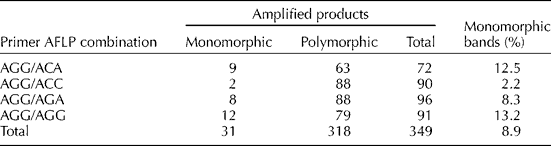
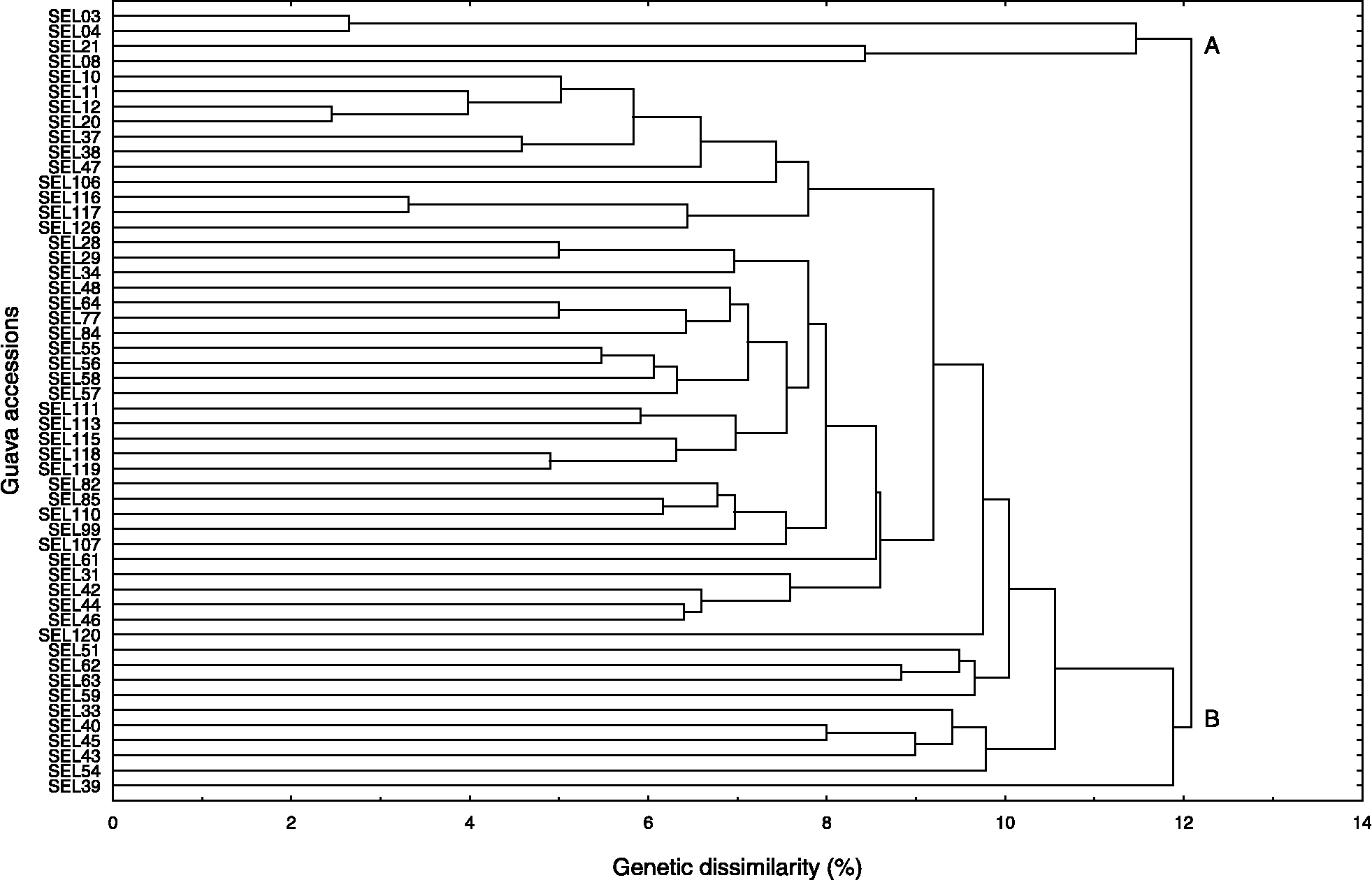
The four AFLP primer combinations produced 349 amplified products where 31 were monomorphic (8.9%) (Table 6). The averaged genetic diversity index in guava germplasm was 0.584. There were significant differences (P < 0.001) for all AMOVA hierarchies assessed (P. cattleianum accessions, P. friedrichsthalianum accessions, the 12 most productive P. guajava accessions and the other 36 less productive P. guajava accessions) but the most variation was found within guava accessions (Table 7). The dendrogram produced two major clusters of guava accessions. Cluster A included accessions 3 and 4 (P. friedrichsthalianum) and 8 and 21 (P. cattleianum) while cluster B included 48 P. guajava accessions (Fig. 2).
Number of amplified bands by four amplified fragment length polymorphism (AFLP) combinations in 52 guava accessions

Analysis of molecular variance (AMOVA) for guava germplasm analysed with amplified fragment length polymorphisms

Dendrogram of genetic dissimilarities among 52 guava accessions, performed by the UPGMA algorithm.

Discussion
Morphological and productive diversity
In our work, we found low morphological diversity among guava accessions. Low morphological diversity has been reportedly found in Mexico (Laksminarayana and Moreno, Reference Laksminarayana and Moreno1978; Perales and Silguero, Reference Perales and Silguero1995; Padilla-Ramírez et al., Reference Padilla-Ramírez, González-Gaona, Esquivel-Villagrana, Mercado-Silva, Hernández-Delgado and Mayek-Pérez2002; Martínez-De Lara et al., Reference Martínez-De Lara, Barrientos-Lara, Reyes-de Anda, Hernández-Delgado, Padilla-Ramírez and Mayek-Pérez2004) and in other countries (Du Preez and Welgemoed, Reference Du Preez and Welgemoed1990; Tong et al., Reference Tong, Medina and Esparza1991; Ribeiro et al., Reference Ribeiro, Picarelli, Antunes, Magali and Igue1998). The three major principal components (PCs) produced by the PCA explained less than 30% of total variation found in guava germplasm. For the PCs 1 and 3, the most explicative characteristics were fruit traits, while for PC 2 the characteristics were tree and leaf traits. Sanabria et al. (Reference Sanabria, García, Díaz and Muñoz2005) reported 72% of explained variation by the three major PCs generated from the morphological analysis of 53 guava accessions from Valle del Cauca, Colombia. In addition, 75% of the quantitative traits measured were highly variable and explicative of morphological variability of Colombian guava, and each PC was led by a group of traits: PC 1 included fruit yield characteristics, PC 2 included tree traits, and PC 3 was defined by fruit quality variables. Our work could be less explicative due to the fact that we took 50 characteristics into account, 33 qualitative and 17 quantitative while Sanabria et al. (Reference Sanabria, García, Díaz and Muñoz2005) used 25 descriptors, 16 quantitative and only 9 qualitative. We found a high frequency of accessions with ovoid fruit shape (77%) and beige/cream mesocarp colour (73%). Sanabria et al. (Reference Sanabria, García, Díaz and Muñoz2005) reported a high frequency of guavas with ovoid fruit shape (53%) and pink mesocarp (57%). In each case, the most frequent fruit characteristics are closely associated with local preferences for fresh guava marketing (González-Gaona et al., Reference González-Gaona, Padilla-Ramírez, Reyes-Muro, Perales-De la Cruz and Esquivel-Villagrana2002; Molero et al., Reference Molero, Molina and Casassa-Padron2003; Sanabria et al., Reference Sanabria, García, Díaz and Muñoz2005). In Mexico, guavas must show those characteristics exhibited by the ‘Media China’ fruit type commonly grown in the Calvillo-Cañones region, which includes TSSC > 10° Brix, softness of mesocarp, juiciness and low acidity. In addition, fruit must show intermediate weight (50–100 g/fruit), round–ovoid shape, cream/beige mesocarp colour, and high mesocarp/seeds weights ratio (González-Gaona et al., Reference González-Gaona, Padilla-Ramírez, Reyes-Muro, Perales-De la Cruz and Esquivel-Villagrana2002). These characteristics have been successful and empirically selected by guava farmers from the Calvillo-Cañones region. Mexican guava germplasm shows lower average fruit weight and higher TSSC compared to germplasm from Cuba (Rodríguez et al., Reference Rodríguez, Valdés-Infante, Becker, Velázquez, Coto, Ritter and Rohde2004), Colombia (Quijano et al., Reference Quijano, Suárez and Duque1999), Venezuela (Tong et al., Reference Tong, Medina and Esparza1991; Molero et al., Reference Molero, Molina and Casassa-Padron2003; Isea-Luna et al., Reference Isea-Luna, Marín-Larreal, Arenas and Sandoval2004), Malaysia and Vietnam (Yusof, Reference Yusof1989). In addition, Mexican guava germplasm shows good adaptation to the highly restrictive growing conditions of the Calvillo-Cañones region where water deficits and frost commonly occur, and soils are frequently shallow and of poor fertility (Padilla-Ramírez et al., Reference Padilla-Ramírez, González-Gaona, Esquivel-Villagrana, Mercado-Silva, Hernández-Delgado and Mayek-Pérez2002). Our results correspond to those of Martínez-De Lara et al. (Reference Martínez-De Lara, Barrientos-Lara, Reyes-de Anda, Hernández-Delgado, Padilla-Ramírez and Mayek-Pérez2004) since fruit traits such as polar and equatorial diameter, mesocarp thickness and colour, and fruit weight and shape give a good indication of phenotypic variability in Mexican guava. In addition, the results suggest that each guava orchard in the Calvillo-Cañones region has been established using plants with diverse origins, or even plants produced by seeds (Laksminarayana and Moreno, Reference Laksminarayana and Moreno1978; Martínez-De Lara et al., Reference Martínez-De Lara, Barrientos-Lara, Reyes-de Anda, Hernández-Delgado, Padilla-Ramírez and Mayek-Pérez2004). We found no strong correlation between morphology and productivity in guava as described by Muy-Rangel et al. (Reference Muy-Rangel, Pérez-Rubio, Báez-Sañudo, García-Estrada and Siller-Cepeda1999), who studied bred guava germplasm growing in north-eastern Mexico. Therefore, there is a low probability of identifying reliable morphological markers for high fruit yield breeding in guavas from Calvillo-Cañones, Mexico.
Genetic diversity
AFLP fingerprinting clearly separated the wild guava accessions (P. cattleianum and P. friedrichsthalianum) from cultivated P. guajava accessions. Valdés-Infante et al. (Reference Valdés-Infante, Decker, Rodríguez, Velázquez, González, Sourd, Rodríguez, Ritter and Rohde2003) showed the absence of separated clusters representing accessions introduced from Florida, USA or the Seychelles Islands from Cuban germplasm, due the selection of guava lines from open pollination rather than from controlled crosses. Prakash et al. (2002), Rueda et al. (Reference Rueda, Muñoz, Saavedra, Palacio, Bravo and Escobar-Soto2003) and Sanabria et al. (Reference Sanabria, García, Muñoz and Díaz2006) analysed 41 genotypes of Psidium from India using RAPDs, 27 guava accessions growing at a germplasm bank in Colombia, and 53 native accessions from Valle del Cauca, Colombia, respectively. In all cases, molecular marker analyses reported a clear differentiation and high genetic heterozygosity based on geographical origin of guava accessions.
The AMOVA indicated that the highest genetic variance is located in the guava accessions rather than among species or groups of accessions based on productivity, as Sanabria et al. (Reference Sanabria, García, Muñoz and Díaz2006) found in native Colombian guavas. Despite significant differentiation among the analysed hierarchies in the AMOVA, genetic flux among guava populations from the different locations of collection is highly probable, as sexual propagation of guavas is a common practice and open pollination frequent. In addition, birds, cattle or humans can propagate guava seeds (Molero et al., Reference Molero, Molina and Casassa-Padron2003). High average genetic diversity was found (DI = 0.584) compared to the DI reported by Sanabria et al. (Reference Sanabria, García, Muñoz and Díaz2006) (0.439) and Rueda et al. (Reference Rueda, Muñoz, Saavedra, Palacio, Bravo and Escobar-Soto2003) (0.198). Lower DI values were probably influenced by the sample sizes used by the last two authors, and the total amplified products subjected to statistical analysis were significantly less than the number of bands analysed in the present work.
Concluding remarks
Despite the low morphological diversity found in guava germplasm from the Calvillo-Cañones region, we have identified promising germplasm on the basis of fruit and productive characteristics, such as the intermediate fruit weight, beige mesocarp colour, ovoid or round fruit shape, low contents of seeds, and high TSSC, all of them important characteristics for Mexican markets and industry (González-Gaona et al., Reference González-Gaona, Padilla-Ramírez, Reyes-Muro, Perales-De la Cruz and Esquivel-Villagrana2002). Although vitamin C contents were not measured in this work, previous studies where guava germplasm from Calvillo has been included show that Mexican germplasm has up to 520 mg/100 g of mesocarp, compared to 80 mg of vitamin C/100 g of mesocarp in foreign germplasm (Laksminarayana and Moreno, Reference Laksminarayana and Moreno1978). In addition, Vasco-Méndez et al. (Reference Vasco-Méndez, Guevara-Romero, Acero-Godínez and Toro-Vázquez2002) emphasized that guava germplasm from the Calvillo-Cañones region indicates high concentrations of K (1.04 to 1.44%) and the lipidic fraction of seeds indicates high concentrations of linolenic (80%), palmitic (8%) and oleic (7%) acids, with good potential for industry.
As a first step, we suggest that outstanding accessions could be propagated extensively for re-planting or the establishment of new orchards in the Calvillo-Cañones region, to avoid phenotypic and genetic variability within orchards. Later, outstanding accessions could be crossed with them or crossed with foreign-bred germplasm and then pedigree methods or individual selection could be applied. The low heritability of fruit yield can affect the efficiency of any breeding strategy. This fact can be avoided by reducing variable environmental conditions during the evaluation of segregating germplasm.
Molecular marker methodologies such as RAPDs (Padilla-Ramírez et al., Reference Padilla-Ramírez, González-Gaona, Esquivel-Villagrana, Mercado-Silva, Hernández-Delgado and Mayek-Pérez2002; Prakash et al., Reference Prakash, Narayanaswamy, Suresh and Sondur2002), AFLPs (Valdés-Infante et al., Reference Valdés-Infante, Decker, Rodríguez, Velázquez, González, Sourd, Rodríguez, Ritter and Rohde2003) and microsatellites (Risterucci et al., Reference Risterucci, Duval, Rhode and Billotte2005; Valdés-Infante et al., Reference Valdés-Infante, Becker, Rodríguez, Velázquez, González, Sourd, Rodríguez, Ritter and Rohde2005; Sanabria et al., Reference Sanabria, García, Muñoz and Díaz2006) have been applied successfully in guava, and precise differentiation and classification have been reported. Until recently, guava characterizations had been limited to morphological and productive analysis of native genetic resources or outstanding native and introduced bred genotypes in different locations and years of evaluation. This is the first report where a reliable molecular marker system such as AFLPs has been used to identify genetic differences among guava germplasm and to establish its relationship with productivity in Mexico. Genetic diversity levels of Mexican guava germplasm will provide the breeders with a starting point for designing crosses to increase the genetic diversity of their material. AFLPs could constitute a reliable molecular marker test for assessing distinctness of new guava cultivars and for the management of reference collections, and provide the potential for identifying guava cultivars and predicting whether a particular propagated tree could have promising productive traits. Marker-assisted selection is a major challenge for guava breeders.
As traditional breeding has been successfully conducted for production of new cultivars (Gonzaga-Neto et al., Reference Gonzaga-Neto, Pedorsa, Abramof, Bezerra, Dantas, Silva and Souza1986, Reference Gonzaga-Neto, Abramos, Becerra, Pedrosa and Silva1987, Reference Gonzaga-Neto, Fernandez and de Souza2003; González-Gaona et al., Reference González-Gaona, Padilla-Ramírez, Reyes-Muro, Perales-De la Cruz and Esquivel-Villagrana2002), future efforts should be focused on developing strategies for molecular breeding. In this sense, the genetic analysis of native and/or bred guava germplasm has been a good beginning. Molecular marker methodologies have helped to develop Psidium molecular physical maps and mapping quantitative trait loci (QTLs) associated with vegetative and productive characteristics (Valdés-Infante et al., Reference Valdés-Infante, Decker, Rodríguez, Velázquez, González, Sourd, Rodríguez, Ritter and Rohde2003, Reference Valdés-Infante, Becker, Rodríguez, Velázquez, González, Sourd, Rodríguez, Ritter and Rohde2005). Further mapping of important genes and QTLs for both fruit yield and quality, together with morpho-agronomic characterization, could help guava breeding programmes in Mexico and other countries.
Acknowledgements
The authors wish to thank A. de Alba Ávila M.Sc. (Campo Experimental Pabellón-INIFAP), P. Larralde-Corona Ph.D. (CBG-IPN) and R. Rico-Martínez Ph.D. (Universidad Autónoma de Aguascalientes) for critical reading and useful suggestions to the manuscript. We also thank M. González-Paz B.Sc. (CBG-IPN) for assistance with data analysis. Financial support was supplied by Dirección General de Educación Tecnológica Agropecuaria (DGETA-SEP), FOMIX-Gobierno del Estado de Tamaulipas (grant TAMPS-2003-C01-03) and SNICS-SAGARPA (grant No. 056). S.H.-D. thanks COSNET-SEP for the fellowship for his M.Sc. studies at ITA-20. N.M.-P. and J.S.P.-R. are SNI fellows and N.M.-P. is a COFAA-IPN and EDI-IPN fellow.