St Mary’s parish church at Sparham (fig 1), located some 20 km north west of Norwich, in Norfolk, contains two striking paintings of animated corpses, which originally belonged to its late fifteenth-century rood-screen. One shows a pair of clothed figures in a pastoral setting; the other a shrouded, skeletal body kneeling in an intramural tomb (fig 2). These panels constitute one of England’s most original medieval contributions to the genre of death imagery. Their iconography, grounded in local and northern European traditions, is both sophisticated and unique. Yet they are representative of late medieval English panel painting as a whole in being under-researched and imperfectly understood. The Sparham panels have never been analysed in detail: the most substantial previous discussions are a two-page letter in the Gentleman’s Magazine for 1846 and a short catalogue entry in Audrey Baker’s Courtauld Institute doctoral thesis of 1938.Footnote 1 In mainstream scholarly literature, the tendency has been to regard them as Huizingarian inflections in a devotional landscape considered emotionally, and to an extent artistically, less colourful than that of the continent. The watercolours, simultaneously ghoulish and droll, accompanying Bede Camm’s article on screen painting in Clement Ingleby’s Supplement to Blomefield’s Norfolk (1929) encapsulate the received view of these important works as idiosyncratic, even quaint, aberrations.Footnote 2 The following study is an attempt to contextualize, describe and explain the Sparham panels in a way that acknowledges their status and power as art objects, but also assumes the limitations of such a classification in the pursuit of historically rooted meaning.
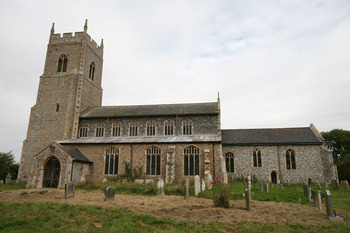
Sparham: parish church, from the south. Photograph: author

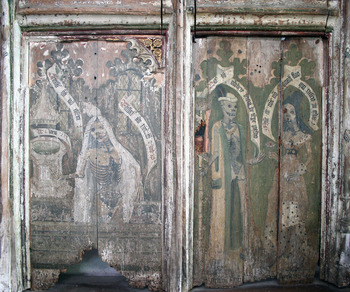
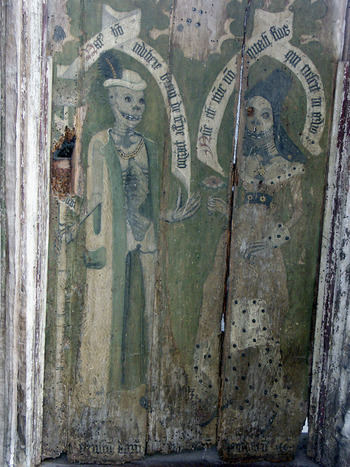
Surviving section from the south side of the Sparham rood-screen, displaying the cadaver iconography. Photograph: author

Date and setting
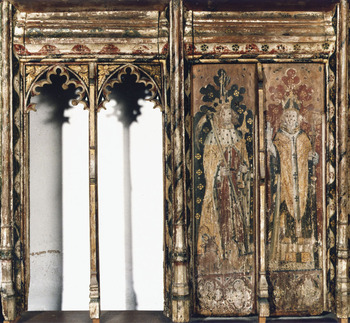
Only the dado of Sparham’s rood-screen survives, and from this the sole plate (the timber ‘foot’ on which the screen stood) has been lost. In all there are four panels with figure-painting and two frames (mullions, sill and tracery) from which the panels have been lost. The panels with the corpse paintings are of two lights each; the others of the usual single light. These single-light panels displayed images of saints: figures of St Walstan of Bawburgh and an unidentified archbishop survive (fig 3). A length of open carved cresting with a shield in the centre bearing the ragged staff of George Grey, Lord Ruthin and Earl of Kent (d 1505), who held the advowson of Sparham in the late fifteenth century, may also have belonged to it. The dado sections currently stand against the wall in the north nave aisle. In the mid-1950s, the Wall Paintings Committee of the Council for the Care of Churches was sufficiently worried about this damp and inappropriate location that it suggested the corpse panels should be mounted as an altar reredos; the idea was understandably dismissed by the parish because ‘the subject-matter was too macabre’. By way of compromise, the panels were mounted in the treated hardwood frames they occupy today, and in which they were exhibited at the University of East Anglia in 1983 – the only occasion on which these works have been exposed to a wider public.Footnote 3 The dado of the rood-screen seems to have been removed from the chancel arch in the nineteenth century, perhaps during the late Victorian restoration of the church (1886–9).Footnote 4 It was in situ in 1730, when Thomas Martin, the Norfolk antiquary, drew it; it was seen there in 1840 by Caddy Thomas and in 1841 by Dawson Turner, who had one of his daughters (her name is not recorded) paint uninspired copies of the corpse panels.Footnote 5 By this time the church was in poor condition generally: Thomas described what survived of the screen as ‘very dilapidated’.Footnote 6 A significant cause of this was beetle infestation. The bases of the corpse panels have been riddled to the point of disintegration, and the sole plate on which they originally stood was presumably too much decayed to be thought worth saving. Palliative conservation work in the mid-twentieth century has prolonged the life of the panels, but they now require further attention, particularly along the vertical joins of the timbers, where there has been extensive paint loss. The right-hand corpse panel has particularly suffered, because its makers, or the painter, attempted to produce a plane painting-surface by sticking fabric along the joins of the bevelled boards: much of this fabric has fallen off, or been peeled off, along with its paint.Footnote 7 General fading of the colour has also robbed the images of some of their intended impact, muting the symbolically important grass-greenness of the setting and the gaudiness of the clothes in the right-hand corpse panel. There has also been vandalism, probably inflicted at an early date. The eye-sockets of the corpses in the right-hand panel have been gouged, and the face of the corpse on the left, along with the surviving figures of saints, has been ‘cancelled’ with the shallow scratches often found on rood-screen images. The corpses cannot have been mistaken for saints, so if this damage was ideologically motivated, rather than a result of squeamishness, then the figures’ location was the trigger for it.

An absence of documentation makes precise dating of these paintings impossible, but they can be safely assigned to the last quarter of the fifteenth century. Previous estimates, ranging from c 1460 to the early sixteenth century, have usually been based on the costume shown in the right-hand panel. The fact that the compositions correspond to an increasing narrative interest in rood-screen painting in the early sixteenth century, a phenomenon linked to artists’ use of printed exemplars, may also have influenced judgements about their date.Footnote 8 With regard to costume, the preponderance of evidence in tomb sculpture, monumental brasses, manuscript and panel painting (Franco-Flemish as well as English) suggests c 1480–90, although execution c 1500 is possible, particularly if the screen was not made until after the roofing of the clerestory at the end of the fifteenth century.Footnote 9 A significant problem with dating a work of art by costume is that, while such evidence can often provide an approximate terminus post quem, it cannot of itself supply a reliable terminus ante quem (a late medieval artist might depict figures in outmoded dress for several reasons, including commemoration of individuals dead for some time or, more simply, use of outdated pictorial models). Some support for a date in the 1480s is given by the fact that the artist can be attributed on stylistic grounds with images of the four Doctors of the Latin Church on the screen doors at nearby Foxley, along with small donor figures of John Baymont and his wife asking for prayers. John Baymont bequeathed four marks to painting the Foxley screen, presumably including these panels, in 1485.Footnote 10 It is unfortunate that no bequest towards the building of Sparham’s screen is known, because the dado was evidently designed with the corpse imagery in mind. The double panels needed to accommodate it show no trace of modification: they have always lacked the central mullions with set-offs and stilted bases found on the other section of the dado. Two-light panels exist elsewhere on Norfolk rood-screens (for example, at Loddon, Mattishall and Tacolneston), but their combination with others of one light here is extremely unusual, if not unique. The Sparham dado uses the same elaborately cusped tracery and mouldings throughout, showing that the surviving sections of its superstructure were not separately made. Clearly, the dado was custom-built to accommodate the two different sizes of composition.
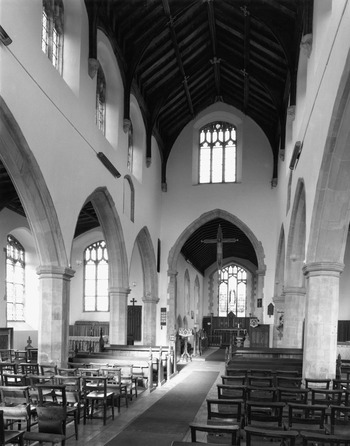
The screen was almost certainly built in conjunction with a major late fifteenth-century renovation of the church, designed to reflect the status of a wealthy and religious parish in an economically buoyant region (fig 4).Footnote 11 This work included lengthening the nave to the west by two bays, remodelling the aisles (both have reset Decorated west windows), rebuilding the clerestory and adding the existing south porch. The chancel was also partially refenestrated, notably its east wall.Footnote 12 This work was perhaps under way as early as 1459, when 13s 4d were left to the ‘fabric and repairs’ of the nave.Footnote 13 Subsequently, Johanna Butte bequeathed all her property with appurtenances in the village towards ‘vnius nove ele de parte australi ecclesie de Sparham’, presumably constructed soon after probate was granted in January 1482.Footnote 14 While not identical, the clerestory is very similar to that at neighbouring Great Witchingham, and perhaps by the same designer. No specific date can be attached to Great Witchingham’s clerestory, but construction in the 1480s or even the early 1490s is suggested by a bequest towards its ‘new’ roof in 1493.Footnote 15 Sparham’s clerestory seems to have been contemporary with this: a bequest of £40 for the ‘fabric’ of St Mary’s made by Clement Wulvesby in 1498 was probably related to it, as the initials ‘CW’ formerly appeared in all of the clerestory windows.Footnote 16
Interior of Sparham parish church, looking east from the nave. Photograph: © Courtauld Institute of Art

This fashionable space was appropriately furnished with richly carved benches and an octagonal pulpit with blind Perpendicular tracery.Footnote 17 It was also crowded with images. Most, if not all, of the windows were glazed with figure subjects, petitionary inscriptions and armorial shields. Much of this survived to be recorded by Thomas Martin in 1730, while Caddy Thomas noticed ‘many tolerably perfect figures of saints, &c.’ over a century later.Footnote 18 A window on the south side of the chancel displayed the four evangelists in the head, and large standing figures of saints in the main lights. The nave aisle glazing included images of the deacon-martyrs Laurence, Stephen and Vincent grouped together and, in separate windows, the Holy Trinity, the Virgin Mary, St Michael, St Blaise holding a flesh-hook, St Edmund of Bury (not named, but described by Martin as ‘a large king with a long arrow in his left hand’), St Gregory, and the scene of Christ’s Temptation by the Devil accompanied by the Vulgate text of Matthew 4:3–4 and 4:9. The fifteen clerestory windows, which in 1730 were ‘for ye most part pretty Entire’, had an image of a saint in each light. There were shields of the Trinity and the Five Wounds, of England (independently and in the Garter), and of local landholders, including Grey of Ruthyn, Clinton, Leybourn, and Giggs. The easternmost window of the north aisle contained a figure in secular dress with a scroll inscribed ‘Credo in unum deum’, while the chancel must have had an Assumption or Coronation of the Virgin, Tree of Jesse, or other subject related to the church’s dedication in the windows above the high altar.Footnote 19 Wall paintings with figure subjects and devotional sculpture were usual in ostentatious churches like St Mary’s, although in this case, besides a series of eighteen stone roof corbels carved with angels, all that is documented of either is that the elaborate niche over the west door of the tower contained a figure of the dedicatee. In January 1527, the priest Peter Mitchell asked that his body ‘be buryed in the church yarde of Sparham at the stepyll dore befor the image of our lady’.Footnote 20 Wills of the 1430s and 1440s mentioning lights to the Virgin, St John the Baptist and St Nicholas may indicate the presence of sculpture, and the light dedicated to the Virgin in particular was either associated with or complemented by a gild of ‘Our Lady of Sparham’ recorded in wills of 1498, 1510 and 1534 and certainly oriented towards an image or images in the nave.Footnote 21 In addition there were monumental brasses in the form of small figures, inscription-plates and, as shown by its indent, at least one chalice-brass. Three figure-brasses are recorded before the rood-screen. That to William Mustarder (d c 1493) – the rector under whom most of the church’s remodelling was carried out (he received the living in or before 1467) – survives, while others – to Robert and Alice Giggs (d 1534 and 1535 respectively) and the rector Richard Dykke (instituted 1505) – have been lost.Footnote 22
The rood-screen itself stood at the centre of this panoply, guarding and dignifying the chancel beyond it. Fixing-marks and narrow patches of discolouration on the inner faces of the piers of the chancel arch, plus the presence of a vice and elevated door, which gave access to the rood-loft on the north side, show that it was mounted (as usual) directly beneath the arch, rather than to the west of it. This means that nothing other than the losses already noted can be missing of the screen’s dado: the total number of painted panels was six. The chancel arch is only 3.65m wide, and the sections of the dado respectively 1.43m and 1.41m, leaving a modest 0.81m for the chancel door.
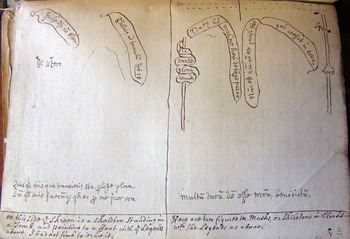
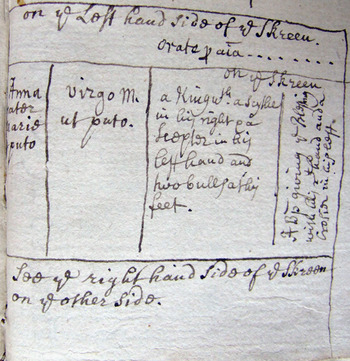
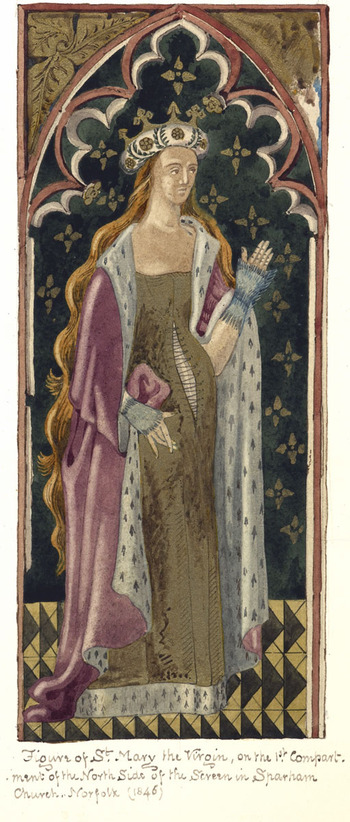
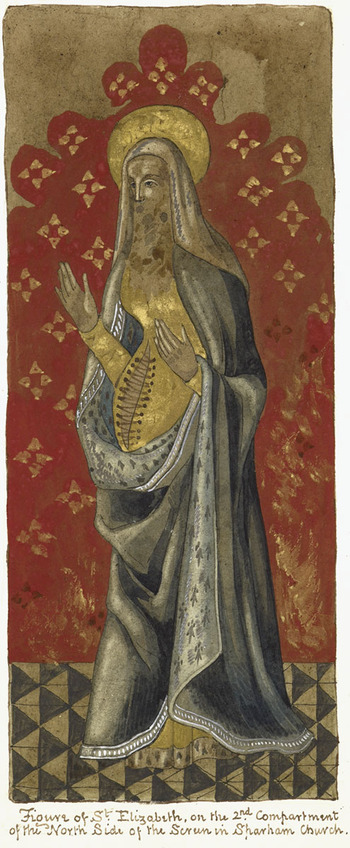
Like many East Anglian screens, the structural elements at Sparham were painted red, green and white, with gilded sculptural ornament. Above the loft there must have been a Crucifixion group, sculpted in wood and lit by a three-light Perpendicular window over the chancel arch. Thomas Martin, a sympathetic observer of medieval art, was refreshingly interested in the screen’s iconography. His notes contain two sketches, one labelled ‘ye left hand side of ye Skreen’, the other ‘ye right hand side’, indicating respectively the sections to the north and south of the chancel door. The corpse panels, he says, were on the right-hand or south side, a position corroborated by Thomas and Turner.Footnote 23 Martin began and subsequently abandoned a copy of them, thankfully after adding the inscriptions legible to him (fig 5).Footnote 24 To the north he recorded four single-light panels, containing (from north to south) ‘Anna mater Marie et puto’, ‘Virgo M. et puto’, ‘a King with a scythe in his right & a sceptre in his left hand and two bulls at his feet’ and ‘a Bishop giving ye blessing with his right hand and a crosier in his left’ (fig 6).Footnote 25 The latter two descriptions indicate the surviving figures of St Walstan and an archbishop, but the former are misidentifications of pregnant figures of the Virgin Mary and St Elizabeth, which together formed a Visitation group, possibly relating to the dedication of the church or to the gild of Our Lady of Sparham.Footnote 26 This group occupied the now-empty frames attached to the left-hand side of the panels with male saints. Dawson Turner painted competent watercolours of all four figures and stated, in notes beneath them, that the Virgin occupied the northernmost panel of the screen and St Elizabeth ‘the 2nd compartment of the north side’ (figs 7 and 8). The costumes of the female saints – especially the split and laced pregnancy gowns and decorative fur cuffs of the Virgin’s sleeves – display an interest in modish secular dress paralleled in the right-hand corpse panel.Footnote 27
Thomas Martin’s sketch of the south side of the Sparham rood-screen (executed 1730): NRO, ms Rye 17(3), fol 217r. Photograph: © Norfolk Record Office

Thomas Martin’s sketch of the north side of the Sparham rood-screen (executed 1730): NRO, ms Rye 17(3), fol 214r. Photograph: © Norfolk Record Office

Dawson Turner’s watercolour of the Virgin Mary panel from the north side of the Sparham rood-screen: BL, Add ms 23044, fol 119 (copied 1846). Reproduced by permission of the British Library Board

Dawson Turner’s watercolour of the St Elizabeth panel from the north side of the Sparham rood-screen: BL, Add ms 23044, fol 120 (copied 1846). Reproduced by permission of the British Library Board

Description and categorization
If the corpse panels were materially modest components of the church as a whole, their subject-matter and location were calculated to garner a proportionately large share of parishioners’ attention, particularly in the case of those who sat and knelt in front of them during services and sermons. Although separated vertically by a mullion, the two compositions are intended, through juxtaposition, the incorporation of shared motifs and the common use of inscriptions from the Book of Job, to be read together. A series of compositional contrasts emphasizes this unity by inviting reflection across both panels on the significance of the motifs and contexts represented. Thus, one composition contains two gendered figures clothed in finery and standing in a flowery field, while the other represents a single figure de-sexed by putrefaction, naked except for a winding-sheet and kneeling in an intramural tomb. The obvious unifying motif is, of course, the animate, outward-staring corpse, whose impact on responsive minds would have been increased by its setting. To the extent that location mediated the reception and function of images, the position of these paintings on the rood-screen must be reckoned an aspect of their iconography. While mural paintings of death subjects were conventional in parish churches – and some, like St Andrew’s at Norwich, had related imagery in stained glass – there is very little comparable evidence for such iconography in this pivotal, emotionally invested location. Hexham Abbey, in Northumberland, has rood-screen-sized panels with Dance of Death scenes, but their original setting is unknown.Footnote 28 At Battle, in East Sussex, the Three Dead confronted the Three Living on the spandrels of the chancel arch above the screen, and Last Judgements in this position, such as that at Wenhaston in Suffolk, seem often to have included images of resurrected people in shrouds arising from graves.Footnote 29 Closer to Sparham, the heavily restored screen at Ditchingham, in Norfolk, has a carved figure of a shrouded skeleton on the south side of the dado, which may not be medieval and is in any case very small.Footnote 30 Nearby Yoxford (Suffolk) was said, in the nineteenth century, to have possessed ‘screen’ panels showing a death subject or subjects, but no evidence for this seems to exist in the early antiquarian record, and there is nothing of the sort in the church today.Footnote 31 Records of ‘3 long cloaths hanging before the rood loft, steined or painted with the Dawnce of Powlis’ at Long Melford are the only substantial evidence for death imagery in this location, and these were evidently impermanent installations.Footnote 32 (A similar set of banners owned by the church of All Saints at Bristol was not displayed on the screen.)Footnote 33 Where positioned under an arcade, as at Denston (Suffolk), or in the sides of chantry chapels, as at Lincoln and Winchester cathedrals, cadaver tombs belonged to, or formed of themselves, a screen-like partition (called ‘pariete’ in one fifteenth-century will); but the east–west arrangement of such monuments meant that they were not incorporated into rood-screens.Footnote 34 Cadaver brasses set before the threshold of the chancel and (when a hearse stood close to a chancel door) burial palls with death imagery, like those from Bury St Edmunds and Sudbury in Suffolk, represent the commonest collocation of screen and corpse imagery in the parish domain.Footnote 35 As discussed below, the Sparham panels share aspects of style, meaning and function with these monuments, but their precise positioning, vertical orientation, colour and narrative aspects are all essential points of difference. The incongruity of such imagery in a space customarily reserved for familiar and consoling images of angels and saints was challenging in effect, and surely also in intention.
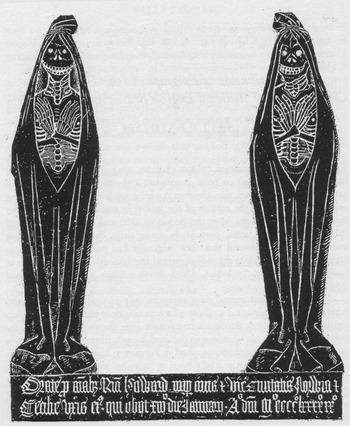
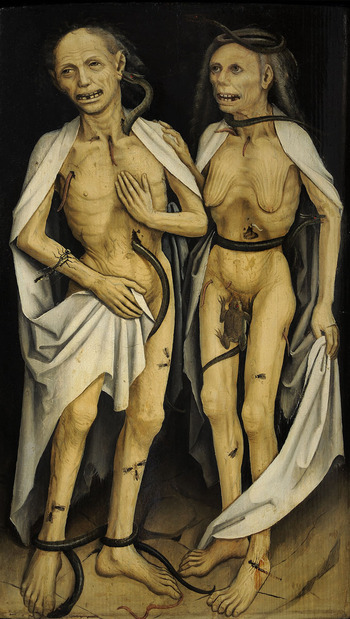
The right-hand panel contains two standing corpses approximately 0.74m in height, one in male clothing, the other in female dress (fig 9). What can be seen of the bodies is practically skeletal, with the exception of the upper torsos, necks and heads which, as in most English images of corpses, are painted brown and black to suggest a residue of dried skin. Both figures, and that of the left-hand panel, are typical of English death imagery in showing no signs of active decay: the flesh that remains is taut rather than ragged, and there is none of the vermin that often infests corpses in continental imagery. More of the male corpse can be seen than the female. Its gown hangs open from throat to ankle, revealing a hollow, stiffly articulated torso, jagged pelvis and tubular, bony leg. The neckline of the female’s dress is very low-cut on the neck and shoulders, and the artist has emphasized the widely spaced breasts by shading black the hollow at the bottom of the sternum. The fleshless hands of both corpses are unnaturally large, and the mouths starkly and simply represented as dark crescents studded with oversized white teeth. This sort of caricature had been part of English painting since the early fourteenth century. It is present, for example, in the Madonna Master’s figures of the Three Dead in the De Lisle Psalter (c 1310), the personification of Death smiting a king in a ‘Somme le roi’ manuscript illuminated by the Queen Mary Psalter workshop (c 1320–30), and the ‘Placebo’ page of the Macclesfield Psalter (c 1335).Footnote 36 Mural and manuscript painting of the later fourteenth and fifteenth centuries both yield numerous surviving examples. Closest in style and feel to the panels are the grinning, toothy figures of the Norwich-workshop cadaver brass commemorating Richard (d 1499) and Cecily Howard at nearby Aylsham (fig 10).Footnote 37 The Sparham couple resembles that at Aylsham in having eye sockets large enough to suggest raised bony brows. The male cadaver’s lower jaw is also clearly hinged, and the black spot above it, indicating the position of the right ear, looks like some sort of fixing device. Thomas Martin can be excused for having entertained the idea that the figures wore masks: the structure and modelling of the male face in particular recalls the mask-like Death’s head on fol 213r of the Luttrell Psalter (BL, Add ms 42130: c 1340), which Michael Camille related to contemporary mumming.Footnote 38 These elements of morbid stylization are complemented in artistic terms by bold, confident drawing, an interest in chiaroscuro modelling uncommon in East Anglian rood-screen painting, controlled and effective use of impasto, skilful manipulation of perspective in the left-hand panel and a good sense of pictorial design in general. However unusual the subject-matter and location, the figures bear a convincing relationship to one another and to their surroundings.
The right-hand corpse panel. Photograph: author

Brass to Richard (d 1499) and Cecily Howard at Aylsham. Photograph: Sally Badham

Both corpses are very richly dressed, indicating a social status familiar both in Norwich and its satellite villages, with which the city’s elites had close connections.Footnote 39 The fading of the colours scarcely disguises the fact that these were, in the language of the period, people of ‘power and value’.Footnote 40 The female cadaver wears a black bonnet with a high crown and broad, turned-back brim, the latter ample enough to cover the sides and back of the head and neck as far down as the shoulders. This is combined with a diaphanous veil covering, but not hiding, the upper part of the face. The dress – originally red with pale embroidered ornament indicated by passages of impasto – has a neckline so broad and low-cut that the entire upper part of the chest, along with the shoulders, is bare except for a transparent silk mantle. Its collar, the broad cuffs of the sleeves, and the hem and lower lining of the skirt are of ermine fur: the corpse holds up the folds of its skirt in a gesture conventional in fifteenth-century secular portraiture (it is used, for example, in Jan van Eyck’s Arnolfini Betrothal), allowing the viewer to appreciate the extent to which this prestigious material is used. Skirt and bodice meet at a high and very tightly drawn waist, constricted by a black belt with gold floral ornaments and a gold buckle or clasp on the left-hand side. The figure also wears a gold pendant in the shape of a flower or shell around its neck, and has black shoes with open insteps, which reveal bony feet. The cut of the bodice, the large area of exposed and modelled flesh and the skirt-raising gesture carry an unmistakable suggestion of sexuality, whose macabre subversion in receptive minds was surely a planned aspect of the figure’s moral potency. A similar idea seems to underlie the presentation of the male corpse, whose ankle-length gown, made of a tawny-coloured fur with a lining of green fabric, is wide open at the front and worn without undergarments. Here, however, the pathetic gesture of concealment displayed by so many transi effigies is unnecessary, for the genitals have completely rotted away. The desexualization caused by death is thus emphasized in a moral manner. The only other items of costume are black shoes, a heavy gold chain, suggestive of worldly prestige, and a round, white hat with a low crown and a large, dark feather in the brim. These flamboyant accessories draw attention to the figure’s nakedness by embellishing it without any attempt at concealment.
While they look directly at their audience, and address it through speech scrolls attached by thin threads to their mouths and hands, these corpses also interact with one another. The female holds a posy of flowers, which the male seems in the act of giving or receiving. The green background is meant to suggest an outdoor setting, as do the flowers and grass still visible around the feet of the figures. There is a suggestion of youthfulness here, as well as prosperity: were it not for their condition, the couple might be Maying, or even pledging troth. But no sooner are the qualities of youth and the status of its attendant pleasures recognized than they are overwhelmed by the recognition of mortality, accentuated not only by the decayed faces and bodies but also by the clever resemblance of the speech scrolls above them to the knotted winding-sheets common in death imagery, along with the paraphrase of Job 14:1–2 contained in these scrolls and the symbols of evanescence held by the corpses. The text of the scrolls, which is continuous, is in verse:
Natus homo [de] muliere brevi de tempore parvo
Nunc est nunc non est quasi flos qui crescit in arvo.
[The life of] a man born of a woman [is] brief, of little span
Now it is, now it is not, like a flower which blooms in a field.
A similar paraphrase forms one of a series of mortality couplets written into the margins of a copy of Thomas Hoccleve’s Ars sciendi mori:
Est homo res fragilis durans sed tempore paruo
Nunc est nunc non est quasi flos qui crescit in agro.
A man is but a fragile thing, lasting but a little time
Now he is, now he is not, as a flower which blooms in a field.Footnote 41
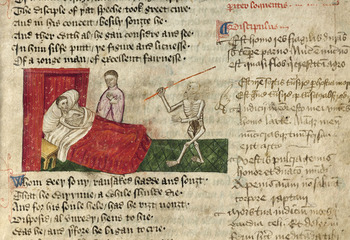
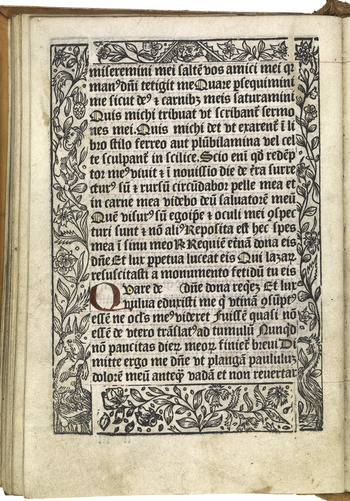
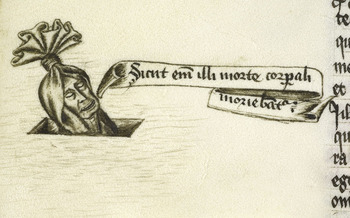
This manuscript, and its conventional illustration of Death threatening a man in extremis, dates from around 1430, but the adventitious couplet is in a later (though still fifteenth-century) hand (fig 11). It suggests a contemporary currency for the Sparham paraphrase: the two versions of the couplet must have a common root. The Biblical text was most widely familiar through its use in the Office of the Dead.Footnote 42 It introduces the fifth lesson of the Dirige, and was thus a standard feature of parochial liturgy, as well as a subject of widespread private meditation through its inclusion in books of hours and vernacular paraphrases such as the Pety Job.Footnote 43
The verse ‘Est homo res fragilis’ is in the upper right-hand margin: Bodleian, Selden Supra 53, fol 118r. Photograph: © Bodleian Library

The cut flowers of the posy and the blooms around the couple’s feet, along with sculpted flowers contained in the tracery and spandrels of the panels, resonate with this text in an obvious way. So too does the flaming graduated candle held by the male corpse which, before its poetically fitting destruction by death watch beetle, had a scroll wound around it inscribed ‘Sic transit gloria mundi’ (‘Thus passes the vanity of the world’). This candle, with its evenly spaced markings, may be unique as a symbol of mortality in English art of the period: the intensity of its flame suggests the rapidity with which time consumes life in what the language of contemporary piety called ‘the darke nyght of this worlde’.Footnote 44 Less unusual is the inscription, which occurs in such diverse contexts as John of Bromyard’s sermons on mortality, the tomb of the chronicler Robert Fabyan (d 1512), a drawing of the Wheel of Fortune in a Polychronicon of c 1400 from Exeter Cathedral and Guyot Marchant’s 1491 edition of the Danse macabre des femmes.Footnote 45 The phrase is a straightforward example of ‘vernacular Latin’, whose meaning was clear to anyone able to read it.Footnote 46
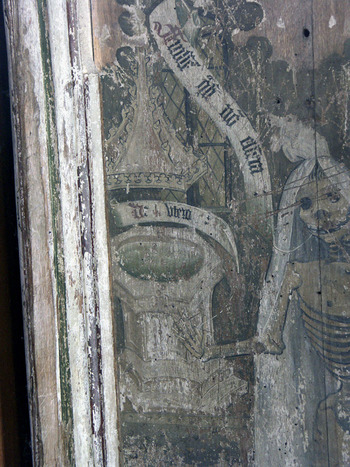
In the left-hand panel, the solitary corpse is shown in the act of rising from a tomb (fig 12). This figure is more animated: it turns to confront the viewer, gesturing with its right hand and inclining its head to establish an inescapable interaction. Once again, it ‘speaks’ through the medium of scrolls coming from its mouth and hands. The tomb in which it kneels is a broad chest of dark ornamentally carved stone from which the top slab has been pushed. Dress is reduced to a winding-sheet, knotted on the top of the head and open at the front to display the detritus of the body. The figure still has its hair, and a suggestion of flesh remains on the chest and neck, including the right nipple. While the sex is indistinct, this figure is probably meant for a man. Had a woman been intended, the artist would have suggested breasts as he did in the right-hand panel. The poverty of the winding sheet (a topos of medieval homiletic literature) and the solitude of the figure create a stark contrast with the finery and futile dalliance displayed by the paired corpses.Footnote 47 Behind the tomb and its occupant is a plain grey wall pierced by two-light windows with depressed trefoil heads and clear glass in lozenge-shaped quarries. To the left is a fashionable octagonal font with a raised Gothic cover, which the artist has tilted to display its sanctified water (fig 13). Nothing in this scene closely resembles architecture or furnishings at Sparham (where the font is modern), but the setting of the scene in a church nave nevertheless established a semblance of juxtaposition between the wide-eyed corpse and its viewers.
The left-hand corpse panel. Photograph: author

Detail of the font from the left-hand corpse panel. Photograph: author

In this instance the scroll-texts are taken directly from the Vulgate Job, and carry a citation of their source. They are designed to be read continuously, in an anticlockwise direction: ‘Fuissem quasi [qui] non essem/de utero/translatus ad tumulum. Iob 10.’ (‘I should have been as if I had not been, carried from the womb to the grave. Job [chapter] 10.’) Specifically, this is Job 10:19, which formed part of the ninth lesson of the Dirige.Footnote 48 It, too, was thus an aspect of the liturgy enshrined in contemporary service- and prayer-books, something suggested in the use of book-like rubrics at the head of each scroll, and for the title and chapter of the Biblical source (fig 14). As in the right-hand panel, text and image are palpably interrelated. A tomb is visible in word and object. The font is presented as a symbolic womb, the inscription ‘de utero’ between its cover and bowl recalling the ‘Benedictio fontis’ in the Sarum manual, with its reference to ‘the immaculate womb of the divine font’.Footnote 49 As Charles Linnell recognized, there is also an ineluctable allusion here to Romans 6:3: ‘Know you not that all we, who are baptized in Christ Jesus, are baptized in his death?’Footnote 50 Moreover, the inclusion of the name of Job in a scroll held by the dried-up corpse vividly calls to mind the prophet’s self-referential rhetoric of death, decay and desiccation: ‘My flesh is clothed with rottenness and the filth of dust; my skin is withered and drawn together.’Footnote 51 Moral and devotional consciousness (St Job’s memorial on 6 May is recorded in at least one contemporary Norfolk-related calendar) may even have stimulated some viewers to reflect upon the suffering prophet himself.Footnote 52 In this connection the image can be compared with a later medieval French tradition of illustrating Job as a cadaver, represented in French Bibles of the fourteenth century.Footnote 53
Page from a Sarum book of hours printed in 1492. The text corresponding to the right-hand corpse panel is at the bottom: Cambridge, University Library, Inc. 4 J 1 2, fol 99v. Photograph: © Syndics of Cambridge University Library

Finally, it is important to note that the moulded sill of the dado above the corpse paintings, the vertical mullions which divided them, and the bases of the panels, all carried inscriptions. Of those on the sill, Martin copied only the letters ‘Si’ (perhaps the word ‘If’) before observing simply that ‘four lines too much defac’d to be read’ originally stood above the right-hand panel.Footnote 54 There was evidently a separate two-line inscription over each corpse. Turner, who could not read these either, took the liberty of supposing them to have documented ‘by whom, and at whose expense, and in what year [the screen] was erected and painted’; presumably because he noticed the surviving incipit of a rogatory inscription (‘Orate pro anima’) over the panels of St Walstan and the archbishop.Footnote 55 Nothing is recorded by the antiquaries above the left-hand panel, but surviving traces show that there was a black-letter text here too. On the mullion to the right of the paired corpses the words ‘spero’ and ‘lucem’ can still be read. This is evidence of another extract from the ‘Dirige’, which must have begun with the words ‘post tenebras’ on the central mullion, where only fragments of letters now remain. ‘Post tenebras spero lucem’ (‘After the darkness [of death] I hope for the light’), from Job 17:12, is part of the seventh lesson.Footnote 56 The inscriptions at the bases of the panels, which Martin did manage to record, are discussed below in relation to the panels’ function. One of them was a specialized type of ‘cras tibi’, while the other was evidently indecipherable, to the antiquary at least.
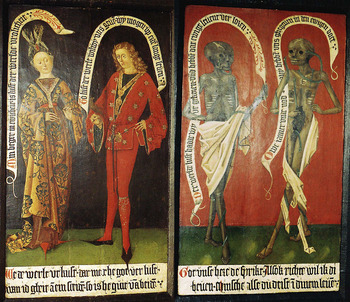
Before turning to investigate questions of meaning and function, the unusualness of the imagery deserves emphasis. Christopher Woodforde, the mid-twentieth-century scholar of Norfolk stained glass, found it ‘difficult to believe’ that the Sparham artist did not have ‘some actual picture to copy’, but no close parallel for these scenes has been found in either English or continental art.Footnote 57 A number of writers have described the right-hand panel as a Dance of Death scene, or simply a Dance of Death, even though it contains two individualized corpses rather than a personification of Death and a living victim. Others, most recently Sophie Oosterwijk, have pointed out the error in this.Footnote 58 Tancred Borenius and Ernest Tristram called it ‘a representation of the Triumph of Death’ but this, too, is obviously wrong, especially (but not solely) in so far as it associates the work with the pictorial cycles deriving from Petrarch’s Trionfi.Footnote 59 What seems to be unique here, at least in pre-Reformation art, is the representation of two animated but dead lovers dressed in finery.Footnote 60 The artist has effectively conflated the distinct images of living and dead couples (or personifications of Death) found on certain two-sided German panel paintings of the period. This type of image, a sort of macabre double portrait, is exemplified by an Upper Rhenish or Swabian work of c 1470 now split between the Cleveland Museum of Art (the obverse, displaying two courting lovers, sumptuously dressed) and the Musée de l’œuvre Notre-Dame in Strasbourg (the reverse – fig 15 – showing the same couple as sentient but rotting corpses, clothed only in winding-sheets and being consumed by vermin).Footnote 61 A variant of the type, popular in Franco-Flemish ivory carving of the later fifteenth and first half of the sixteenth century, juxtaposes richly dressed lovers with a repellent personification of Death.Footnote 62 This was further reduced in some cases to a macabre single portrait, either two-sided or in diptych format: the two diptychs painted c 1487 for Hieronymus Tschekkenbürlin, the great patron of the Basel charterhouse, are the most widely recognized examples.Footnote 63 While these are typically small, private images, the double-portrait type in particular has been linked to publicly displayed two-sided panels with the same iconography said to have hung in German churches during the late Middle Ages as warnings against sin. An example dated 1383 was recorded in the parish church at Minden (Westphalia) at the beginning of the eighteenth century, while another (fig 16), of c 1500, survives at Lauenburg an der Elbe (Schleswig-Holstein).Footnote 64 In the latter example the corpses, in winding-sheets rather than finery, hold moralizing inscriptions on scrolls, which arch over their heads like shrouds, though they lack the evocative ‘top-knot’ loops that appear in the Sparham panels.
Swabian panel representing two lovers as corpses (c 1470): Strasbourg, Musée de l’œuvre Notre-Dame. Photograph: M Bertola; © Musées de la Ville de Strasbourg

Lauenburg an der Elbe (Schleswig-Holstein): two-sided panel representing lovers in finery and as shrouded corpses (c 1500). Photograph: © Parish of Lauenburg an der Elbe

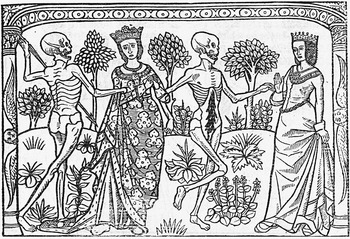
Whether or not the Sparham artist knew the macabre double-portrait type, or its single-figure variant, is an intractable question. However, any professional painter living in or near Norwich, the wealthiest city on England’s eastern seaboard after London, would have been exposed to continental art as a matter of course. There is also the possibility that the artist himself was foreign, as a number of others who worked on East Anglian rood-screens appear to have been.Footnote 65 In any case, his design is just as likely to be an adaptation of a work or works familiar to him as a copy of a given model. A macabre double portrait is only one possible source of influence. Another is a pair of figures from a Dance of Death cycle. Modification of, for example, either couple (Death and the Queen or Death and the Duchess) from the edition of the Danse macabre des femmes printed in Paris in 1486 by Guyot Marchant would have been within the powers of an inventive mind used to tailoring the form and content of images to patronal requirements (fig 17). If the painting is late enough, then Marchant’s 1491 edition of the Danse, which has twenty-one extra woodcuts of Death and female victims, could have served. The compositional elements and many points of detail, including the outdoor setting and flowers of the field, were already in place, leaving the artist to clothe and render sedate the figure of Death (which, despite the caption ‘La Morte’ in these books, has the flat pectorals of a man), represent the clothed victim as a corpse and add the texts according to his patron’s direction.Footnote 66 While it is important not to over-simplify the metaphysics of artistic invention, the similarities in this case are sufficiently clear, and access to the source sufficiently possible, to justify the suggestion, even though, as noted, the final product does not belong to the Dance of Death category. Of course, other possibilities recommend themselves, including adjustment of the model presented by well-dressed couples on monumental brasses. That these paintings arose from the broader object-domain of fifteenth-century death imagery is obvious, but the formal paradigm, if there was one, need not have represented corpses or skeletons.
Illustration of couples from the first printed edition of the Danse macabre des femmes (Guyot Marchant, Paris, 1486). Photograph: author

While the left-hand panel as a whole is no less unusual, the corpse it contains is of a more familiar type. Dead or resurrected people clad in winding-sheets and lying in or arising from tombs were represented in all mainstream artistic media during the fifteenth and early sixteenth centuries. The symbolic equivalence of the motif for late medieval viewers with the condition of being dead is emphasized particularly where it is abstracted from narrative context. There is a representative fifteenth-century example of this in BL, Harley ms 612, where a shrouded, reclining corpse with a speech scroll has been added in a margin to emphasize the content of a clause mentioning death, which the scribe left out of the body of the text (fig 18).Footnote 67 In the parochial sphere, scenes of the Last Judgement and sepulchral monuments were its main vehicles, and the Sparham figure is formally and conceptually related to both. It resembles the figures – which are not, properly speaking, corpses – on so-called resurrection brasses such as those to Elizabeth Mattock (d 1485) at Hitchin (Hertfordshire), Thomas Spryng (d 1486) and his family at Lavenham (Suffolk) and Thomasine Tendring (d 1485) at Yoxford (Suffolk), in showing a rising figure in a winding-sheet, but differs in its lack of a buxom, re-fleshed body.Footnote 68 Rather, its shrivelled condition aligns it with transi effigies and shroud brasses, like the monuments to John Baret (d 1467) at Bury St Edmunds, the Howards at Aylsham (in whose staring eye-sockets and stark grins is a promise of reanimation) and the earlier brass to John Brigge (made c 1430) at nearby Salle. The indistinctness of its categorization complicates understanding of what it was designed to represent. A particular dead individual is one possibility raised below, although the gestures and inscriptions from Job make it unlikely that this corpse arises in response to the Second Coming. Another possibility, not necessarily contradictory, is that it was meant to suggest Death personified. As Pamela King has shown, with reference to Norfolk examples, distinctions between images of Death on the one hand and dead individuals on the other could be fluid in the period: the intention might be to represent both in one figure.Footnote 69 Some association of both panels with the admonitory living dead who populate the medieval ‘ghost’ stories ‘let loose in sermons and exempla’ of the later Middle Ages, not least the frequently painted Three Dead, may also have been anticipated, and certainly perceived.Footnote 70 There were late medieval literary contexts for the pre-Doomsday animation of the ‘common’ dead (i.e. not Christ, Death personified or the beneficiaries of miracles) which did not involve ghosts: John Lydgate’s translation of Deguileville’s Pilgrimage of the Life of Man contains an example that is nicely illustrated in an East Anglian copy of the text.Footnote 71 However, the Sparham corpses do not belong to any of them. There is no need to suggest that the panels related to some particular, locally known ghost story, but rather that the pervasiveness of a genre which tended to illustrate morals of broad relevance may have influenced those who commissioned, made and used them.
Image of a shrounded cadaver in the margins of a copy of the ‘Revelations of St Bridget’ (c 1440–50): BL, Harley ms 612, fol 78v. Reproduced by permission of the British Library Board

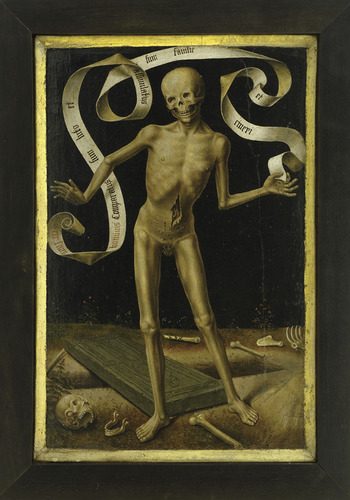
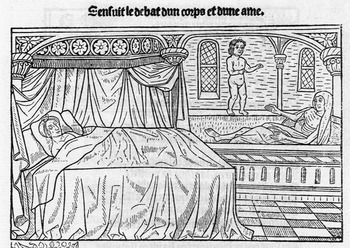
In iconographic terms, the closest existing parallel for this image is the familiar representation of a standing corpse by Hans Memling, on what is known as the Triptych of Earthly Vanity and Divine Salvation (c 1485–90: fig 19). While the Memling panel is much smaller than that at Sparham (the corpse it shows is only around 175mm in height), its quality, clarity of composition and combination with an exemplification of vanity and a horrifying scene of perdition, invest it with a similarly powerful impact.Footnote 72 Here the figure is also positioned in relation to a prominent sepulchre, and proffers a moralizing scroll with a text from Job, though there is no font, and no suggestion of an intramural setting. A simpler formal parallel exists in the woodcut of the disputing body and soul prefacing the Debat du corps et de lame, included in Guyot Marchant’s 1486 edition of the Danse macabre (fig 20).Footnote 73 Here, in the background, is a shrouded figure arising from an intramural tomb with a tall, lozenge-quarried window above. Again, the proper diffidence with which an example from this or a similar source is suggested (not least because the Debat illustration entirely lacks the power of the Sparham painting) has to be reconciled with its potential availability to the artist, as well as the correspondences in form and content. In any case, as with the right-hand panel, the absence of an obvious exemplar makes it difficult to take the question of artistic influence further than the domain of death and resurrection imagery in general.
Image of Death from Hans Memling’s Triptych of Earthly Vanity and Divine Salvation (c 1485–90): Strasbourg, Musée des Beaux-Arts. Photograph: M Bertola; © Musées de la Ville de Strasbourg

Debat du corps et de lame: the opening illustration of Guyot Marchant’s 1486 edition, printed together with the Danse macabre des femmes. Photograph: author

Audience and interpretation
There are two fundamental approaches to the meaning of the Sparham paintings, and a third which is less obvious but sanctioned by the inscription that formerly existed beneath the shrouded corpse. While they will be discussed in turn, the main approaches were symbiotic, and it is pointless to ask which is more important. Fifteenth-century treatises on the meaning of church architecture, furnishings and ceremonial often give single explanations of given features or aspects of ritual, suggesting a rather doctrinaire hermeneutics of art.Footnote 74 However, without dismissing the vitality of such testimony to attitudes and priorities, or denying the breadth of its influence through the medium of the sermon, it is perfectly reasonable to assume that both individuals and the parish corporate had a complex and heterogeneous understanding of objects such as the Sparham paintings. The audience for these works was mixed in the conditions and faculties which influenced the reading of death imagery: to name the most obvious ones, age, gender and social status; intelligence, education and experience; imagination, belief and conscience. Moreover, it is doubtful whether all viewers were interested in the paintings as religious objects. Some probably shied away from or ignored them, while others may have thought them incongruous, or even funny: Klaus Jankofsky has discussed the humorous potential of fifteenth-century English corpse imagery in a manner potentially relevant to these works.Footnote 75 However, to the extent that the rood and its screen were ‘overwhelmingly’ (as Eamon Duffy puts it) the main focal point of imagery for most East Anglian parishioners, and constituted a nucleus of devotion and pious ritual, the Sparham panels must have contributed to the moral and eschatological thinking of many people.Footnote 76
There is nothing unusual about the two main lines of interpretation. The first is that the paintings were intended and received as moral admonitions to avoid the vanities of earthly life and to nurture one’s spiritual health while one could. This moralizing function has been noted in the past, particularly with reference to the right-hand panel. Of course, any corpse, real or imaged, could function as a common caveat: the homilist John Myrc described ‘a corse browth to þe church’ before burial as ‘a myrroure to vs alle’.Footnote 77 But a dead body on its own was insufficiently eloquent for the artist and patron of the Sparham paintings. The rich attire, taper and flowers of the right-hand panel, and the texts of both, make the intention to warn and rebuke as explicit as possible. Pairing and gendering the corpses hammered home the universality of the message. There is no question here of identifying the vice of delight in fine clothing with women specifically, as late medieval sources often do.Footnote 78 Although the sumptuous clothes seem targeted mainly at the best-dressed parishioners (who, if not in the chancel, would have sat closest to the screen during services and sermons), they had a broader relevance as generic signifiers of pride, the most egregious sin and the cause of all others (Eccl 10:15).Footnote 79
Pride’s association with frippery was a mainstream homiletic topic in the late Middle Ages, given savour by the inevitability of opulent dress as a signifier of elevated social status. Widely circulated indications of it exist in texts such as John Peckham’s Exornatorium curatorum, surviving in at least ten pre-Reformation printed abridgements and appointed to be read aloud in churches by parish priests four times each year, where pride is identified with ‘golde … syluer [and] ryche clothes’. Myrc’s Festial also complains of decayed virtue ‘turned … ynto pryde by dyuerse gyses of cloþyng’.Footnote 80 Pride in the material things exhibited in the right-hand panel was the theme of a widely known passage (it was reproduced by Bromyard and Myrc, and is found in Caxton’s Golden Legend) in the Good Friday ‘improperia’, through which Christ reproved mankind for ignoring his sacrifice and prolonging his agony.Footnote 81 This consists of a series of contrasts between the condition of the crucified Christ and a well-dressed man, which would have been particularly salient for hearers assembled before a rood-screen. One of these contrasts nicely evokes the male corpse at Sparham: ‘Your side [ie the side of your gown] is slit to show your vanity; and my side is pierced for suffering’.Footnote 82 When considered in relation to the rood above it, the right-hand panel captures the substance of this reproach in an effective and permanent way, while demonstrating in the same instant the foolishness and ultimate futility of pride in appearances.Footnote 83 It may be that such associations were expounded from the pulpit at Sparham, which, if its current position is authentic, stood directly beside the corpse paintings: there is no proof, of course, but the collocation of panels and pulpit evokes the popularity of mors as a homiletic theme, and the large amount of space devoted to it in mainstream preaching compendia like Bromyard’s Summa predicantium. Alan Fletcher has recently stressed the degree to which visual reminders of death and sermons on the same theme reinforced one another during the period.Footnote 84 In any case, like Christ, death was known to be no respecter of dress. A fifteenth-century inscription on the north chancel wall at Acle in Norfolk warned that ‘those [women] who wear horns or veils are not redeemed [from death] by their fortune’.Footnote 85 In the end, as the left-hand panel was intended to indicate, fortune is reduced to a winding-sheet.Footnote 86
A further suggestion of pride, its consequences and the universal need for redemption through Christ, exists in a subtle allusion to the Fall of Man present in the right-hand panel (fig 9).Footnote 87 The ubiquity of images of Adam and Eve, and references to their sin as the origin of death in fifteenth-century art and literature, would originally have made this correspondence clear. The parallel rests on formal resemblance, accomplished by the pairing and interrelation of male and female corpses (the exchange of a ruddy ephemeral object seems particularly suggestive) and reinforced through commonly understood symbolic associations which went back through Isidore of Seville to St Paul (I Cor 15:22, 45).Footnote 88 As the cause of the Crucifixion, and the bar to Paradise which the partition between nave and chancel symbolized, the Fall was a fitting subject for rood-screens: examples, coupled with the Expulsion, existed at Brooke and Poringland (Norfolk) and (still in situ) at Bradninch (Devon).Footnote 89 By embodying the obvious result of disobedience, the Sparham figures collapsed the distance between Adam and Eve and their late fifteenth-century progeny in an organic and evocative way. The same task was fulfilled less subtly by late medieval and early modern continental images showing the Tree of Knowledge growing out of a skeleton or dead body, and less economically in late medieval prayer-books which juxtaposed Adam and Eve with separate images of death or, as in a printed Sarum primer of 1531, the text of the Dirige.Footnote 90
The second basic approach to interpretation is that the panels possessed salvational overtones, which could make viewing them an essentially affirmative, edifying experience; an idea that depends as much on their location as their iconography and texts. Perhaps inevitably, their imagery offered a carrot as well as a stick, for the point of moral admonition was to effect changes that could lead to salvation. The Sparham paintings are not, therefore, simply images of ‘transience rather than transcendence’; they are both.Footnote 91 Derek Pearsall has called Lydgate’s Daunce of Machabree ‘not so much the Dance of Death as the Dance of Life’ because the poem encouraged the moral behaviour necessary for both a fulfilling earthly existence and a blissful eternal one.Footnote 92 This idea is perfectly logical in the context of late medieval religion, and can be extended to practically all death imagery of the period. The unusualness of the Sparham paintings lies in the sophistication and, as with the admonition, the iteration of its expression. Location on the rood-screen, beneath what Valentin Gröbner refers to as ‘the late medieval dead body par excellence’, was central to their prospective function.Footnote 93 Notwithstanding Jacqueline Jung’s influential view of rood- and choir-screens as vehicles of social inclusion which integrated clerical and lay spheres, such objects were commonly construed as barriers between two symbolically and anagogically distinct realms, one associated with temporal forms, affairs and conditions (albeit with privileged enclaves around the nave altars and font), the other with their spiritual equivalents.Footnote 94 ‘The particioun betwene the queer and the book of the churche betokenyth that the myndis of the spiritualte shulde be departid in especialle fro alle erthelye thyngis lyke as thaye be departid fro the laye people bodely in tyme of goddis seruyce’: although one-dimensional, this exposition of the point from a mid- to late fifteenth-century copy of a treatise on the physical and ritual meaning of churches represents at least one tenet of common belief.Footnote 95 In ideal terms, the screen paralleled death as an obstacle between earthly and eternal life. Thus, in the words of the same treatise, the chancel door symbolized ‘cryste[,] for by hym we shal entre in to the blysse off hevyn after this lyfe … for he sayethe in the gospelle Ego sum hostium’.Footnote 96 The symmetry of this with the physical figure of Christ on the rood above, whose redeeming blood anointed those passing through the door, and also those on its threshold (hence the great popularity of burial before the rood), was both seamless and obvious. In tandem with the painted Doom on the chancel arch (where one existed), the screen with its door was the eschatological fulcrum of the church.
The implications of these points for the Sparham corpse paintings should be clear. Like the saints usual in their position, whose intercession could help to secure eternal life, the figures of both panels represented a universal conduit to salvation: for, in the language of St Paul, the seed is not quickened except it dies (I Corinthians 15:36). Specifically, they reminded viewers that the progress of individual salvation necessitated bodily decomposition, an idea sometimes discussed with reference to transi tombs and, as Caroline Walker Bynum has emphasized, understood historically as a process of cleansing and even healing, which rationalized the repulsiveness of putrefaction without denying it.Footnote 97 Where appropriately contextualized, physical decay could even suggest triumph over death: a case in point is the cadaver effigy of Richard Fox, Bishop of Winchester (d 1528), the feet of which rest on a skull.Footnote 98 Although, as noted, it does not relate to the Last Judgement in a narrative sense, the corpse in the left-hand panel refers through its setting, posture and association with a crucial sacrament (baptism) to the idea of salvation through resurrection. In this it was of a piece symbolically with the tomb-slabs and brasses that lay before it. Under a separate rubric heading, the treatise cited above explains the significance of ecclesiastical ‘berying placis’ in this way: ‘þer ben buryed the bodies of true cristen people there to rest and abide the comyng of oure lorde to the dome and then oure bodies shalle aryse fro dethe to lyfe as sekulye as oure lorde Ihesu cryste rose from dethe to lyfe’.Footnote 99 Furthermore, the inscriptions borrowed from the Dirige elicited a text whose main purpose was spiritual salvation. While they do not include the popular and optimistic ‘Credo quod Redemptor meus vivit’ of Job 19, they did incorporate the no less positive ‘Post tenebras spero lucem’. Salvation is also implied by the corpses’ privileged position in the shadow of the rood, where, with the bodies of William Mustarder, Robert and Alice Giggs, and Richard Dykke, they profited from a constant metaphysical effusion of holy blood.
Spiritual cleansing through death and purgation are referred to explicitly by the font in the left-hand panel, its cover raised and perspective tilted to show the holy water (figs 12 and 13). In theory the use of holy water as a defence against the supernatural – emphasized in the exorcisms of the baptismal rite – could support an exclusively negative interpretation of the figure, which finds support elsewhere in English later medieval art.Footnote 100 A wall painting of the Three Living and Three Dead at Widford in Oxfordshire, for example, shows the youngest king calling for holy water with which to asperge the approaching spectres.Footnote 101 But positive connotations are clearly dominant here. The font, to which the corpse gestures with its right hand, is an inherently optimistic motif, conveying the idea of redemption, even if the panel’s iconography is assessed independently of its physical and ritual settings. Combining a font with an entombed corpse elicits inevitable associations with resurrection and salvation, through both St Paul’s metaphor of ‘burial in baptism’ (Romans 6:3–7 and Colossians 2:12), which stresses the part that dead Christians will have in Christ’s resurrection, and the common understanding of sacramental utility. This understanding can be used to illustrate the left-hand panel’s redemptive connotations at a level which takes account of the rood-screen’s environment. A contemporary treatise declares that ‘Out of crystes ryght syde … ran … precious blood & watyr for oure redempcion/Whyche signify [the] .ij. sacramentes our most helfull wasshyng/Baptysm & Eukaryst necessary to our saluacion’.Footnote 102 The standard emphasis on baptism and the eucharist as two necessary conditions for salvation draws the font motif together with the Crucifixion standing above the screen and the masses celebrated around it to indicate the dead figure’s eligibility for redemption. If the corpse is taken to symbolize humanity’s common lot, as, for example, was the shrouded figure of Adam painted beneath the Holy Cross on a panel at Attleborough, then this eligibility is also pervasive.Footnote 103
The question of identity leads directly to the third approach to the paintings’ meaning and function, namely, that they constituted what Richard Marks calls a ‘surrogate sepulchral monument’. Citing a specific example involving stained glass, Marks argues that ‘the placing of the lights in the window next to [a] grave meant that the glazing became part of the structure of … memorialisation’.Footnote 104 In line with this definition, if the patron of the paintings (or a nominee of the patron) was buried in front of them, or nearby, then the panels can also be interpreted as a monument. From a formal point of view, the principle is little different from the late medieval practice of mounting memorial brasses and incised stones vertically in a wall near the burial place of those they commemorated. This type of commemoration may have been more common than the absence of current recognition suggests. Because they were located close to the pavement, rood-screen and parclose panels not mounted on altars were well suited to act as accompaniments to burials. Where Sparham is concerned, a particularly strong piece of evidence for this interpretation exists in the form of a ‘Quisquis’ inscription originally painted at the base of the left-hand panel. Martin recorded this familiar text in full: ‘Quis quis eris qui transieris, sta, perlege, plora/Sum quod eris, fueramque quod es, pro me, precor, ora’ (‘Whoever it is that passes by, stand! read! weep!/I am what you will become, I was what you are; pray for me, I beg’) (fig 6). As Jerome Bertram has pointed out, the ‘Quisquis’ appears on at least twenty-one tombs, including cadaver brasses contemporary with the Sparham panels.Footnote 105 However, it never seems to occur elsewhere: if not part of a ‘surrogate’ tomb, then Sparham’s is the only recognized non-sepulchral example. Clearly, the inscription was devised for and specially suited to use on funerary monuments. If it had been inscribed within the pictorial field of the left-hand panel, and specifically on the side of the tomb, then one might be inclined to interpret it as a touch of verisimilitude. However, this was not the case. Each panel had at its base a white inscription field around 75mm in height, traces of which survive. It is here that the ‘Quisquis’ was painted. In the corresponding position on the right-hand panel, Martin recorded an inscription which appears to be incomplete, and cannot be reconciled with any known text. The reading of the fifth word, of which the antiquary copied only the letters ‘mru’ with a mark of suspension, is doubtful. If this is a fragment of a verse inscription, then a possible, if grammatically forlorn, reading is: ‘Multum durum deus esse mortuum, benedictum’.Footnote 106 At all events, if ‘benedictum’ (‘blessed’) is accurate, then the optimism of ‘post tenebras spero lucem’ was reinforced in a way which contrasts with the stark admonition of the ‘Quisquis’.
Although they do not strengthen the argument for a memorial function, certain other features which the panels share with contemporary tombs may have led viewers to identify them with commemoration. For example, they demonstrate careful observation of the epigraphy as well as the pictorial conventions of monumental brasses. The letter-forms chosen by the artist for the inscriptions, most notably the ‘split letter’ capitals, are explicitly similar to those found on Norwich-made brasses such as (again) that of the Howards at Aylsham (fig 10).Footnote 107 The ‘threads’ which connect the scrolls to the corpses’ hands and mouths are also a feature of contemporary brasses. Use of texts from the Office of the Dead is a widespread characteristic of funerary monuments.Footnote 108 It is true that the passages from Job on the panels are not those generally found on tombs (although the ‘post tenebras’ was found together with an image of a corpse on the pall from Sudbury mentioned above): the responsories of the Dirige were much more common in this context than the lessons.Footnote 109 But the texts nevertheless chime generally with a convention of borrowings from the Office which is particularly well suited to commemoration, and is otherwise rare. Recently, it has been supposed that the right-hand panel represents individuals wearing the clothes in which they were buried, with the implication that these corpses were originally identifiable as dead parishioners.Footnote 110 The point about dress is probably incorrect, but the theory has the virtue of reminding one how unconventional the iconography is in the context of a painted screen, and thus how open to interpretation. The lost inscriptions on the sill above the panels may have offered support for the idea of a personalized commemorative function, but the extraordinary nature of the subject-matter means that it would be unsafe to assume that these were of the normal commemorative type.Footnote 111 They could conceivably have related morals and aspirations of common concern to the parish, or reproduced further gobbets of the liturgy.
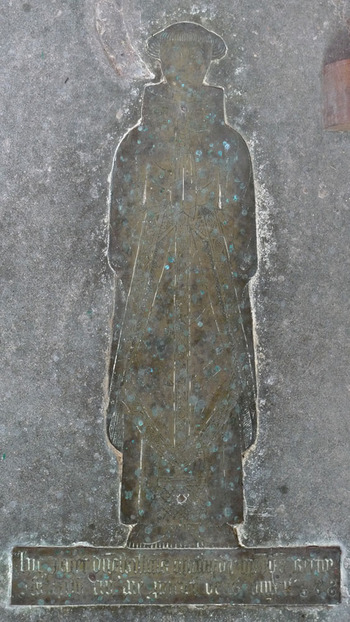
If the panels did function as a type of sepulchral monument, then the iconography is appropriate to commemoration of a husband and wife, with the male corpse in the left-hand panel suggesting emphasis on, and perhaps commission by, the husband or his executors. This need not mean that the corpses were cadaverous analogues of the full-length donor portraits (unusual in themselves) found on the screens at Edgefield and Fritton (both Norfolk), but only that the number and gender of the commemorated were reflected by the imagery.Footnote 112 The uncertainty surrounding the panels’ date makes it hard to align their manufacture with any recorded burial in the church. Johanna Butte, mentioned above as an important benefactor, is a possibility, given the panels’ proximity to the aisle she helped to rebuild, but her brass commemorated only herself, and her will has nothing in it regarding the screen. Clement Wulvesby (d 1498) is at the near end of the acceptable date-range, and there is no sign of the initials ‘CW’ so ostentatiously displayed in the windows he paid for. The rector, William Mustarder (d c 1493), may be a stronger candidate, particularly in light of the idea that the panels were intended to relate to preaching. According to Martin, Mustarder’s brass (fig 21) lay at the ‘Upper end of ye Middle Isle by the Skreen’.Footnote 113 If this was the case, then the male and female corpses were intended from the outset as exemplars, with only a generic moral connection to the commemorated, while the corpse in the left-hand panel is personalized. These suggestions are, however, conjectural; and while the ‘Quisquis’ inscription supports the theory that the panels designated a specific burial or burials, the identity of the commemorated is likely to remain uncertain.
Brass of William Mustarder (d c 1493), rector of Sparham. Photograph: author

Conclusion
On the basis of the account offered here, the significance of the Sparham corpse panels can be understood to lie in two different and, to some extent, contradictory directions. First, the uniqueness of the panels’ imagery and the unusualness of its location make them compelling counter-examples to the iconographic standardization common in later medieval English art. That they have a foot in the domain of continental imagery, while also reproducing aspects of local subject-matter and style, provides supporting evidence for the hypotheses about foreign and cross-media influences advanced by previous historians of East Anglian art. Second, and agreeing with Paul Binski’s observation that English parish church art of the period had a ‘constitutive’ rather than simply accessorial role in religion, they functioned as orthodox manifestations of virtue, morality, eschatology, devotion and, perhaps, aesthetics: in this sense they represented an aspect of the commonplace, or, appealing once again to Duffy’s terminology, tradition.Footnote 114 How real this distinction is thought to be depends on one’s view of the quiddity of medieval art; whether it was essentially material and visual (and thus capable of isolation and categorization according to traditional scholarly methods), or rather an aspect (or association of aspects) of a system of practice and belief which, like other cultures, cannot be measured, numbered or weighed. This contribution to the study of the panels has dealt in both kinds, emphasizing their artistic importance with reference to date, imagery, material context and iconographic relationships, while also suggesting their status as characteristics of religion in the broad sense, local in advertisement but expressive of pervasive beliefs. With reference to the latter, interconnected hypotheses about admonitory, salvational and commemorative functions have been proposed: it has been argued that the Sparham corpse panels were moralizing and inspiriting objects which probably also commemorated a dead soul or souls, and can thus be understood as a form of sepulchral monument. Such a binary approach to late medieval art seems a particularly obvious one for in situ objects such as screen paintings, where a stubborn trace of the authentic aura continues to attract and repulse almost five centuries after the Reformation.
Acknowledgements
The main ideas in this paper were tested at the International Congress on Medieval Studies at Kalamazoo (2007) and the University of East Anglia’s study day at Norwich cathedral (2008). Everyone who contributed comments on those occasions has my gratitude. I wish to acknowledge individually the help of the following friends and scholars: Paul Binski, FSA, Jane Bridgeman, Claire Daunton, Pamela King, FSA, and Ann Eljenholm Nichols (all of whom read drafts of this paper or discussed aspects of the panels with me at length); Sally Badham, FSA, Jerome Bertram, FSA, Bettina Bildhauer, David Griffith, Sandy Heslop, FSA, David King, Berthold Kreß, John Mitchell, FSA, Sophie Oosterwijk, FSA, David Park, FSA (who granted access to the Sparham file in the Conservation of Wall Painting Department at the Courtauld Institute of Art), Carole Rawcliffe, FSA, and Clive Sneddon.
Abbreviations and Bibliography
- Abbreviations
- BL
British Library
- NCC
Norwich Consistory Court
- NRO
Norfolk Record Office