INTRODUCTION
Delirium is a clinical syndrome that is known to be under recognised by palliative care teams. More than half of cases in terminally ill cancer patients were missed by palliative care doctors and nurses in a palliative care center (Fang et al., Reference Fang, Chen and Liu2008). Prevalence rates within terminally ill cancer patients range from ~28–50%, making it a common condition even at the conservative end of this range (Hjermstad et al., Reference Hjermstad, Loge and Kaasa2004). This wide variation may reflect differences in definitions and assessment methods, patient characteristics, and study design.
Terminally ill patients have multiple risk factors for developing delirium. They may be elderly, have dementia or other organic brain pathology, develop biochemical abnormalities and infections, and be taking a variety of medications that can predispose them to becoming delirious (Burns et al., Reference Burns, Gallagley and Byrne2004).
A defining characteristic of delirium is rapidity of onset, adversely affecting a patient's level of consciousness, thinking, memory, and behavior. Delirium compromises the ability of a terminally ill patient to communicate with family, friends and health care staff, jeopardizing autonomy and mental capacity at a time when crucial discussions and decisions may need to occur. Delirium has been described in this population as “a tragic waste of time” (Spiller & Keen, Reference Spiller and Keen2006).
Patients who recover from a delirious episode recall having felt extremely distressed during this time (Breitbart et al., Reference Breitbart, Gibson and Tremblay2002) and family members perceive physical restlessness and emotional lability as particularly distressing to observe in dying patients (Morita et al., Reference Morita, Hirai and Sakaguchi2004).
Delirium has been found to be reversible in nearly 50% of cancer patients (Lawlor et al., Reference Lawlor, Gagnon and Mancini2000), but crucial to this is diagnosing it in the first place. Clinical guidelines have been created in order to improve the prevention, detection, and management of delirium in general hospital inpatients (British Geriatrics Society & Royal College of Physicians, 2006).
We examined our Hospital Palliative Care Team's usual practice of recognising and documenting delirium using retrospective and prospective surveys, the latter incorporating the Confusion Assessment Method (CAM) (Inouye et al., Reference Inouye, van Dyck and Alessi1990) as a tool to improve diagnosis of the condition within the team.
We aimed to obtain a prevalence for delirium from the retrospective survey and then by applying the CAM, to observe whether its use would improve detection by the team and hence alter the prevalence rate.
METHOD
Retrospective Survey
A survey of 61 consecutive referrals made to the team in 2006 was conducted. Initial assessment records were examined to detect the presence of the word “delirium” and of words that could be used to describe the condition, such as confused, muddled, agitated and restless.
Prospective Survey
The CAM was introduced to the team via an educational session delivered by Dr. Kumar. During the summer months of 2007 members of the hospital palliative care team continued to assess their new referrals in their usual way. In addition they were asked to complete a CAM form after the initial assessment. During the study period, a form was completed for 59 patients, representing a completion rate of 85% of all new referrals.
RESULTS
Retrospective Survey
The word “delirium” was absent from all 61 sets of documentation recording the team member's initial assessment. Given the reported prevalence rates, we concluded that delirious patients were being described using synonyms.
Four patients were described as being either “confused” or “agitated” and a further two were described as both confused and agitated. Another patient was said to have “low mood, lethargy, and cognitive impairment” which could suggest the possible presence of hypoactive delirium. No further details were given in any of the initial assessment records.
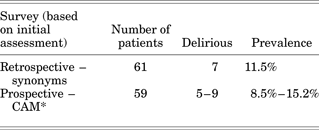
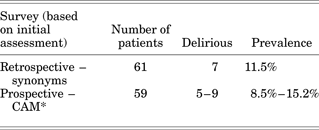
Taking these potential synonyms into account, a baseline prevalence of 11.5% for possible delirium was obtained (Table 1)
Results of retrospective and prospective delirium surveys
*Confusion assessment method.
Prospective Survey
Five patients fulfilled the CAM criteria for delirium but a further four may have been classified as delirious had some uncertain or blank answers been recorded as “yes,” taking the potential prevalence to 15.2% (Table 1). Uncertainty was particularly evident in relation to the question regarding acute change in the patient's mental status — team members may have felt unable to assess this directly on their first meeting with the patient.
DISCUSSION
Both prospective and retrospective data reveal a lower prevalence rate of delirium in this hospital palliative care inpatient population, the majority of whom had cancer (88%), than in other reported series. An important first step in the diagnosis of delirium is to be vigilant to its presence, so palliative care teams must raise their level of awareness of this condition. Another retrospective study has found low rates of documentation of delirium by a multidisciplinary hospice care team (Irwin et al., Reference Irwin, Rao and Bower2008), suggesting that under recognition may be a significant feature within palliative care teams.
The educational session that introduced the team to the CAM served to raise the profile of delirium as a diagnostic entity and enable the team to understand its effects on cognition, behaviour, and consciousness level. Raised awareness of the hypoactive subtype was especially welcomed as this variant is even less likely to be diagnosed by clinical teams (Fang et al., Reference Fang, Chen and Liu2008) and yet is just as distressing to the patient (Breitbart et al., Reference Breitbart, Gibson and Tremblay2002). With the CAM, team members reported increased confidence in their discussions with ward-based teams and felt that they were now able to interpret aspects of their patients' physical and mental state more meaningfully, which could then be translated into improved patient care. They also found the CAM easy to use and unobtrusive, as it did not involve having to engage frail patients in additional direct questioning (Inouye et al., Reference Inouye, van Dyck and Alessi1990). The CAM has been validated for use within palliative care settings (Ryan et al., Reference Ryan, Leonard and Guerin2009) and demonstrated high sensitivity and specificity.
Why were our prevalence rates so low? The retrospective data are limited given the reliance on synonyms indicative of possible delirium. The fact that we had to resort to using synonyms suggests that recognition within the Palliative Care Team was lower than could be reasonably expected from the literature. These data also suggest that the level of recognition and recording of delirium within ward-based teams may also be low and national guidelines may help address this Delirium has been found to be reversible in nearly 50% of cancer patients (Lawlor et al., Reference Lawlor, Gagnon and Mancini2000), but crucial to this is diagnosing it in the first place. Clinical guidelines have been created in order to improve the prevention, detection, and management of delirium in general hospital inpatients (British Geriatrics Society & Royal College of Physicians, 2006). Educational initiatives delivered to ward staff can reduce the prevalence of delirium and improve recognition (Tabet et al., Reference Tabet, Hudson and Sweeney2005).
The prospective survey results were interesting in that even with the addition of the CAM the rates remained lower than expected. The Palliative Care Team members applied the algorithm directly after their initial assessments, which would have happened during office hours. As delirium is a fluctuating condition it is possible, for example, that a nocturnal presentation of delirium was missed. Repeated assessment of an individual thought to be at risk of delirium will increase the likelihood of its detection, as recommended by national guidelines ((British Geriatrics Society & Royal College of Physicians, 2006).
One domain of the CAM algorithm giving rise to some “uncertain” responses from the assessors was that relating to the presence of an acute change in the patient's mental status. Corroborative information from family members and carers can aid this process, which may not have been available at the time. If cognition is not formally assessed and recorded it can be difficult to consequently gauge whether a change has occurred from baseline and at what rate this change is evolving. This is reflected in guidelines that advocate the routine, serial assessment of cognitive state in hospitalized patients using the Mini Mental State Examination (British Geriatrics Society & Royal College of Physicians, 2006).
Disorganised thinking and inattention were other domains recorded as “uncertain” in our study, and a pilot study revealed that errors on the part of assessors affected the sensitivity of the CAM (Ryan et al., Reference Ryan, Leonard and Guerin2009). Our training session did not adopt the rigor of the recommended training procedure for the CAM (Inouye, Reference Inouye2003) as this would have altered normal clinical practice and it is possible that incidences of delirium were missed as a result (Ryan et al., Reference Ryan, Leonard and Guerin2009).
The prevalence of delirium may have been lower in this population for other reasons. Not all delirious patients with a terminal diagnosis would have necessarily been referred by the ward-based teams. A lower proportion may have been in the terminal phase of their illness and they may not have had predisposing biochemical or organic brain pathology.
Delirium constitutes a major source of distress to patients and families and is a barrier to optimal nursing and medical care. The CAM can be accepted by and integrated into the work of a hospital palliative care team and intermittent use during the course of a patient's follow-up could further increase the likelihood of delirium being recognized and managed appropriately. It can enable the team to recognize the importance of delirium as a diagnosis and strengthen its role in providing timely symptom management and support to ward-based teams.
ACKNOWLEDGMENTS
We thank the Palliative Care Team at The Leeds Teaching Hospitals Trust for their support and assistance during this study.